#MarketersTalks : Poursuivre l'innovation dans le marketing numérique - Entretien avec Neal Schaffer
Neal Schaffer est l'un des spécialistes du marketing les plus influents dans le monde numérique et l'auteur de plusieurs ouvrages sur le marketing des réseaux sociaux. Nous lui avons demandé comment rester innovant dans un monde en constante évolution et comment travailler avec le marketing d'influence.
Il a également partagé quelques conseils sur la manière de repenser le marketing TikTok et a donné de précieux conseils aux jeunes spécialistes du marketing.
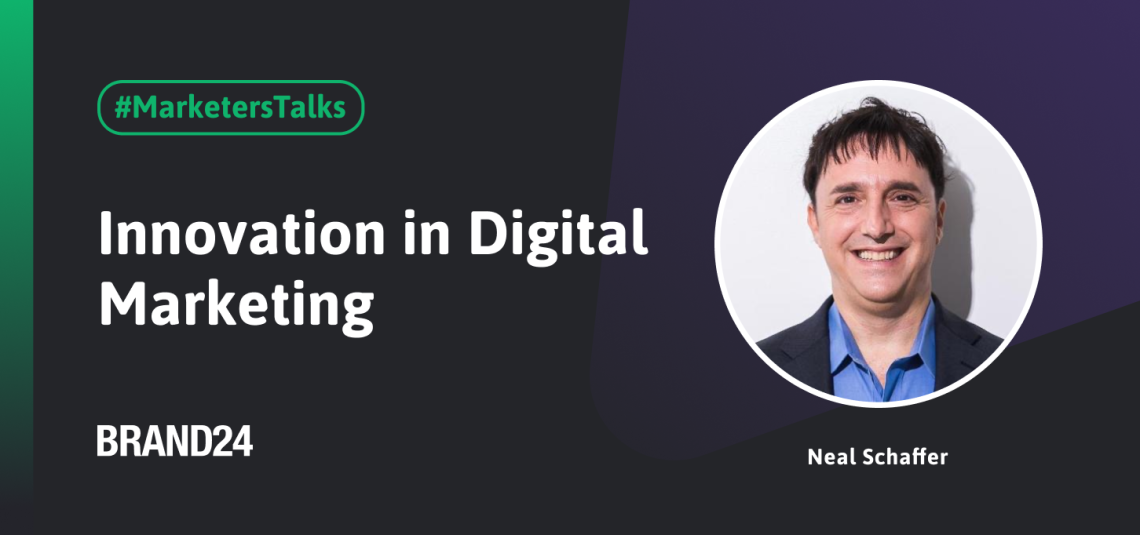
Neal Schaffer est une autorité de premier plan dans l'accompagnement des entreprises dans leur transformation numérique des ventes et des marketing en conseillant, formant et aidant les entreprises de toutes tailles dans leurs stratégies de marketing sur les réseaux sociaux, leur marketing d'influence et leurs initiatives de vente sociale.
Il est président de l'agence de médias sociaux PDCA Social et enseigne également les médias numériques aux cadres supérieurs.
Neal Schaffer est l'un des 100 principaux influenceurs du marketing numérique présentés dans le rapport de Brand24.
1. Comment avez-vous commencé votre parcours dans le marketing numérique ?
J'ai commencé mon parcours dans le marketing sur les réseaux sociaux. Avant cela, j'avais une carrière professionnelle dans la vente B2B et le développement commercial.
Cependant, en tant que directeur national ou vice-président régional des ventes dans une start-up, j'ai souvent dû endosser plusieurs casquettes, dont celle de responsable marketing dans de nombreux cas.
J'ai beaucoup appris sur le marketing dans le cadre de mon travail. En réorientant ma carrière vers les réseaux sociaux, j'ai commencé à transférer de plus en plus ces connaissances commerciales vers le marketing. J'ai commencé par le numérique/les réseaux sociaux et Linkedin en raison de mon expérience dans le domaine du B2B.
De plus, à l'époque, c'était le seul réseau social destiné aux professionnels. J'ai commencé par enseigner aux entreprises comment tirer parti de LinkedIn dans le domaine des ventes B2B, mais aussi dans celui du marketing médiatique.
Comme aujourd'hui, le marketing était le principal moteur des réseaux sociaux à l'époque. La demande était beaucoup plus forte pour le marketing sur les réseaux sociaux que pour les ventes sociales ou le social selling. Mais, avec le temps, je voulais éviter de devenir un spécialiste d'un seul domaine.
Ainsi, même si j'ai publié deux livres sur LinkedIn, j'ai réalisé que mes clients n'avaient pas seulement besoin de LinkedIn. Ils avaient besoin d'aide pour tous les réseaux sociaux. C'est alors que j'ai investi dans l'apprentissage, l'expérimentation et la création de ma propre marque sur tous les réseaux sociaux pertinents.
Cela a abouti à la publication de Maximize Social en 2013, qui traite de la création d'une stratégie complète de marketing des médias sociaux. Puis, en mars 2020, j'ai publié mon quatrième livre, The Age of Influence, qui traite de l'influence sur le marketing. Cela m'a amené à m'intéresser au marketing numérique.
J'aime dire que je suis passé du marketing sur les réseaux sociaux au marketing numérique, car lorsque j'ai publié mon livre, il était impossible de rencontrer physiquement des gens. J'ai donc dû trouver des moyens de commercialiser mon livre par voie numérique, et les réseaux sociaux n'étaient qu'une pièce du puzzle.
Il y a aussi la recherche et le courrier électronique, et c'est là que j'ai passé beaucoup de temps au cours des deux dernières années. J'ai créé mon blog pour me concentrer sur des sujets qui lassent un peu les experts en marketing numérique : l'optimisation des moteurs de recherche, le marketing par courrier électronique et automatisation du marketing.
Mais grâce à mon expérience dans le marketing sur les réseaux sociaux, je les vois sous un nouveau jour. J'essaie d'insuffler une nouvelle vie et une nouvelle perspective à ces domaines.
2. Y a-t-il des outils indispensables dans votre boîte à outils marketing ?
Si je devais citer quelques outils indispensables, je commencerais par les tableaux de bord des médias sociaux Agora Pulse et SocialBee. Je les utilise pour publier différents contenus sur différents réseaux, et les deux fonctionnent bien pour moi.
J'utilise également Inoreader, qui m'aide à créer des ensembles personnalisés de flux RSS. Je peux ensuite importer ces flux dans un outil de médias sociaux et l'utiliser comme tableau de bord pour la création de contenu. Cela me permet également de me tenir au courant des dernières nouveautés en matière de médias numériques et sociaux.
Un autre tableau de bord des médias sociaux que j'ajouterais au mélange est Tailwind, qui est très spécifique à Pinterest.
Les autres outils SEO indispensables que j'utilise sont Semrush et, bien sûr, Google Analytics. Et même si je n'utilise pas beaucoup l'IA pour l'écriture, j'utilise Frase.io pour l'analyse SEO. Lorsque j'ai besoin d'un outil IA pour trouver des idées de contenu simples, j'utilise Jasper.
Mon outil préféré pour le marketing par e-mail est ConvertKit, mais je sais que beaucoup de clients préfèrent Active Campaign. Chaque fois que j'ai besoin d'aide dans un domaine où je ne suis pas experte, je recherche et engage généralement des experts sur Upwork.
3. Quelle est la meilleure étude de cas de marketing numérique que vous ayez vue ? Quelle est la première chose qui vous vient à l'esprit lorsque vous pensez à la meilleure ?
J'ai écrit quelques articles de blog sur des études de cas de marketing numérique, et de nombreuses études de cas de marketing numérique ont été publiées. études de cas sur le marketing sont dans mon propre livre. Et la première chose qui me vient à l'esprit est la suivante : quel a été l'impact réel de cette étude de cas sur l'activité ?
Ce n'est pas le nombre de likes et d'impressions qui compte, mais leur impact sur leur activité. Combien de ventes supplémentaires ont-ils générées ? Et, par rapport à d'autres canaux, quelle a été leur efficacité supplémentaire ?
Et puis, globalement, cela a-t-il doublé leurs ventes ? Cela a-t-il contribué à une augmentation de 1 % des ventes ? Ce sont les premières questions qui me viennent à l'esprit lorsque je pense à la meilleure étude de cas en matière de marketing numérique.
Peu importe de quelle étude de cas il s'agit. J'en ai vu beaucoup de bonnes, mais ce sont celles-là que je recherche.
4. Quelle est la chose que les marques peuvent faire pour intensifier leurs efforts de marquage ?
Les marques peuvent faire beaucoup de choses, mais je pense que le marketing d'influence est un élément clé qui leur permet d'être relatables et de s'engager plus profondément avec les créateurs de contenu qui ont une part de voix de plus en plus importante dans les médias sociaux, où il est de plus en plus difficile pour les marques de rivaliser pour toute une série de raisons.
5. Comment rester innovant en matière de marketing numérique ?
Vous devez toujours consommer du contenu sur les canaux de marketing numérique les plus populaires. Et cela signifie beaucoup de contenus courts - YouTube Shorts, Instagram Reels, Tiktok videos - tous très différents.
La meilleure façon de rester innovant est de consommer, d'analyser, de faire de la rétro-ingénierie et, en fin de compte, de créer son propre contenu - ou de collaborer avec des personnes influentes pour créer ce contenu pour vous.
Il faut être en phase avec son temps et avoir envie d'innover. C'est du moins ce que j'ai constaté.
6. Que pensez-vous du contenu rédigé par l'IA en termes de référencement et des dernières mises à jour de Google Search ? Pensez-vous que ce secteur va se développer ou qu'il sera mal vu ?
Examinons-les séparément.
Mise à jour « Contenu utile » de Google. Il est clair que Google souhaite faire passer le message que votre contenu doit non seulement être utile, mais également pertinent pour votre niche.
C'est ce que j'ai compris en lisant cela. Il est donc facile d'utiliser des outils d'IA pour générer rapidement un texte correct sur n'importe quel sujet.
Mais si votre blog traite des réseaux sociaux et que vous commencez soudainement à publier des articles sur les cryptomonnaies, vous n'obtiendrez pas un classement aussi élevé que les articles similaires publiés sur un site web qui traite uniquement des cryptomonnaies, car c'est le domaine dans lequel ils sont spécialisés.
Évidemment, Google a également dit des choses comme “ ajoutez des expériences personnelles ” et autres. Mais chaque fois que Google effectue une mise à jour, il envoie simplement le même message sous une forme différente : publiez du contenu pertinent qui semble avoir été rédigé par des humains. Je ne pense donc pas qu'il y ait quoi que ce soit de nouveau.
Ils ne font que réagir et ajustent constamment leurs algorithmes. J'ai clairement constaté une augmentation de mon trafic, et je suis un utilisateur d'outils d'IA.
Examinons donc l'autre question, celle des outils d'IA par rapport au contenu rédigé par l'IA.
Les algorithmes d'IA déterminent ce que nous voyons dans les fils d'actualité des réseaux sociaux. L'IA est déjà utilisée dans les technologies qui nous entourent. Je ne pense pas que l'IA soit nécessairement mauvaise.
Avec l'émergence de DALL·E 2, la génération de contenu visuel alimentée par l'IA est un cas d'utilisation convaincant. En quelques secondes, les spécialistes du marketing peuvent créer une image qui semble meilleure que n'importe quelle photo d'archive.
Si vous recherchez des photos d'archives pour vos articles de blog ou vos présentations PowerPoint, cela vous fera gagner beaucoup de temps, donc je suis tout à fait pour, et j'ai l'intention d'en faire davantage dans ce domaine.
J'utilise également des outils d'intelligence artificielle pour l'analyse du contenu, qui s'avèrent très utiles et permettent de gagner beaucoup de temps.
Lorsqu'il s'agit de contenu écrit, nous disposons déjà d'outils tels que les outils de paraphrase. Nous disposons déjà d'outils tels que les outils de paraphrase, qui permettent de prendre une phrase et d'en tirer quelque chose d'unique - le même sens, mais différent. La technologie a en quelque sorte toujours existé. Je pense que l'IA évolue et que, du point de vue de la création de contenu, elle doit être considérée comme une aide.
Je pense que l'IA pour la création de contenu est particulièrement efficace lorsque vous recherchez différents textes publicitaires et que vous souhaitez obtenir 20 variantes d'un même concept. L'IA peut alors s'avérer très utile, car elle peut générer ces textes pour vous et vous donner de nombreuses idées.
Par exemple, si vous êtes bloqué dans la rédaction d'un paragraphe et que vous avez besoin d'idées nouvelles, vous pouvez vous inspirer d'un texte généré par l'IA. Cela peut vous guider sur ce qu'il faut écrire ou ne pas écrire. Le contenu généré par l'IA a beaucoup plus de valeur pour les textes courts, comme les textes publicitaires, les titres SEO et les descriptions.
Mais plus le contenu dont vous avez besoin est long, moins il a de valeur.
En fin de compte, cela peut ne pas être aussi convaincant que du contenu rédigé par des humains, même si l'écart se réduit. En résumé, le contenu rédigé par l'IA a sa place, mais je considère davantage l'IA comme une aide que comme un outil qui rédigera tout le contenu à ma place.
Si chaque fois que vous rédigez du contenu, il s'agit simplement d'un résumé de ce qui est disponible sur Internet, alors l'IA peut le rédiger à votre place. Mais ce type de contenu sera de plus en plus difficile à classer.
Et il sera de plus en plus difficile d'amener les gens à le lire et à vouloir agir après l'avoir lu. Cela ne servira donc pas vos intérêts.
7. Comment conseilleriez-vous de tirer parti du marketing d'influence à l'heure actuelle ?
Je définis marketing d'influence comme le fait de tirer parti de l'influence des gens. Si votre compte Twitter a 500 followers et que quelqu'un en a 1000, cette personne a plus d'influence que vous.
Je considère également les influenceurs en termes d'affinité avec la marque. Qui sont les personnes influentes sur les réseaux sociaux qui aiment et/ou font confiance à votre marque ?
Cela commence par vos employés, vos clients et les personnes qui vous suivent sur les réseaux sociaux. Ils ne sont pas encore clients, mais ils ont une affinité pour vous. Ils vous connaissent. Ils ont interagi avec vous. Et puis, bien sûr, viennent les partenaires, les distributeurs, les revendeurs, etc. Je commencerais toujours par ceux qui vous connaissent déjà.
Et lorsque vous commencez avec vos clients et créez programmes de partenariatLe marketing d'affiliation est un marketing d'influence. Le marketing d'affiliation est un marketing d'influence. Vous tirez parti des affiliés parce qu'ils ont de l'influence.
Donc, quand on considère le marketing d'influence de manière globale, comme je le fais, il ne s'agit pas de faux followers sur Instagram. Il s'agit plutôt des entreprises qui décident avec quels influenceurs elles souhaitent s'engager. Et elles devraient toujours commencer par se poser la question suivante :
“ Êtes-vous un utilisateur de notre produit ? ” Et s'ils ne le sont pas, vous souhaitez leur envoyer le produit d'abord et leur demander : “ Qu'avez-vous pensé du produit ? ”
Le secteur du marketing d'influence souffre depuis quelque temps d'une mauvaise image, mais ce ne sont pas les influenceurs qui en sont responsables. Ceux-ci ont été incités à acheter de faux followers parce que les marques ne s'intéressaient qu'aux indicateurs de vanité.
Mais il s'agit là du marketing d'influence avant la COVID. C'était avant que j'écrive L'âge de l'influence sur le marketing d'influence. Il a considérablement évolué depuis lors, et les gens démasquent rapidement les publicités mensongères.
Mais d'un autre côté, quand je regarde mes enfants de la génération Z et les milléniaux, ils ne voient pas d'inconvénient à ce que les influenceurs proposent du contenu sponsorisé si cela leur apporte une valeur ajoutée. C'est donc un élément à prendre en considération.
8. Avez-vous des trucs ou des astuces pour vous souvenir ou faire de la rétro-ingénierie, comme vous l'avez dit, du bon contenu de YouTube Shorts, TikTok ou d'autres chaînes ?
J'ai fait une présentation au Content Marketing World sur la manière de procéder à une ingénierie inverse de la stratégie de contenu de vos concurrents sur les réseaux sociaux. Et je dirais, en ce qui concerne les réseaux sociaux en général, comment les gens fonctionnent-ils ?
Ils ont des calendriers et des catégories de contenu, et ils publient généralement du contenu en fonction de ces catégories. Je pense que ce n'est pas facile à faire avec LinkedIn, Twitter et Facebook.
Mais vous commencez à étiqueter l'objectif de chaque élément de contenu, et bien sûr, le sujet du contenu, puis vous organisez ces étiquettes, vous examinez l'engagement, vous examinez la fréquence, et vous pouvez commencer à examiner la stratégie de contenu des réseaux sociaux de vos concurrents.
Cette approche est efficace si vous êtes nouveau dans le secteur, si vous pensez prendre du retard ou si vous souhaitez simplement redéfinir votre stratégie de contenu sur les réseaux sociaux. C'est ce que j'ai constaté chez mes clients qui souhaitaient redéfinir leur stratégie de contenu sur les réseaux sociaux. Cela leur convenait parfaitement.
Pour les plateformes plus créatives comme YouTube Shorts, TikTok, je ne parlerai même pas d'Instagram Reels parce qu'elles ont pris une direction très différente. TikTok est la plateforme la plus convaincante parce que c'est la plus difficile pour les marques et les gens de comprendre comment créer du contenu si vous ne le consommez pas cinq heures par jour comme le font mes enfants.
En quoi les courts métrages de YouTube sont-ils différents ? Dans YouTube Short, vous pouvez créer un court métrage à partir d'une vidéo YouTube. Vous pouvez prendre un extrait d'une vidéo YouTube et créer un court métrage à partir de celui-ci. Là encore, c'est très différent de TikTok, qui est 100% creative.
Je suis actuellement en train de faire de l'ingénierie inverse sur TikTok pour créer ma propre stratégie, et je suis un peu en retard dans le jeu. Mais il n'est jamais trop tard pour se lancer dans les réseaux sociaux, et les personnes plus âgées consomment de plus en plus TikTok.
De plus, il y a davantage de contenu informatif et davantage de contenu B2B.
C'est donc le moment idéal pour se lancer. Tout comme Instagram est devenu plus B2B au fil du temps. Ou plutôt, il est désormais acceptable d'y publier davantage de contenu B2B qu'il y a 10 ans.
Avec Tik Tok, on comprend vraiment que cela repose avant tout sur les mèmes. Beaucoup de vidéos populaires sont basées sur des sons tendance. Auparavant, elles étaient basées sur des danses tendance, mais je pense qu'aujourd'hui, elles se sont tournées vers les sons tendance, où beaucoup de gens apportent leur touche personnelle à l'audio, et je ne parle pas de musique.
Je parle des gens qui disent “ À l'aide ! À l'aide ! ”, puis je regarde comment toutes ces personnes différentes créent du contenu autour de cela.
Ce que vous remarquerez, c'est qu'il s'agit d'une combinaison de plusieurs éléments. Vous avez des têtes parlantes, des vidéos où les gens sont silencieux, regardant la caméra ou s'en éloignant, et différents types de superpositions de texte.
Je fais actuellement cette ingénierie inverse dans la catégorie des blogs. Ce qui est vraiment cool avec TikTok, c'est que vous n'avez pas besoin d'entrer un hashtag. Vous entrez un mot-clé, et il vous présente simplement vidéo après vidéo après vidéo.
Si vous avez une heure devant vous, entrez un mot-clé et regardez les 10 ou 20 premières vidéos qui apparaissent. Vous pouvez consulter leurs descriptions et leurs hashtags.
Mais surtout, en observant les moyens visuels utilisés pour créer ce contenu, vous commencerez à discerner des schémas récurrents.
Comme je l'ai dit, TikTok est une culture meme basée sur beaucoup de contenu condescendant. Et quels sont les modèles les plus fréquents ? Sur quoi est-il judicieux de créer du contenu ?
Et ce serait mon point de départ. Ensuite, vous voudrez essayer différents formats. Vous voudrez collecter des données et voir comment cela stimule votre activité, etc. Mais c'est un bon point de départ.
9. Vous nous avez donné votre recette pour rester innovant - mais comment trouver le temps et l'endroit dans un environnement qui évolue rapidement ? Quelles sont vos suggestions pour trouver le temps de s'améliorer ?
J'ai tendance à ne pas organiser de réunions le vendredi, qui est mon jour de recherche et développement. Gary Vaynerchuk a été le premier à préconiser cette règle, mais beaucoup d'autres l'ont également mentionée : faites en sorte que 20% de votre temps soit consacré à la recherche et au développement.
Cela vous donne le temps d'expérimenter différentes plateformes et de consommer de nouveaux contenus. Je fais de mon mieux pour que le vendredi soit ce moment. Si vous consultez mon calendrier, vous verrez que ces vendredis sont pleins jusqu'à la fin des temps. C'est une façon de procéder. Si cela ne suffit pas, vous devez aller dans votre calendrier et bloquer du temps. C'est une autre façon efficace de procéder.
Mais il n'y a pas de recette secrète. Il faut du temps pour rester innovant, et vous devez faire en sorte que ce temps soit investi.
10. Avez-vous des projets passionnants que vous pouvez partager avec nous ? De nouveaux livres à paraître prochainement ?
Je suis actuellement en train de créer ma première classe d'apprentissage en cohorte. Il portera sur le thème du marketing d'influence.
J'enseigne le marketing d'influence à l'UCLA Extension, ce qui me permettra d'offrir à tout le monde les enseignements que je dispense au niveau universitaire. Je suis donc très enthousiaste à l'idée de lancer cette initiative.
Je suis également en train d'écrire mon cinquième livre, qui sera un manuel de marketing numérique pour l'économie post-COVID. Je jette un nouveau regard sur les anciens sujets du marketing numérique comme le SEO, l'email marketing, l'automatisation du marketing, mais j'y inclus aussi mes conseils les plus récents sur le marketing des médias sociaux, le marketing d'influence et le marketing de contenu.
J'ai également l'intention d'exploiter davantage ma chaîne YouTube. La vidéo sera un axe stratégique. Et c'est sur YouTube que j'ai l'intention de commencer Tiktok, pour de nombreuses raisons différentes. Nous pourrons en parler séparément.
11. Avez-vous des conseils à donner aux spécialistes du marketing débutants ?
La seule façon d'apprendre est de faire.
J'ai passé les 15 premières années de ma carrière au Japon. Il existe un terme appelé « shokunin », qui désigne une culture de l'artisanat. Il représente non seulement la culture japonaise, mais aussi de nombreux créateurs et hommes d'affaires japonais que je connais : vous perfectionnez sans cesse vos compétences et affûtez vos outils. La seule façon d'y parvenir est d'acquérir de l'expérience.
Et si vous n'avez pas cette expérience, créez-la avec votre marque personnelle (comme je l'ai fait) ou en tant que stagiaire, ou contactez une association locale à but non lucratif et demandez-lui si elle a besoin d'aide. La plupart d'entre elles en ont probablement besoin.
Vous acquérez ainsi l'expérience et la confiance nécessaires lorsque vous commencez à gérer plusieurs marques, car vous pouvez alors observer les tendances et disposer de davantage de données pour travailler.
C'est comme ma fille, qui est encore lycéenne. Elle a fait un stage dans une entreprise et s'occupait du marketing d'influence pour eux alors qu'elle était encore lycéenne. Tous les influenceurs ayant plus de 10 000 abonnés sur Instagram voulaient être rémunérés.
Mais tous ceux qui avaient moins de 10 000 abonnés ont accepté de participer à la campagne d'influence uniquement pour obtenir un produit gratuit, sans demander d'argent supplémentaire. C'est une information précieuse. Désormais, lorsqu'elle fera du marketing d'influence pour une autre entreprise, elle pourra partir du principe qu'elle ne paiera personne ayant moins de 10 000 abonnés. Et elle pourra négocier cela avec toute personne ayant moins de 10 000 abonnés.
Les cadeaux devraient suffire, et si cela ne vous intéresse pas, elle trouvera d'autres influenceurs qui seront intéressés, car elle sait que cela fonctionne.
Les données apportent la connaissance, la confiance et la croissance. Il faut donc générer ces données.
Articles connexes

#MarketersTalks : Comment évoluer et rester au fait des tendances du secteur - Entretien avec Gini Dietrich
Lectures de haut niveau
Surveillance de marque : outils et guide pour 2026
Stratégie de notoriété de marque [Le guide ultime pour 2026]
Le meilleur AI Hashtag Tracker et autres outils de suivi de hashtag [2026]
Portée des réseaux sociaux : comment la mesurer et l'améliorer en 2026 ?
Outils d'analyse X (Twitter) : Les 10 meilleurs à essayer en 2026
Analyse des sentiments : qu'est-ce que c'est et pourquoi en aurez-vous besoin en 2026 ?
Part de voix : définition, calcul, outils [Guide 2026]
Gestion de la réputation de marque : 6 conseils d'experts pour 2026
Analyse des médias sociaux : Guide complet pour 2026
Comment voir combien de fois un hashtag a été utilisé sur X (Twitter)
Démarrage Écoute sociale !
Obtenez la version d'essai Brand24 et commencez l'écoute sociale comme un PRO.