What’s the Difference Between Social Listening and Social Monitoring? [Expert Guide]
Table des matières
Social media is one giant group chat you never asked to join, and your brand is always being mentioned, tagged, or talked behind your back. Some conversations are easy to spot, others… definitely not. Understanding these conversations is key to protecting your brand’s reputation and improving customer engagement.
That’s exactly why social monitoring and social listening exist. They sound similar, but there are key differences between them, particularly in terms of use cases.
This guide breaks down the concepts clearly, shows how they complement each other, and provides an actionable framework you can implement immediately.
What’s the difference between social listening and social monitoring?
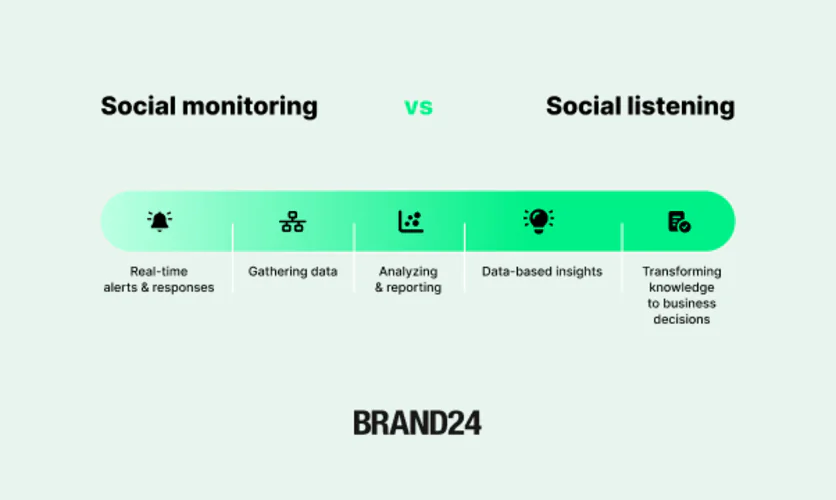
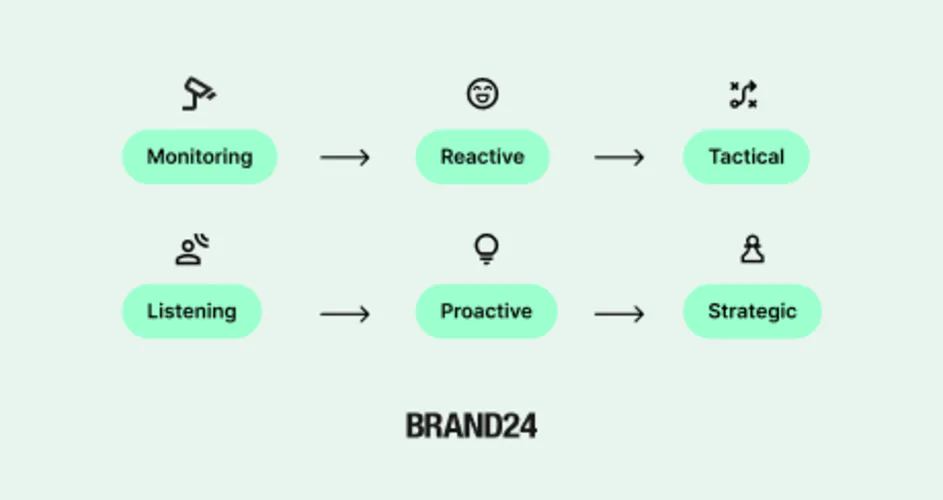
– Surveillance sociale tracks and responds to direct brand mentions and customer queries in real time – it’s reactive and focuses on immediate interactions across social media platforms.
– Écoute sociale analyzes broader online conversations, industry trends, and customer sentiment – it’s proactive, offering valuable insights that guide long-term social media strategy, product innovation, and business decision-making.
What is social monitoring?
Surveillance sociale (often miscalled surveillance des médias sociaux) is the process of tracking direct mentions, tags, keywords, and conversation threads related to your brand. It’s a real-time, reactive approach that helps social media managers:
- Répondre rapidement aux préoccupations des clients
- Address negative feedback before it escalates
- Acknowledge positive comments
- Provide timely support
- Protect the brand’s online presence
Here’s what it can look like in action:
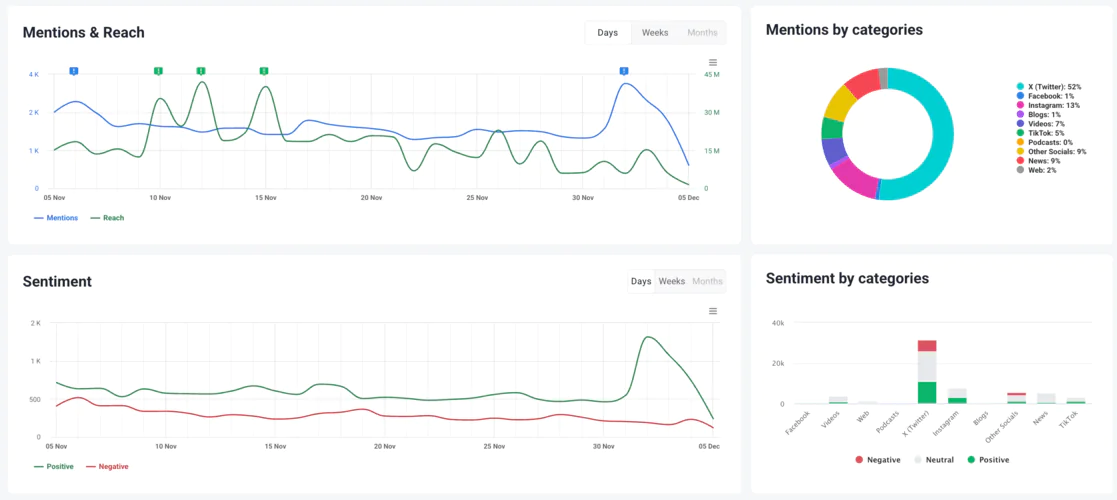
I created a Samsung project in a media monitoring tool and immediately spotted a mention where a user expressed concerns about the product’s price.

This kind of real-time insight is incredibly valuable because the moment a potential issue surfaces, you can step in, provide context, offer support, or simply acknowledge the concern.
Thanks to monitoring, you’re able to respond quickly, shape the conversation, and show customers that their feedback matters.
Qu'est-ce que la surveillance des médias sociaux ?
Social media monitoring is generally the same, but focused specifically on social media, so it’s quite easy to misunderstand the terms.
Key characteristics of social monitoring:
- Il se concentre sur média mentions and user-generated content
- It’s optimized for timely responses
- Identifies recurring pain points through repeated queries
- Centers on immediate interactions with customers online
Why is social monitoring important?
- Improves customer support
- Helps with gestion de la communauté
- Great for early crisis detection and PR
- Maintaining a consistent brand message
How to set up social monitoring?
A proactive social media monitoring should include these steps:
- Choose your monitoring keywords
Include branded terms, product names, and common misspellings. - Track mentions in real time across various channels
Ensure your tool captures all relevant conversations, including user-generated content and niche-specific forums. - Mise en place d'alertes
This ensures social media managers can respond promptly to customer queries and issues. - Respond promptly
Just tracking gives you nothing – make sure to take care of the conversations happening. For example, using monitoring for tracking mentions needing a reply can be a massive improvement for your social media management system.
What are the KPIs for social monitoring?
They can differ depending on your goals and monitoring needs, but usually, professionals evaluate their surveillance des médias work based on:
- Average response time
- Volume of brand mentions
- Resolution rate
- Customer satisfaction rate
- Sentiment change
| Surveillance sociale | |
|---|---|
| Définition | Tracking brand mentions and conversations about your brand in real time across social media platforms and online channels. |
| Objectif | Provide timely responses, manage customer concerns, and maintain your brand’s online presence. |
| Approche | Reactive – focuses on immediate interactions and responding. |
| Data scope | Specific, brand-focused: brand mentions, customer queries, positive/negative comments, user-generated content. |
| Key activities | Responding to customer feedback, addressing issues, tracking direct mentions, and managing conversations. |
| Mesures suivies | Response time, brand mentions volume, and sentiment. |
| Use cases | Customer support, community management, quick crisis detection, and maintaining consistent brand messaging. |
| Value | Helps brands promptly address customer concerns, protect reputation, and improve real-time engagement. |
| AI’s role | AI automates mention detection, prioritizes customer concerns, predicts crises, and enables faster, more accurate real-time responses. |
Qu'est-ce que la surveillance des médias par l'IA ?
Ok, but there’s so much talk about AI changing the landscape… is monitoring also affected?
Yes! Absolutely. AI has transformed media monitoring in a big way, mostly by automating the process and making insights faster, deeper, and more accurate.
Instead of manually scanning social media, news, blogs, or forums, AI media monitoring uses machine learning and natural language processing to instantly detect mentions of your brand, analyze sentiment, spot trends, and alert you to anything that may require attention.
In short, it’s smarter, quicker, and far more scalable than traditional monitoring.
But there’s another layer that brands can’t ignore: how they are perceived by large language models.
As LLMs like ChatGPT, Gemini, or Claude increasingly shape online information flow and consumer decision-making, monitoring how these models understand and describe your brand is becoming a new essential part of any modern monitoring strategy.
Just as you track social sentiment or media narratives, you now also need to ensure that AI mentions reflect accurate, up-to-date, and positive information about your company.
This is quickly becoming a crucial part of brand image management in the AI era.
And the good news is: we now have tools designed specifically for this new challenge.
ChatBeat, for example, monitors how large language models reference your brand and in what contexts they surface it.
Here’s a screenshot showing the prompts where Samsung appears in LLM-generated answers:
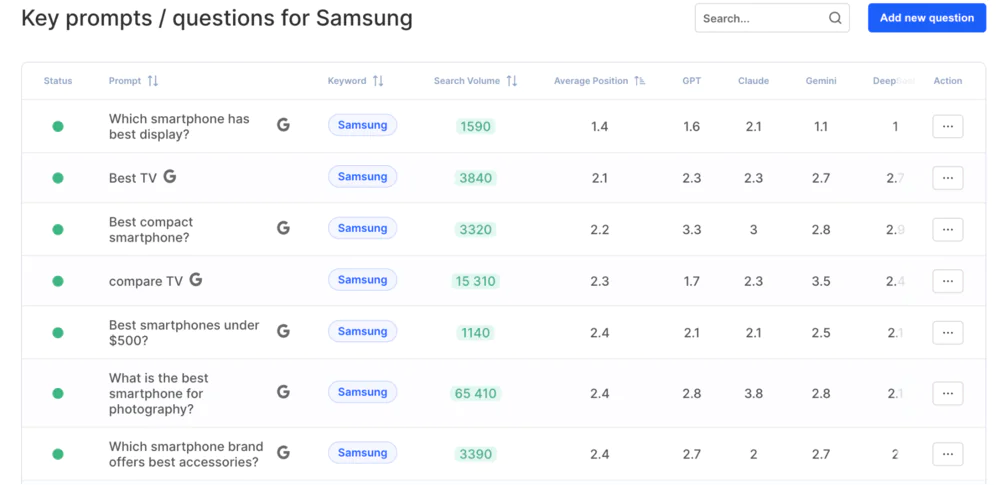
Insights like this help you understand how your brand is mentioned, and why, in what situations, and whether the narrative aligns with your desired brand positioning.
If that sounds interesting – check out this article: How to Rank Your Brand on ChatGPT [2026]
Qu'est-ce que l'écoute sociale ?
Écoute sociale goes deeper. It’s the process of analyzing vast amounts of social media data to uncover industry conversations, audience insights, market trends, and deeper insights about how people feel, not just what they say.
Key characteristics:
- Focuses on sentiment, patterns, and emerging trends
- Captures conversations beyond direct mentions
- Identifies competitors’ customers and industry pain points
- Helps businesses gain insights into customer needs
- Fuels strategic decision-making through actionable insights
Qu'est-ce que l'écoute des médias sociaux ?
Social media listening is generally the same, but it is specifically focused on social media.
Pourquoi l'écoute sociale est-elle importante ?
- Improves marketing strategy with data-based insights
- Guides product development
- Identifies gaps in customer experience
- It’s a benchmarking tool against competitors
- Helps to understand the target audience better

How to set up social listening?
Social listening strategy goes beyond tracking brand mentions, and it requires structured analysis.
It makes it a little more advanced process.
Here are 5 steps to consider:
- Define your listening goals
- Identify emerging trends
- Analyze industry conversations (including competitors)
- Map relevant keywords by category
- Marque
- L'industrie
- Concurrents
- Customer needs
- Analyze social listening data
Use AI-powered tools to identify topic clusters, patterns, and recurring pain points. - Interpret insights
Create reports for product teams, marketing, and leadership.
Plus, take advantage of today’s technology – for example, in Brand24, you can get automated reports and not waste time on creating them manually. - Translate insights into action
Adjust messaging, enhance content strategy, and innovate based on customer feedback.
| Écoute sociale | |
|---|---|
| Définition | Analyzing relevant conversations, customer sentiment, and industry trends across social media channels, not just direct mentions. |
| Objectif | Gain valuable insights to guide long-term business strategy, marketing decisions, and product development. |
| Approche | Proactive – identifies patterns, uncovers trends, and deeper insights from social media data. |
| Data scope | Wide and strategic: analyse des sentiments, topic clusters, competitor discussions, industry conversations, audience insights. |
| Key activities | Identifying emerging trends, analyzing customer sentiment, tracking industry trends, finding recurring pain points, and benchmarking competitors. |
| Mesures suivies | Sentiment trends, share of voice, topic clusters, market trends, audience needs. |
| Use cases | Product innovation, campaign planning, brand perception analysis, and strategic decision making. |
| Value | Helps brands gain insights, understand customer needs, and make more informed decisions for long-term growth. |
| AI’s role | AI analyzes vast amounts of data, identifies topic clusters, decodes sentiment nuances, uncovers emerging trends, and provides predictive insights. |
How can monitoring & listening work together?
Social monitoring and social listening aren’t competing approaches. They’re two sides that complete each other.
Why combine both?
- Monitoring reveals ce que customers say.
- Listening reveals pourquoi ils le disent.
Together, they help brands stay relevant, deliver timely responses, and shape long-term, effective strategies.
How to set up social listening with social monitoring?
Here’s a step-by-step guide:
- Run monitoring continuously
- Conduct listening deep dives periodically
- Extract insights → convert into actions
- Close the loop with updated CS, business, content, and communication strategy
Use cases in different industries
The ways you should look at social listening and social monitoring will be quite different based on your industry.
Of course, you’d look for other analysis when having a beauty brand and tech, but… the main difference is in B2C vs B2B businesses.
Here’s a quick overview for each:
How to use social listening and monitoring for B2C brands?
Here are a few key use cases for B2C companies:
- Identify recurring pain points in customer experience
- Track real-time responses during product launches
- Use social listening data for campaign ideation
- Improve service quality with consistent monitoring
Keep them in mind when creating your strategy!
How to use social listening and monitoring for B2B brands?
B2B listening requires patience. You’re mining for strategic gold in places most brands ignore. Here’s where to dig:
- Monitor industry trends that influence enterprise decisions
- Track sentiment around competitors
- Identify gaps in the market
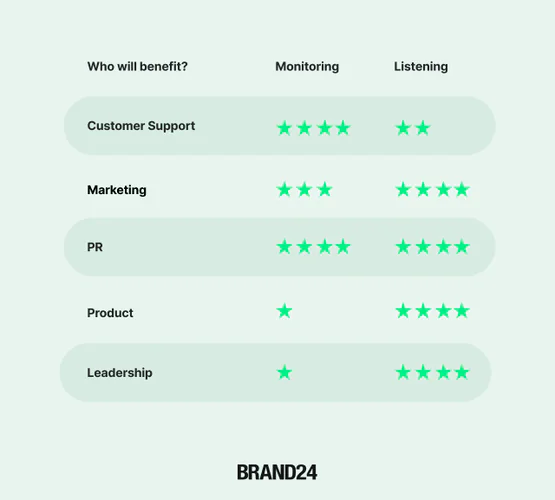
Plus, different teams will benefit more from listening, while others might use monitoring more. Here’s a breakdown:
Best listening and monitoring tools
There are many great tools on the market. Make sure to choose one that aligns with your goals and can be easily implemented in your current workflow.
Here are some of my top picks:
What are the best social listening tools?
Ideal for analyzing conversations en ligne, tendances du marchéet audience insights:
- Brand24 (AI-powered insights and reports, LLM tracking, great source coverage)
- Brandwatch (historical data, advanced dashboards, strong segmentation & topic clustering)
- Talkwalker (image & logo recognition, broad media coverage, trend forecasting)
- Meltwater (comprehensive reporting, strong enterprise integrations)
- Sprinklr (AI analysis, powerful competitor & trend insights)
What are the best social monitoring tools?
Best for tracking direct mentions and providing timely responses:
- Hootsuite (social media scheduling & publishing, unified inbox)
- Mention (strong alerting system)
- Sprout Social (scheduling and content planning, customer engagement tools)
What tools combine listening with monitoring?
Most of the platforms above combine social monitoring and listening.
But… some do it better, and others are more tailored for one of these purposes.
If you want outils d'écoute sociale with monitoring, I recommend:
- Brand24
- Sprout Social
- Brandwatch
What to consider when choosing a social listening and monitoring tool?
I suggest focusing on:
- Depth of data analysis
- Real-time monitoring accuracy
- Integration with CRM and marketing tools
- Reporting sophistication
How AI shapes social listening and monitoring in 2026?
AI has transformed the way we understand and react to conversations happening online.
What used to take hours of manual digging, tagging, and sorting now happens in seconds, and often long before we would even notice anything unusual.
Here are the five most exciting changes to explore:
- The rise of predictive analytics.
Instead of waiting for a crisis to unfold, AI can now pick up early warning signs, like subtle sentiment shifts, unusual spikes in negative mentions, or sudden activity around a specific keyword. - Automated response systems
They are now far more natural and helpful. These aren’t the clunky bots we used to know. They can respond to advanced customer questions, freeing up social media managers and CS teams to focus on the conversations that truly need a human touch. - Categorize and interpret insights at a scale that would be impossible manually.
AI groups conversations into topic clusters, identifies recurring pain points, and uncovers deeper patterns, turning proactive social monitoring data into stories you can actually act on.
FAQ
Q: What is the difference between social monitoring and social listening?
A: Monitoring tracks real-time, direct mentions and supports customer engagement. Listening analyzes broader industry and consumer conversations for long-term strategy.
Q: Is social listening or social monitoring more important for my business?
A: Both. Monitoring ensures timely responses; listening delivers strategic insights. Combined, they offer significant advantages.
Q: What tools combine listening and monitoring?
A: Brand24, Sprout Social, and Brandwatch provide integrated features.
Q: How do I implement social listening if I already do social monitoring?
A: Expand beyond direct mentions, add industry terms, analyze sentiment, and convert insights into strategic actions.
Conclusion
Understanding the difference between social listening and social monitoring is a valuable insight.
Monitoring helps you respond promptly to customer concerns, while listening helps you gain insights that drive better marketing strategies, product improvements, and strategic decision-making.
It’s best when you combine both of them.
This way, you can get deeper insights, stronger relationships with your target audience, and a holistic view of your brand’s online presence.