Tabela de conteúdo
What is Claude AI Used For? We Analyzed 774k Mentions [2026]
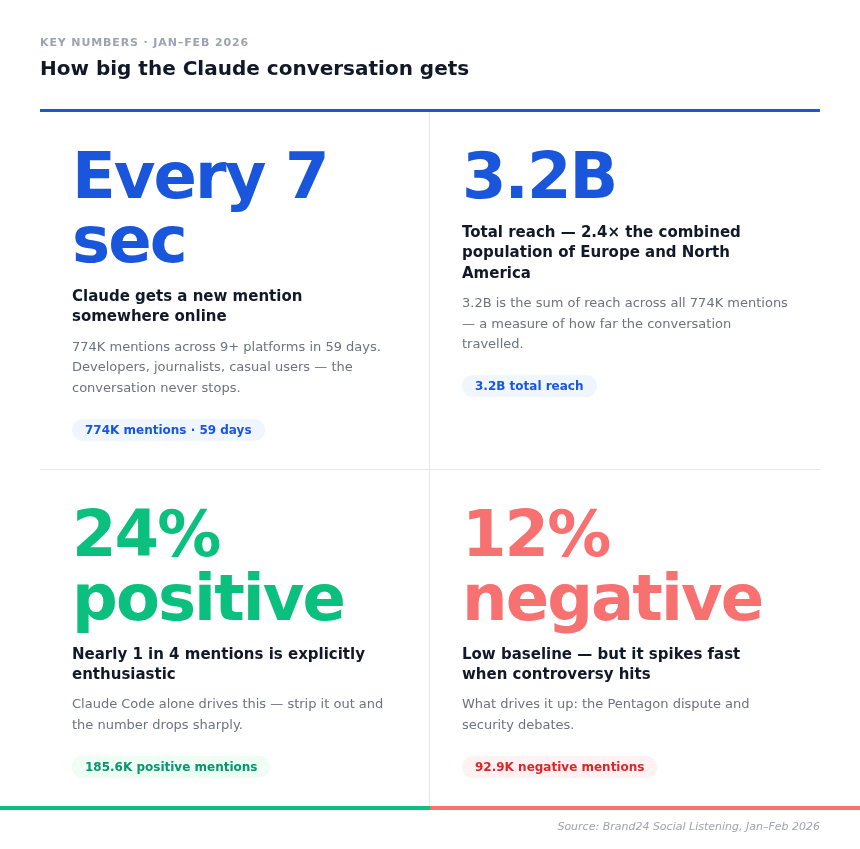
In January and February 2026, Claude was generating a new marca mention online every 7 seconds.
We tracked and analyzed 774k of them through social media monitoring to understand what Claude is used for, how people talk about it, and what topics they cover.
What we found is that Claude’s brand reputation is built almost entirely by one audience: Claude Code developers! 52% of all conversations and the highest positive sentiment come from people sharing their Claude Code outcomes.
Principais conclusões:
-
Product reputation and company reputation move independently, and they need separate tracking.
Over the same two months, Claude topics showed sentiment ratios ranging from 2.56:1 positive-to-negative to 0.16:1 – a 16x difference. Set up separate social listening projects for your product names and company name, and track their sentiment trends side by side. When one starts moving while the other stays flat, that's your early warning.
-
When one topic owns more than half your conversation, your overall sentiment score is basically that topic's score.
Claude Code was 52% of all mentions, so "Claude's overall sentiment" was really the developer community's sentiment. Before you trust any single brand monitoring metric, identify your biggest topic cluster and check whether it's pulling the whole number. Segment first, conclude second.
-
Users showing real outcomes outperform anything you publish yourself. Help them be visible.
The highest-performing Claude content was developers sharing builds, benchmarks, and workflow wins. Find the people already posting about your product, and amplify them: reshare, feature in newsletters, reach out. UGC about concrete outcomes earns more positive sentiment than any branded messaging about capabilities.
-
When users publicly compare you to a competitor, that could be your acquisition moment.
Some of the strongest positive Claude mentions were users explaining why they left ChatGPT. Those posts spread with zero paid distribution. Set up media monitoring project on your top competitors combined with words like "switching," "alternative," "tired of," and "cancelled." When those mentions spike, that's your window.
Claude AI generates a new mention every 7 seconds
Claude mentions got 3.2 billion total reach in 60 days. To put that in perspective: Claude’s combined mention reach during January and February 2026 is larger than the population of Europe and North America combined!
In the first two months of 2026, people posted about, shared, debated, and reacted to Claude and Anthropic 774k times in social and non-social media. That’s 12.9k per day, with a 97k per week on average.
And that’s not surprising when you consider the scale: Claude attracted 176M website visitors in December 2025 alone.
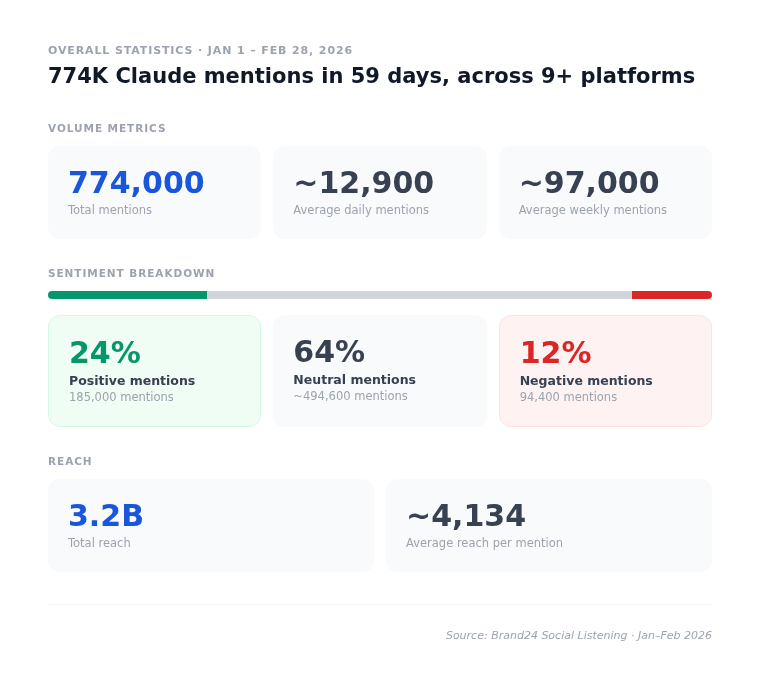
In February, we saw a 25% mentions spike, compared to January (from 344k to 430k). Reach grew even faster: up 46%, from 1.3 billion to 1.9 billion.
A few events caused this jump:
- 1 Anthropic launched Claude Opus 4.6 on February 5–6, then Claude Sonnet 4.6 on February 17.
- 2 Then, in the final week of the month, Claude was involved in an IBM stock shift and a dispute with the US government.
One topic dominates half of Claude AI usage conversations
The conversation is pretty concentrated, a bit similar to what we found in our analysis of discussions about how people use ChatGPT.
Usually, when people talk about a product online, they cover all sorts of things: general use, comparisons, entertainment, company news, or viral moments.
With Claude, the discussions are almost entirely focused on one specific feature, with a surprising amount of intensity.
52% of the Share of Voice (every second mention) goes to a single topic: Claude Code.
The next largest topic groups are way smaller:
- 1 AI Business Impact (12%)
- 2 Anthropic–Pentagon Dispute (7%)
- 3 Claude AI Experiences (6%)
- 4 AI Social Media Content (6%)
- 5 Security & Pricing (2%)
Basically, Claude Code is crushing it!
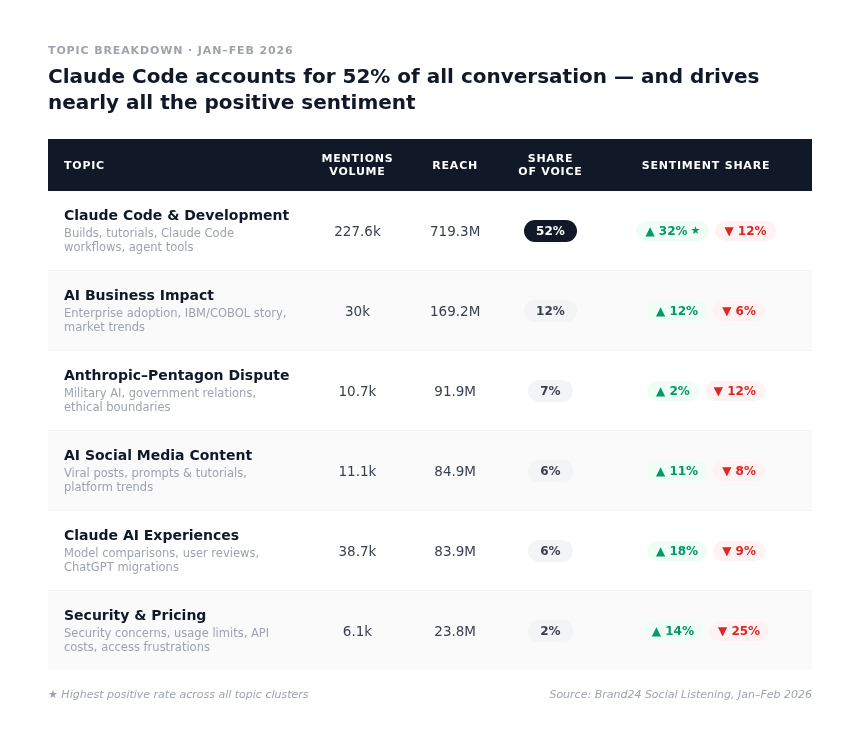
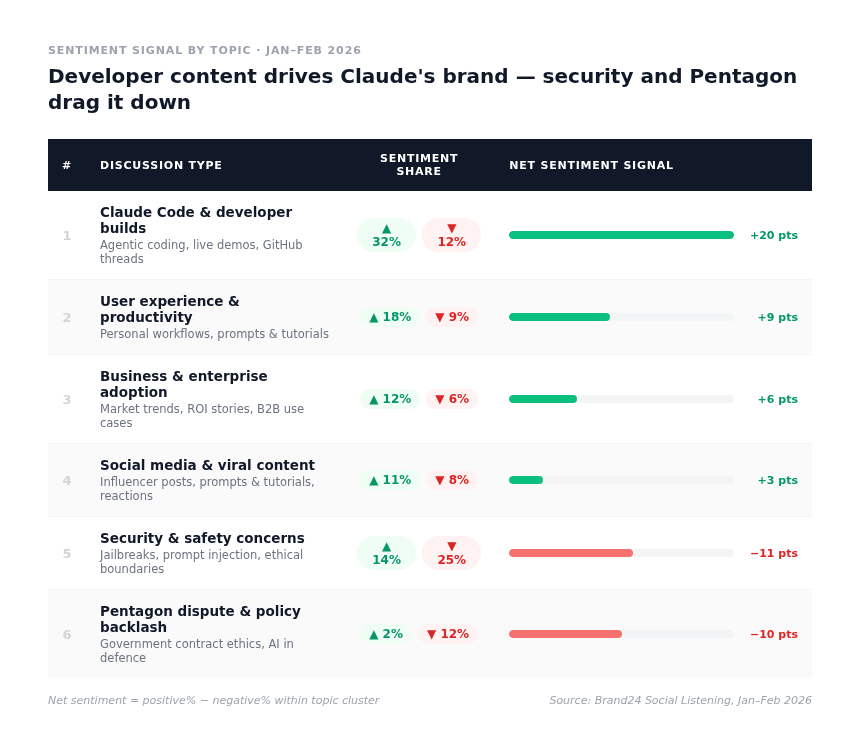
The “Claude Code” topic has the most positive sentiment overall, with 31.6% of mentions.
However, since it’s also where most people are talking, it also has the most negativo comments in total numbers: 12% negative out of 227.6k mentions is a pretty big chunk of unhappy users.
On the other hand, we have the Pentagon Dispute topic. Even though it only had about 10.7k mentions, it generated a massive 91.9M reach. It is almost as much as the AI Business Impact topic, even though that one was mentioned almost three times more often!
This is because high-authority news outlets and politically active X accounts pushed that story, something a simple developer tutorial can’t hope to match.
Security & Pricing, a small cluster of 6,100 mentions is the only one where the negative talk outweighs the positive voices. The ratio is 0.56:1, meaning there were many more complaints than supportive comments.
52% of online mentions is about one Claude AI use case: writing code
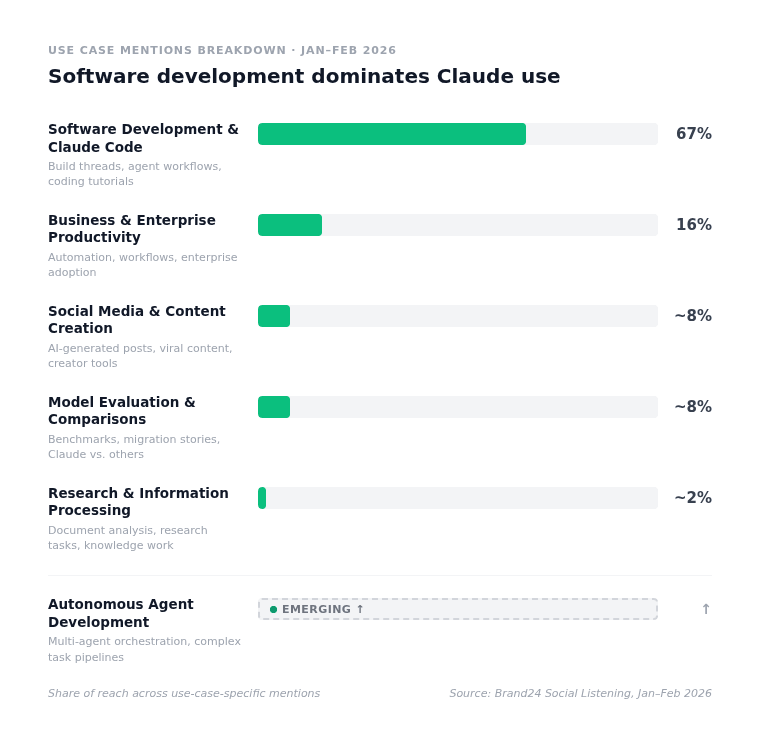
When we look specifically at Claude AI use cases — what people say they’re actually using it for, software development is by far the most popular answer: it takes up a much bigger share of voice than you’d expect from a “general” AI tool.
Professional and technical work dominated in Claude tool use with 67% of reach, seguido por:
- 1 Business and enterprise applications (16%)
- 2 Social media & content creation (~8%)
- 3 Claude model evaluation and vs. others comparisons (~8%)
- 4 Research & knowledge tasks (~2%)
- 5 Autonomous agent development (Emerging topic)
This is interesting from a brand reputation and sentiment analysis perspective:
Discussions about como people are using Claude were much more positive than just general talk about the tool or the company. The positive sentiment jumped to 31.6% compared to 24% overall.
So, when people are talking about the things they’re getting done with Claude, they’re happier than when they’re just debating the “big picture” of AI.
Less common use cases worth noting
Three specific areas showed up that were less common than the coding and enterprise work, but really interesting from a social listening point of view:
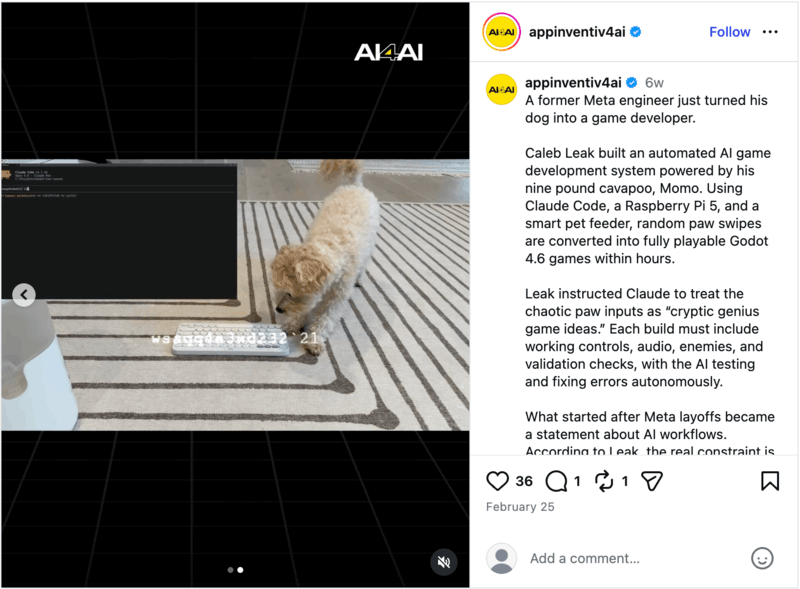
01 Game development and interactive apps
Small but consistent threads of content around building games with Claude (not AAA titles, but quick, fun, experimental projects).
- Building “funny games” and interactive applications from scratch
- Quick prototyping of playable demos without a full dev team
- Theme appeared consistently across YouTube and TikTok in the analyzed period
02 Climate, ESG, and legal work
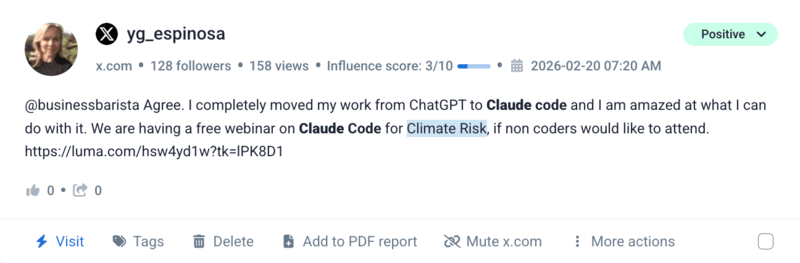
Professionals in regulations-heavy fields are quietly finding Claude useful for exactly the kind of dense, document-heavy tasks that are hard to automate:
- Workshops dedicated to using Claude for understanding climate risks
- Automating reports on Environmental, Social, and Governance (ESG) and getting help with legal disclosures
- Analyzing environmental data: a niche task you don’t usually hear about when people talk about AI
03 Industrial IoT and historical research
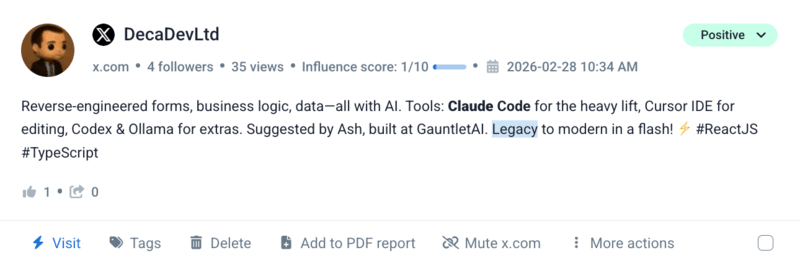
Two very different worlds, both showing up organically in our data:
- AI for academics: Historians and researchers are using Claude to pull together information from a variety of historical sources.
- Making industrial gadgets faster: People learning how to use Claude Code to quickly build prototypes for industrial IoT.
- Integration with legacy systems: Claude is being used to make older, existing systems work better in real-time.
Overall Claude sentiment was positive… until February
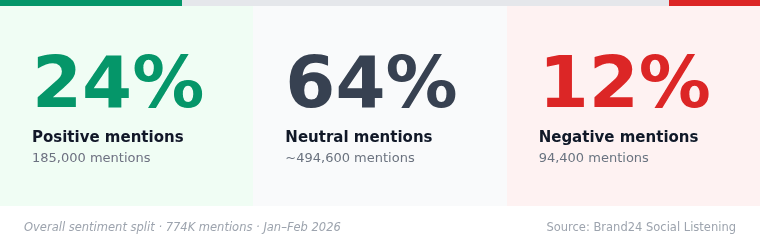
Most of what people said about Claude (64%) had a neutral sentiment. That’s usually how people talk about it online: they share their workflows, post tutorials, or compare it to other AI models without getting super emotional about it.
The comments where people fez have a strong feeling are pretty interesting. The positive mentions (24%) almost doubled the negative ones (12%): that’s a ratio of 1.96 positive comments for every 1 negative one.
However, how people felt didn’t stay the same the whole time.
Análise de sentimento showed a noticeable change:
Negative comments jumped by almost a third (+30%) between January and February, but positive comments only went up by about a tenth (+11%).
While the total number of comments was up 25%, the overall feeling definitely got a bit more complicated.
This change was caused by a few different events, like product issues, company news, and competitors’ moves, all happening around the same time in February.
Most of the growth in Claude mentions came from just four weeks
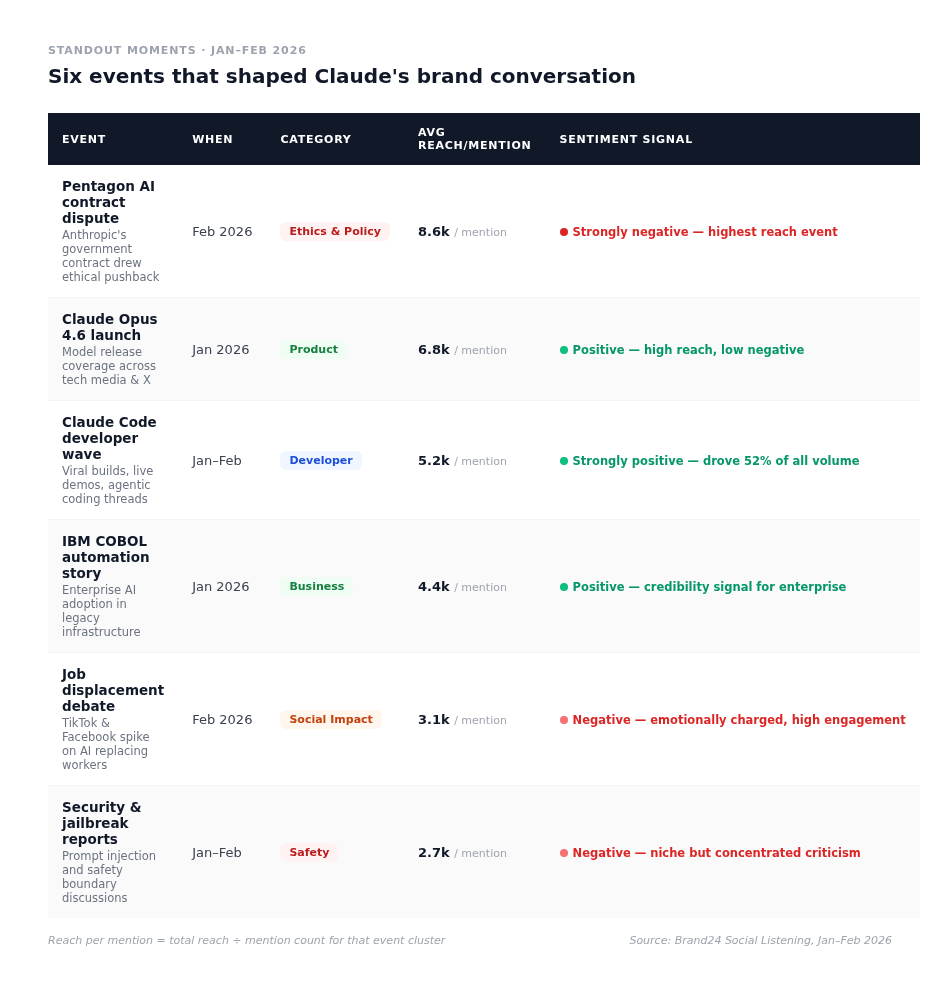
We spotted a few different hot topics driving the Claude AI conversation. Some of them gathered massive reach, with a huge audience and generating a lot of highly emotional talk.
Claude Code got more positive sentiment than any official launch
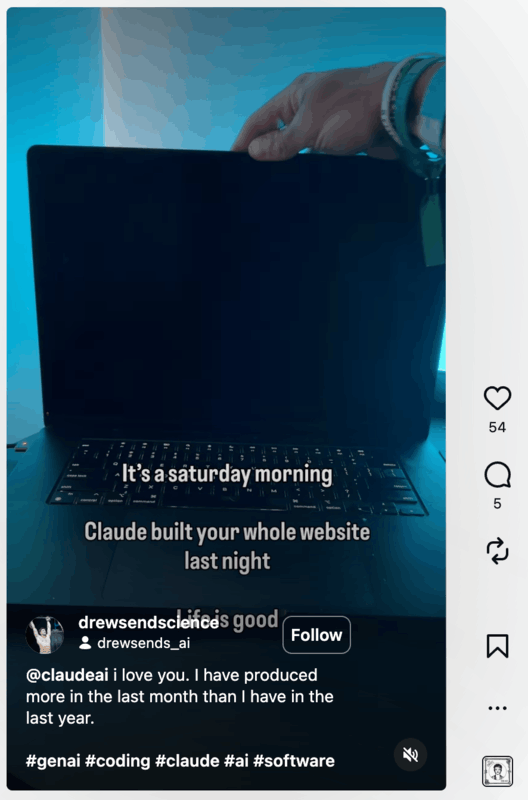
The most positive reactions in the dataset didn’t come from any Anthropic announcements. It was the people-developers showing off the apps and workflows they built with Claude Code and Claude Cowork.
01 When Claude helps with code, people love it
During the analyzed period, we saw a high volume of posts mentioning specific, measurable wins with Claude Code:
- people talking about building whole apps in one go,
- setting up automated checklist for their code reviews,
- ou slashing app build times from days to just minutes.
Posts describing concrete results consistently outperform any brand content on sentiment – one of the clearest percepções de marketing from this dataset.
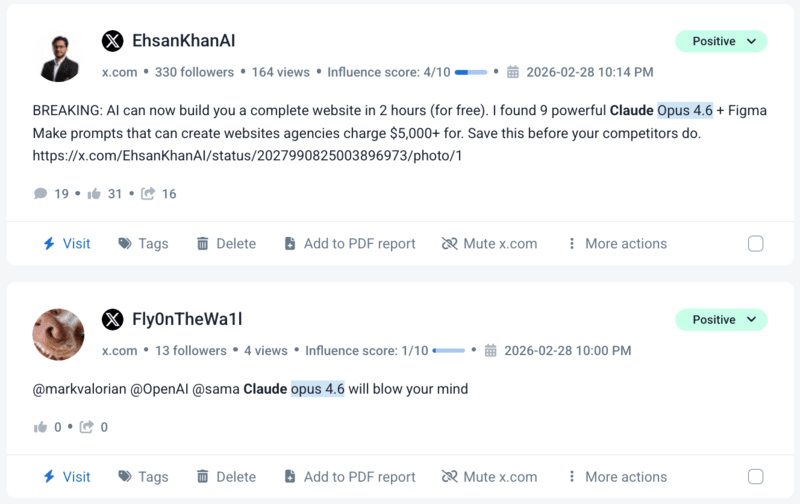
02 The Opus 4.6 launch was a hit (Feb 5–6)
One mention basically “crowned” it, saying ‘Anthropic’s new Claude is now the best AI for real work.’ That simple phrase: “best AI for real work” became the go-to way to describe Claude’s key benefit.
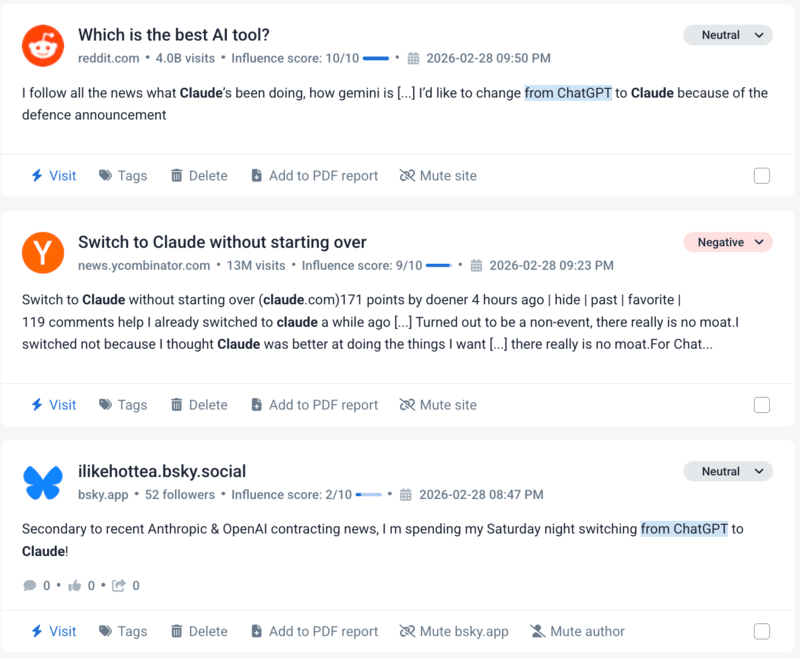
03 User migration from ChatGPT to Claude
One user said, “I haven’t paid for a ChatGPT subscription in a couple years, but I’m working on moving all my data over to Claude now, so far very happy.”
These stories about switching from a competitor carry a fair share of positive sentiment because they come from experienced users who made a conscious, informed choice.
04 Enterprise adoption signals
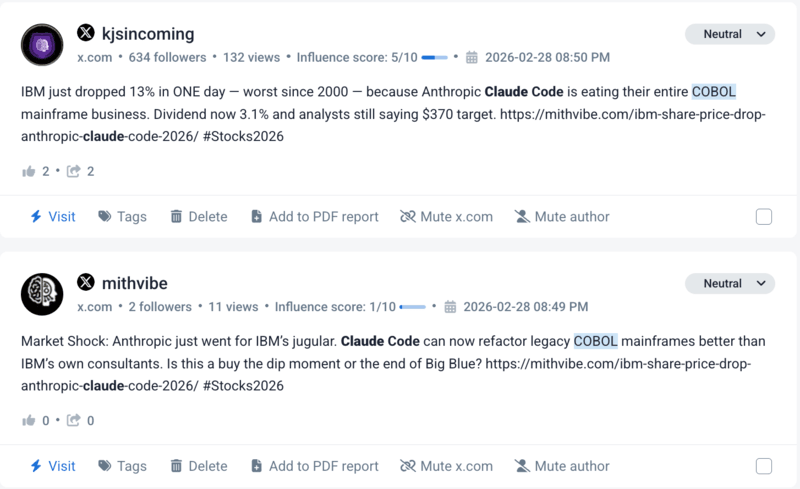
News that over 300,000 companies are using Claude was huge.
People especially liked the idea of integrating it with Excel (for ‘making decisions without leaving Excel’) and Claude’s ability to handle old-school COBOL code for system upgrades.
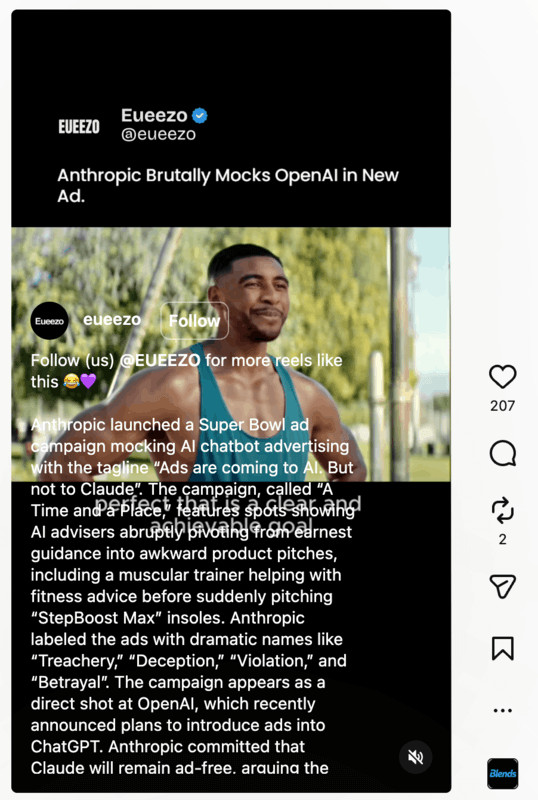
05 The ad-free commitment
Anthropic publicly committing to an ad-free Claude to ‘protect trust’ resonated well with the audience.
It generated a lot of positive sentiment, especially in online communities where people often debate the ethics of how AI companies make money.
Usage limits led the negative talk, but the Pentagon story spread far
Negative sentiment falls into two categories: emotional reactions to Anthropic decisions, and simple frustration with things like access, usage limits, and cost.
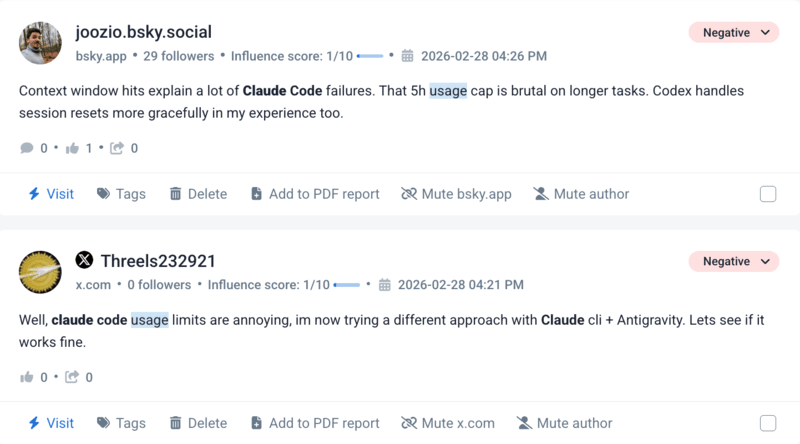
01 Pricing and usage limits: highest negative sentiment of any topic at 25%
People were most annoyed when usage caps stopped them mid-workflow. This topic is unique because it actually had mais negative mentions than positive ones.
02 The Anthropic–Pentagon dispute: just 1.7% positive
Legal tensions over military AI applications, including the government possibly ‘seizing’ Claude. The 91.9M reach this generated means the company-level story traveled far beyond the AI coding community.
03 Fears about losing jobs
This was hidden within the 30k mentions about AI’s impact on business, especially for entry-level coding and administrative work.
The tone was more resigned, with people just accepting it than truly angry, which is why 82% of the talk in that group was pretty neutral.
04 AI existential risk discussions
Anthropic’s reported experiments about whether AI could “eliminate” humans sparked some philosophical worries. While there wasn’t a huge volume of this talk, the news channels amplified it.
People trust the Claude product more than they trust Anthropic
If you look at how people talk about Claude vs Anthropic, ferramenta de monitoramento de marca data shows a clear split: the product’s reputação da marca and the company’s reputation follow completely separate paths.
When users discuss Claude AI usage: what it does, what they built, how it compares on a specific task, then sentiment is consistently positive.
Users and their hands-on experiences are much more positive than negative (about 2.5 times more positive, actually).
However…
When users discuss Anthropic as a company in topics like its relationship with government, its decisions about military AI, the sentiment nearly reverses.
Discussions about the Pentagon dispute are heavily negative (only 0.16 positive comments for every 1 negative one).
Por outro lado, Anthropic’s focus on ethics earns them some positive sentiment, even when they’re in the middle of a controversy.
Almost all of the 1.7% positive reactions during the Pentagon dispute came from people who liked that Anthropic stuck to its principles.
What people say about Claude changes a lot depending on the platform
Social listening data shows that onde people talk about Claude often matters more than o que they’re talking about when it comes to overall reconhecimento da marca e sentimento.
Social media drives about 73% of all mentions, while traditional media like news sites and blogs makes up roughly 19%.
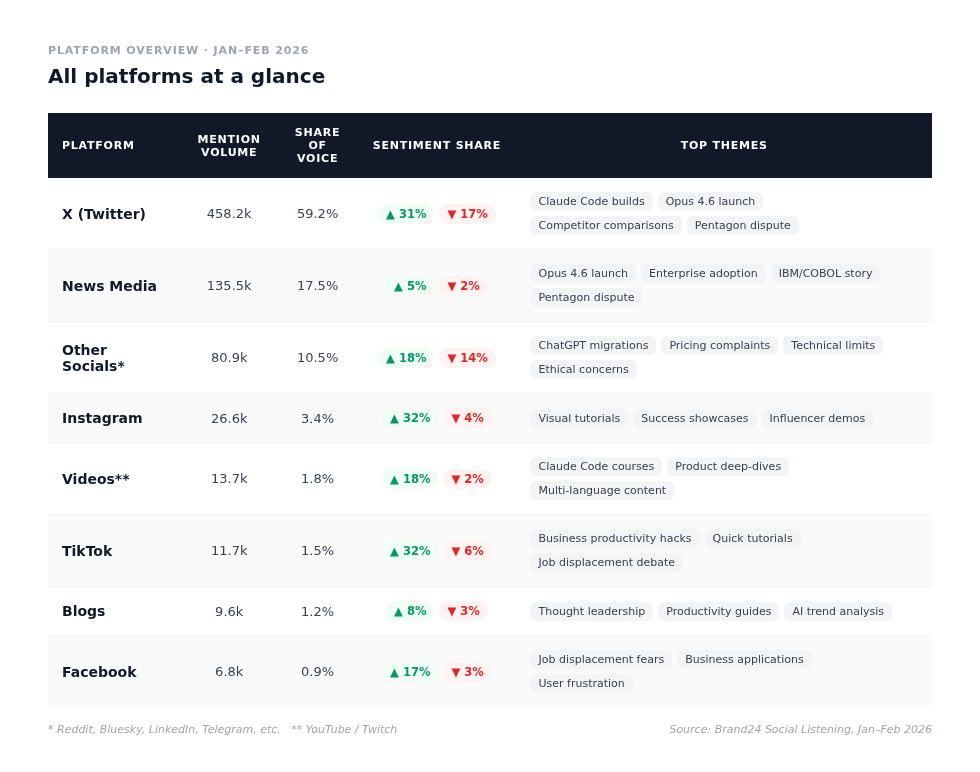
And when you dig into Brand24 social listening data and break down mentions by platform, you can see that:
- Instagram: People are excited to show off what Claude can do.
- X (Twitter): It’s mixed, because some users are “all-in”, while others are pretty critical.
- News outlets: They drive the more authoritative narrative (“best AI for real work”) that tends to reach decision-makers.
- Reddit and other socials: Users write honest, detailed takes like what’s working and what’s frustrating.
- Facebook: Conversations are more about worries about job displacement and AI’s broader impact on society.
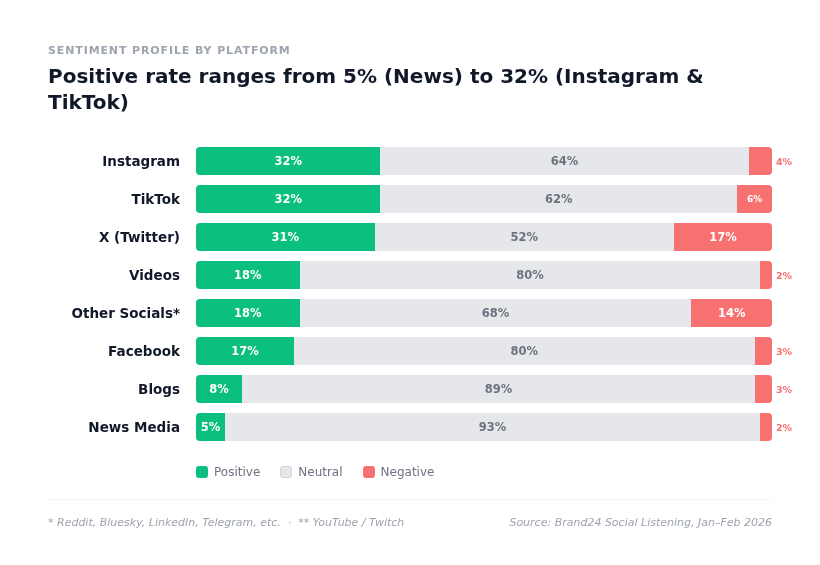
What’s driving Claude mentions tone on the top 5 channels?
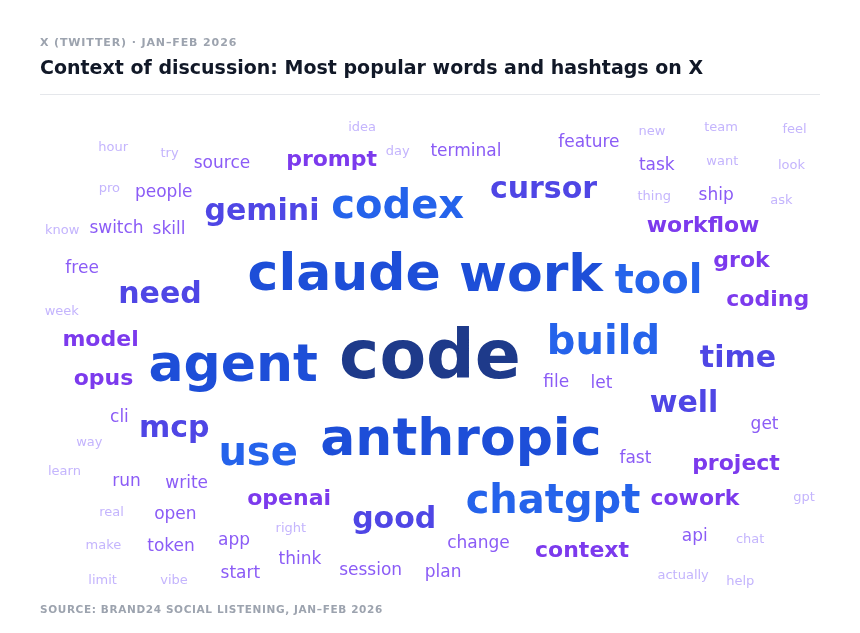
01 X (Twitter): Real-time pulse check of Claude Code users
Key themes:
- 1 Claude Code implementation
- 2 GitHub repository updates and code sharing
- 3 Claude Opus 4.6 launch analysis and benchmarks and Claude Sonnet 4.6 feature breakdowns
- 4 Anthropic's response to Pentagon demands and military AI ethics debates
- 5 ChatGPT to Claude migration threads
Context of discussion:
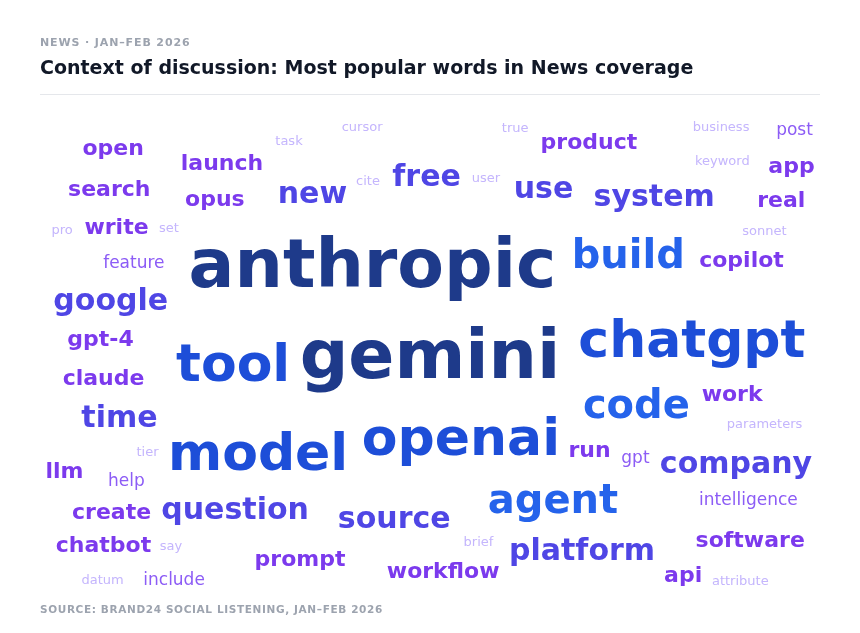
02 News media: The authoritative framing layer
Key themes:
- 1 "Introducing Claude Opus 4.6" – official Anthropic announcements
- 2 Industry analyst commentary and expert opinions and reviews
- 3 Platform and third party tool integration announcements
- 4 Anthropic market share analyses
- 5 Claude adoption statistics and reports
Context of discussion:
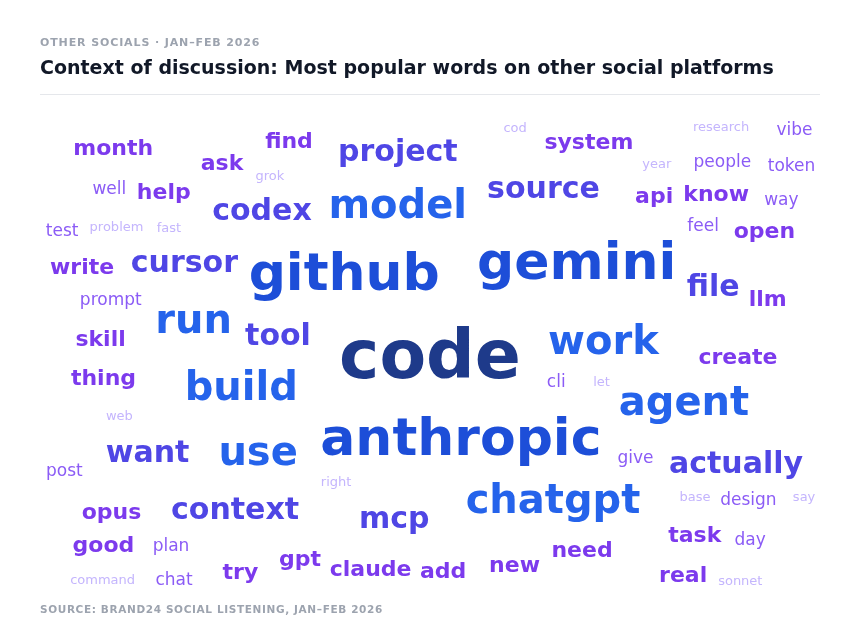
03 Other socials: The honest opinion layer
Key themes:
- 1 "Moving to Claude" – detailed transition experiences from ChatGPT (Reddit)
- 2 "Is Claude Chat down?" real-time status discussions (Reddit)
- 3 Pentagon controversy breaking news (Telegram)
- 4 Safety and reliability concerns and anti-corporate AI perspectives (Bluesky)
- 5 Rate limiting complaints and API reliability threads (Reddit)
Context of discussion:
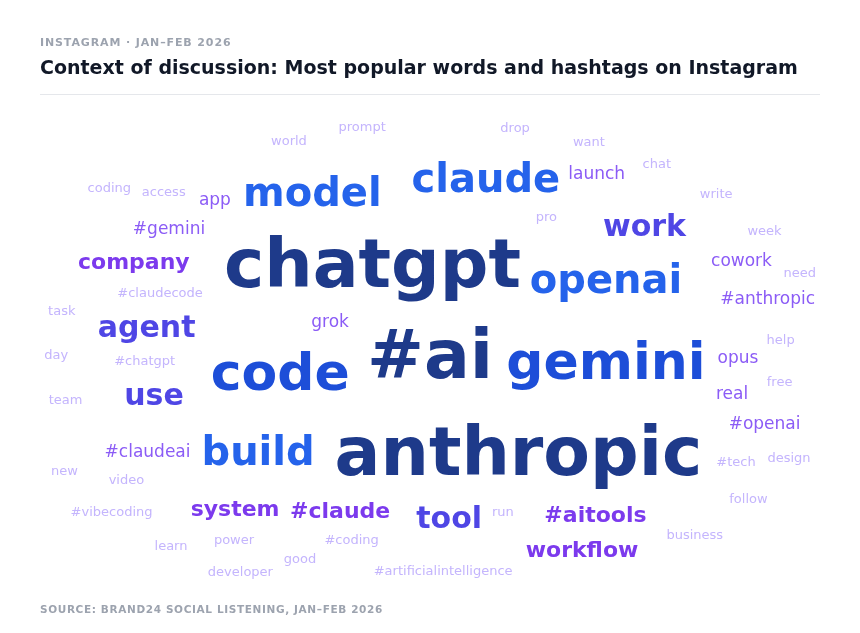
04 Instagram: The most positive channel
Key themes:
- 1 Creators showcasing artwork and designs made with Claude
- 2 Before/after transformations using AI assistance
- 3 "This changed my business" transformation posts
- 4 Portfolio projects that showcase collaborating with AI
- 5 Claude usage success stories from creators and entrepreneurs
Context of discussion:
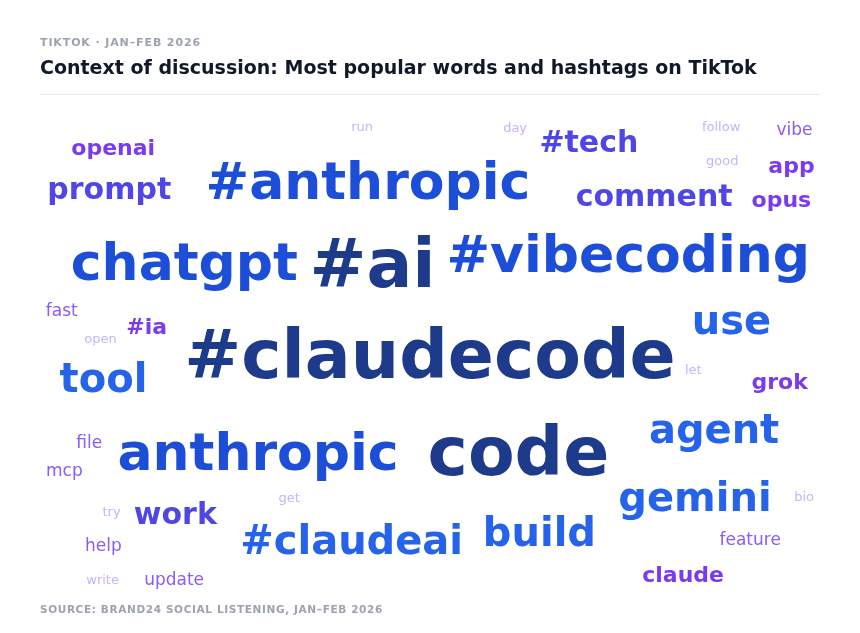
05 TikTok: Much educational content, with mixed-to-positive sentiment
Key themes:
- 1 "ChatGPT vs Claude vs Gemini vs Grok vs DeepSeek" head-to-head challenges
- 2 Same prompt tested across multiple AIs
- 3 "This replaced my assistant" testimonials
- 4 Pentagon dispute simplified explanations
- 5 "You're using Claude wrong" correction videos
Context of discussion:
The week Claude appeared on CNBC and moved a stock
In the last week of February 2026, a few separate storylines all collided at once.
- 1 Opus 4.6 was still generating developer content on X and YouTube.
- 2 Sonnet 4.6 had just become the default model for free users, and it brought another wave of mentions.
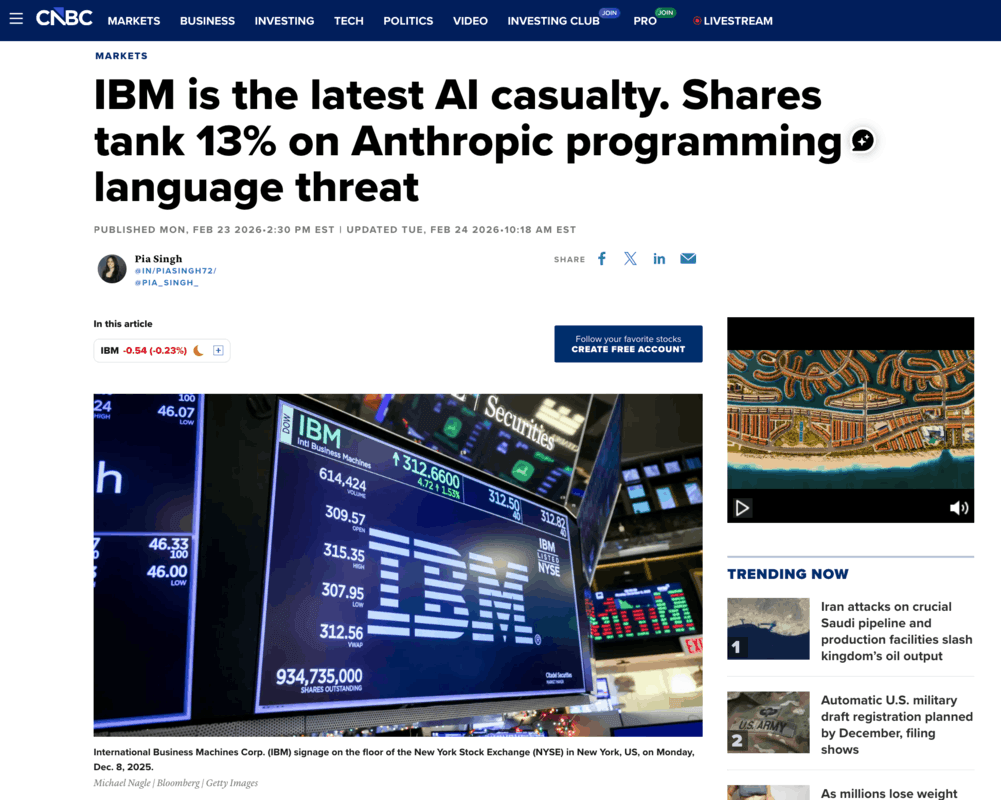
- 3 Then the American business news channel, CNBC, showed a material on IBM’s stock falling, and tied it directly to Claude’s COBOL capabilities.
- 4 On top of that, the Anthropic–Pentagon conflict hit mainstream media that same week.
We could see:
- developers and regular users sharing their code and other Claude outcomes,
- business journalists discussing Anthropic’s market impact,
- and policy reporters writing about government pressure,
and they all referenced Claude within the same seven-day window.
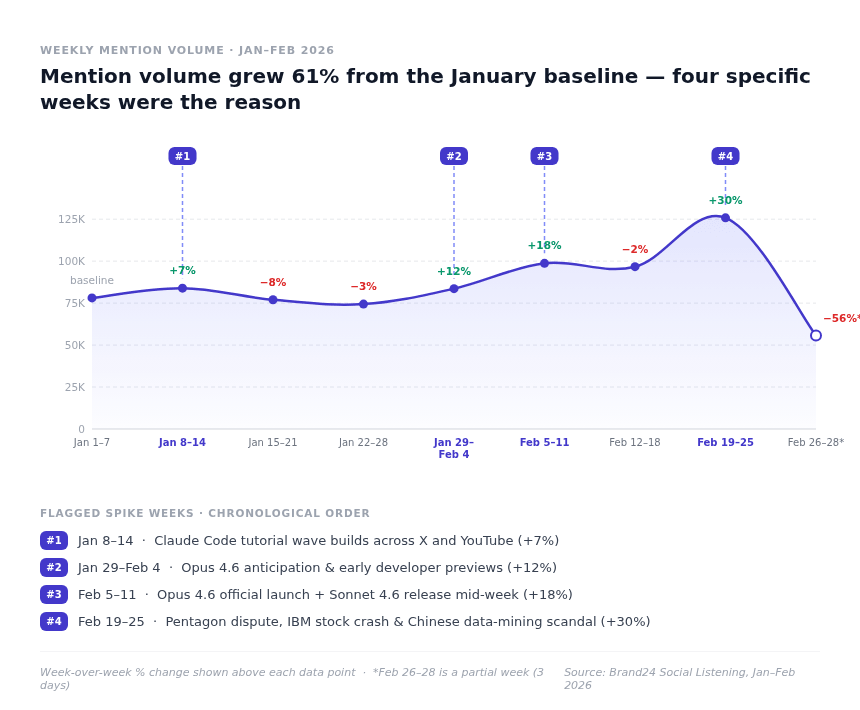
The week of February 19–25 produced 125,800 mentions and 516.6M reach in just 7 days.
That’s 30% more mentions and 20% more reach than the week before, mainly driven by:
01 The IBM stock story
When a CNBC segment highlighted Claude’s ability to handle COBOL, IBM’s stock took a hit. This framed Claude as a ‘danger’ to older, established enterprise technology.
That moment put Claude on the financial news map for the first time in a big way, reaching a huge audience of everyday people as well as business and finance experts.
02 The Pentagon dispute
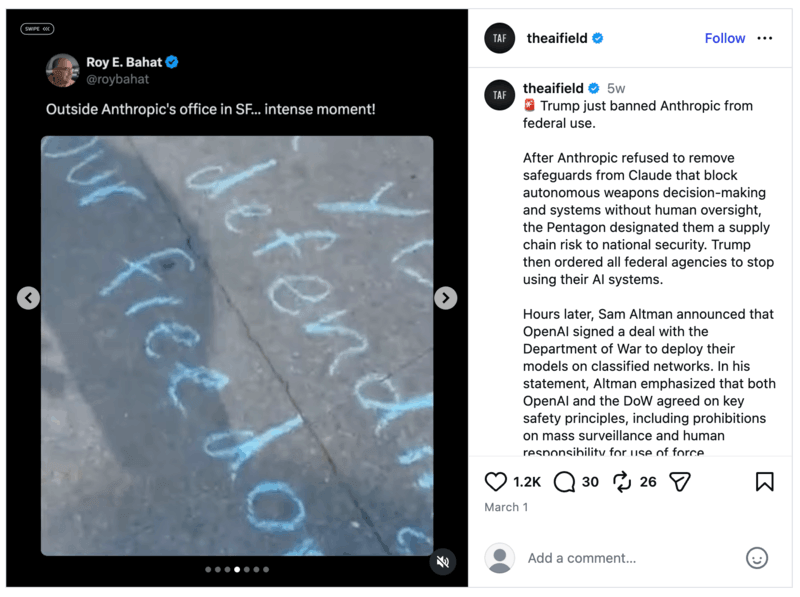
With government threats to possibly ‘taking over’ Claude all over political media, the story started reaching defense analysts, legal observers, and political commentators.
Getting an average of 8,6k views per mention for the Pentagon story, which is more than 2x the average for all the data. It shows what can happen when a tech story turns into a political one.
What this means for marketers in 2026
Here are four social listening insights from the Claude data, each tied to a specific finding and applicable beyond the AI world:
01 If one topic represents more than half your conversation, it can blur everything else
In this dataset, Claude Code made up 52% of all topic-cluster mentions. So the “overall Claude conversation” is basically the developer conversation, with a light sprinkle of everything else.
The pricing complaints, job displacement worries, competitor comparisons: they’re all in there, just getting averaged out.
If you’re tracking your brand and one discussion topic is driving that much volume, your overall sentiment score is essentially that topic’s sentiment score.
Before you trust any single social listening metric, identify your biggest topic cluster. Otherwise, the aggregate number hides more than it helps.
02 Your product reputation and your company reputation can often be two separate assets. Monitor them both.
The Claude mentions from the coding community showed a 2.56:1 positive-to-negative ratio.
Meanwhile, the Pentagon controversy came in at 0.16:1. Same brand, same two months, and a 16x difference in sentiment.
That’s why it’s smart to set up separate monitoramento de mídia project for your product name, your company and CEO names, and key topics in your industry.
Track their overall sentiment, but also make sure you review their sentiment trends individually.
When one starts pulling away from the others, that gap is the exact place you need to analyze, and your response plan should change depending on which one is moving (and in what direction).
03 Make it easy for the people to show how they use your product. It’s your most valuable content asset.
The Claude mentions from the coding community showed a 2.56:1 positive-to-negative ratio. Meanwhile, the Pentagon controversy discussions came in at 0.16:1.
Same brand, same two months, and a 16x difference in sentiment, depending on whether people talk about what they did with the product, or about what the company fez.
Use media monitoring tools to find the people already posting about how, when, or where they used your product.
Then boost those mentions by reposting, featuring in your newsletter, or even by direct outreach to the authors.
When you lead with real user outcomes, you’ll usually earn more positive sentiment than if you focus on brand capability claims.
04 People talking about leaving a competitor can be your best free advertising. Pay attention to these mentions.
Some of the strongest positive content in this report was users describing why they switched from ChatGPT: ‘I haven’t paid a subscription in a couple years for ChatGPT, but I’m working on moving all my data over to Claude now, so far very happy.’
These posts spread on their own: no production budget, no paid distribution.
They work because they’re coming from real, experienced users making a clear comparison, and people can tell that’s different from a brand ad.
Set up a social media listening project to monitor your top competitors’ names combined with frustration keywords like “switching,” “alternative,” “tired of,” e “cancelled.”
When mentions spike, that’s your acquisition moment.
The goal here isn’t to jump in with targeted ads only, but also to show up in these conversations, be helpful, and stay visible right when users are actively looking for a reason to leave.