Table of contents
2M Marketers

Digital channels now account for nearly 75% of total ad spend, meaning the brands winning today are those that understand exactly how far their message travels — and why. That metric has a name: brand reach, and mastering it is no longer optional.
Key takeaways
-
It takes 5 to 7 interactions for a consumer to remember a brand.
Reach isn't just about getting in front of as many people as possible — it's about showing up consistently enough across enough touchpoints that your brand actually sticks.
-
Organic search is still the number one channel for brand discovery.
Nearly 1 in 3 internet users discover new products through Google, making SEO-optimized content your highest-leverage long-term investment for expanding reach.
-
Brand consistency directly impacts revenue, not just recognition.
Companies with consistent branding across all channels see 10–20% higher revenue growth — meaning every inconsistent logo, mismatched tone, or off-brand ad is quietly costing you money.
-
Earned reach — mentions, shares, and coverage you didn't pay for — is the hardest to measure but often the most valuable.
Tracking brand mentions with a monitoring tool like Brand24 reveals where organic conversations are already happening, so you can amplify what's working instead of guessing.
-
Expanding reach without tracking share of voice gives you an incomplete picture.
Share of voice tells you how your brand's presence is growing relative to competitors — without it, you can't tell if you're actually winning ground in your category or just running in place.
What is brand reach?
Brand reach is the total number of unique individuals exposed to your brand’s message over a given period. It answers a simple but critical question: how many people actually saw what you put out there?
Note: It’s important to distinguish reach from impressions. Reach counts distinct people; impressions count total views.
A single person who sees your ad five times generates five impressions but only one unit of reach. Both metrics matter, but reach is the foundation — you can’t build awareness, trust, or revenue on an audience that never encountered you in the first place.
Key fact: It typically takes 5 to 7 interactions for a consumer to remember a brand, which means reach isn’t just about breadth — it’s about creating enough consistent touchpoints to move someone from stranger to customer.
How to measure brand reach?
Measuring brand reach effectively requires tracking it across multiple channels. Here’s where to look:
- Social media platforms — Facebook, Instagram, LinkedIn, and TikTok all provide native reach data in their analytics dashboards. This tells you how many unique accounts saw each post or ad.
- Google Analytics — tracks website reach through unique visitors, showing how many distinct people landed on your site from organic search, paid campaigns, or referral traffic.
- Brand monitoring tools — platforms like Brand24 aggregate reach across the web, tracking mentions, news coverage, and social conversation volume. These tools are particularly useful for measuring earned reach (coverage you didn’t pay for).
- Branded search volume — the number of people searching your brand name directly in Google is a strong proxy for overall brand awareness and reach at scale.
Key metrics to track alongside raw reach figures include:
- share of voice (how much of the conversation in your category you own),
- sentiment (whether that reach is positive or negative),
- reach-to-engagement ratio (how many people who saw your content actually interacted with it).
How to measure brand reach with media monitoring?
Media monitoring tools like Brand24 track every time your brand is mentioned online — across social media, news sites, blogs, forums, and more.
This gives you a real, data-backed picture of your brand reach rather than relying on estimates or platform-limited analytics.
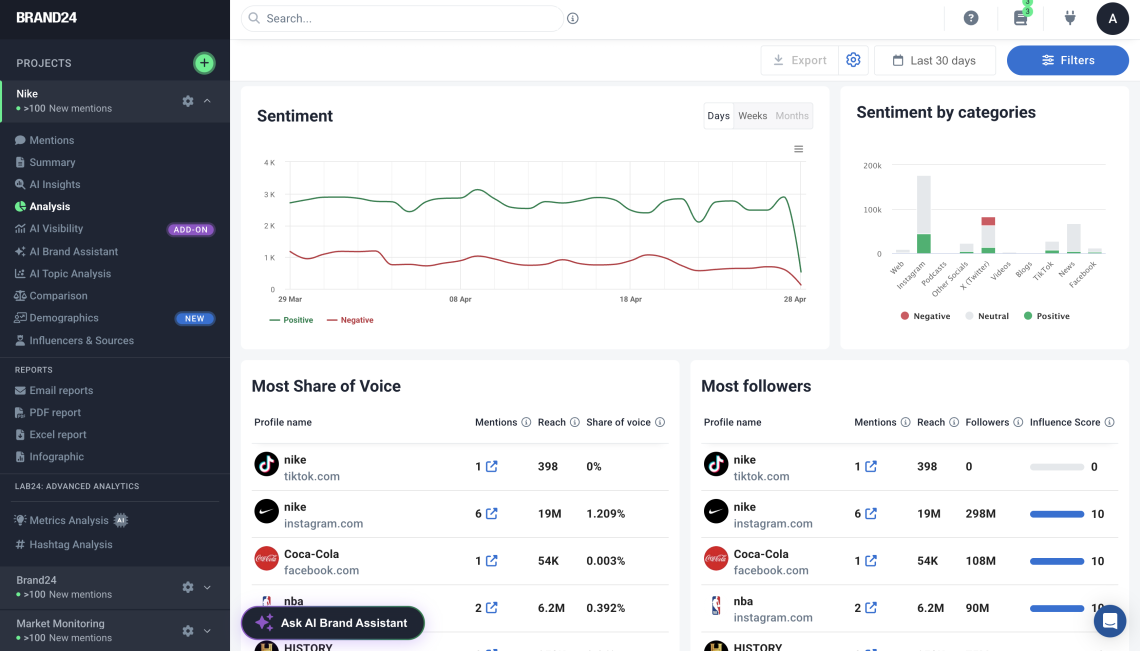
Media monitoring doesn’t just measure brand reach — it shows you exactly where the gaps and opportunities are so you can act on them.
| Feature | What it shows | Why it's useful |
|---|---|---|
|
Presence Score |
How visible your brand is in search results |
Benchmark your search visibility against competitors |
|
Mentions |
Total brand mentions split by social vs. non-social media |
Identify where your brand is being discussed most |
|
Influencers |
Top influencers who mentioned your brand |
Find people to engage with to amplify your reach |
|
Mentions by category |
Mention sources broken down by platform (X, Blogs, Web, etc.) |
See which platforms drive the most brand conversation |
|
Trending Links |
Most shared links connected to your brand |
Track how specific content or campaigns are spreading |
|
Top & most active public profiles |
Profiles that mention your brand most and those with the highest influence |
Spot potential brand ambassadors and partnership opportunities |
|
Context of Discussion |
Word cloud showing topics most associated with your brand |
Understand how your brand is perceived and tailor your messaging |
|
Trending hashtags |
Hashtags related to your brand that are currently trending |
Join relevant conversations and boost visibility |
How to maximize your brand reach? [6 strategies]
1. Invest in Content Marketing and SEO
Content marketing compounds over time. Companies generate 67% more leads through blogs, and organic search remains one of the highest-reach channels available.
Search engines are still the number one source of brand discovery for online adults, with nearly 1 in 3 internet users saying they learn about new products through platforms like Google.
The strategy: create in-depth, genuinely useful content targeting keywords your audience is already searching. Optimize for both traditional search and AI-generated answers (GEO), as AI overviews increasingly summarize content directly in search results, amplifying reach for sources they cite.
2. Use Paid Advertising and Remarketing Strategically
Paid channels accelerate reach that organic alone can’t achieve. Worldwide social media ad spend is projected to reach $277 billion in 2025 — more than $5 billion per week — which reflects how aggressively brands are using paid social to extend their reach to new audiences.
The strategy: Remarketing specifically targets users who’ve already encountered your brand, reinforcing recognition among warm audiences at a lower cost per impression than cold prospecting.
3. Leverage Video Content
Nine out of 10 consumers want more video from brands, and 91% of businesses now use video in their marketing. Video is the single highest-reach format on most social platforms, benefiting from algorithmic preference and higher shareability than static content.
The strategy: Short-form video (Reels, TikTok, YouTube Shorts) is particularly powerful for reach because it surfaces to non-followers through discovery feeds.
4. Partner with Influencers and Creators
Influencer marketing remains one of the most cost-efficient ways to reach new audiences quickly. In 2026, 61% of marketers plan to increase their investment in creator content, reflecting growing confidence in creator-led reach strategies.
The strategy: The key is selecting partners whose audiences genuinely overlap with your target customer — borrowed reach only converts if it’s the right audience.
5. Build Consistency Across Every Channel
Reach means nothing if people can’t recognize you after seeing your message. 55% of a brand’s first impression comes from visuals alone, and 68% of companies say brand consistency adds 10–20% to revenue growth.
The strategy: Consistent logos, colors, tone of voice, and messaging across social media, your website, email, and ads ensure that every impression you earn reinforces the same identity — accelerating the recognition that turns reach into recall, and recall into revenue.
Key Takeaways
Growing your brand reach isn’t a one-time campaign — it’s an ongoing process of measuring, testing, and refining across every channel you operate in. Here’s what to keep in mind as you put it all into practice.
| Action | How to do it |
|---|---|
|
1
Step 1: Measure reach across every channel — not just one |
Before you can improve brand reach, you need to know where you stand. Pull reach data from your social media analytics, Google Analytics (unique visitors), and a brand monitoring tool to capture earned mentions. Looking at all three together gives you a complete picture — relying on just one channel will always leave blind spots. |
|
2
Step 2: Separate your reach from your impressions |
Go into your analytics and find both numbers. If your impressions are high but reach is low, the same small group of people is seeing your content repeatedly — you’re not growing your audience. Use this gap as a diagnostic: it tells you whether you need to focus on expanding your audience or deepening engagement with the one you already have. |
|
3
Step 3: Build your organic foundation with content and SEO |
Identify the keywords your target audience is searching for and create genuinely useful content around them. This is your long-term reach engine — it compounds over time and doesn’t stop working when your ad budget runs out. |
|
4
Step 4: Accelerate reach with paid and influencer campaigns |
Once your organic foundation is in place, use paid social and influencer partnerships to push your content in front of new audiences faster. Set up remarketing campaigns to re-engage people who’ve already encountered your brand — they’re cheaper to reach and more likely to convert. |
|
5
Step 5: Audit your brand consistency across every touchpoint |
Check that your logo, colors, tone of voice, and messaging are consistent across your website, social profiles, email, and ads. Run a quick audit: if a stranger saw your Instagram post and then landed on your website, would they immediately know it was the same brand? If not, inconsistency is costing you recognition — and recognition is what turns reach into revenue. |
|
6
Step 6: Track share of voice and mentions, not just owned metrics |
Set up a brand monitoring tool to track how often your brand is mentioned across the web — in articles, social posts, forums, and reviews. Monitor your share of voice over time to see whether your brand is growing its presence in your category relative to competitors. This is the clearest signal that your reach efforts are actually working. |
FAQ
Why does brand reach matter?
Reach is the top of the funnel for everything else. Without it, your content marketing, paid ads, email campaigns, and social media efforts are all operating on a smaller stage than they need to be.
Brand consistency boosts revenue by 20%, and 47% of social media followers are likely to visit a brand’s website after engaging with content. But none of that happens if those followers never found you in the first place. Reach is the prerequisite.
63% of customers are more willing to buy from familiar brands, and familiarity only develops through repeated exposure. Expanding your brand reach is, at its core, a revenue strategy — not just a vanity metric.
What is the difference between brand awareness and reach?
Reach is a numbers game — it counts how many unique people were exposed to your brand’s message. Brand awareness is about what happens after that exposure — whether those people actually recognized, remembered, and formed an opinion about your brand.
The simplest way to think about it: reach is the size of your audience, awareness is the quality of their connection to you. High reach with low awareness means people are seeing your brand but it isn’t registering. High awareness with low reach means your existing audience knows you well, but you’re not growing. A strong brand strategy builds both simultaneously.
How to expand brand reach?
There are five proven ways to expand brand reach:
- 1 Create SEO-optimized content that targets what your audience is already searching for — organic search is still the number one channel for brand discovery online.Create SEO-optimized content that targets what your audience is already searching for — organic search is still the number one channel for brand discovery online
- 2 Run paid social and display ads to put your brand in front of audiences who haven't encountered you yet.
- 3 Partner with influencers and creators whose audiences overlap with your target customer — this is the fastest way to borrow reach from someone who's already built it.
- 4 Publish short-form video on platforms like TikTok, Instagram Reels, and YouTube Shorts, which algorithmically surface content to non-followers.
- 5 Monitor your brand mentions to identify organic conversations already happening around your brand — then engage with them to amplify them further.
How to measure brand reach on social media?
Every major social platform provides native reach data in its analytics dashboard:
- Facebook and Instagram — Meta Business Suite shows reach per post, story, and ad, broken down by organic and paid.
- LinkedIn — shows impressions and unique reach per post in the analytics tab.
- TikTok — provides video views alongside a reach figure in TikTok Analytics.
- X (Twitter) — shows impressions per tweet in the analytics dashboard.
Beyond platform-native data, use a brand monitoring tool to capture reach from mentions, shares, and conversations that happen outside your own profile — this earned reach is often significant and easy to miss if you’re only looking at owned analytics.
Why is brand reach important?
Brand reach is the starting point for every other marketing outcome. Without it, even the best content, strongest offer, or most compelling product goes unseen.
More practically: 63% of customers are more likely to buy from brands they’re already familiar with, and familiarity only develops through repeated exposure. The more people you reach consistently, the larger the pool of potential customers who know who you are when they’re ready to buy. Reach isn’t a vanity metric — it’s the foundation that makes everything else in your marketing funnel possible.
What is reach in marketing?
In marketing, reach refers to the total number of unique people who were exposed to a piece of content, an ad, or a brand message during a specific time period. It’s one of the most fundamental metrics in marketing because it defines the actual size of your audience — not how many times your content was viewed, but how many distinct individuals saw it.
Reach applies across every channel: a social media post has a reach figure, a paid ad campaign has a reach figure, a PR mention in a publication has a reach figure. Taken together, these numbers tell you how wide your brand’s presence actually is — and where the gaps are.