Table of contents
2M Marketers

Nielsen’s Global Trust in Advertising states that 63% of customers are more willing to buy from familiar brands.
I analyzed 5,699 online mentions about share of voice using Brand24 social listening tool, and the biggest finding was this: the conversation around share of voice in AI search is now 3.4× larger than traditional SoV discussions.
This guide explains what that means for how you grow and measure your share of voice in 2026.
Key takeaways
-
What is share of voice?
Share of Voice (SOV) is the percentage of the total online conversation or visibility your brand gets compared to your competitors, in social media, search, PR, ads, and AI chatbot responses.
-
What is AI share of voice?
AI Share of Voice is a new metric that measures how often your brand is cited or recommended in responses from ChatGPT, Google AI Overviews, Gemini, and Perplexity, compared to competitors.
-
What is excess SOV and why is it important?
Excess Share of Voice (ESOV) happens when your share of voice is higher than your market share. It’s one of the best indicators of future growth! Brands with positive ESOV tend to consistently grow faster than the market.
-
How often do marketers talk about AI SoV?
According to Brand24's 2026 research, 82% of online SOV discussions now have an AI angle, with #geo, #aisearch, and #aeo dominating the hashtag conversation.
-
Why is measuring share of voice important?
With 71% of consumers more likely to buy from brands they recognize on social media (Sprout Social Index 2026), share of voice (SOV) plays a direct role in boosting purchase intent.
What is share of voice? Definition
Share of voice (SOV) is a marketing metric that shows how much of the total conversation or visibility in a market your brand owns compared to competitors.
It’s usually shown as a percentage: the higher your SOV, the more authority your brand has within its niche.
Where can you measure share of voice?
The answer is very simple! You can measure SOV in any channel where brands compete for attention:
| Channel | What can you measure with SOV? |
|---|---|
| Social media | Your share of mentions, engagement, or conversations vs. competitors |
| Search/SEO | Your share of keyword rankings, clicks, or overall brand visibility in search |
| AI Search | How often your brand is cited or recommended in ChatGPT, Gemini, Perplexity, Google AI Overview responses, and other LLMs |
| PR & Media | The media coverage your brand earns compared to others in your space |
| Advertising | Your portion of total ad spend or impressions across TV, digital, print, or OOH |
| E-commerce | Your share of product impressions, sponsored placements, or reviews on marketplaces |
How to interpret share of voice?
Share of voice tells you how visible your brand is. It won’t show whether you are efficient or profitable. It’s more of an early signal that growth might be coming, not a measure of it.
💡 My tip: A high SOV doesn’t automatically mean your brand’s winning.
Some of the biggest mistakes I’ve seen brands make are:
1. Assuming SOV is always a good thing, combining metrics that don’t really match across channels
2. Focusing on too short a timeframe
3. Comparing against the wrong competitors
4. Treating SOV like it’s the same as ROI
Calculating your share of voice is one number, understanding what’s driving it is the real value.
But how to do that?
We created our free “Prompts to Analyze Media Mentions Better” list to make analyzing such metrics easier.
It will walk you from “this is my brand’s SOV” to “why it’s moving, and what to do next” (specifically look at the prompts on site 10).
Download it and try AI for your SOV analysis!

The most useful signal I recommend looking at is Excess SOV (ESOV), calculated as SOV minus Share of Market (SOM):
- If SOV > SOM → growth is likely
- If SOV < SOM → visibility decline is a risk
- If SOV ≈ SOM → performance is probably stable
One more reason to take SOV seriously: Edelman’s 2026 Trust Barometer found that consumers are almost 2× more willing to support a brand, when it’s both trusted and relevant.
What is AI share of voice?
AI Share of Voice measures how often your brand is cited, recommended, or mentioned in AI chatbot responses (in ChatGPT, Google AI Overviews, Gemini, Perplexity, and other LLMs), compared to your competitors.
Why does the share of voice in AI search matter in 2026?
According to McKinsey State of the Consumer 2026, only 1% of sources cited by LLMs come from brand-owned websites.
The rest comes from third-party editorial sources, reviews, and social media (5–22% of LLM citations). So your AI share of voice is built almost entirely on what others say about you!
eMarketer data from 2025 stated that 66.6% of US consumers have already used social search: a clear sign that search is moving to the same platforms that influence LLM citations.
A quick comparison of traditional SOV and AI SOV:
| Aspect | Traditional share of voice | Share of voice in AI Search |
|---|---|---|
| Measured in | Mentions, impressions, ad spend, clicks | Frequency of citation in LLM responses |
| Where it happens | Social media, search, media, ads | ChatGPT, Gemini, Perplexity, AI Overviews, and other AI chatbots |
| You control | Your content, ads, and outreach | Third-party sources that LLMs cite |
| Key metric | % of total market mentions | % of AI-generated answers that include your brand |
How to measure share of voice in AI search? [A real example]
From what I’ve seen working with share of voice data, the brands making the most progress on AI SOV are the ones that map their competitive landscape first:
- where they already win in AI,
- and where no clear brand has yet claimed the space.
A Forbes analysis of AI visibility strategies recommends that marketing leaders “track AI share of voice, answer engine mentions, citation sources, sentiment accuracy, competitor inclusion and conversion paths” — treating AI SOV as a core KPI alongside traditional metrics.
Market share vs. share of voice
Market share and share of voice are sometimes confused, but they measure two very different things.
In simple words:
- Market share is the % of total sales in your industry that your company brings in.
- Share of voice is how visible and talked-about your brand is compared to competitors.
One is about revenue, the other is about presence.
A quick comparison table:
| Aspect | Market share | Share of voice |
|---|---|---|
| Measures | % of total sales in the market | % of brand mentions or visibility in the market |
| Focuses on | Revenue and customers | Visibility and awareness |
| Tells you | How much of the market you own | How much of the conversation you dominate |
| Based on | Sales data | Media monitoring metrics |
| Timeframe | Reflects past performance | Predicts future growth |
How to interpret differences between market share and share of voice?
- High SOV + Low Market Share → You’re investing in growth, likely to gain market share over time.
- Low SOV + High Market Share → Risk of losing future sales as visibility declines.
- SOV ≈ Market Share → Balanced presence and performance.
- SOV > Market Share (ESOV) → Strongest signal of upcoming growth.
We break down the differences in detail in our guide to share of voice vs. share of market.
How to calculate the share of voice?
The core formula is simple. The tricky part (and what I’ll walk you through below) is figuring out which metric to use in each channel.
Share of voice formula
Share of Voice = (Your Brand Metrics ÷ Total Market Metrics) × 100
“Brand metrics” can be mentions, impressions, ad spend, clicks, or keyword rankings, depending on the channel.
The key is consistency: compare the same metric type across all brands in your competitive set.
Curious where you stand against competitors? Our free share of voice calculator gives you your SOV in seconds.
💡 My tip:
I’d recommend starting with online brand mentions if you’re new to share of voice analysis. It’s the easiest to pull, and social listening tools calculate it automatically the moment you add your competitors to a project.
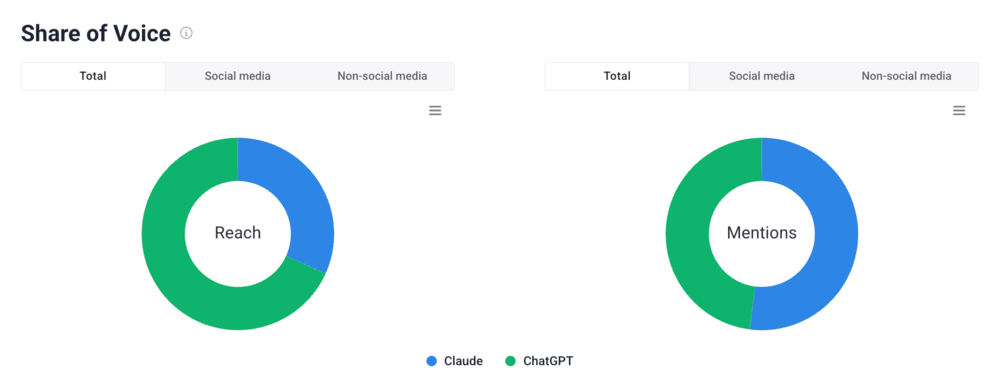
Share of voice in SEO
SEO share of voice measures your brand’s search visibility as a % of total visibility for a defined keyword set.
To measure it, you need an SEO tool (like Ahrefs or Semrush) that tracks keyword rankings across your brand and your competitors. I use Ahrefs for this on a weekly basis, and the steps are really simple:
- 1 Define your keyword set (the topics where you compete for search visibility).
- 2 Set up a rank tracker for your brand and add your main competitors.
- 3 The tool compares your visibility (based on rankings, click-through rate estimates, and search volume) to the total available visibility across all competitors.
💡 My tip:
What I find most useful about share of voice SEO is that it gives you a warning signal before traffic numbers confirm a trend. If your SEO share is dropping, it’s time to act!
Share of voice in PR
PR share of voice is one of the brand metrics that shows how much earned media attention your brand gets in your industry compared to your competitors.
Honestly, this is the trickiest SOV to calculate manually! You’d need to:
- track every piece of coverage,
- estimate each outlet’s reach,
- and compare across the whole industry
… and all this for your brand and all your competitors simultaneously.
A media monitoring tool handles this automatically. For example, Brand24 aggregates mentions from news sites, blogs, newsletters, and social platforms, and calculates your share of the total conversation.
💡 My tip:
I’d suggest calculating PR share of voice around your campaigns: measure a baseline for 2–4 weeks before launch, then compare it to the results during and after. That side-by-side view is usually the easiest way to show PR ROI to stakeholders!
Share of voice in advertising
PPC (pay-per-click) share of voice measures how often your ads appear compared to total available impressions for your target keywords.
PPC share of voice formula:
PPC Share of Voice = (Your Brand Advertising ÷ Total Market Advertising) × 100
Google Ads refers to this metric as Impression Share, and you can see it right in your Google Ads dashboard. If your Impression Share drops below 70%, it usually means you’re losing paid visibility to competitors.
To calculate PPC SOV manually, you need:
- 1 A list of target keywords (yours and competitors')
- 2 Your total ad spend and estimated market ad spend
- 3 CTR (click-through rate) data from Google Analytics or your ad platform
Most SEO and PPC tools calculate this automatically and track it over time, which is way more useful than one-time snapshots.
How do marketers discuss share of voice? [2026 study]
To understand how practitioners and marketers are talking about share of voice in 2026, I used Brand24’s AI Brand Assistant to analyze 5,699 online mentions about share of voice in social and non-social sources, covering the period June 16 – July 16, 2026.
Let’s see what the data shows!
How big is the conversation around SOV?
The “share of voice” topic generated 5,699 total mentions with a combined reach of 10.0M. Most of the discussion is just informational (93.8% neutral sentiment), which isn’t surprising for a metrics-heavy topic. Positive mentions make up 4.9%, while negative mentions are only 1.3%.
Top hashtags in the share of voice mentions:
| Hashtag | Mention volume |
|---|---|
| #geo | 54 |
| #aisearch | 46 |
| #aeo | 43 |
| #seo | 35 |
| #digitalmarketing | 33 |
| #chatgpt | 29 |
In my opinion, the hashtag picture is striking! #geo, #aisearch, and #aeo together outpace #seo, and it’s a clear signal that the share of voice conversation has moved toward AI-native metrics.
What emotions are present in the share of voice discussions?
| Emotion | Share |
|---|---|
| Trust | 34.7% |
| Joy | 20.8% |
| Anticipation | 19.9% |
| Distrust | 13.6% |
| Anger | 3.8% |
Trust is the leading emotion here, so SOV is mostly discussed as a credible and reliable metric.
The 13.6% Distrust comes from skepticism about new AI share of voice interpretations (when I looked at mentions, I found an active Reddit thread debating whether AI share of voice is a “real metric or just noise”).
And about 1 in 5 marketers shows anticipation, which points to real excitement about where these share of voice metrics are going!
What do marketers talk about when they mention share of voice?
When analyzing the discussion, I noticed something very interesting: the online conversation clearly splits into two groups, “traditional” marketing SOV and AI-focused SOV.
A quick comparison table:
| Metric | Share of voice in AI search | Traditional marketing share of voice |
|---|---|---|
| Mention volume | 4,683 | 1,358 |
| Reach | 7.3M | 3.4M |
| Positive sentiment | 4.4% | 6.6% |
| Negative sentiment | 0.9% | 2.4% |
The AI-focused conversation is 3.4× larger by volume and 2.2× larger by reach. However, traditional SOV carries a higher positive rate (6.6% vs. 4.4%), suggesting that marketers talking about it are more emotionally invested. It also has a higher negative rate, reflecting the longer history of frustrations and debates around traditional SOV measurement.
AI-related conversations are 3.4× bigger in volume and 2.2× bigger in reach.
On the other hand, traditional share of voice has a higher share of positive sentiment (6.6% vs. 4.4%), which suggests marketers discussing it feel more emotionally invested.
It also gets more negative mentions, reflecting the longer history of frustrations and debates around its measurement.
Traditional share of voice topics
Traditional share of voice discussions center on the core ways this metric has been used for years:
- brand and media measurement,
- competitive intelligence,
- campaign ROI.
Examples of real mentions from the conversation:
- “This is 100% accurate. SOV, like most vanity metrics, is all noise and no signal unless you’re looking at a much longer timeline. Even then, limited utility without a qualitative assessment of the coverage.”
- “Yes to Share of Voice. More of us should be looking at this.”
- “The global football tournament 26 is the ultimate marketing arena, but who is actually winning the battle for global share of voice? With 3.3M+ total mentions and a mind-blowing 3.76T+ potential impressions generated across the entire tournament conversation so far…”
Share of voice in AI search topics
The AI-focused conversation centers on two questions:
- how often does your brand appear in AI chatbot responses?
- and how do you grow that visibility?
Examples of real mentions from the conversation:
- “Been diving into AI Share of Voice for a few months now. Concept makes total sense — track how often your brand gets cited or mentioned in ChatGPT, Gemini, Perplexity responses vs. competitors. But the data is flaky as hell… run the same prompt five times and get different results.”
- “Yeah, the ‘run same prompt 5x, get 5 different answers’ thing is why I treat AI SOV as directional, not a KPI. For clients we fix as many variables as possible: locked prompt sets per use case, fixed model versions, scheduled runs, then average over time and look at trends vs. absolutes.”
- “Someone hands you a benchmark for what a healthy Attributed Share of Voice looks like. ASOV is a real metric and worth running.”
- “Track AI share of voice, answer engine mentions, citation sources, sentiment accuracy, competitor inclusion and conversion paths.”
Industries most actively discussing share of voice
| Industry | Share of Voice | What do people discuss? |
|---|---|---|
| AI / Tech / SaaS | 60.3% | LLM citation tracking, GEO/AEO optimization |
| Marketing / PR | 15.5% | SOV as a core retainer KPI, proving campaign ROI |
| Fashion / Entertainment | 10.3% | Event-driven SOV scoring for celebrities and designers |
| Sports / Sponsorship | 6.9% | Tournament SOV battles, ambush marketing |
| Healthcare / Pharma | 3.4% | TV ad impression SOV + AI disruption of HCP outreach |
| E-commerce / Retail | 2.2% | Platform shelf visibility (Amazon, Walmart) |
| OOH / DOOH | 1.2% | Guaranteed SOV as a purchasable media unit |
How to increase share of voice [+ Success stories]
Once you know your SOV, the question becomes: how do you grow it?
I’ve gathered the strategies I see working consistently, and backed each one with real Brand24 customer results, because “publish more content” advice isn’t useful without proof!
01 Build a social media presence that earns brand mentions
It may sound obvious, but it’s so true: share of voice in social media grows when you show up consistently and engage with your audience, not just when you post a lot.
Action points
- 1 Spend your time on the platforms your audience actually uses
- 2 Publish content with a steady schedule
- 3 Respond to people's mentions so it feels like a real, natural conversation with a genuine human
Sprout Social’s 2026 data found that 71% of consumers are more likely to buy from brands they recognize on social media, and recognition is built through repetition and genuine interaction.
And McKinsey data shows 34% of Gen Z say social media plays a key role in purchase decisions, vs. 16% of boomers. If your audience is younger, measuring share of voice in social media can’t be optional!
Real-world success story:
Uber used a social listening tool, Brand24, to monitor and respond to mentions across markets. Within two days of a single campaign launch, online discussion about Uber increased 100% (from approximately 8–9k mentions to 16–22k) with a direct 11% increase in new users.
02 Create content that gets shared and cited
Share of voice and social media presence grow when people share and reference your content.
Here’s a trend worth keeping on your radar: Adobe research found that 1 in 10 marketers say trend-based content has driven referrals through ChatGPT or other LLMs.
In simple words, publishing timely, relevant content can directly help boost your AI share of voice.
Action points
- 1 For traditional SOV, that means investing in content strategy that earns organic shares.
- 2 For AI SOV, it means publishing content that LLMs are likely to cite: original research, expert-authored pieces, and content with specific data points.

Real success story:
eRecruiter used Brand24, one of media monitoring tools, to check which content topics were generating the most conversation.
By consistently publishing and responding in their topic area, they achieved a 10% year-over-year increase in mentions vs. 2024, with steadily rising visibility treated as a measurable KPI.
03 Engage in every mention
Share of voice grows fastest when brands engage with their community rather than just posting.
Action points
- 1 Reply to every mention of your brand
- 2 Acknowledge every comment (e.g. even with a like or replying with a relevant emoji)
- 3 Join conversations that your audience treat as important (here, social listening tools help a lot!)
Sprout Social data shows that 73% of social users say they’ll buy from a competitor if a brand doesn’t respond on social. Engagement is not just good PR but a direct driver of your share of conversation!
Real-world success:
MailerLite used Brand24 to proactively engage with every brand mention rather than just monitoring. In a single Black Friday campaign, their brand visibility rose by 20% and social media reach grew by 169%, with engagement data used to prove ROI to stakeholders.
04 Monitor competitors to find gaps in share of voice
One of the quickest ways to boost your SOV is to find topics where your competitors are showing up and you’re not, and then jump into those conversations and show up with real authority.
Real case study:
Appwrite’s content team uses the Topic Analysis feature available in Brand24, one of the media monitoring tools, to monitor competitor projects and identify which subjects generate the most audience engagement.
When a topic appears across competitors’ platforms:
This approach lets small teams achieve higher visibility by focusing content investment where it most improves share of voice.
05 Build AI visibility along with the traditional share of voice
In 2026, growing your share of voice means showing up in search results, social feeds but also in AI-generated responses.
The quickest way to make that happen is to get your brand mentioned in the sources LLMs rely on most:
- editorial coverage,
- industry publications,
- high-authority review sites,
- and social platforms.
Real-world result:
Viessmann’s experience is a great example!
After using Chatbeat to map their share of voice in AI search by topic, they focused on conversations where AI models didn’t have a “clear champion” and jumped in as the go-to expert.
The result was a 10+ percentage point improvement in AI Share of Voice, with 3 of their 5 monitored projects showing clear, systematic improvement.
06 Become a named voice in your industry
Industry authority makes every other share of voice tactic work harder.
When your brand leaders (e.g., your CEO, your in-house experts, or your senior team members) are regularly quoted, cited, and mentioned in industry conversations, your share of voice grows way faster than any paid campaign could do this.
Edelman’s 2026 Trust Barometer found that 70% of consumers worldwide are unsure about or completely unwilling to trust information from organizations that don’t clearly and actively share their values.
That’s why thought leadership (like executives who speak honestly, take a stand, and show up consistently) is one of the most effective ways to bridge the trust gap at scale.
A real example:
Brand24’s CEO, Michał Sadowski, has built one of the most recognized personal brands in marketing in Poland through years of consistent social media activity.
Besides a strong personal reputation, Brand24 also benefits anytime he’s mentioned online, boosting the brand’s share of voice with every reference.
Best share of voice tools
I’ve tested or worked with all of these. Here’s what I’d recommend depending on your use case and budget:
“Traditional” share of voice software
| Tool | Best for | Sources covered | Pricing |
|---|---|---|---|
| Brand24 | Brands that want real-time share of voice + sentiment + AI tracking in one platform | Social media, news, blogs, review sites, podcasts, newsletters, forums and communities, video platforms | From $199/mo |
| Brandwatch | Enterprise teams with large budgets and dedicated analysts | Social, news, forums, blogs | On request |
| Talkwalker | Large agencies and global brand teams | Social, news, blogs, TV/radio | From $9,600/yr |
| Sprout Social | Teams managing social publishing + listening in one tool | Major social platforms | From $249/mo |
Best share of voice tools for AI Search
Tracking AI share of voice is a relatively new territory, and the tooling is still evolving quickly. Here’s where things stand:
| Tool | What it tracks | Best for | Pricing |
|---|---|---|---|
| Chatbeat | Brand mentions in LLM responses, AI sentiment, competitor AI visibility, trends over time | Brands wanting AI SOV + traditional SOV in one platform | From $199/mo |
| Semrush | Google AI Overview appearances for tracked keywords | SEO teams already using Semrush | From $139/mo |
| Ahrefs | Google AI Overview visibility for keyword sets | SEO teams already using Ahrefs | From $129/mo |
| Rankability | LLM citation tracking across ChatGPT, Perplexity, Gemini | Teams focused specifically on GEO/AEO | On request |
FAQ
Share of Voice (SOV) is a marketing metric that measures how much of the total conversation or visibility in a market your brand owns compared to competitors, expressed as a percentage. SOV can be measured across social media, search, PR/media coverage, advertising, and AI search responses.
Use the share of voice formula: SOV = (Your Brand Metrics ÷ Total Market Metrics) × 100.
Your brand metrics can be mentions, impressions, ad spend, keyword rankings, or clicks — depending on the channel.
Total market metrics are the sum of the same measure across all brands in your competitive set.
Most social listening tools (like Brand24) and SEO platforms automatically calculate SOV.
To measure share of voice, you need to track your brand’s visibility against competitors:
- For social media SOV, use a media monitoring tool like Brand24 that collects mentions across online sources.
- For SEO SOV, use an SEO tool to compare keyword visibility.
- For PPC SOV, check your Impression Share in Google Ads.
- For AI share of voice, use tools like Chatbeat or Brand24’s AI Brand Assistant to see how often your brand is cited in LLM-generated responses.
To increase share of voice, maintain a consistent, engaged social presence; publish content that drives organic sharing and LLM citations; respond to every brand mention to increase conversation volume; track competitors for topic gaps and join missing conversations; and earn citations in high-quality editorial sources to build AI search authority.
A “good” share of voice depends on market size and competition. In crowded markets, 20–30% is strong; in niches with 3–4 competitors, under 25% can signal underperformance. The best benchmark is SOV vs. market share: higher SOV suggests growth, lower SOV signals rising visibility risk.
Social media share of voice equals your brand’s mentions (or engagements/reach) divided by total mentions for all brands in your competitive set, multiplied by 100. Use a social listening tool to track your brand and competitors; most of them auto-calculate SOV across platforms.
The best tools for measuring share of voice are: Brand24 (social listening + AI SOV, 14-day free trial), Brandwatch (enterprise-level, no public pricing), Talkwalker (from $9,600/year), Sprout Social (social management with listening features), Ahrefs and Semrush (for SEO share of voice and AI Overview tracking). For AI-specific share of voice, Chatbeat or Brand24’s AI Brand Assistant are the most comprehensive options currently available.
AI share of voice tracks how often your brand is cited or recommended by tools like ChatGPT, Google AI Overviews, Gemini, and Perplexity, compared to competitors. Measure it with standardized prompts, tracking mentions, prominence, and sentiment over time. Tools like Chatbeat automate queries and summarize competitive visibility data.
PR share of voice measures the percentage of earned media coverage in your industry that your brand receives, compared to all other brands in your competitive set. It is used to measure campaign impact, track competitive media presence, and prove communications ROI.
To track share of voice, use a media monitoring tool that continuously analyzes it, not just on demand. For example, Brand24 measures real-time mentions across social, news, blogs, podcasts, and AI search. Set up brand and competitor projects, review weekly/monthly, and watch for sudden SOV drops or sustained growth above market share.


