Table of contents
2M Marketers

Every time someone writes about your brand in a news article, Reddit thread, or blog post, that’s a media mention, and most of them won’t tag you, notify you, or link back to your site. If you’re not tracking them, you won’t know they happened, good or bad, and won’t be able to take advantage of them.
This guide breaks down what media mentions are, the KPIs that prove whether they’re helping or hurting your brand, and exactly how to track, analyze, and act on them in 2026.
Key takeaways
-
Media mentions are any reference to your brand across the web
Whether it's a news article, a Reddit thread, a podcast transcript, or a tweet without a tag, every mention shapes how people perceive your brand. Most of them happen without notifying you.
-
Untagged mentions are where the real conversations happen
The majority of online discussions about brands don't use @handles or official hashtags. If you're only tracking tagged mentions, you're missing most of what's being said.
-
Tracking media mentions protects your reputation in real time
Negative press or a viral complaint can escalate fast. Monitoring tools alert you to spikes in mentions so you can respond before a small issue becomes a PR crisis.
-
Sentiment analysis turns mention volume into actionable insight
Knowing you received 10,000 mentions means little without context. Sentiment scoring tells you whether that coverage is helping or hurting, and where to focus your response.
-
Google Alerts is free but very limited
It covers some news sources and blogs, but misses social media, forums, podcasts, and paywalled content. For complete coverage, a dedicated media monitoring tool is the practical choice.
-
In 2026, media mentions directly impact your SEO and AEO
Unlinked brand mentions are an E-E-A-T signal. The more authoritative sources reference your brand, the more trust search engines attribute to you, even without a backlink.
What are media mentions?
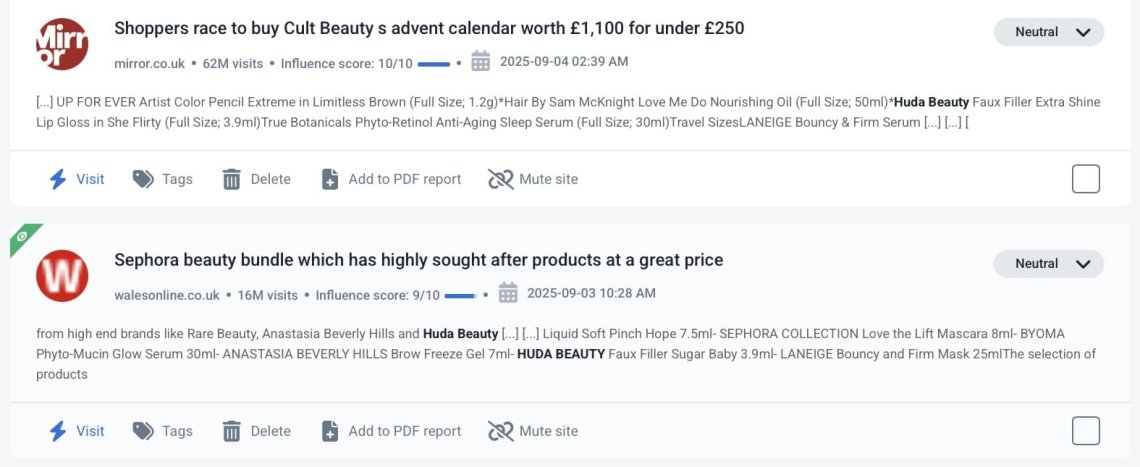
Media mentions are when your brand, product, or industry topic is discussed in different media types. This includes online places like social media, blogs, websites, podcasts, or review sites.
Here you have an example of untagged media mentions:
But why are these online mentions important?
Well, they can completely change how people see your brand.
Media mentions can completely change how people perceive your brand:
- Positive references build popularity, authority, and social proof.
- Negative references require quick action to protect reputation.
- References about competitors or your market provide valuable insights for positioning and strategy.
Tracking mentions, especially social media mentions, is key to understanding where your brand stands in the media.
Benefits of tracking media mentions:
01 Reputation management and crisis prevention.
Most PR crises don’t appear out of nowhere, they start as a single negative post that gets shared, then picked up by a journalist, then amplified. Tracking media mentions in real time means you see the problem at the single-post stage, not after it’s already trending.
💡 Example: Piwik PRO’s PR team uses this exact approach: mention-level monitoring feeds directly into their reputation management and media relationship building, letting them catch issues before they need a crisis response (case study).
02 Brand awareness and SEO.
Every mention of your brand across news sites, blogs, and review platforms builds your digital footprint. Even unlinked mentions contribute to your search visibility – Google treats them as E-E-A-T signals, indicators that real people and real publications are talking about you. The more authoritative sources that reference your brand, the stronger your domain authority case becomes over time.
💡 Example: When Uber tracked a single app rollout through social listening, they measured a 24% increase in social media engagement, an 11% increase in new users, and a 7% increase in average rides per user in the following weeks (case study).
eRecruiter took the slower, steadier route: consistent monitoring helped them grow mentions 10% year-over-year and turn visibility into a KPI they actively manage (case study).
03 Audience intelligence and influencer discovery.
What people say about you when they’re not talking to you is the most honest market research available. Media mentions reveal which features your customers actually care about, how they describe your product in their own words, and where confusion or frustration tends to cluster.
💡 Example: Neon Panda uses this to stay ahead of shifting trends in their market rather than reacting after competitors already have (case study).
- Competitive intelligence and market trends.
Your competitors’ mentions are as valuable as your own. Tracking what people say about competing products tells you where their customers are frustrated, which features they’re praising, and how their brand narrative is shifting.
💡 Example: XTB runs dedicated monitoring projects around industry keywords like “forex” and “online trading” to spot which topics are gaining traction in their market before building content or campaigns around them (case study).
How to track media mentions?
There are two approaches to tracking media mentions: free tools with limited coverage and dedicated monitoring platforms that cover everything.
Which one makes sense depends on what you actually need to know.
So, which is the best solution for you?
01 Manual tracking (free, time-consuming)
Social media mentions can be tracked within the apps by counting the notifications.
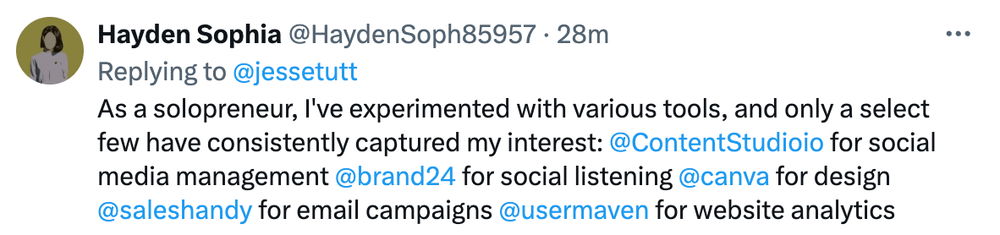
But that’s extremely time-consuming and doesn’t give you much information about your overall brand awareness.
You’ll have no idea about what’s being said about your brand on forums, podcasts, and many more.
And imagine someone wanted to share feedback but made a typo and didn’t tag you – you won’t notice that, too.
If you want to stay fully free, most platforms give you a manual way to search for untagged mentions:
- X (Twitter): use Advanced Search with your brand name in quotes, filtered by date and excluding your own account, to catch mentions that don’t use @handles.
- Instagram and TikTok: search your brand name directly in the app’s search bar – this surfaces Reels, Stories captions, and comments that reference you without a tag.
- Reddit: search your brand name site-wide (not just in your industry’s subreddits). Brand complaints and comparisons often surface in unrelated communities first.
- Google Alerts: covers the news and blog side of “free,” which is why it’s worth pairing with the manual searches above (see the next section).
But the thing is, none of these scales. The moment you’re checking more than one or two keywords across four or five platforms, manual search stops being “free” and starts costing you hours every week.
Ralecon is a great example of it – before switching to a dedicated tool, their online reputation research took two full weeks; with Brand24 running the same searches continuously, it takes two hours (case study).
Lucky us, there are social listening tools that can do that hard work for us.

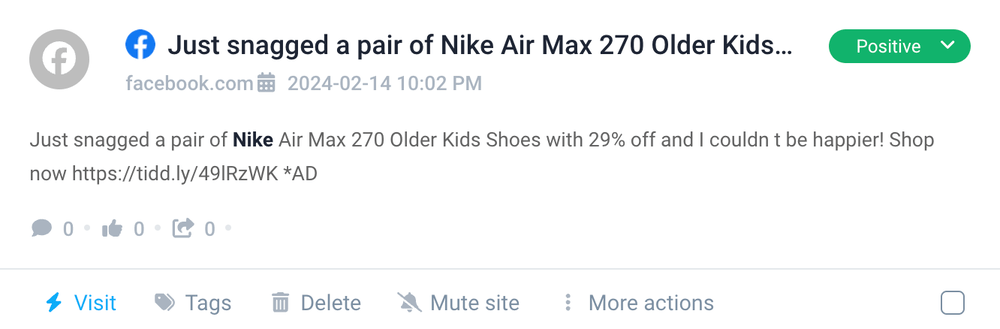
For example, advanced media monitoring tools can track online mentions (even those not tagged directly). This is what an untagged mention looks like in the dashboard:
02 Google Alerts (free, limited)
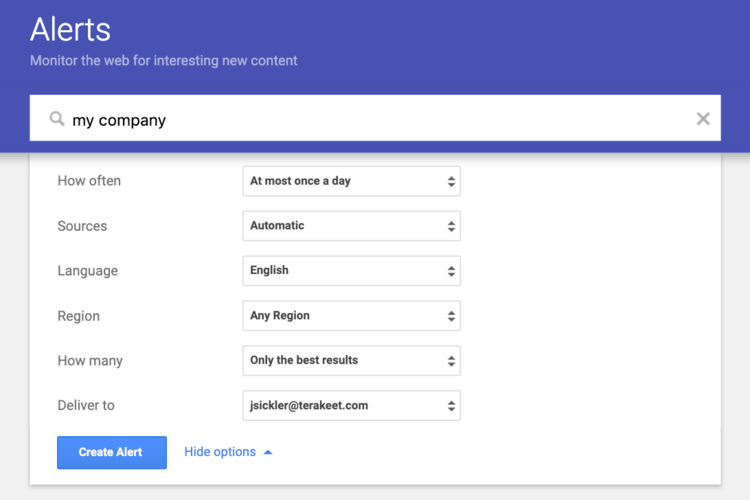
This is a popular choice for tracking media mentions, especially if the company has a limited budget. This free media mentions tool is attractive due to its simplicity.
Sadly, it has many limitations.
The main problem is the lack of coverage. You might only see a fraction of the conversations about your brand, as the tool doesn’t have the ability to search all platforms.
This leads to a lack of context and detail in the data gathered.
Plus, people admit they find it inconsistent in capturing mentions. Many relevant discussions and references might slip through unnoticed, leaving gaps in your monitoring.
But, setup takes two minutes:
- Go to [google.com/alerts]
- Enter your brand name
- Set frequency to “As it happens” for real-time alerts
- Choose “All results” under Sources to maximize coverage
- Add your CEO’s name, product names, and main competitors as separate alerts
As a result, after trying out a free solution like Google Alerts, many PR professionals and businesses ultimately turn to more sophisticated solutions.
Further read: Google Alerts Alternatives: A Detailed Comparison for 2026
03 Real-time media mention tracking (using a media monitoring tool)
One of the most reliable ways to track media mentions in 2026 is by using AI tools to monitor online conversations and brand reputation.
For example, Brand24 scans social media, news sites, blogs, forums, podcasts, review sites, and AI platforms like ChatGPT and Perplexity in real time.
Here’s how to set it up:
Step 1: Create a project
Log into Brand24 and click Add new project. Name it after your brand or the topic you want to monitor. You can run multiple projects simultaneously, one for your brand, one for competitors, one for industry terms.
Step 2: Add your keywords
Enter your brand name as the main keyword (Brand24 will automatically track variations). Add secondary keywords for your products, your CEO’s name, or relevant industry terms.
Step 3: Exclude noise
Use the Excluded keywords field to filter out irrelevant results. If your brand name is a common word, this step significantly reduces false positives.
Step 4: Set up notifications
Configure email digests (daily or weekly) and real-time Slack alerts for high-reach mentions or sudden volume spikes. This is especially useful for catching PR crises early.
Step 5: Review your dashboard
Your dashboard shows incoming mentions in real time, organized by source, sentiment, and reach. The Storm Alert feature notifies you when mention volume spikes unusually, either a PR win or a developing crisis.
Once your project is running (Steps 1–5 above), two settings make the difference:
- Set your notification frequency to instant, not daily/weekly, for the keywords you can’t afford to miss (your brand name, your CEO’s name, active campaign hashtags).
- Turn on Storm Alert. It flags unusual spikes in mention volume the moment they start, which is what lets you catch a viral complaint or a sudden wave of positive coverage while it’s still small enough to act on.
This applies the same way across every social platform – Instagram, X, TikTok, Facebook, Reddit, LinkedIn, Pinterest, and YouTube. So, you’re not switching between five apps to know what’s happening on your brand right now.
But, it only collects public mentions, not private groups or profiles, but this still covers the majority of conversations that shape your brand’s reputation.
This makes it easier to monitor social media performance, manage reputation, and keep track of competitors—all within a single dashboard.
With all this data in a single dashboard, businesses can:
- Monitor social media performance in real time
- Track key media metrics, such as customer engagement and share of voice.
- Receive email alerts for brand mentions and respond instantly.
- Generate fresh content ideas based on AI insights and online conversations.
- Manage online reputation more effectively with AI-driven sentiment analysis.
- Track competitors with precision and discover market opportunities.
And a bit more about the two features I find especially useful for mention monitoring:
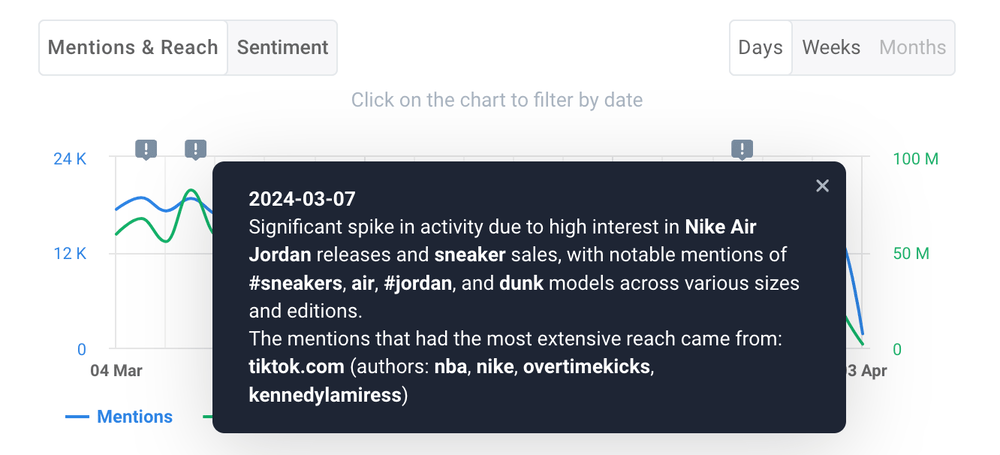
- AI Event detector: It shows when there’s a sudden change in how often your brand is mentioned.
This is a valuable feature for brand reputation, as you can quickly find out about potential problems.
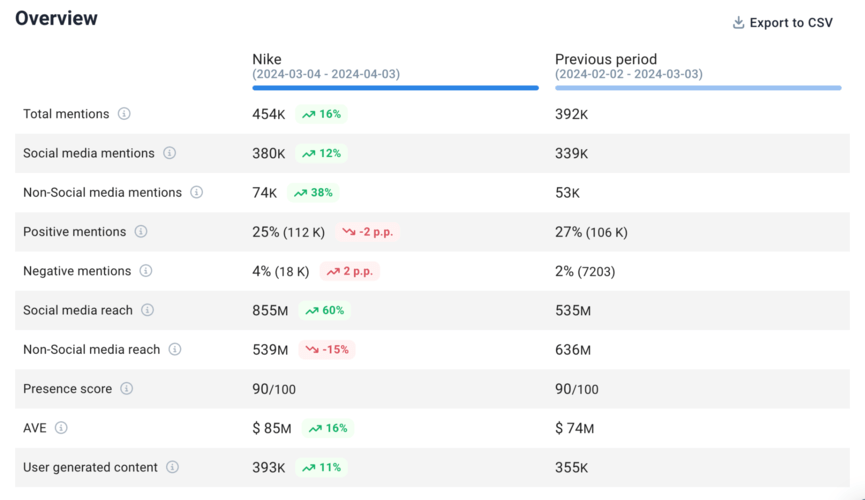
- Comparison tab: Lets you compare different times or even check out what competitors are doing. This is helpful for seeing how your brand is doing over a given period of time or compared to others.
Which sources does Brand24 monitor?
Brand24 covers over 25 million online sources, including:
- Social media: X (Twitter), Instagram, Facebook, LinkedIn, TikTok, YouTube, Reddit, Pinterest, Twitch
- News and media: Online news sites, press releases, industry publications
- Blogs and websites: WordPress, Medium, personal blogs, review sites (Trustpilot, G2, Capterra)
- Podcasts: Audio mentions transcribed and indexed
- Forums: Reddit, Quora, niche community forums
- AI platforms: ChatGPT, Gemini, Claude — Brand24 tracks whether your brand appears in AI-generated responses
A note on print and broadcast: Brand24’s core coverage is digital: online news, blogs, forums, podcasts, social platforms, and AI-generated answers. TV and radio segments and print-only newspaper coverage aren’t part of that 25M+ source count unless the outlet also republishes the piece online (which most do).
How to monitor competitor media mentions?
Set up a second Brand24 project using your competitor’s brand name, product names, and executive names as keywords. The same way you configured your own project in Step 2.
This gives you an independent read on their mention volume, sentiment, and top sources, without relying on their own marketing claims.
Use the Comparison tab explained above to put your project and a competitor’s project side by side over the same time window.
This is the fastest way to answer questions like “did our launch generate more coverage than theirs did?” or “is their sentiment trending down while ours holds steady?”
XTB uses this exact setup to track which topics are gaining traction across the online trading category before competitors capitalize on them (case study).
How to export media mentions into a report?
Filter your mentions by date range, source, or sentiment inside your project, then export the results as a PDF or CSV, or push them straight into a live, shareable dashboard.
A monthly or quarterly PR report typically needs four things: total mention volume, the sentiment split (positive/negative/neutral), reach, and your top five sources by mention count or influence score.
For a full guide of what to include and how to structure it for stakeholders, see How to Write a Media Monitoring Report.
Media mentions: Tools comparison
| Tool | Social media coverage | News & blogs | Reddit & forums | Podcasts | AI platforms | Sentiment analysis | Real-time alerts | Influencer detection and analysis | Competitor tracking |
|---|---|---|---|---|---|---|---|---|---|
|
✅ Full |
✅ |
✅ |
✅ |
✅ |
✅ AI-powered |
✅ |
✅ |
✅ |
|
|
❌ None |
✅ Limited |
❌ |
❌ |
❌ |
❌ |
✅ |
❌ |
✅ Limited |
|
|
✅ Full |
✅ |
⚠️ Limited |
⚠️ Limited |
⚠️ Limited |
✅ |
✅ |
⚠️ Limited |
✅ |
|
|
✅ Full |
✅ |
✅ |
✅ |
⚠️ Limited |
✅ AI-powered |
✅ |
✅ |
✅ |
|
|
✅ Full |
✅ |
✅ |
✅ |
⚠️ Limited |
✅ AI-powered |
✅ |
✅ |
✅ |
The shortcut:
- Google Alerts is the right tool if you have zero budget and only need basic news coverage.
- Mention is a reasonable step up if you want dedicated social and news monitoring without enterprise pricing.
- Meltwater and Talkwalker make sense at enterprise scale – global-language coverage, dedicated broadcast and print monitoring, and budgets to match.
- Choose Brand24 for comprehensive social, news, forum, podcast, and AI platform coverage with ready AI-based analysis.
How to measure media mentions? – Key metrics and KPIs
Mention volume alone tells you almost nothing. To actually measure whether your media mentions are working for you, track five numbers:
- Total mention volume – the raw count of mentions in a given period. Useful as a baseline, meaningless without the metrics below attached to it.
- Share of Voice (SOV) – your mention volume as a percentage of total category mentions (yours + your competitors’).
Formula: (your brand mentions ÷ total market mentions) × 100.
This is the number that tells you whether you’re actually winning the conversation, not just generating noise.
Read more here: Share of Voice: Definition, Calculation, Tools. - Reach and impressions – how many people could plausibly have seen the mentions, based on the audience size of the accounts and outlets involved. This is what separates a mention in a major publication from one on a personal blog with twelve readers.
- Sentiment ratio – the split between positive, negative, and neutral mentions. Ten thousand mentions with 80% negative sentiment is a crisis; the same volume at 80% positive is a campaign win.
- Engagement rate – likes, shares, comments, and replies generated per mention, which shows whether people are just seeing your brand mentioned or actually reacting to it.
+ A note on AVE and EMV:
- Advertising Value Equivalency (AVE) is pricing a mention as if it were paid ad space. It is the oldest way PR teams tried to put a dollar figure on coverage, but it’s been widely discredited because it ignores sentiment (a scathing review and a glowing one get the same “value” if they’re the same size).
- Earned Media Value (EMV) tries to fix this by factoring in engagement and estimated reach, but it’s still a proxy, not a real financial figure. Most PR and marketing teams today track the five metrics above directly instead of collapsing everything into one dollar amount.
How to analyze media mentions to gain insights?
Collecting mentions is the easy part. The value is in what you do with them.
Here are the four analysis moves that turn raw mention data into something actionable:
1. Track sentiment over time
Mention volume tells you how much people are talking about you. Sentiment tells you whether that conversation is helping or hurting your brand.
The two metrics often diverge: a product launch might generate high volume and positive sentiment, while a customer service failure generates high volume and negative sentiment… the number looks the same, the situation is completely different.
In Brand24, the Sentiment tab breaks down mentions into positive, negative, and neutral, and shows how that ratio changes day by day. Look for:
- Sudden drops in positive sentiment (early warning of a problem)
- Spikes in negative sentiment tied to a specific source (a critical review, a viral complaint)
- Changes in sentiment following a specific campaign or announcement
2. Identify your most valuable mentions by reach
Not all mentions carry equal weight.
A mention in TechCrunch or a tweet from a journalist with 50,000 followers matters more than a post on a low-traffic blog.
Brand24’s Presence Score and Influencer Score surface these high-value mentions automatically.
When you spot a high-reach positive mention, don’t just note it, but act on it. Reach out to the author, share it, or use it as social proof.
When you spot a high-reach negative mention, respond quickly. The faster you address a visible complaint, the less it compounds.
3. Map mentions to your marketing calendar
Layer your mention data against your campaign calendar, and you get a direct read on what’s working.
Did the PR push in Q3 actually move the needle? Did the product launch generate earned coverage, or did it fall flat?
In Brand24, you can filter mentions by date range and export them, making it easy to build a monthly or quarterly report showing mention volume, sentiment, reach, and top sources for each period.
4. Use AI Topic Analysis to find patterns in large datasets
When you’re monitoring a brand the size of Samsung (700,000+ mentions a month) or tracking an industry keyword rather than a brand name, manual review isn’t feasible.
Brand24’s AI Topic Analysis automatically clusters mentions into themes (customer complaints, product feedback, competitor comparisons, industry news), so you can see at a glance what the conversation is actually about.
This is particularly useful for:
- Product teams: finding recurring feature requests or complaints buried in thousands of mentions
- PR teams: identifying which stories are gaining traction before they go wide
- Competitive intelligence: understanding what customers say about competitors, not just your own brand
What to do when you find a negative mention?
The instinct is often to respond immediately and defensively. That’s rarely the right move.
Instead:
- Assess reach first. A negative comment on a low-traffic forum is different from a critical piece in a major publication. Your response should be proportionate.
- Respond where the mention lives. Don’t ask someone to take a conversation elsewhere – address it in the channel where it happened.
- Acknowledge before explaining. Even if the criticism is unfair, starting with acknowledgment is more effective than starting with a correction.
💪 Case study: Domino’s “Pizza Turnaround”
Instead of defending the product, Domino’s opened its ads with real customer complaints like “worst excuse for pizza I’ve ever had,” crust that “tastes like cardboard” before explaining what it was changing.
That same-quarter honesty was credited with a 14.3% jump in U.S. same-store sales in Q1 2010, the largest quarterly gain in the category at the time. (case study source: Columbia Business School)
How to respond to positive media mentions?
Positive mentions are easy to ignore because they don’t feel urgent.
That’s exactly why most brands under-use them. Three moves turn a good mention into more value than the mention itself:
- Engage publicly, fast. A reply, a share, or a comment on the original post signals to the author (and their audience) that you noticed and appreciated it. This is often what turns a one-off customer into a repeat advocate.
- Ask before you republish. If a mention is strong enough to use as a testimonial, in an ad, or on your site, ask the author for permission first, even if the platform’s terms technically allow reuse.
- Route it to the right team. A positive mention from a journalist is a PR relationship worth nurturing directly; a positive mention from a customer is social proof worth feeding to marketing and sales.
There’s also something really cool called AI Brand Assistant.
You can ask questions about your project, and it gives you answers using your own data. This makes sure you get useful and correct information.
Here, you can see the mentions analysis conducted by Brand Assistant for Huda Beauty:
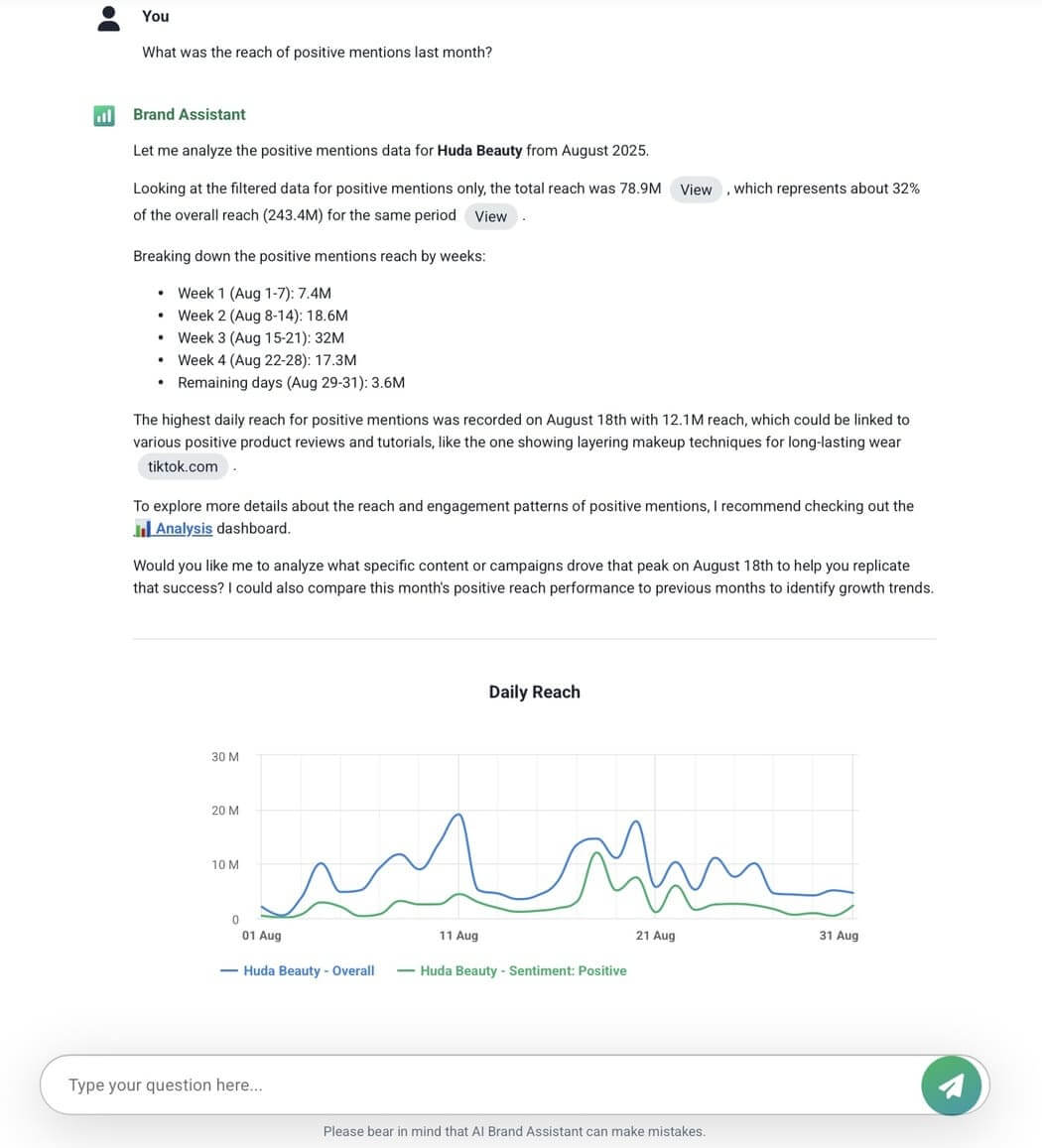
That saves my time and gets straight to the conclusions I need to shape marketing strategy or speed up the marketing reporting process.
How to get more media mentions?
The fastest free way to get more media mentions is pitching journalists directly through a service like HARO (Help a Reporter Out).
It’s a free service, now owned by Featured.com, that emails three digests a day of journalists actively looking for expert sources and quotes. You scan the queries relevant to your industry, pitch a short, specific response, and if a journalist uses it, you usually get named — often with a link back to your site.
Beyond HARO, four tactics consistently generate earned media mentions:
- Issue press releases for anything genuinely newsworthy – funding rounds, product launches, original research, executive hires at a certain level. Distribute through a wire service or directly to journalists who already cover your category.
- Create linkable assets. Original data, surveys, or research (like the metrics breakdown above) give journalists and bloggers a reason to reference you as a source, rather than just mentioning your product.
- Build relationships with the journalists and creators who already cover your space, before you need something from them. A cold pitch to someone who’s never heard of you converts far less often than a warm one to someone who’s covered you before.
- Work with influencers and industry voices whose audience overlaps with your customers, a mention from a credible voice in your niche often carries more weight with that audience than a mention in a general news outlet.
Whichever tactic you use, track the results the same way: set up your brand and campaign keywords in Brand24 before you start outreach, so you can measure the mention volume and sentiment lift the campaign actually produced.


