Table of contents
2M Marketers
Customers ask ChatGPT for suggestions before making a purchase. Is your brand among the responses? AI brand visibility tracking tools can show you: how often your brand is mentioned by AI, how it describes your brand, and which brands it selects instead.
I include the tracking of AI brand visibility in my day-to-day responsibilities, and I know what a difficult task it would be if there weren’t a proper tool available.
You can find in this list the 16 best AI brand visibility tracking tools that I examined in terms of mentions, sentiment, share of voice, prompts, and the sources that AI models used.
Best AI brand visibility tracking tools: shortlist
- Chatbeat: best for ready insights, with Brand Score, share of voice, sentiment and Key Sources in one customizable dashboard
- Brand24: best for teams that want social listening and AI visibility tracking in one place
- Profound: best for agencies running GEO for various clients
- Peec AI: best for agencies tracking many brands and prompt sets
- Semrush: best for SEO teams already working in Semrush
- Ahrefs: best for competitor benchmarking
- Scrunch: best for brands that want to see how AI agents crawl and cite their site
- SE Visible: best for multi-brand reporting
- Similarweb: best for tying AI visibility to traffic
- Otterly: best for low-budget first-timers
- AthenaHQ: best for growth-stage SaaS teams (free tier to start)
- Evertune: best for large brands that need statistically robust data
- Rankscale: best for the widest engine list at the lowest entry price
- Promptwatch: best for city- and state-level AI visibility tracking
- Nightwatch: best for classic rank tracking and AI tracking in one tool
- ZipTie: best for technical GEO audits
AI brand visibility tracking tools: summary
| Tool | Best for | Engines tracked | Entry pricing | Free trial | G2 rating |
|---|---|---|---|---|---|
|
1
|
Brand-level insights in a customizable dashboard |
ChatGPT, Gemini, Claude, Perplexity, DeepSeek, Grok, Copilot, Google AI Overviews, and more |
$99/mo |
14 days |
4.6/5 (359, Brand24 suite) |
|
2
|
Social listening + AI visibility in one account |
ChatGPT, Claude, Gemini, Perplexity, AI Overviews, AI Mode, DeepSeek, Grok, Copilot + social, news, web |
From $99/mo + add-on |
14 days |
4.6/5 (359) |
|
3
|
Enterprise GEO programs |
Up to 9: ChatGPT, Perplexity, Gemini, Copilot, DeepSeek, Claude, AI Overviews, AI Mode, Exa |
Custom (enterprise) |
Demo only |
4.5/5 (1,130) |
|
4
|
Agencies and multi-brand teams |
3 of your choice on self-serve plans; 13+ on Enterprise |
~€89/mo |
7 days |
4.7/5 (21) |
|
5
|
SEO teams on Semrush |
ChatGPT, Gemini, Perplexity, Google AI Overviews and AI Mode |
$99/mo per domain (annual) |
Via Semrush plan |
4.4/5 (4,000+, full suite) |
|
6
|
Market-wide benchmarking |
ChatGPT, Gemini, Perplexity, Copilot, AI Overviews, AI Mode, plus YouTube, Reddit, TikTok |
$199/mo (custom prompts from $50) |
No |
4.5/5 (714, full suite) |
|
7
|
AI agent traffic and page audits |
ChatGPT, Claude, Gemini, Perplexity, Google AI Overviews and AI Mode, Meta AI |
$300/mo ($250 annual) |
7 days |
4.6/5 (73) |
|
Multi-brand reporting, mid budget |
ChatGPT, Gemini, Perplexity, Google AI Overviews and AI Mode |
$99/mo ($79 annual) |
10 days |
Not rated yet |
|
|
AI visibility + referral traffic |
ChatGPT, Perplexity, Gemini, AI Mode |
$99/mo |
Yes |
4.4/5 (1,190, full suite) |
|
|
10
|
Low-budget first-timers |
ChatGPT, Perplexity, Copilot, Google AI Overviews |
$29/mo |
Yes |
4.7/5 (54) |
|
11
|
Growth-stage SaaS |
11 incl. ChatGPT, Claude, Gemini, Perplexity, Copilot, Grok, DeepSeek, Mistral |
Free tier or $295/mo |
Free tier |
4.9/5 (48) |
|
12
|
Statistically robust data for large brands |
11 incl. ChatGPT, Gemini, Claude, Copilot, Perplexity, Meta AI, DeepSeek |
$800/mo |
Demo only |
Not rated yet |
|
13
|
Widest engine list, lowest price |
ChatGPT, Gemini, Perplexity, Claude, DeepSeek, Mistral, Grok, Copilot, and more |
$20/mo |
7 days (Pro plan) |
5.0/5 (2) |
|
14
|
Local (city/state) tracking |
ChatGPT, Perplexity, Google, Claude, Gemini, Meta AI, DeepSeek, Grok |
$95/mo |
7 days |
4.5/5 (18) |
|
15
|
Rank tracking + AI tracking |
ChatGPT, Claude, Gemini, Perplexity, Google AI Overviews and AI Mode |
€79/mo |
14 days |
4.7/5 (64, full suite) |
|
16
|
Technical GEO audits |
ChatGPT, Gemini, Perplexity, Copilot, Bing AI, Google AI Overviews and AI Mode |
$42.75/mo |
7 days |
Not rated yet |
The prices and ratings were checked on the pricing pages and on G2 on September 28, 2026.
Why tracking your brand’s AI visibility matters in 2026?
AI brand visibility is how often, how prominently and in what tone AI models mention your brand when people ask about your category.
Simply said, it’s the AI version of brand monitoring: instead of tracking what people say about you online, you track what AI search engines like ChatGPT, Gemini or Perplexity say about you to millions of people.
- The audience is already in place. By February 2026, ChatGPT had reached 900 million weekly active users.
- Traffic generated by AI is valuable. According to Adobe Analytics, AI referrals to US retail sites increased by 138% from the previous year in May 2026 and converted 54% better than traffic that is not AI.
- The number of people who click through decreases. According to Pew Research, Google users click on a result 8% of the time when an AI Overview is displayed, compared with 15% when it isn’t.
Ranking on page one isn’t enough anymore. If your brand isn’t named inside the AI answer, many people will never see you at all.
Why is a single AI visibility check misleading?
AI answers are not stable.
- SparkToro study included 2,961 runs across ChatGPT and Google AI and found the same list of brands came back in the same order about 1 time in 1,000.
That’s the most important thing to understand before you buy a tool.
Visibility percentage across many runs is worth tracking. A one-time mention in ChatGPT is not.

Which is why effective AI search monitoring should involve repeated runs over time, and why I evaluated each of the tools on this list based on their ability to track brand visibility trends rather than relying on one-off snapshots.

For this list, I looked at what happens inside AI answers, and compared each tool against five brand-tracking criteria:
-
- Repeated querying: Does it re-run prompts over time and show trends?
-
- Engine coverage: Does it track more than one AI platform, ideally ChatGPT, Gemini, Perplexity and Google AI Overviews at minimum?
-
- Brand context: Does it show sentiment, share of voice against named competitors, and how the brand is described?
-
- Sources: Does it show which domains and pages AI models cite, so you know what to fix?
-
- Transparent pricing: Can you see what you’ll pay and how many prompts you get?
AI brand visibility tracking tools: my honest reviews
01 Chatbeat
4.6/5
G2 (359 reviews, full Brand24 suite)
14 days / Free trial
From $99 / Month
Best for: brands and marketing teams that want to know not just whether LLMs mention them, but why, in a dashboard that they can adjust to their own reporting.
Why I picked Chatbeat?
Chatbeat is the tool I open every week to track Brand24’s visibility in AI answers and how my work impacts it.
It’s built around four brand metrics:
- Brand Score (0-100%): combines how often your brand appears in AI answers with how prominently it’s placed, so one number reflects both reach and position.
- Share of Voice: calculated against named competitors, with a first-place mention weighted more than a passing one.
- Sentiment: flags whether the AI described your brand positively, neutrally or negatively.
- Key Sources: lists the specific domains and pages each model draws on for your category.
I make the most use of Key Sources since it converts “our visibility dropped” into “these three competitor articles are being cited instead of ours”, and that gives us something we can act on.
Plus, it gives direction for content creation that drives AI recognition.
Many users highlight the UX friendliness – how the tool suggests prompts and guides through the analysis.
Testimonial from their website:

As an AI visibility tracker, Chatbeat re-runs prompts across ChatGPT, Gemini, Claude, Perplexity, DeepSeek, Grok, Copilot, Google AI Overviews and more. Given how unstable AI answers are, that repetition is what makes the Brand Score worth watching over time.
The dashboard is the most customizable I’ve used; the setup process takes only a few minutes, and the tool comes with ready-made AI insights that summarize the changes, so I no longer have to go through the raw data every Monday.
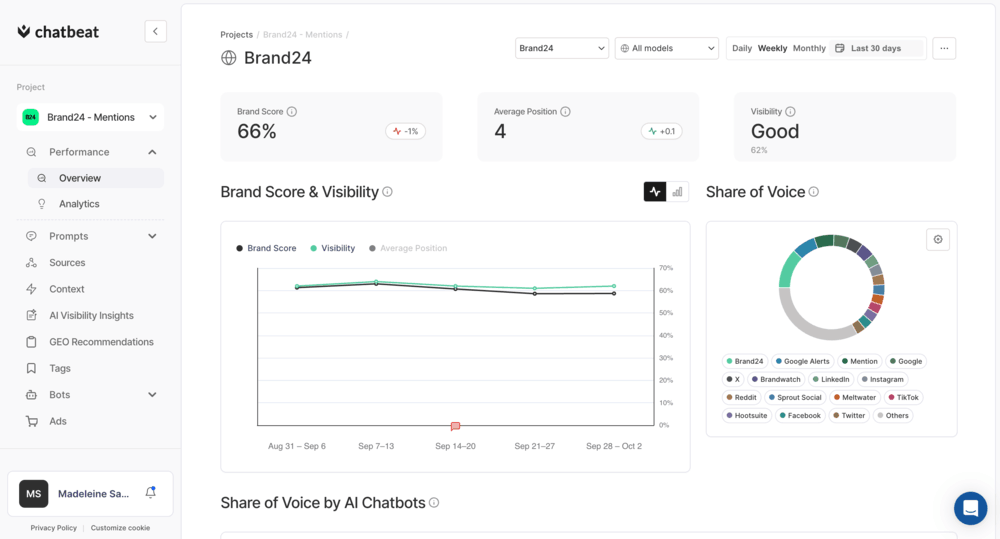
Monitored sources: ChatGPT, Gemini, Claude, Perplexity, DeepSeek, Grok, Copilot, Google AI Overviews, and more
Pros:
- Brand Score combines frequency and prominence into one easy-to-monitor number
- Key Sources shows the exact pages you need to outrank or get featured on
- Share of Voice against key competitors
- GEO Recommendations, an action plan to improve
- Most customizable dashboard I tested, with AI-generated insights
- API access for custom reporting
- 8+ engines, including Grok and DeepSeek
Cons:
- The Essential plan includes 30 prompts and 1 project, which growing teams can quickly outgrow
💡 Pro tip: Chatbeat also works as an add-on inside Brand24 (see #2 below). If you already use Brand24 for social listening, you can see what people say about your brand online and what AI says about it in one account.
02 Brand24
4.6/5
G2 (359 reviews, full Brand24 suite)
14 days / Free trial
From $199 / Month
Why I picked Brand24?
Brand24 is a social listening tool, and with the AI Visibility add-on, it gets an LLM Listening tab that tracks your brand inside AI answers.
You get the Chatbeat metrics (Brand Score, Median Position, Share of Voice, key prompts and key sources) right next to your social, news, blog, forum, podcast and review mentions.
That combination is the reason to choose it.
AI models often draw on Reddit threads, reviews and news articles. Brand24 shows you those conversations as they happen, and the AI Visibility tab shows whether they end up shaping how AI describes your brand.
It’s also useful for reputation protection. If AI starts describing you as “budget-friendly” or claims you only serve one region, you’ll see it in the AI data. Then you can trace it back to the online conversations that may be driving it.
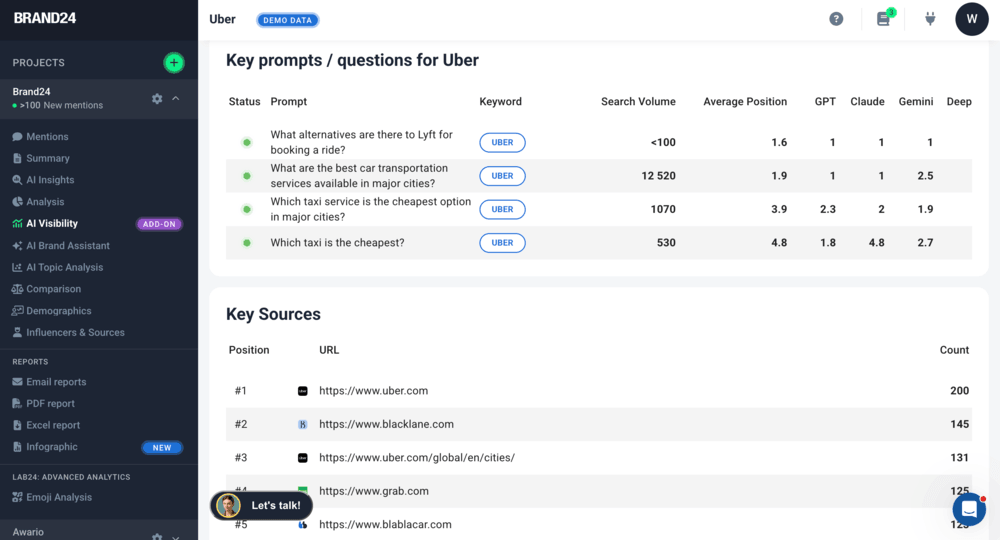
Monitored sources: ChatGPT, Claude, Gemini, Perplexity, Google AI Overviews, Google AI Mode, DeepSeek, Grok, Copilot, plus social media, news, blogs, forums, podcasts and review sites through Brand24
Pros:
- Social listening and AI visibility tracking in one place
- See the online sources that feed AI answers as they’re published
- Brand Score, Position and Share of Voice per chatbot
- Provides API / MCP
Cons:
- The LLM Listening tab isn’t available on trial accounts by default (ask the team via chat to see it)
- The add-on is priced on top of your Brand24 plan
- If you only need AI visibility tracking, standalone Chatbeat is the simpler choice
03 Profound
4.5/5
G2 (1,128 reviews)
No free trial
Custom pricing
Best for: enterprise brands that take GEO very seriously and agencies with multiple clients.
Why I picked Profound?
Profound shows up in almost every AI visibility roundup, and for enterprise brand tracking it earns the spot. It tracks your brand across up to nine answer engines, keeps all-time data history, and lets you export everything via API or CSV/JSON.
My own setup was quick, and the dashboard, in my experience, was easy to navigate.
The reason it is suitable for use in an enterprise environment is all the features relating to the data, specifically SOC 2 compliance, SSO, and AI agents that produce a content brief from a visibility gap without requiring a switch between tools.
Testimonial from their website:

One thing to know before you book a demo: in September 2026, Profound dropped its self-serve Starter and Growth brand plans. If you’re a small team, that puts it out of reach for now.
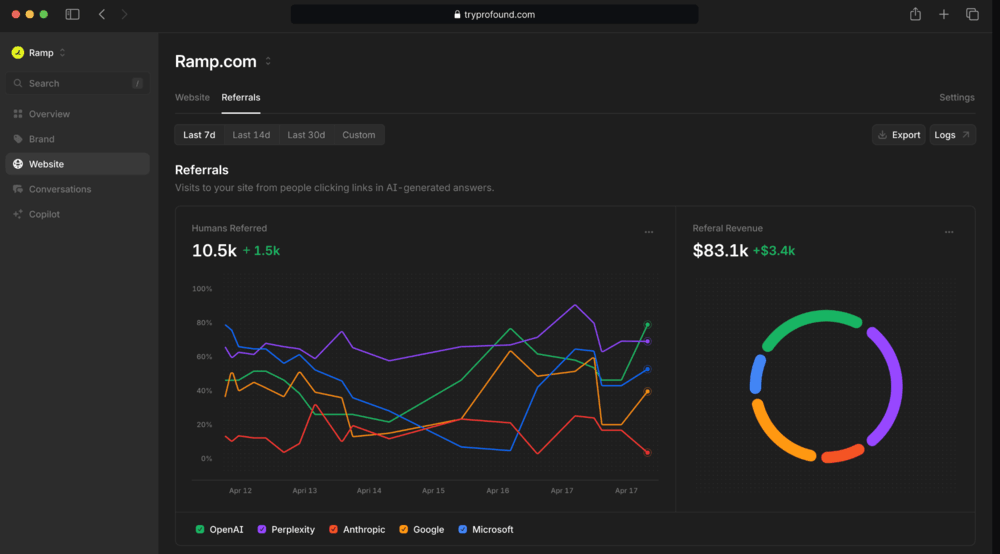
Monitored sources: ChatGPT, Perplexity, Gemini, Copilot, DeepSeek, Claude, Google AI Overviews, Google AI Mode, Exa
Pros:
- Up to 9 engines and all-time data history
- Full API plus CSV/JSON exports
- SOC 2 and SSO for enterprise security reviews
- AI agents that connect visibility gaps to content workflows
Cons:
- No self-serve brand plans since September 2026
- Price is the most common complaint on G2
- More depth than most small teams will use
04 Peec AI
4.8/5
G2 (21 reviews)
Free trial / 7 days
From €89 / Month
Best for: agencies and in-house teams managing several brands or clients.
Why I picked Peec AI?
Peec AI organizes prompts into Pitch Workspaces, so each client or brand gets its own clean space instead of one crowded project list. For agencies, that alone saves hours of filtering before every client call.
Reporting is where Peec shines. There’s a native Looker Studio connector (on the Advanced plan), an MCP integration, unlimited users, and daily tracking, which makes it a solid pick for following competitor visibility over time. In my testing, the reports were among the most polished on this list.
The catch is engine choice: self-serve plans let you pick 3 engines, and Claude is Enterprise-only.
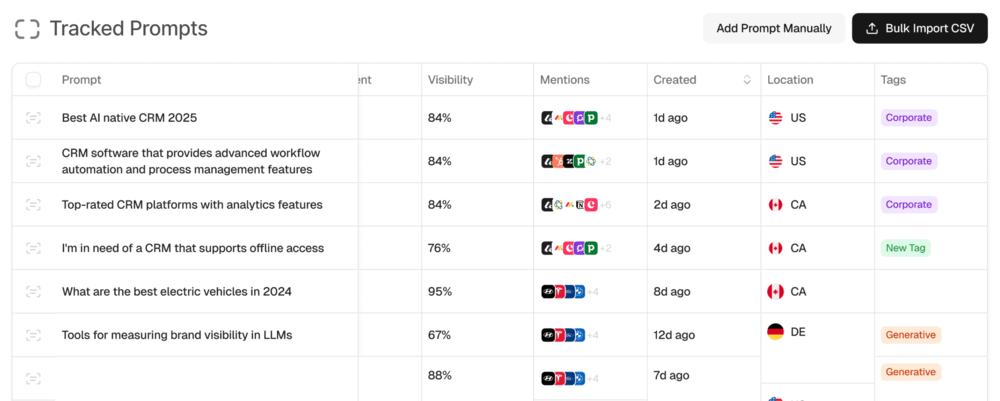
Monitored sources: 3 of your choice from ChatGPT, Google AI Mode, Google AI Overviews, Copilot, Gemini, Grok and Naver AI; 13+ on Enterprise plan
Pros:
- Pitch Workspaces built for multi-client work
- Looker Studio connector and MCP integration
- Unlimited users and daily tracking
- Competitor benchmarking
Cons:
- Only 3 engines on self-serve plans
- Shows the data but offers little guidance on what to do next
- No historical backfill
05 Semrush
4.4/5
G2 (4,034 reviews)
Trial / Via Semrush plan
From $99-165 / Month (add-on)
Best for: SEO teams that want AI brand visibility as one more tab in a tool they already use daily.
Why I picked Semrush?
The Brand Performance report shows your share of voice, sentiment and the narratives AI models use to describe you, right next to your keyword and backlink data.
But it has it’s drawbacks – here’s what users on Reddit say:
“Yeah Semrush’s AI tracking is pretty limited honestly. The core issue is that their approach was built for traditional search, massive crawler networks monitoring internet traffic. That works great for Google rankings but AI search is fundamentally different.” (source)
That side-by-side view is useful. I can see a keyword where Brand24 ranks well in Google and check whether AI answers for the same topic mention us at all.
The entry plan is tight, though: 25 tracked prompts a day, and no Claude or Copilot.
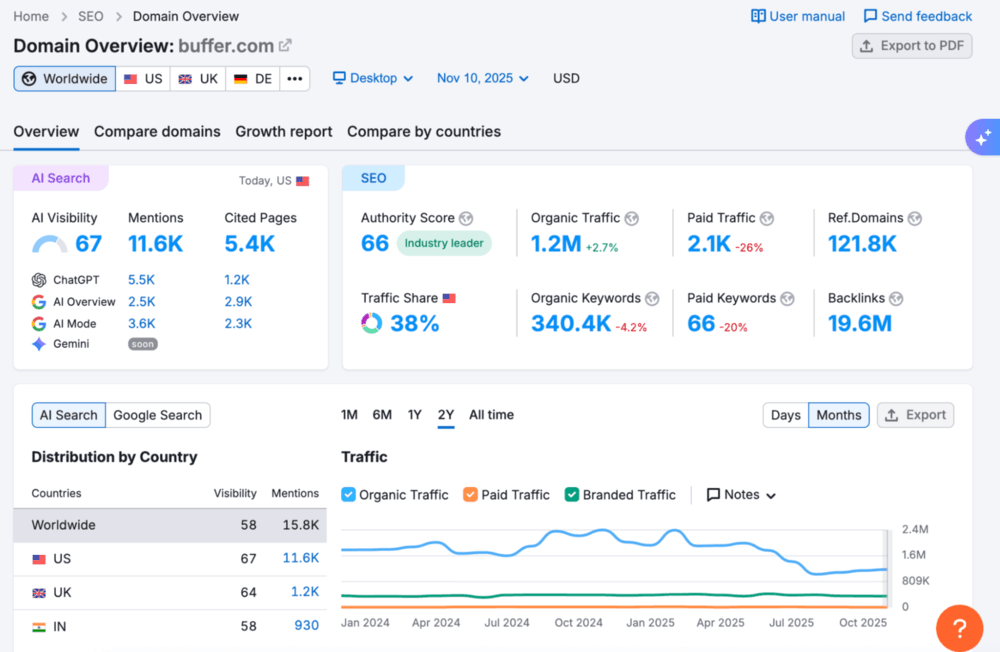
Monitored sources: ChatGPT, Gemini, Perplexity, Google AI Overviews, Google AI Mode
Pros:
- Brand Performance report with share of voice, sentiment and narratives
- AI visibility next to your SEO data
- AI site audit and prompt research included
- 40+ regions
- API access
Cons:
- Only 25 prompts on the entry plan
- 4 engines, with no Claude or Copilot
- Less customizable than dedicated AI visibility tools
06 Ahrefs
4.5/5
G2 (714 reviews, full Ahrefs suite)
Trial / Via Ahrefs plan
From $199 / Month (add-on)
Best for: teams that want to benchmark their brand against competitors across the whole market.
Why I picked Ahrefs Brand Radar?
Brand Radar works differently from most tools here. Instead of tracking only the prompts you enter, it draws on a database of 475M+ prompts, so you see market-wide visibility for your brand and competitors from day one.
It’s also the only tool on this list that puts AI answers next to mentions on YouTube, Reddit and TikTok. That matters because those platforms are some of the sources AI models cite most.
I use Brand Radar citation data in my own SEO/AEO impact reports. It’s great for “where do we stand?”, but less helpful for “what should we do next?”
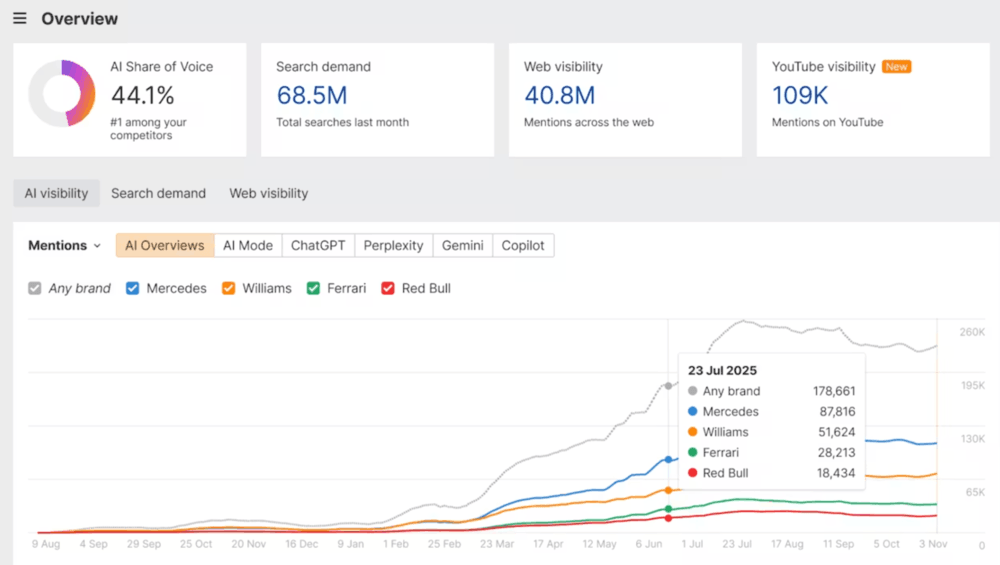
Monitored sources: ChatGPT, Gemini, Perplexity, Copilot, Google AI Overviews, Google AI Mode (Grok and Claude on Custom Prompts), plus YouTube, Reddit and TikTok
Pros:
- Market-wide visibility with no setup
- Covers social platforms alongside AI engines
- Competitor share of voice and cited domains/pages
- API and MCP access
Cons:
- Limited tracking of your own custom prompts on the base plan
- Descriptive rather than prescriptive
- Gets expensive once combined with a full Ahrefs plan
07 Scrunch
4.5/5
G2 (73 reviews)
Free trial / 7-days
From $300 / Month
Best for: brands that want to see not only what AI says about them, but whether AI agents can read their site in the first place.
Why I picked Scrunch?
Scrunch goes one step beyond answer tracking.
On top of citation tracking and page audits, its Growth plan tracks AI agent visits to your site, so you can check if AI crawlers read the specific page.
The Starter plan is generous on prompts: 350 custom prompts plus 1,000 industry prompts and 3 users. It also has an Enterprise Data API, SSO and dedicated agency support.
G2 reviewers mention limited exports, though. Some users screenshot dashboards to build client reports, which slows agencies down.
But the overall rating is positive.
“The control it gives us over how we’re tracking our clients’ AI visibility is second-to-none. By curating our own prompts based on traditional search demand data, we can have confidence we’re seeing the closest-to-truth picture possible.” – Sarah S. on G2
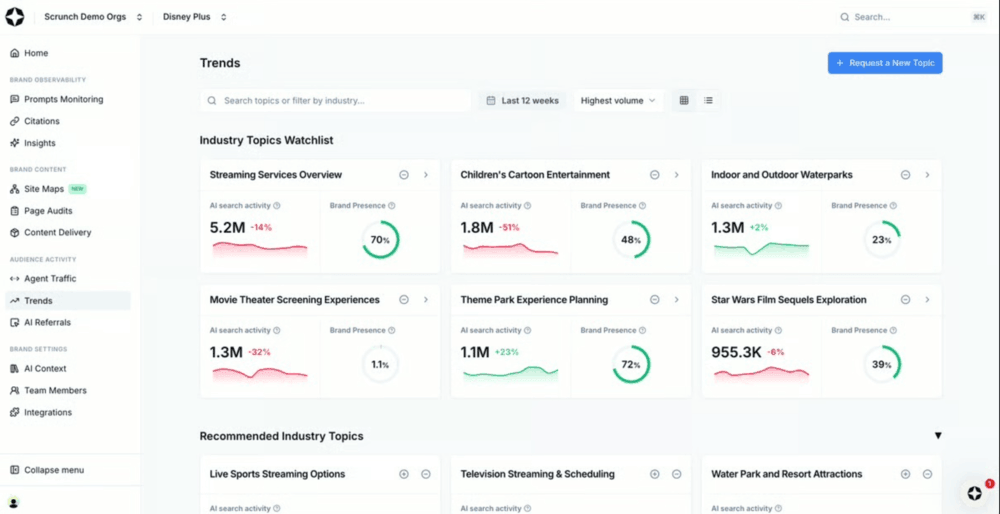
Monitored sources: ChatGPT, Claude, Gemini, Perplexity, Google AI Overviews, Google AI Mode, Meta AI
Pros:
- 350 custom + 1,000 industry prompts on the entry plan
- AI agent traffic tracking (Growth plan)
- Citation tracking and page audits
- Enterprise Data API and SSO
Cons:
- High entry price compared to mid-tier tools
- Limited export options, based on G2 reviews
- Learning curve for non-technical users
08 SE Visible
No G2 rating yet
Free trial / 10 days
From $99 / Month
Best for: teams tracking several brands, sub-brands, or clients and have a limited budget.
Why I picked SE Visible?
SE Visible is SE Ranking’s standalone AI visibility product (you’ll find it at visible.seranking.com).
Its standout for brand tracking is that every plan includes unlimited brands and seats, which is rare at this price point.
One dashboard shows your visibility score, average position, net sentiment and share of voice against competitors. You can also filter results by region and language, which helps if your brand is described differently in different markets.
It’s a monitoring tool, not an optimization tool. You’ll see the gaps, but you won’t find any recommendations.
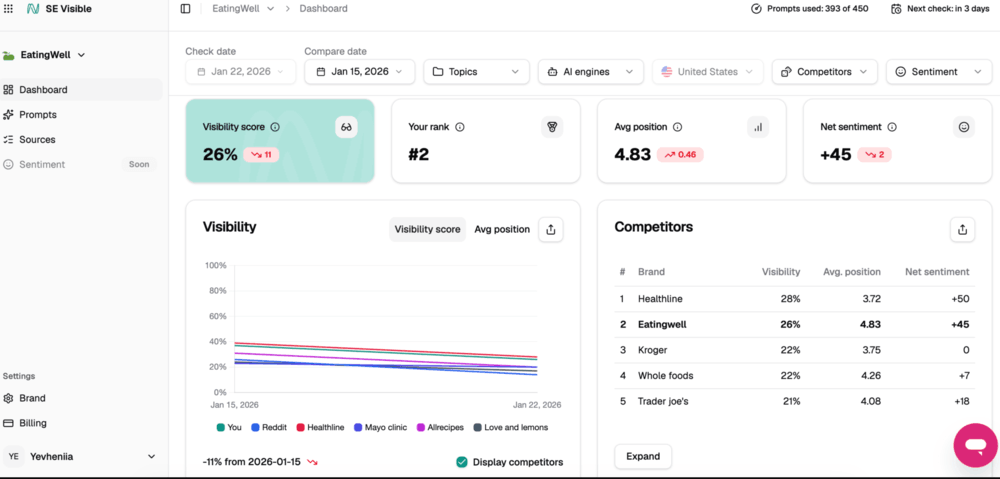
Monitored sources: ChatGPT, Gemini, Perplexity, Google AI Overviews, Google AI Mode (Claude listed as coming soon)
Pros:
- Unlimited brands and seats on every plan
- Net sentiment and share of voice in one dashboard
- Region and language filters
- 200 prompts on the entry plan
Cons:
- No Copilot or Claude yet
- Monitoring only, with no built-in recommendations
09 Similarweb
4.4/5
G2 (1,190 reviews, full Similarweb suite)
No free trial / Demo-based
Pricing / Not published
Best for: teams that need to prove AI visibility turns into real visits and increased traffic.
Why I picked Similarweb?
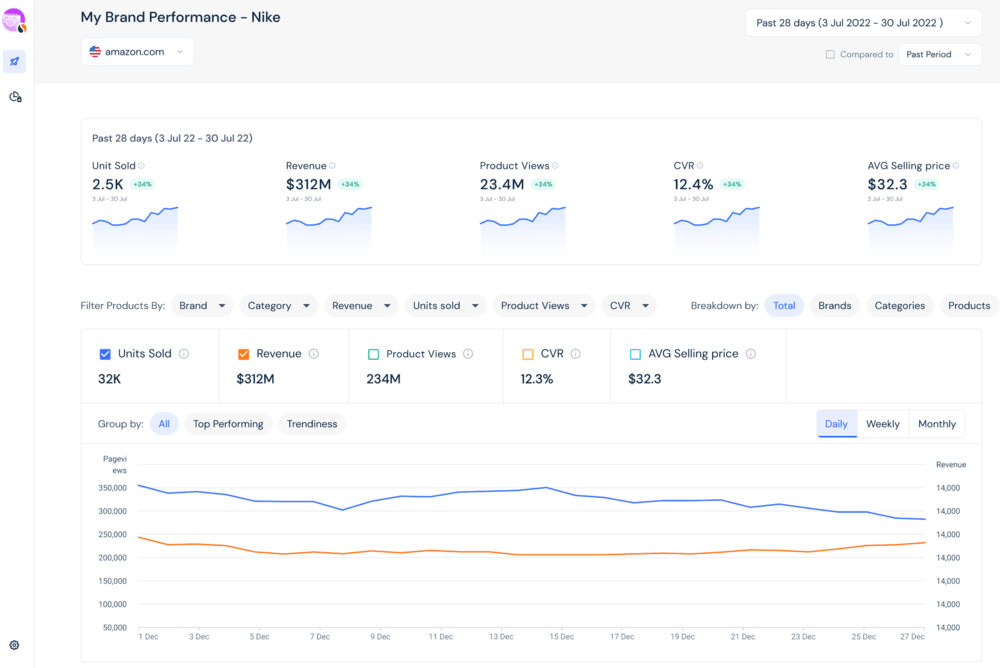
Similarweb’s strength is traffic.
It displays AI visibility alongside AI referral traffic, allowing you to link ‘ChatGPT mentions us more’ with ‘ChatGPT gives us more visitors’, which is the point that convinces a doubtful CFO.
Testimonial from their website:

It also breaks sentiment down by topic and benchmarks you against the top 30 brands in each topic, which gives useful context for share of voice reporting.
In my testing, the interface took a while to get used to. And every tier includes only one user seat.
Monitored sources: ChatGPT, Perplexity, Gemini, Google AI Mode for visibility; Claude, Copilot, Grok and DeepSeek for referral traffic only
Pros:
- AI visibility and AI referral traffic in one place
- Sentiment by topic
- Benchmarking against the top 30 brands per topic
- Strong for stakeholder reporting
Cons:
- One user seat on every plan
- Only 4 engines for visibility tracking
10 Otterly.ai
4.7/5
G2 (54 reviews)
Free trial / Length not disclosed
From $29 / Month
Best for: solo marketers and small teams testing whether AI brand tracking is worth a bigger budget.
Why I picked Otterly.ai?
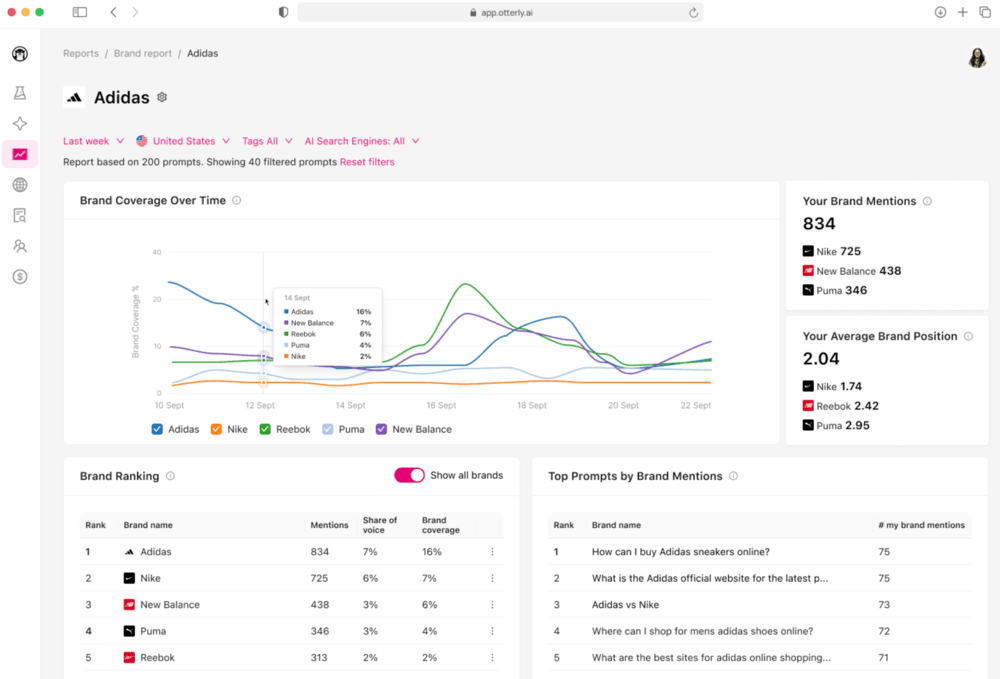
It is the cheapest credible way to start. The Lite plan gives you a Brand Visibility Index, a domain citation ranking, sentiment analysis and 1,000 GEO URL audits a month.
The keyword-to-prompt feature is handy when you don’t know which prompts to track yet. You paste your SEO keywords and Otterly suggests matching AI prompts.
In my testing, though, the dashboard loaded slowly and the source coverage felt thin. G2 reviewers also mention a big price jump from Lite ($29) to Standard ($189).
Monitored sources: ChatGPT, Perplexity, Copilot, Google AI Overviews (Gemini, AI Mode and Claude as add-ons)
Pros:
- Low entry price
- Brand Visibility Index and domain citation ranking
- Keyword-to-prompt conversion for easy setup
- API and MCP from the Standard plan
Cons:
- Only 15 prompts on Lite
- Slow dashboard and data refresh in my testing
- Sentiment is sometimes misclassified, according to G2 reviews
11 AthenaHQ
4.9/5
G2 (44 reviews)
Free plan / Limited
Free or $295 / Month
Best for: growth-stage SaaS teams that need solid GEO analytics without an enterprise contract.
Why I picked AthenaHQ?
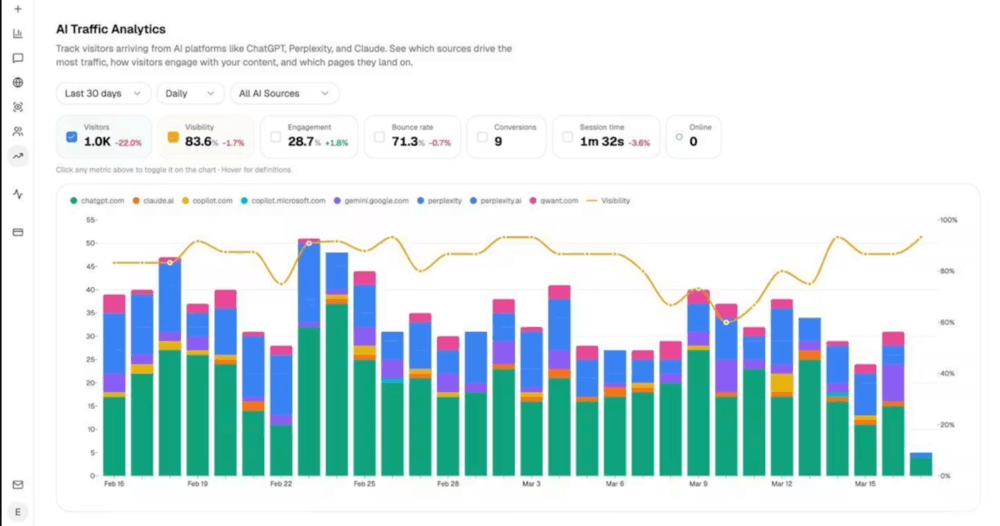
AthenaHQ covers 11 AI models and includes unlimited seats from the Starter plan. The free tier is a nice touch: you can test it on your own brand before paying anything.
For brand tracking, the competitor heatmaps are the most useful view. They show at a glance which topics your competitors own in AI answers, with most-cited sources right underneath.
The feature mix is a bit unusual, though. There’s a content optimization agent and task management next to the analytics, while things like BI integrations are locked to Enterprise.
Monitored sources: ChatGPT, Perplexity, Google AI Overviews, Gemini, Copilot, Claude, Grok, DeepSeek, Mistral, and more
Pros:
- Free tier to start
- 11 models and unlimited seats
- Competitor heatmaps and most-cited sources
- Content optimization agent
Cons:
- Advanced features (BI integrations, white-label reports) are locked to Enterprise
- API is a paid add-on
- No industry prompt templates
12 Evertune
No G2 rating yet
No free trial / demo only
From $800 / Month
Best for: large consumer brands that need AI visibility numbers stable enough for brand-health reporting.
Why I picked Evertune?
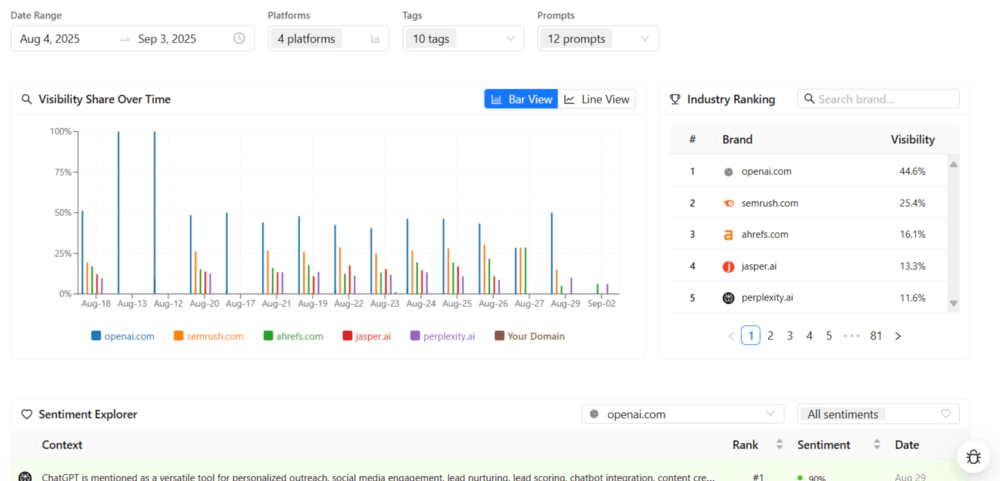
Evertune deals with the AI inconsistency problem directly. It samples each prompt up to 100 times per model, across 11 models, so the results are statistically meaningful rather than a lucky or unlucky draw.
The Pro plan covers 100,000 tracked prompts and 25 AI-optimized articles a month. EverPanel picks prompts based on observed user behavior, so you’re not guessing what people actually ask.
Testimonial from their website:

The price makes this a tool for brands with a REAL budget. There’s no trial, and Enterprise pricing isn’t published.
But it offers interesting features that other tools don’t include.
Monitored sources: 11 models, including ChatGPT, ChatGPT Search, Gemini, Google AI Mode, Google AI Overviews, Claude, Copilot, Perplexity, Meta AI, DeepSeek
Pros:
- Up to 100 samples per prompt per model
- 100,000 prompts on the Pro plan
- Prompt selection based on real user behavior
- AI bot analytics on Enterprise
Cons:
- The highest entry price on this list
- No free trial
13 Rankscale
5/5
G2 (2 reviews)
7-day free trial (Pro plan)
From $20 / Month
Best for: small teams and agencies that want the broadest engine coverage for the lowest price.
Why I picked Rankscale?
Rankscale covers niche engines like Mistral, DeepSeek and Grok alongside the big ones, starting at $20 a month. That’s the widest coverage with such a low price on this list.
For agencies, the Pro plan ($99) includes up to 10 brand dashboards, and Growth adds a REST API and white-labelling. There’s also a Looker Studio integration and page audits.
With only two G2 reviews, the rating doesn’t say much yet. One reviewer found the interface overwhelming at first.
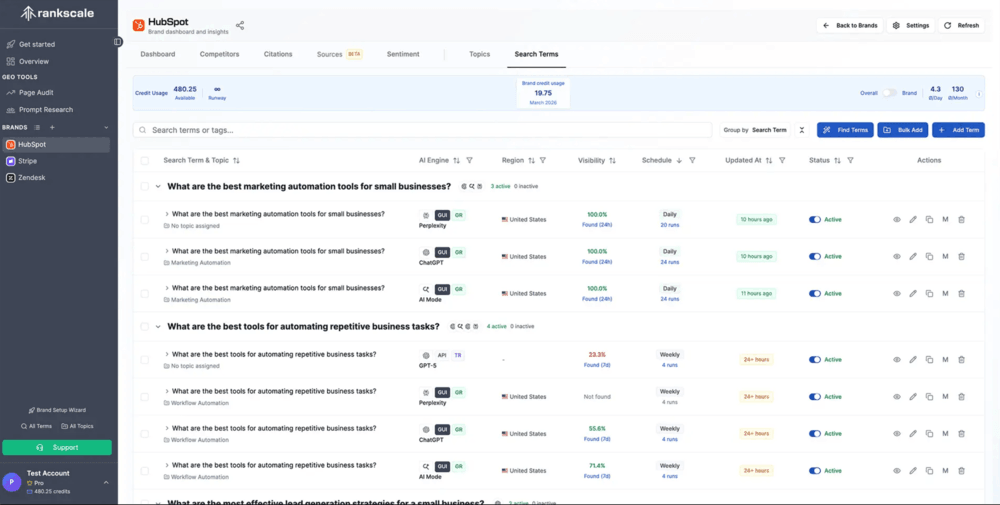
Monitored sources: ChatGPT, Gemini, Perplexity, Claude, DeepSeek, Mistral, Grok, Copilot, and more
Pros:
- Lowest entry price on this list
- Broad engine list, including niche models
- Looker Studio integration
- White-label and API on higher plans
Cons:
- Very few independent reviews
- The interface can feel overwhelming at first
14 Promptwatch
4.5/5
G2 (18 reviews)
7-day free trial
From $95 / Month
Best for: multi-location brands that need to see how AI answers differ by city or state.
Why I picked Promptwatch?
Promptwatch can track AI answers by city or state, which is useful if you have more than one location.
For example: a restaurant chain might show up in AI recommendations across the US overall but barely appear in Chicago. Without local tracking, you’d never see that gap.
API and MCP access come with every plan, which is unusual at this price. From the Professional plan, it also tracks AI agent visits to your site and generates AEO-ready articles (but they sound a little off).
Testimonial from their website:

G2 reviewers mention a hard-to-navigate interface and the lack of agency accounts.
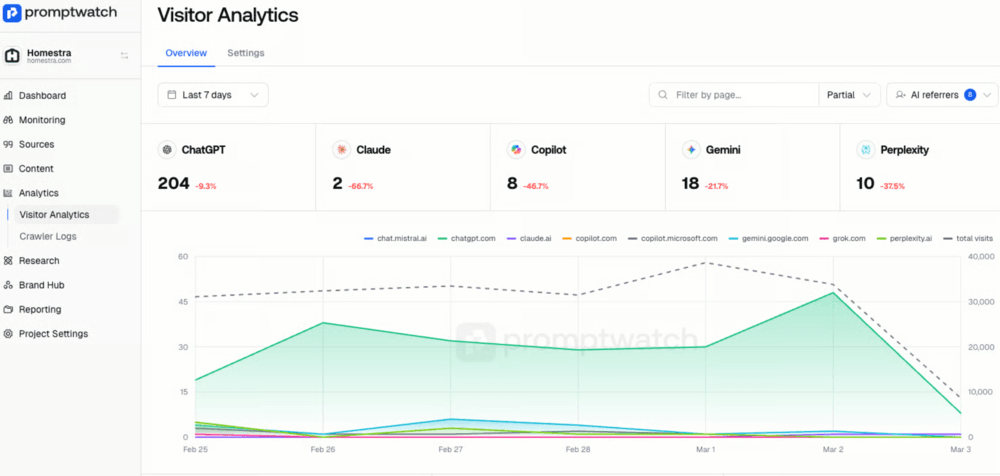
Monitored sources: ChatGPT, Perplexity, Google AI, Claude, Gemini, Meta AI, DeepSeek, Grok
Pros:
- City- and state-level tracking
- API and MCP on every plan
- AI agent visit tracking (Professional plan)
- Shopping insights on the Business plan
Cons:
- 50 prompts on the entry plan
- Not UX friendly
15 Nightwatch
4.7/5
G2 (64 reviews)
14-day free trial
From $79 / Month
Best for: SEO teams that want classic Google rank tracking and AI answer tracking in one report.
Why I picked Nightwatch?
Nightwatch started as a classic rank tracker and added AI tracking later. So you get one place where you can spot a keyword where you rank #1 in Google but don’t appear in the AI answer for the same topic.
It also includes automated client reports, local SEO tracking and Google Analytics and Search Console integrations.
AI tracking is the newer part of the product, so it’s lighter on brand context (sentiment, sources) than dedicated AI visibility tools.
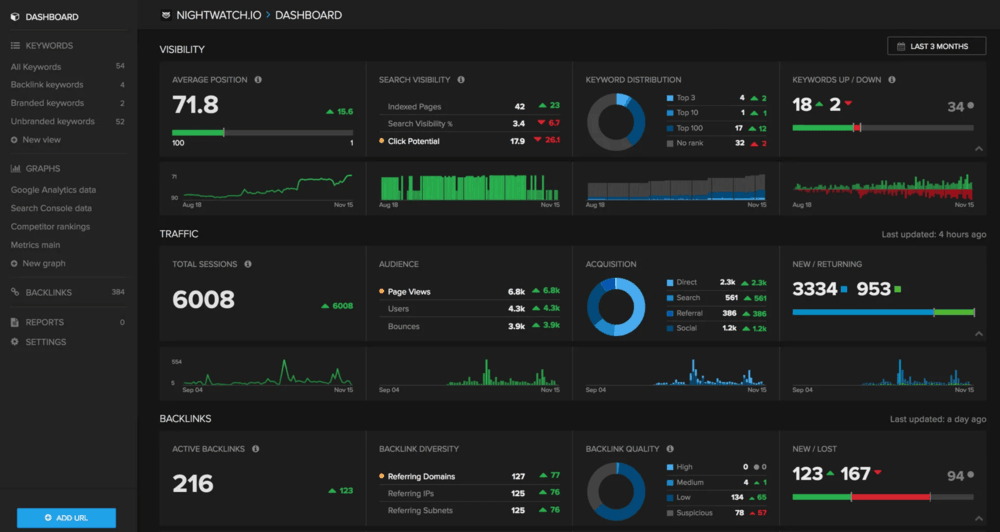
Monitored sources: ChatGPT, Claude, Gemini, Perplexity, Google AI Overviews, Google AI Mode
Pros:
- Rank tracking and AI tracking in one tool
- 14-day trial with all features
- Automated client reports
- GA and Search Console integrations
Cons:
- Only 50 AI prompts on the entry plan
- Less brand context than dedicated AI visibility tools
- Limited report customization
16 ZipTie
4.5./5
G2 (just 1 review)
7 days / Free trial
From $35 / Month
Best for: technical SEO teams checking whether AI engines can find and cite their pages.
Why I picked ZipTie?
ZipTie checks AI answers the same way a real user would see them, in an actual browser. For every prompt, it gives you one simple score based on whether your brand was mentioned, whether your site was cited, and how positive the answer was. That makes it easy to see which of your pages AI cites, and which ones it skips.
My favorite part is the Action Center, where ZipTie suggests fixes. And also, a feature worth mentioning – the UGC Impact view (a paid add-on) shows which user-generated content influenced your visibility.
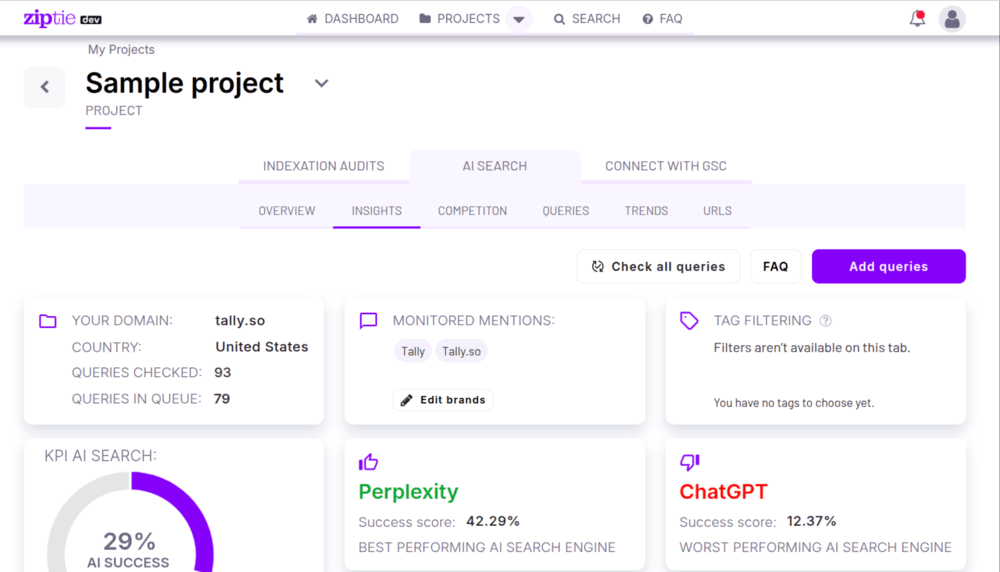
Monitored sources: ChatGPT, Gemini, Perplexity, Copilot, Bing AI Overview, Google AI Overviews, Google AI Mode
Pros:
- Per-query success score (mentions, citations, sentiment)
- Action Center with improvement suggestions
- Unlimited projects and seats
- Checks answers in real browsers
Cons:
- Usage-based pricing is hard to forecast
- API/MCP and UGC Impact are paid add-ons
- Less focus on brand benchmarking
Tools that almost made the list
A few AI visibility tools didn’t make my brand-tracking cut, but they’re worth a look for other use cases:
- Writesonic, Surfer and Clearscope: writing tools first, with AI visibility tracking added on.
- Amplitude AI Visibility: free and tied to product analytics, but with unclear engine coverage.
- Conductor and BrightEdge: enterprise SEO platforms with AI tracking, a good fit for teams already using those.
- Alhena AI: SKU-level tracking for ecommerce.
Free AI brand visibility checkers to try
Free AI visibility checkers give you a one-time baseline of how AI models see your brand.
They don’t track trends, but they’re the fastest way to see whether you have a visibility problem before paying for a tool.
| Checker | What it shows | Engines | Signup |
|---|---|---|---|
| Ahrefs AI Visibility Checker | Total mentions, top topics, cited domains and pages | ChatGPT, Gemini, Perplexity, Copilot, AI Overviews | None |
| Semrush AI Search Visibility Checker | AI Visibility Score (0-100), mentions, cited pages, competitors | ChatGPT, Gemini, AI Overviews, AI Mode | None (3 checks/day) |
| HubSpot AI Search Grader | Score out of 100 for sentiment, recognition, share of voice, positioning | ChatGPT, Perplexity, Gemini | None |
| Frase AI Visibility Checker | Share of voice, citations, sentiment for 3 test phrases | ChatGPT (Perplexity, Gemini with email) | Email for more engines |
| Otterly GEO tools | GEO score and fixes for a URL, AI crawlability check | Page-level audit | Not required for basic checks |
💡 Pro tip: Run two checkers on the same day and compare. If they disagree a lot, that’s the inconsistency problem I talked about. For more accurate results move from one-off checks to proper AI search monitoring.
How to build a prompt set for AI brand tracking? [Template]
The prompts you track decide what your data can tell you. A good prompt set for brand tracking has 20 to 50 prompts split across five types.
Many of the tools above will suggest the prompt list, so you don’t need to worry about this process. But, sometimes a manual check is also valuable.
Here’s the template you can use, filled in for Brand24 as an example:
| Prompt type | Example | What it tells you |
|---|---|---|
| Category discovery | “What are the best social listening tools?” | Whether you’re mentioned at all |
| Use case | “How can I track brand mentions on TikTok?” | Whether AI connects you to specific use cases |
| Comparison | “Brand24 vs Brandwatch: which is better for a small team?” | How you’re positioned against named competitors |
| Branded | “Is Brand24 good for agencies?” | What AI says when people already know you (sentiment!) |
| Problem / pain point | “Why am I missing mentions of my brand online?” | Whether you show up before people know the category |
There are two universal rules that make the tracking easier and cleaner:
- Keep prompts in the words customers actually use (pull them from sales calls, Reddit threads or your support inbox).
- Don’t change the set more than once a quarter, or you won’t know whether the trend moved or your prompts did.
My AI brand tracking workflow as a Content Marketer
This is the workflow I use to track the Brand24 visibility in AI answers with Chatbeat. Once it’s set up, it runs continuously in the background.
- Track by a whole topic cluster. I set up separate relevant prompt groups (in my case, for Social Listening, Brand Monitoring, Mentions, Share of Voice, and Sentiment Analysis).
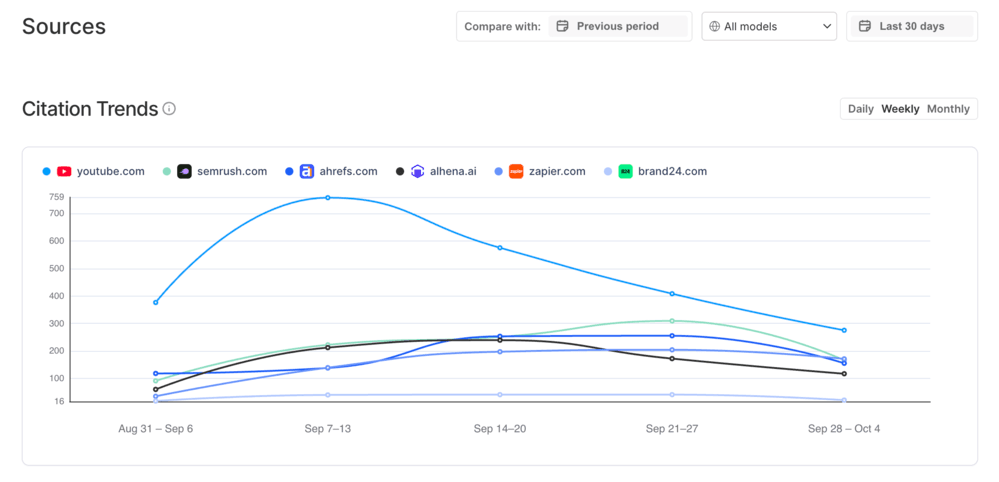
- Watch Key Sources repeatedly. When a competitor page appears in Key Sources for a cluster where we’re weak, it goes onto my content backlog so we can try to improve.
- Update the article and monitor. I optimize the article (with things like a new intro, FAQ, fresh data) and monitor how the changes impact AI visibility.
- Compare two periods. I export the citation data for the period before and after the update and compare article-level citations and changes per AI model.
Here’s an example of how the sources analysis looks in the tool for my project:
Which AI brand visibility tool should you choose?
The right tool depends on your budget and what you need to track.
Here’s how I’d pick:
| Your situation | Budget | Start with |
|---|---|---|
|
Just checking if you have a problem
|
$0 |
Ahrefs, Semrush or HubSpot free checkers |
|
Solo marketer, your first paid tool
|
Under $50/mo |
Otterly.ai or Rankscale |
|
Marketing team that needs brand insights and sources in detail
|
~$100/mo |
Chatbeat |
|
PR or marketing team already doing social listening
|
Brand24 plan + add-on |
Brand24 with the AI Visibility add-on |
|
SEO team already on a suite
|
~$100-200/mo add-on |
Semrush AI Visibility Toolkit or Ahrefs Brand Radar |
|
Agency with many clients
|
$100-300/mo |
Peec AI, SE Visible or Rankscale |
|
Need to prove AI traffic to stakeholders
|
~$100/mo+ |
Similarweb |
|
Multi-location brand
|
~$100/mo+ |
Promptwatch |
|
Enterprise GEO program
|
$800+/mo or custom |
Profound or Evertune |
Conclusion
AI models now describe your brand to hundreds of millions of people, and most probably, they do it differently every time.
AI brand visibility tracking tools help you track those visibility trends and let you see: how often you’re mentioned, in what tone, next to whom, and based on which sources.
FAQ
An AI brand visibility tracking tool (also called an AI search monitoring tool) is software that repeatedly sends customer-style prompts to AI engines like ChatGPT, Gemini, Perplexity and Google AI Overviews and records whether your brand appears. It then tracks mentions, sentiment, share of voice against competitors and the sources AI cites, over time.
The best AI visibility tool depends on your team. Profound is the strongest option for enterprise GEO programs, Chatbeat is best for brand-level insights like Brand Score, sentiment and Key Sources from $99/month, and Semrush or Ahrefs suit SEO teams already on those suites.
You track AI visibility by running a fixed set of 20 to 50 prompts across several AI engines, repeatedly, and measuring how often your brand appears. Tools like Chatbeat, Peec AI or other from the list automate this and show trends, sentiment and cited sources. Single manual checks are unreliable because AI answers change between runs.
You increase AI visibility by getting your brand onto the pages AI models already cite. Check the cited sources in your tracking tool, update your own articles with clear answers, fresh data and FAQs, and earn mentions on third-party sites, reviews and forums like Reddit that AI draws from.
Yes, for a one-time baseline. Ahrefs, Semrush, HubSpot and Frase offer free AI visibility checkers, and AthenaHQ has a free tier. Ongoing tracking needs a paid plan, because repeated querying across many models costs vendors money to run.
Yes, if your tool offers it. Brand24 users can add AI Visibility as an add-on, which puts an LLM Listening tab with Brand Score, Share of Voice and key sources next to their online mentions. Suite users can do the same with the Semrush AI Visibility Toolkit or Ahrefs Brand Radar.
Entry plans range from $20 to $29/month (Rankscale, Otterly.ai) to around $99/month for mid-tier tools like Chatbeat, Semrush and SE Visible. Enterprise tools like Evertune start at $800/month, and Profound is priced on request.