Table of contents
2M Marketers

I use AI visibility tools daily to track how my blog articles move Brand24’s overall visibility inside AI models. That’s the use case I know best, but it’s just a narrow slice of what these tools actually do. In this list, you’ll find the 12 best AI visibility tools for very different use cases like GEO analytics, more technical crawlability audits, and proving AI traffic to your stakeholders.
Best AI visibility tools: shortlist
- Chatbeat – best overall, includes AI-based insights and a highly personalized dashboard
- Profound – best for AI traffic analysis for your site, includes Adobe integration
- Peec AI – best for prompt tracking and brand reputation
- Semrush AI Toolkit – best for content teams already using Semrush that want everything in one dashboard
- Ahrefs Brand Radar – best for competitor benchmarking, analyzing the specific platforms’ impact on GEO
- Otterlyai – best for low-budget first-timers that need GEO basic audits
- Surfer AI Search Analytics – best for content creation and optimizing it for AI, with AI visibility monitoring as an add-on
- Similarweb – best for comparing your performance with competitors
- ZipTie – best for technical GEO audits, thanks to its URL checks
- Writesonic – best for content teams that want to optimize for GEO
- AthenaHQ – best for growth-stage SaaS teams that need GEO analytics without enterprise pricing
- Amplitude AI Visibility – best for tying AI visibility all the way through to product usage and revenue
AI visibility tools: summary
| Tool | Best for | Engines tracked | Entry pricing | Free trial | G2 rating |
|---|---|---|---|---|---|
 Chatbeat Chatbeat | Brands looking for advanced metrics and AI-based insights in a highly personalized dashboard | ChatGPT, Gemini, Claude, Perplexity, DeepSeek, Grok, Copilot, Google AI Overviews, and more | $99/mo | 14 days | 4.6/5 (359 reviews, full Brand24 suite) |
 Profound Profound | AI traffic analysis for your site, with Adobe integration | ChatGPT, Gemini, Claude, Perplexity, DeepSeek, Grok, Copilot, Google AI Overviews, and more | from $99/mo | 7 days (for Growth plan) | 4.5/5 (1,128 reviews) |
 Peec AI Peec AI | Prompt tracking and brand reputation monitoring | ChatGPT, Gemini, Perplexity, Claude | ~€89/mo | Yes | 4.8/5 (20 reviews) |
 Semrush AI Toolkit Semrush AI Toolkit | Content teams on Semrush who want everything in one dashboard | Major LLMs (via 260M+ prompt database) | ~$99-165/mo add-on | Trial via Semrush | 4.4/5 (4,034 reviews, full Semrush suite) |
 Ahrefs Brand Radar Ahrefs Brand Radar | Competitor benchmarking, broken down by platform impact on GEO | ChatGPT, Google (AI Overviews, AI Mode), Gemini, Perplexity, Copilot | ~$199/mo add-on | Trial via Ahrefs | 4.5/5 (714 reviews, full Ahrefs suite) |
 Otterly.ai Otterly.ai | Low budget first-timers who need basic GEO audits | ChatGPT, Perplexity, Gemini | ~$29/mo | Yes | 4.7/5 (54 reviews) |
 Similarweb Similarweb | Comparing your performance with competitors | No information | Not published | No | 4.4/5 (1,190 reviews, full Similarweb suite) |
 ZipTie ZipTie | Technical GEO audits, thanks to its URL checks | ChatGPT, Google (AI Overviews, AI Mode), Gemini, Perplexity, Copilot, Bing AI | ~$35/mo | 7 days | 0 reviews yet (new listing) |
 Writesonic Writesonic | Content teams that want to optimize for GEO | ChatGPT, Gemini, Perplexity | Not published | 7 days | 4.7/5 (2,125 reviews, full Writesonic suite) |
 AthenaHQ AthenaHQ | Growth-stage SaaS teams that need GEO analytics without enterprise pricing | ChatGPT, Google (AI Overviews, AI Mode), Gemini, Perplexity, Copilot | Free limited plan or $295/mo | Free limited plan | 4.9/5 (48 reviews) |
 Surfer AI Search Analytics Surfer AI Search Analytics | Content creation and optimizing it for AI, with AI visibility monitoring as an add-on | ChatGPT, Gemini, Google AI Overviews, Google AI Mode, Perplexity | from $82/mo (Standard plan, requires full Surfer suite) | No free trial, but a money-back guarantee instead | 4.8/5 (546 reviews, full Surfer suite) |
 Amplitude AI Visibility Amplitude AI Visibility | Tying AI visibility to actual product usage and revenue | ChatGPT and Google AI Overview confirmed on all plans; broader coverage referenced, but is not fully confirmed | Free plan | Free plan | 4.5/5 (2,990 reviews, full Amplitude suite) |
Why this list matters in 2026?
AI visibility tools (also called GEO tools, LLM monitoring platforms, or AI search visibility trackers) exist because a huge share of searches now happen in AI-generated answer. If your brand isn’t part of it, you’re losing a big part of your potential audience.
- Brands appearing in ChatGPT recommendations were 2.5x more likely to receive a site visit within 7 days than brands not recommended. (source: Similarweb, June 2026)
- AI Overviews already appear in 75.24% of personalized U.S. Google searches (according to Advanced Web Ranking’s AI Overview tracker, dataset as of August 31, 2026, based on 8k tracked keywords)
I hand-tested each tool on the list. The tool only made the cut if it covers more than one AI model, shows repeated results instead of a single snapshot, and points you toward what’s actually driving your visibility. I highlighted each tool’s pros and cons based on my own experience and what other users say on review platforms like G2 or Capterra, and broader platforms like Reddit.
Here’s what I found!
AI visibility tools: My honest reviews
01 Chatbeat
4.6/5
G2 (359 reviews, full Brand24 suite)
14 days / Free trial
From $99 / Month
Best for: Teams that need advanced metrics and a deep dive into data in a simple dashboard.
Why I picked Chatbeat?
Chatbeat is built around four core pieces of data:
- A Brand Score (0-100%) combines how often a brand appears in AI answers with how prominently it’s positioned, so a single number reflects both reach and rank.
- Share of Voice view, weighted so a first-place mention against a named competitor is more.
- A sentiment analysis that flags whether the AI framed the brand positively, neutrally, or negatively.
- Key Sources breakdown lists the specific domains and pages each model pulls from when it discusses the category. That’s what turns a visibility gap into a content idea or PR target, instead of just a number to stare at.
All of this runs on repeated querying across ChatGPT, Gemini, Claude, Perplexity, DeepSeek, Grok, Copilot, Google AI Overviews, and more.
I believe a single check won’t tell you much, since the same question can get a different answer from AI each time. That repetition is what makes the Brand Score worth tracking over weeks, rather than treating it as a one-off screenshot.
Out of every tool on this list, Chatbeat has the most customizable dashboard I tested, and it’s the one where I could have easily customized the dashboard to my needs.
Setup was easy, the UX is friendly, and I like that it surfaces ready-made AI insights that summarize the crucial changes for me instead of making me dig for them myself.
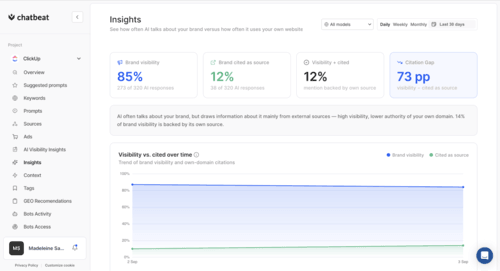
🔍 Monitored sources: ChatGPT, Gemini, Claude, Perplexity, DeepSeek, Grok, Copilot, Google AI Overviews, and more
✅ Pros:
- Brand Score (0-100%) combines appearance frequency and ranking prominence into one number
- Key Sources view names the specific competing page to beat
- Share of Voice calculated against named competitors
- Most customizable dashboard I tested, with an easy setup and a friendly UX
- Ready-made AI insights that summarize the important changes for you
- Provides an API
- Covers 8+ engines, including Grok and DeepSeek
❌ Cons:
- The Essential tier is just 30 prompts and 1 project, which even small teams can outgrow quickly

My pro tip worth knowing before you set up a standalone account:
Chatbeat is also available as an add-on inside Brand24, a broader social listening platform that tracks what people say about brands online.
If your team already runs Brand24 or needs broader media monitoring, you can add Chatbeat’s AI visibility monitoring to the same account rather than managing it as a separate tool.
02 Profound
4.5/5
G2 (1,128 reviews)
7 days / Free trial (Growth plan)
From $99 / Month
Best for: enterprises running GEO as a formal, dedicated program.
Why I picked Profound?
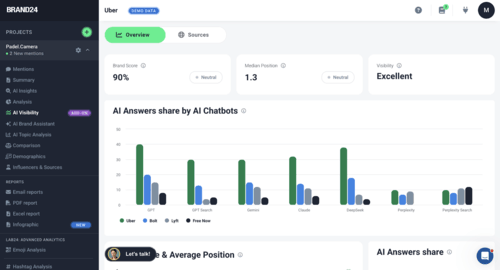
Profound covers a wide range of answer engines. It also builds content generation right into the workflow, so you can go from “missing in this answer” to drafting content that would fix the gap without switching tools.
My own experience with Profound was smooth. The dashboard is friendly and easy to navigate, and setup didn’t take long.
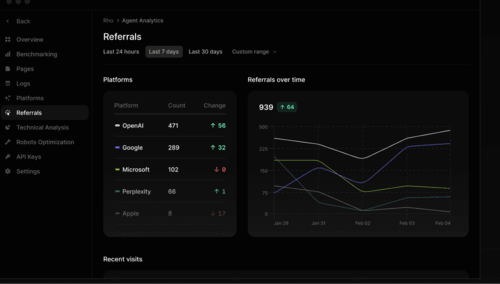
The Adobe integration is a standout if you’re on a product team; it brings AI visibility data straight into a workflow that those teams are probably already using (I personally didn’t find it useful, but it’s not my use case)
🔍 Monitored sources: ChatGPT, Gemini, Claude, Perplexity, DeepSeek, Grok, Copilot, Google AI Overviews, and more
✅ Pros:
- Friendly, easy-to-navigate dashboard with a quick setup
- Adobe integration – very useful for product teams
- Built-in content generation tied to visibility gaps
- 7-day trial available on the Growth plan
❌ Cons:
- Pricing scales quickly past the starter tier
- More depth than most small teams need, can be hard for non-technical teams
03 Peec AI
4.8/5
G2 (20 reviews)
Free trial / Length not disclosed
From €89 / Month
Best for: agencies and larger in-house teams tracking dozens of prompt sets at once.
Why I picked Peec AI?
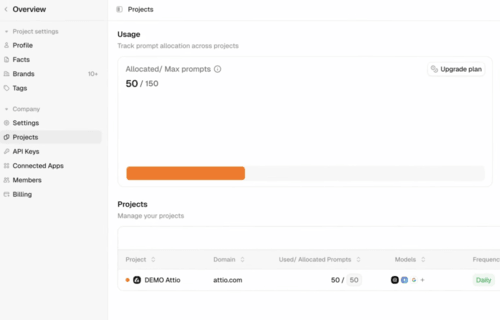
Pitch Workspaces let you organize prompts by client or campaign cleanly, instead of dumping everything into one project list as most competitors do. This makes it an ideal choice for agencies or multiple brand organizations.
A direct Looker Studio connector matters too if a team’s reporting already lives there instead of inside the vendor’s own dashboard, and overall, I found the reporting capabilities really solid.
🔍 Monitored sources: ChatGPT, Gemini, Perplexity, Claude
✅ Pros:
- Pitch Workspaces built for multi-client management
- Native Looker Studio connector
- Solid overall reporting capabilities
- Provides an API
❌ Cons:
- No AI insights and guidance based on the analysis
- Stronger on data collection than on next-step recommendations
04 Semrush AI Toolkit
4.4/5
G2 (4,034 reviews, full Semrush suite)
Trial / Via Semrush plan
From $99-165 / Month (add-on)
Best for: SEO teams who want AI visibility as one more tab in a suite they already pay for and use.
Why I picked Semrush AI Toolkit?
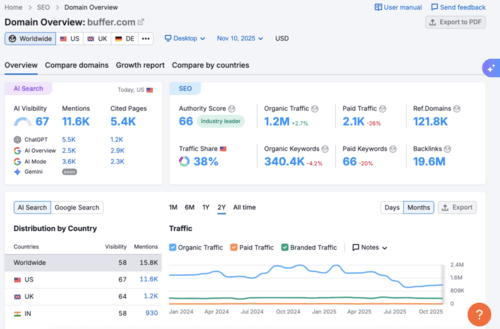
It draws on a database of over 260 million prompts, a scale most GEO tools don’t match.
It also lives inside the same Semrush dashboard as the keyword and backlink data. If your team uses Semrush for that purpose – they already check it daily, so instead of buying a separate platform, you’re layering AI visibility data into a workflow you already run.
What stood out to me is the combination of all you need in one place: general analytics, audits, and content GEO insights all in one place (plus, you have API access).
If you’re already using Semrush, this is the easiest way in.
🔍 Monitored sources: major LLMs via Semrush’s prompt database (not specified)
✅ Pros:
- 260M+ prompt database for pattern discovery
- Good combination of general analytics, audits, and content GEO insights
- Provides an API
- Lives inside a broader interface that teams may already use
- Add-on pricing is lower than that of most standalone specialists
❌ Cons:
- Requires an existing Semrush subscription
- Not as advanced GEO-specific features as in purpose-built tools
- Fewer source-level citations and customization of the dashboard
05 Ahrefs Brand Radar
4.5/5
G2 (714 reviews, full Ahrefs suite)
Trial / Via Ahrefs plan
From $199 / Month (add-on)
Best for: SEO-first teams that want AI visibility benchmarking without leaving the Ahrefs ecosystem.
Why I picked Ahrefs Brand Radar?
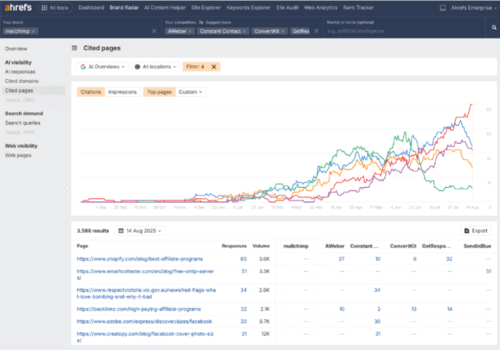
It brings AI visibility features to Ahrefs’ backlink and analytics for the organic search dashboard. Main plus? Similar to Smrush, the interface feels immediately familiar to teams that already use the tool.
It’s especially useful for competitive benchmarking in AI search, with straightforward comparisons against named competitors.
Like Semrush’s toolkit, it combines general analytics, audits, and content GEO insights, and provides an API. It’s the obvious choice if you’re already using Ahrefs.
🔍 Monitored sources: ChatGPT, Google (AI Overviews, AI Mode),Gemini, Perplexity, Copilot
✅ Pros:
- Familiar interface for existing Ahrefs users
- Clean competitor benchmarking view
- Good combination of general analytics, audits, and content GEO insights
- Provides an API
- Ties directly to organic keyword data already tracked, while going beyond traditional SEO tools
❌ Cons:
- Narrower engine coverage than dedicated AI visibility tools like Chatbeat or Profound (6 vs. 8+)
- Stays descriptive rather than prescriptive (It’s showing you the data without turning that data into a recommended next step)
- Requires an existing Ahrefs subscription
06 Otterly.ai
4.7/5
G2 (54 reviews)
Free trial / Length not disclosed
From $29 / Month
Best for: solo marketers or small teams testing whether AI visibility monitoring is worth a bigger investment.
Why I picked Otterly.ai?
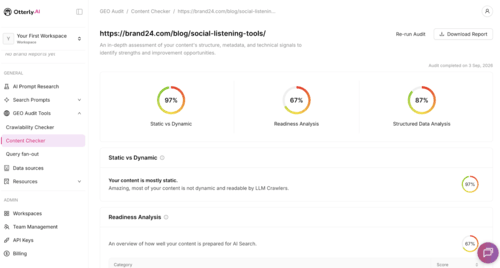
Its Lite tier is the cheapest credible way to start monitoring, and the keyword-to-prompt conversion feature is genuinely handy if you’re just getting started with tracking AI visibility.
Plus, a built-in AI visibility audit is included even at such a low price point (and can be done for your specific pages, not just overall domain).
My own experience with Otterly wasn’t the best, though. The dashboard took a long time to load, and the source coverage didn’t feel deep enough compared to the other tools on this list.
If budget is your main constraint, it’s still worth trying, just expect a lighter, slower experience than the more established platforms above it.
🔍 Monitored sources: ChatGPT, Perplexity, Gemini
✅ Pros:
- Lowest entry price on this list
- Keyword-to-prompt feature for easy setup in just a few clicks
- Built-in GEO audit
- Provides API
❌ Cons:
- The dashboard was slow to load in my testing
- Source coverage isn’t as deep as other tools on this list
- Lower daily prompt allowance than mid-tier and enterprise options
07 Surfer AI Search Analytics
4.8/5
G2 (546 reviews, full Surfer suite)
No free trial / Money-back guarantee
From $99 / Month (Standard plan)
Best for: content teams that want to create and optimize content for AI search, with AI visibility monitoring as a built-in add-on rather than the main draw.
Why I picked Surfer?
- Surfer’s real strength is its focus on content creation and AI optimization. Its content auditing features (the same ones that make Surfer’s Content Editor useful for traditional SEO) carry over into flagging what a page needs to be more citable in an AI answer, so the visibility data feeds straight back into a fix rather than sitting in a separate dashboard.
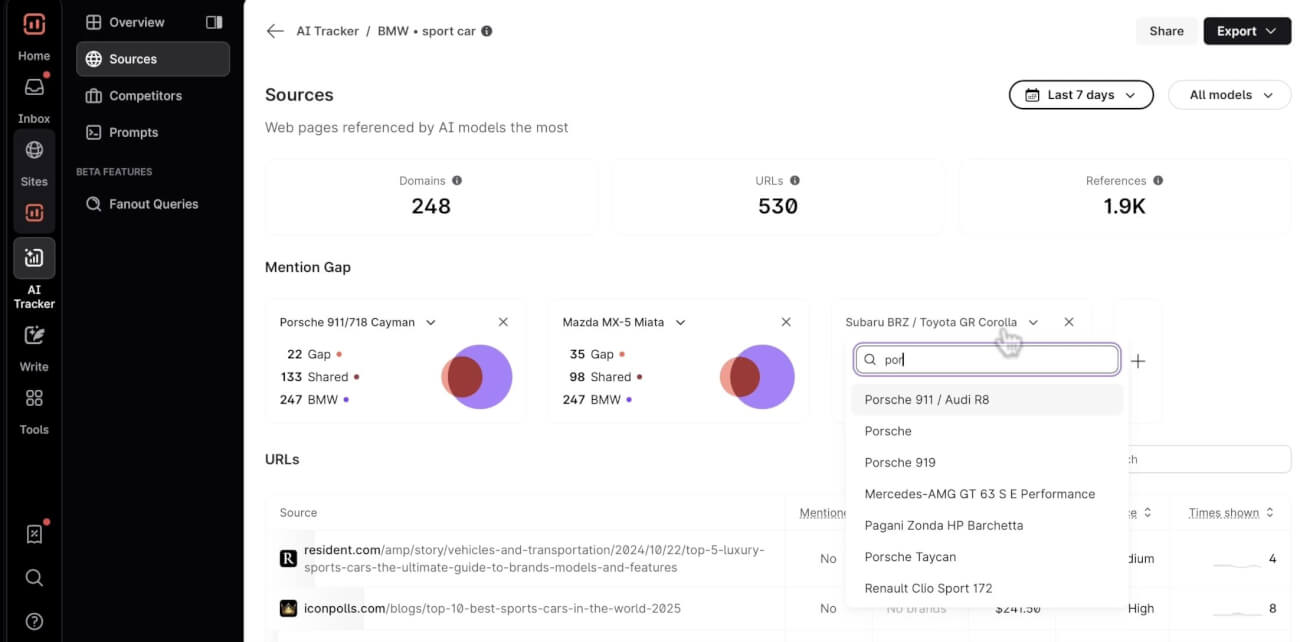
- AI Search Analytics offers citation-source analysis, which makes it a genuinely useful tool for competitor benchmarking. It shows what your site and your competitors’ sites each get cited for on a given prompt. Additionally, it includes your visibility score, most-cited sources for your topics, fanout queries, and more.
The dashboard and setup are among the nicer ones I tested, approachable enough that a non-technical marketer could get it running without a learning curve.
When it comes to coverage, it tracks five engines (ChatGPT, Gemini, Google AI Overviews, Google AI Mode, and Perplexity), leaving out Copilot, Claude, Grok, and DeepSeek.
Surfer AI Search Analytics is included in every Surfer plan. But if you’re not interested in content planning, writing, and optimization features and would rather only pay for AI tracking, you can also purchase the tool as a standalone subscription.
🔍 Monitored sources: ChatGPT, Gemini, Google AI Overviews, Google AI Mode, Perplexity
✅ Pros:
- Strong content creation and auditing features in the same dashboard as Surfer’s core content-optimization product
- Citation-source analysis that compares what your site and competitors get cited for, prompt by prompt
- Competitor share-of-voice view showing who the engines default to recommending
❌ Cons:
- It’s not a dedicated GEO platform, so it’s less deep on visibility specifically than the tools built around it
- Only 5 engines tracked, and Copilot, Claude, Grok, and DeepSeek aren’t covered at any tier
08 Similarweb
4.4/5
G2 (1,190 reviews, full Similarweb suite)
No free trial / Demo-based
Pricing / Not published
Best for: teams that need to justify AI visibility spend with hard traffic numbers.
Why I picked Similarweb?
It ties AI visibility to actual site traffic, showing how much of a site’s visits now start from AI-referred traffic rather than classic organic search.
That’s the strongest argument I’ve seen for proving to a skeptical stakeholder that this isn’t just a random metric but something marketers should actually pay attention to.
It’s also a good choice for comparing your performance against rivals, but personally, I found the interface confusing, and it took me a while to figure out how to navigate it.
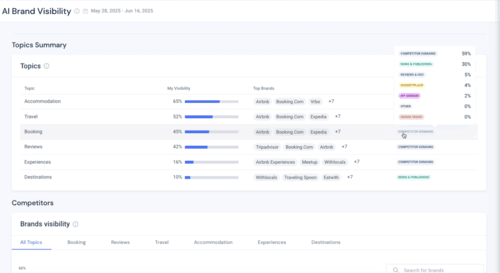
🔍 Monitored sources: not specified, according to their site “traffic-based AI tracking for referral trends, side by side with SEO data”
✅ Pros:
- Direct link between AI visibility and referral traffic
- Useful for board-level or stakeholder reporting
- Combines SEO and GEO traffic in one report
❌ Cons:
- The interface felt confusing and hard to navigate in my testing
- Enterprise-only pricing, contact sales required
09 ZipTie
No G2 rating yet
0 reviews
7 days / Free trial
From $35 / Month
Best for: technical SEO teams auditing whether AI crawlers can even see their content.
Why I picked ZipTie?
Its URL-level analysis and indexation audits catch technical blockers that a content-only tool would completely miss, like pages that AI crawlers can’t read and need some adjustments.
This citation source detection can help you identify high-performing internal pages.
The tool also gives you in-platform content optimization suggestions alongside those technical audits.
What I like most, though, is the “Action Center” tab, where the tool offers its own AI-based suggestions to improve your AI visibility.
The dashboard itself is clear and easy to use, and it includes a couple of less common features, like “UGC impact,” which shows the specific profiles that have influenced your AI visibility.
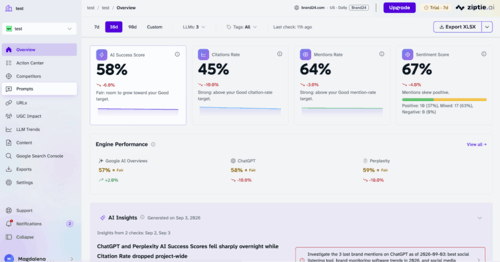
🔍 Monitored sources: ChatGPT, Google AI Overviews, Perplexity, and four more AI engines (not specified)
✅ Pros:
- “Action Center” tab with AI-based improvement suggestions
- Clear, easy-to-use dashboard
- “UGC impact” view showing specific domains with urls that influenced your visibility
- URL-level indexation audits built specifically for AI crawlers
- Affordable entry price for the technical depth offered
- Content optimization and generaion tool included
❌ Cons:
- Smaller engine list than the category leaders
- Less brand-benchmarking focus than competitor-tracking tools
10 Writesonic
4.7/5
G2 (2,125 reviews, full Writesonic suite)
7 days / Free trial
Pricing / Not published
Best for: content teams who want a lightweight visibility check alongside their writing workflow.
Why I picked Writesonic?
It’s built into a content generation suite you may already be using to draft, so checking brand mentions, reputation signals, and AI responses doesn’t need a separate login.
In my experience, it’s good for content optimization and for monitoring how those changes perform.
Don’t expect much in the way of deep analytics though, it’s a simple layer on top of a content tool, not a dedicated GEO platform.
🔍 Monitored sources: ChatGPT, Gemini, Perplexity
✅ Pros:
- Visibility tracking inside the content drafting tool
- Good for content optimization and monitoring results
- Sentiment analysis and mention tracking included
❌ Cons:
- Not much depth in analytics
- Visibility tracking is added directly into a content tool, not a dedicated GEO platform
- Narrow engine coverage
11 AthenaHQ
4.9/5
G2 (44 reviews)
Free plan / Limited
Free or $295 / Month
Best for: growth-stage SaaS teams that need GEO analytics without an enterprise contract.
Why I picked AthenaHQ?
It targets a gap most of this list skips: SaaS companies past the “just starting out” stage but not yet ready for a deep data dive and enterprise pricing.
It’s a bit of an unusual mix, honestly.
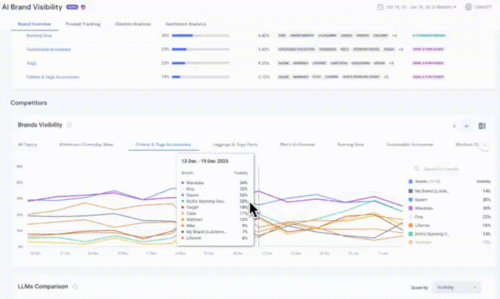
Alongside the analytics, it includes a task management feature for content creation and some cool visualizations, like competitor heatmaps.
It also surfaces useful metrics like most-cited sources, so there’s real data underneath the unconventional layout.
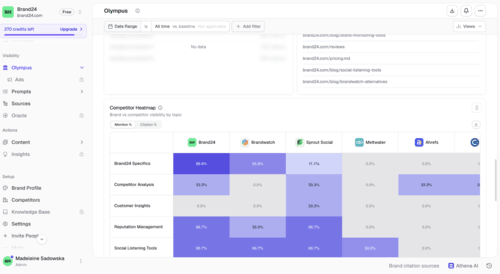
🔍 Monitored sources: multiple major AI engines (ChatGPT, Google (AI Overviews, AI Mode), Gemini, Perplexity, Copilot)
✅ Pros:
- Competitor heatmaps and other visualizations I haven’t seen elsewhere
- Task management feature built in for content creation
- Useful metrics like most-cited sources
❌ Cons:
- Feature mix that seems random (task management + analytics)
- Less established track record than category leaders
12 Amplitude AI Visibility
4.5/5
G2 (2,990 reviews, full Amplitude suite)
Free / No signup needed
Free / Every plan
Best for: product-led teams that already use (or want to use) Amplitude and want AI visibility tied all the way through to feature adoption and revenue, at no extra cost.
Why I picked Amplitude AI Visibility?
- It’s the only tool on this list that connects AI visibility to full product analytics, not just traffic. Because it sits inside Amplitude’s core platform, it can show not just that ChatGPT mentioned your company, but whether those visitors activated, which features they explored, and whether they converted to paying customers, using the same session replay, funnels, and analytics Amplitude is already known for.
- It’s free. AI Visibility is included at no extra cost on every Amplitude plan, including the permanent Free tier.
Amplitude launched AI Visibility in October 2025, calling it, in founder Spenser Skates’ words, the company’s first free product.
Its own current product page confirms ChatGPT and Google AI Overview are tracked on all plans, while other Amplitude materials also reference Claude, Gemini, and Perplexity, so the exact engine list may depend on plan or may simply have grown since launch.
I couldn’t get a fully consistent answer on this from Amplitude’s own pages (treat the engine coverage as the biggest open question here)
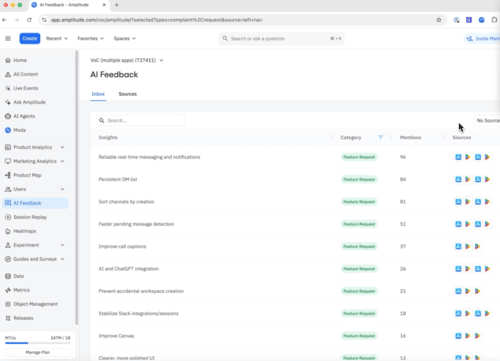
🔍 Monitored sources: ChatGPT and Google AI Overview confirmed on all plans; Claude, Gemini, and Perplexity referenced elsewhere by Amplitude but not consistently confirmed
✅ Pros:
- Ties AI brand visibility directly to activation, feature usage, and revenue through Amplitude’s existing product analytics
- Free permanent plan
- Provides visibility score, competitor benchmarking, and source/citation analysis
❌ Cons:
- Exact engine coverage is unclear and possibly the narrowest on this list; confirmed at 2 engines on the product page versus up to 4-5 referenced in other Amplitude materials
- Only useful as a dedicated AI-visibility tool if you’re willing to bring a full product analytics platform along with it

Conclusion
AI Overviews already reach 75.24% of personalized U.S. Google searches, and that share is still climbing. A brand that shows up inside that answer gets the click. That’s the entire case for putting one of these twelve tools to work in 2026.
You don’t need all twelve of these tools running at once, and the most expensive one on this list isn’t automatically the right one for you.
FAQ
It’s a platform that repeatedly sends real, customer-style prompts into AI search engines like ChatGPT, Gemini, Claude, and Perplexity, then tracks brand visibility in AI-generated answers by evaluating both mentions and citations. AI presence is how often and where a brand appears in AI search results, and these tools measure it.
Regular SEO software measures a brand’s position in search engines. An AI visibility tool measures whether a brand exists inside a generated answer at all, plus the sentiment and sourcing behind it. There’s no “page one” to climb toward here, only presence, prominence, and tone.
Start with the systems that shape the most discovery today: ChatGPT, Gemini, Perplexity, and Google AI Mode. Add Claude and Copilot if your audience is technical or enterprise. Watch DeepSeek and Grok if your category has a global or younger-skewing audience. Some tools include conversation-explorer-style features that surface the prompts behind the analysis. In general, more sources tracked means a more complete picture.
Most tools on this list, including Chatbeat, offer a free trial or a limited free check, enough to see whether a brand shows up at all. Ongoing tracking requires a paid plan, since repeated querying across multiple models costs the vendor real money to run.
Entry tiers generally run $25-100/month for small teams, mid-tier plans sit around $150-300/month, and enterprise pricing goes well beyond that, depending on prompt volume and engine coverage.
It depends on what your listening tool already covers. Some social listening platforms, including Brand24, are adding AI-visibility modules like Chatbeat, which lets you consolidate both into one account. Others, like Brandwatch and Mention, are building similar AI-monitoring layers into their own platforms. If your current stack doesn’t ingest AI-referred mentions yet, a standalone GEO tool from this list is the faster path in the meantime.