Table of contents
2M Marketers

Earned media value (EMV) measures how much your brand’s organic visibility (mentions, shares, and media coverage) is worth in monetary terms.
Sounds simple, but in reality, EMV is one of the most inconsistently calculated metrics in marketing.
This guide breaks down how to measure the value of earned media step by step and shows you how to make it useful for evaluating your PR and marketing performance.
Key takeaways:
-
Earned media value (EMV) shows what your brand visibility is worth in money
It assigns a monetary value to organic mentions, based on reach, engagement, and context.
-
There’s no single EMV formula
You can calculate it using reach (CPM), engagement (CPE), or hybrid models that combine both.
-
The most accurate approach combines multiple factors
Hybrid models adjust EMV based on engagement rate, sentiment, and content quality.
-
EMV has clear limitations
It doesn’t measure revenue and can vary depending on the method or tool used.
-
You need additional metrics for full context
Reach, engagement, sentiment, and share of voice help explain what EMV alone can’t.
-
Specialized tools help you track and calculate earned media value
Media monitoring and social listening tools like Brand24 collect mentions and provide the data needed to estimate value of earned media.
What is earned media value? Definition
Earned media value (EMV) is a way to estimate how much your brand’s organic exposure is worth in money. It’s an estimate of what you’d have to spend to achieve the same exposure through ads.
In this case, “organic” means unpaid mentions from third-party sources, like:
- Press coverage – articles, interviews, or features in online media
- Social media mentions – posts, comments, or threads about your brand
- Customer reviews – on platforms like Google, G2, Capterra, App Store, etc.
- Influencer mentions (non-sponsored) – organic posts, not paid collaborations
- User-generated content (UGC) – photos, videos, or posts created by your customers
Quick examples of earned media
| Situation | Is this earned media? | Why? |
|---|---|---|
| A journalist writes about your product | ✅ Yes | Independent, unpaid coverage |
| A customer posts a TikTok review | ✅ Yes | Organic user-generated content |
| An influencer mentions you without any deal | ✅ Yes | Organic, genuine recommendation |
| You run a Meta ad | ❌ No (paid media) | You paid for placement |
| You publish a post on your company’s Linkedin page | ❌ No (owned media) | You control the content |
| You pay an influencer for a sponsored post | ❌ No (paid media) | Sponsored = not earned |
In other words, EMV translates organic visibility into a dollar amount by answering: “If we had to pay for the same exposure in an ad, how much would it cost?”
Most EMV calculations are based on three elements:
- Reach – how many people could see the mention
- Engagement – whether people interact with it (likes, comments, shares)
- Source – where it appears and how influential or credible it is
How to calculate earned media value (EMV)
Earned media value can be measured in different ways, depending on how much context you include.
If you look at different tools and articles, you’ll see different calculations. That’s because EMV is an estimate based on how you choose to value attention.
In practice, most approaches fall into three groups:
01 Basic method: reach-based EMV
This is the simplest method. It uses advertising pricing as a reference point: a metric called CPM.
CPM (cost per mille) means the cost of reaching 1,000 people with paid advertising.
For example, if a platform charges $10 CPM, it means: you pay $10 to show your ad to 1,000 people.
In this case, the earned media value formula would look like this:
EMV = (Impressions ÷ 1,000) × CPM
Example 1: 50,000 impressions with a $10 CPM = $500 EMV
Example 2: A TikTok mention of Garmin with 955,000 impressions with a $10 CPM = $9,550 EMV

| Aspect | What it means |
|---|---|
| What it measures | Estimates how much it would cost to buy the same reach using ads |
| How it works | Treats every impression as having equal value |
| Strength | Simple, fast, easy to compare |
| Limitation | Ignores engagement, sentiment, and context |
02 Engagement-based EMV (CPE model)
This approach focuses on interactions instead of just reach.
Instead of CPM, it uses CPE (cost per engagement) or assigns value to each type of interaction.
CPE (cost per engagement) is a metric that shows how much you pay for a single interaction (a like, comment, or share) in paid campaigns.
Example values:
- Like = $0.10
- Comment = $0.50
- Share = $1.00
Here, the EMV formula would look like this:
EMV = (Likes × value) + (Comments × value) + (Shares × value)
Example 1:
Let’s say your post generated:
- 100 likes
- 50 comments
- 20 shares
EMV = (100 × $0.10) + (50 × $0.50) + (20 × $1.00)
= $10 + $25 + $20
= $55 EMV
Example 2:
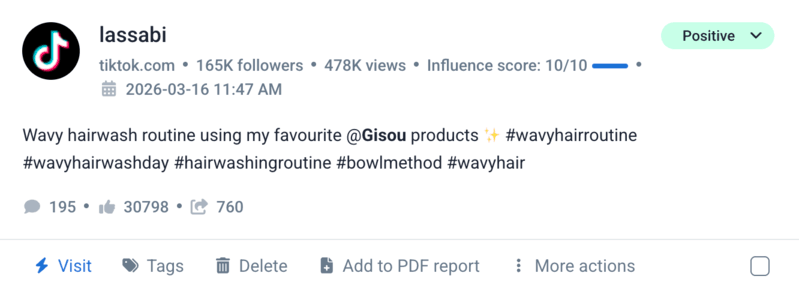
An organic TikTok post mentioning a viral beauty brand, Gisou, generated:
- 30,798 likes
- 195 comments
- 760 shares
EMV = (30,798 × $0.10) + (195 × $0.50) + (760 × $1.00)
= $3,079.8 + $97.5 + $760
= $3,937.3 EMV
| Aspect | What it means |
|---|---|
| What it measures | Estimates the value of interactions (likes, comments, shares) |
| How it works | Assigns a monetary value to each type of engagement |
| Strength | Reflects actual user interest and activity |
| Limitation | Ignores reach and overall visibility |
03 Hybrid EMV (reach + engagement + context)
This is the most advanced approach.
It combines reach, engagement, and additional adjustment factors like sentiment, content quality or relevance.
The adjustment factor is a multiplier that reflects the quality of the mention.
For example, it can increase or decrease EMV based on:
- sentiment (positive vs negative)
- source credibility (major media vs small blog)
- relevance (on-topic vs random mention)
Examples of adjustment factors based on sentiment:
- Positive mention: ×1.2
- Neutral mention: ×1.0
- Negative mention: ×0.5
So, the EMV formula in this approach would look like this:
EMV = (Impressions ÷ 1,000 × CPM) × engagement rate × adjustment factor
Quick example:
Imagine your brand monitoring tool flags that your brand just got mentioned in a viral post:
- Most reactions have positive sentiment
- It reaches 100,000 people
- It gets 5,000 interactions (likes, comments, shares)
Step 1: Estimate the value of reach
We start with CPM:
- $10 CPM means: $10 to reach 1,000 people
- 100,000 impressions = 100 × 1,000
- Your base EMV = $1,000 (this is what it would cost to buy the same reach as ads)
Step 2: Adjust for engagement
Now we check how many people actually interacted:
- 5,000 interactions out of 100,000 views
- Engagement rate = 5%
This means:
- most people just saw the content
- only a small portion engaged
So we reduce the value:
$1,000 × 0.05 = $50
Step 3: Adjust for sentiment
Now we look at quality:
- The mention is positive
- Adjustment factor = x1.2
So we increase the value slightly:
$50 × 1.2 = $60 EMV
Step 4: Final EMV
$1,000 × 0.05 × 1.2 = $60 EMV
Example with real data:
Let’s say you’re tracking a viral TikTok post about IKEA kitchens:

- The post reaches 11M views
- It generates:
- 855,239 likes
- 20,042 comments
- 113,169 shares
- The sentiment is neutral
Step 1: Estimate the value of reach
We start with CPM:
- Assume $10 CPM (cost per 1,000 impressions)
- 11,000,000 impressions = 11,000 × 1,000
Base EMV = 11,000 × $10 = $110,000
Step 2: Adjust for engagement
Now we check how people reacted:
- Total interactions = 988,450
- Engagement rate = 988,450 ÷ 11,000,000 ≈ 9%
This tells us:
- the post didn’t just reach people
- it actually drove strong interaction
So we adjust the value:
$110,000 × 0.09 = $9,900
Step 3: Adjust for sentiment
Now we look at context:
- Sentiment = neutral
- Adjustment factor = ×1.0
So the value stays unchanged:
$9,900 × 1.0 = $9,900 EMV
Step 4: Final EMV
$110,000 × 0.09 × 1.0 = $9,900 EMV
| Aspect | What it means |
|---|---|
| What it measures | Estimates overall impact (visibility + interaction + quality) |
| How it works | Combines reach with engagement and adjusts based on context |
| Strength | More complete and closer to real impact |
| Limitation | Not standardized: the results depend on how factors are defined |
Is it worth measuring the value of earned media?
Yes, but only if you understand what this metric represents.
EMV is not a performance metric in the same sense as conversions or revenue. It’s an estimation of visibility and attention, based on earned media signals.
When EMV is misleading
It’s pretty simple: when you treat it as a standalone number.
For example:
- You focus only on reach: A mention seen by 100,000 people looks great but if no one engages, its real impact is much limited
- You ignore sentiment type: Negative press or complaints can still generate high EMV, even though they harm your brand
- You compare numbers across tools: Different platforms calculate EMV differently, so results aren’t directly comparable
When EMV is useful
EMV is most useful when you treat it as a comparative metric, not an absolute one.
It works best when you use it to:
- Compare campaigns over time: to see which activities generate more visibility
- Benchmark your own performance: to track whether your PR efforts are improving
- Estimate the scale of exposure: to understand how much attention your brand is getting
What to watch out for when calculating EMV
Before you rely on earned media value, it’s worth knowing what can go wrong.
01 Different tools calculate it differently
There’s no standard formula for EMV. Each tool and model measures it differently.
Some models use:
- advertising equivalents (CPM, CPC)
- engagement-based values (likes, comments, shares)
- custom multipliers/adjustment factors
That’s why the same campaign can produce different EMV depending on the tool or method.
Example:
A mention with 100,000 reach might be valued at $1,000 in a CPM-based model, but only $200-$300 in an engagement-based model if interaction is low.
02 You don’t always see how it’s calculated
Only some media monitoring tools clearly show how EMV is calculated.
You might see the final number without knowing:
- what data was included
- how different interactions were valued
If the method isn’t clear, it’s difficult to evaluate how reliable the result is.
03 The formula needs to match your goals
EMV should reflect your marketing goals precisely.
For example:
- if you focus on reach: visibility will dominate the result
- if you include engagement: interaction becomes more important
If the calculation doesn’t match your priorities, the result can be misleading.
Example:
A PR campaign focused on brand awareness may look successful in a reach-based model (high EMV), but the same campaign can look weak in an engagement-based model if people didn’t interact with the content.
04 It’s easy to overinterpret the number
EMV is useful, but incomplete.
Used on its own, it can:
- exaggerate low-quality visibility
- hide negative sentiment
- miss what actually drives your marketing results
Example:
A campaign can generate high EMV because it was widely mentioned, but sentiment analysis may show that a large share of those mentions was negative.
EMV vs other metrics
EMV combines reach, engagement, and other signals into one number.
But it doesn’t show:
- whether people interacted
- whether the mentions were positive or negative
- what actually drove the spike
That’s why you need other metrics alongside it.
| Metric | What it helps you understand | When to use it | What to watch out for |
|---|---|---|---|
| EMV | Overall value of earned media | Comparing campaigns or PR results | Can hide what actually drove the result |
| MIV | Value of media/influencer placements | Influencer & media performance analysis | Proprietary: hard to compare across tools |
| ROI | Business outcome (revenue vs cost) | Performance and growth tracking | Doesn’t capture awareness or PR impact |
| AVE | Ad-equivalent value of coverage | Traditional PR reporting | Oversimplified, often misleading |
FAQ
What is earned media value?
Earned media value (EMV) estimates how much your brand awareness and exposure from unpaid sources, like media coverage, social media mentions, or influencer content, would be worth if you paid for it.
It translates reach and engagement into a monetary value to help you quantify visibility.
What does earned media value mean in practice?
In practice, EMV shows the value of attention your brand earns organically.
Instead of measuring just impressions or clicks, it combines visibility and interactions into a single number you can use for reporting and comparison.
What is the earned media value formula?
There’s no single standard formula for EMV.
The most common approaches are:
- Reach-based: impressions × CPM
- Engagement-based: interactions × cost per engagement (CPE)
- Hybrid: combines reach, engagement, and sometimes sentiment
The exact formula depends on the methodology or tool you use.
What are the best tools for tracking earned media value?
Tools for tracking EMV usually fall into three categories. Here are some of the best options to check out:
- Brand24 for media monitoring of mentions, reach, sentiment, and engagement across web and social
- Muck Rack for PR coverage and media impact tracking
- HypeAuditor for influencer campaign performance and audience quality
📚 Further read: Best PR Tools for Analytics, Monitoring, Outreach & More [2026]
What is earned media value in influencer marketing?
In influencer marketing, EMV measures the value generated by influencer content based on reach, engagement, and audience quality.
Two creators with similar follower counts can produce very different EMV depending on how their audience interacts with the content.
📚 Further read: 11 Key Influencer Marketing Metrics You Should Track in 2026
What is the average earned media value?
There’s no universal benchmark for EMV. The value depends on your industry, channel, and campaign type.
Instead of comparing your brand’s EMV to a general average, it’s more useful to track changes over time or compare results across your own campaigns.