Table of contents
2M Marketers

Your customers are talking about your brand right now—on Reddit, in TikTok comments, on X, and on Instagram. Most of these posts aren’t tagged. Most go unnoticed. And it’s precisely where social media listening can increase customer advocacy.
Brands that succeed at building loyalty simply listen better. Social listening insights provide the infrastructure to understand customer needs in real time, identify emerging trends, and engage the right people at the right moment.
Here’s exactly how.
Key takeaways
-
Responding to mentions builds trust
44% of people find brand responses to comments more meaningful than paid ads and social listening ensures you never miss a critical conversation
-
Your best advocates are already talking about you
Social listening helps you identify loyal customers and micro-influencers who already love your brand — the most authentic (and cost-effective) promoters you can find
-
User-generated content outperforms influencer content by 8x
Monitor UGC, reshare it, and reward creators to build a self-sustaining advocacy loop
-
Sentiment analysis shows you what's really driving loyalty
Tracking sentiment trends over time reveals recurring pain points and helps you fix the issues that matter most to customers.
What is customer advocacy?
Customer advocacy is a situation when customers are actively promoting and recommending a brand, product, or service to others.
They may share positive experiences through word-of-mouth, reviews, or social media, influencing others to trust and buy from the brand.
Why should you care about customer advocacy?
Let me share two stats:
- According to McKinsey research, in-person recommendations are the primary factors behind 20 to 50% of all purchasing decisions.
- Nielsen’s study found that 92% of consumers trust earned media, such as recommendations from friends and family. More than any other form of advertising.
This means that customer advocacy is an extremely trustworthy and powerful driver of purchasing decisions!
But how can you identify potential advocates and encourage them to evangelize your brand? And how to scale it?
The answers lie in social media listening.
What is social media listening?
Social media listening is the process of tracking social media conversations to gain insights and – ultimately – take strategic actions that improve business performance.
The whole process is pretty straightforward and consists of four phases:
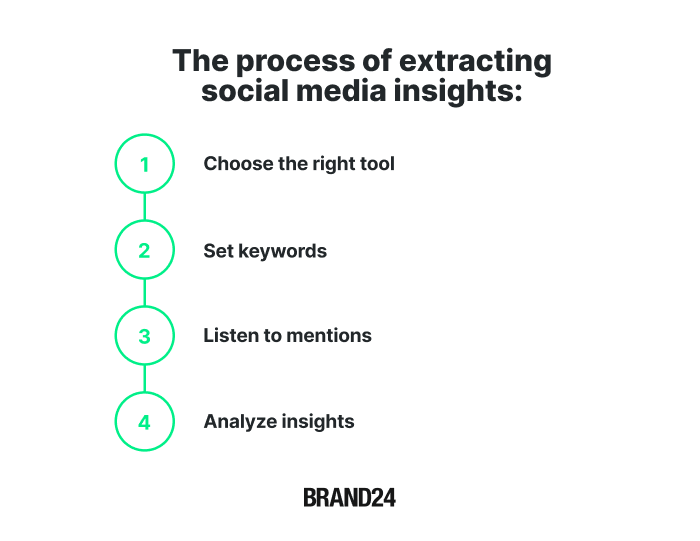
01 Choose the right tool
To perform social media listening, you need to equip yourself with the right software.
Here’s what to consider when researching the social media listening tools:
- Coverage of social media platforms – the more social media channels the tool monitors, the broader & comprehensive your insights will be;
- Real-time media monitoring – the tool should provide instant alerts and notifications when your brand is mentioned;
- Ease-of-use – no matter how advanced, the tool should be intuitive and easy to navigate;
- Sentiment analysis– it should recognize customer sentiment (positive, negative, neutral);
- AI-driven insights – the social media listening software should go beyond just collecting mentions and offer actionable, AI-powered insights.
In this article, I’ll present Brand24 – the top social listening software with broad coverage of social platforms and helpful AI features.
You might wonder why social listening tools are better than native social media analytics solutions like Meta Business Suite.
Well, there are two major advantages of social media listening tools:
- You can gather, track, and analyze mentions from multiple social media platforms at once.
- You can track both tagged and untagged mentions (native solutions can’t).
See our article presenting the top social listening tools.
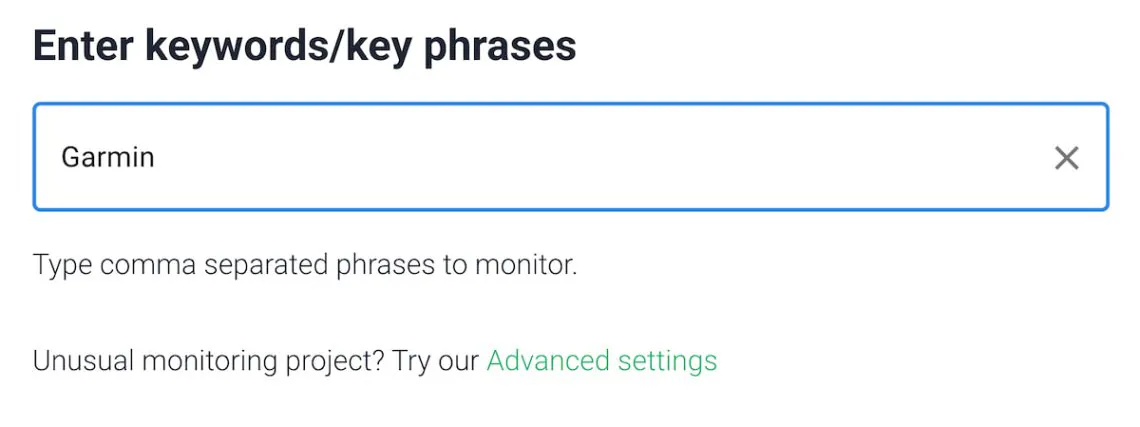
02 Set keywords
To start social media listening, you need to define a keyword or keywords – such as your brand name, competitors, or industry terms – to track.
03 Listen to mentions
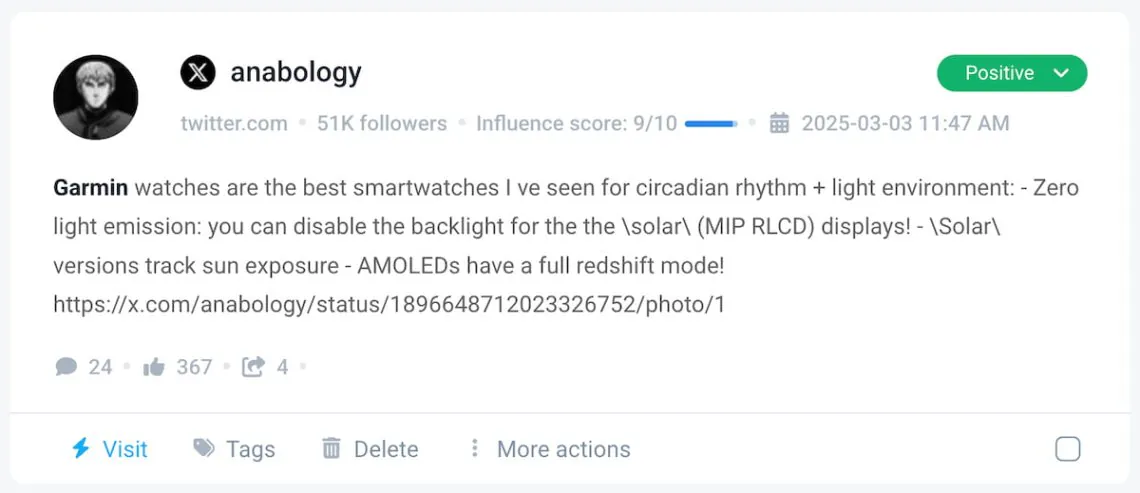
Each time someone uses your tracked keyword in an online conversation, it counts as a mention and is stored in the tool’s database for analysis.
04 Analyze insights
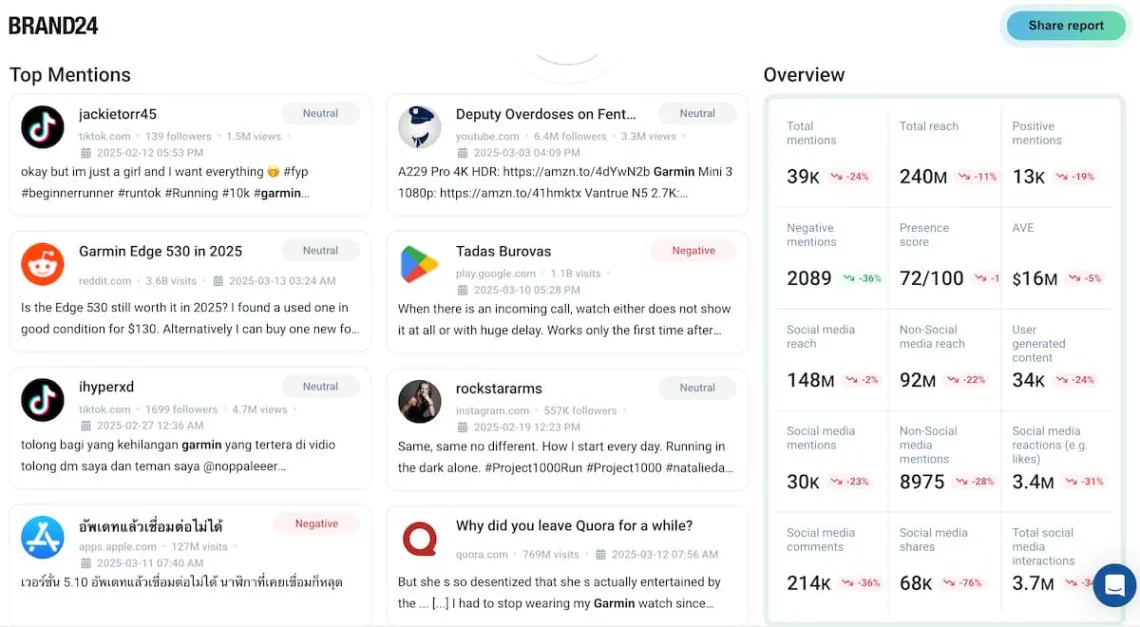
Depending on the tool, you can analyze individual mentions (such as source, sentiment, reach, etc.) and uncover broader trends (such as which topics generate the most buzz, top influencers, etc.).
Why is social media listening important to increase customer advocacy?
Customer feedback is rare like finding matching socks straight out from the laundry machine.
In fact, according to the study conducted by Fera.ai, the average review submission rate is only 10%.
Okay, and why does it even matter?
Because, according to the BrightLocal Consumer Review Survey 2025, 42% of people trust consumer reviews as much as personal recommendations from friends and family.
Impressive number?
Indeed, but at the same time, it marks an 8% decline compared to 2024.
There are many reasons behind that drop, such as growing awareness that many businesses unfairly pay for positive reviews or the fact that 30 – 40% of online reviews are simply fake.
At the same time, people are keen on actively discussing brands, products, and services through social media.
It’s worth noting that as much as 76% of consumers trust more in the content the “normal people” share rather than traditional advertising or branded content.
The takeaway?
These observations underscore the growing influence of organic, user-generated content over carefully crafted marketing messages.
In other words, people are shifting from traditional advertising and reviews to authentic, unfiltered conversations happening on social media.
This makes it even more crucial for brands to monitor organic conversations on social media and other online platforms.
Because that’s where real advocacy happens.
How social media listening can improve customer advocacy? 4 ways
Now, let’s put the social listening strategy into practice.
I’ll present you four ways you can use it to enhance customer advocacy.
| Method | What it does | Best for |
|---|---|---|
|
1
Respond to critical mentions
|
Identifies and prioritizes top social media mentions for fast response |
Brands with high mention volume; crisis-prone industries (finance, healthcare, retail) |
|
2
Identify top brand advocates
|
Surfaces influential customers already promoting your brand organically |
Brands seeking authentic nano/micro-influencer partnerships on a limited budget |
|
3
Leverage UGC
|
Discovers customer-created content for resharing and advocacy amplification |
E-commerce, lifestyle, and B2C brands building community-driven marketing |
|
4
Monitor brand sentiment
|
Tracks overall sentiment trends to identify and resolve pain points early |
All brands — especially post-product launch, post-campaign, or post-crisis |
01 Discover critical social media mentions and respond to them
Discovering mentions published on various social media platforms is a primary task of social listening tools.
And the necessary first step in responding to them.
Fine, but should you even care? Does responding to social media posts or comments impact customer advocacy?
The answer is: definitely yes!
According to Edelman’s Trust Barometer, 44% of people perceive brand conversations (i.e., responses to comments) as more significant than what the brand says in its advertising.
No wonder – advertising is almost always painting a perfect picture. The reality is often totally different.
Moreover, as Bain & Company states, engaging with customers via social media creates loyalty and makes them spend up to 40% more.
When brands engage in real conversations – answer questions or react to negative feedback – they demonstrate authenticity and build trust.
And trust is one of the core foundations of customer advocacy.
How to discover the most important social media mentions with social listening?
Discovering social media mentions with Brand24 is effortless.
It’s enough to visit the Mentions tab and apply two filters:
- Date range;
- Sources filter – as Brand24 covers both social and non-social sources, filter your results to Facebook, Instagram, X (Twitter), TikTok, Videos (there’s YouTube, etc.), and Other Socials (Reddit, Twitch, Telegram, etc.).
Now, sort the results by popular first.
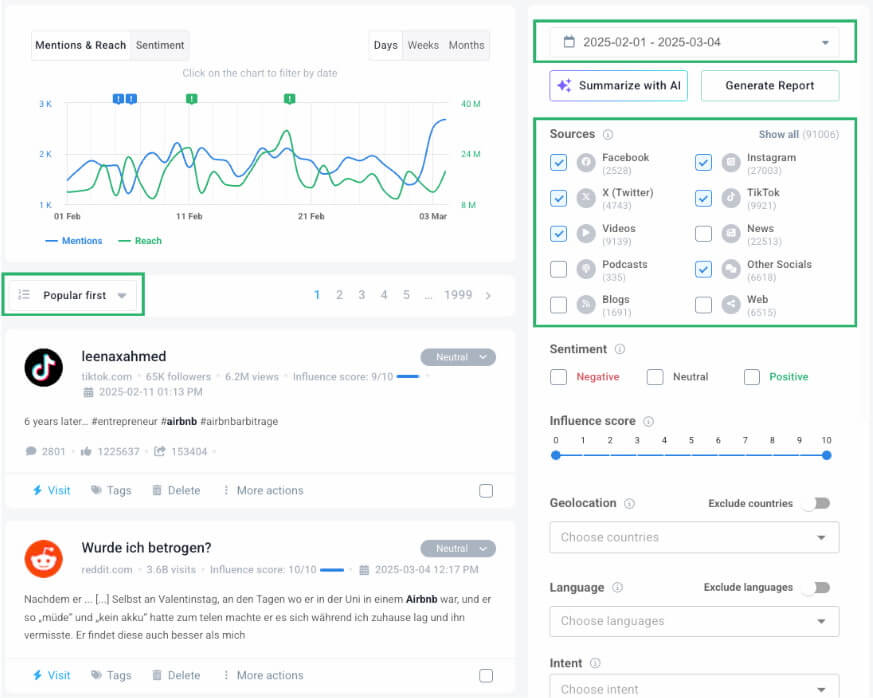
This is how you’ll discover your most important mentions. Now, it’s your turn to dig through them, identify potential customer concerns, and respond to them.
02 Identify and engage your top brand advocates
Engaging your existing and influential brand fans is one of the most effective ways to strengthen customer advocacy.
Why?
Data shows that 69% of consumers trust influencers’ recommendations more than information directly from a brand.
The key is to find your most influential customers on social media – those who already like and talk about your brand.
As they’ve already had good experiences with your products, they’ll be more open to working with you and will sound more authentic to their followers.
That’s what makes them so effective – they already trust your brand, and their audience trusts them. When engagement and reach come into play, their advocacy becomes a real force.
Brand Advocacy Power = Trust x Engagement x Reach
Pro Tip: Cooperate with nano- and micro-influencers
For many brands, nano- and micro-influencers partnerships are the most cost-effective.
Smaller influencers are easier to negotiate with and expect lower fees. Although they have a smaller reach than mid-tier and large influencers, they generate much higher engagement:
⭐ Nano-influencers (1,000 – 10,000 followers) enjoy a 13% engagement rate;
⭐ Micro-influencers (10,001 – 50,000 followers) enjoy a 9.5% engagement rate.
How to identify your top brand advocates with social media listening?
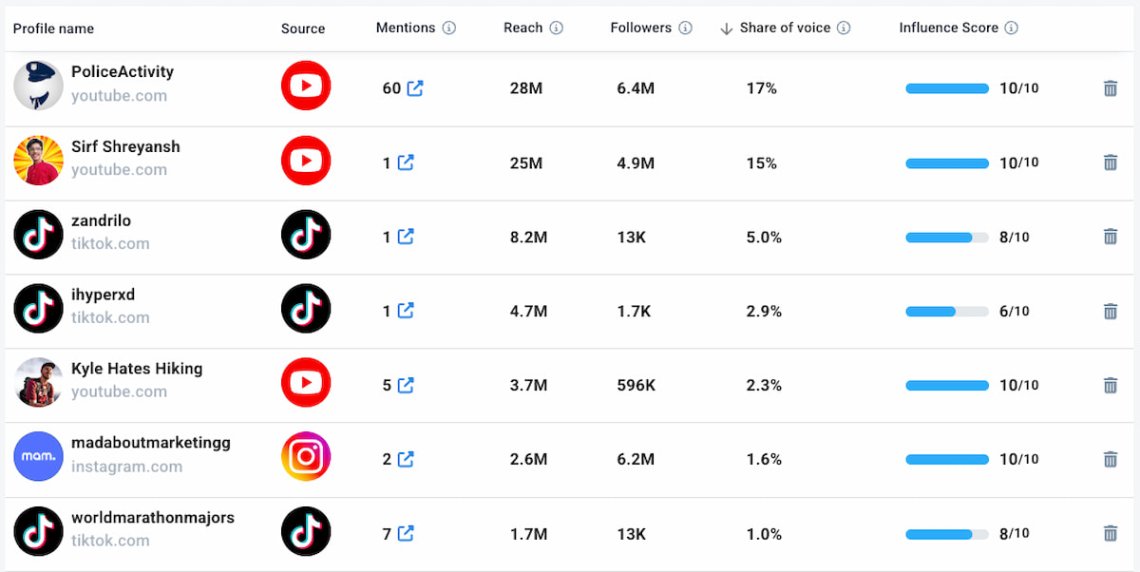
To see your most influential brand advocates, visit Brand24’s Influencers tab and apply two filters (the same as in the case of mentions):
- Date range;
- Sources – Facebook, Instagram, X (Twitter), TikTok, Videos (there’s YouTube, etc.), and Other Socials (Reddit, Twitch, Telegram, etc.).
To see which profiles matter the most, sort the results by share of voice.
As you can see, in the case of Garmin, there’s a huge diversification in terms of platforms.
Among the top 7 profiles, there are 3 YouTube channels, 3 TikTokers, and 1 Instagram profile.
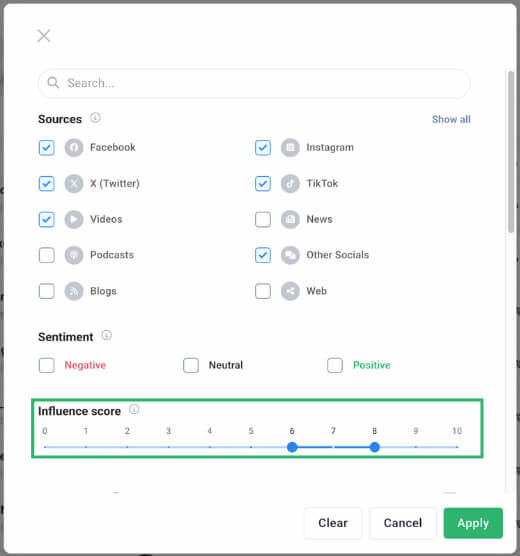
If you’d like to use my pro tip and check only nano- and micro-influencers, you should apply one more filter.
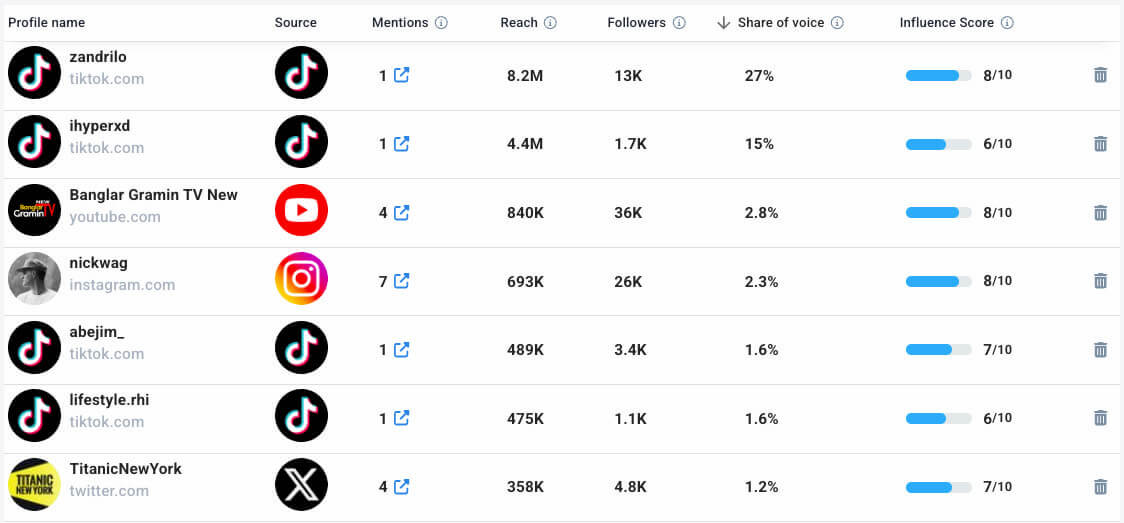
Set the Influencer Score slider to the range 6 to 8. It will limit the search to profiles with 1,000 – 50,000 followers.
Garmin’s social media platforms diversification is visible again but with a higher share of TikTok profiles.
03 Leverage user-generated content
As its name suggests, user-generated content (UGC) is content created by customers rather than the brand itself.
It serves as authentic, word-of-mouth marketing that resembles unpaid influencer collaborations. However, user-generated content is generally more powerful than influencer marketing.
According to Social Media Today research, consumer-created content has an 8x greater impact on purchase decisions than content made by influencers.
What’s even more noteworthy – people simply want to be shared!
The EnTribe’s State of UGC report unveils that 55% of GenZers want to be featured on brands’ social media pages.
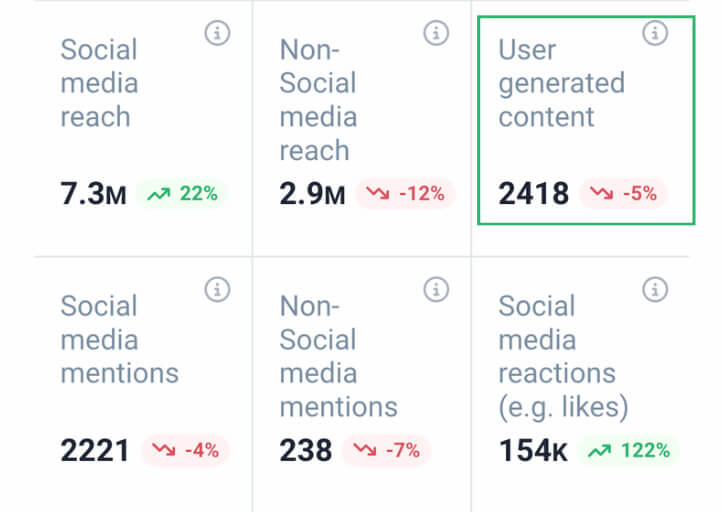
So, basically, you don’t need to struggle for UGC – rather, you should encourage it through your actions. What actions?
You can, for example:
- Reshare UGC on your social media channels
- Offer incentives, discounts, or exclusive awards
Leveraging user-generated content beneficial on many levels:
- When a brand shares customer-generated content, it increases its (customers’) exposure and can boost its follower count.
- Authentic and organic content presenting customer satisfaction increases the positive brand reputation.
- When a brand regularly re-shares customer content, it encourages others to create it. In other words, you create a customer advocacy-friendly environment!
How to discover your top user-generated content with social media listening?
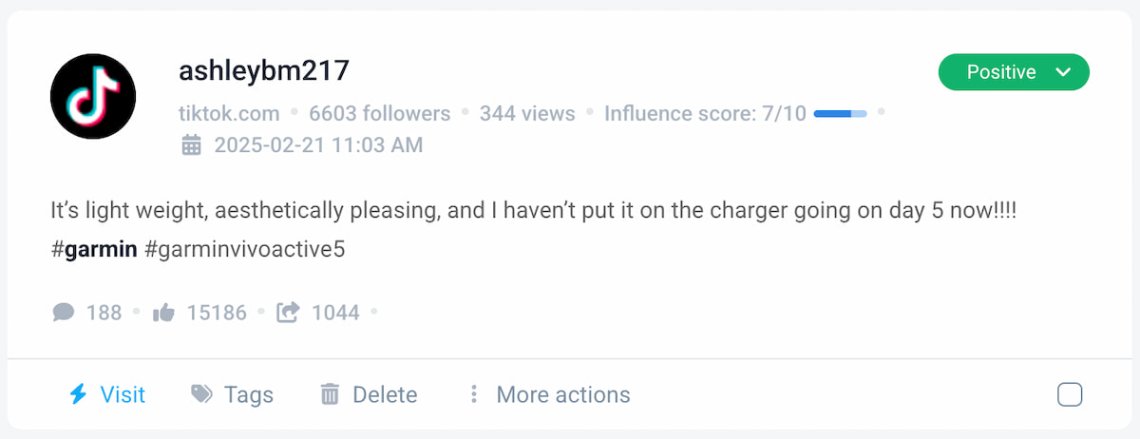
To check your top user-generated content, it’s enough to visit Brand24’s Mentions tab and apply the following filters:
- Date range;
- Sources – Facebook, Instagram, X (Twitter), TikTok, Videos (there’s YouTube, etc.), and Other Socials (Reddit, Twitch, Telegram, etc.).
- Intent – limit search to “Opinion sharing”.
And just like before, sort the results by “Popular first”.
This way, you’ll see the list of top opinion-sharing content created by your (hopefully!) satisfied customers.
04 Monitor and improve brand sentiment
Customer advocacy isn’t just about encouraging positive conversations – it’s also about understanding and managing how people really feel about your brand.
Monitoring brand sentiment allows you to track changes in public perception, identify industry trends, and address customer concerns to strengthen your loyal customer base.
So, think of sentiment analysis as a bird’ s-eye view of customer emotions – it helps you spot more general patterns rather than focusing only on individual mentions.
It’s a priceless source for understanding:
- Product or service quality – which issues regularly cause an increase in negative sentiment?
- Communication effectiveness – is your social media presence well across all platforms, or are some channels underperforming?
- Customer experience – are there repeating complaints about customer support or usability?
- Brand perception over time – do your efforts improve your brand sentiment or quite the opposite?
All of these factors directly impact your ability to build healthy foundations for customer advocacy.
When people feel heard and valued, they are much more likely to praise your brand publicly.
How to monitor and improve brand sentiment with social media listening?
Brand24 offers a very comprehensive sentiment analysis.
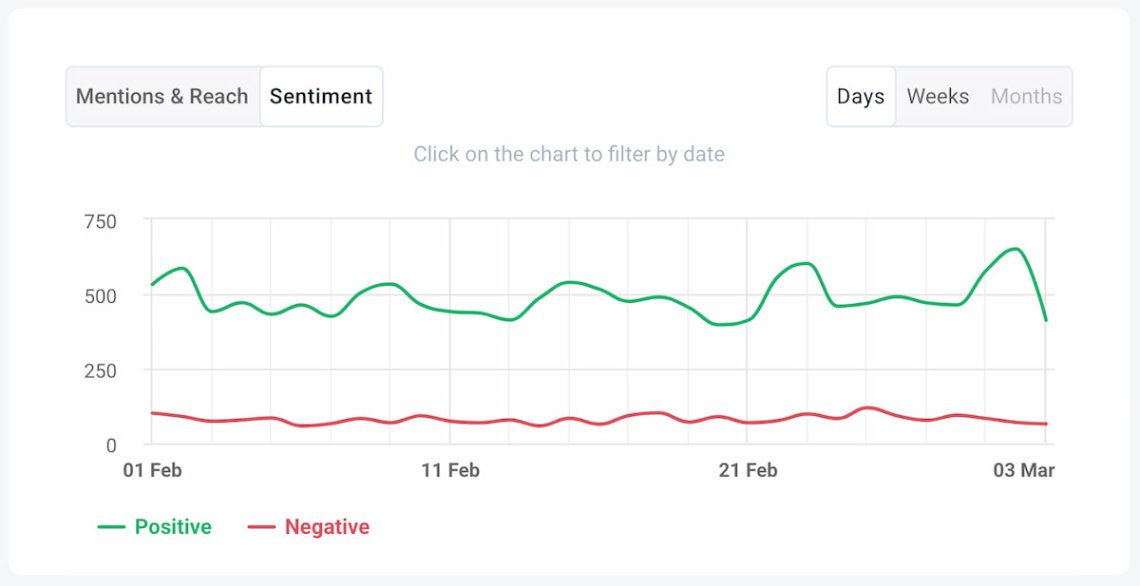
The great starting point is the Mentions tab, where you can see the sentiment chart. It reveals the general trend of your social media mentions.
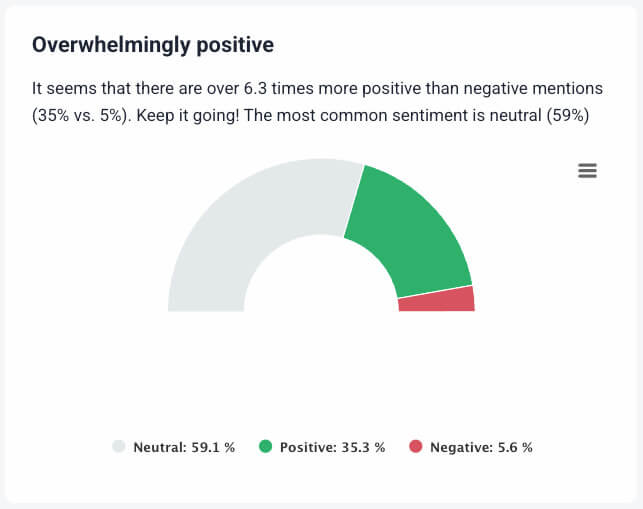
Next, you can visit AI Metrics Analysis to see the summary of your sentiment.
For example, Garmin’s positive mentions occur over 6 times more frequently than negative ones.
To identify which issues repeatedly cause negative feedback, you can use the AI Brand Assistant.
This feature works as ChatGPT, but – unlike ChatGPT and other AI tools – it is equipped with internal project data. Therefore, Brand Assistant’s insights are much more accurate.
For example, I asked it to share the top 3 issues that constantly bring negative sentiment to Garmin.
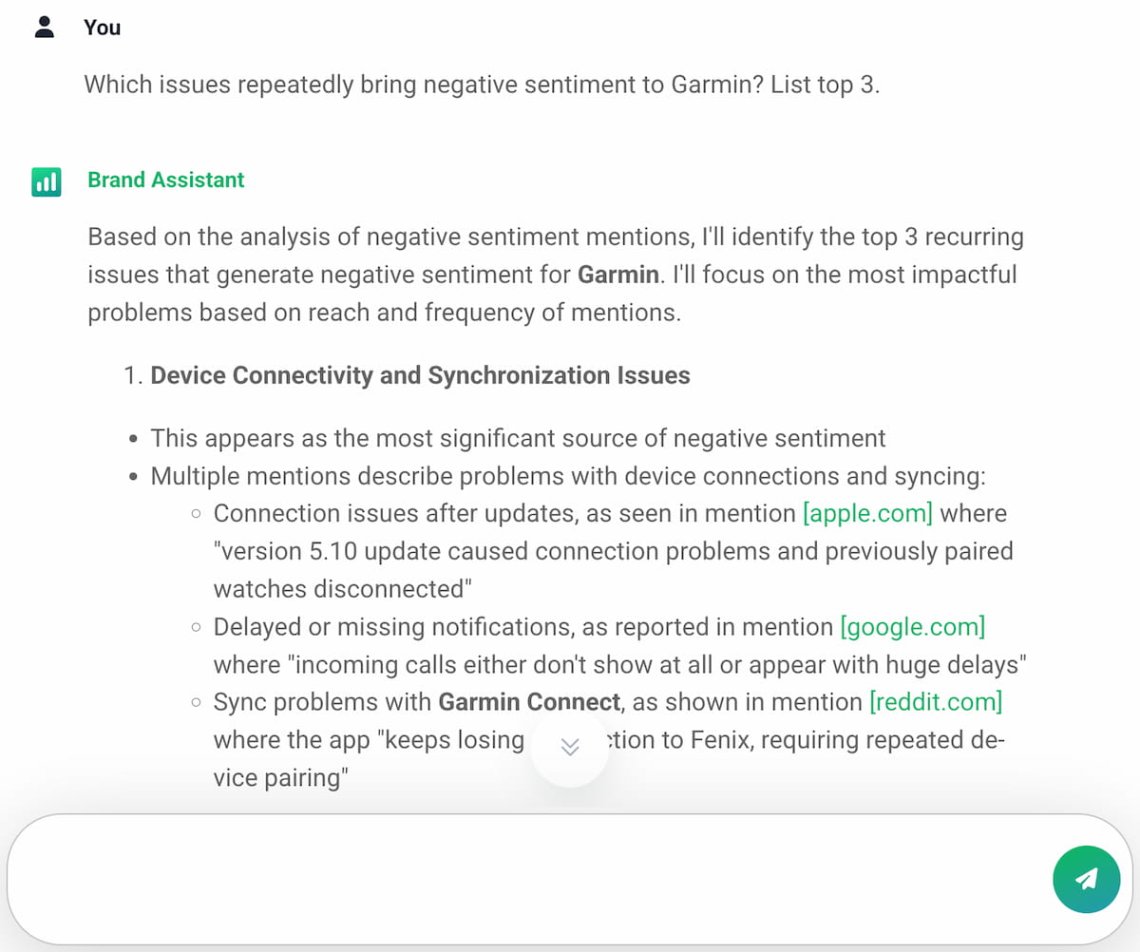
The AI Brand Assistant responded that these are:
- Device connectivity and synchronization issues (I totally agree! I constantly have these problems with my Garmin watch!);
- Hardware reliability;
- Software-related glitches.
The conclusion is that Garmin should focus on resolving its product-related issues if it wants to improve its customer advocacy efforts.
FAQ
What is customer advocacy?
Strong customer advocacy is one of the most cost-effective forms of marketing: according to McKinsey, it drives 20–50% of all purchasing decisions.
What is the difference between customer advocacy and brand advocacy?
How does social media listening help increase customer advocacy?
1. It identifies critical mentions so brands can respond quickly and build trust.
2. It surfaces top brand advocates — existing customers who already promote the brand — enabling brands to engage and amplify them.
3. It discovers user-generated content (UGC) that can be reshared to reward and encourage advocates.
4. It monitors brand sentiment to identify and fix pain points before they damage customer relationships.
How do you measure customer advocacy?
Net Promoter Score (NPS) — surveys customers on likelihood to recommend.
Brand mentions volume — tracks how often customers organically mention the brand online.
Sentiment ratio — the proportion of positive vs. negative mentions.
UGC volume — the amount of unprompted, customer-created content.
Share of voice — how often your brand appears in conversations relative to competitors.
Social media listening tools like Brand24 can track mentions, sentiment, and UGC automatically in real time.
What are examples of customer advocacy in practice?
What is the best tool for tracking customer advocacy on social media?
What is the best tool for tracking customer advocacy on social media?
How do I build a customer advocacy program using social media listening?
1. Set up keyword monitoring for your brand name, products, and key hashtags.
2. Identify your top advocates using the Influencers tab (sorted by share of voice).
3. Reach out to top advocates and offer value (early access, features, perks).
4. Reshare their UGC to reward their content and encourage others.
5. Monitor sentiment trends monthly to catch satisfaction drops early.
6. Use AI Brand Assistant to identify recurring issues that erode advocacy.
Start the Brand24 14-day free trial and skyrocket your brand advocacy!