Table of contents
2M Marketers

Open TikTok. Search your brand name. The video at the top of your screen is probably worth more than your last paid campaign… and until two minutes ago, you didn’t know it existed. That’s the gap TikTok social listening is built to close.
In this guide: a TikTok social listening setup, the four factors that really matter (sounds, comments, sentiment spikes, creator overlap), the three tools worth your money in 2026, and benchmarks for what “good” looks like.
No “what is TikTok” basics.
Let’s go!
Key takeaways
-
What is TikTok social listening?
It's the practice of tracking, analyzing, and acting on every conversation about your brand happening on TikTok, including the videos and comments where nobody bothered to tag you.
-
Why does it matter for brands?
TikTok runs on virality and audio, and according to Capital One Shopping research, 49% of TikTok users have purchased a product after discovering it on the platform – many of them through TikTok Shop. The only way to know about that conversation in time to react is to be listening continuously, not checking notifications in the app.
-
How do you start TikTok social listening?
Pick a tool that monitors TikTok natively, set up keywords for your brand and competitors, turn on real-time alerts for spikes, and check the Mentions tab daily for the first two weeks. That's it, the strategy comes from what you find.
What is TikTok social listening?
TikTok social listening is the process of monitoring TikTok content like videos, comments, captions, and hashtags to understand what’s being said about your brand, your competitors, and your category.
You can think of it as continuous market research that updates every minute, much better than a quarterly survey nobody trusts by the time it lands.
In simple words: it’s how you find every TikTok where someone is talking about you, even if they didn’t tag you, mention you in the caption, or use your brand hashtag.
Here’s what makes it different from just scrolling through your notifications.
- When a creator says your brand name out loud in a video, that’s a mention.
- When 200 people comment your name under a “what’s your favorite X” video, those are mentions too.
A social listening tool automatically captures all of this.
You’d see a spike on a Tuesday afternoon, click through, and find out a creator just shared a 90-second tutorial with 400K views. You’d know within an hour, not three days later, when your warehouse is wondering why everyone wants what they promoted.
Why TikTok brand mentions matter?
TikTok is no longer “that app for dancing teenagers” and hasn’t been for years.
It’s where product discovery happens for Gen Z.
Google’s own senior VP, Prabhakar Raghavan, publicly shared internal data showing nearly 40% of young people use TikTok or Instagram instead of Google when looking for a place to eat.
Sprout Social’s 2026 TikTok report puts purchase intent even higher: 72% of Gen Z buy a product after seeing it on TikTok.
Also, keep in mind:
⚠️ Every brand mention on TikTok is also training data for the AI tools your customers will use to make decisions.
If your brand isn’t being talked about positively on TikTok in 2026, you’re not just losing TikTok Shop sales, you’re losing visibility in places you can’t even see yet.
Truth is, those brand mentions almost never come with a tag. People casually drop brand names in voiceovers. They reply to TikTok comments with recommendations. They duet, stitch, and remix without ever opening the “tag” field.
If your monitoring stops at the @ symbol, you shouldn’t call yourself a marketer (sorry for being so forthright).

What makes TikTok social listening different?
Before we get into strategy, you need to understand what TikTok rewards, because that changes how you listen.
- Sound is crucial.
A trending sound on TikTok isn’t just background music. In this case, it’s the carrier of a meme, a format, or a cultural moment.
According to Buffer’s trend research, trend-tracking services flag more than 100 new TikTok trends every month, on average, three weeks before they peak, meaning the brands monitoring the trends are already three weeks ahead of the brands that aren’t.
- Short-form means fast feedback loops.
A 15-second video gets reactions instantly. Sentiment shifts on TikTok happen in hours, not days. By the time a perception report would normally land on your desk, the conversation is already three trends old.
- Creators run the culture.
TikTok is a creator economy where engagement scales inversely with follower count, according to SociaVault’s engagement benchmarks. Accounts under 100K followers average 7.5% engagement, while accounts over 10M average just 2.88%.
A niche creator with 30K followers genuinely can drive more action than a celebrity with 30M. Listening on TikTok also means listening to creators from your niche – what they’re saying, what they’re recommending, what they’re hating.
And with social listening, you’re not limited to just captions and comments. You can tap into what creators are actually saying in their videos. Tools with TikTok transcription can catch spoken brand mentions, recommendations, and opinions you might otherwise miss.
TikTok monitoring vs. TikTok social listening
These get used interchangeably, but they’re not the same thing, and the difference is where most strategies break down:
| TikTok Monitoring | TikTok Social Listening | |
|---|---|---|
|
What it does
|
Tracks individual mentions of your brand
|
Analyzes patterns across all mentions
|
|
Time horizon
|
Real-time, reactive
|
Ongoing, strategic
|
|
Output
|
“Someone mentioned us”
|
“Here’s what people actually think”
|
|
Use case
|
Customer service, crisis spotting
|
Strategy, product, brand perception
|
|
Question it answers
|
What was said?
|
What does it mean?
|
You need both. Monitoring catches the fire, while listening tells you why the building keeps burning.
But most of the tools combine both!
How to conduct TikTok social listening?
This is the part most guides skip, so here’s the actual sequence I would run when setting up TikTok listening for a new project.
Step 1: Define what you’re looking for
Before you set up a single keyword, write down what business question you’re trying to answer.
“Track our brand on TikTok” is not a question.
Good examples:
- “Find out why our return rate spiked last month.”
- “Identify the top 10 creators driving organic conversation in our category.”
Tie every listening project to a business outcome, and to the specific marketing strategies you’re trying to validate or improve.
If you can’t, you’ll end up with dashboards full of data nobody uses.
Step 2: Map your keywords
Your keyword list should include:
- Your brand name
- Product names and SKU nicknames customers actually use
- Competitor brand names
- Category terms that come up in conversations
- Branded hashtags and any campaign hashtags you’ve ever launched
- Creator handles you’ve worked with or want to track
💡 Pro tip: Spend an hour scrolling TikTok manually before you build your keyword list. The way people talk about your category on TikTok is almost never the way you talk about it in your marketing.
Step 3: Choose the right TikTok social listening tool
Native TikTok analytics will tell you about your own posts. They will not surface what anyone else on the platform is saying about you. For that, you need a third-party tool with proper TikTok listening capabilities.
A quick comparison of the six I’ve tested most often, plus two TikTok-native entrants worth knowing about in 2026:
| Tool | Key Features | TikTok Coverage | Best For |
|---|---|---|---|
|
1
|
Real-time mentions, TikTok video transcription, sentiment, AI Assistant, AI Insights, influencer scoring, share of voice
|
All publicly available data
|
Mid to big teams, agencies, enterprises
|
|
Image/logo recognition, sentiment
|
Captions + comments
|
Mid to big teams
|
|
|
Listening + publishing + CRM in one stack, sentiment, share-of-voice
|
Captions + comments
|
Teams that want one bill across publishing and listening
|
|
|
Deep historical data (5+ years), strong audience segmentation, custom queries
|
Captions + comments
|
Strategy and insights teams
|
|
|
PR + social listening, sentiment
|
Captions + comments
|
PR-led teams who treat TikTok as earned media
|
|
|
6
|
Tracks profiles, hashtags, songs
|
All publicly available data (TikTok only)
|
Brands focused on TikTok analytics specifically
|
|
7
|
TikTok creator + competitor benchmarking, audio analytics
|
TikTok-only, deep
|
Brands focused on TikTok analytics specifically
|
I’ve tested most of these, so here’s my honest take:
- Brand24 is where I default for mid-market teams because setup takes 10 minutes, TikTok transcriptions help catch spoken mentions, and the AI Insights feature distills hundreds of mentions into AI-generated insights (without locking you into a six-figure annual contract).
- If you’re already paying for Hootsuite’s publishing stack, test their Insights module first before adding another tool to your bill. For smaller brands that mostly need basic mention tracking, the bundle is enough.
- Talkwalker (same as Sprinklr) is worth the complexity only if you need image recognition at scale or operate across a few markets simultaneously.
- Brandwatch and Meltwater are better picks if you live downstream of a strategy or PR team that cares about historical depth and earned-media context more than real-time alerts.
- And the TikTok-native tools Pentos and Exolyt are worth a sidecar if your entire program runs on TikTok, but they don’t replace cross-platform listening; they complement it.
The right answer depends on your stack. The wrong answer is doing nothing because you can’t decide 😉
Step 4: Set up your first project
Once you’ve picked a tool:
- Add your keyword list (start narrow, cause you can always expand)
- Filter mentions to TikTok specifically in the platform settings
- Apply a sentiment filter so you can sort positive/negative/neutral instantly
- Add language filters if your brand operates in specific markets
- Set up real-time alerts for any spike in volume or any negative mention with reach above a certain threshold
- Try AI features – it can speed up the process of gaining insights
The tool will look chaotic on day one. That’s normal. Filter it down. Use the starter guide to go through all features.
Within days, you’ll be good.
Step 5: Configure for audience and actionable insights
This is where most setups fail.
Once mentions are flowing in, you need to turn them into something you can act on.
Whatever tool you’ve picked, the configuration playbook is mostly the same:
- Build a dashboard for audience insights (demographics, top creators, top hashtags)
- Find recurring themes (product complaints, feature requests, comparison-to-competitor mentions)
- Monitor sentiment shifts
- Schedule a weekly auto report to whoever owns the product, CX, and brand strategy
The goal isn’t to read every mention. The goal is for the mentions to read themselves and surface what matters.
TikTok social listening use cases
Align your TikTok with customers’ needs
A mention is worth different things at different stages of the funnel.
A creator unboxing your product belongs to brand awareness. A “is this worth it?” comment thread under a competitor’s video is under consideration. A complaint about shipping is post-purchase.
Map your TikTok signals to journey stages, then prioritize the ones closest to revenue.
Awareness mentions are great, but a thread of people saying, “I almost bought this, does anyone have it?” can be worth more than 100 generic positive videos. That’s a sale waiting to be unlocked with the right reply.
Operationally, this means setting up keyword filter rules inside your listening tool that auto-tag mentions by stage.
Here’s how I do it:
- Awareness: brand name + sounds + branded hashtags. Use for future strategy and content planning
- Consideration: phrases like “is this worth it,” “vs,” “should I buy,” “alternative to,” “[your brand] or [competitor].” Great for PR / Affiliate marketing
- Purchase: “just bought,” “ordered,” “discount code.” Insights for every team.
- Post-purchase: complaints about shipping, sizing, returns, defects, plus product feature requests. Move directly to CX and product, not marketing.
Consideration mentions from accounts with over 100K followers should hit your community team within the hour.
Post-purchase complaints with 50+ engagements should be routed to CX within 4 hours.
Awareness mentions can wait until the weekly review.
Without those rules, you treat every mention the same and miss the high-priority ones.

1. Detect trends
TikTok trends die fast, both your category-specific trends and the broader industry trends shaping consumer behavior.
A sound that’s hot on Monday is cringe by Friday. Speed matters more than polish.
This is where real-time alerts earn their keep. Configure your tool to alert you on:
- Rising sounds in your category even before they’re mainstream
- Hashtag spikes related to your brand or competitors
- Sudden volume changes in mentions, even when TikTok sentiment is neutral
When a cultural moment pops up, you might have 24-48 hours to participate authentically before it’s too late.
The brands that win on TikTok have pre-approved creative templates ready to drop into a trending format or have the budget to focus on the trend and do something more personalized and aligned with the brand.
Speed beats perfect every time on this platform.
2. Sentiment for brand image
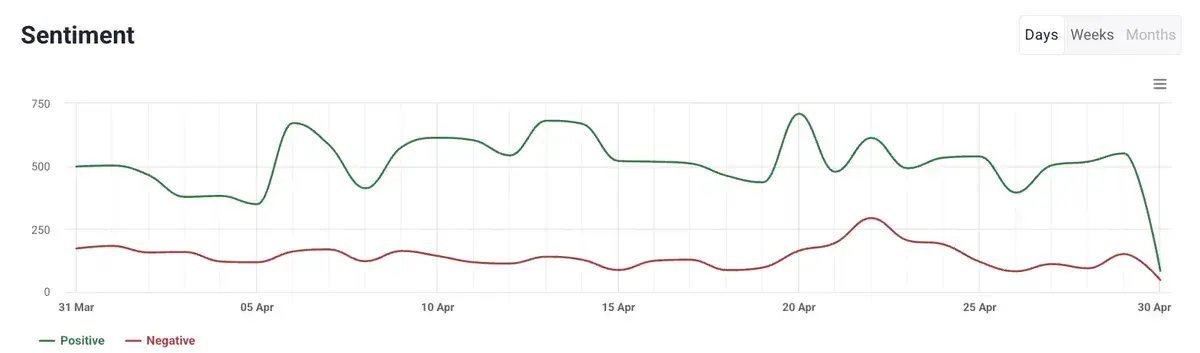
Mention volume tells you how loud the conversation is. Sentiment tells you whether it’s working for you or against you.
In terms of sentiment analysis, I track three things:
- Sentiment over time (am I trending positive or negative week over week?)
- Sentiment per topic (is the negative coming from product, shipping, or pricing?)
- Sentiment correlated with campaigns (did the new launch actually shift perception?)
Set thresholds. If negative sentiment crosses, say, 25% of total mentions in a 24-hour window, that’s an automatic alert to your team.
Don’t wait for someone to notice it in a weekly report!
3. Use audience insights for product and CX
This is the most underused source of TikTok insights, and it’s where the biggest wins are.
Most teams treat audience insights as a marketing report. The smarter teams treat them as actionable insights for product, support, and sales.
Every week, your TikTok brand mentions contain a free stream of market research:
- A list of features people are publicly asking for
- The specific words customers use to describe your product (gold for your copywriters)
- The competitors people compare you to
- The exact friction points in the buying experience

4. Influencers and partnerships finding
The best creator partnerships are the ones where the creator was already organically talking about you.
Listening tells you who those people are before your competitors find them.
What I look for in a TikTok creator:
- Engagement rate, not just follower count, according to SociaVault, TikTok’s overall average is 2.5%, but micro-creators under 100K hit 7.5%; a 10K-follower creator at that rate beats a 200K creator coasting at 1%
- Brand fit – do their other videos make sense alongside yours, or would the partnership feel forced?
- Audience authenticity – are the comments from real humans, or is the engagement bot-driven?
- Consistency of voice – would they make a good 6-month partner, not just a one-video moment?
Once you’ve built your shortlist, send focused collaboration briefs.
Don’t pitch them on a “campaign” but pitch them on a partnership that makes sense, given what they already say about your category.

Influencer Tab: Analysis for Rhode by Brand24.
Advanced TikTok social listening tips
A few things I’ve learned during my social listening road trip:
- Listen to comments.
Specifically for high-engagement comments (50+ likes) under videos in your category. The video might be neutral; the top comment is often where the real sentiment lives.
When you find a comment thread that’s swinging negative under a creator video that mentions you, reply directly from your brand account within two hours – public replies get screenshotted and re-shared, and a fast, human response can flip the thread.
2. Track duets and stitches.
When someone duets or stitches your video, the conversation has multiplied, and you now own a thread, not just a video. Reply, re-stitch, or feature the best ones in your own content. Brands that engage with duets get 2–3x the secondary engagement on the original video, because the algorithm reads it as community activity.
3. Watch your competitors’ negative mentions weekly.
When you find a comment thread where 10+ people complain about a specific issue (e.g., “Stanley lids leak,” “their app crashes on Android”), create a response video or comment addressing how your product solves that exact problem (but don’t be too pushy – keep it natural).
Glossier effectively countered competitors’ “too many steps” skincare complaints by replying directly in threads with their 3-step routine.
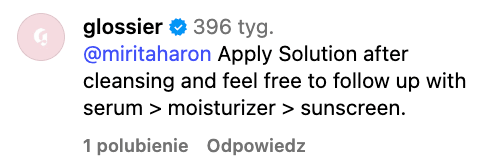
Treat these threads as warm lead pools, not just intelligence every complaint there is a customer actively shopping for an alternative.
4. Don’t ignore “neutral” sentiment from high-reach creators.
A neutral mention from a creator with 500K followers still counts as half a million impressions, and the algorithm doesn’t weigh sentiment. It weighs engagement.
What TikTok social listening metrics are important?
This is what separates real social listening from “we have a dashboard.”
You need to define success metrics tied to your listening insights and define what “good” actually looks like for each one, because a metric without a benchmark is just a number on a slide.
I personally would pay attention to:
- Conversion attribution from identified TikTok signals.
Track how many sales (or qualified leads, sign-ups, demo requests) come from creator brand mentions, viral sounds, or hashtag spikes you surfaced through listening.
The industry-level benchmark to anchor against: according to a TikTok meta-study across roughly 100 conversion lift tests, click-only attribution undervalues TikTok purchases by 73%. And Sprinklr reports brands using AI-powered social listening see up to 10% faster revenue growth across categories.
- Net sentiment.
Aim for net positive sentiment above 65% across TikTok brand mentions, with negative held below 15%. These % numbers aren’t a universal target – you need to check your specific niche and its realities.
Generally, if you drop under 50% positive in a single week without a known cause, that’s a structural issue (product, pricing, or experience), not a comms problem.
According to Thematic and Sprout Social: a sentiment score above 80% indicates strong brand health, while below 50% signals customer experience issues that demand immediate attention. (data source)
Track week over week, not quarter over quarter, as TikTok moves too fast for quarterly snapshots (for big brands, of course).
- Share of voice.
Set a target relative to your marketing spend.
If you’re spending equal to a competitor on TikTok creator partnerships, your share of voice should be within 10 percentage points of theirs. If you’re spending more and they’re winning SOV, the issue is your fit, not budget.
- Crisis response time.
Benchmark against a 60-minute first-response target.
In my experience across roughly a dozen sentiment spikes managed in real time, brands that respond within one hour see noticeably less secondary amplification than those responding after four hours.
The algorithm rewards early engagement on a thread, including from the brand.
TikTok social listening limitations
A few honest notes on the listening capabilities (and real limitations) of TikTok monitoring tools in 2026:
- Private accounts and DMs are off-limits. This is true for every listening tool on the market. There’s no workaround, just a constraint to plan around.
- Comment-level data depth varies. Some tools index every comment; some only top-level. Ask before you commit!
- API access changes. TikTok updates its developer policies regularly. Verify with your tool provider that your data flow is current.
TikTok social listening case study: Rhode
What happens when a founder, a celebrity, and a festival converge on TikTok?
Rhode’s April 2026 was one of the cleanest examples of a TikTok cultural moment in real time.
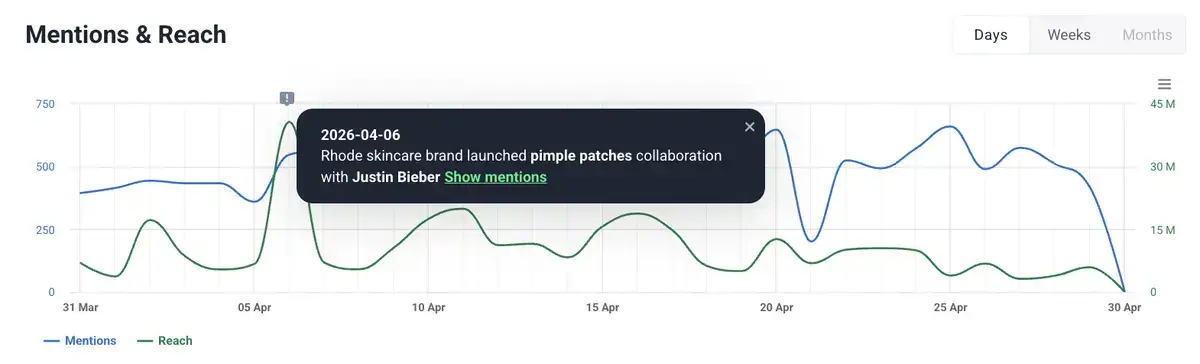
According to Brand24’s listening data for the period 31 March – 30 April 2026, Rhode generated:
- 14,968 mentions and 315M reach in 30 days (a +5,548% jump in mentions and +1,488% jump in reach) versus the prior period.
- Sentiment landed at 50% positive (7,493 mentions), 47% neutral, 2% negative (343 mentions)
- AVE for the month: $42M. Brand presence score climbed from 17 to 77 – higher than 87% of all brands tracked.
The trigger was a single video: on April 6, founder Hailey Bieber posted “say hi to spotwear @rhode skin in collab with @Justin Bieber hehe” – 21M reach, the highest of any single mention in the period.
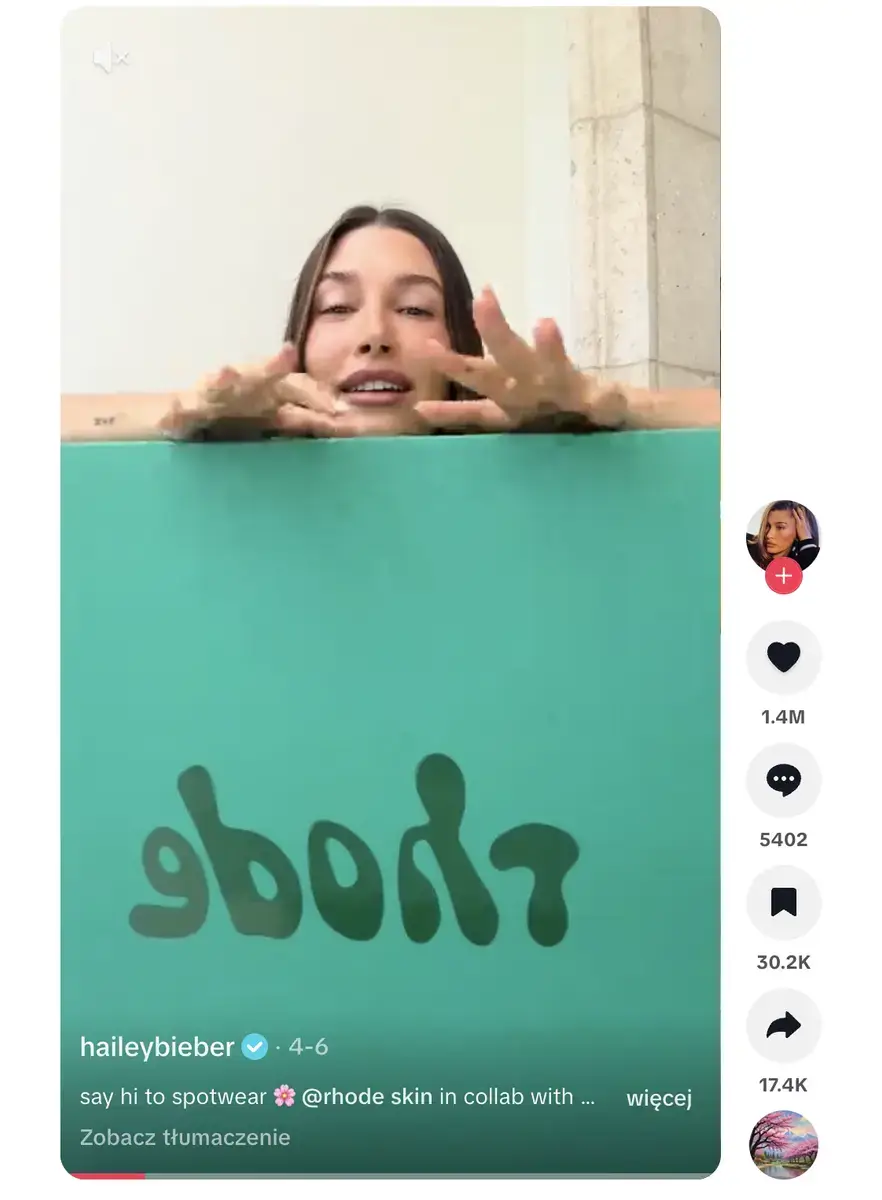
That alone would have been a big moment.
What turned it into a wave was the Coachella overlap: April 10–19 layered #coachella and #bieberchella onto the same conversation that was already running #rhode (6,480 mentions), #rhodeskin (2,613), #haileybieber (2,033), and #justinbieber (952). The brand didn’t have to chase the festival – the festival came to the brand because the founder was already inside it.
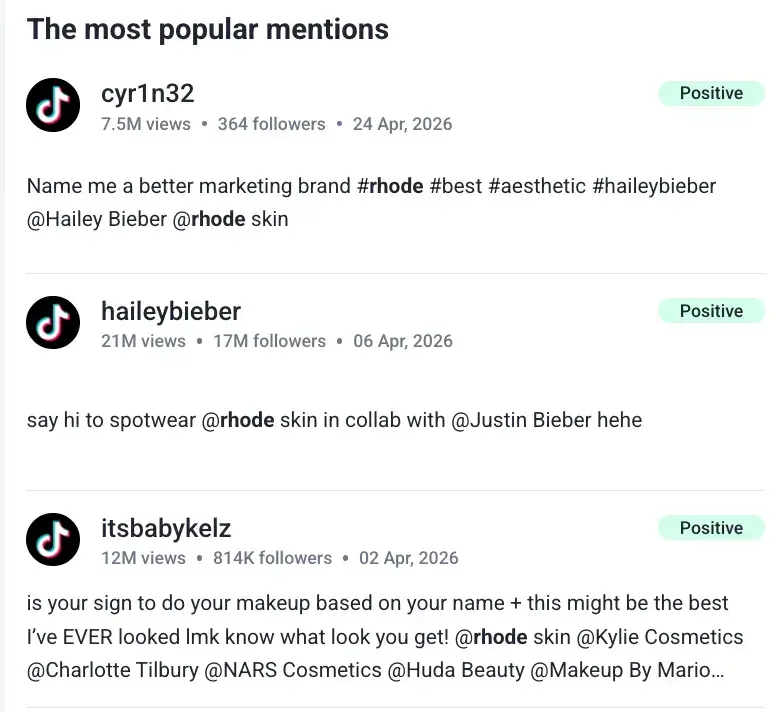
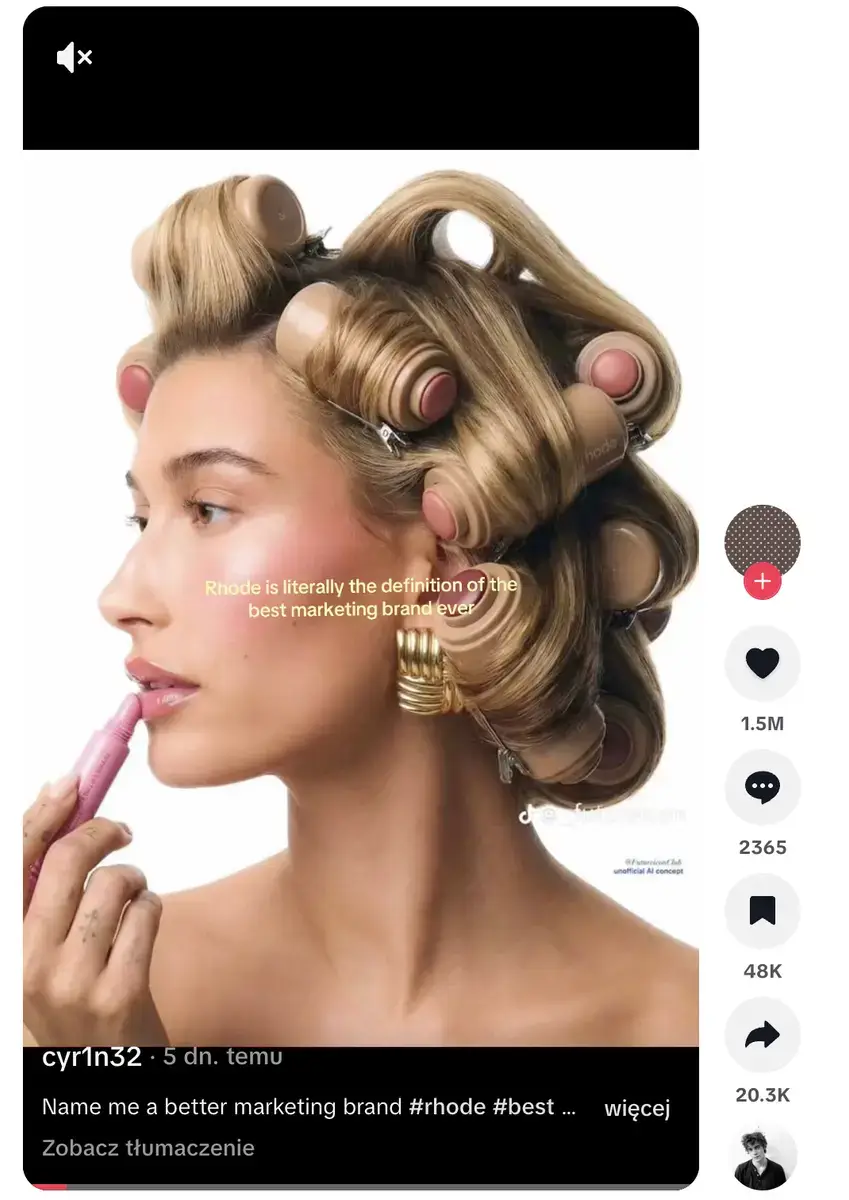
The most interesting signal in the data wasn’t the macro-creators. It was a creator with 364 followers (@cyr1n32) whose single Rhode post reached 7.5M people.
Conclusion
TikTok in 2026 is where culture sprints, where creators run the economy, and where the conversations that decide your brand’s reputation are happening – whether you’re listening or not.
The good news: you don’t need a 12-person team and a $100K tool stack to start. You need a clear question, a focused keyword list, and a tool that catches what your notifications miss.
The brands with the strongest TikTok marketing strategies aren’t the ones posting the most. They’re the ones who hear the conversation early, understand what it means, and act on it before anyone else does.
FAQ
What are the best TikTok social listening tools and why?
What TikTok metrics can I track with social listening?
Can I monitor TikTok brand mentions if my brand isn’t tagged?
How is TikTok social listening different from listening on other platforms?
What happens if a brand doesn’t use social listening in 2026?
Related articles


Top Reads
X (Twitter) Analytics Tools: The 15 Best for 2026
Brand Awareness Strategy [Ultimate Guide for 2026]
Sentiment Analysis in 2026: Definition, AI Methods & Original Research
Brand Monitoring: Tools & Guide for 2026
Brand Reputation Management: Expert Guide + Original Research [2026]
How to See How Many Times a Hashtag Was Used on X (Twitter)
9 Hashtag Tracking Tools Tested in 2026
Social Media Reach: How to Measure & Improve It in 2026?
Share of Voice: Definition, Formula, Tools [2026 Guide]
Social Media Analysis: Complete Guide for 2026
Start Social Listening!
Get the Brand24 trial and start social listening like a PRO.