Sentiment Analysis: What is it & Why do You Need it in 2026?
Updated: September 17, 2025
17 min read
In the era of data overload, it’s not just about what your customers say, it’s about how they feel. That’s where sentiment analysis comes in. In fact, brands using AI-powered sentiment detection have seen up to a 4x higher conversion rate. Want to benefit too? Here’s your guide!
Quick Summary:
– Sentiment analysis is a way to figure out how people felt when they wrote the specific text. It can be negative, positive, or neutral and include more specific emotions like anger and joy.
– Businesses use it to understand what customers think and feel about their products, campaigns, or company in general. It helps with better decisions, stronger branding, and faster reactions to feedback.
– Most tools use machine learning to learn from lots of labeled examples. They scan text, look for patterns, and decide the mood or emotion behind it.
Market forecast predictions:
The global sentiment analytics market is rapidly growing and is projected to reach USD 7.13 billion by 2028.
Social media analytics and sentiment analysis generated approximately USD 3.94 billion in revenue in 2024 and is projected to grow to over USD 17.05 billion by 2030.
What is sentiment analysis?
Sentiment analysis is a natural language processing (NLP) technique for determining the emotional tone behind text, speech, or other forms of communication. The goal is to understand whether people express positive, negative, or neutral feelings about a brand, product, or topic.
In simple words: It’s a tool that understands how people feel when they express themselves online.
How it works:
Data collection: The tool starts by monitoring multiple online sources.
Natural Language Processing (NLP): NLP algorithms analyze the text structure, context, and meaning.
Sentiment classification: Machine learning models or rule-based methods classify the sentiment.
In practice, sentiment analysis tools automatically scan online mentions and assign them a sentiment score. For example:
Positive sentiment: “I love how easy this app is to use!”
Neutral sentiment: “This app was released in March.”
Negative sentiment: “The app keeps crashing all the time.”
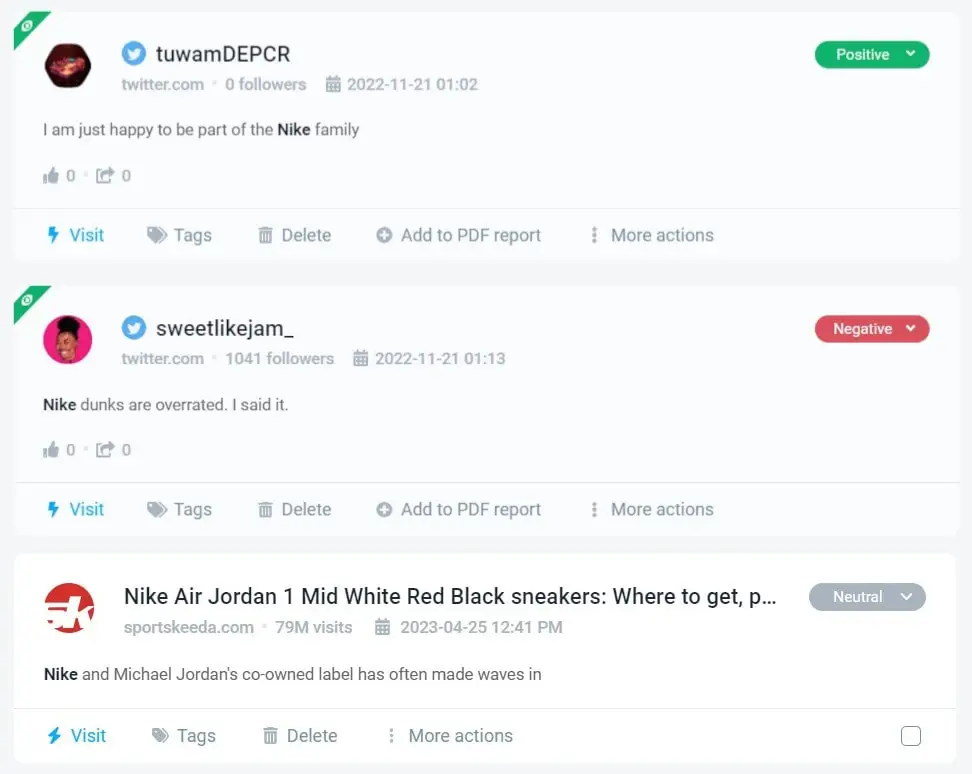
Example of positive, neutral, and negative online mentions
To give you deeper insights into customer feelings, more advanced AI sentiment analysis can even detect:
Irony,
Sarcasm,
Specific emotions (like admiration, anger, disgust, fear, joy, sadness),
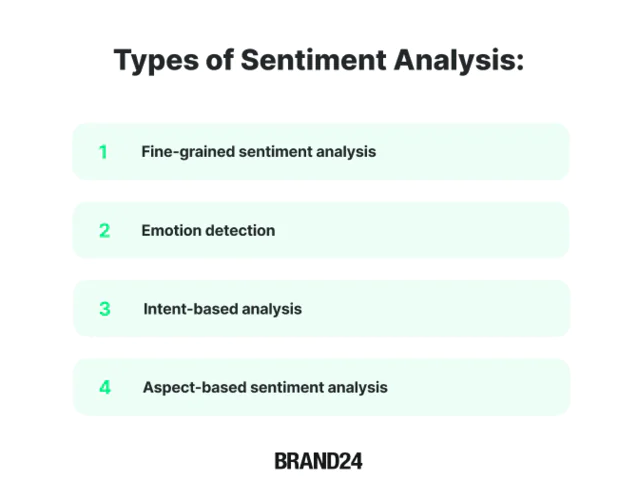
Here are the main types of sentiment analysis. Each with its own way of digging into what’s behind people’s talk:
1. Fine-grained sentiment analysis
Goes beyond “positive/negative” to classify into multiple levels, such as:
Very positive
Positive
Neutral
Negative
Very negative
It can be star ratings or scoring something from 0 to 100.
Use case: Perfect for surveys and customer feedback.
2. Emotion analysis
Goes beyond polarity to identify specific emotions such as:
Joy
Anger
Sadness
Fear
Disgust
Use case: This helps brands understand how people feel, not just whether the sentiment is good or bad.
For example, “I can’t stop smiling after using this app” would be tagged as happy, not just positive.
3. Intent-based analysis
Detects not just tone, but user intention behind a message:
Complaint
Praise
Suggestion
Purchase intent
Use case: Super useful for customer service and market research.
For example, if someone says, “I struggled a lot to set up my account,” it may detect the intent to ask for help rather than just expressing frustration.
4. Aspect-based sentiment analysis
This type breaks down sentiment by topic or aspect. For instance:
Product quality: positive sentiment
Customer support: negative sentiment
Use case: Widely used in customer feedback analysis.
For example, if someone writes, “The app is awesome, but the notifications drive me crazy,” the system knows the bad review concerns the notifications strategy, not the whole app.
66% of consumers say their trust in a brand improves when the brand responds transparently to negative sentiment
In 2026, sentiment analysis is a brand’s early warning system and trust builder.
It analyzes online conversations, product reviews, social media posts, and customer feedback to reveal meaningful insights in real time.
These emotional insights help teams:
Detect and prevent crises
Shape brand messaging
Improve products and services
Stay ahead of competitors
Understand public opinion and social trends
Brand reputation management
In the age of instant feedback and viral reactions, reputation can shift overnight. Sentiment analysis algorithms help monitor brand perception across channels, from Reels to TikTok.
You can:
Understand how the public perceives your brand, campaigns, or products
Respond quickly to negativity or misinformation
Track long-term sentiment trends to guide communication strategy
Example: A spike in negative mentions about delivery delays helps a retail brand identify operational issues before review scores drop.
Brand monitoring
By analyzing sentiment around your competitors, industry trends, or keywords, you can gain a complete picture of your market position.
You can:
Benchmark brand performance against competitors
Discover what resonates with your audience (and theirs)
Identify white-space opportunities or PR risks
Example: A SaaS company notices rising positive sentiment for a competitor’s new feature, prompting it to fast-track a similar rollout.
Customer feedback analysis
Feedback is now public, fast-moving, and spread across platforms. Sentiment detection captures and categorizes this data, saving time and surfacing trends.
You can:
Automatically classify thousands of reviews, tweets, and comments
Measure overall customer satisfaction
Identify recurring pain points or praise
Example: A cosmetics brand detects consistent negative customer sentiment around the scent of a new lotion, leading to a reformulation before the next batch ships.
Crisis detection and prevention
With real-time alerts and historical sentiment baselines, teams can identify and mitigate potential crises before they escalate.
You can:
Get alerted to sudden spikes in negative sentiment
Diagnose the root cause of negative buzz
Deploy the right messaging quickly
Example: A fintech app detects backlash about a security update within minutes and issues a transparent FAQ, calming users and avoiding media scrutiny.
Improving customer service
Support teams receive a flood of DMs, emails, and comments. Thanks to sentiment detection, you can find critical mentions and tailor responses more empathetically.
You can:
Detecting topics that generate frustration in real time
Prioritizing critical issues
Monitor sentiment in support channels over time
Example: An airline uses sentiment detection to fast-track distressed passenger messages during flight delays, preventing social media fallout.
Market research and product development
Sentiment analysis delivers organic, unfiltered market insights, without relying on traditional research methods.
You can:
Explore emerging customer preferences and behaviors
Uncover unmet needs and feature requests
Analyze public reaction to new campaigns or products
Example: A gaming company analyzes sentiment around beta feedback, discovers unexpected love for a side character, and turns them into a major DLC.
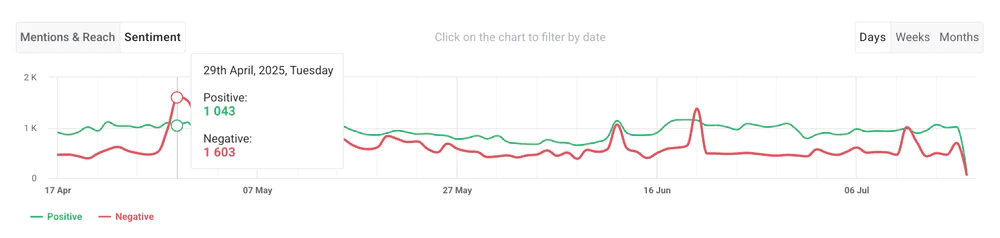
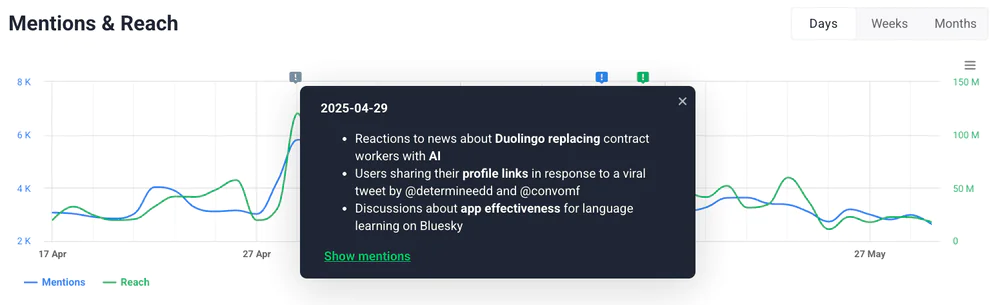
It was also the time when more negative mentions occurred than positive ones.
Sentiment analysis tools: Sentiment chart of Duolingo by Brand24
After selecting April and May as a time range, I used the AI Events feature and discovered that fans didn’t like the AI replacements in the company:
What’s behind negative sentiment? AI Events feature by Brand24.
Monitoring sentiment over time helps identify emerging trends in customer feedback and public opinion, allowing you to spot new shifts or patterns as they develop.
As you can see, thanks to sentiment analysis, you can monitor changes in customer emotions easily.
04 Sentiment by topic
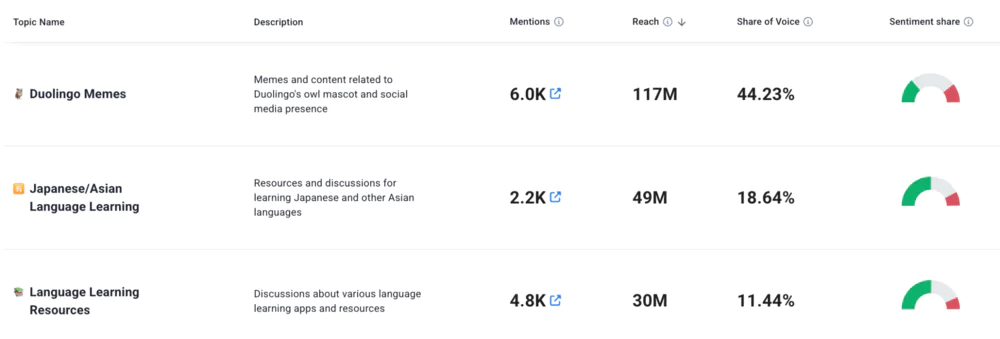
Thanks to the AI Topic Analysis feature, I discovered the most important and trending topics related to Duolingo:
AI Topic Analysis feature by Brand24
And I can easily check what their sentiment is by clicking the “more stats” button.
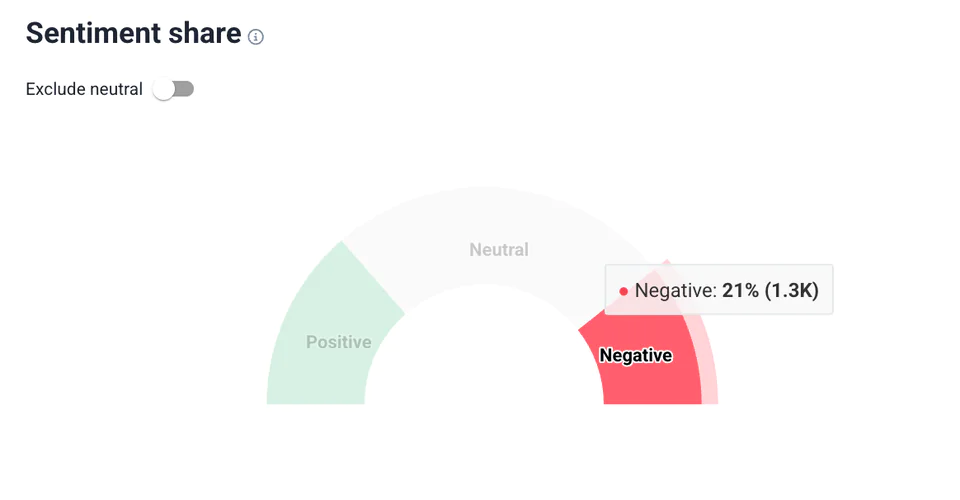
Here’s what it looks like based on the most popular topic – Duolingo Memes.
This topic has 27% of positive mentions and 21% of negative mentions.
Sentiment share of a specific topic (generating the biggest number of negative mentions)
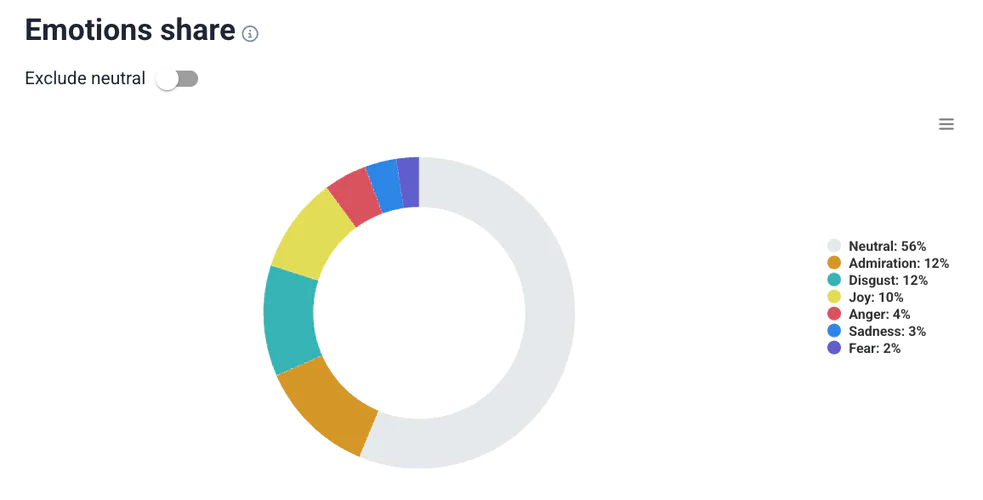
The most common emotions within the topic are admiration and disgust.
AI Emotion Analysis feature by Brand24
05 Sentiment of speaking authors
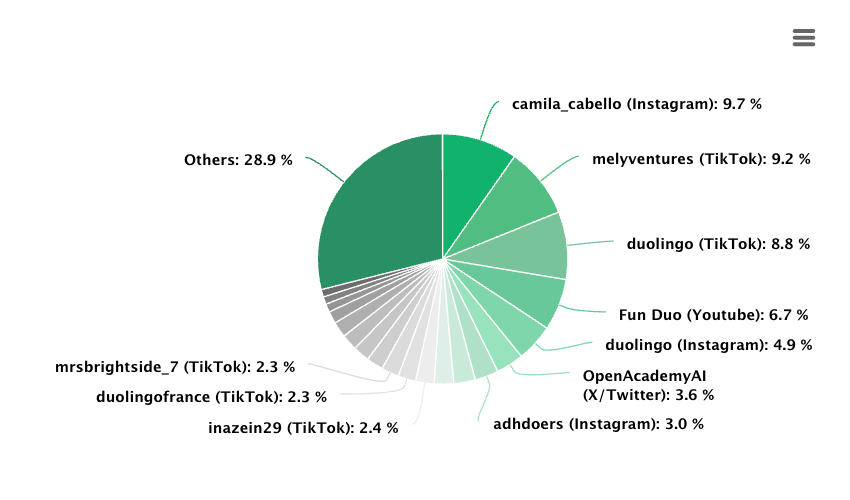
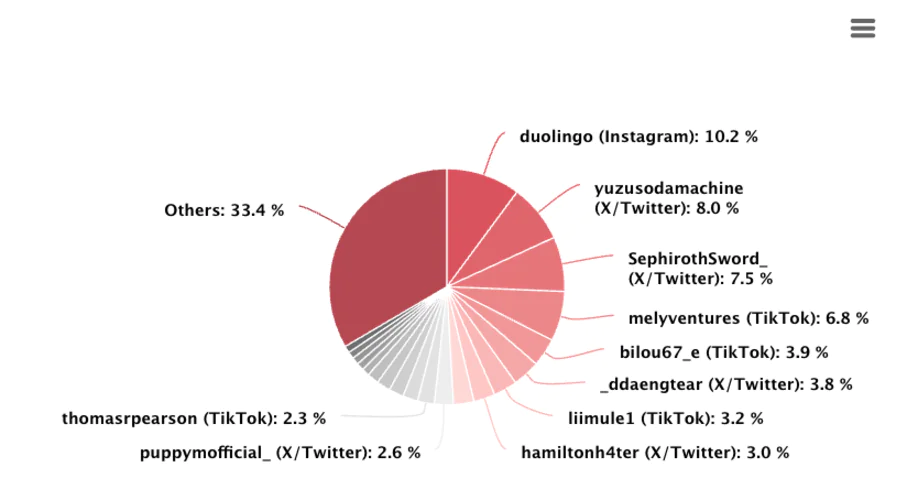
Now, let’s detect who is talking about Duolingo in a positive and negative way.
You can find this analysis in the “Influencer Analysis” Tab.
Here are the most positive people:
Participation of positively speaking authors
And here are the most negative people:
Participation of negatively speaking authors
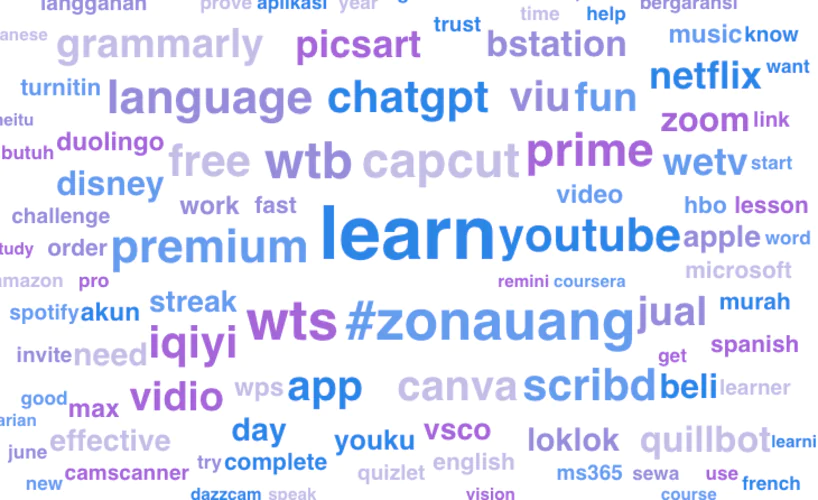
06 Context of a discussion
During the last 3 months, discussions around Duolingo were mostly around words like:
Context of discussion about Duolingo
How does sentiment analysis work?
Sentiment analysis uses natural language processing (NLP) and machine learning (ML) to classify text as positive, neutral, or negative.
Sentiment analysis technologies might use various types of algorithms.
What kind of?
1. Automatic (Machine Learning)
Learns from labeled data (positive/negative/neutral).
Finds patterns and applies them to new texts.
Can process huge datasets, but often works like a “black box.”
Accuracy depends heavily on training data.
2. Rule-Based
Relies on predefined lexicons and rules (e.g., word lists, syntax).
Transparent and easy to implement.
Struggles with complex language like negation, sarcasm, or metaphors.
3. Hybrid
Combines ML accuracy with rule-based stability.
Most advanced tools use this approach for the best results.
How does sentiment analysis work in the Brand24 tool?
To provide you with reliable information, I consulted Krzysztof Rajda, Head of AI at the media monitoring software company, who has over 10 years of experience.
Here are his thoughts:
Brand24’s sentiment analysis relies on a branch of AI known as machine learning by exposing a machine learning algorithm to a massive amount of carefully selected data.
It can automatically learn and improve from experience.
Our AI Team incorporated recent advantages of Pretrained Language Models (PLM), a technique also used by Big Tech companies (like Google, Microsoft, Facebook, or Baidu).
Why?
It results in the machine’s capabilities being as close as possible to the real understanding of the text with the current state of scientific knowledge.
What’s more, the usage of multilingual PLM allows us to perform sentiment analysis in over 100 languages of the world!
If you’d like to learn more about this process, we recently contributed to the science with our work on multilingual sentiment analysis.
Due to language complexity, sentiment analysis has to face at least a couple of issues.
In some cases, it gets difficult to assign a sentiment classification to a phrase.
That’s where natural language processing-based sentiment analysis comes in handy, as the algorithm attempts to mimic regular human language.
So, what are the most common sentiment analysis challenges?
1. Contrastive conjunctions
Sentences can mix positive and negative words, making interpretation tricky.
Example: “The weather was terrible, but the hike was amazing!”
2. Named-entity recognition
Words may have multiple meanings depending on context.
Example: “Everest” could mean the mountain or the movie.
3. Anaphora resolution
Determining what pronouns or nouns refer to is often difficult.
Example: “We went to the theater and had dinner. It was awful.”
4. Sarcasm & irony
Sarcasm often flips sentiment, and irony depends on tone, which the text lacks.
Example: “I’m so happy the plane is delayed.”
5. Internet language
Online text is full of abbreviations, misspellings, poor grammar, and complicated analysis.
Example: “gr8 movie lol” or “smh this update sux.”
6. Negation
Negation can reverse sentiment.
Example: “Not good” ≠ “good.”
7. Context
The exact meaning of the words can shift depending on the surrounding sentences.
Example: “The movie was cold.” (bad atmosphere vs. literally low temperature).
8. Idiomatic language
Idioms rarely mean what the words literally suggest, confusing algorithms.
Example: “Break the ice” means starting a conversation, not destroying frozen water.
And finally, there’s also a data struggle that tools face:
How do industries use sentiment analysis tools?
Here are some examples of how sentiment analysis is used in different industries:
Retailers use sentiment analysis to:
Improve customer satisfaction
Optimize product development
Manage brand reputation
Real-time analysis of social media and customer reviews enables them to track shifting preferences, personalize promotions, and reduce negative feedback.
According to Journal of Big Data, it can help improve retention and up to 95% increases in profit.
By analyzing tone and emotion in policyholder interactions, insurers can improve customer experience and streamline claims processing in increasingly digitized workflows.
Manufacturers use sentiment analysis to improve:
Product quality
Supply chain responsiveness
Predictive maintenance.
In fact, over 55% of manufacturers now use AI tools for these purposes, reflecting a trend toward data-driven quality control (source: Deloitte).
Media and entertainment organizations apply sentiment analysis to:
Personalize content delivery
Track viewer engagement
Optimize marketing campaigns
As the OTT market grows rapidly, studios and platforms use sentiment tools to include audience reactions across social platforms in their plans.
Finance companies use sentiment analytics for:
Decision-making aligned with public and investor sentiment
Enhanced risk assessment and trading strategy development
Analyzing sentiment from financial news, earnings calls, and social media enables institutions to forecast market behavior and adjust their portfolios accordingly.
Telecom providers use sentiment analysis to:
Identify churn risks
Proactively intervene with service enhancements or targeted retention offers
Monitoring customer interactions across channels helps telecoms detect dissatisfaction early and implement corrective measures to improve loyalty.
Political organizations use sentiment analysis to:
Analyze public sentiment on policies and services
Guide decision-making during crises
Improve communication strategies
By evaluating voter and citizen sentiment in real time (especially during elections or emergencies), government can tailor their messaging, build trust, and respond more effectively to public concerns.
Healthcare use sentiment analysis to:
Analyze patient feedback
Uncover service gaps
Enhance satisfaction and care quality
Hospitals can use sentiment tools to monitor emotional tone in patient reviews and survey responses, helping improve doctor-patient communication, improve treatments, and increase overall patient satisfaction.
Sentiment analysis is built on natural language processing (NLP) in general. It allows computers to process and make sense of human language and unstructured data.
Today’s NLP tools are far more advanced, making it possible to detect emotions and opinions with greater accuracy and depth.
Common NLP methods used in sentiment analysis include: 1. Lexicon-based techniques that use sentiment word lists to assign polarity 2. Machine learning models trained on labeled data to classify text by sentiment 3. Deep learning frameworks like BERT and GPT that understand context and subtle tone 4. Aspect-based sentiment analysis, which focuses on specific parts of a product or service to determine targeted sentiment
Here’s an expert explanation by Krzysztof Rajda, Head of AI at Brand24: Natural Language Processing (NLP), a part of AI that deals with textual data, is an essential technique in the modern world for discovering the unknown from media monitoring results.One of the most useful NLP tasks is sentiment analysis – a method for the automatic detection of emotions behind the text.Sentiment can be analyzed at different levels – from identifying positive, negative, or neutral opinions, quantifying the level of positivity or negativity, to even opinion mining and identifying the fine-grained emotion behind the opinion (e.g., happiness, anger, sadness, etc.).
What is the difference between sentiment analysis and emotion detection?
Sentiment and emotion detection are related but distinct tasks in natural language processing (NLP). Sentiment analysis focuses on determining the overall attitude or opinion expressed in a text. Emotion detection goes deeper by identifying specific emotional states such as joy, anger, sadness, fear, or surprise. While a sentiment analysis model provides a broad sense of polarity, emotion detection captures the nuanced emotional tone behind the words.
For example, the sentence “I can’t believe they forgot my order again” would be labeled as negative in sentiment analysis, but emotion detection might identify it as expressing frustration or anger.
What is a sentiment score?
One of the means to assess sentiment is the sentiment score. Sentiment score is a scaling system that reflects the emotional depth of emotions in a piece of text. It detects emotions and assigns them sentiment scores, for example, from 0 up to 10, from the most negative to the most positive sentiment.
There are various ways to calculate a sentiment score, but the most common method is to use a dictionary of negative, neutral, or positive words. To calculate a sentiment score, various factors are taken into account, such as: 1. The number and type of emotions expressed 2. The strength of those emotions 3. The context in which they are used.
Can ChatGPT do sentiment analysis?
Yes, ChatGPT can perform basic sentiment analysis. It can read text and suggest whether the tone is positive, negative, or neutral. It may also detect some emotions like joy, anger, or sadness.
However, there are a few drawbacks. ChatGPT doesn’t consistently follow strict sentiment labels like specialized sentiment analysis tools do. Plus, its analysis isn’t automated or scalable – you’d need to feed in text manually or build a custom workflow to analyze large volumes of data.
Content Team Leader and Social Listening Expert at Brand24
56 published articles
For over 4 years, she's been taking part in developing an AI media monitoring tool. Katarzyna wrote content about mentions monitoring, sentiment analysis, and brand strategies. Currently managing a team of talented writers.
Analyze your sentiment & understand what's behind it with AI!
Sentiment Analysis: What is it & Why do You Need it in 2026? | Brand24
Blog
Sentiment Analysis
Brand24
Insights, analyses & case studies
Katarzyna Dereń
What is AI-powered sentiment analysis, and why is it important? This guide includes a step-by-step tutorial, real-world examples, and crucial definitions!
What is NLP sentiment analysis?
Sentiment analysis is built on natural language processing (NLP) in general. It allows computers to process and make sense of human language and unstructured data.
Today’s NLP tools are far more advanced, making it possible to detect emotions and opinions with greater accuracy and depth.
Common NLP methods used in sentiment analysis include: 1. Lexicon-based techniques that use sentiment word lists to assign polarity 2. Machine learning models trained on labeled data to classify text by sentiment 3. Deep learning frameworks like BERT and GPT that understand context and subtle tone 4. Aspect-based sentiment analysis, which focuses on specific parts of a product or service to determine targeted sentiment
Here’s an expert explanation by Krzysztof Rajda, Head of AI at Brand24: Natural Language Processing (NLP), a part of AI that deals with textual data, is an essential technique in the modern world for discovering the unknown from media monitoring results.One of the most useful NLP tasks is sentiment analysis – a method for the automatic detection of emotions behind the text.Sentiment can be analyzed at different levels – from identifying positive, negative, or neutral opinions, quantifying the level of positivity or negativity, to even opinion mining and identifying the fine-grained emotion behind the opinion (e.g., happiness, anger, sadness, etc.).
What is the difference between sentiment analysis and emotion detection?
Sentiment and emotion detection are related but distinct tasks in natural language processing (NLP). Sentiment analysis focuses on determining the overall attitude or opinion expressed in a text. Emotion detection goes deeper by identifying specific emotional states such as joy, anger, sadness, fear, or surprise. While a sentiment analysis model provides a broad sense of polarity, emotion detection captures the nuanced emotional tone behind the words.
For example, the sentence “I can’t believe they forgot my order again” would be labeled as negative in sentiment analysis, but emotion detection might identify it as expressing frustration or anger.
What is a sentiment score?
One of the means to assess sentiment is the sentiment score. Sentiment score is a scaling system that reflects the emotional depth of emotions in a piece of text. It detects emotions and assigns them sentiment scores, for example, from 0 up to 10, from the most negative to the most positive sentiment.
There are various ways to calculate a sentiment score, but the most common method is to use a dictionary of negative, neutral, or positive words. To calculate a sentiment score, various factors are taken into account, such as: 1. The number and type of emotions expressed 2. The strength of those emotions 3. The context in which they are used.
Can ChatGPT do sentiment analysis?
Yes, ChatGPT can perform basic sentiment analysis. It can read text and suggest whether the tone is positive, negative, or neutral. It may also detect some emotions like joy, anger, or sadness.
However, there are a few drawbacks. ChatGPT doesn't consistently follow strict sentiment labels like specialized sentiment analysis tools do. Plus, its analysis isn’t automated or scalable - you’d need to feed in text manually or build a custom workflow to analyze large volumes of data.