Table of contents
2M Marketers

In 2026, people aren’t the only ones talking about your brand online. AI models are too. Last month alone, AI tools mentioned Brand24 around 89,000 times, 36,000 more than the month before, according to Chatbeat.
But how is AI actually talking about the brand? Is it recommending brands, questioning its quality, or repeating something from a Reddit thread about a wardrobe that never fits together?
ChatGPT, Gemini, Perplexity, and Google AI Overviews don’t just mention brands. They interpret what they find and cite the sources, which makes your AI brand reputation part of your overall online brand reputation.
In this guide, I’ll show you how AI talks about brands, how to monitor what it says, where those narratives come from, and how to improve them with Generative Engine Optimization.
Key takeaways:
-
AI is becoming part of brand reputation management
People increasingly use AI to discover brands, compare options, and research what others say about them.
-
GEO goes beyond your website
AI-generated brand narratives are influenced by social media platforms, community forums, and other third-party sources.
-
Repeated reviews shape buyer perception
A single negative mention may have limited impact, but the same claim appearing across multiple independent sources can become part of how AI describes a brand.
-
AI reputation requires monitoring both outputs and sources
Track what AI says about your brand and the sources, conversations, and claims that may be influencing those direct answers.
What is GEO for brand reputation?
Generative Engine Optimization (GEO) for brand reputation is the practice of shaping how AI chatbots and search engines perceive, cite, and recommend your company.
In the context of brand reputation management, GEO focuses on making sure the information available to AI systems is accurate, relevant, consistent, and up to date.
This doesn’t mean that brands can fully control how AI models perceive them. However, brands can take steps to improve their online reputation.
GEO vs. traditional SEO for brand reputation
This article focuses on GEO, but it’s important to clarify one thing first: What’s the difference between SEO and GEO? Both approaches aim to improve a brand’s visibility and credibility, but they operate in different environments.
Traditional SEO is primarily focused on helping pages rank in traditional search engine results pages (SERPs), including Google Search results, where users can compare multiple links and decide which sources to visit.
GEO focuses on how generative AI systems discover, interpret, and represent information about a brand in AI-generated answers, where the user receives a single answer built from many sources.
This means a brand can be highly visible on Google while being invisible in the responses generated by AI agents.
| Traditional SEO | GEO | |
|---|---|---|
| What you control | Your pages and the links to them | Your pages — plus other sources AI draws on |
| What you measure | Rankings, traffic, CTR | AI mentions, citations, sentiment, and AI share of voice |
| Where the risk sits | Losing a position | No mention, or a mention in a negative context |
| What a win looks like | Ranking first | Being named — accurately — inside the answer |
GEO strategies and best practices I’ve tested
There is a lot of advice about GEO right now. Over the past months, I’ve been testing different GEO strategies, AI visibility tools, and monitoring approaches to check what actually matters from a brand reputation perspective.
And one thing has become clear: there is no single optimization that makes a brand appear exactly the way you want in AI-generated answers. It’s a combination of actions that helps AI systems discover, understand, and represent your brand more accurately.
Here are the strategies I’ve found most useful:
1. Monitor your AI citations
I start by checking where and how often a brand appears in AI answers — and based on what is cited along the way.
Understanding which sources AI systems cite most frequently helps you see which information is shaping how your brand is represented. It also shows which websites, publications, reviews, or community discussions may be influencing the narrative around your brand.
This is one of the most useful parts of generative engine optimization (GEO) and answer engine optimization (AEO): understanding not only whether your brand appears in AI search, but what drives AI citations behind those answers.
I look at:
- which domains and pages AI cites,
- which of my pages get cited at all,
- which prompts they show up for,
- how citations differ between platforms,
- which sources keep coming back,
- and which sources are cited for competitors but not for my brand.
Traditional SEO metrics and rank tracking alone aren’t enough in the AI era. A page can perform well in traditional search results and barely exist in AI answers. That’s why I treat AI citation monitoring as an additional layer of search engine optimization, not a replacement for it.
For this kind of work, it’s worth using a tool built specifically for AI analysis. I’ve tested several recently.
Here are the 3 best AI reputation management tools:
| Tool | Best for | What you can monitor |
|---|---|---|
| Semrush AI Visibility Toolkit | Monitoring brand mentions across AI search | Brand mentions, citations, prompts, sentiment, competitors, and how AI visibility compares with traditional SEO |
| Ahrefs Brand Radar | Understanding where AI mentions come from | AI-cited pages, cited domains, brand mentions, and the difference between sources AI finds and sources it actually cites |
| Chatbeat | Monitoring where and how your brand is represented in AI | Brand mentions, Brand Score, share of voice, position, sentiment, prompts, and key sources |
2. Make your brand information easy to understand
If you want AI engines to represent your brand accurately, make sure they can easily find and understand the information you publish about it.
I pay particular attention to the pages that define the brand and their content quality: what the product does, who it’s for, how much it costs, its limitations, security, key differentiators, and brand positioning.
Clear headings, concise answers, bullet points, internal links, structured data, and relevant schema markup can make this information easier for search engines and AI systems to interpret.
- Give direct, concise answers to the questions people actually ask about the brand, even if it isn’t your brand’s strongest point.
- Structure content clearly with descriptive headings, short paragraphs, bullet points, and tables.
- Keep brand information consistent across key pages, helping search engines understand the brand as an entity and connect it with relevant knowledge graphs.
- Use structured data and relevant schema markup to provide additional context about your organization, products, authors, and content.
- Support important claims with proof, such as original data, case studies, customer reviews, and credible third-party sources.
In the AI era, the goal isn’t to create content just for AI. It’s to make the information that defines your brand clear, consistent, and easy to understand.
None of this guarantees that AI engines will cite your website. But if your own information is unclear or difficult to find, you leave more room for other sources to shape how your brand appears in AI-generated responses. This is especially risky for topics that aren’t your brand’s strongest point.
3. Build brand authority around key topics
Build a strong, repeatable association between your brand and the topics you want to be known for.
Choose 3–5 core topics, not twenty
Pick topics narrow enough that you can realistically become one of the best sources on the internet for them.
Then cover the full range of questions inside each topic: definitions, how it works, tools, pricing, comparisons, common mistakes, metrics, real examples, and limitations.

Prove it outside your own website
Let’s start with some data to show the scale of it.
Around 84% of AI citations come from earned, third-party media rather than brand-owned sites — Muck Rack’s analysis of over 25 million links cited by ChatGPT, Claude, and Gemini.
So brand authority gets built through:
- 1 original research and data
- 2 expert-led content with a named author
- 3 customer stories and reviews
- 4 industry publications and media coverage
- 5 relevant communities and third-party sources
- 6 press releases and other branded mentions
- 7 consistent expert and company profiles
Your website can state what you know. External sources help prove it.
And this is where I think GEO connects with E-E-A-T. Experience, Expertise, Authoritativeness, and Trustworthiness. The goal isn’t to publish content just because you think AI will cite it. It’s to build enough topic authority that your brand becomes a credible source across your website and the wider web.
4. Listen to the wider brand narrative
As I mentioned earlier, your website is just one of many sources of information about your brand.
People talk about you on Reddit, YouTube, LinkedIn, review platforms, industry forums, X, TikTok, blogs, news sites, podcasts, and many other places you don’t fully control.
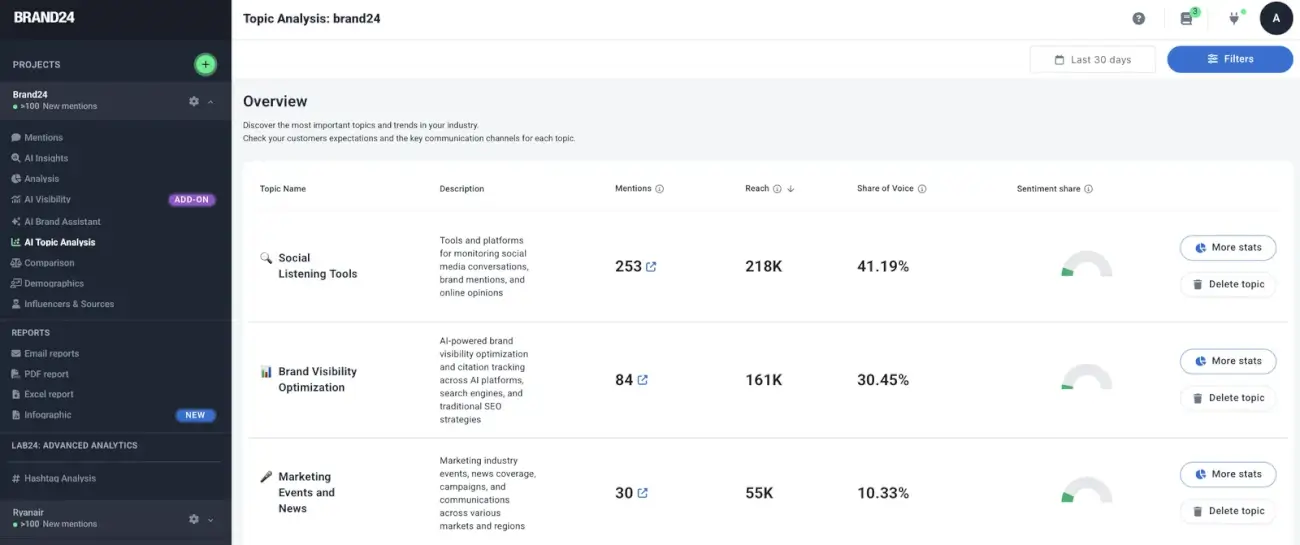
That’s why media monitoring and social listening should be part of your GEO strategy. The goal is to understand whether all those conversations together create an accurate and relatively consistent picture of the brand.
- what topics people associate with the brand
- which strengths and weaknesses appear repeatedly
- how sentiment changes
- where important conversations happen
- whether the same criticism appears across multiple sources
- which people or platforms are driving it
- and whether external conversations match the brand voice and positioning.
Why does the cross-platform view matter?
In our analysis of 1.3 million ChatGPT mentions, positive sentiment reached 31% on Instagram but only 10% on X during the same period. Same product, completely different conversation depending on the platform.
We saw something similar in Brand24’s research into AI visibility. The analysis covered 46,350 mentions with 85.9 million reach, and one of the more useful findings was that criticism amplified later by large accounts had often already been appearing for weeks among smaller voices.
That’s exactly why, in addition to monitoring my own content, I use social media monitoring tools to track Reddit mentions, YouTube videos, LinkedIn posts, reviews, and discussions on industry forums—all of which currently influence how the brand is perceived.
5. Track the prompts people actually use
According to G2’s The Answer Economy report, based on 1,076 B2B decision-makers, 51% of B2B software buyers now start their research with an AI chatbot more often than with Google, up from 29% a year earlier.
That means understanding how people search for your brand in AI matters just as much as understanding what they search for in traditional search engines.
People increasingly use AI tools to research brands, compare options, and validate their choices. That’s why you should first understand how your audience describes its problems, doubts, objections, and comparisons — and then turn those patterns into prompts you can track.
Combine traditional keyword research with prompt research. AI search queries are often more conversational and specific than the queries we’re used to optimizing for in traditional search engines.
Here’s my prompt list to track for reputation management:
- “[brand] vs [competitor] — which is better?”
- “Is [brand] trustworthy?”
- “What do users dislike about [brand]?”
- “Is [brand] worth the price?”
- “What are the biggest problems with [brand]?”
When I audit AI visibility, these are the kinds of prompts I find much more useful than simply asking ChatGPT, “What is [brand]?”
6. Measure how AI represents your brand
In fact, measurement is already one of the biggest challenges around AI visibility. In our analysis of 46k mentions, AI Brand Visibility Measurement was the largest discussion topic by mention volume, with recurring concerns that visibility scores based on too few prompts or platforms can give marketers a distorted picture.
So when I measure GEO, I look across multiple relevant prompts and multiple AI platforms. These are the metrics I track:
| Metric | What does it tell you |
|---|---|
| Visibility (presence rate) | How often your brand appears across your prompt set |
| Share of voice | Your share of brand mentions compared to competitors for the same prompts |
| Position | Whether you’re recommended first, listed third, or added at the end |
| Sentiment | Whether the description is positive, neutral, or negative |
| Citations and key sources | Which domains the answer is actually built from |
| Brand score | A composite metric that most tools calculate from visibility, position, and sentiment |
| Competitor presence over time | How all of the above shift month to month |
The question isn’t simply:
“Do we rank?”
It’s:
“How often do we appear, how are we described, who appears next to us, and which sources keep showing up?”
A high AI visibility score doesn’t automatically mean a strong reputation. Your brand can appear frequently and still be associated with outdated information, recurring criticism, or an inaccurate description.
Visibility metrics tell you whether you show up. Sentiment and citations tell you how. That’s why I combine AI visibility with traditional brand monitoring and traditional SEO.
What to do when AI gets your brand reputation wrong?
So, what happens when ChatGPT, Gemini, Google AI Overviews, or another AI tool already says something negative or simply incorrect about your brand?
I can’t just open an AI-generated answer and edit it. So I start by working backward. Don’t panic, take a deep breath, and check those 6 steps to analyze your brand reputation in AI models:
Step 1: Check whether AI is actually wrong
Before trying to change the answer, check whether the criticism is true.
If AI says your support is slow and your support is slow, you don’t have a GEO problem.
You have a customer experience problem wearing an AI costume.
The same applies to pricing complaints, missing features, security concerns, or any other recurring criticism.
Start with the evidence you already have: customer reviews, support data, social listening, sentiment, product feedback, and existing brand mentions.
If the problem is real, fix the underlying issue first. No amount of GEO optimization will make a real customer problem disappear for long.
Step 2: Trace the claim back to its source
If the information is incorrect or outdated, the next question is:
Where is AI getting this idea from?
Start with the citations shown in the AI answer.
Then go wider.
Look at Reddit, YouTube, review platforms, LinkedIn, industry forums, news coverage, blogs, comparison pages, podcasts, and other places where the same claim may appear.
This is where AI citation tracking and media monitoring work really well together.
An AI brand visibility tracking tool can help you see which sources AI mentions most often. A social listening tool, on the other hand, can show you what people are actually talking about, how they feel about it, and how those conversations change over time.
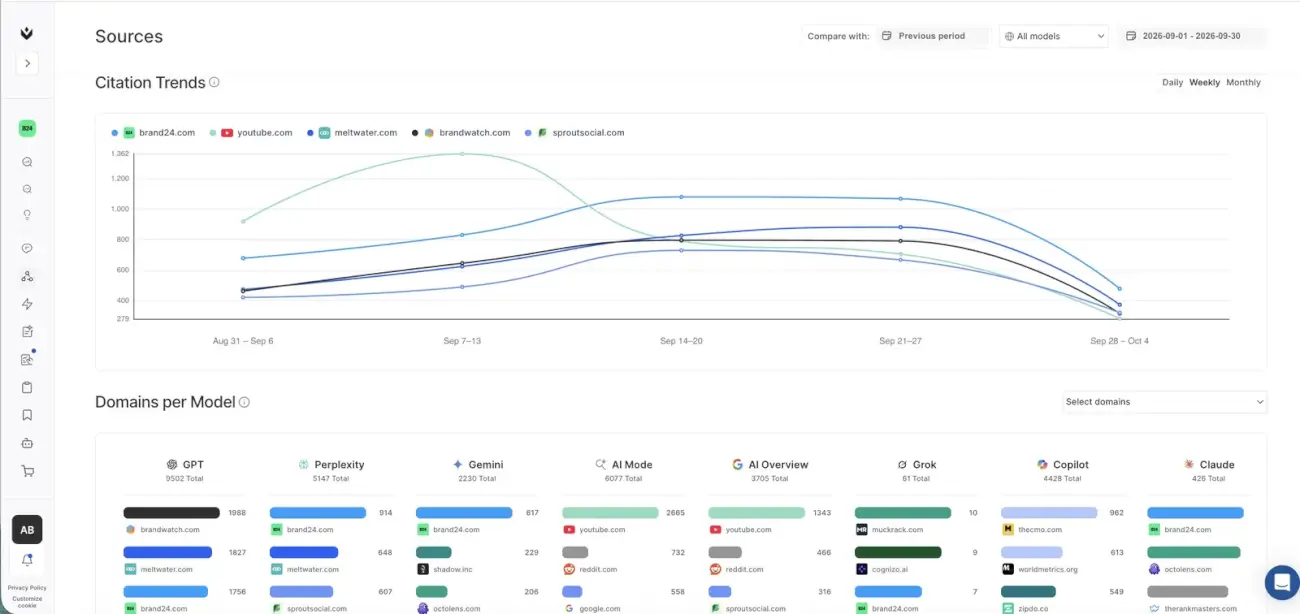
This also helps determine whether you’re dealing with a single outdated source or a broader narrative that AI draws from multiple places.
Step 3: Update the information you control
Once you know where the problem comes from, start with the information you control.
Update outdated:
- product pages,
- pricing,
- documentation,
- leadership information,
- security and compliance pages,
- FAQs,
- product descriptions,
- statistics,
- and other facts that no longer reflect the business.
Then move to external sources. The goal is to make accurate information easier to find than outdated information.
- If an old comparison article says your product is missing a feature you launched two years ago, try to contact the publisher.
- If a marketplace profile still uses an outdated product description, update it.
- If journalists or partners repeatedly use an outdated company description, make sure your current press materials use the correct one.
This is basically the same logic behind classic online reputation protection, but applied to a new search environment.
Step 4: Fill the information gaps
Sometimes AI isn’t repeating a false claim from anywhere. It’s making one up. Everyone who’s more into AI, GEO, and AEO topics knows about AI hallucinations. If not, then an AI hallucination is a response generated by an AI model that contains false or fabricated information presented as facts.
And it happens more often than most brands assume. Across 3,000 AI answers tested by 22 public broadcasters, 45% had at least one significant issue, and 31% had missing, misleading, or incorrect sources.
This happens because AI doesn’t always know how to answer questions, and so instead of “admitting” its mistake, it acts like a student who makes up information, hoping no one will catch on during a test.
Imagine users regularly ask:
- “Is [brand] secure?”
- “Who is [brand] best for?”
- “Why is [brand] expensive?”
- “What are the limitations of [brand]?”
Now check your website.
Do you actually answer those questions?
If not, AI still needs to produce an answer. And third-party sources may provide most of the material it has to work with.
There’s also one important thing here. Brands don’t like to talk about their limitations or weaknesses. Who does?
But while working on GEO, I’ve recently noticed that it’s better to also talk about them yourself. Why? If you don’t, your competitors probably will. And that means you’re giving them an easy opportunity to shape the answer about your brand.
You don’t have to highlight every weakness of your product. But if people are already asking about them, it’s better to provide your own, honest context rather than leave the answer entirely to third-party sources or AI hallucinations.
Step 5: Build independent proof for your claims
Repeating “We provide excellent customer service” five times on your website doesn’t give you five different pieces of evidence. It’s still the same claim.
Instead, look for different sources that support the same idea:
- A detailed customer review does.
- A case study showing actual results does.
- An industry publication describing the same strength gives you another perspective.
- A customer sharing their experience on Reddit or YouTube gives you another one.
GEO for brand reputation is the work of the whole marketing team. Digital PR, SEO, link building, customer experience, reviews, social media coverage, expert contributions, community presence, and brand mentions all contribute to the wider evidence around your brand.
And this is where the goal becomes slightly different from classic link building.
A useful third-party mention doesn’t have to exist only to pass link authority. From a reputation perspective, it also gives users, and potentially AI systems, another independent source describing what your brand does and how people experience it.
Step 6: Monitor whether the narrative actually changes
Finally, go back to the prompts that exposed the problem and track them over time.
Don’t just check whether AI changed its answer. Look at what changed behind it:
- Are the same sources still being cited?
- Is the same criticism still appearing across Reddit, reviews, and other platforms?
- Are new sources starting to influence the answer?
- Is the narrative changing across AI platforms?
- Does the wider conversation about your brand match what AI is saying?
For example, if AI keeps saying your product is expensive after you update your website with clearer pricing, check the wider conversation. The same perception may still be repeated across reviews, Reddit threads, comparison articles, or other third-party sources.
Your website may have changed, while the wider narrative around the brand hasn’t.
That’s why I look at both sides over time: what people are saying about the brand and what AI is saying about it. Comparing the two makes it easier to understand which sources and conversations are shaping the AI narrative.
Why is GEO important for reputation management?
In 2026, more and more people are likely to check a brand in a large language model (LLM) before they use traditional search. User queries look like: “what’s the best company/tool for…”, “what is this company”, “what are people saying about them”, and they take the answer at face value.
- 57% of them use AI to narrow down their choices
- 51% use it during early discovery
- 53% compare products they are already considering
- 50% use it to make a final decision
Source: Semrush, How AI Tools Influence the Modern Buyer Journey: A Survey of 1,000+ US Consumers, March 2026
First, AI has become a new environment for monitoring brand visibility, a place where people discover brands, evaluate them, and form opinions about them.
Second, AI models directly impact your brand’s reputation. It is these AI-generated mentions that shape customers’ perceptions of the brand, especially among people who have never heard of it before.
For the visibility side of GEO, see our guide to AI brand visibility and how to rank your brand on ChatGPT for the tactics that earn more AI mentions.

