Table of contents
2M Marketers

To build a stronger brand, you first need to know what people think of the one you already have. And how they feel about it, too!
That’s what sentiment analysis is for. By looking into the emotional tone of online conversations, you can identify what’s earning your brand praise and what’s doing the exact opposite.
In this guide, I’ll show you how to use sentiment analysis for brand building, with practical examples from Brand24 and tips you can apply to your own strategy.
Key takeaways:
-
Sentiment analysis tells you how people feel about your brand, at scale
It classifies mentions as positive, negative, or neutral, and more advanced tools also detect specific emotions, such as anger or joy.
-
Emotions drive loyalty
Emotionally connected customers are 5.7x more likely to trust a brand, so knowing how people feel about you matters as much as knowing what they say.
-
Sentiment shows you where to act next
Recurring questions and complaints point to content gaps you can fill, and the words happy customers use to praise you should be part of your messaging.
-
Your industry has a big influence on brand sentiment
In my 30-day analysis of six major brands from six different industries, positive-to-negative ratios ranged from 3:1 for Spotify to 1:4 for Ryanair. Keep your industry’s typical sentiment patterns in mind when evaluating your own results and setting realistic goals.
Why sentiment analysis matters for brand building
People may forget what you said or did, but they’ll remember how you made them feel. That’s as true for me and you as it is for any brand.
Emotions are a major factor in customer brand loyalty. In fact, according to a 2026 Qualtrics study, emotionally connected customers are 5.7x more likely to trust a brand.
What’s more, 85% of customers who had a positive emotional experience with a brand said they intended to buy more from it. In practice, this means your positive sentiment is a leading indicator of repeat revenue.
So, by tapping into your customers’ emotions, you can elevate their loyalty and trust in your brand. And get those sales up!
That’s why sentiment analysis should be a big part of your brand-building strategy. But if you need a few more reasons, here they are:
- Improve brand perception and customer loyalty: Once you start analyzing how your audience reacts to your campaigns, you can adjust accordingly and track whether opinions change over time.
- Find your competitive edge: Compare customer sentiment toward your brand and its competitors to see where you’re winning people over.
- Protect your reputation: By zooming in on negative conversations, you can catch any unusual spikes early and investigate the cause before they gain momentum.
- Perfect your content strategy: Identify the topics that engage your audience most and let them guide it.
Now, let’s get into it!
How to use sentiment analysis for brand building
So, how do you put brand sentiment analysis to work? Start by monitoring what people are already saying about you on the web.
By analyzing how customers, industry experts, and the wider online community talk about your brand, you can see exactly what’s driving positive and negative opinions.
And more importantly, use what you learn to build a stronger brand.
Let me show you how I do it, using my favourite out of brand sentiment analysis tools, Brand24.
01 Find out how people feel about your brand
First things first: you need to know where your brand stands. Are people generally happy with it, or is frustration starting to take over?
To find out, see how many positive vs. negative mentions you get. The ratio between the two will give you an overview of how your customers, or customers-to-be, feel about your brand.
Here’s how to do it in Brand24:
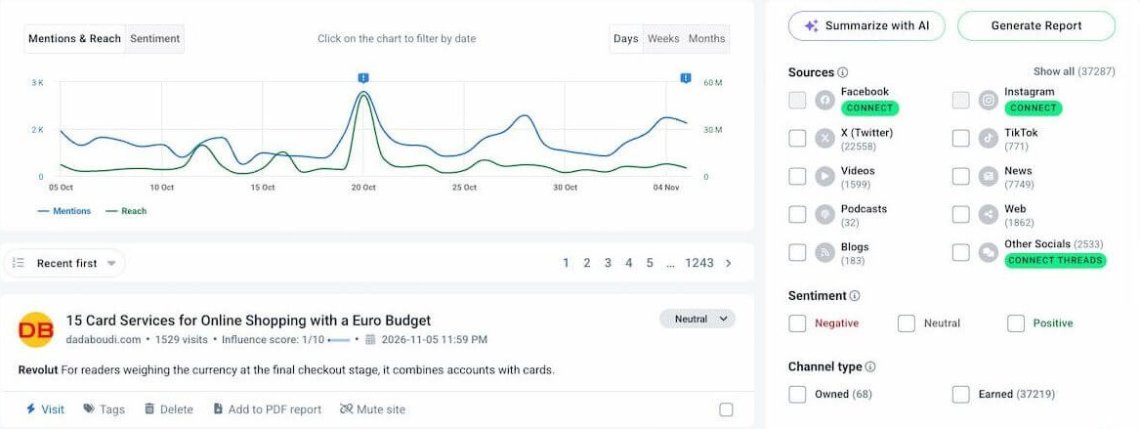
- Open the Mentions tab. This is where you’ll find all the mentions of your brand. Brand24 automatically classifies them as positive, negative, or neutral.
- Check the Sentiment chart. It’s gonna give you an overview of how positive and negative conversations shift over time.
- Go to the Analytics tab. Here, you’ll find all the numbers, including the total number of positive and negative mentions for your selected period. Compare the two to calculate your positive-to-negative ratio and get a clearer picture of your overall brand sentiment.
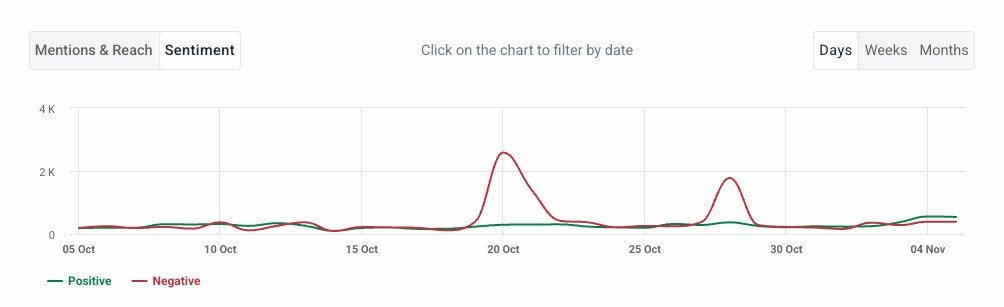
While there’s no universal ratio you should aim for, your industry matters a lot. Airlines, telecoms, and banks naturally attract complaints, while entertainment and consumer apps skew positive.
To show you just how much a sentiment score can vary, I analyzed six major brands from six different industries in Brand24, comparing their positive and negative mentions over the same 30-day period.
Here’s what I found:
| Brand | Industry | Positive Mentions | Negative Mentions | Positive-to-Negative Ratio |
|---|---|---|---|---|
|
Spotify |
Music
|
71 414
|
27 336
|
3:1
|
|
Zara |
Fashion & retail
|
2 952
|
2 161
|
2:1
|
|
PlayStation |
Gaming
|
1 981
|
3 116
|
1:2
|
|
Revolut |
Banking & fintech
|
3 059
|
3 648
|
1:1
|
|
Netflix |
Streaming
|
64 392
|
71 746
|
1:1
|
|
Ryanair |
Airlines
|
3 412
|
12 552
|
1:4
|
Data collected between October 5 and November 5, 2026. Positive-to-negative ratios are rounded to whole numbers.
As you can see, the differences can be substantial. But before you start comparing your brand to the best-performing one, there’s something worth keeping in mind.
Your most useful benchmarks are your direct competitors. Compare your ratio against two or three brands in your category, then use your initial results to set a realistic improvement goal.
For example, if you’re currently getting four negative mentions for every positive one, aim to bring that down over the next quarter, but stay within realistic industry standards.
02 Catch reputation issues before they escalate
Even brands with predominantly positive brand sentiment still get negative mentions. I bet yours does, too. And yet, they don’t always lead to a crisis. So how do you identify the ones that could?
What I watch out for is change. Such as:
- Big increases in negative sentiment. When a crisis is brewing, negative mentions pile up. What starts with one account escalates, and within a few hours, hundreds of people are replying and adding their own complaints. You can easily spot this in the Sentiment chart via Brand24’s Event Detector, which flags any sudden increases in mentions and helps you investigate the cause.
- Complaints that are gaining reach. A complaint coming from a small account will have a different effect than one coming from a journalist or an influencer. Prioritize the latter: it can spread quickly and attract more attention. To get to those mentions first, filter by Popular Mentions. You can also take a peek at the author’s follower count and Influencer score to better assess the risk.
Once you’ve spotted a spike, figure out what kind of problem you’re dealing with. If lots of people are frustrated about the same thing, like late deliveries, it’s an experience problem.
Replying to every post won’t make it go away; fixing the thing will. Acknowledge the issue, let people know you’re working on it, and follow up once it’s sorted.
A PR crisis is different. It’s usually about something your brand said or did that people find offensive or dishonest.
Here, how you communicate matters most. Get the facts straight, decide who speaks for the brand, and put out one clear statement. And whatever you do, don’t start arguing in the replies.
Of course, none of this helps if you find out too late. To spot trouble early, set up Storm Alerts. Those will notify you when your mention volume spikes out of nowhere.
03 Figure out why people feel the way they do
Angry mentions usually mean something broke. Disappointed ones mean you promised more than you delivered. You fix those in very different ways: one with your product team, the other with your copywriters.
Brand24 helps separate them at scale by breaking mentions down into specific emotions, such as joy, anger, and sadness, so you can spot patterns quickly.
And to get an overview of what’s causing those reactions, you can head over to my trusted Topic Analysis.
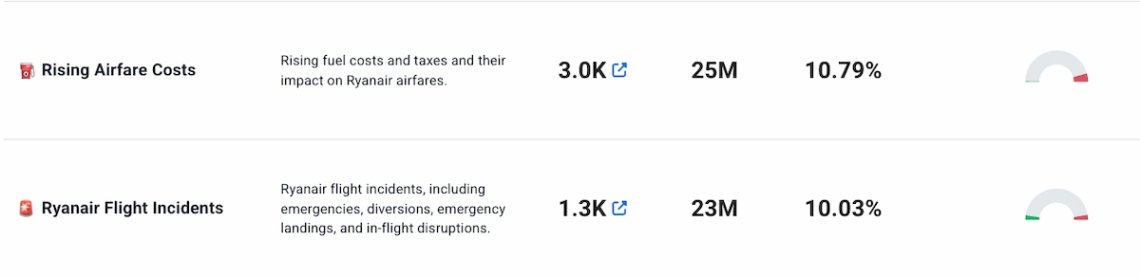
It groups mentions into themes, so instead of reading a thousand negative takes one by one, you can see which topics drive most of them.
For example, in Ryanair’s case, Topic Analysis highlighted discussions about rising airfares, flight incidents, and changes to baggage rules.
I looked at the remaining five brands, too. I picked one of the leading topics for each to show you what to pay attention to when you’re running a sentiment analysis yourself.
| Brand | Topic Name | Description | Mentions | Share of Positive vs. Negative Mentions |
|---|---|---|---|---|
|
Spotify |
Music Releases and Sharing
|
Music releases, recommendations, track sharing, and availability across streaming platforms.
|
76K
|
23% Positive vs. 3% Negative
|
|
Zara |
Zara Shopping Hauls
|
Zara clothing purchases, try-ons, and shopping haul videos.
|
1K
|
26% Positive vs. 1% Negative
|
|
PlayStation |
PlayStation vs Xbox Debate
|
Discussions and debates comparing PlayStation and Xbox consoles, including exclusives, pricing, and platform rivalry.
|
19K
|
11% Positive vs. 45% Negative
|
|
Revolut |
Revolut Service Outages
|
Reports of Revolut service disruptions, including the Google Cloud outage in London.
|
2K
|
28% Negative
|
|
Netflix |
Streaming Service Opinions
|
User opinions and discussions about streaming service subscriptions, costs, and value.
|
16K
|
11% Positive vs. 54% Negative
|
|
Ryanair |
Ryanair Brand Opinions
|
General opinions, humor, comparisons, and casual discussion about Ryanair as an airline.
|
5.6K
|
12% Positive vs. 48% Negative
|
You can’t build a better brand until you know which part needs work. And once you know the topics, you know where to focus.
For example, in the Netflix project, the highlighted conversations revolving around subscription costs and people’s experiences with streaming services had 54% negative mentions. Ouch!
That’s a pretty clear signal that pricing and value deserve a closer look.
04 Fine-tune your brand communication
Your positive mentions are a ready-made list of what people love about you. So when it’s time to communicate with them, use the same words they use.
If customers keep saying your app is “ridiculously easy,” that phrase will probably land better than anything your team comes up with in a brainstorm. So put it right in your messaging!
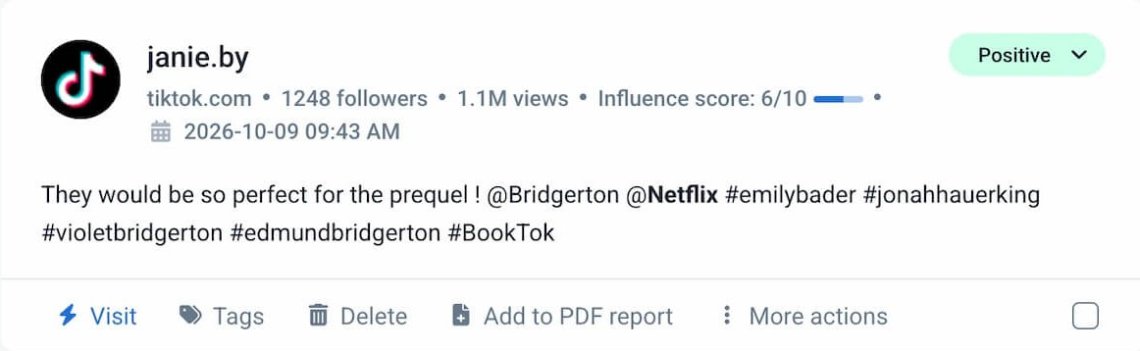
Positive mentions are also a great source of social proof. Reach out to happy customers and ask if you could feature their posts. Most people are flattered to even be asked.
Here’s a good example of such a mention:
Negative mentions can be useful pointers, too. When the same question or complaint keeps coming up, you’ve found a content gap. Turn it into an FAQ entry or a short video.
You’ll answer the question once instead of a hundred times in the replies, and people will see that you’re actually hearing them out.
05 See how you stack up against competitors
Comparing your numbers with your competitors’ results will help you understand where your brand stands in the market and where there’s room to win people over.
To do that, add your competitors as separate projects in Brand24 and compare them in the Comparison tab. Two things to look at:
- Compare ratios, not numbers alone. A bigger brand will always get more mentions overall. The positive-to-negative ratio can actually help you benchmark against them.
- Read what people praise them for. If customers keep complimenting a competitor’s customer service team and nobody mentions yours, that’s a gap you can close. And if they keep complaining about something you already do well, put that front and center in your messaging!
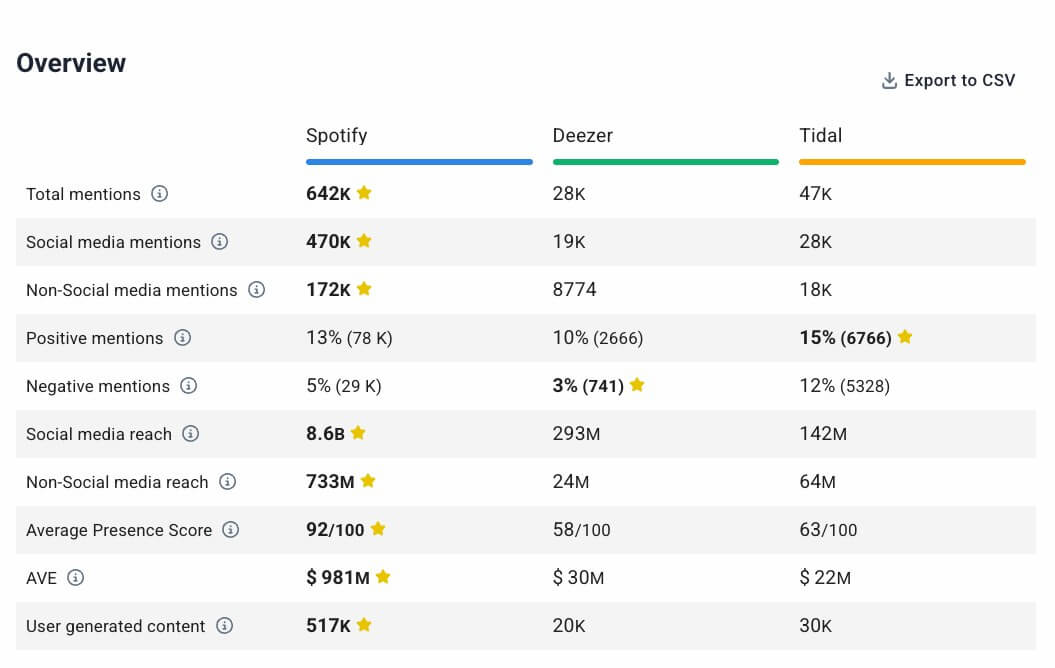
Tbh, this is one of my favorite parts of the whole process. Your competitors’ unhappy customers are telling you exactly how to win them over, for free. It feels almost illegal to access that information… But it’s not!
06 Identify your biggest brand advocates
By looking at who’s consistently speaking positively about your brand, you can find people who are already recommending you to others. And those relationships are worth investing in.
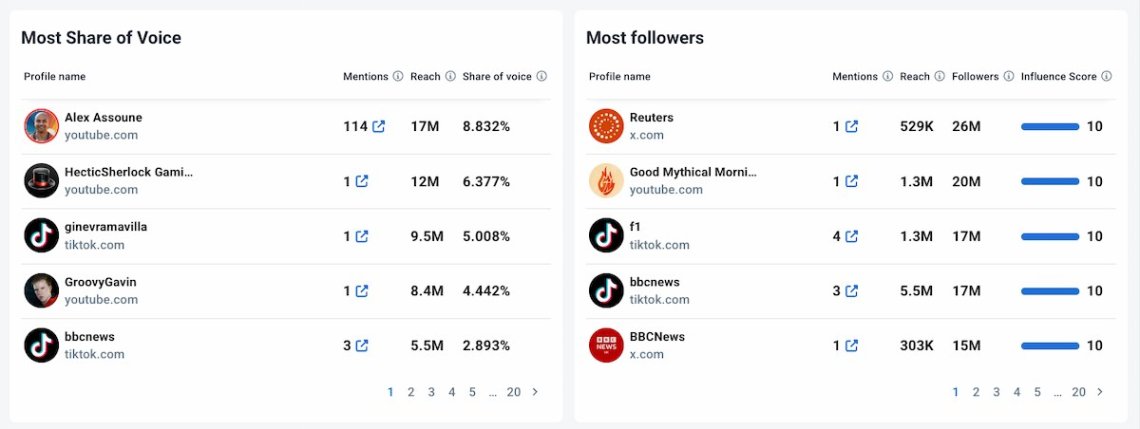
In Brand24, go to the Analytics tab and check two lists:
- Most active profiles. These are the people who mention you again and again. They’re often loyal customers who’d happily work with you if you asked.
- Most influential profiles. These accounts have the biggest reach. Filter them for positive mentions and track brand sentiment to see who’s actually saying nice things about you.
The sweet spot is someone who shows up on both lists. Big reach, frequent mentions, positive tone. That’s an advocate.
Don’t overlook the smaller accounts, though.
Someone with 3K followers who posts about your brand every week can often do more for you than a big creator who mentioned you once. Their audience trusts them, and they’re clearly not doing it for the paycheck.
Once you’ve found your advocates, reach out to them.
You can just say thanks or give them something extra, like early access to a new feature. You can also invite the most enthusiastic ones into an ambassador program, if you have one.
People who already like you will likely be thrilled that you noticed!
07 Track the impact of your campaigns
I’ve found it’s best to run the same sentiment check every month or quarter and compare it to your starting point. Just make sure you’re using the same monitoring project and filters. That will show you the long-term trend.
For individual campaigns, though, you’ll need something more precise. Compare the 14 days before launch with the 14 days after, and track these metrics:
- Number of mentions overall
- Positive-to-negative ratio
- Share of joy vs. disappointment
- Top topics
A good way to judge if a campaign worked is to see whether your sentiment ratio improves and remains that way into the second week. If it jumps for a few days and drops back to your baseline, you got some attention, but you didn’t change the general feel around your brand.
Conclusion
Sentiment analysis won’t build your brand for you. It shows you where to put your efforts, though, which is the next best thing.
If you’re not sure where to start, pick the goal that matters most to you right now and work from there:
| Your goal | What to look for in sentiment data | What to do next |
|---|---|---|
|
Build customer trust |
Complaints that keep coming back, such as hidden fees or broken promises
|
If the same complaint keeps coming up, address its cause and publicly explain what you’ve changed.
|
|
Strengthen brand loyalty |
Praise for specific products, features, or experiences
|
Identify what customers consistently love and prioritize preserving those experiences.
|
|
Protect your reputation |
Sudden spikes in negative mentions, especially from accounts with big reach
|
If negative mentions jump to 2–3x your daily average, investigate the cause and alert your PR team if the issue is spreading.
|
|
Sharpen brand messaging |
Reactions to campaigns, both positive and negative
|
If customers keep misunderstanding your message, identify the confusing claims and rewrite them using clearer language.
|
|
Stand out from competitors |
Differences in sentiment toward competing brands
|
Check whether your offer better solves those frustrations. If it does, highlight that advantage in your messaging.
|
|
Improve customer experience |
Repeated complaints or unmet customer expectations
|
Group complaints by topic, flag the most frequent issues to the relevant team, and monitor sentiment after fixes are introduced.
|
And one more thing before you go… Don’t treat sentiment analysis as a one-time audit. People’s opinions change, and so should your approach.
Keep listening, check whether your improvements are making a difference, tweak and adjust as you go.
And a month from now, you’ll know whether what you’re doing is working, which is more than most brands can say!
FAQ
Sentiment analysis is good at identifying overall patterns in positive and negative conversations, but it’s not 100% accurate. The results depend on the language, context, and quality of the data being analyzed. That’s why you should manually check a sample of mentions, especially when you notice an unusual shift in sentiment.
Sarcasm is one of the trickiest things for sentiment analysis tools to interpret. A comment like “Great, another delayed flight. Thanks, Ryanair!” uses positive words to express frustration. AI-powered tools can recognize some sarcastic comments from their context, but they won’t catch every one, so it’s worth double-checking ambiguous mentions.
Negative brand sentiment often comes from poor customer experiences or unmet expectations. Use emotion and topic analysis to identify what’s driving the criticism and turn recurring complaints into actionable insights. If complaints about the same issue keep appearing, investigate the cause and involve the team responsible for fixing it.
Check sentiment trends weekly and conduct a more detailed brand sentiment audit monthly. During major campaigns, product launches, or potential PR crises, track customer sentiment daily. Use automated brand sentiment tracking to catch unusual spikes so important changes don’t go unnoticed between checks.
Some of the best value-for-money sentiment analysis tools for small marketing teams include Brand24, Mentionlytics, and Awario. All three are intuitive, with clean dashboards that help track brand mentions and analyze sentiment. All that without requiring a large marketing budget.
With a $200/month budget, consider Brand24, Mentionlytics, or BrandMentions. All three offer automated sentiment analysis and monitoring across social media and online news sources. Brand24 starts at $199/month with annual billing, while Mentionlytics and BrandMentions offer lower-cost plans. Compare user limits, mention allowances, and reporting features before making a choice.
If you mainly need to understand how people feel about your brand, consider Brand24, Talkwalker, or Sprout Social. All three offer sentiment analysis to help you track positive and negative conversations. Brand24 also provides Emotion Analysis to identify specific emotional reactions, while Talkwalker offers more advanced consumer intelligence features. Sprout Social is the one if social media management is a priority for you.