Table of contents
2M Marketers

A PR crisis can spiral in minutes and if you’re not prepared, you’re already behind. The key isn’t just reacting fast, but knowing exactly what to do at each stage.
In this guide, we walk you through an effective 7-step PR crisis management process you can put into action right away!
Key takeaways:
-
PR crisis management is about speed and clarity
The faster you identify and assess the situation, the better your chances of controlling the narrative.
-
Your first response matters more than a perfect response
Delays create space for speculation, misinformation, and negative sentiment to grow.
-
You need a predefined crisis plan before anything happens
Teams that improvise during a crisis usually lose control of communication.
-
Media monitoring is your early warning system
Real-time mention tracking in media monitoring tools helps you detect mention volume spikes, negative sentiment trends, and emerging user issues before they escalate.
-
Not every negative mention is a crisis
Classify situations (green, orange, red) to avoid overreacting (or worse, underreacting).
What is Public Relations crisis management? Definition
PR crisis management is the process of preparing an organization for a major event that threatens its business reputation, stakeholders, or the general public.
It is key to protecting your brand’s reputation when things get tough. It’s all about responding quickly and thoughtfully to limit negative impressions.
Strong crisis management also means keeping a close eye on media channels, tracking public sentiment, and shaping messages that make sense in the moment.
During a crisis, the PR team’s top priority is to keep everyone in the loop on what’s happening, potential risks, and the steps being taken.
A solid crisis plan should already include the first message you’ll share publicly.
To make this complicated process easier to follow, we broke the communication and management guidelines into three phases:
- Pre-crisis management
- Crisis management
- Post-crisis management
This way, you’ll know what to do at each step!
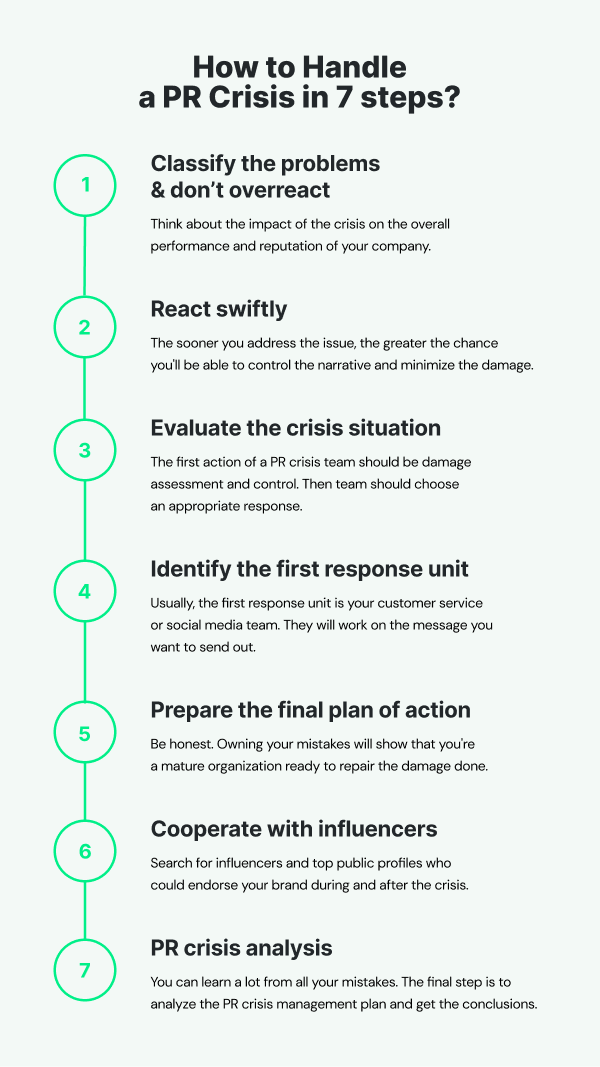
How to manage a Public Relations crisis? 7 steps
Having a crisis communication strategy is important, but it’s just as important to know what to do when things actually go wrong.
If you’re unsure about the best way to handle a PR crisis, we’ve put together a simple 7-step list to help you navigate the tough moments.
These are our tried-and-true best practices: follow them, and you’ll be able to stay in control.
01 Classify the problems & don’t overreact
Not every negative comment about your brand is a full-blown PR crisis. That said, you still shouldn’t ignore negative feedback.
Just don’t involve your CEO into replying to a bad Google review.
Instead, look at the potential impact on your overall PR performance and your company’s reputation.
Some issues will fade on their own, and responding can sometimes amplify the problem by drawing more attention to it.
02 React fast
Once you realize you’re dealing with a PR crisis, you need to move quickly.
Time really matters here. The faster you address the issue, the better your chances of shaping the narrative and limiting the impact.
People expect a response almost immediately, so you may not have time to write a perfectly polished statement. That’s why it helps to have a few ready-to-go, general responses you can publish right away and adjust as needed.
Choose the communication channel your customers actually use. The key is to show that you’re aware of the situation and actively managing it: then you can share more details as you learn more.
But I know how hard it can be sometimes to match the tone and response, especially when the situation can escalate fast.
AI can be a lifesaver here!
Using the right prompt is key to getting a perfect, ready-to-paste response.
We recently created a free resource full of useful AI prompts for media monitoring. Check the site 20 with the reputation guards ideas:

03 Identify the first response unit
In most cases, your first line of response is your customer service or social media team.
Customer service gets to talk to customers directly, which means they can catch potential PR issues early, before they spread to a bigger audience, like the press.
Sometimes a negative comment can start gaining traction on social media. If your media monitoring tool flags it in real time, you still have time to step in and protect your organization’s reputation.
If the situation escalates, you’ll want a well-rounded team you can rely on. Make sure you bring in key people from across your organization, like:
- 1 CEO
- 2 Someone with legal expertise
- 3 A point person for media communications
- 4 A point person for other stakeholder communications
- 5 A point person for customer communications
- 6 Someone with strong technical knowledge
This will ensure that your crisis communications efforts will run smoothly and everyone will be at the right place at the right time.
04 Evaluate the crisis situation
Trained team members should quickly evaluate the PR mishap and respond accordingly.
Every PR crisis is different, so there’s no one-size-fits-all playbook. That’s why the PR response team’s first move should be assessing the damage and getting it under control.
Based on how big the crisis is and what it could impact, the team should pick the most appropriate response.
Once they’ve decided on a plan, they can start taking steps to reduce the damage.
05 Prepare the final action plan
You’ve got your holding statements ready to buy you some time. Now it’s time to put together your final plan of action.
And you need to be honest. It’s natural to want to limit the damage, but denying there’s a problem, blaming someone else, or leaving out key details will only make things worse.
Taking responsibility shows you’re a mature organization that’s ready to make things right.
06 Cooperate with influencers
When your brand, product, or service is under fire, it helps to have people who can back you up.
That’s why it’s worth checking out influencers and high-profile public figures who could support your brand during and after a crisis.
The key to a strong influencer campaign is choosing the right partner, and chances are, the best-fit influencers are already talking about your brand.
A media monitoring tool makes it easy to spot the right influencers to help you navigate a PR crisis.
After you log into your project in Brand24, head to the Influencers & Sources tab. You’ll see a few types of data there:
- Influencers list
- Influencer analysis tab
- Sources analysis tab
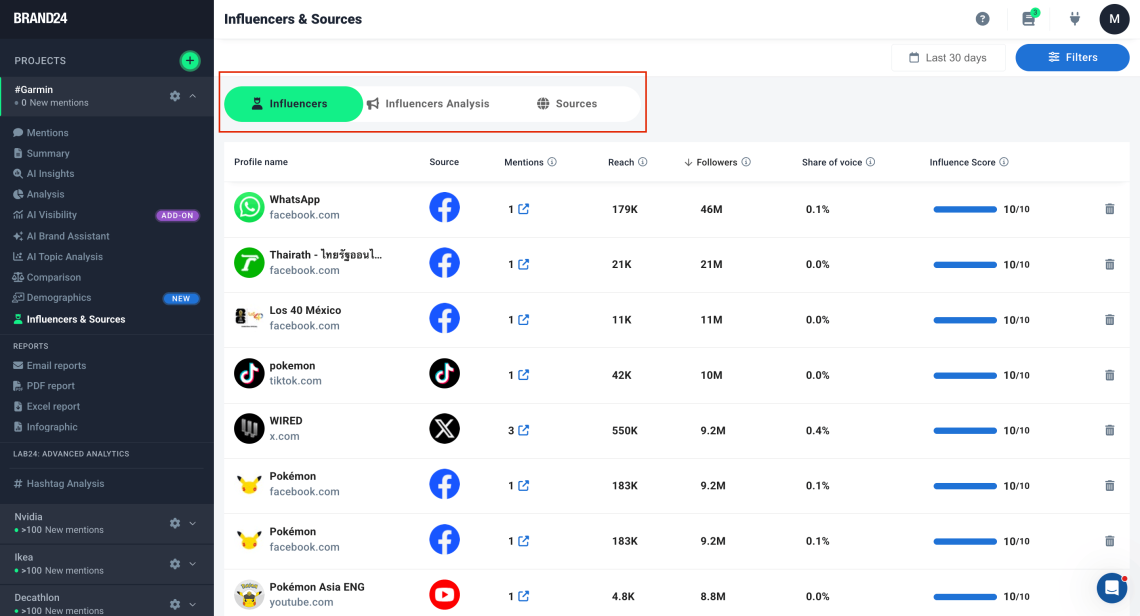
You’ll still want to vet the names. Check what kind of content they post, what engagement looks like on their posts, and which social platforms they’re active on.
Then, based on what you find, pick the influencer who’s the best fit to represent your brand.
📚 Further read: Best PR Tools for Analytics, Monitoring, Outreach & More [2026]
07 Conduct a post-crisis analysis
The final step matters just as much as everything that came before it. You can also learn a lot from the mistakes you made along the way.
That’s why it’s important to review and analyze your PR crisis management plan:
- 1 What worked well?
- 2 What didn’t?
- 3 What should you adjust for next time?
This is also the right moment to evaluate your crisis response team:
- 1 Do any team members need extra training?
- 2 Should you shift responsibilities, update roles, or bring in additional support?
Then look at how people reacted to the PR messages you shared:
- 1 Could they be clearer or more effective?
- 2 Should you try different channels, change the tone, or rewrite the wording?
A solid PR crisis review gives you the insights you need to strengthen your overall crisis strategy.
When should you respond to PR crises?
First, you need to know when and how to respond, so let’s start with the “when.”
Not every negative comment is a full-blown PR crisis that can hurt your brand or requires your CEO to step in.
The real issue is when a mistake starts gaining traction and spreads into business news.
A simple triage approach can help you quickly judge how serious the situation is. Catching it early makes it easier to manage and helps you avoid spending time and resources on things that don’t need it.
For any situation that feels like a brand image threat, assign it a color: green, orange, or red.
01 Green tag
Green is for situations where your organization doesn’t need to take immediate action.
For instance, if a competitor is dealing with a crisis, it may not directly impact your business.
That said, there’s still a chance it could affect you. Keep an eye on what’s happening and be ready to bring in your crisis response team if needed.
Also, check Google search results. If your company starts trending in the media, the status may shift from green to orange.
02 Orange tag
The orange tag highlights situations that could potentially hurt your business and damage customer trust in your brand.
For example, if you spot ten negative reviews among hundreds of positive comments, it’s worth monitoring, but there’s no need to call in your PR crisis team just yet.
03 Red tag
Red is your “act now” moment. Your reputation and revenue could be on the line, so it’s time to bring in your PR response team fast.
A code red covers situations that can seriously hurt your brand or disrupt your supply chain, and those impacts can quickly show up in your bottom line.
The toughest crises often involve executive misconduct or, unfortunately, sexual harassment. You’ll want to address issues like these immediately: ideally before your audience or the media even catch wind of what’s happening.
Keep in mind that things can escalate fast. A situation can shift from code green to orange, or straight to red, in just a couple of hours. That’s why continuous social listening and media monitoring are so important.
How to prepare for a PR crisis?
There’s bad news and good news.
- Bad news: there’s a strong chance your organization will face a crisis at some point.
- Good news: with the right crisis communications plan, you can be ready for it and limit the impact.
You likely already have a solid PR strategy. But do you also have a plan to help you manage PR crises when they happen?
A strong PR crisis strategy makes sure everyone on your team knows exactly what to do.
Here’s what you’ll want to consider as you build your PR crisis management plan:
01 Monitor news cycle around your brand
We live in a world that’s always online, and social media lets anyone share opinions or post reviews.
Chances are, a crisis will start online on channels you don’t own. That’s the worst-case scenario because your audience may notice it before your PR team does.
To keep an online crisis from escalating, you need to know what people are saying about your company or product.
The challenge is that with so many platforms out there, it’s nearly impossible to track every single mention of your brand manually.
What is the solution?
A simple option is to use a media monitoring and analysis tool.
For instance, Brand24 tracks and analyzes publicly available online mentions from both social media and non-social sources (like news, blogs, podcasts, or video platforms) that include your chosen keyword.
But Brand24 isn’t just a feed of posts. Its AI-powered features like AI Brand Assistant or AI Topic analysis also you make sense of the chatter by analyzing those mentions. You can tag them based on what matters to you, so the insights you need are easier to spot and act on.
From a PR crisis management standpoint, which media monitoring features matter most?
Let’s go through the list one by one!
1. Sentiment analysis & the volume of mentions
A social listening tool automatically applies sentiment to the online mentions it collects.
That way, you can quickly see whether people are talking about your brand in a positive, negative, or neutral way.
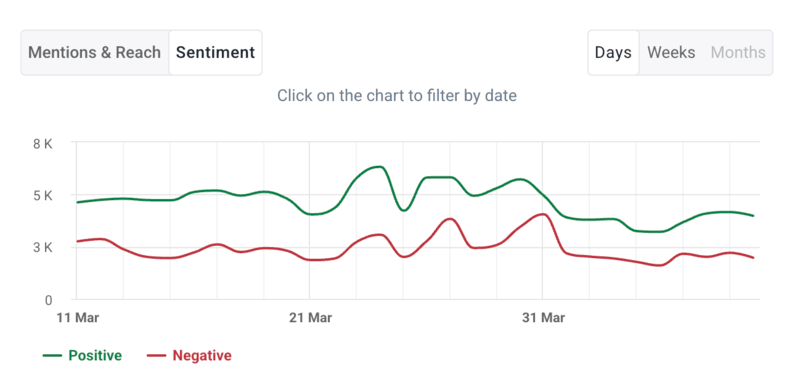
Pro tip: To get the most out of media monitoring and PR sentiment analysis, combine the metric with the volume of mentions.
The volume of mentions is simply the total number of times you’re mentioned within a set time period.
If mentions suddenly spike and the overall sentiment turns negative, that’s often a sign a PR issue could be brewing. Keep a close eye on those metrics so you can respond before the press catches on.
On the other hand, a spike in positive mentions usually means you’re doing something right!
2. Filters
If you’re tracking mentions around a big company or a popular product, you’re going to get a lot of brand or product mentions.
Some of them may be relevant to your project, but you might only need to focus on a specific slice of the online conversation.
To make that easier, we’ve built a set of filters you can use in your project.
Here are some of the filters you’ll find in the Brand24 dashboard:
- AI-powered Smart Context Search
- Sources
- Time Range
- Geolocation
- Language
- Brand Sentiment
📚 Further read: Social Listening Filters: 10 Time-Saving Filters Every Tool Should Have
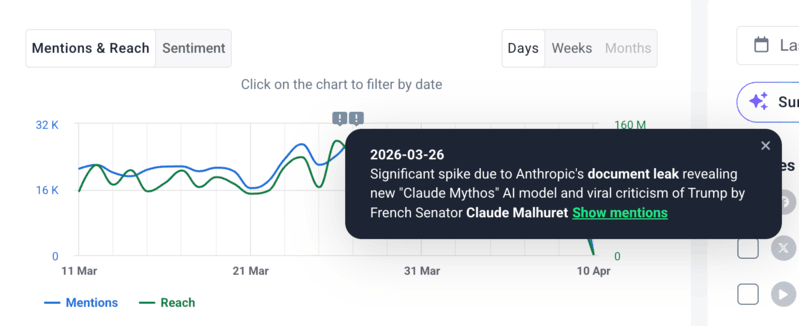
3. AI Anomaly Detector
The Anomaly Detector is like that friend who always notices the first signs that something bigger might be coming.
It flags unusual spikes in conversations about your brand across media platforms. By catching these early, your team can dig into what’s happening before it escalates.
That means you can respond faster to negative chatter and stay in control of your brand’s narrative.
4. Notifications and Storm Alerts
To stop a PR crisis from spreading, you need to know it’s happening in the first place.
That’s why a reliable notification system matters. With Brand24 notifications, you can get alerts for every mention, or only the ones you’ve already filtered.

In Brand24, we offer three types of notifications and Storm Alerts that will help you manage a PR crisis:
Slack notifications
This one’s my personal favorite. Whenever a new mention shows up in the dashboard, you’ll get a Slack notification, so you’re always up to date.
Email notifications
If you don’t have Slack access, you can still stay in the loop with email notifications. Choose alerts in real time, hourly, every 6 or 12 hours, or on a daily, weekly, or monthly schedule.
In-app notifications
Brand24 has an app for both iOS and Android, so you can check all your project mentions right from your phone.
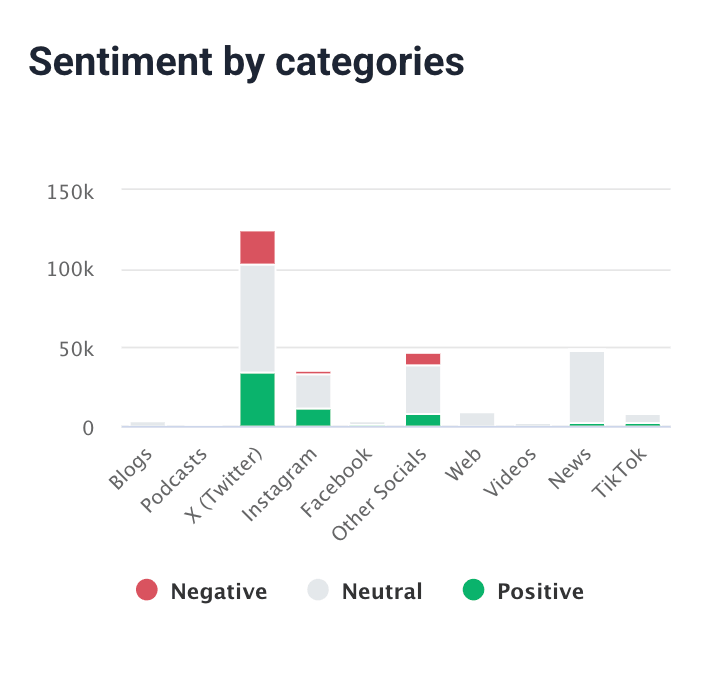
5. Sentiment source analysis
You’ll find this feature in the Brand24 Analysis tab.
This chart breaks down how many positive vs neutral vs negative mentions you’re getting from each source or channel.
Spotting which source is driving the most negativity makes it easier to tell whether your crisis management efforts are actually working.
Use these insights to make smarter, data-backed decisions during a PR crisis.
02 Always be prepared
You may feel confident that your product is great and your organization runs smoothly, but that doesn’t mean you’re crisis-proof.
These days, it’s less about if a PR issue will happen and more about when.
That’s why it’s smart to have a crisis response plan ready to go. When something comes up, people across key departments will already know who does what, how to respond, and what steps to take.
A crisis communication plan also helps new employees who join during a rough patch. They can get up to speed quickly and follow the company’s approach right away.
FAQ
What is PR crisis management?
PR crisis management is the process of handling events that threaten a company’s reputation. It includes detecting issues early, responding quickly, and communicating clearly across channels.
How fast should you respond to a PR crisis?
Ideally within hours. The first response doesn’t need to be perfect, but it should acknowledge the issue and show you’re taking action.
What is the first step in PR crisis management?
The first step is classifying the situation: understanding whether it’s a minor issue or a full-scale crisis. This determines how urgently and broadly you respond.
How do you detect a PR crisis early?
By monitoring online mentions across social media, news, blogs, and forums. Sudden spikes in discussion or negative sentiment are early warning signs and can be tracked by media monitoring tools like Brand24.
What are some common causes of a PR crisis?
A PR crisis can be triggered by negative media coverage, customer backlash, product failures, employee misconduct, or viral social media discussions.
How can a crisis response team prevent PR mishaps?
A crisis response team prevents PR mishaps by preparing in advance, monitoring online conversations in real time, and reacting quickly with clear, consistent communication.
Defined roles and a structured response process help avoid confusion and delays.
The key is to catch issues early and deal with them before they turn into a full-blown crisis, so you can help maintain a positive brand reputation.