Table of contents
How to Check Brand Mentions in ChatGPT and Improve Them?
Every day, 2.5 billion prompts are entered into ChatGPT (Axios, July 2025). Each of these ChatGPT answers is an opportunity to create another touchpoint with the brand. Therefore, it is important to understand how to maximise your brand visibility! Let’s take a closer look!
User attention is like a cake. When a new, popular channel appears, the proportions change. Similarly, the growing popularity of AI search, including ChatGPT-driven search, has caused us to consume content differently.
Although search engine optimisation (SEO) is still important, AI tools like ChatGPT are reshaping how users approach search and discovery.
Rather than browsing websites, users look for quick answers in one place — often without going to Google anymore, relying instead on AI-generated answers.
For many of them, ChatGPT has already become the first place to ask questions, compare solutions with competitors, and look for recommendations, often replacing the traditional search journey entirely.
Learn more about the brand’s presence in AI-generated answers!
Why is it important for your brand to have a presence in ChatGPT responses?
People increasingly use LLMs as part of their search process, not just traditional search engines.
For a marketing manager, visibility in AI search means reaching users at the moment they compare options and form decisions, exactly where competitive advantage starts.
What is the best way to improve visibility in ChatGPT?
Research by NP Digital shows that brand mentions have the greatest impact on visibility in AI chats such as ChatGPT.
What are brand mentions in ChatGPT?
In simple words, brand mentions in ChatGPT are all those moments when your company name or brand appears in the AI-generated answers.
Through ChatGPT answers, brands often appear as recommendations, comparisons, or ready-made solutions to specific user problems.
It shows up in a comparison with competitors, a discussion of product features, or as a solution to a user problem.
From a consumer’s perspective, a brand mentioned by ChatGPT seems to have been verified and selected in advance, even if no direct link is provided.
In practice, when ChatGPT mentions your brand, it indicates semantic visibility. The model recognises your brand as part of the conversation that users are having.
ChatGPT relies on machine learning to detect patterns, associations, and recurring signals across large volumes of content, which explains why consistent context and repetition matter so much for brand exposure.
Although this doesn’t generate traffic to your website or social media, it has a strong influence on brand awareness, positioning and decision-making.
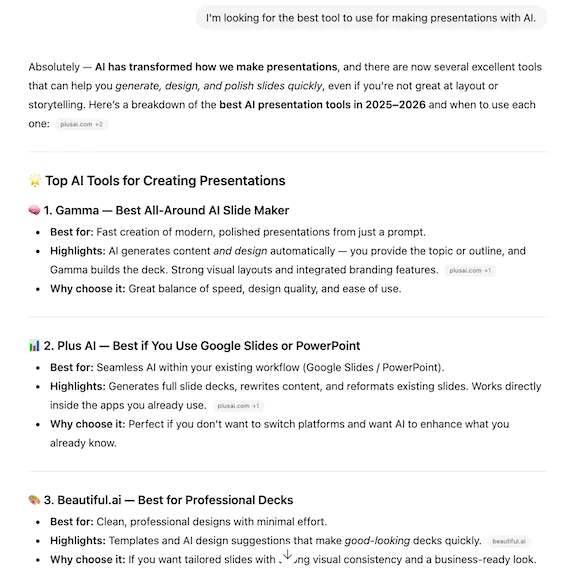
Brand positioning in AI chats, such as ChatGPT, is crucial today for building brand recognition and trust.
With around 5.6 billion monthly visits, ChatGPT has become a massive decision-shaping channel where brand perception forms long before users reach any website.
In 2026, ChatGPT plays a role similar to a trusted advisor, shaping opinions about brands and competitors long before consumers visit a website or talk to sales.
Users are aware that AI analyses huge data sets to provide the most suitable response to their needs.
So, if they receive suggestions for a specific brand in ChatGPT responses, there is a good chance that it will meet their expectations.
What benefits does building brand visibility on ChatGPT offer?
- Builds brand visibility by making your brand feel familiar and recognisable through repeated ChatGPT brand mentions.
- Boosts brand credibility and authority by being referenced alongside well-known companies.
- Supports zero-click discovery, meaning that visibility matters even when users don’t click links or visit pages.
- Influences early decision-making, AI-mentioned brands often shape user choices before potential customers evaluate competitors or visit any website.
- Reaches high-intent users, many of whom use ChatGPT for product research, comparisons, recommendations, or problem-solving.
AI visibility is becoming an increasingly important part of content strategies. You can really impact how your brand is positioned!
ChatGPT brand mentions vs. ChatGPT citations
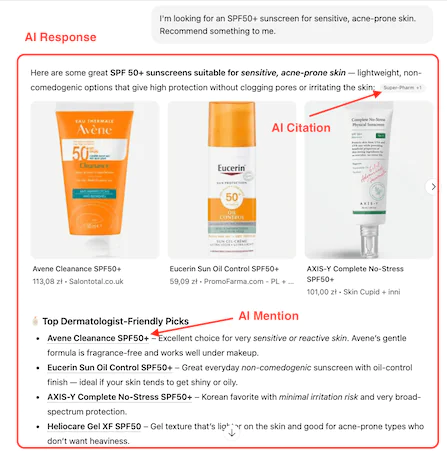
If you want to track brand mentions and track your brand’s visibility in ChatGPT effectively, it’s important to understand the difference between an AI mention and an AI citation.
| Brand Mentions in ChatGPT | Brand citations in ChatGPT |
| No link, just text | Link to the source (eg. your website, listing or expert article |
| Example, recommendation, or part of a list | Origin of data, insight, or explanation |
| Brand recognised as relevant | Your (or other’s) website recognised as a trusted source |
| Builds the brand’s visibility | Builds high-quality backlinks |
| Quickly builds brand recognition | Supports the deepening of brand awareness |
Brand mentions in ChatGPT vs. LLM responses
| Brand mentions in ChatGPT | LLM responses |
| The brand appears in text (e.g. posts, articles, discussions) | A full ChatGPT response based on multiple data |
| One element of the broader response | A full explanation or recommendation |
| Often based on human-generated content (reviews, discussions) | Aggregated knowledge gained from large-scale data |
How to track brand mentions in ChatGPT?
As with other large platforms (search engines, social media, etc.), large language models do not share their algorithms.
So, we will never fully understand what it takes to get to the top of the suggested brands list. There is no formula that guarantees 100% success.
However, building visibility in ChatGPT (and other LLMs) is not rocket science.
While tools like Google Analytics track traffic and on-site behaviour, AI visibility requires additional external tools focused on brand mentions and AI search.
You can choose to track brand mentions using either traditional SEO tools or dedicated brand monitoring tools focused on AI search visibility in ChatGPT.
SEO tools with LLM and ChatGPT brand monitoring
- Ahrefs – provides reports under AI Overviews and Generative Search, as well as analysing CTR and content visibility in AI responses.
- Semrush – offers AI visibility insights (GEO/AEO), and monitors the brand presence, and content in generative AI responses.
- Sistrix – track the impact of AI Overviews on organic visibility and any changes in click behaviour.
Brand monitoring tools with ChatGPT monitoring
- Chatbeat – track brand mentions, sources, the most popular prompts, and brand visibility in relation to competitors in AI search.
- Profound – track how the brand appears in AI search, track brand mentions, comparisons, and recommendations across LLMs like ChatGPT.
- Otterly – tracks brand AI visibility in large language models, including Google AI Overviews and ChatGPT mentions.
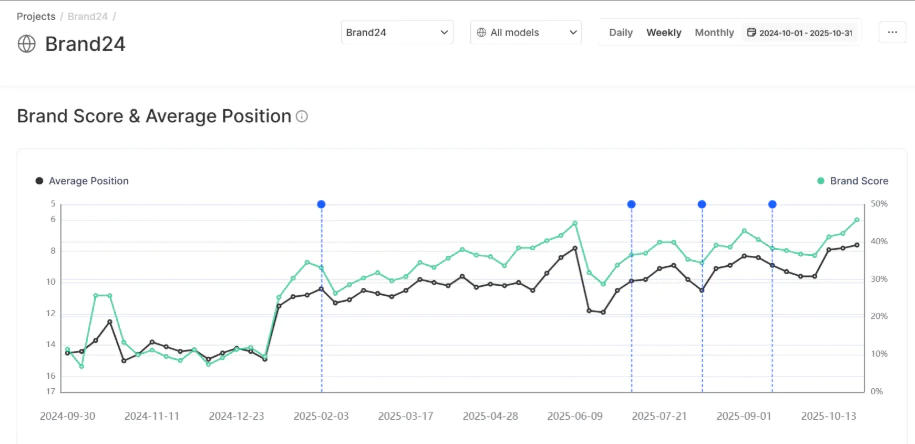
A dedicated ChatGPT mention tracker allows you to systematically monitor how often your brand appears in AI-generated responses, how you compare to your competitors, and how your visibility changes over time.
How to get more brand mentions in ChatGPT, Perplexity and AI Mode?
AI visibility is no longer a marketing novelty but a permanent and important element of strategy — a new frontier alongside traditional SEO and PR activities.
If you want to build a competitive edge, it is worth taking steps to increase the number of brand mentions in ChatGPT and other AI systems.
What works most effectively from my perspective?
Track brand mentions
To increase the number of AI search mentions, also in ChatGPT, you need to understand which sources models use and identify opportunities. By looking at the sources behind those ChatGPT mentions, you can see where it’s worth investing.
Industry reports, which detail the key AI brand visibility channels for specific industries, are also a valuable source of information.
Firstly, assess the current situation and try to identify valuable sources of LLMs that do not yet feature your brand but already mention competitors.
Do digital PR and brand reputation strategy
Beyond the number of ChatGPT mentions, it’s worth looking at the authority of the domains where they appear.
Generative AI chats tend to rely on authoritative sources, such as well-known industry publications that attract attention and, more importantly, user trust.
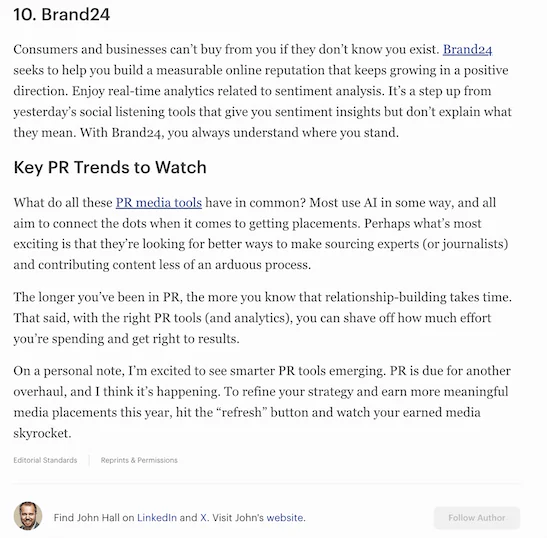
So, PR is back!
Brand mentions on high-authority sites such as Forbes or Business Insider (or other industry-specific platforms) carry extra weight today.
Firstly, they build credibility and trust among potential customers. Secondly, they build visibility.
Track and get authentic reviews
User reviews are an excellent source of structured data for ChatGPT and other LLMs, especially when platforms use review schema to clearly describe ratings, opinions, and product context.
They provide the most up-to-date and authentic information, so are likely to generate an accurate response to a question.
Use industry insights and research to find out where potential customers look for opinions about brands. These could include:
- B2B marketplaces (G2, Capterra).
- B2C marketplaces (Etsy, Amazon).
- Local review platforms (Yelp, TripAdvisor, Google).
- App review platforms (App Store, Google Play).
- Blogs and influencers
Create content optimised for AI-powered search
AI models look for data they can process into answers that satisfy users, such as structured descriptions of product features provided through product schema.
In my experience, there are several effective and easy-to-implement practices:
- Bullet points and tables: which provide structured knowledge accessible to both people and algorithms;
- Simple definitions: Clearly describing the topic of the article at the beginning, as in this text, is a simple technique that we use anyway when optimising for traditional SEO.
- Quotes and authors: LLMs look for credible content, for example, that is written by recognised experts. Quoting real people and signing blog articles with the author’s name increases the text’s authenticity.
- Update articles: both users and crawlers look for up-to-date content. This increases the likelihood that the information they contain is still relevant. Therefore, it is worth updating texts at least once a year. Prioritizing the latest content helps algorithms avoid outdated information.
All of these optimisations are important for increasing the visibility of your brand in ChatGPT presence and AI search in general.
However, it is important to remember that at the end of each channel is a person — your customer.
So, the content should be tailored first and foremost to their needs. Only then will your marketing efforts achieve ultimate success.
Presence in the relevant channels
Several platforms are considered universally good sources of mentions LLMs rely on. Including them in your content marketing strategy will support your brand’s long-term visibility in ChatGPT and other chat responses.
- YouTube: ChatGPT and other LLMs can learn perfectly from transcribed videos. In AI Mode, we also have a whole section dedicated to Shorts.
- LinkedIn: articles containing expert, credible content work best here. As they are longer, they usually cover a given topic more thoroughly.
- Reddit: current discussions between real people are the most reliable source of information.
- Quora: questions and answers. Could there be any easier content to quote?
- Google: an important platform for searching for information. There is also good news for any marketing manager who has been investing in SEO for years.
Your action plan to increase ChatGPT visibility
To increase ChatGPT brand mentions, you need a data-driven plan.
It’s no different to other elements of your marketing strategy. I have prepared a few steps to help you get started.
1. Choose the best tool
Track mentions and your visibility in ChatGPT and other LLMs. Some of them offer a free plan for a few days, so you can see what works best for you.
Analyse your brand presence and gain valuable insights to help you stay ahead of the competitors.
2. Create a content strategy
Choose channels such as YouTube, Reddit, G2, or Wikipedia and focus on them for a few months. Decide what kind of content you want to publish and how often.
You can also ask ChatGPT for inspiration on new content formats. This will give you an additional perspective. However, do not treat its answers as guidelines. You can do this even with a free plan.
3. Implement your strategy consistently
As with Google, frequency is extremely important for ChatGPT. The aim is not to go viral, but to be consistent.
Posting regularly, new mentions in the media, and getting new reviews will increase your brand presence in ChatGPT.
4. Look out for emerging trends
Algorithms are constantly changing. One day, it is possible that some sources will be more valuable for ChatGPT. Stay alert! Run some experiments to figure out what works best for your brand.
5. Track the results
Track your results. Check which actions and sources generate more mentions, improve your brand’s visibility, and strengthen your position against competitors.
Remember: there are no universal solutions that work for everyone all of the time. This is a constantly changing environment, so ongoing brand monitoring is crucial.
FAQ
How can I check if my brand is mentioned in ChatGPT answers?
Use brand monitoring tools in LLMs, such as:
- Chatbeat,
- Profound,
- Otterly,
- Ahrefs,
- Semrush,
- Sistrix.
Using them will help you to quickly get clear answers. As a marketing manager, you know that quick access to information leads to greater effectiveness.
Another solution is to ask ChatGPT specific questions and check if your brand is mentioned in the responses.
However, this can be very time-consuming, and the results may be biased as the chatbot will want to give you the answers you want to see. Such an analysis requires objective data.
How does ChatGPT decide which brands to mention?
ChatGPT tends to reference brands that frequently appear in contexts relevant to a given topic, and that clearly signal expertise or authority.
The model identifies these associations by recognising recurring patterns in high-quality sources, such as industry media, expert articles, reviews and comparison platforms.
In practice, brands that consistently appear in educational or recommendation contexts are much more likely to be cited as meaningful examples than to be mentioned incidentally.
What types of content improve brand mentions in ChatGPT?
It is crucial to ensure that your content is semantically aligned with the topics and use cases you want your brand to be associated with.
In this context, relevance matters more than volume — the clearer the connection, the stronger the signal for LLMs. In practice, the strongest impact delivers:
- educational content,
- expert commentary,
- product comparisons,
- FAQs,
- reviews published on trusted domains.

Article Reviewed by