Table of contents
2M Marketers

Accordingly to Brand24, American Airlines picked up nearly 29,000 online mentions and reached more than 144 million people in a single month. Earning a Presence Score of 67 out of 100.
Most companies never see numbers like that, because they’re not tracking the right signals. So, what do you actually know about your own brand’s visibility?
Key takeaways
-
Track brand visibility with 8 key metrics
Monitor share of voice (SOV), Presence Score, volume of mentions, reach, website traffic, search engine rankings, keywords.
-
Always consider the context
For example: over the past 30 days, you might have generated 4,000 mentions and reached over 14 million users, but without context, it’s hard to know what that actually means. Raw numbers matter, but benchmarking them against competitors and industry standards provides the real insight.
-
Choose the right tools for each metric
Use Google Search Console and GA4 to measure website traffic and search performance, and a social listening platform (such as Brand24, Mention, or Talkwalker) to monitor mentions, reach, Presence Score, and share of voice.
-
Increasing visibility takes more than one tactic
Combine content marketing, SEO, social media, PR and partnerships, customer recommendations, paid promotion, and consistent branding — together they compound your reach across search and social.
What is brand visibility?
Brand visibility is how often and how meaningfully your target audience encounters your brand across all your marketing channels.
It means how easily potential customers notice, discover, and recognize you when they’re actively looking for a solution.
Why does brand visibility matter?
Brand visibility is crucial for brands because it sets off a chain reaction:
Visibility → Awareness → Trust → Customers
People can’t become aware of a brand they’ve never spotted. They can’t trust one they’re not aware of, and they don’t buy from one they don’t trust. Visibility is where all customer connections start.
Although these concepts often complement each other, they differ fundamentally:
Brand visibility decides whether people notice you. It’s the broader idea of how often your name, logo, or content shows up in the first place.
Brand awareness is whether they remember you afterward, how familiar they are with who you are, and what you offer.
How to effectively measure brand visibility?
Measuring brand visibility is key to understanding where your brand stands in the market and how effectively it captures your audience’s attention. It gives you the insight to sharpen your digital marketing strategy and grow overall brand recognition.
You measure it by tracking eight metrics across search, social, and AI: website traffic, search engine rankings, keywords, social media reach, volume of mentions, Presence Score, share of voice.
Pair every metric with competitor monitoring to benchmark your results and set smarter goals.
01 Share of voice
Share of voice (SOV) measures your brand’s visibility and recognition in a competitive market, compared to your competitors. It’s one of the most important brand visibility metrics because it shows how visible your brand is relative to others in your industry.
It’s expressed as a percentage of the total conversation in your industry, relative to your competitors.
That’s why share of voice is basically a snapshot of how your brand stacks up against the competition in terms of visibility, engagement, and overall market share. It helps you measure visibility and evaluate whether your brand visibility efforts are actually increasing your market presence.
How to measure it?
To calculate SOV, divide your brand’s specific metric (e.g., mentions, ad impressions, or search visibility) by the total market metric (your data plus all competitors’ data), then multiply by 100.
SOV = Your Brand Metric / Total Market Metric × 100
However, doing this by hand is time-consuming, inefficient, and prone to error. The simplest and fastest way to measure share of voice is to use media monitoring software, which collects all the data you need on your brand and your competitors in real time.
Here’s what that looks like for Qatar Airways compared to Etihad Airways and Flydubai.
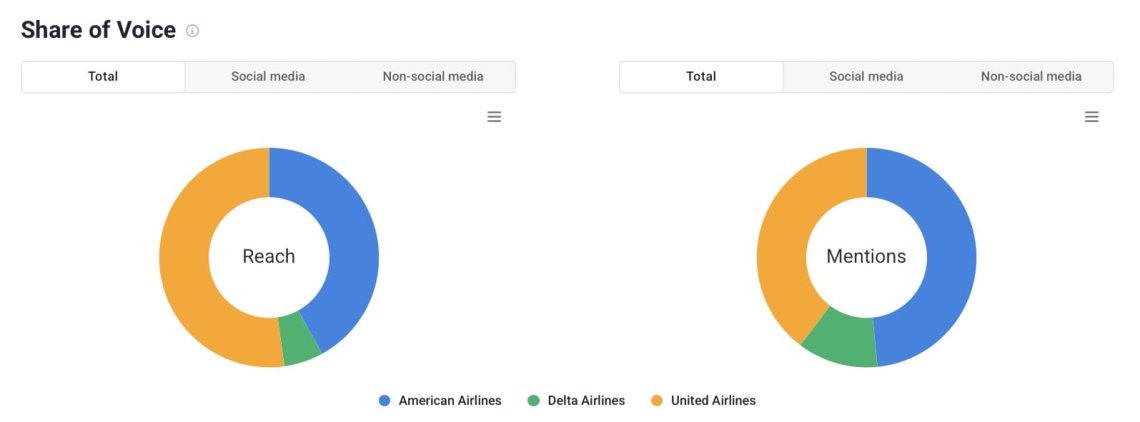
For a more detailed picture, it’s worth checking each social media channel separately and reviewing the mentions that had the greatest impact, which you can easily do with the filters built into the tool.
02 Volume & reach of brand mentions
Mention volume tells you how many times your brand’s name has been mentioned across different platforms (including offline media), including social media channels like Facebook, Instagram, Twitter (X), TikTok, LinkedIn, Quora, Reddit, Telegram, and Twitch.
In other words, this metric shows how often and where people talk about your brand.
Mention reach is the estimated number of people who could have seen that content, based on factors like follower counts and the share of them who actually saw what you published.
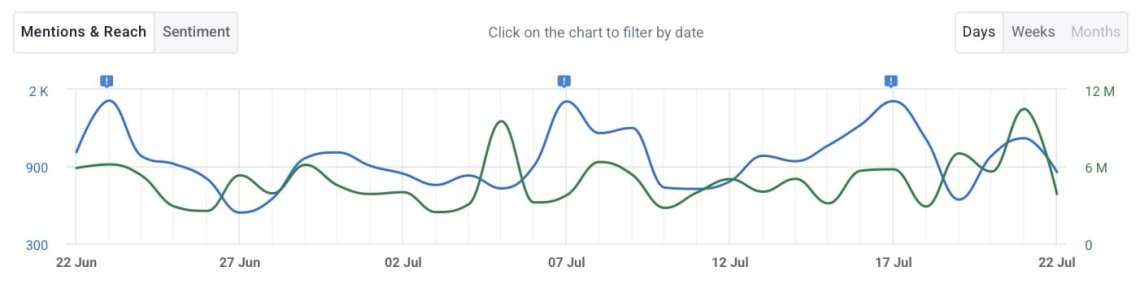
Tracking these two metrics helps you understand your brand’s popularity trend, monitor social media campaign performance in real time, catch potential drops, and spot opportunities for strategy improvement. It also shows where your brand appears across digital channels and whether your brand visibility efforts are reaching a wider audience.
How to measure it?
Tracking mention volume and reach is possible with social listening tools.
Pick a tool that lets you track brand mentions across multiple channels—not just social media, but also news sites, blogs, forums, podcasts, and videos.
The dashboard makes it easy to surface every mention, tagged and untagged alike, and filter them by channel, sentiment, or even language. Monitoring sentiment is especially valuable because it reveals not only where your brand appears, but also how those conversations shape overall brand perception.
Here, for example, you can see the mention volume for Brand X.
03 Presence Score
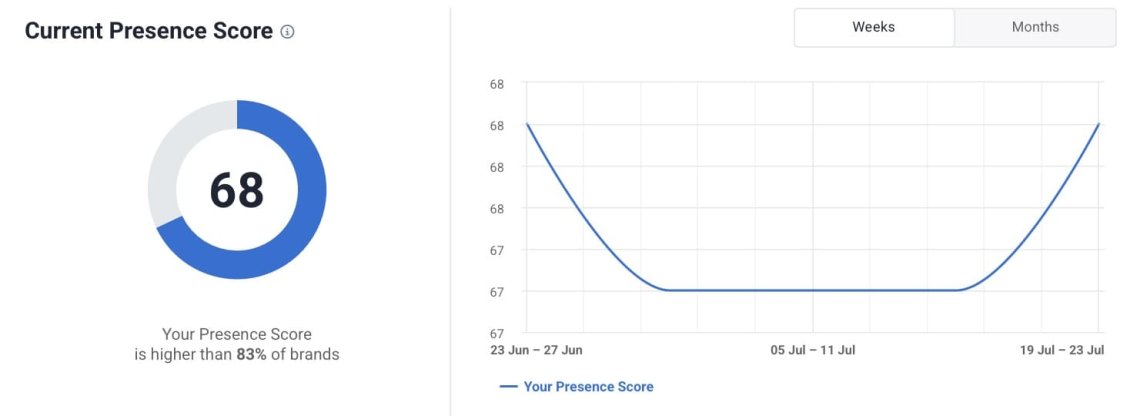
Presence Score is a metric that shows your online visibility and popularity at a given moment.
Presence Score runs on a scale from 0 to 100 and is based on two key components: mention volume and reach.
I’m a big fan of this metric because it quickly summarizes brand visibility and gives you a clear picture of how visible your brand is compared to the whole market. It’s one of the most useful brand visibility metrics for understanding whether your building visibility efforts are paying off and whether your target audience recognizes your brand more often over time.
How to measure it?
Presence Score runs on a scale from 0 to 100, where 100 is the score reached by globally recognizable brands.
Its growth rate slows down as it climbs—it’s far harder to push your Presence Score from 70 to 80 than from 10 to 20. That’s why many brands focus on consistently building brand awareness instead of chasing short-term spikes in visibility.
It’s also worth comparing your Presence Score against the competition, like here:
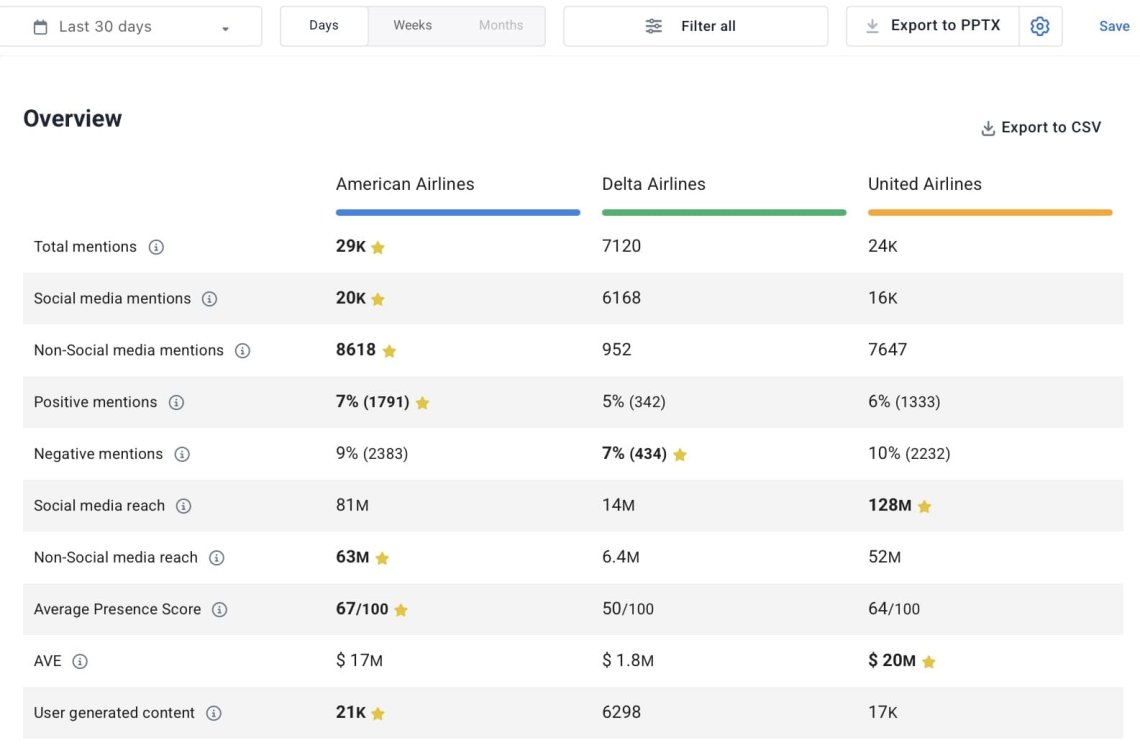
A higher Presence Score doesn’t automatically mean you have the strongest brand, but it does indicate that your brand appears more frequently across the online landscape and is becoming increasingly recognizable within your market.
04 Website traffic and search engine rankings
Website traffic is a key metric showing how many people visited your site in a given period.
In terms of brand visibility, the number of visitors reflects how exposed and attractive your brand is online, directly impacting brand exposure, brand awareness, and recognition. It’s also one of the clearest indicators of your search engine visibility.
A closer look at your traffic sources also tells you a lot:
- how well your brand visibility strategy is working,
- how your content strategy and content marketing efforts are performing,
- which social media channels matter most,
- who your target audience actually is.
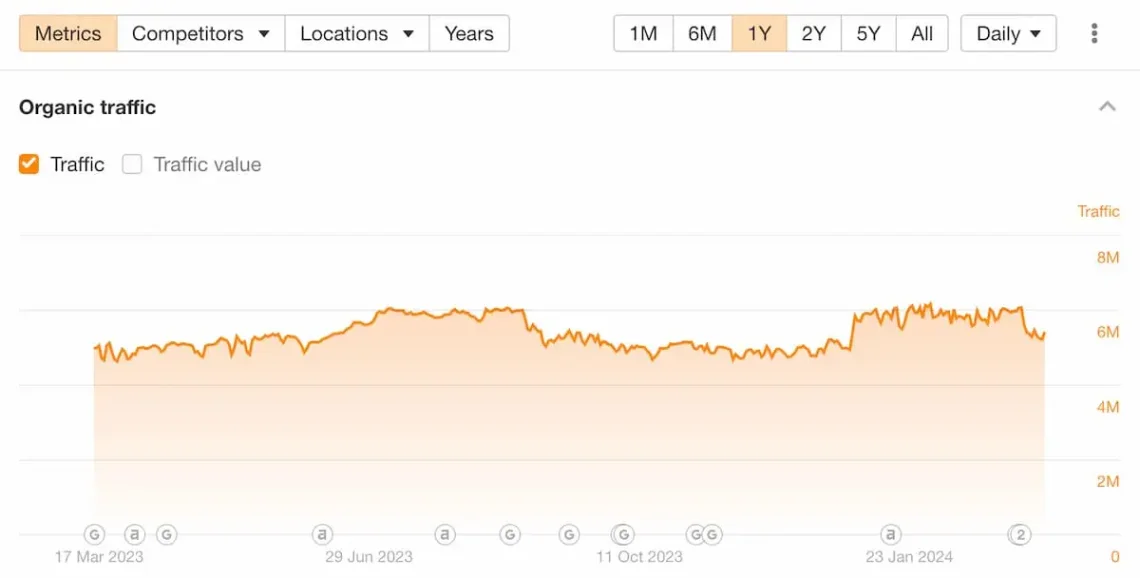
Search engine rankings are closely tied to this. They show how your website performs in search results for relevant queries.
Higher rankings mean your brand is more visible to people searching for related topics or products. Simply put, the higher your page appears in search results, the greater the chance potential customers will notice your brand, increasing your brand’s reach and online visibility.
Fast load times, mobile-friendliness, strong search engine optimization (SEO), and high-quality content that genuinely answers users’ questions all contribute to better rankings.
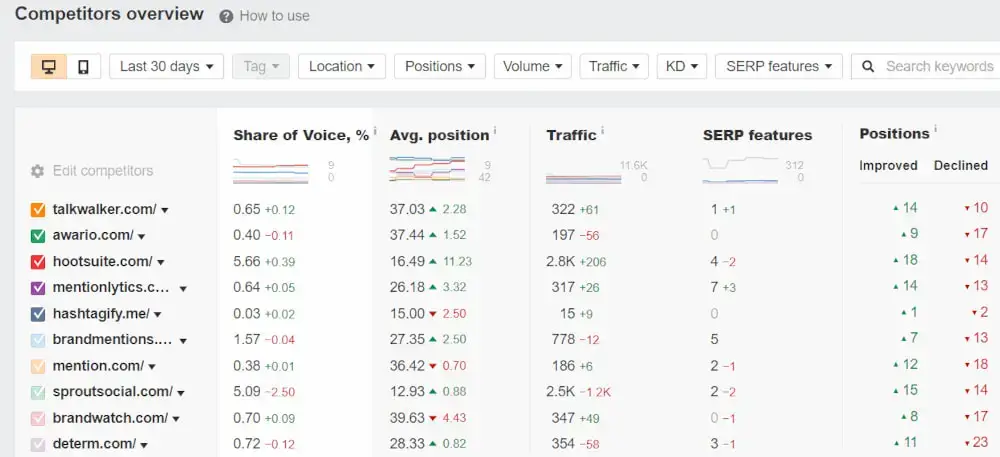
Beyond classic rankings: AI visibility and LLM citations
In 2026, visibility doesn’t stop at traditional search results. More people discover brands through AI platforms such as ChatGPT, Perplexity, and Google AI Overviews, where AI answers often replace the need to click through to a website. That’s why it’s worth monitoring whether AI systems mention your brand or reference your content.
Learn more in our complete guide to AI brand visibility.
How to measure it?
Connect your site to Google Search Console to see traffic for specific queries, then layer in Google Analytics for a deeper look at site performance.
Google Search Console is another good source for checking your website traffic.
For rankings, tools like Ahrefs, Moz, or Semrush let you track your position over time, identify content opportunities, and evaluate the effectiveness of your search engine optimization efforts.
For AI visibility, use tools that monitor mentions and citations across AI search platforms.
05 Keywords and branded search volume
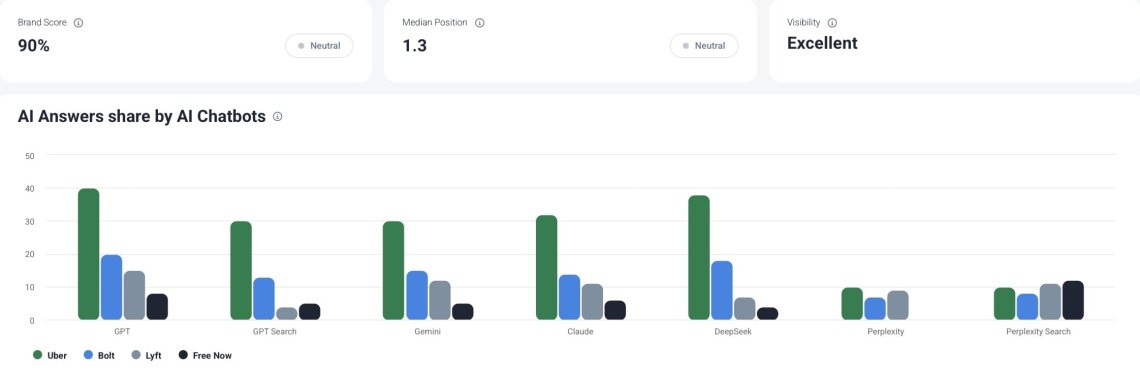
Since we’ve already touched on website traffic and search engine rankings, there’s one more SEO element worth measuring: keywords.
Tracking how your website ranks for relevant keywords is essential for assessing brand visibility. The higher your page ranks for high-volume queries, the greater the chance users will discover your brand. Monitoring keyword performance is also a key SEO strategy for expanding your organic visibility over time.
It’s also worth paying attention to branded search volume—the number of times people search for your company or product name directly. Growing branded search demand is one of the strongest indicators of increased brand awareness, showing that more people recognize your brand and actively seek it out.
Check the full guide on brand mentions for SEO to see how mentions and keywords work together.
How to measure it?
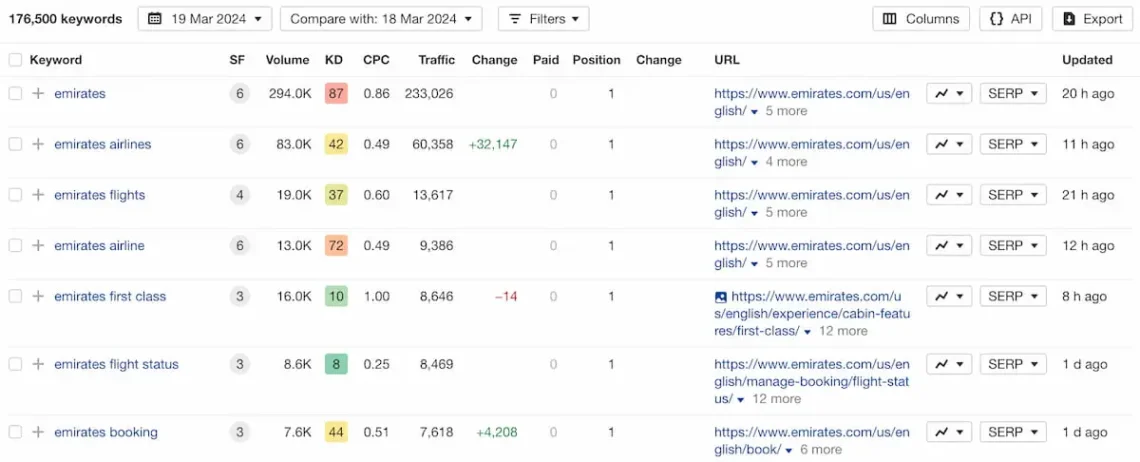
Connect your website to Google Search Console to track keyword performance, search queries, impressions, clicks, and image visibility. For deeper insights, integrate it with Google Analytics to better understand how organic traffic translates into engagement and conversions.
Keywords monitoring tools like Ahrefs, Moz, and Semrush can help you monitor keyword rankings over time, identify new opportunities, estimate branded search volume, and discover keywords that drive the most qualified traffic from your target audience.
7 key strategies to enhance brand visibility
All right, now that we know what to measure, let’s look at how to actually improve brand visibility.
Building a stronger online presence requires more than a single tactic. The most successful brands combine search engine optimization, content marketing, PR, social media, and partnerships with reputable websites into one cohesive marketing strategy.
Together, these efforts increase brand exposure, expand your brand’s reach, and make it easier for your target audience to discover your brand across search engines, social media, and AI-powered experiences.
1. Create valuable content
Content marketing remains one of the most effective ways to increase brand visibility. High-quality content positions your brand as an authority – and authoritative brands are more likely to be remembered, recommended, and cited.
Focus on creating content that answers your audience’s real questions and matches genuine search intent. And don’t think of content as a one-off asset. A single report can be repurposed into LinkedIn posts, newsletters, videos, webinars, and expert commentary, extending its reach across multiple channels.
The same applies to conversations happening around your industry.
Use a social listening tool to spot trending discussions before they peak. That’s exactly what eRecruiter did. Brand24 detected a conversation on a niche industry forum that wasn’t on the team’s usual PR radar. Instead of pitching their product, they joined the discussion with a genuinely helpful resource. That single reply generated a dozen clicks and several downloads, and became part of a strategy that increased the brand’s mentions by 10% year over year.
2. Invest in SEO
More than 90% of online experiences still begin with search, making SEO one of the biggest drivers of brand awareness.
Start with the fundamentals:
- Target the right keywords
- Improve technical performance
- Optimize page speed
- Build authoritative backlinks
But in 2026, SEO goes beyond Google. Your brand also needs to be understandable and trustworthy across modern search experiences, including AI-powered search.
Strong E-E-A-T signals, structured data, and consistent brand information across the web all increase your chances of being discovered and cited.
3. Build a strong social media presence
You don’t need to be everywhere – only where your audience actually spends time.
Mix educational content with expert insights, behind-the-scenes stories, and customer success stories. Stay active, join conversations, and create content people want to share.
Visibility often grows in spikes, not gradually. Monitoring online discussions helps you spot trends early and capitalize on them before the conversation moves on.
4. Leverage PR, partnerships, and influencers
Every mention in an industry publication, podcast, newsletter, or webinar creates another trust signal.
Collaborate with industry experts, publish guest content, and partner with brands or creators that reach similar audiences.
A good PR strategy doesn’t only generate reach – it builds authority, making your brand more visible in both traditional search and AI-generated answers.
5. Encourage customer recommendations
The most convincing marketing message still comes from a satisfied customer.
Reviews, testimonials, and user-generated content influence purchasing decisions and strengthen your brand’s credibility in the eyes of search engines and AI systems.
Turn your best customer stories into case studies and consider referral or ambassador programs. Trust scales visibility.
6. Use paid promotion
Paid campaigns work best when they amplify what’s already performing.
Promote high-performing content, support SEO efforts with Search campaigns, and use remarketing to reconnect with people who already know your brand.
Organic builds long-term visibility; paid media helps you accelerate it.
7. Maintain consistent branding
Brand recognition isn’t built through a logo alone. It’s built through consistent interactions.
Keep your messaging, visual identity, and tone of voice aligned across every channel. People should immediately understand who you are and what makes your brand different.
The more consistently your brand communicates, the easier it becomes to recognize and trust it.