Table of contents
2M Marketers

The most effective way to create a strong brand presence is to spend 55 million USD and organize the stratosphere jump event. But hey, if you don’t have that kind of spare change in your pocket, don’t worry. There are plenty of smarter, budget-friendly ways to make your brand unforgettable.
So, save your millions for another occasion, grab a coffee, and let me walk you through some tricks to boost your brand presence. No spacesuit is needed.
Key takeaways
-
What is brand presence?
Brand presence is how visible and memorable your brand is across channels (social, search, communities, press), and it matters because it drives trust, loyalty, and competitive advantage. While it’s abstract, you can measure it with concrete signals like mentions, reach, sentiment, and overall perception.
-
How to measure brand presence?
A fast way to gauge it is Brand24’s Presence Score, based on mention volume + total reach, and it also helps you benchmark against competitors.
-
Key insight
You don’t need huge budgets—presence grows from consistent, smart moves like focusing on the channels and content formats that perform best, using data-driven/AI insights tailored to your brand, staying active in conversations by responding to mentions, and leveraging unlinked mentions as SEO backlinks.
Secret Tip: How to quickly check your Brand Presence
You may ask yourself, “How to monitor my brand’s online presence?”
There is one way to assess brand presence quickly.
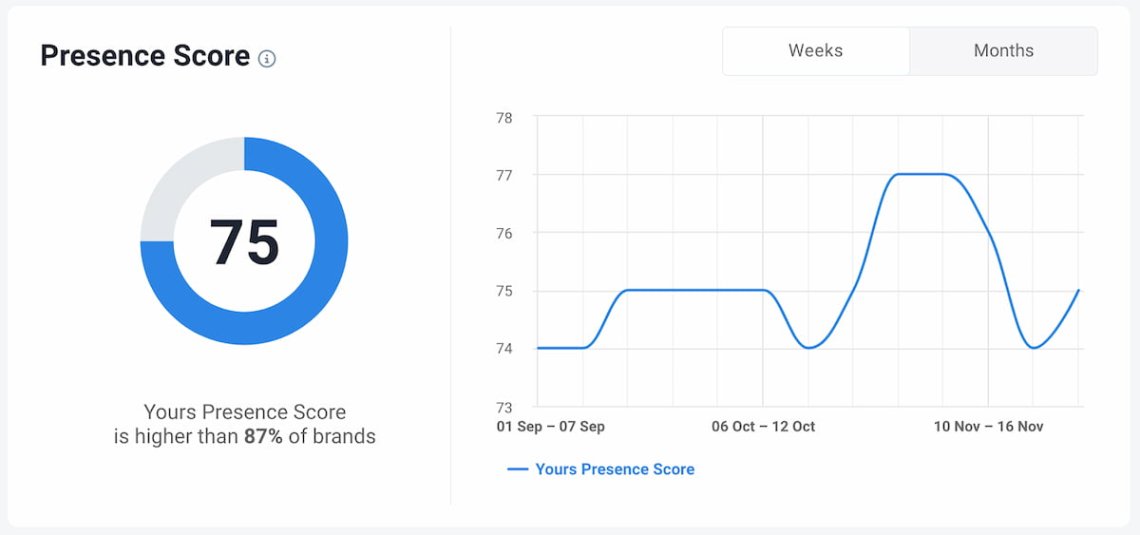
Tip: You can quickly check your brand’s online presence with Brand24’s Presence Score – it shows your current presence level and lets you compare how you’re performing against other brands. It’s based on the number of mentions and their total reach.
Let’s take Red Bull and its brand presence over the three months (September – November 2025).
As shown below, Red Bull’s Presence Score fluctuated between 74 and 77 during this period, placing it among the top 10 to 15% of the most recognizable brands in the world.
Now you know:
- how to measure brand’s online presence
- how to benchmark brand presence against competitors
So, let’s move on to the top tips and tricks to build up a strong brand presence!
6 ready-to-implement tips and tricks to increase Brand Presence
01 Use brand-tailored recommendations
Do you know what’s better than boosting your brand presence? Having someone (or something) do it for you! What do I mean by “something”? A freaking artificial intelligence, of course!
The key fact is that AI tools can do a lot to increase your brand’s online presence fast and efficiently. The key is to use the right tools with the right data in the right way.
Short answer: The easiest way to improve brand presence is to prompt ChatGPT. It’s much more time-efficient than googling each brand-related issue separately. Such research gives you a concise but, unfortunately, quite generic response.
And it’s not even close to brand-tailored recommendations from more specialized AI-powered tools like Brand24.
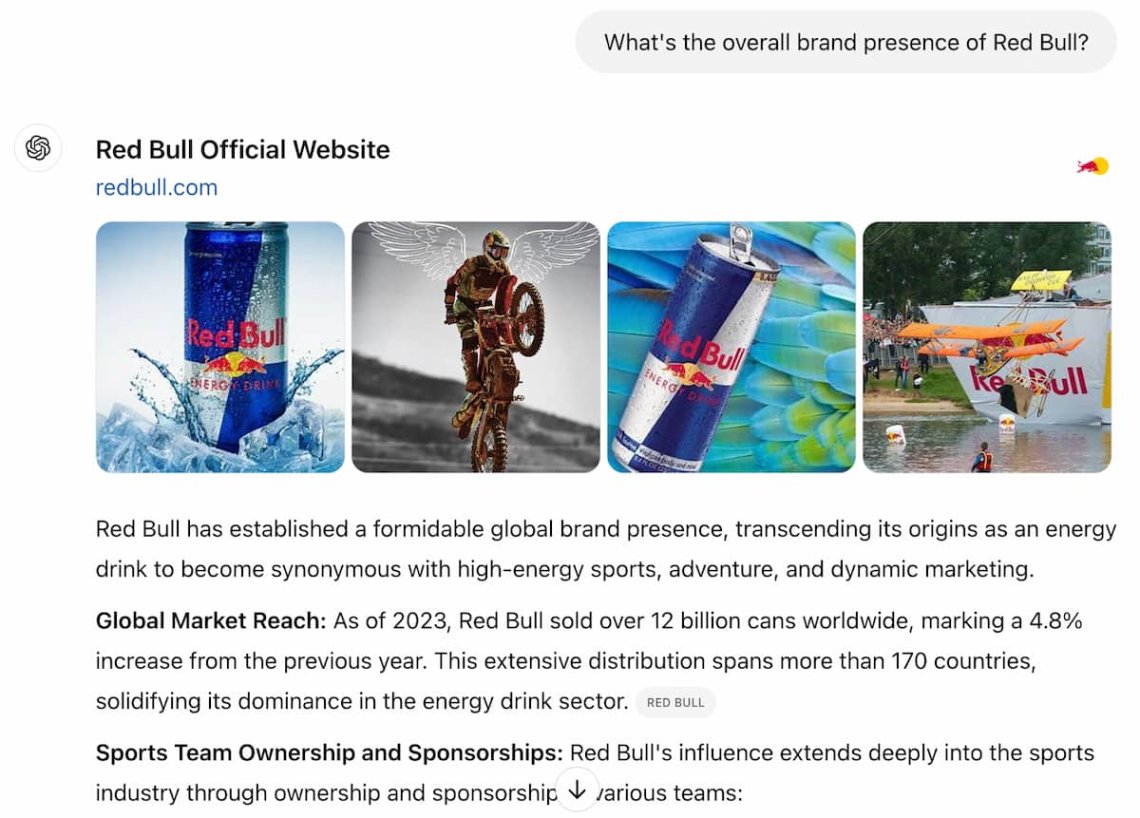
One of the key AI features of that tool is AI Insights.
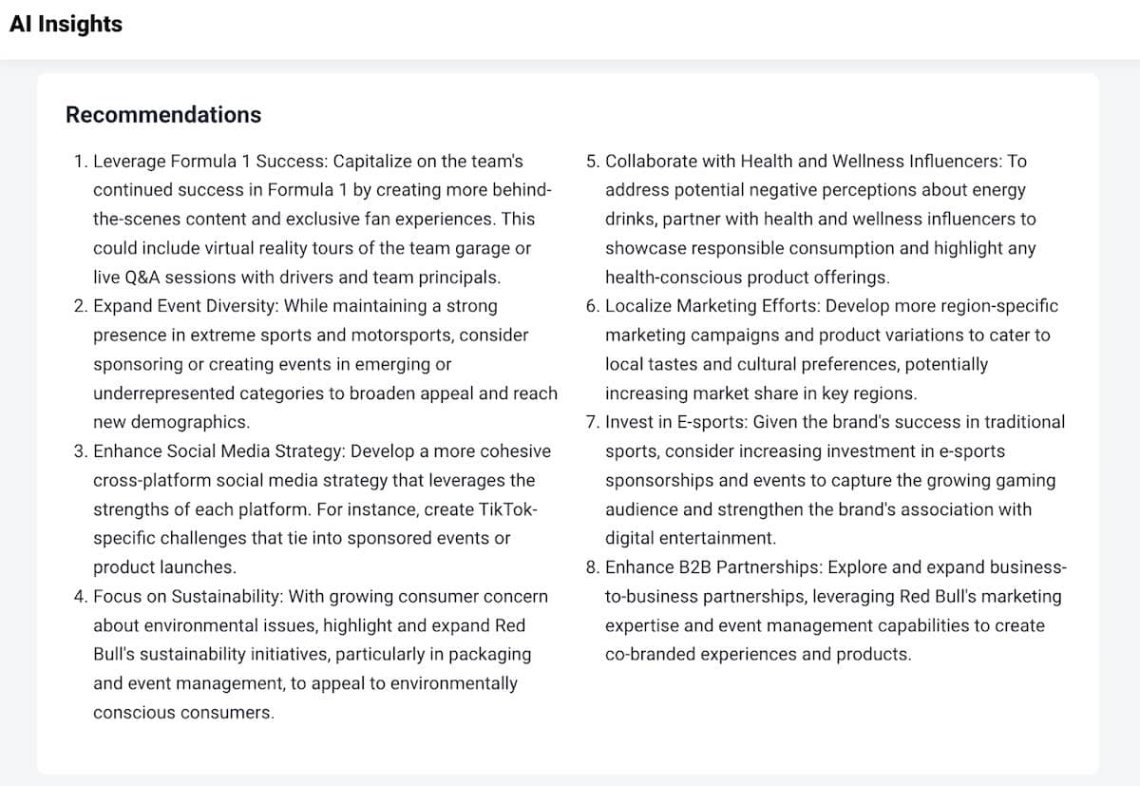
Think of it as a machine learning-powered report that delivers the most essential insights, trends, and recommendations. All are tailored specifically to your brand.
The real magic of AI Insights is in the input.
Quick tip: Use media monitoring tools like Brand24 to increase brand’s online presence. Unlike ChatGPT (and similar tools), AI Insights taps into the internal data from your tracked project.
These are the volume and reach of your mentions, their detailed sentiment analysis, top influencers, topic clusters, and much (much!) more.
And, since Brand24 tracks nearly all social media platforms and multiple non-social sources such as blogs, forums, news sites, video platforms, and so on, the data pool is both extensive and highly relevant to your brand.
Just take a look at Red Bull again.
According to AI Insights’ recommendations, the brand should collaborate with health and wellness influencers to address potential negative perceptions about energy drinks.
And that’s exactly what I mean – pure gold!
02 Use the most effective channels
The time doesn’t stretch, and we must accept it.
Therefore, you must focus on what’s most effective for building a brand presence. This rule applies especially to your communication channels.
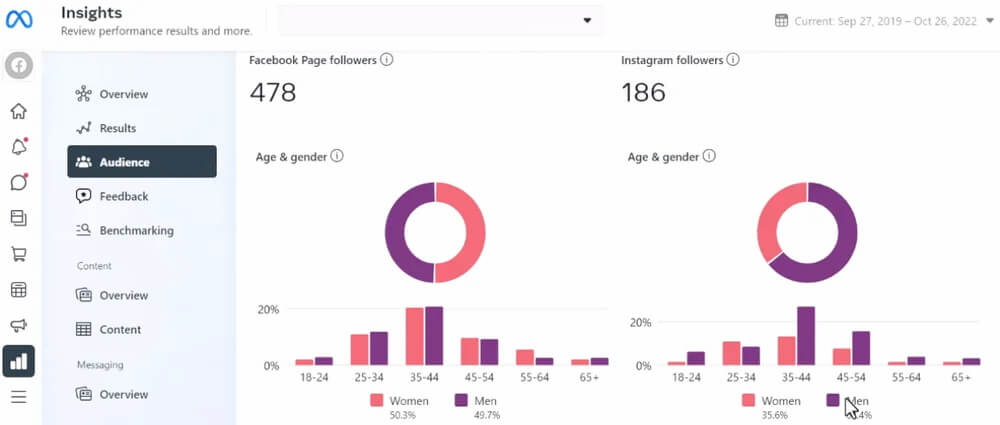
Thankfully, social media platforms provide extensive data about reach and engagement, making it easy to identify which channels work best for your brand.
But what about channels that don’t automatically provide this data, like news sites, blogs, or forums? And is it even possible to compare all the channels and easily check which of them are your most impactful?
There is one answer to both questions: there are tools for that!
Brand24, for instance, can help you track mentions and calculate reach across these harder-to-measure platforms.
Quick tip: Use media monitoring tools that aggregate data from diverse sources, including blogs, forums, news sites, and even podcasts, to provide a unified view of your brand’s performance across all channels.
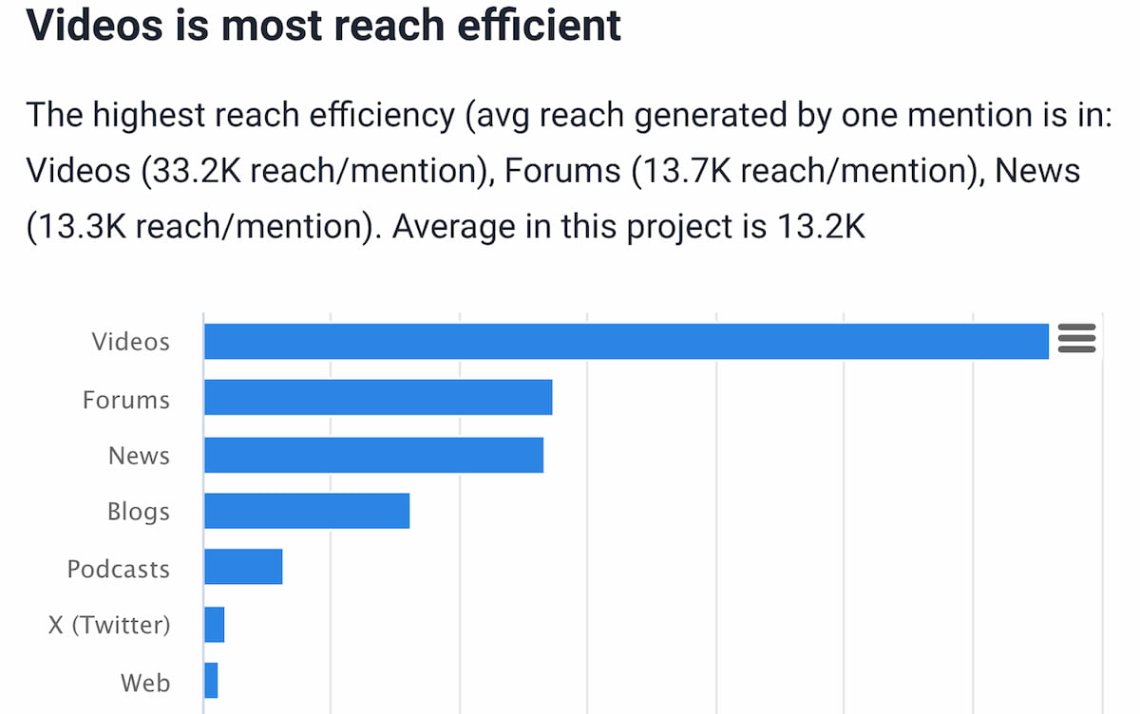
Check by yourself. Below, I pasted a screenshot of the AI Metrics for Red Bull.
As you can see, videos are definitely the most reach-efficient. Other channels are far away. The conclusion?
More vids, Red Bull folks!
03 Amplify the power of storytelling
In October 2012, Red Bull became the hottest brand in the world. Why?
Because of the unforgettable stratosphere jump made by a professional skydiver, Felix Baumgartner, and sponsored by the famous energy drink brand.
Okay, fine, I promised you not to spend your millions on building brand presence. But please, give me a chance!
I just want to show you the mechanics of telling stories that boost brand awareness to the sky and above.
The Stratos campaign was literally out of this world, but only a few people remember the brilliance of Red Bull’s storytelling strategy. The story wasn’t just about a man jumping from the edge of space.

It was a hero tale about pushing the limits of human potential and showcasing what happens when courage, innovation, and determination come together.
In practice, Red Bull released behind-the-scenes content, interviews with Baumgartner, and teasers for months before the event.
The brand strategically heated up the atmosphere, built anticipation, and made people follow the skydiver’s preparations for the stunt.
When the event finally started, the YouTube live-streamed jump was watched by 8 million people – a record that was only broken in 2023.
After the jump, Red Bull extended the story with documentaries, interviews, and much more. This epic campaign elevated Red Bull’s brand online presence to stratospheric levels.
What can you take from this marketing case study?
The most important thing is to think of your brand as the storyteller and your audience as the listener. Use storytelling to create an emotional connection, build anticipation, and keep the conversation alive even after the main event.
Even if you can’t afford something as spectacular as the Stratos Jump (and, let’s be honest, very few can), you can leverage the same principles of great storytelling.
Key fact: According to research by Headstream, 44% of people who love a brand story are likely to share it further, strengthening brand recognition.
04 Answer to brand mentions
By responding to brand mentions, you show that your brand is attentive, approachable, and values interaction.
Building brand presence resembles building a house.
Just as a house is constructed brick by brick, your brand’s online presence is built through small, consistent actions – and one of those crucial “bricks” is how you handle brand mentions.
Each mention – whether it’s a positive review, a neutral post, or a negative comment – is an opportunity to strengthen your foundation.
Key fact: According to Edelman’s Trust Barometer, trust plays a critical role in building lasting relationships with customers.
The first step in leveraging mentions is to identify them. The easiest and most effective way to do this is by using a media monitoring tool like Brand24.
Here’s why:
- The tool identifies both tagged and untagged mentions, ensuring you’ll not miss any relevant (or potentially harmful) conversations.
- It offers valuable insights, such as AI-powered sentiment analysis, the reach of each mention, Influence Score, and much more, helping you prioritize your responses effectively.
Once you’ve identified your brand mentions, the obvious next step is prioritizing them. Here’s a very smart tip to streamline this process.
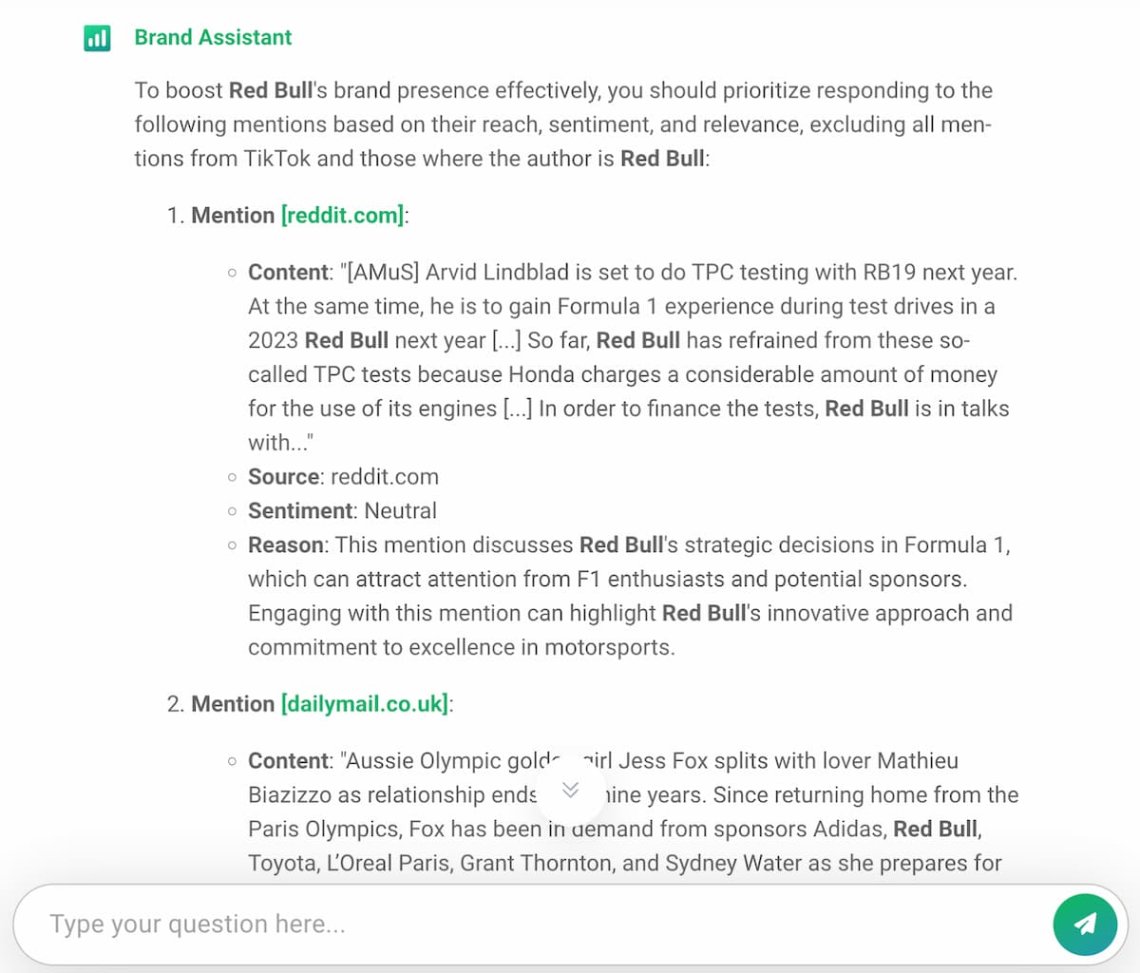
You can use AI Brand Assistant, a ChatGPT-style feature that accesses your project’s internal data. For example, I prompted it to list the top 10 Red Bull mentions the brand should answer first to boost its presence.
As you can see below, the Assistant provided me with a detailed list of mentions and explained why it chose them.
In the end, you should respond to your chosen mentions! To keep things concise, I encourage you to check out our article on how to respond to discussion posts for actionable tips and best practices.
05 Create amazing content
If there’s one universal truth in building brand presence, it’s this: content is king.
Remember, though, that creating amazing content isn’t about just posting whatever comes to your mind.
Short answer: Creating amazing content is about delivering value, boosting social media engagement, and leaving a lasting impression on your audience.
Start by understanding your audience’s needs and preferences.
What challenges do they face? What questions do they want answered? Your content should address these pain points while aligning with your brand identity, voice, and goals.
Great content can take many forms – blog posts, videos, infographics, podcasts, eBooks, and even user-generated content. It’s up to you to identify what works best for you. How to do it?
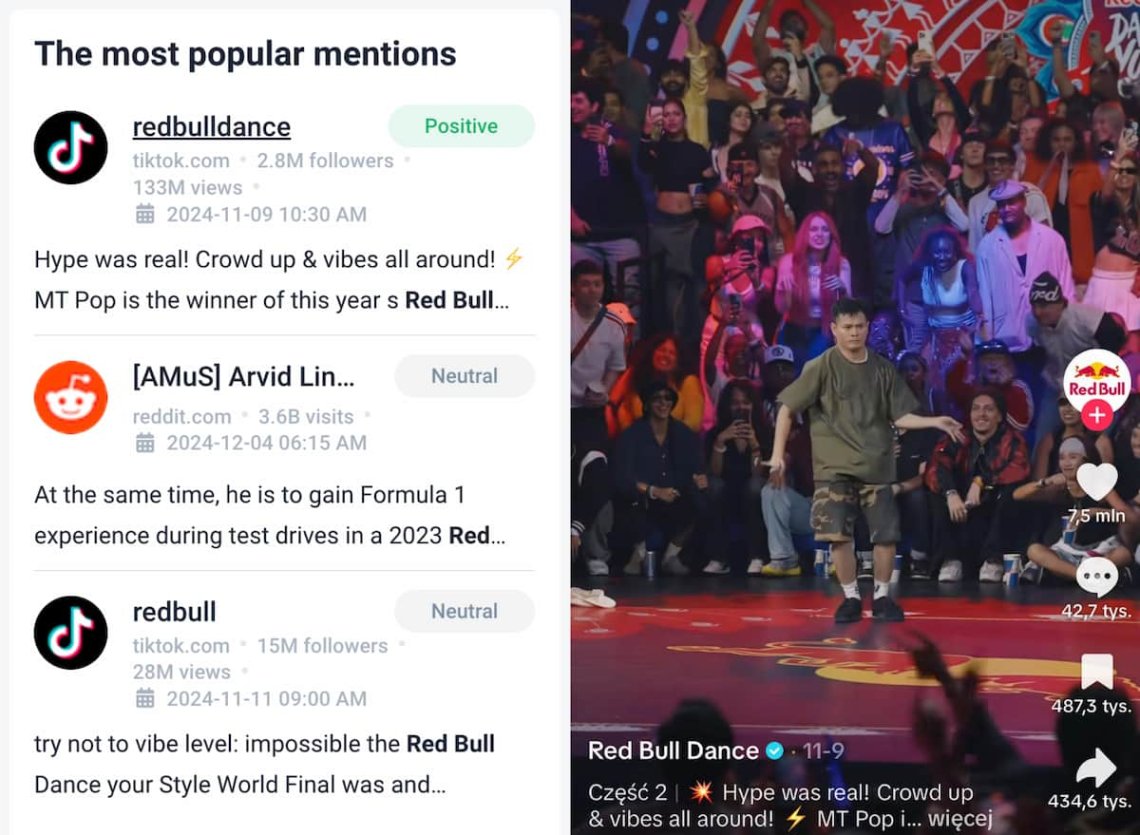
To summarize, next to the most effective channels (which we discussed in tip #2), a great way to discover which content formats to use is to check your most popular mentions.
In the case of Red Bull, the undisputed leader in November 2024 was a TikTok video from one of its “Dance Your Style” events. According to Brand24, the video reached about 133 million people. Wow!
In general, no matter what you choose, the key is to make it relevant, engaging, and shareable.
Get inspiration from the masters of content, like Red Bull or my second favorite adventurous brand, GoPro. These brands don’t just create content. They create experiences.
So, don’t be afraid to experiment with content, and always measure your results!
Because if the content is king, the data is queen.
Need inspiration? Analyze how brands like IKEA, H&M, or Zara establish their online presence using the Brand Checker.
06 Find backlink opportunities
Last but not least, don’t underestimate the role of backlinks in building your online brand presence. Why are they so important?
If you’re not immersed in the world of search engine optimization, you might be a bit surprised that backlinks are (still) one of the most critical ranking factors for Google and other search engines.
They act as votes of confidence: when reputable websites link to your domain, it signals that your content is valuable and relevant.
Search engine algorithms interpret this as evidence that your site provides value to users and other websites.
As a result, they reward you with higher rankings for high-traffic niche keywords, boosting your brand’s visibility.
That increases your brand perception as a thought leader and, ultimately, builds your strong brand’s online presence!
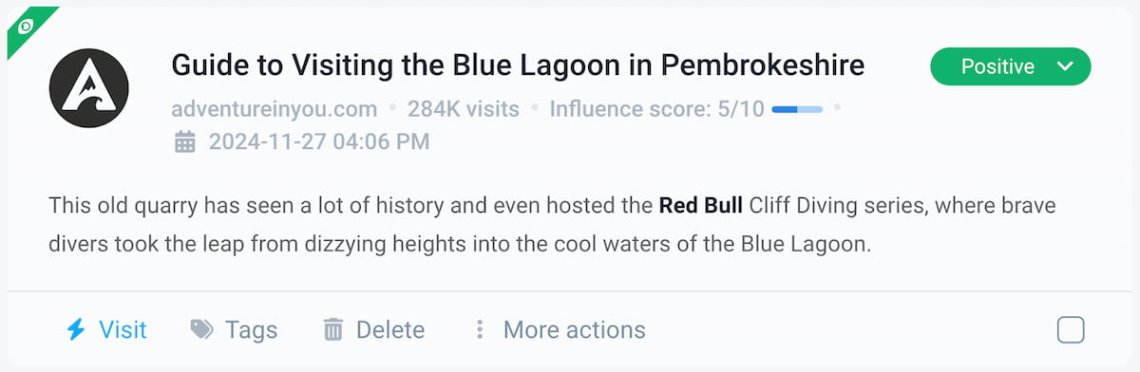
Your role here, next to creating great content, is finding backlink opportunities. Because websites sometimes mention your brand without linking back to your website.
These unlinked mentions are hidden gems!
The easiest tactic to find backlinks is by tracking your brand mentions.
Quick tip: Each time your brand is mentioned online, check if the mention includes a link back to your website. If it doesn’t, reach out to the website owner or author with a polite request to add a link.
Media monitoring tools make this process effortless by monitoring both linked and unlinked brand mentions across the web.
Just filter the sources to blogs and websites only and scroll the list of mentions to find your backlink opportunities!
Conclusion
Building a strong brand presence doesn’t require a sky-high budget.
No matter how much funds you have, strengthening your brand’s presence requires smart, consistent efforts across various touchpoints.
Here is a short to-do list I made on how to build brand presence in a few steps:
| To-do | How can Brand24 help |
|---|---|
| Check your baseline | Open Presence Score and note your current level + trend |
| Pick your top channels | Identify 1–2 channels with the best reach efficiency |
| Pull tailored recommendations | Review AI Insights and pick 1 recommendation to act on |
| Build a mini storytelling series | Plan Before / During / After content for one campaign |
| Respond to high-impact mentions | Find top mentions by reach/influence; reply to the biggest first |
| Create content people already share | Look at top mentions; recreate the winning format/topic |
| Hunt unlinked mentions | Find brand mentions without a link and request a backlink |
| Measure weekly | Review Presence Score, reach, sentiment, and top channels weekly |
All these small actions are bricks that will compound into significant results over time. Consistency is key, as every interaction contributes to the perception of your brand.
With dedication and a clear strategy, your brand can grow its visibility, trust, and loyalty, making a lasting mark in 2026. Good luck!
Key takeaways:
- Presence Score is the fastest way to check your current brand presence.
- AI-powered tools like Brand24 can take a lot of your work and help you build a strong brand presence.
- With limited time and resources, focus on your most essential channels and content types.
Start Brand24 14-day free trial and power up your brand presence!
FAQ
Brand presence is how strongly your brand shows up and sticks in your audience’s mind across the places they discover, research, and talk about solutions (search, social media, review sites, communities, press, newsletters, events).
It’s usually made of:
- Share of voice: how much attention you get compared to competitors
- Visibility: how often you appear (impressions, mentions, rankings)
- Recognition: whether people remember and identify you quickly
- Association: what you’re known for (e.g., “best for SMB”, “premium”, “fast support”)
Yes—social media is one of the fastest ways to increase presence because it creates repeated exposure and makes your brand feel active and approachable.
Where it helps most:
- Getting discovered by new people (feeds, shares, recommendations)
- Building trust through visible interaction (comments, UGC, customer replies)
- Reinforcing recognition through consistent formats (series, templates, tone)
It’s strongest when your brand message is clear; otherwise you may get reach without recall.
Do the fundamentals, then repeat them consistently.
Engage daily (replies/comments) so you’re part of the conversation, not just broadcasting.
- Define your positioning (who it’s for + why you)
- Pick 1–2 platforms and commit
- Use 3–5 content themes and turn them into recurring series
Learn more: 36 Achievable Tips to Build a Social Media Presence
You don’t need big campaigns to be visible. With a small budget, the goal is simple: show up consistently in the right places, reuse what works, and build credibility step by step.
| What to do | Why it works | Low-budget example |
|---|---|---|
| Pick one niche + one clear message | People remember you faster | “We help [audience] do [result] without [pain].” |
| Post consistently (small, repeatable) | Consistency builds presence | 2 posts/week: 1 tip + 1 story/lesson |
| Use other people’s audiences | Free reach + faster trust | Guest post, podcast, webinar, newsletter swap |
| Collect and share proof | Social proof makes you credible | 3 short testimonials + 1 mini case study |
| Be helpful where people ask questions | Visibility without ads | Answer questions in LinkedIn comments, groups, Reddit |
| Boost only what already performs | Spend money smarter | Put $20–$50 behind your best post |
| Track mentions + join conversations | Presence grows through interaction | Set alerts for brand/competitors/keywords and reply |
This is about building an organic system that keeps putting your brand in front of the right people.
Focus on these three levers:
- Compounding discovery: SEO content, YouTube, evergreen guides, comparison pages
- Credibility: case studies, reviews, customer quotes, expert mentions
- Distribution loops you control: newsletter, community, employee advocacy
What often makes the biggest difference is not volume—it’s consistency of message plus proof. People should quickly understand what you do and why you’re credible.
| Do this | Example |
|---|---|
| Be consistent | 2 posts per week |
| Be visible in comments | 10 min/day commenting on relevant posts |
| Reuse your best content | Turn 1 post into 3–5 formats |
| Show proof | Share 1 testimonial or result weekly |
| Join conversations | Answer questions in 1 community weekly |
| Collaborate | Guest post / co-webinar with a partner |
| Create 1 free resource | Checklist or template people can share |
In crowded markets, presence is about distinctiveness, not just frequency.
The playbook:
- Narrow your target (win a specific segment first).
- Own a point of view (memorable brands take a stance).
- Build proof competitors can’t easily copy (data, benchmarks, methodology, standout customer stories).
- Out-distribute on 1–2 channels (better content + better partnerships + better SEO).
Here’s the trade-off that matters most:
| Approach | Outcome |
|---|---|
| “We do what everyone does” | forgettable, price pressure |
| “We do X for Y, because Z” | recall, trust, preference |
SEO improves presence by making your brand appear when people search for problems, options, comparisons, and solutions—often before they even know your brand exists.
The highest-impact SEO work tends to be:
- Growing authority (digital PR, backlinks, expert commentary)
- Building topic clusters (one pillar page + supporting articles)
- Publishing high-intent pages (“best”, “vs”, “alternatives”, “pricing”, “reviews”)
- Creating proof content (case studies, use cases by industry)
| SEO element | What to do | Presence signal it increases |
|---|---|---|
| Topic clusters | Cover a topic deeply with internal links | More impressions across keywords |
| Comparison intent | “X vs Y”, “alternatives” pages | Visibility at decision stage |
| Proof pages | Results, testimonials, use cases | Trust + recall |
| Authority building | PR, links, mentions | Higher rankings + credibility |
Think of presence as a system with five parts: Discoverability → Recognition → Trust → Engagement → Next step.
A practical way to optimize is to audit each part:
- Discoverability: Are you visible in search/social/directories for your category?
- Recognition: Do your visuals and tone look/sound consistent across channels?
- Trust: Can someone find proof in under 30 seconds?
- Engagement: Do you actually participate and respond, or only broadcast?
- Next step: Is there a clear CTA (newsletter, demo, trial, lead magnet)?
If you improve just one weak link (often “trust assets” or “consistency”), presence typically lifts across all channels.
To analyze your brand presence in AI, use Brand24’s LLM Listening tab (Chatbeat) to see how major AI models talk about and recommend your brand—and how you compare to competitors.
What to do (in Brand24)
- Open the LLM Listening tab (Chatbeat) in your Brand24 dashboard. It works like a plug-in, and you don’t need to build complex prompt sets—your first project can be prepared for you.
- Check your AI Visibility / Brand Score (0–100) to understand how “visible” your brand is in AI answers overall.
- Track your position in AI recommendations (e.g., #1, #2, not mentioned) for relevant prompts and categories.
- Compare Share of Voice vs competitors across different AI assistants (ChatGPT, Claude, Gemini, Perplexity, etc.) to see who dominates the conversation.
- Review “Key Sources” AI relies on (the sites AI models cite when answering about your market). This tells you where AI is learning from—and where you need to be present.
- Inspect real prompts and outputs to spot:
- where your brand appears (and how it’s framed),
- where competitors show up instead,
- and any inaccuracies you should correct.
Treat it like SEO analytics, but for AI: improve the content and sources that AI models cite so your brand becomes easier to recommend and harder to ignore.