Table of contents
How Can Sentiment Analysis Be Used to Improve Customer Experience in 2026?
Sentiment analysis helps you enhance the customer experience by changing complex feedback into actionable customer insights.
- In 2026, the reaction speed matters more than ever because customers easily switch if they feel ignored: 73% of social users say they’ll buy from a competitor if a brand doesn’t respond on social (source: Sprout Social research).
- Sentiment analysis also impacts revenue as 58% of consumers would pay more to support a company with good reviews, and sentiment is the quickest way to see whether your “reviews narrative” is improving or slipping (source: Podium research).
The truth is, customers rarely wake up and think, “Today I churn.”
They churn when they’ve been quietly disappointed for weeks until one last friction point tips them over.
Quick summary:
Sentiment analysis is how companies understand customer experience in real time.
It analyzes public and private customer conversations (reviews, social media, forums, surveys, support tickets, and emails) to detect emotional shifts before they turn into churn, complaints, or revenue loss.
Why sentiment analysis matters in 2026:
- 🔥 Customers expect fast, human responses
- ⭐️ Public sentiment directly affects trust and buying decisions
- 🔎 Customer conversations increasingly influence visibility in search engines and AI-generated answers (ChatGPT, Google AI Overviews, Perplexity)
What sentiment analysis helps you do:
- Detect negative sentiment early, before issues escalate
- Identify the causes behind customer frustration
- Prioritize customer experience improvements
- Reduce churn and protect brand reputation
Why keep reading?
This article is a perfect guide for:
- Customer experience professionals
- Marketers
- Business leaders
Who want to use sentiment analysis to improve customer experience in 2026.
You will learn how to collect feedback and conduct customer sentiment analysis to improve your product, user experience, and, in the long run, customer loyalty.
Plus, I’ll show you the best sentiment analysis tools and how to choose the one for you.
So, ready to turn Reddit threads, “random” comments, and social data into decisions that matter?
You ask, I deliver!
What is sentiment analysis in customer experience?
Sentiment analysis in customer experience refers to the data analysis process of understanding and measuring how a customer feels about a particular product, service or brand.
It is a data analysis technique used to interpret written and spoken language to understand how customers feel about a product or brand, and it relies on natural language processing (NLP) and machine learning to classify feedback.
Tools can analyze customer feedback (positive/neutral/negative) across various channels like reviews, surveys, support tickets, chats, and social posts.
Plus, they can help you spot what caused the sentiment and where it happened.
In real life, customer sentiment analysis helps you answer:
- “Are we getting better?”
- “Which part of the journey is causing frustration?”
- “Is this a one-off complaint or the start of a pattern?”
But remember: Sentiment alone tells you customer emotions, but to improve customer experience, you also need to know why the themes and root causes are inside the text.
You can think of sentiment as the smoke alarm – the analysis tells you where the fire is.
| Output | What it gives you |
|---|---|
| Sentiment score | Emotional direction |
| Topic clusters/themes | The “why” behind emotion |
| Trend lines | Whether fixes worked |
What are the benefits of sentiment analysis?
It helps businesses:
- Understand how customers feel in real time
- Spot problems before they escalate
- Identify what’s working (and what isn’t)
- Prioritize actions better
In practice, sentiment analysis leads to higher customer satisfaction, lower churn, stronger brand reputation, and more focused improvements across support, product, and marketing teams.

| If you want | Sentiment analysis helps you |
|---|---|
| Fewer churning customers | Spot negative feedback early |
| Better customer satisfaction | Prioritize high-frustration cases |
| Smarter customer experience decisions | Connect feelings to root causes |
Now that we’ve defined sentiment analysis and understand its importance, let’s look at how it works in practice.
How to make sentiment analysis work?
Most “how-to” guides miss one thing: sentiment analysis is not a “single-day” project… it’s an ongoing, continuous work.
A sentiment analysis process includes these five steps:
- Gathering customer data from multiple sources (interviews, emails, reviews, media monitoring, chats, etc.).
- Identifying sentiment patterns using quantitative (NPS/CSAT) + qualitative text signals.
- Gaining actionable insights (like “Oatly is hard to find in my local stores”).
- Making improvements (e.g., enhancing distribution, expanding to new stores).
- Measuring impact with KPIs.
So, as you see, the win isn’t just “analyzing sentiment”. Yep, it sounds pro, but it means nothing for your business if you stop there.
The win is shortening the time between an emotional shift, action, and recovery.
| The step | What “good” looks like |
|---|---|
| Collect customer feedback | Going multichannel, not just surveys |
| Conduct customer sentiment analysis | Patterns + themes not, single comments |
| Improve customer experience | Based on insights you gained – act! |
| Measure the impact | Sentiment data change, and its impact on KPIs |
Ok, great, but how to find data to analyze? Let me explain.
Where to collect sentiment data from?
If you only look at surveys, you’re basically listening to customers who had the patience to fill out a form (and believe it or not, it’s just the tip of an iceberg).
Here’s the list of the most critical data sources with examples of where you can find such customer data:
- Online reviews (Google reviews)
- Niche forums threads (social listening tools)
- Customer satisfaction surveys (SurveyMonkey, or in-app surveys)
- Social media monitoring (media monitoring tools)
- Emails and written correspondence (Customer emails, feedback forms, contact forms)
- Support tickets + customer service chats – especially for real-time mood shifts (Zendesk, Userpilot)
The more channels you include, the less likely you are to miss your customer feedback.
| Source | What it’s best at |
|---|---|
| Social media / online | Early signals + crisis risk |
| Support tickets/chats | Operational friction, recurring issues |
| Reviews | Expectation vs reality and your customer satisfaction |
Let’s say you gather a lot of data, but now you’re stuck. What’s the next move?
How can sentiment analysis be used to improve customer experience?
Simply said, by answering customers’ needs better.
They don’t churn because of one bad interaction, but they churn because frustration goes unnoticed, unresolved, and unacknowledged for too long.
Research methodology
I wanted to understand how customer experience fails in real life in 2026.
So I ranked the ways sentiment analysis improves customer experience using three criteria:
- How early does the method help you detect a customer experience problem?
- How much emotional damage can it prevent if acted on in time?
- How many teams can realistically act on it without a massive process change?
That’s why the list starts with early detection and root-cause identification, moves into churn prevention and support impact, and only then covers optimization, personalization, and competitive advantage.
The order goes from most crucial for protecting customer experience to still valuable, but dependent on everything above working first.
So, how can sentiment analysis be used to improve customer experience?
01 Analyze customer feedback before it becomes a real problem
The biggest advantage of sentiment analysis in terms of customer experience is timing.
Sentiment analysis enables the detection of emotional shifts early.
A slow rise in negative sentiment around onboarding, pricing, or a feature update is your warning sign.
Nothing is “on fire” yet, but it will be if you ignore it.
This is how teams fix issues quietly, without public blowups or churn spikes.
When analyzing customer sentiment of Oatly, I found numerous complaints about… bugs 😐

02 Identify the cause of customer sentiment
“Sentiment is down” is not an insight.
Knowing why sentiment is down is.
By pairing sentiment with topic or text analysis, you can see which exact issues create the strongest negative reactions…
Unclear instructions, missing features, billing confusion, and slow responses.
Instead of saying (“customers are unhappy”), you can fix a specific pain point.
How to connect sentiment to the cause (so fixes actually work)?
You should analyze the topic first, then overlay sentiment to understand intensity and prioritize what matters most.
Imagine Oatly sees a negative sentiment rising and assumes it’s a random brand backlash.
They leave it and go on with their life, but the sentiment keeps getting worse…
To find reasons behind such shifts, I check AI Topic Analysis and look at the sentiment charts:
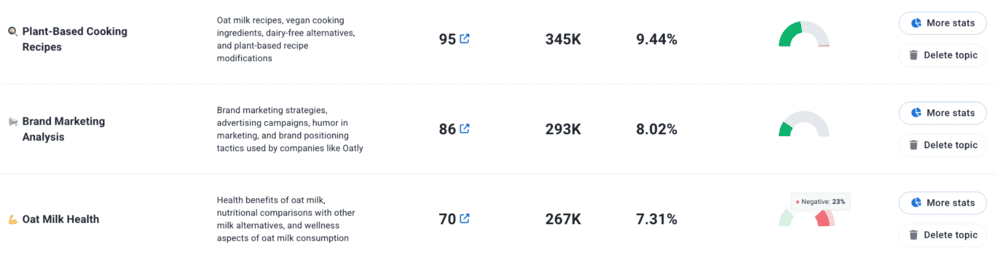
The analysis reveals most complaints are about milk alternatives’ health, not the brand itself.
People are calling oat milk “too processed” and worrying about “hidden sugar.”
Once Oatly identifies this topic, they can address those concerns directly with clear explanations.
In practice, I focus on combining topic analysis, sentiment, and spike alerts.
It allows me to quickly:
- Identify the specific topic cluster (“shipping delays,” “health concerns,” etc.)
- Analyze customer emotions
- Prioritize the clusters that create the strongest negative reaction
| Feature | Question it answers |
|---|---|
| AI Topic Analysis | “What are customers talking about?” |
| Sentiment analysis | “Is this a topic we should address?” |
| Alerts | “What should we focus on now?” |
03 Reduce churn by acting fast
Sentiment analysis reveals early churn signals like:
- “Used to love this.”
- Repeated frustration with particular aspects of your business
- Neutral and then negative language replacing enthusiasm
These are the moments when rescue is still possible.
How can sentiment analysis reduce churn?
Teams can identify areas that require intervention with fixes, clearer communication, or additional outreach before customers decide it’s not worth the effort anymore.
Especially look for:
- Sudden negative spikes
- Negative sentiment rising inside a specific topic
- Influencer-driven complaints (because reach amplifies risk)
04 Improve customer support
Not every support interaction needs the same response.
Sentiment analysis helps teams spot:
- High-frustration cases that need more advanced agents
- Patterns in what customers complain about after support interactions
This lets support teams prioritize more risky conversations, adjust tone, and train agents based on real customer reactions, not assumptions.
05 Fix the customer journey pain points
Customer journeys usually break in very specific places.
Sentiment analysis enables you to map those key stages, including:
- Onboarding
- Purchasing
- Support
If sentiment drops sharply during one stage, that’s where CX work should start.
You don’t need to redesign the entire journey. You need to fix the moment where frustration spikes.
This keeps CX efforts focused, realistic, and measurable.
06 Make better product decisions
Product feedback is endless and often hard to manage.
Sentiment analysis helps you prioritize product feedback.
When negative sentiment consistently clusters around product quality and availability, that’s real emotional cost.

How does sentiment analysis improve product development?
Sentiment analysis helps product teams prioritize:
- What customers want more of
- What customers hate
- What’s confusing enough to kill adoption
Here’s a practical workflow you can use:
- Cluster feedback by topic
- Pick “high-volume + high-negativity” issues first
- Do the fix
- Re-measure your sentiment post-release and track if the fix worked
Over time, this leads to products that feel easier, not just more powerful.
| Prioritization rule | Why it works? |
|---|---|
| High negativity + high frequency | The biggest customer experience pain |
| High positivity + high reach | Great advocacy opportunities |
07 Integrating sentiment analysis with marketing for deeper insights
Campaign performance can appear impressive on paper, but without checking the sentiment, you may wake up in a real mess if the traffic wasn’t in your favor.
Sentiment analysis reveals how people emotionally respond to your messaging, whether it feels helpful, confusing, tone-deaf, or overly promising.
That allows marketers to:
- Adjust campaigns better
- Understand customer interactions
- Stop efforts that harm trust and adjust their emotional tone
- Double down on language that genuinely resonates and build customer satisfaction
You don’t just optimize for engagement. You optimize for long-term customer loyalty.
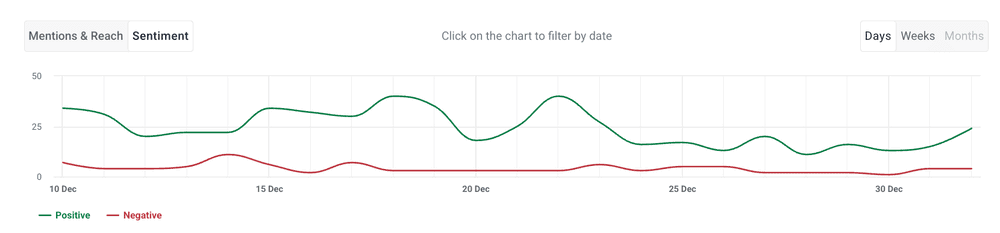
Check the sentiment charts and how they change over time. Look for patterns – does the negativity rise align with your recent campaign?
08 Simplify onboarding and reduce friction
Monitor customer comments around FAQs, help centers, or chatbots.
Why?
Cause negative talk there usually means one thing: customers are stuck and will likely leave.
Conducting sentiment analysis can help spot:
- Where self-service fails
- Which explanations confuse instead of helping
- When automation escalates frustration
Fixing these issues can be a bigger help than you think, as customers want to solve problems themselves, quickly, and don’t want to spend time on your help chats.
09 Improve customer service teams’ processes
Customer sentiment is a mirror for how teams show up.
By analyzing sentiment tied to interactions, customer support teams can:
- Spot language or behaviors that frustrate customers
- Reinforce what customers praise
- Design training around real emotional responses
This makes training more relevant, more motivating, and more effective for customer-facing teams.
10 Gain insights to strengthen your positioning
Sentiment analysis doesn’t stop with your own brand.
Tracking how customers feel about competitors reveals:
- What they consistently complain about
- Where expectations aren’t met
- Which differentiators actually matter emotionally
Instead of guessing how to position yourself, you can align your strengths directly against competitor pain points.
💡 In short: Sentiment analysis improves customer experience most when it’s used as an early-warning system, a prioritization engine, and a reality check. Not a “monthly report”.
It provides insights that help improve the overall customer experience by identifying pain points, enabling proactive issue resolution, reducing churn, and allowing for personalized interactions across all customer touchpoints.
What are the best customer sentiment analysis tools?
There’s no single “best” customer sentiment analysis tool.
However, your tool of choice should align with where your customers actually interact and how your team operates.
- Focused on surveys
Tools like Qualtrics or Medallia make the most sense. They’re built to analyze large volumes of structured and semi-structured feedback, spot recurring themes, and analyze emotions across customer responses. - Focused on online conversations (social media, forums, blogs, reviews, news sites)
You’ll want a tool with social listening like Brand24, SproutSocial, or Brandwatch. These platforms track sentiment in real time, show how sentiment changes over time, and add context to the analysis.
What features should you look for in a sentiment analysis tool in 2026?
Here are a few must-haves:
- AI + NLP that handles nuance and conducts analysis for you
- Multichannel monitoring (no more blind spots)
- Real-time alerts for spikes/crises
- Visualization (charts, trends, segmentation)
- Integrations with CRM/support systems you use
Generally, choose tools that move you: data –> insight –> action
What are the sentiment analysis challenges?
Two limitations show up the most:
- Sarcasm and nuance are hard. A system may miss subtle tone, misspellings, or context, so it’s not perfect.
- AI alone won’t be 100% accurate. You still need some human review, especially for high-stakes decisions and edge-case phrasing (like “Great, I guess.”).
Can I rely on AI software and machine learning for 100% accurate sentiment analysis? Not really.
My practical rule:
- Trust sentiment for trends and prioritization
- Use human review for exceptions, sarcasm, and any big decisions
Don’t aim for perfection. Aim for early detection + faster learning loops.
FAQ
Does sentiment analysis replace surveys and NPS/CSAT?
No. It complements them. NPS/CSAT are great for benchmarking. Sentiment analysis explains the emotion behind changes and catches issues earlier across more channels.
What is text-based sentiment analysis?
It works by collecting text from sources like:
- Surveys
- Social media comments
- Online reviews
- Support tickets
- Emails
Then, AI-powered tools use NLP and machine learning to read customer interactions, classify them as positive, negative, or neutral, and surface patterns you can act on.
In short: you gather what customers say, let AI interpret how they feel, and use those customer insights to make better decisions.
What is natural language processing in customer sentiment analytics?
Natural language processing (NLP) allows tools to understand human language. It helps systems interpret context, tone, and emotion in customer messages, so feedback isn’t analyzed as isolated keywords, but as meaningful communication.
In short: NLP is what makes sentiment analysis accurate instead of literal.
What’s the biggest mistake teams make in customer experience sentiment analysis?
They stop at “positive/negative” and never identify the topic and cause, so nothing in terms of customer experience changes.
Is sentiment analysis accurate enough to trust?
Yes, it’s accurate enough for trends, prioritization, and alerts, but not 100% reliable when it comes to sarcasm and nuance, so you may need selective human review. Still, you can get many valuable customer sentiment insights.

Article Reviewed by