Table of contents
AI Brand Visibility: How to Measure & Maximize It?
If I got $1 each time someone said “AI has revolutionized [something]”, I wouldn’t be here writing this article. I’d be chilling on my private beach in Hawaii. But okay: AI really has changed how brands get discovered, and most brands are responding to that change by doing the wrong things.
Key takeaways
-
You’re probably optimizing the wrong thing
The most crucial factor of appearing in AI results is branded web mentions on third-party sites. On-site content is not even close.
-
Publishing more content is pointless
Increasing the volume of content is the most response to concerns about AI visibility. It's also totally ineffective. The brands showing up most in AI answers aren’t the ones publishing most.
-
Most brands are invisible in at least one AI ecosystem
Only 7.2% of domains get cited in both LLMs like ChatGPT and Google’s AI Overview. You can be performing well in one system and not exist in the other. Cross-ecosystem monitoring is the only way to see the full picture.
-
SEO is the basis for AI visibility, not the competition
Most AI citations come from pages already ranking in the top 10 of traditional search. GEO tactics are useful, but SEO is the foundation they sit on. Skip SEO to chase GEO, and you’ll fail.
What is AI brand visibility?
AI brand visibility is how often and in what context your brand gets mentioned, cited, or recommended inside generative AI tools: ChatGPT, Google’s AI Overview, Perplexity, Gemini, DeepSeek, and others.
Think of it as a share of voice, but for AI-generated answers rather than search results or social feeds.
In short: AI brand visibility = how and how often AI mentions your brand when someone asks about your category.
How it works in practice?
When someone asks ChatGPT: “What’s the best media monitoring tool for PR teams?” the system checks its training data and trusted web sources.
The brands it recommends aren’t the ones that paid to be there. They’re the ones the internet has decided to be relevant and worth mentioning.
Quick test: ask ChatGPT “What is the best furniture brand?”
I’m sure IKEA will appear near the top. You know why?
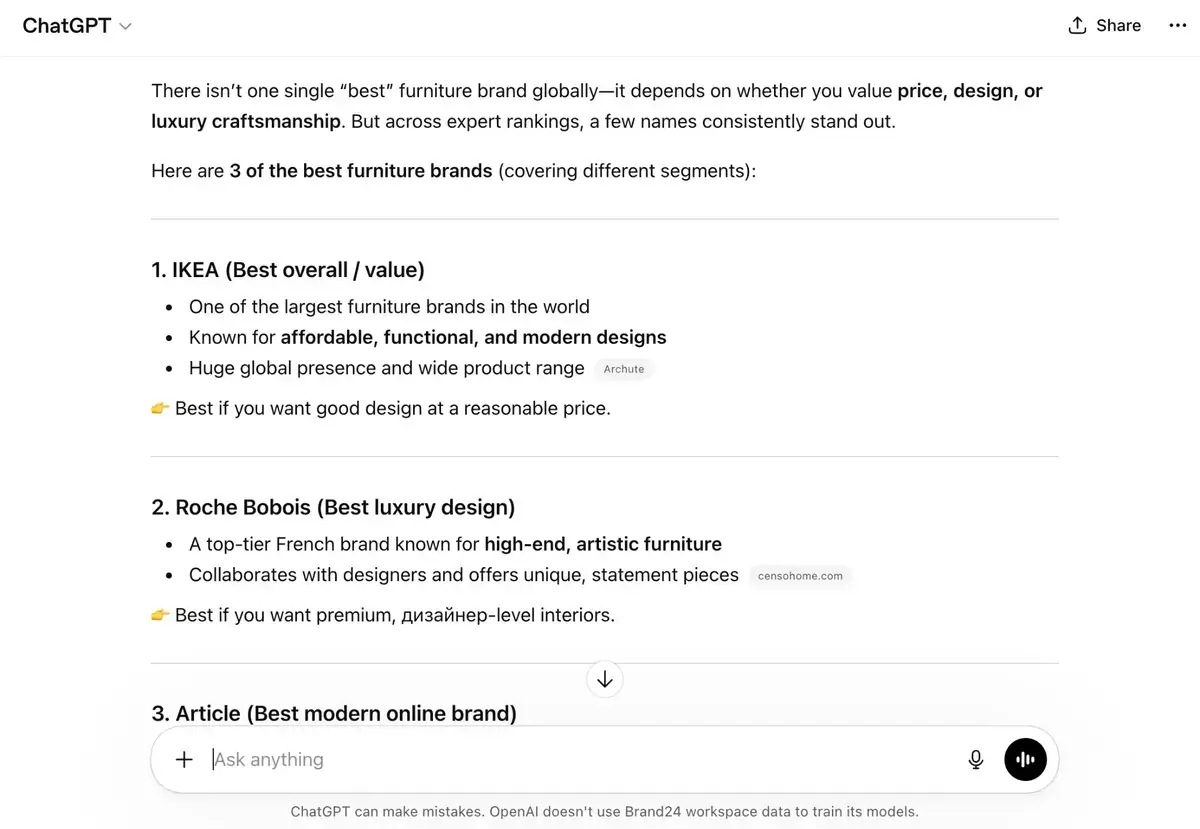
It’s because decades of reviews, articles, and forum posts have, by default, associated IKEA furniture with the training data. That mechanism changes what “optimization” should mean for most brands.
4 factors that actually drive AI brand visibility
01 Brand mentions
The Ahrefs data shows a correlation of 0.664. Nothing else measured comes even close. The undisputed number one.
Further read: Brand mentions for SEO and AI visibility
02 Authority of citing sources
AI models weigh trusted sources. Research shows only 7.2% of domains get cited in both LLMs and Google’s AI Overview.
Being present on high-authority domains (Wikipedia, Reuters, Forbes, leading industry publications) dramatically improves your cross-ecosystem reach.

03 Context and sentiment
A brand consistently described as “reliable” or “best for X” in credible sources has much higher chances of being recommended than one that people are constantly complaining about.
04 Relevance
Brands strongly associated with specific topics or use cases get recommended when those topics come up.
Depth of association with a specific niche matters more than broad, generic visibility.
Why does AI brand visibility matter?
Let me give you the numbers first, then explain what they mean:
- According to the Adyen Retail Report, 56% of consumers have used AI to discover brands they didn’t know before.
- The same report found 37% now use AI when making shopping decisions.
- DataReportal’s Digital 2026 report puts AI chatbot monthly active users at 1 to 1.5 billion.
Those are discovery numbers.
A significant share of your potential customers are now finding brands through a conversation with an AI tool, not through Google or social. If your brand doesn’t appear in those conversations, you’re not even considered.
Harsh but true.
Competitive advantage
Search Engine Land research found 82% of users find AI-powered search more helpful than traditional search engines.
Success loop
Brands that already have a strong presence in AI training data and enjoy high-authority source coverage have a massive advantage: the more they’re cited, the more AI systems treat them as credible, the more they get cited.
The longer you wait, the more you lose to competitors who started earlier.
A rare advantage for niche brands
The Ahrefs analysis found that brands having the most web mentions received 169 median AI citations, compared to 0 to 3 for the lower tiers. That’s not an enormous gap!
This is also great news for well-positioned niche brands.
A brand with a specific audience, strong community presence, and authentic third-party coverage can win over a larger competitor with a bigger ad budget but worse earned-media footprint.
That’s not something you could do as easily in paid search.
Brands in the top quartile for web mentions received 169 median AI citations, compared to just 0–3 for those in the bottom half. The relationship between off-site brand presence and AI visibility is not linear. It’s exponential.
Perpetuum mobile
Brands that appear most often in AI-generated results see up to 10x more mentions than lower-visibility competitors.
More AI mentions means more users clicking through, more branded search queries, more direct traffic, and more conversions.
AI brand visibility vs. traditional brand visibility
The most important row in the table below isn’t about platforms or measurement. It’s about control level.
| Category | AI visibility | Traditional visibility |
|---|---|---|
| Primary platforms | ChatGPT, Perplexity, Google AI Overview, Gemini, Claude, DeepSeek | Google Search, social media, paid ads, PR, display |
| Key drivers | Branded mentions on third-party sites, authority of citing sources, contextual relevance, sentiment | SEO, content marketing, paid advertising, PR campaigns, media coverage |
| Your control level | 📉 Low – AI systems decide based on training data and authority signals you can only indirectly influence. | 📈 High – direct influence through budget, optimization, targeting, and creative. |
| How to measure | AI citations, brand mention frequency in LLMs, share of voice in AI answers, sentiment in AI responses | Keyword rankings, traffic, social engagement, share of voice, brand mentions |
| Speed of impact | Slow – builds over months as off-site presence accumulates. | Variable – paid visibility is near-instant but organic SEO takes months. |
With traditional visibility, you have real direct control: buy search ads, run PR campaigns, boost social posts.
AI visibility doesn’t work that way. There are no paid placements in AI-generated answers. You influence what AI systems say about your brand indirectly, through the quality, volume, and credibility of what the rest of the web says about you.
The brands winning at AI visibility aren’t necessarily the ones with the biggest budgets. They’re the ones that have earned the most consistent, credible, widespread presence across the web.
That’s a fundamental shift in what “marketing” means for brand discovery.
Earned media, digital PR, and community presence matter more now than they have in years.
How to track AI brand visibility?
AI chatbots don’t produce the same answer twice.
Ask ChatGPT “What’s the best CRM tool?” today, and you might get a different response tomorrow: different wording, different brands, different framing.
This makes AI visibility inherently harder to measure than a keyword ranking.
The practical approach: use tools that run structured prompts across AI models at regular intervals, track which brands appear and in what context, and give you trend data over time.
But before the tools, let’s answer another super important question: why some brands get cited, and others don’t?
Knowing the mechanism helps you interpret what you’re seeing.
Why AI tools trust some brands and not others?
Brandlight research found that 40% of ChatGPT responses cite Wikipedia as a source.
If your brand doesn’t have a Wikipedia page, or has a sparse and uncurated one, you’re behind in one of the most influential source pools AI systems rely on.
The same trust logic applies to every high-authority reference source: Crunchbase, Google Business profiles, LinkedIn company pages, G2, Capterra, Trustpilot, and relevant industry directories.
AI tools pattern-match across their training data and real-time sources.
Brands with consistent, high-quality coverage across trusted domains get surfaced. Brands that only exist on their own website often don’t.
SEO tools with LLM tracking
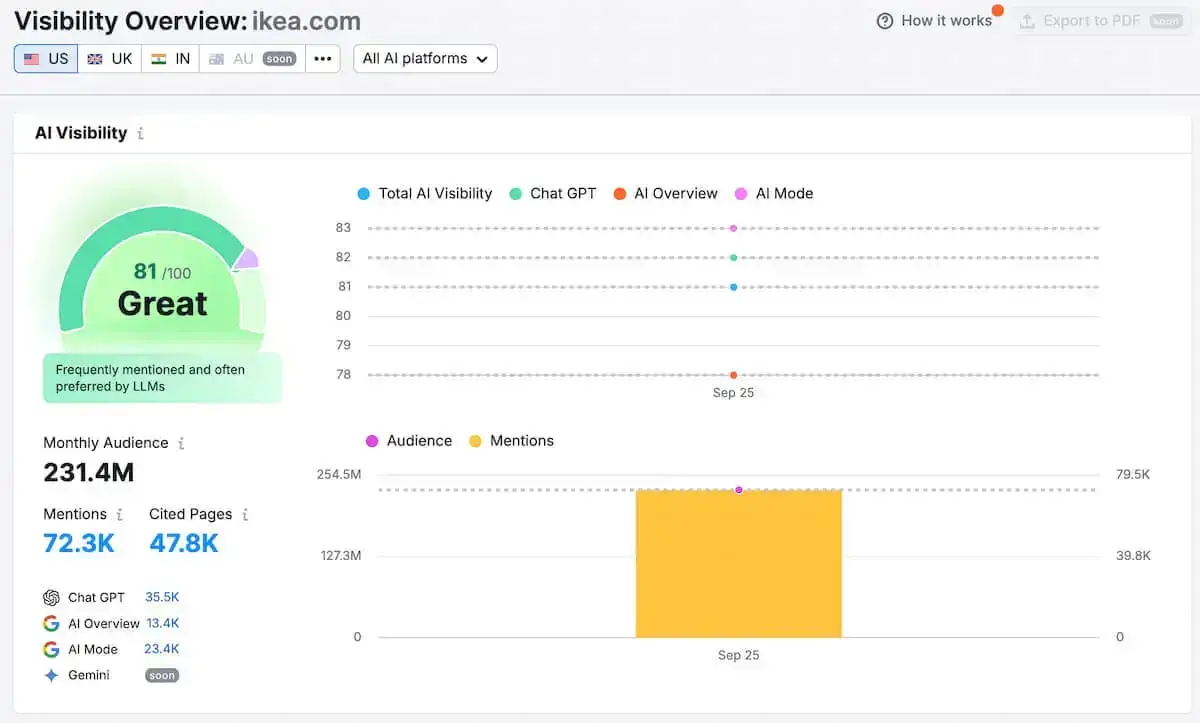
Semrush has expanded to measure visibility across ChatGPT, Google AI Overview, Perplexity, and other platforms. Capabilities include competitor research, prompt analysis, brand tracking, performance measurement, and insights into question intent.
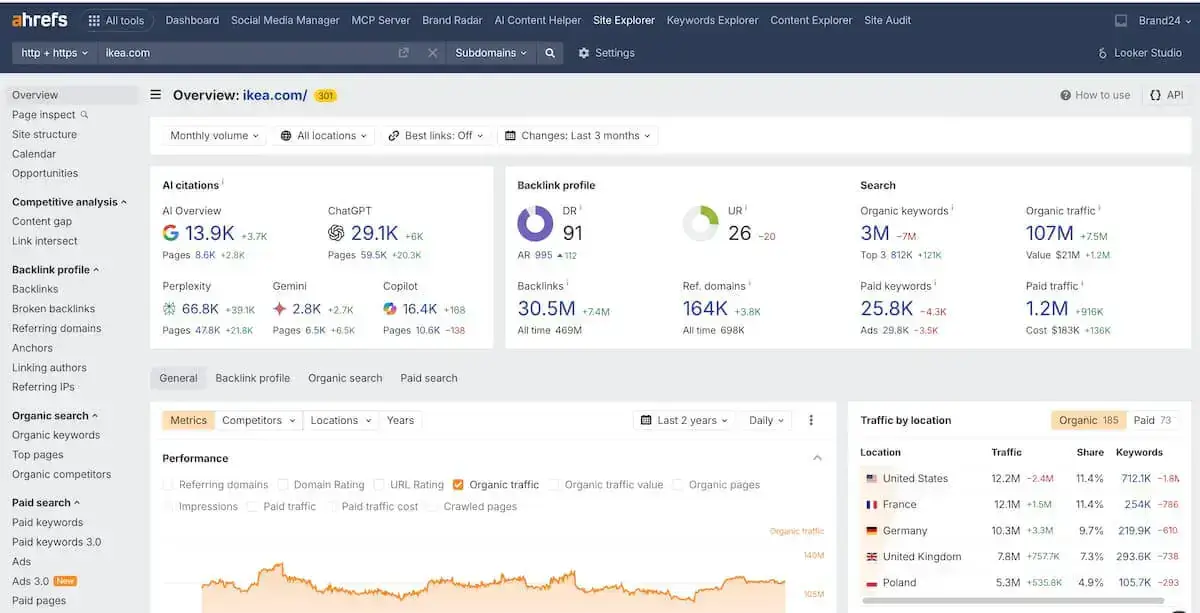
Ahrefs now tracks AI and LLM visibility alongside traditional SEO metrics. It monitors citations in AI-generated results, shows context and sentiment of brand mentions, and tracks source attribution across Google AI Overview, ChatGPT, and Perplexity.
Online monitoring tools with LLM tracking
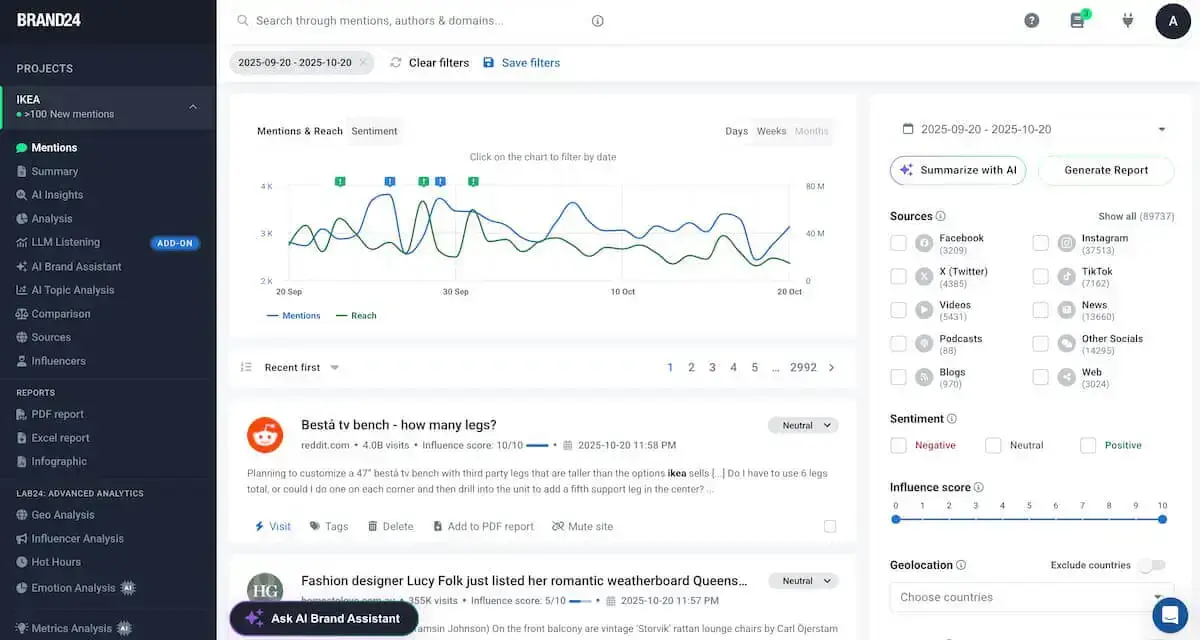
Brand24 is an AI-powered media monitoring tool tracking brand mentions across social media (Facebook, Instagram, X, LinkedIn, YouTube, TikTok, Reddit, and more), news sites, blogs, podcasts, review platforms, and forums.
Brand24’s relevance to AI visibility goes beyond traditional mention tracking. Those off-site mentions are precisely the raw material AI systems use to assess your brand’s credibility.
I work at Brand24, so take that with appropriate skepticism, but the underlying logic holds regardless of which tool you use.
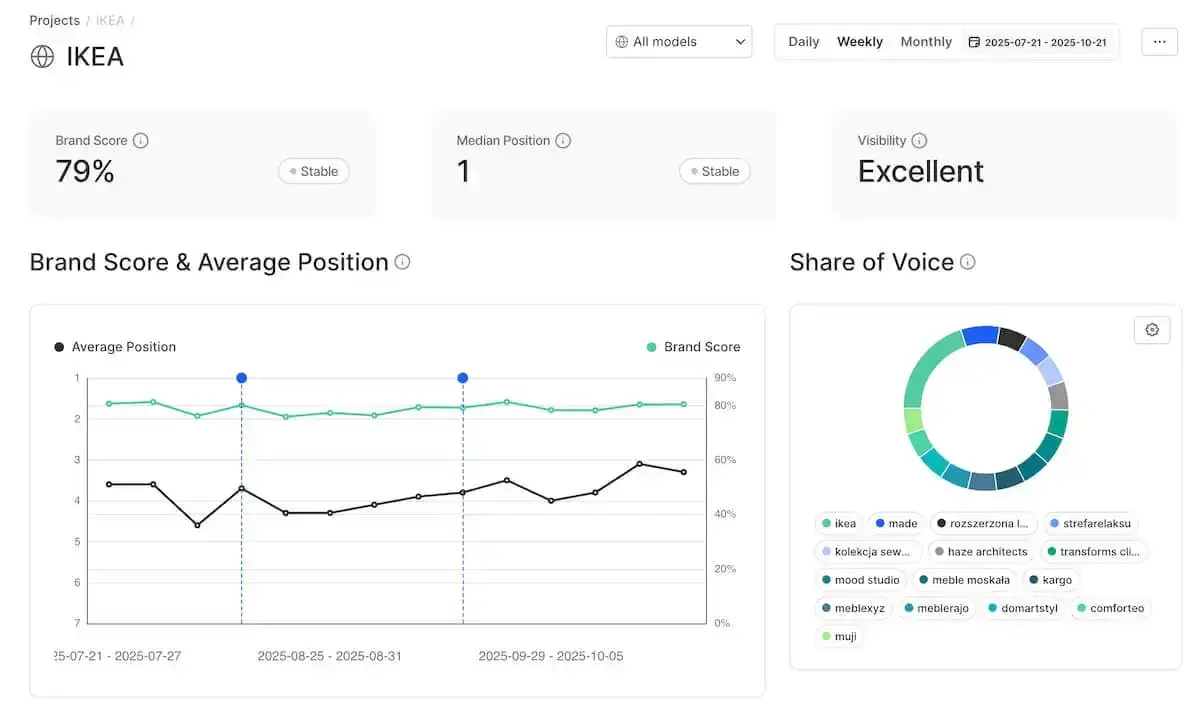
Chatbeat is a dedicated AI visibility monitoring platform that tracks your brand’s appearance in ChatGPT, Gemini, Claude, Perplexity, DeepSeek, Grok, Copilot, and Google AI Overview by running structured prompts across these models.
Metrics include Brand Score, Median Position, Visibility Rating, and Share of Voice.
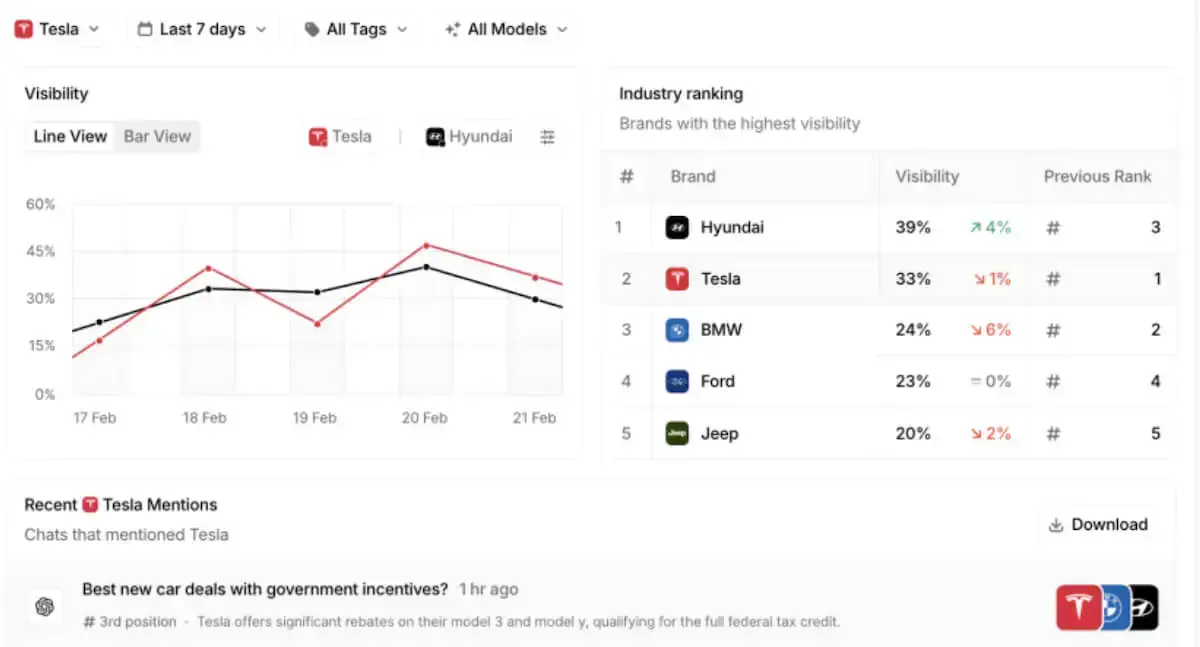
Peec AI is an LLM visibility and brand intelligence platform monitoring mentions, citations, and sentiment across ChatGPT, Gemini, Claude, Perplexity, and Google AI Overview.
It offers share-of-voice analytics, visibility trends, and contextual narrative analysis.
How to improve AI brand visibility
Most AI visibility guides give you a list of tactics. Here’s the research behind each one, starting with the activity with the highest impact.
01 Build your off-site mention base
If you only do one thing, make it this: generate more branded mentions on third-party sites.
The Ahrefs study reports a correlation of 0.664 between branded web mentions and AI appearance.
Domain rating correlates at 0.326.
Backlink count at 0.295.
Your own on-site content quality doesn’t rank in the top measured factors at all.
This is what works in practice:
- Digital PR campaigns that earn coverage in publications your audience reads,
- Guest contributions to industry outlets,
- Presence in comparison and “best of” listicles,
- Professional and community presence on LinkedIn, Reddit and niche forums,
- Earning reviews and mentions from customers.
Monitoring tools like Brand24 are useful here not just for tracking where you’re mentioned, but for identifying where you’re not and what the sentiment looks like when you are.
02 Stop treating content volume as a strategy
This needs its own heading because it’s the most common mistake I see brands making.
They respond to AI visibility concerns by publishing more content on their own site. The data doesn’t support this approach.
The correlation between your own content output and AI visibility is simply not in the top measured factors.
What matters to AI systems isn’t how much you publish on your domain – it’s how often credible external sources talk about you.
A brand that earns three awesome third-party mentions in a month is likely to outperform a brand that publishes twenty blog posts but earns zero external coverage.
Where content investment should go:
- Producing unique researches and studies,
- Articles and blog posts that strengthen E-E-A-T
- PR activities that earn mentions on other people’s channels.
03 Get serious about high-authority reference sources
If your brand doesn’t have a Wikipedia page – create it. If your LinkedIn presence is boring – change it.
Keep your Crunchbase profile complete, your Google Business listing accurate, and your presence on relevant review platforms actively managed.
AI tools use these sources to verify claims about brands.
Inconsistent information across sources creates noise, reducing citation confidence. Consistent, accurate profiles give AI systems a clean signal about who you are.
04 Earn reviews with outcome-specific content
BrightLocal’s Consumer Review Survey found 96% of consumers read reviews before buying. You knew that already. What’s less discussed: AI tools scrape and reference review content when generating summaries and comparisons.
A brand with 500 detailed, outcome-specific reviews describing actual use cases gets cited differently by AI systems than one with 50 generic four-star ratings.
Encourage your customers to describe what changed for them after using your product, in specific contexts.
That specificity is what makes review content useful to AI systems generating recommendations.
05 Invest in digital PR and earned media
Being mentioned in a Reuters article, a prestigious analyst report, or a leading publication in your niche signals to AI systems that you’re worth citing. Those sources are high-trust signals in the information network that AI models depend on.
The ROI calculation for PR has always been hard to quantify.
AI visibility gives it a new measurable dimension: coverage in high-authority publications directly builds the off-site mention base that the data shows is the strongest predictor of AI citation.
Track it. Report it as an AI visibility input. And justify the investment.
06 Optimize content in the right order
Here’s the insight most GEO guides miss: 76% of Google’s AI Overview citations come from pages already ranking in the top 10 of traditional search (Ahrefs). AI visibility is largely an outcome of existing SEO performance.
GEO tactics aren’t useless.
Structuring content to directly answer specific questions, using natural language, including FAQ sections, schema markups, and citing facts with named sources: all of it helps.
But if your pages aren’t already competitive in traditional search, GEO tactics alone won’t get you into AI Overviews.
Fix SEO first. Use GEO to amplify.
07 Keep your messaging consistent across every channel
AI models build their understanding of your brand by gathering signals from multiple sources:
- Your website,
- LinkedIn,
- Press materials,
- Reviews,
- Marketplaces,
- and other third-party coverage
If those sources tell different stories, the model gets mixed signals and is less likely to cite you confidently.
Consistency of core messaging across all channels is crucial for direct input into how clearly AI systems can represent your brand when asked.
Conclusion
The core insight from the research is simple, but it’s contrary to how most brands have been doing: AI visibility is mostly built outside your website, not on it.
The brands that appear most often in AI-generated answers are those with the most credible, consistent, and broad third-party presence. Content volume on your own domain is a weak signal. Off-site mentions from trusted sources are the strong one.
If you’re starting from scratch, prioritize in this order:
- Build off-site mentions through PR and community,
- Get your high-authority reference sources (Wikipedia, Crunchbase, review platforms) in order
- Ensure you’ve a solid SEO foundation and add GEO tactics.
And remember to measure your progress across multiple AI ecosystems, not just one.
The brands treating AI visibility as an earned-media challenge, rather than a content production challenge, are the ones pulling ahead.
FAQ
How can I improve my product visibility using AI strategies?
Start with Answer Engine Optimization: structure your product descriptions and supporting content to directly answer the questions your buyers ask AI tools.
“What does [product] do for [use case]?” should be answerable from your content in one or two sentences, not buried in marketing language.
Add schema markup with specific product details: price, availability, brand, reviews, and use cases. This makes it technically easier for AI systems to extract accurate information about your product without ambiguity.
Build off-site presence too: being reviewed, compared, and discussed on third-party sites is the single highest-impact activity for product-level AI visibility.
What are the risks to brand reputation from using AI in marketing?
Using AI can harm brand reputation if it produces biased, misleading, or offensive content that can quickly spread online. Here are some practical examples:
- Mistakes made by AI chatbots or automated customer support can make a company seem careless or inhuman.
- Poor data handling, such as using customer information without consent, may lead to privacy concerns and data breaches.
- Overusing AI in communication can make a brand sound impersonal and, ultimately, weaken trust and authenticity.
How often should I monitor my AI brand visibility?
At a minimum, run structured prompt tests across the major AI platforms (ChatGPT, Perplexity, Google AI Overview) on a monthly basis.
For competitive categories, weekly tracking with a dedicated tool like Chatbeat or Peec AI gives you the trend data you need to spot changes quickly.
Track both your brand’s appearance rate and the sentiment and context of how it’s described.

Article Reviewed by