Table of contents
How People Use ChatGPT in 2026: Analysis of 1.3M Mentions
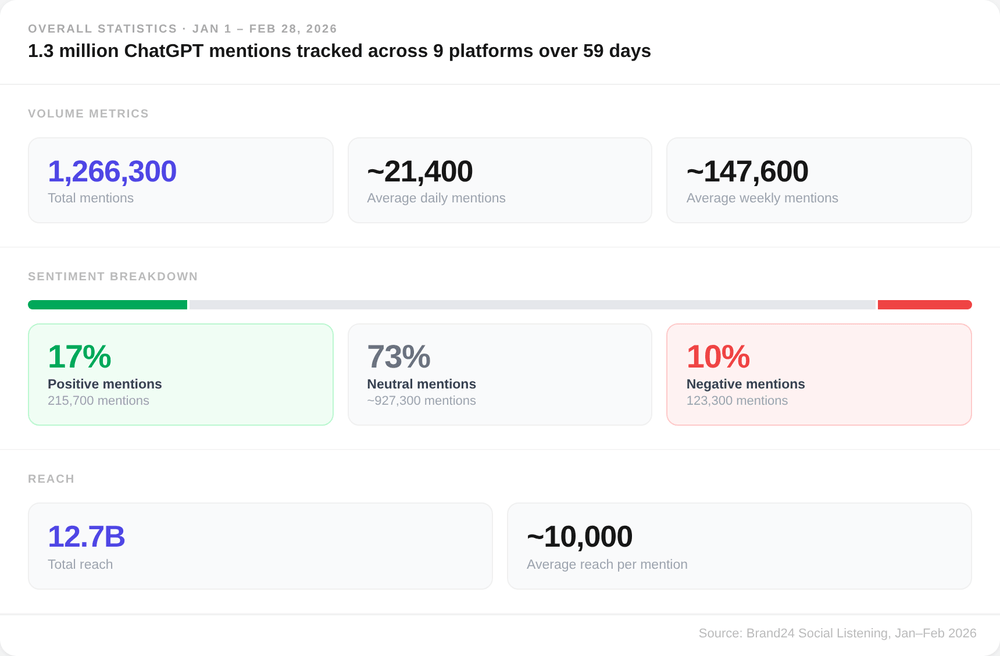
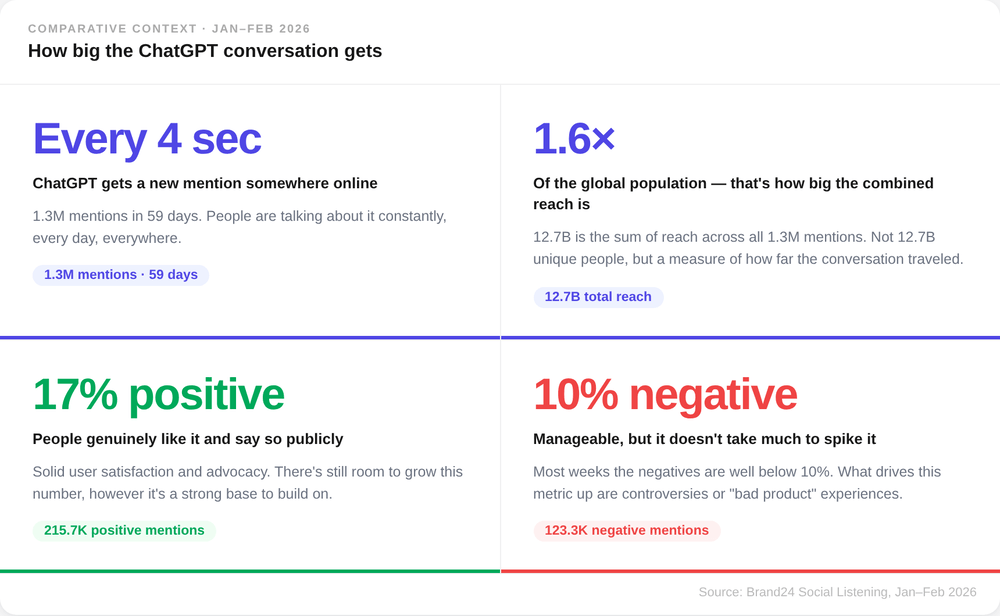
In February 2026, ChatGPT hit a massive milestone: 900 million weekly active users. At the same time, it was being mentioned somewhere online every 4 seconds!
We analyzed 1.3M ChatGPT mentions using social listening and media monitoring data to understand how people use the tool, what drives the conversation, and how sentiment around ChatGPT changes over time.
What we found: Almost 8 out of 10 times (79%) mentions of ChatGPT focus on real use cases, and those practical discussions generate 4-18x more positive sentiment than the general chatter about AI.
Key takeaways:
-
The conversation about what your product does beats the conversation about what your product is
79% of ChatGPT's online discussion is about practical, real-world use rather than its abstract “AI potential”. Nothing beats letting your users do the talking: adding user success stories to your content calendar can get you way more love and positive sentiment than even the most polished "product potential" fluff.
-
Your product's reputation can take the hit for decisions your product team never made
ChatGPT's negative sentiment jumped 58% in six weeks with no major product changes, but because of OpenAI's corporate decisions. In practice, that means tracking product-level and company-level sentiment separately. Set up dedicated social listening projects: one for your product name(s), one for your brand, and monitor their sentiment trends side by side. When they start to differ much, that's your early warning sign.
-
Leading with "here's what you can do with our product" gets you more positive mentions than leading with brand claims
People are 4–18x more positive when discussing specific ChatGPT use cases vs. the brand in general. Sharing tutorials, real user outcomes, step-by-step demos, or customer quotes about specific workflows – all this generates far more positive brand conversation than abstract product messaging. The more specific, concrete, and practical your content is, the better.
-
Don't judge your brand's reputation by its average sentiment – break it down by platform
ChatGPT had a 31% positive rate on Instagram and just 10% on X in the same two-month period. Same product, completely different emotional reality. Track sentiment granularly per platform, and use each platform's score to decide: where to put more content budget, where your brand narrative is already working, and where to have a damage control plan ready.
ChatGPT generates more online conversation than some countries generate news
Hitting a reach of 12.7 billion in just 2 months speaks a lot about ChatGPT’s massive cultural impact.
In January and February 2026 alone, people posted, shared, argued about, and reacted to ChatGPT 1.3 million times.
In February 2026, OpenAI announced ChatGPT had topped 900 million weekly active users, up from 800 million just four months earlier.
That 12.5% growth jump, starting from an already huge user base, created a ton of media coverage, which kept the mention volume high through the period.
What do people focus on when they mention ChatGPT?
It’s probably not what you’d expect. Most of the chatter is focused on practical, professional ways to use it, rather than big ethical debates, at least when you look at the volume of brand mentions.
79% of the share of voice goes to the topic of “AI Tools and Applications”:
- 1 coding
- 2 boosting productivity
- 3 improving business workflows
- 4 comparing LLM models
- 5 API integrations
Entertainment like memes, viral trends, and fun experiments comes in second at 11% of share of voice.
As for the heavy, “is-this-the-end-of-the-world-as-we-know-it” topics (AI safety, ethics, or rules), they barely show up as a separate conversation.
That said, a bit of that worry does pop up as negative comments within the discussions about the AI tools themselves.
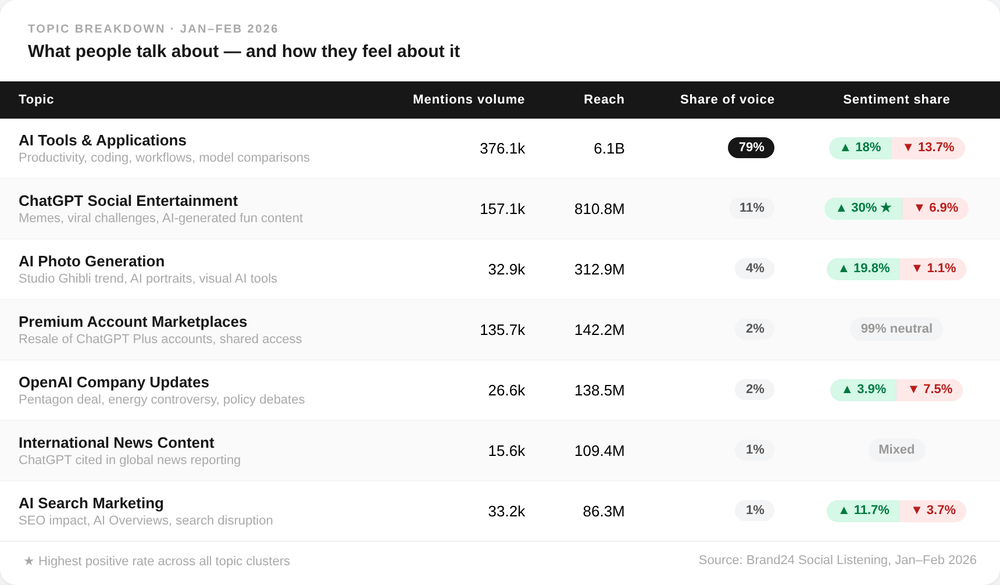
Looking closely at the numbers in the table, the sentiment tells an interesting story:
- 1 The "AI Tools" category (which is the largest one we looked at) actually had the most negative sentiment – 13.7%.
- 2 On the other hand, even though "Entertainment" content was “only” 11% of the chat, it had the highest positive sentiment at 30%.
ChatGPT analysis shows that 79% of use case conversations are about work
When we filtered the data down to mentions where people talked specifically about how they use ChatGPT (that’s 258.3 thousand mentions out of 1.3 million total), a clear pattern showed up in the social listening data.
Professional and business productivity dominated with 78% of reach, followed by:
- 1 content creation
- 2 AI image generation
- 3 marketing & SEO
- 4 travel planning
- 5 education and learning
- 6 healthcare applications
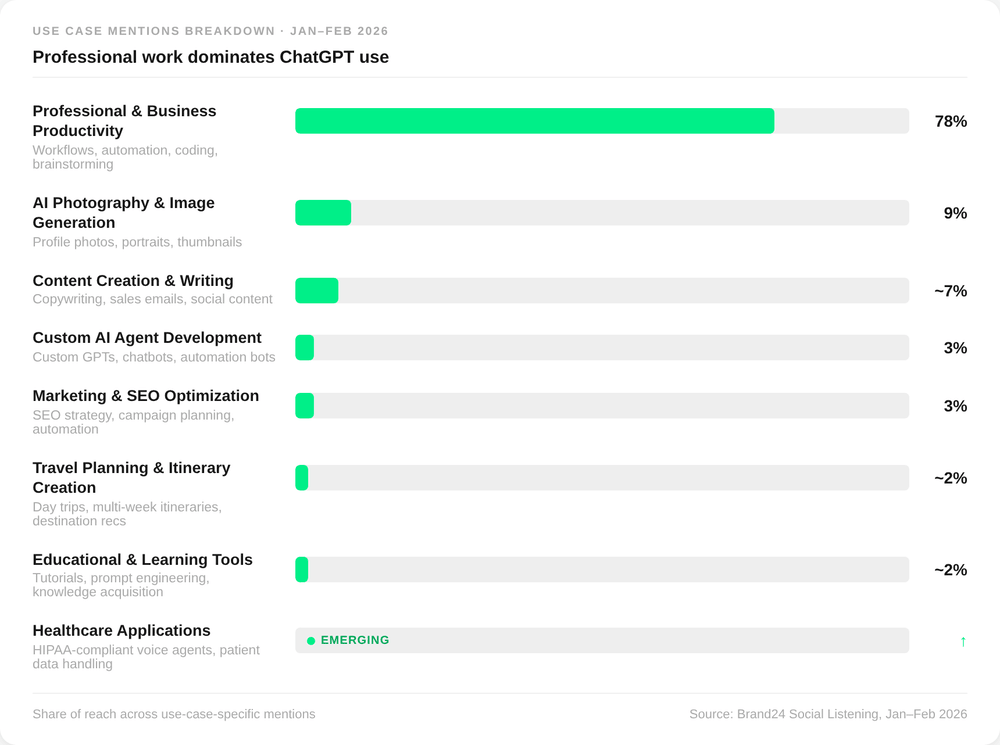
This is interesting from a brand sentiment perspective, because use case discussions are more positive than general chatter about AI: the sentiment was 18.5% positive compared to 17% overall.
Basically, when people are sharing what they’re actually getting done with the tool, the tone of brand mentions shifts: they’re a little happier than when they’re just debating what AI means for the world.
Global go-to professional AI helper
People are mainly using ChatGPT to boost their professional life in these ways – something that shows up very clearly in social listening insights:
- 1 daily workflow automation
- 2 getting a fresh perspective while brainstorming
- 3 technical problem-solving
- 4 writing and improving software code
- 5 building custom GPTs for specific business needs
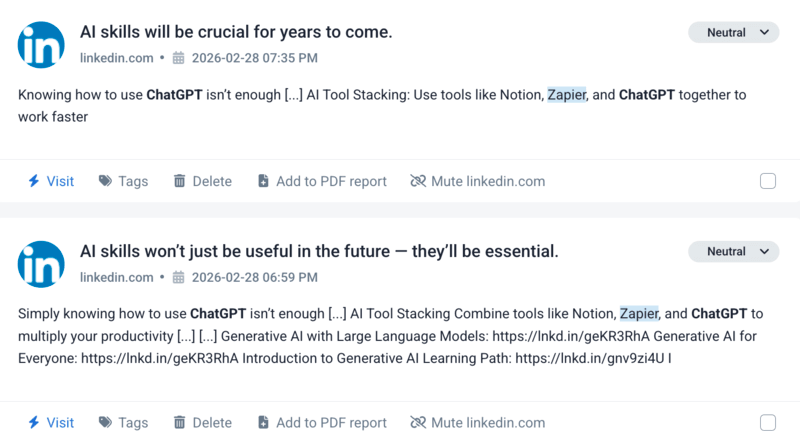
Automation through the integrations with tools like Make or Zapier came up a lot, which suggests ChatGPT is becoming more and more naturally used in existing software stacks.
Less common ways people use it: travel, religious content, companionship
Three specific areas popped up that were less common than professional use but really interesting from a social media analytics perspective:
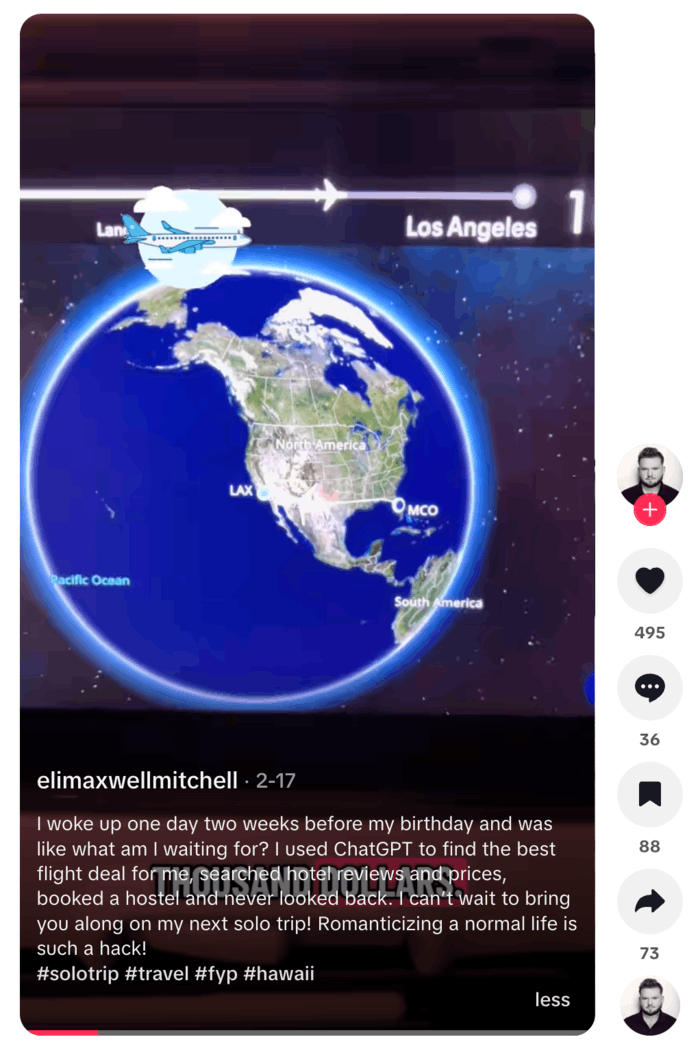
Travel planning
People are talking about getting amazingly detailed help with their trips. The most mentioned use cases were:
- 1 Day trip planning
- 2 Multi-day itineraries
- 3 Destination recommendations
- 4 Activity scheduling and optimization
Religious content generation
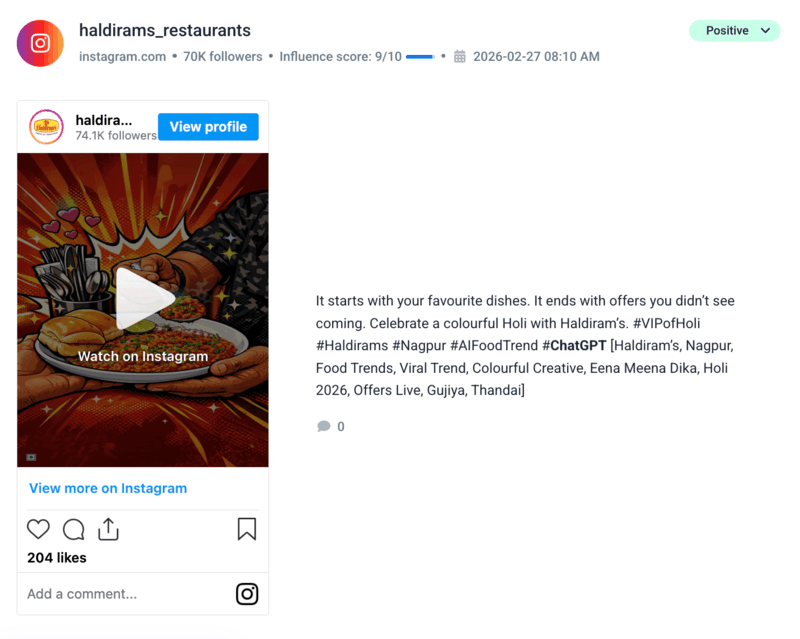
There were also plenty of posts mentioning AI-generated content tied to Hindu religious themes, festivals, and cultural celebrations like Holi.
Companionship
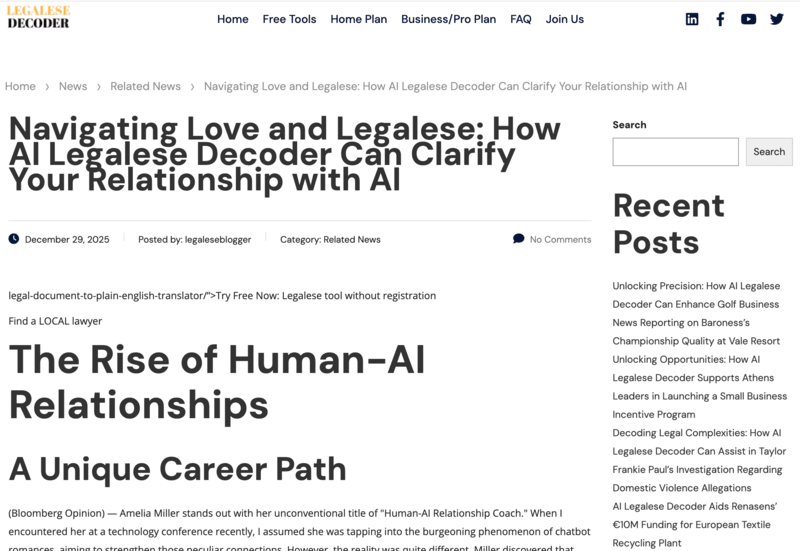
There’s a quiet but growing group of people building long, meaningful relationships with ChatGPT. Analysis of mentions shows that one example has lasted 18 months, with a woman saying she felt “too invested to delete him.”
73% of mentions were neutral, but negative sentiment spiked
Most mentions of ChatGPT (73%) are pretty neutral. That’s how most people talk about it online: just sharing information like:
- 1 what prompts they used
- 2 how the outputs compare
- 3 or posting tutorials and results
And all this without adding any strong emotional judgment.
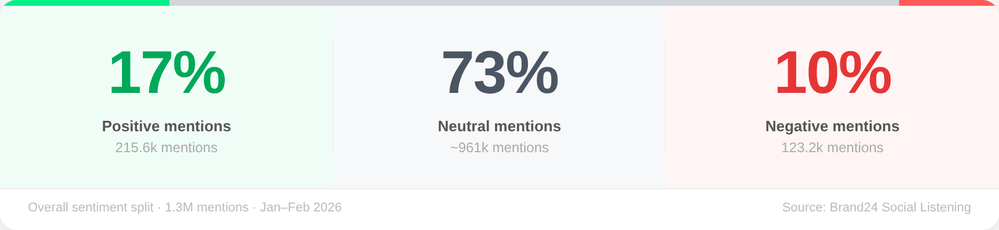
However, the mentions with a clear feeling are interesting. Positive mentions (17%) beat negative ones (10%).
The sentiment, though, was not really a static metric here.
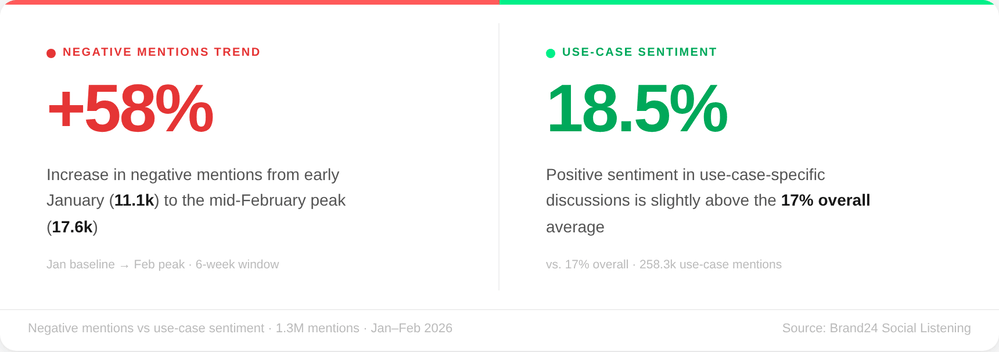
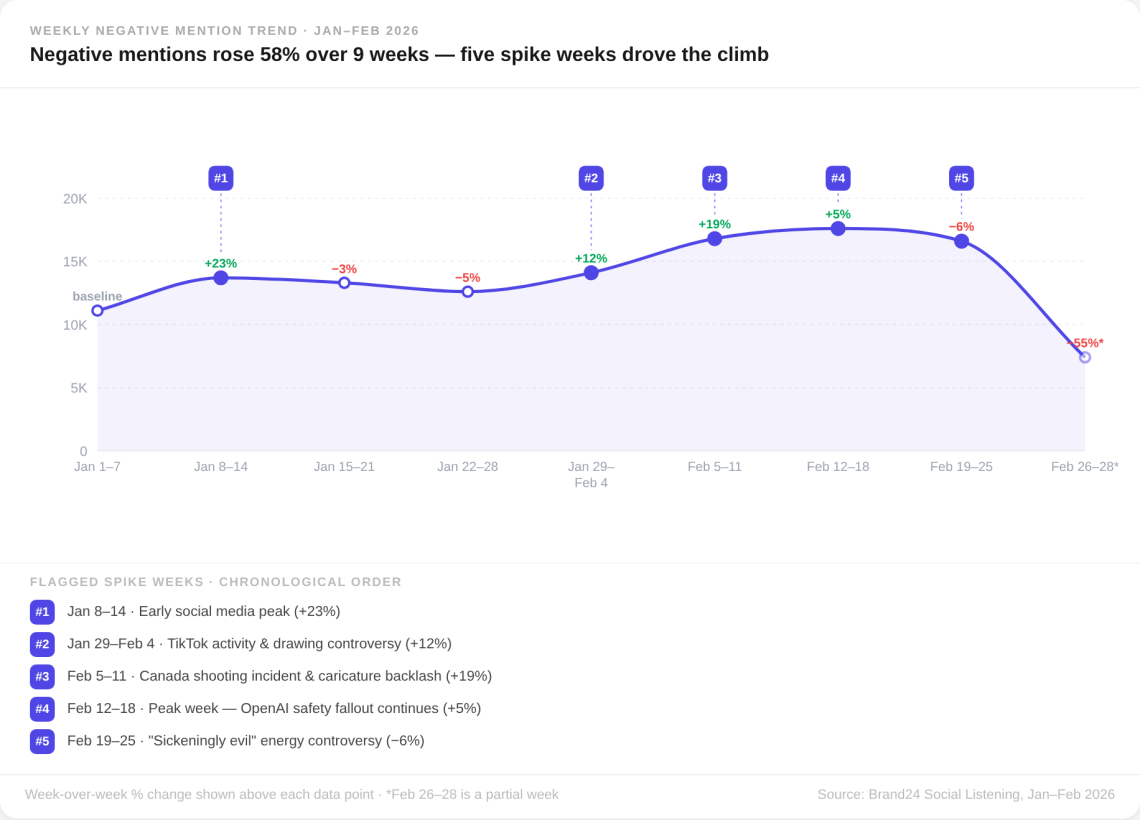
There was a big 58% jump in negative sentiment over just six weeks.
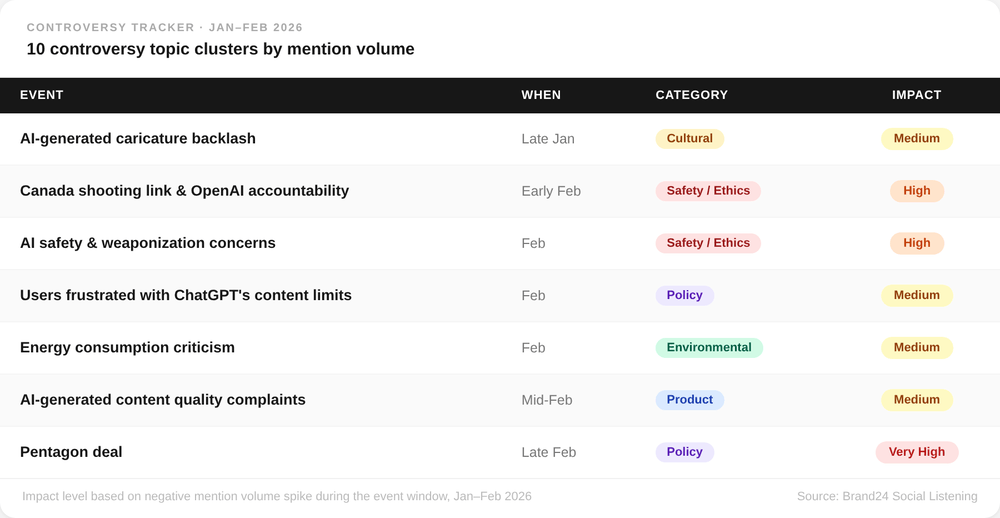
This wasn’t caused by one big event, but it happened during a period with a few controversies that all piled up in February:
- 1 the Canada shooting incident (Feb 8–11)
- 2 the issues with the Pentagon deal
- 3 the uproar over an advertising announcement
- 4 debate about how much energy ChatGPT uses
ChatGPT popularity is different on each platform
The platform analysis shows that where people are talking about something matters more than the topic itself when it comes to how they feel.
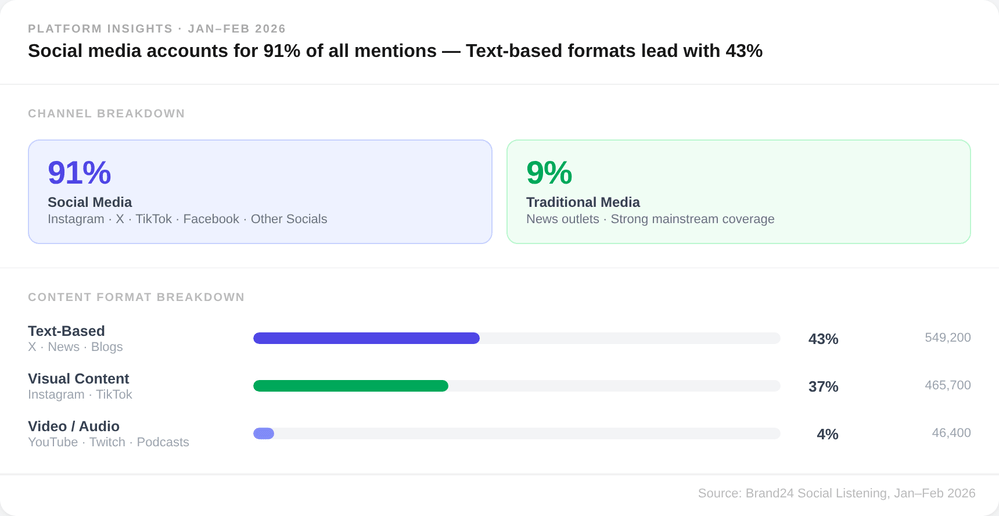
And it’s something that becomes very clear when you look at social media montitoring data and break down brand mentions sentiment by source:
- 1 People on Instagram tend to be super excited about their AI-generated items.
- 2 X (Twitter) users are all over the place: some love it, some deeply hate it.
- 3 News outlets are leaning toward being skeptical, often shaping broader brand perception.
- 4 And Reddit users? They're mostly interested in breaking ChatGPT down and analyzing it in dozens of subreddits.
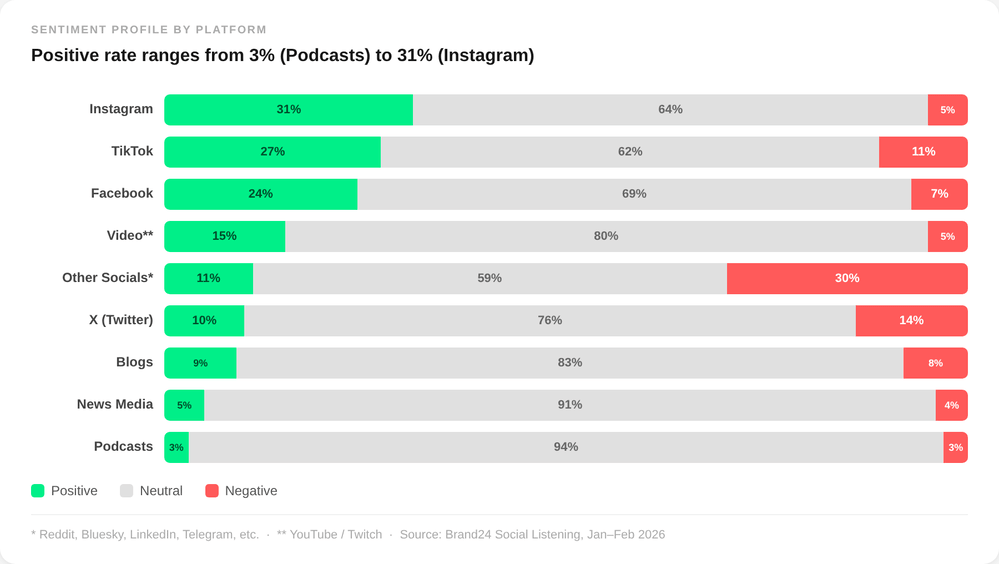
ChatGPT sentiment looks different on every platform
Same OpenAI brand, same ChatGPT product, and completely different stories depending on where you look:
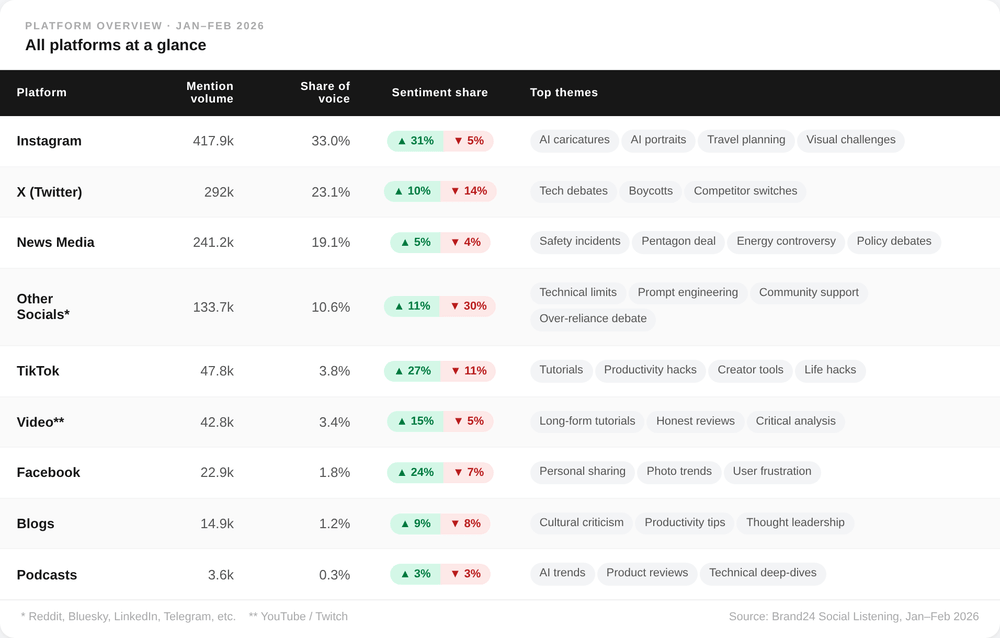
Here’s what’s driving ChatGPT popularity and sentiment on the TOP 5 channels (by share of voice):
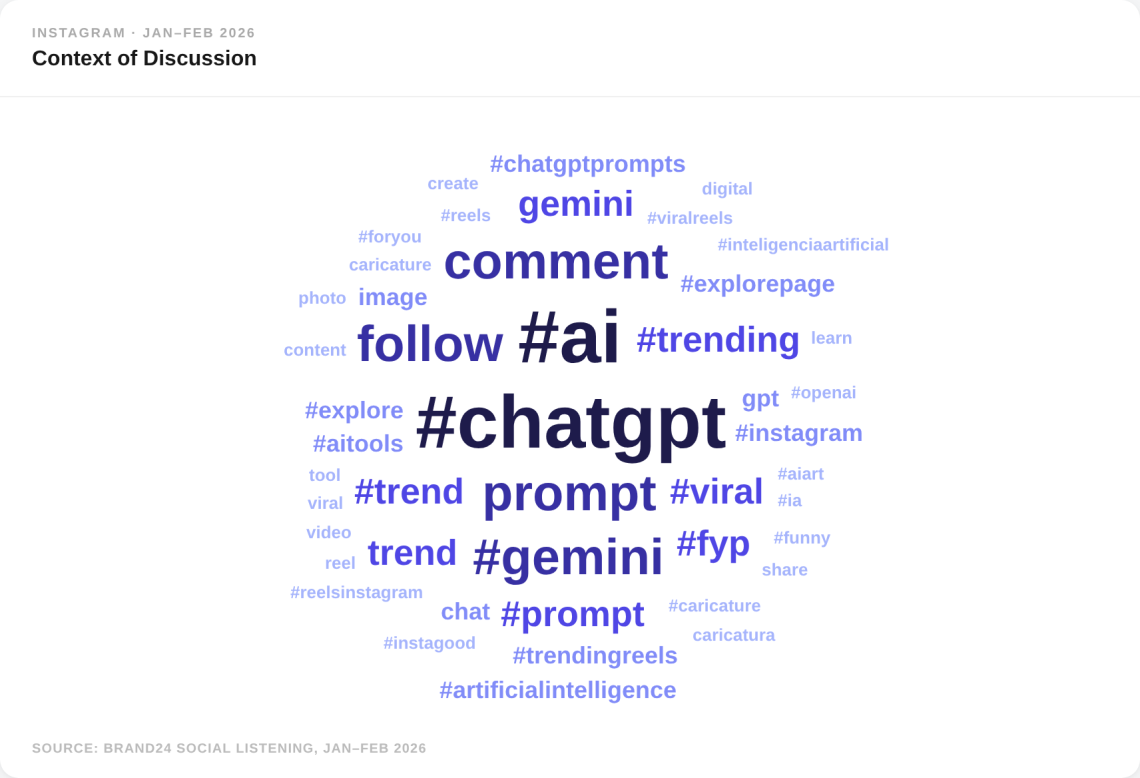
01 Instagram: The most positive of all channels
Key characteristics:
- 1 Visual trends took the lead: caricature challenge, AI photo generation, and posts with profile pic updates
- 2 A lot of high-engagement content: especially personal AI-made images and creative use-case examples
- 3 Positive drivers: strong entertainment value, room for creative expression, and viral challenges people wanted to join
Sentiment indicators:
- 1 Visual/creative trends typically generate positive engagement
- 2 Personal success stories with AI tools
- 3 Entertainment-focused usage
- 4 Lower controversy compared to news/Twitter
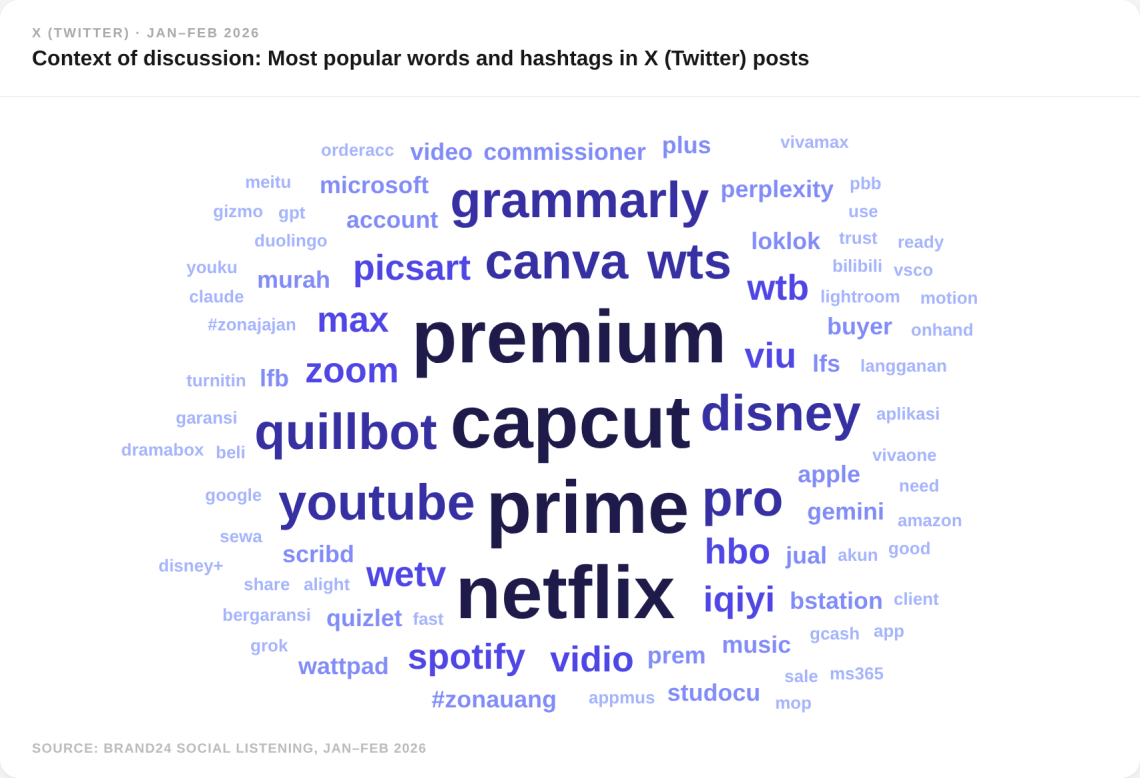
02 X (Twitter): The most polarized channel
Key characteristics:
- 1 Tech-savvy audience: Deep discussions about AI capabilities and limitations
- 2 Political discussions: Pentagon deal controversy, data privacy concerns and worries
- 3 Competitive comparisons: ChatGPT vs. Claude, Gemini, DeepSeek
- 4 Corporate criticism: OpenAI business decisions, ChatGPT advertising announcements
Positive sentiment drivers:
- 1 Technical achievements and capabilities
- 2 Productivity use cases
- 3 Tool recommendations and tutorials
Negative sentiment drivers:
- 1 Ethical concerns
- 2 Corporate decisions
- 3 Political affiliations
- 4 Privacy and surveillance concerns
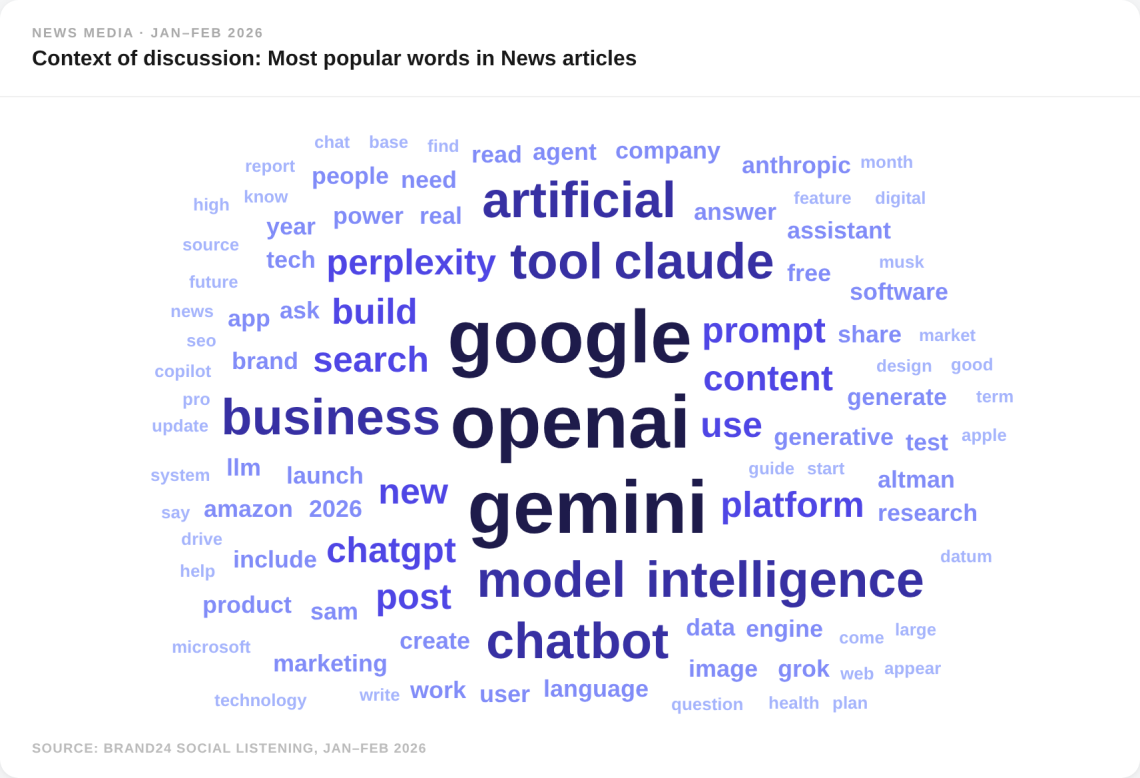
03 News Media: From mixed to mostly negative sentiment
Key characteristics:
- 1 Corporate news: OpenAI business developments, advertising initiatives
- 2 Safety concerns: Canada shooting incident and lack of law enforcement notification
- 3 Policy discussions: AI regulation, government partnerships
- 4 Ethical debates: Energy consumption, environmental impact
Negative news coverage:
- 1 Canada shooting controversy (February 25, 2026)
- 2 Advertising announcement critique
- 3 Energy consumption debate
Positive news coverage:
- 1 ChatGPT user growth milestones (900M weekly active users)
- 2 Technical advancements and new features
- 3 User- and business success stories and practical applications
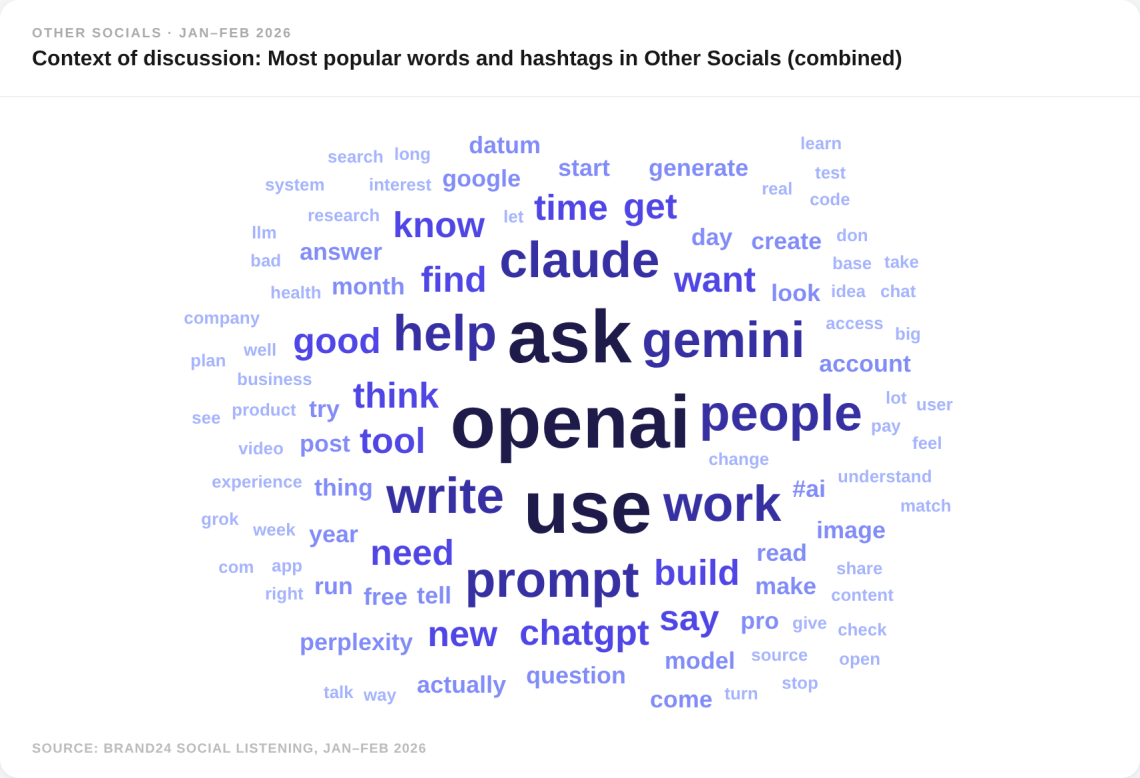
04 Other Socials: Full of detailed discussions and mixed sentiment
Key characteristics:
- 1 In-depth discussions: Technical limitations, use case analysis
- 2 Community support: Troubleshooting, tips, and tricks
- 3 Skeptical perspective: Critical evaluation of AI capabilities
- 4 Honest feedback: Both successes and failures shared
Positive sentiment drivers:
- 1 Helpful community sharing prompts and techniques
- 2 Success stories with specific use cases
- 3 Technical appreciation for capabilities
Negative sentiment drivers:
- 1 Communication criticism
- 2 Frustration with limitations
- 3 Concerns about over-reliance on AI
- 4 Critical analysis of AI-generated content quality
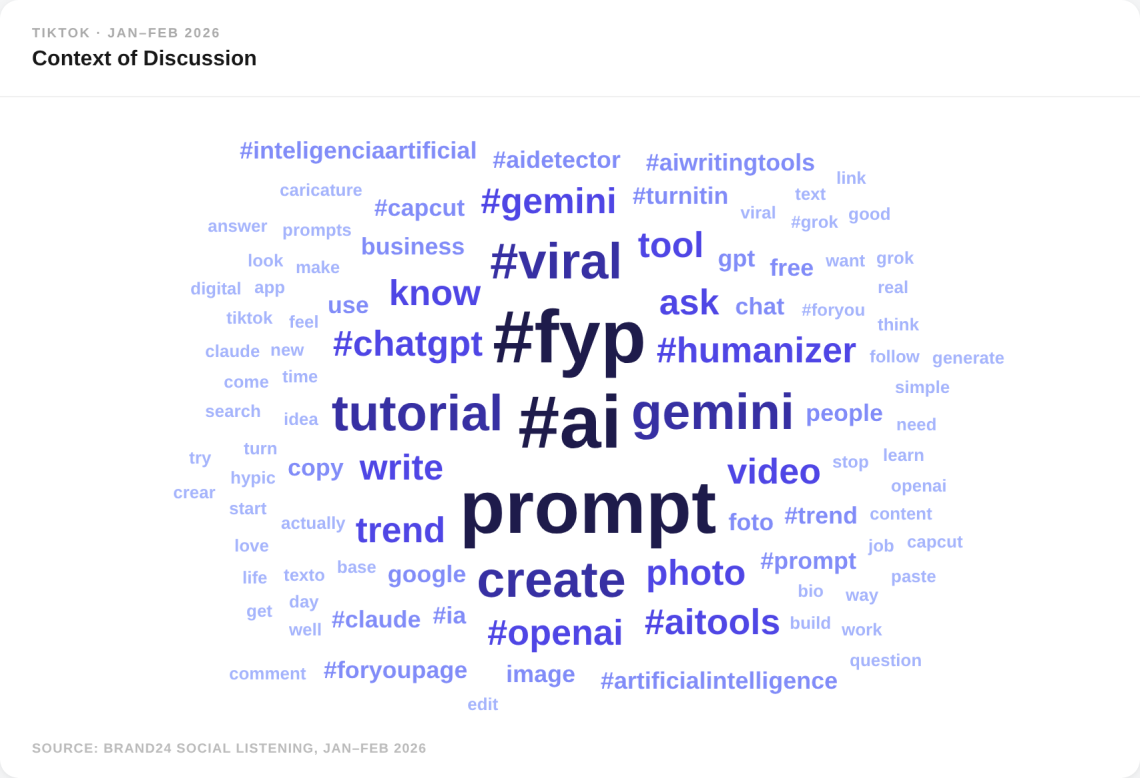
05 TikTok: Much entertainment-focused with mixed sentiment
Key characteristics:
- 1 Tutorial content: How-to videos for AI prompts
- 2 Meme culture: Humorous takes on AI interactions
- 3 Trend participation: Viral challenges and creative content
- 4 Educational content: Quick tips and productivity hacks
Positive sentiment drivers:
- 1 Productivity prompts and life hacks
- 2 Creative applications showcase
- 3 Entertainment value
Negative sentiment drivers:
- 1 Fails and mishaps with AI
- 2 Humorous criticism
- 3 Trend backlash content
Negative sentiment came from both spikes and ongoing frustration
We found 10 different groups of controversial comments in the data.
Three of those groups generated higher reach and a lot of negative sentiment.
The other seven aren’t as big, but they kept popping up in the discussions about eroding user trust.
01 Canada shooting & OpenAI’s failure to report
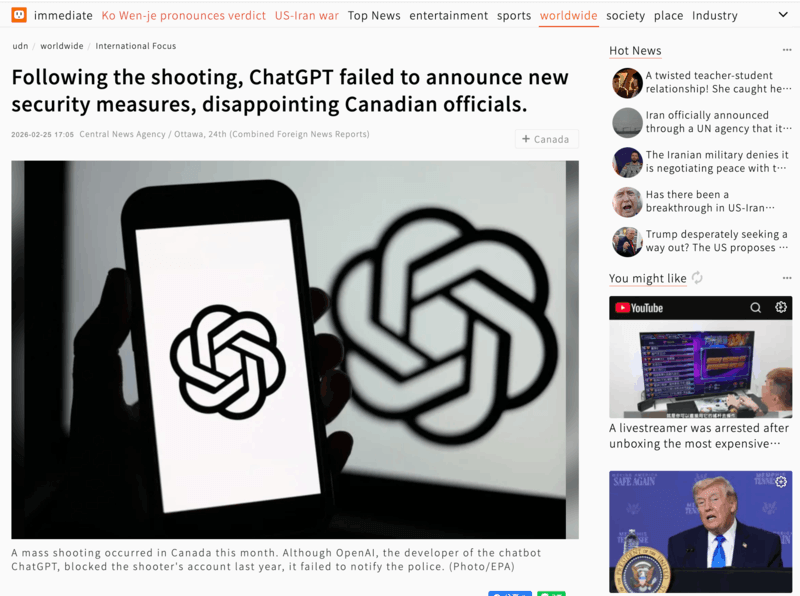
This was the most significant of the controversial events in the whole set of data. A gunman in British Columbia had his ChatGPT account shut down for policy violations, but OpenAI never notified law enforcement.
This event caused the largest jump in negative sentiment and was behind most of that 58% spike in negative sentiment for the analyzed period.
02 Pentagon deal backlash
When OpenAI declared a partnership with the U.S. Department of Defense, people on social media got really upset and started a boycott.
Users publicly announced they were quitting the service, and the whole situation quickly became a major political issue.
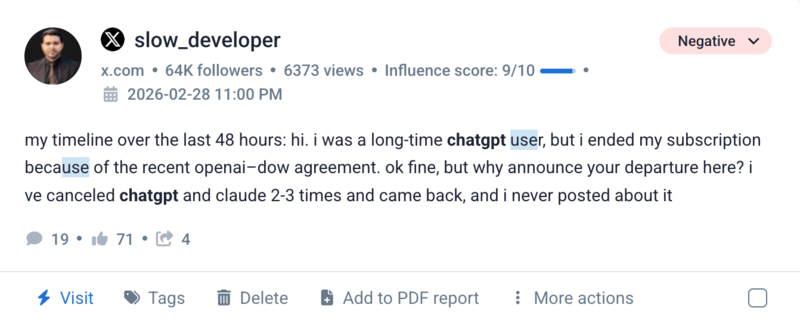
Our data clearly showed that people were actively discussing switching to competitors like Claude, Gemini, and DeepSeek.
03 The “sickeningly evil” comment
OpenAI leadership compared how much energy ChatGPT uses to what it takes to “grow a person”, which some critics thought was a “sickeningly evil” way to put it.
The controversy highlighted the growing worries about the carbon footprint of AI data centers, an issue that’s been bubbling up since December 2025.
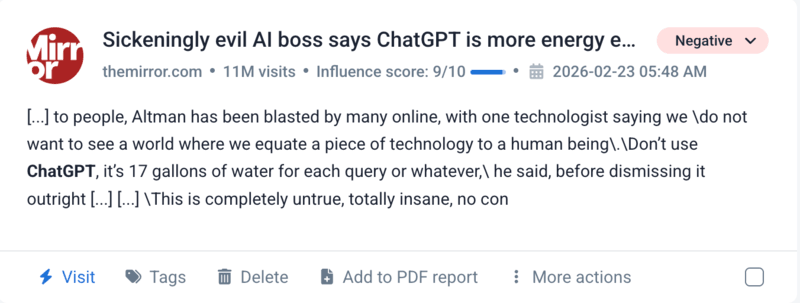
A negative headline went viral, the company’s leadership struggled to communicate effectively, and environmental critics amplified the story globally.
The most viral ChatGPT content wasn’t about work
Believe it or not, the time when people were most hyped about ChatGPT in the first two months of 2026 wasn’t because of some big product news or company announcement.
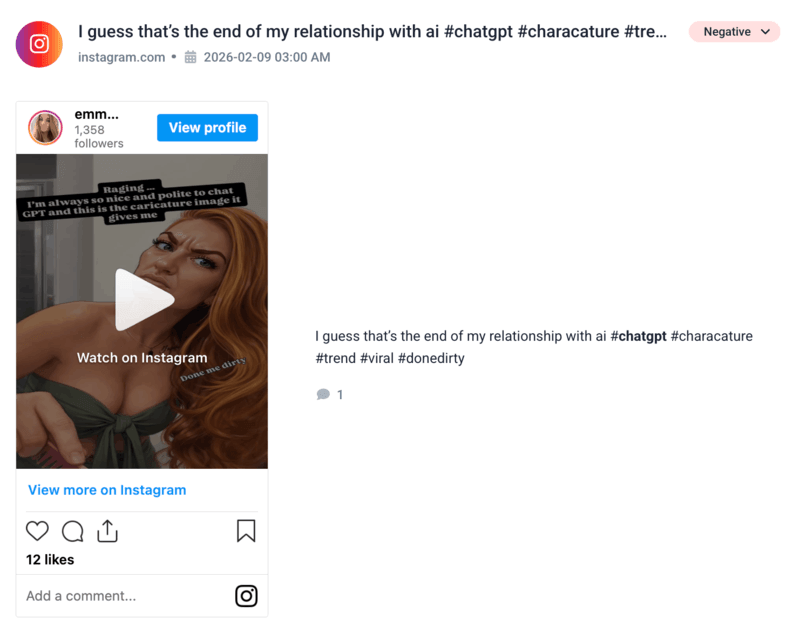
Instead, the biggest moment was all about fun: people asking ChatGPT to draw funny caricatures of them!
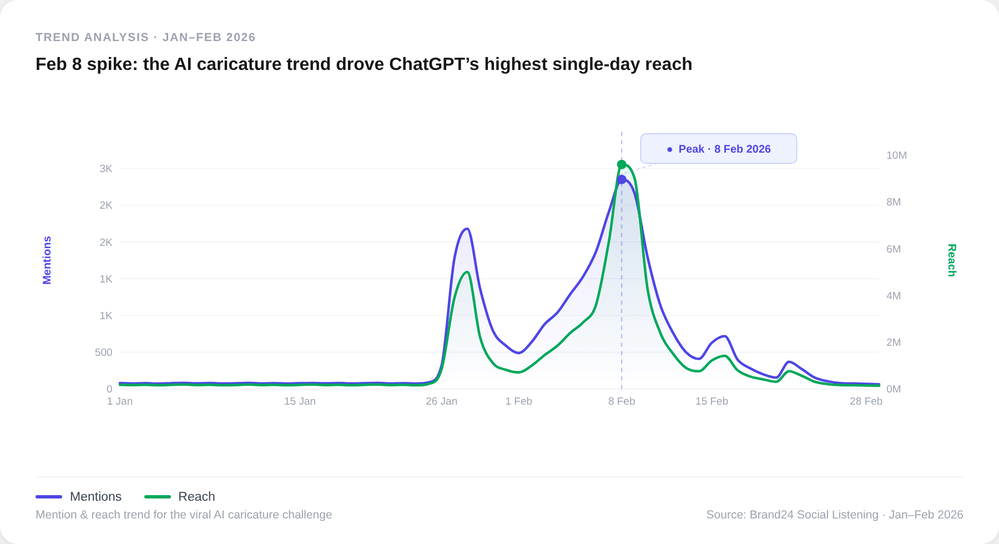
The peak day for chatter was February 9, 2026, when the Caricature Challenge blew up.
People were asking ChatGPT to generate exaggerated versions of themselves using prompts like: “Create a caricature of me and my job based on everything you know about me.”
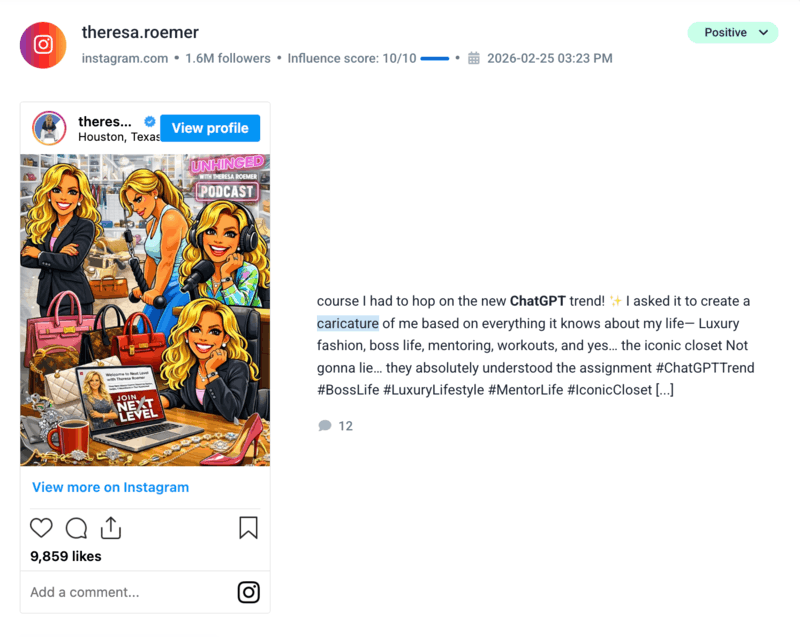
They shared the results across social media using hashtags like #chatgpt, #trend, and #caricature, turning it into a full-on viral moment.
The content spread fast, driving a surge in visibility and brand awareness, even if not everyone was impressed with the results.
People like ChatGPT more when it helps them personally
When we broke down sentiment by discussion type and compared specific use cases with broader AI topics using social listening data, the gap was hard to miss:
- 1 Personal, low-stakes, specific use cases generate clearly positive brand sentiment.
- 2 Broader, high-stakes, professional and abstract discussions about AI tend to be a bit more negative.
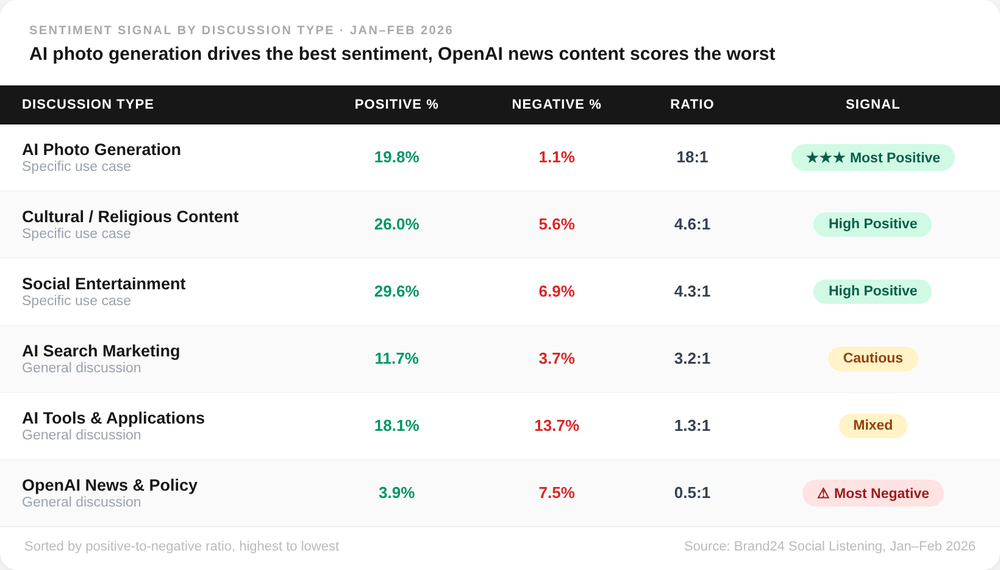
When someone says something along the lines of, “I used ChatGPT and…,” the tone of those brand mentions is usually enthusiastic.
On the other hand, when the conversation shifts to “AI is changing [this or that]…” the sentiment becomes more anxious and defensive.
From a sentiment analysis perspective, it’s the same brand and product, but a completely different emotional response depending on how the topic is framed.
What this means if you’re a marketer in 2026
01 Map your sentiment by platform: the gaps will tell you exactly where to act
ChatGPT had 31% positive sentiment on Instagram and 10% on X. Reddit-style communities were 30% negative. Same brand, same product, same time period, and three completely different conversations happening in parallel.
If you’re doing media monitoring or social listening, looking only at the overall sentiment score will blur the picture. Your content strategy should probably look different on a platform where sentiment is 31% positive versus one where it’s 10%. Does it?
Three scenarios, three different moves:
- High sentiment: That’s your proof platform. Mine it for real quotes, real use cases, and real user language, then use that in your copy everywhere else.
- Mixed sentiment: Don’t average it out. Mixed usually means two different audiences having two completely different experiences with your product. Find where the split is (what are the love/pain points and why people mention both) before you decide what to post.
- Negative sentiment: Try not to go silent there. The conversation keeps going even if you’re not watching, and leaving criticism unanswered on a platform can sometimes snowball fast.
02 Track your product and your company as two separate reputation signals
The biggest spikes in negative brand mentions this year happened because of OpenAI’s high-level corporate decisions. People complained about the product – ChatGPT – too, but those complaints were usually less intense.
Knowing whether a crisis is product-driven or company-driven shapes the entire response strategy, as they’re kind of different fires.
To get a clear read on your brand’s reputation, here’s a simple setup for social listening: treat your product name, your company name, your CEO’s name, and important words for your industry as separate keywords to listen for.
If you see a lot of negative mentions about your CEO, but people are still happy with your product, you get a heads-up right away before things get worse. And if the whole industry is having a rough time, you can get proactive and address the issues first.
📚 Further read: How to Measure Brand Reputation
03 Show what people did, not what your product can do
People are 4–18x more positive when the conversation is about a specific use case than when it’s about a brand or product in general. That gap is too big to ignore.
In practice, this means shifting your content mix toward:
- Customer stories with specific, measurable outcomes: not “Our tool saves time” but “She cut her weekly reporting from 3.5 hours to 20 minutes”
- Step-by-step tutorials showing real workflows – add them as a follow-up to your feature overviews
- Before/after scenarios from actual users – much better than hypothetical use cases written by your marketing team
If you’re already doing this but not seeing the lift, check how specific you’re actually being. “Our customers save time” is not a use case. “A 3-person marketing team replaced their entire reporting stack with one prompt” is.
04 Use social listening to find which platforms are your positive sentiment engines
Visual, short-form platforms like TikTok and Instagram tend to generate the most positive sentiment, and ChatGPT’s data seems to back this up: Instagram at 31% positive, TikTok at 27%, while X sat at 10%. The biggest organic moment of the period, the Caricature Challenge, happened on Instagram too.
The pattern holds broadly across categories, but the specifics are yours to discover. Which visual platform works hardest for your brand depends on your audience and category, and social listening insights can give you the breakdown.

Article Reviewed by