Table of contents
2M Marketers

62% of marketers actively use social media monitoring tools in 2026. The other 38% are making decisions without knowing what their customers, competitors, or critics are saying online.
Brand24 research analyzing 1,099 social media mentions with 4.09M reach shows the conversation around monitoring is overwhelmingly positive — 12.5:1 positive-to-negative ratio.
This guide covers what social media monitoring is, how it works, and how to set it up in a way that delivers value.
Key takeaways
-
What is social media monitoring? Definition
Social media monitoring is the practice of tracking and analyzing (tagged and untaggged) mentions, keywords, and conversations across social platforms in real time.
-
How big is the social media monitoring market?
In 2026, 62% of marketers actively use monitoring tools, and the global social listening market is projected to reach $10.32 billion.
-
How did AI changed social media monitoring?
AI has transformed monitoring from reactive mention-tracking to proactive intelligence: sentiment analysis, anomaly detection, topic clustering, and natural language answers.
-
Brand24 research (May 2026):
1,099 marketing-context mentions of "social media monitoring," 4.09M reach, 12.5:1 positive-to-negative ratio: marketers are overwhelmingly positive about the practice.
-
Monitoring vs listening
Monitoring is reactive and keyword-specific; listening is strategic and pattern-based. Most top tools, including Brand24, offer both
-
Social media monitoring for GEO and AI visibility
Monitoring helps you find untagged brand mentions on platforms AI models cite (Reddit, Quora) and generate original data that AI models reference as primary sources
What is social media monitoring? Definition
Social media monitoring is the process of tracking and analyzing online mentions, conversations, and trends about a brand, product, competitor, person, or topic across social media platforms.
The goal is to understand what people say online about your brand, product, competitors, or industry, and turn that knowledge into strategic action.
In simple words: social media monitoring means keeping track of what people say about your brand on social platforms in real time, including mentions that don’t tag you directly, or patterns you’d never think to look for.
That last part matters more than most marketers realize.
When I was working on a Brand24’s ChatGPT vs. Claude report, I saw a surprising thing: #chatgpt was the 4th most-used social media hashtag by the Claude community!
Hashtags often show how a community describes itself, and if your audience is tagging posts with a competitor’s name, it means your brand awareness and identity are still being explained in relation to theirs.
That’s a great clue you’d likely miss if you only relied on platform notifications.
Social media monitoring is what brings insights like these to the surface, helping you:
- See who is talking about your brand or products and where
- Know whether people speak positively, negatively, or neutrally about you
- Catch trends and viral topics before they peak
- Discover what competitors are doing and how people respond to them
- Find influencers and brand advocates talking about your brand or industry
- Measure and analyze social campaign performance in real time
- Respond to customers or crisis moments while they’re still manageable
From my five years of marketing experience, I’d say that in 2026, any solid social media monitoring software should include these features:
| Feature | Description |
|---|---|
| Tracking mentions | Tracking keywords like brand name, product/service names, CEO, competitors, campaigns, hashtags, or any industry-related keywords |
| Multi-platform coverage | Tracking mentions across Facebook, Instagram, X, TikTok, LinkedIn, YouTube, Reddit, Quora, forums, blogs, news, review sites, and niche communities |
| Real-time alerts | Sending custom notifications the moment a significant mention, spike, or crisis signal appears |
| Sentiment and emotion analysis | Identifying whether conversations are positive, negative, or neutral, and which specific emotions they carry |
| Trend identification | Spotting fresh discussion topics, viral mentions, or recurring problems before they become mainstream |
| AI-powered crisis management | Detecting sudden spikes in negative mentions that could signal the beginning of a PR crisis |
| Impact measurement | Tracking reach, engagement, volume, AVE, and share of voice to measure campaign effectiveness |
Important note: You can monitor only public social media posts and content. The sources of social media mentions depend on which tool you choose.
What is AI social media monitoring?
AI social media monitoring is the process of using artificial intelligence (AI) to automatically track, analyze, and interpret conversations happening across social media platforms.
In simple words: Instead of just showing raw data (mention volume, reach, sentiment share), AI tools go deeper and provide you with in-depth context, actionable insights, and recommendations that you can add to your strategy.
My favourite thing about AI social media monitoring is that it does four things that traditional keyword-based monitoring cannot:
| AI-powered feature | Description |
|---|---|
| Emotions detection | Going beyond positive/negative/neutral sentiment |
| Anomalies explanation | When mention volume spikes, AI tells you why it happenedin plain language, not just that it happened |
| Automatic topic analysis | Grouping thousands of mentions into themes, like for example product quality, pricing, or customer service, without manual tagging |
| Answering questions in natural language | Ask “What caused our negative sentiment last week?” and get an easy-to-understand answer, like a ChatGPT for your brand data |
| Surfacing insights proactively | Instead of waiting to be asked, it flags what matters before you notice it yourself (for example, in custom alerts or reports) |
The best example I have of AI social media monitoring is when I was looking at ChatGPT’s mention data in Brand24 and saw a huge spike in mention volume on April 30.
My immediate thought was that something controversial had happened: I assumed that maybe OpenAI was dealing with another PR issue, or there was some major ChatGPT bug on that day.
But instead of digging through thousands of posts manually, I just clicked the AI event flag, and it explained the spike immediately: it was caused by Instagram posts with viral hashtags and mass Twitter spam from bots and premium account sellers.
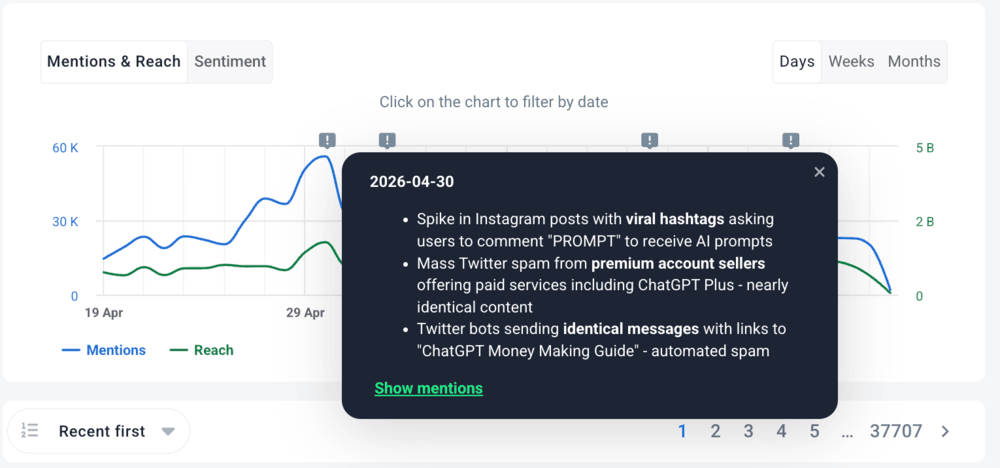
So, what looked like a potential crisis at first turned out to be nothing but unimportant noise.
AI monitoring told me that before I even opened the first mention.
Social media monitoring trends in 2026 [Brand24 original research]
To give you a better idea of how marketers think about social media monitoring today, I set up a Brand24 monitoring project tracking the keyword “social media monitoring” over April and May 2026.
Here’s what I found:
The size of the conversation
I used Smart Context Search filter to focus only on marketing-related mentions, like tool reviews, expert advice, or general topic discussions.
Here’s what the filtered dataset looked like:
- 1,099 mentions in a marketing/tools context over 30 days (April 25 – May 25, 2026)
- 4.09M combined reach, meaning that’s how many people could have seen this conversation
- 85% of mentions have a neutral sentiment, but the rest is heavily positive (12.2% positive vs. only 2.8% negative).
- 12.5:1 positive-to-negative ratio: when marketers talk about monitoring, for every one person complaining, there are almost 13 others saying something positive.
What frustrates marketers most
I went through the negative and critical mentions and spotted some clear trends.
The 10 pain points that people keep bringing up in online discussions about social media monitoring are:
- Cost and pricing of some tools
- The most frequently cited frustration. Enterprise tools range from $249/month (Brand24) to $800+/month (Talkwalker) to $30K+/year for predictive platforms.
- For smaller teams, it’s a constant struggle to justify the cost versus the value they get.
2. There are tools that monitor but don’t listen
- As one expert said, “Social media monitoring tells you the score. Social listening tells you the next play.”
- Too many platforms only provide basic mention volume, when what marketers need is actionable intelligence, not just volume data.
3. Teams have a reactive-only mindset
- There are examples of posts that call out teams that only pull out monitoring data when a crisis hits and are defining them as “already too late.”
- These discussions say that the value of monitoring is in continuous, proactive use.
4. Brands have no social media monitoring team at all
- This is a real infrastructure problem. A viral post from May 2026 said: “It’s 2026 and there’s no proper social media monitoring team for this film.”
- Many organizations still haven’t established any dedicated monitoring function at all.
5. Platform coverage gaps
- One blog article said that “Limited social media monitoring means brand threats are not being detected.” It stated that tools that only cover one or two channelsleave significant blind spots.
6. Setting up a project can be a nightmare
- Social media monitoring tools need careful calibration, and if you set up your project incorrectly, you get a flood of useless, noisy data, which is said to be often worse than having no data at all.
7. The tools feel old and slow
- “Forget the old social media monitoring tools — those are relics.”
- People say older platforms can’t keep up with how fast social media APIs change and are missing the AI features everyone expects now.
8. Tools don’t play well with other tech
- Marketing teams struggle to connect monitoring data with their other tools, like Customer Data Platforms (CDPs) and overall analytics systems.
9. Tools can give a lot of algorithmic noise
- Feed-based monitoring tools can produce wrong sentiment results.
- If a tool relies on the algorithmic feed rather than a full crawl, you might see “overwhelmingly negative sentiment” that reflects the feed’s bias, not actual opinion.
10. Building your own system is getting impossible
- For the teams trying to build custom solutions, simple proxies are not enough.
- Social platforms have gotten so good at anti-bot detection that even their workarounds get blocked.
What marketers love about social media monitoring
I found 251 positive mentions of social media monitoring, with 1.28M reach.
Let’s see what got the most genuine enthusiasm:
- AI-powered decision-making
- There are a lot of positive discussions that say: “AI is transforming social media monitoring in 2026.”
- People think that AI-powered features move monitoring from passive tracking to active intelligence.
2. Real-time sentiment analysis
- “Brands can extract unfiltered consumer sentiment in real time.”
- Multiple marketers described this as “genuinely useful and genuinely worth watching.”
3. Monitoring helps in crisis detection
- “Social media monitoring isn’t just about brand mentions — it’s about sentiment and emerging patterns.”
- Reframed by practitioners as a proactive reputation strategy, not just a reactive one.
4. Trend discovery thanks to monitoring
- “Tracking hashtags, influencers, and viral content that signal shifting interests.”
- Praised as a continuous optimization mechanism that takes out the guesswork from content strategy.
5. Influencer identification
- Consistently listed as a top social media monitoring feature.
- Finding voices already talking about a brand for potential partnership or outreach is a popular use case in the discussions I analyzed.
Top hashtags in social media monitoring discussions
The hashtags in the marketing-context dataset may not be frequent, but they are quite meaningful.
The top ones are:
- #ai (3 mentions),
- #digitalmarketing (2),
- #socialmediamonitoring (2),
- #artificialintelligence (2),
- #marketing (1).
As you can see, #ai and #artificialintelligence show up right alongside #socialmediamonitoring.
It seems that the practical conversation about social media monitoring tools has already mixed with the broader AI conversation.
Social media monitoring vs. listening
Social media monitoring is about tracking what people are saying about your brand right now.
Social media listening is about analyzing what people are talking about on a larger scale and understanding what it means.
In short:
- Social media monitoring = just keeping up
- Social media listening = understanding the bigger picture
| Social media monitoring | Social media listening |
|---|---|
| Focuses on what people are saying | Focuses on why people are saying it |
| Reactive: collects data in real time | Strategic and proactive: extracts insights and meaning from data |
| Tracks specific keywords, hashtags, and discussion topics | Analyzes sentiment, themes, and industry-wide conversations |
| Excellent for customer service and crisis response | Ideal for product development, campaign planning, market research |
| Answers: “What happened?” | Answers: “What does it mean, and what should we do?” |
How do they work together?
While monitoring helps you respond to immediate needs and concerns, listening helps you develop better long-term strategies.
How does social media monitoring work?
In technical terms, monitoring tools use crawlers (similar to Google bots) to scan social platforms in near real-time for your predefined keywords; the crawling is just the start, though.
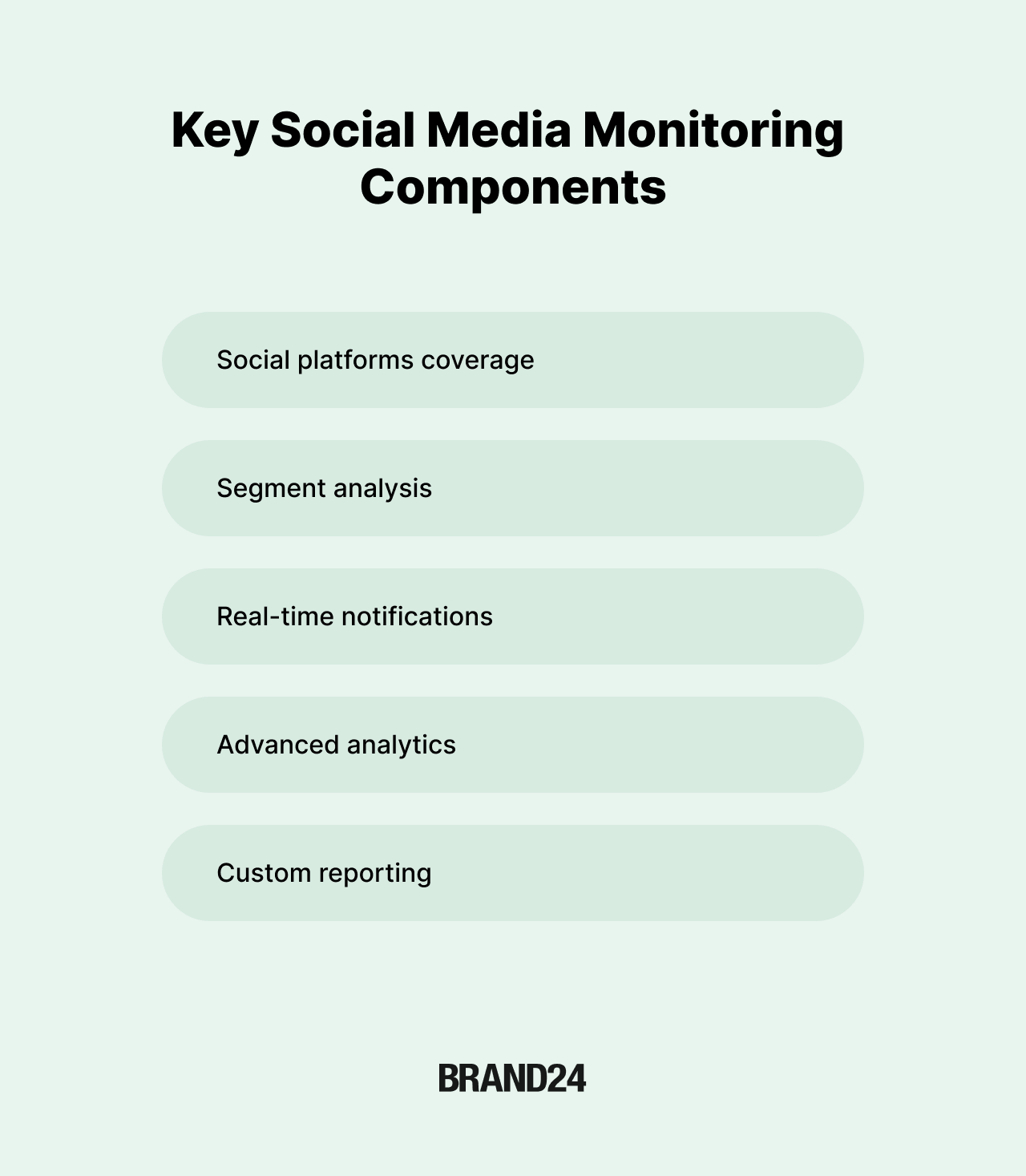
Here are the 5 key components I see as essential for making social media monitoring work:
01 Social platforms coverage
Monitoring only works if the tool is connected to where your audience actually is. In 2026, that means:
- Mainstream platforms: X (Twitter), Facebook, Instagram, LinkedIn, TikTok, YouTube, Telegram, Twitch
- Forums and community sites: Reddit, Quora, Medium, industry forums and communities
- Niche platforms: Spotify, Soundcloud, Bluesky
- Review sites: TripAdvisor, Booking, Yelp, App Store, Google Play, Trustpilot
02 Sentiment analysis
This is what turns a pile of mentions into something useful.
In 2026, a solid tool should detect:
- Sentiment: Positive, neutral, negative tone of mentions and whole topics
- Emotions: Admiration, anger, disgust, fear, joy, sadness
- Intent: Information, promotional, sales, networking, greetings, advocacy, entertaining, opinion sharing
03 Real-time notifications
The best monitoring tools should provide these to let you always stay updated:
- Instant alerts: Also called storm alerts for spikes in mentions
- Crisis detection: Real-time alerts for spikes in negative sentiment
- Email alerts: Regular email summaries of new mentions
- Integrations: Notifications through communication apps, such as Slack or MS Teams
04 Advanced analytics
Raw mention volume doesn’t mean much without context. Features that matter:
- Source breakdown: Identify the social media app from which the mentions come
- Reach and interactions: Measure brand awareness and discover which channels give you the most exposure
- Influencer Score: Identifies the most influential authors and sources mentioning the brand
- Trending hashtags: Discover which hashtags are often used by the target audience
- Topic analysis: Groups mentions by subtopics to understand what people are actually talking about
05 Custom reporting
Types of reports that will make your monitoring job easier:
- Brand health reports: Track how people evaluate brands and products over time
- Campaign performance reports: Measure the impact of specific social media campaigns or hashtags
- Crisis and incident reports: Provide a detailed view of spikes in negative sentiment
- Competitor comparison report: Compare your brand’s visibility and sentiment with competitors
Benefits of social media monitoring [+ real examples]
The benefits of monitoring look different depending on what you’re using it for.
Let’s look at four real-world examples of successful social media monitoring from brands using Brand24.
Brand mentions on social media (including untagged ones) are crucial for SEO and GEO in 2026. They strongly affect visibility in AI Overviews, and mentions on platforms like Reddit, Linkedin, and Quora influence responses from ChatGPT, Perplexity, and other LLMs.
Social media monitoring for customer experience management
It improves CX by:
- Detecting complaints within minutes, not days, before they blow up and become a crisis
- Responding publicly to issues, which signals you’re listening and you actually care.
- Tracking whether your brand sentiment improves after you’ve stepped in to help.
- Turning social conversations into useful feedback that helps improve your products or services.
A real-world example – Global66:
Global66, a Latin American fintech, started using Brand24 to systematically track and address customer feedback.
By March 2024, they managed to turn 18% of their negative social media reviews into positive ones, just by being present and helpful to their target audience.
📚 Global66’s success story: How Media Monitoring Helps FinTech in CX & Influencer Acquisition
Social media monitoring for PR agencies
What PR agencies typically gain:
- Capturing social media mentions that reporters don’t proactively share
- No more wasting time manually checking every platform for brand coverage.
- Identifying earned mentions as they happen
- Finding new opportunities to turn mentions into valuable backlinks.
- Demonstrating quantifiable, earned media value to clients with actual data
What that looks like in practice — ChilliFruit:
ChilliFruit is a PR agency that uses Brand24 to look after over a dozen clients. Every month, their monitoring catches quotes from clients’ teams appearing in social and non-social publications.
The monitoring captures up to 1,500 mentions per month.
Just by tracking these mentions, they’ve filled 10% of their total backlink requirement, with links identified and claimed directly through untagged mention tracking.
📚 ChilliFruit’s success story: Uncovering Hidden Mentions Through Media Monitoring
Social media monitoring for lead generation and community engagement
What community and growth teams gain from monitoring:
- Finding high-intent conversations where the target audience is already present and asking relevant questions
- Joining discussions at exactly the right moment, when a potential customer is actively looking for a solution
- Moving organic engagement directly to website visits and signups without paid ads
- Building brand authority in niche communities over time
- Spotting frequent questions that can show content gaps and positioning opportunities
A real example — TimeCamp:
TimeCamp, a time-tracking SaaS, uses Brand24 to monitor industry conversations on X in real time.
Thanks to monitoring, the team joined popular programming threads during business hours, targeting their exact target audience.
With just one post and a few replies, they saw 30 new additional visits from developers to their site and 3 new registrations.
That’s a massive 900% jump in results compared to their usual marketing efforts for the same amount of work!
📚 TimeCamp’s success story: 900% Higher Conversion Rate: How We Helped TimeCamp Increase Website Traffic
Social media monitoring for SEO and link building
What SEO and link-building teams gain from monitoring:
- Assessing the brand health and sentiment of target sites before sending a sales pitch
- Detecting negative conversations that can be addressed as part of the outreach
- Catching unlinked mentions (social posts that reference the brand but don’t link to it)
What that looks like in practice — Semcore:
Semcore is an SXO agency where link building accounts for about 30% of revenue. They started using Brand24 to help with their outreach workflow.
Now, before they email anyone, they check the tool to assess the presence score and what people say about the brand.
Sites with weak brand health get outreach tailored to address those specific issues, which makes clients way more likely to say yes.
The result: Brand24-powered outreach contributed to +$660,000 in annual revenue for Semcore.
📚 Semcore’s success story: How Brand24 Helped Semcore Acquire +$660K in Annual Revenue
Social media monitoring strategy
From running Brand24 monitoring projects across dozens of use cases, here’s what I’d recommend:
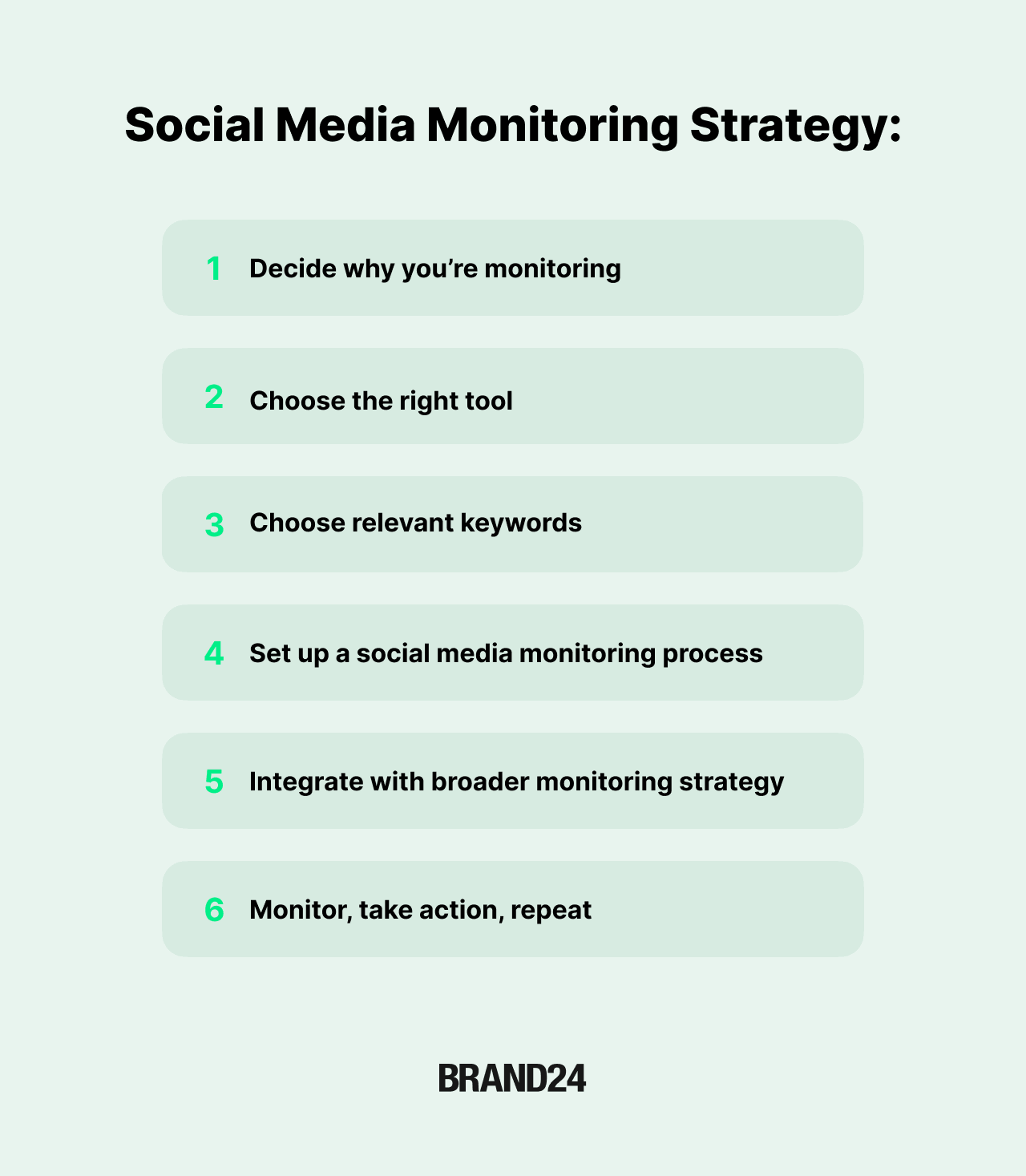
Step 1: Define your purpose
Before you set up a single keyword, be clear on why you want to monitor social media.
The answer changes everything, from which keywords to track and which platforms to monitor, to which metrics you should focus on.
Depending on your role in marketing, your starting objectives can be:
- Protecting brand reputation
- Improving customer service response speed
- Tracking campaign performance
- Understanding competitor positioning
- Identifying industry trends before they go mainstream
- Generating qualified leads through community engagement
- Finding influencer and partnership opportunities
- Collecting product feedback from real users
Step 2: Choose the right tool
When I evaluate monitoring tools, I focus on five aspects:
- Budget: pricing can range from ~$40/month to even $30K+/year! You need to know what you need before you look at features
- Platform coverage: does it cover the channels where your audience is?
- Alert speed: how fast does it flag a crisis signal or a spike?
- Sentiment accuracy: does it detect emotion nuance, or just keyword sentiment?
- Reporting: can it produce the outputs your team and clients need?
Most tools come with free trials: take advantage of them and test the tool with real queries before you commit to a plan!
Step 3: Choose your keywords carefully
I recommend organizing keywords into four groups:
- Brand layer: brand name, common misspellings, social handles (without @), product names, CEO name
- Campaign layer: campaign hashtags, event hashtags, product launch names, influencer names
- Competitor layer: competitor brand names, product names, their campaign hashtags
- Industry layer: industry terms, problems your audience discusses, emerging trends and topics
Pro Tip 1 — Required keywords: use required keywords to narrow results to mentions that contain both your main keyword and a second one. Useful when a brand name has multiple meanings.
Pro Tip 2 — Excluded keywords: use excluded keywords to filter out high-volume irrelevant mentions. If one unrelated term is flooding your project, excluding it cleans everything up fast.
Important note: The more keywords you track, the higher the cost. Most tools base their pricing on the number of keywords monitored.
Step 4: Build a social media monitoring process
Once your social media monitoring project is running, the value comes from consistent tracking and analysis:
- Real-time alerts: configure alerts for spikes and negative sentiment so the team can react in minutes to urgent problems
- Daily or weekly reviews: track ongoing campaigns and regularly check brand health
- Monthly reports: spot long-term trends and pull strategic insights for leadership and clients
Metrics that I think are worth tracking in every review:
| Metric | What it tells you |
|---|---|
| Mention volume | How much are people talking about your brand? |
| Reach | How many people are potentially exposed to those conversations? |
| Sentiment share | How do people feel about the brand overall? Positive, negative, or neutral? |
| Engagement | Are people interacting with the content that mentions the brand? |
| Source breakdown | Where do people talk, and which platforms drive the most mentions and reach? |
| Share of voice | How visible is your brand versus competitors? |
| Top influencers | Who is driving the conversation around you? |
| Trending topics | What themes and topics are surfacing around your brand? |
| Demographic distribution | Are you reaching the right audience? |
Step 5: Integrate with broader marketing strategy
Social media monitoring and analysis deliver valuable insights that can boost your social media marketing efforts in many ways.
That’s why I recommend combining it across teams:
| Marketing department | What it tells you |
|---|---|
| Social media management | Proactively address social media mentions to boost engagement, brand awareness, and customer loyalty |
| Customer support | Track what customers are saying in real time and answer their complaints fast |
| Marketing | Optimize content and campaigns based on rel-life feedback, analytics, and metrics |
| PR | monitor customer sentiment, prepare responses to crises, leverage positive buzz |
| Partnership management | Identify content creators already talking about your brand and find new influencer partnerships |
| Product development | Prioritize improvements and new features based on customer feedback |
Step 6: Monitor, act, repeat
The most common mistake I see with social media monitoring is treating it as a passive tool that only sends you reports.
The value comes from what you do with the data and how you use the tool’s abilities:
- Respond to crucial mentions: engagement builds strong brand recognition
- Update keywords as language and trends evolve: what people call things changes
- Refine filters regularly to keep results clean and relevant
- Compare performance against past benchmarks and competitors every month
Top social media monitoring tools
The tools section of any comparison article is usually just a repackaged feature list.
I wanted to do something more useful, so I analyzed real user perception data for each tool using Brand24’s AI Brand Assistant.
The top four tools worth your attention, updated May 2026:
| Tool | Monitored channels | Best for |
|---|---|---|
| Brand24 | Instagram, X (Twitter), Facebook, Reddit, LinkedIn, Quora, YouTube, TikTok, Telegram, Twitch, Pinterest, Bluesky | Agencies, mid-sized businesses, enterprises needing advanced AI listening features |
| Sprout Social | Facebook, Instagram, Reddit, TikTok, Tumblr, X (Twitter), YouTube | Mid-sized businesses and enterprises needing social management and listening in one platform |
| Hootsuite | Facebook, Instagram, TikTok, Threads, X (Twitter), Bluesky, LinkedIn, YouTube, Pinterest, Reddit | Large agencies and enterprises needing scheduling, management, and basic listening |
| Meltwater | Facebook, Instagram, X (Twitter), YouTube, LinkedIn, Reddit, Twitch, Pinterest, TikTok | Large agencies and enterprises needing deep media intelligence and PR analytics |
Here’s what Brand24’s AI Brand Assistant found when I asked it to summarize what users say online about each of these tools:
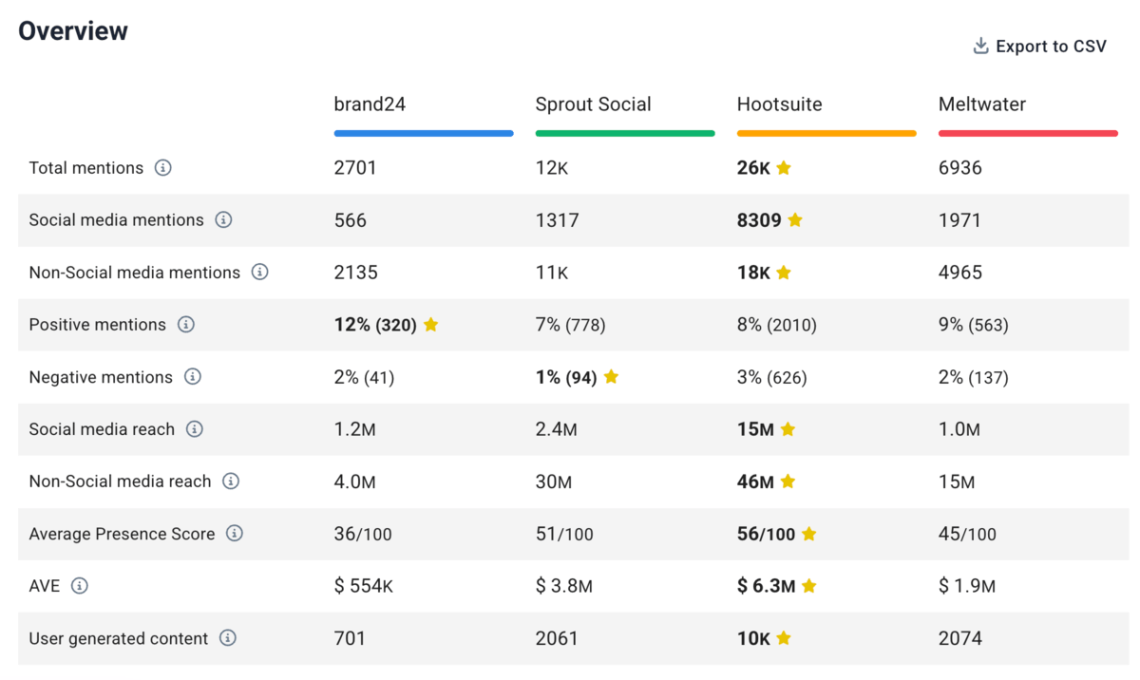
- Hootsuite dominates as the most popular social listening tool, with 26K mentions, $6.3M AVE, and 15M social reach
- But Brand24 users are proportionally the most positive: 12% positive sentiment vs. 9% Meltwater, 8% Hootsuite, 7% Sprout Social. It’s a smaller community, but a more satisfied one.
- Meltwater has an average coverage and reach, and shows the lowest positive sentiment share.
I also researched the key strengths and features of these four tools that people discuss online:
Brand24:
- Accessibility for small and medium-sized businesses and enterprises
- Ranked as a top tool specifically for sentiment analysis
- Users note Brand24 is “using LLMs to build the best product”
Sprout Social:
- Users note it provides “comprehensive analytics and reporting capabilities”
- Development of AI-driven features like the Trellis AI agent
- Noted to “offer robust social listening capabilities that can track keywords and sentiment”
Hootsuite:
- Frequently cited as a go-to tool for “scheduling, monitoring, and reporting tasks” across native social media platforms
- Users highlight Hootsuite’s ability to schedule posts on multiple platforms simultaneously
- Hootsuite Insights is recommended for “enterprise-scale monitoring”
📚 See the full tool guide: Social Media Monitoring Tools to Check in 2026
How important is AI social media monitoring in 2026?
Monitoring tools are already a huge deal: according to Pluggo research, the social listening market will hit over $10B soon, and most marketers (62%!) are already using them.

In 2026, AI has given five core social media monitoring capabilities a serious upgrade:
01 It understands feelings
AI can spot sarcasm, anger, joy, and other emotions – simple keyword tracking misses this completely. Now, the sentiment analysis goes way beyond just “positive”, “neutral”, or “negative”.
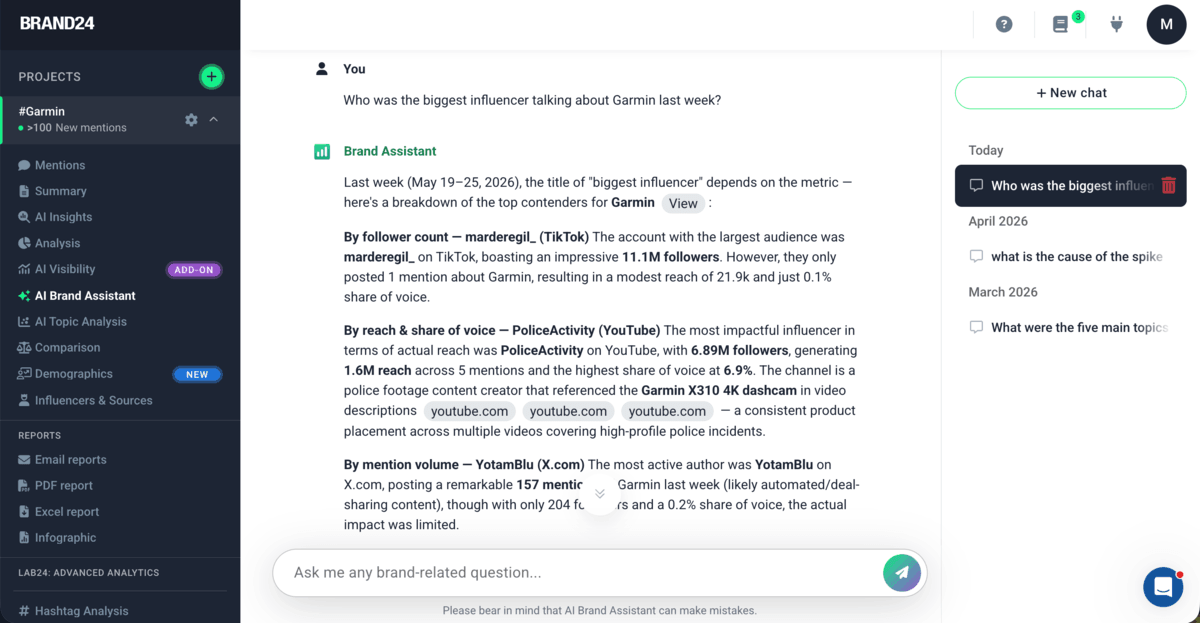
02 Talk to your data
You can literally ask the tool a question in plain language (like, “Who was the biggest influencer talking about our brand last week?”) and get an instant, clear answer. No more digging through charts!
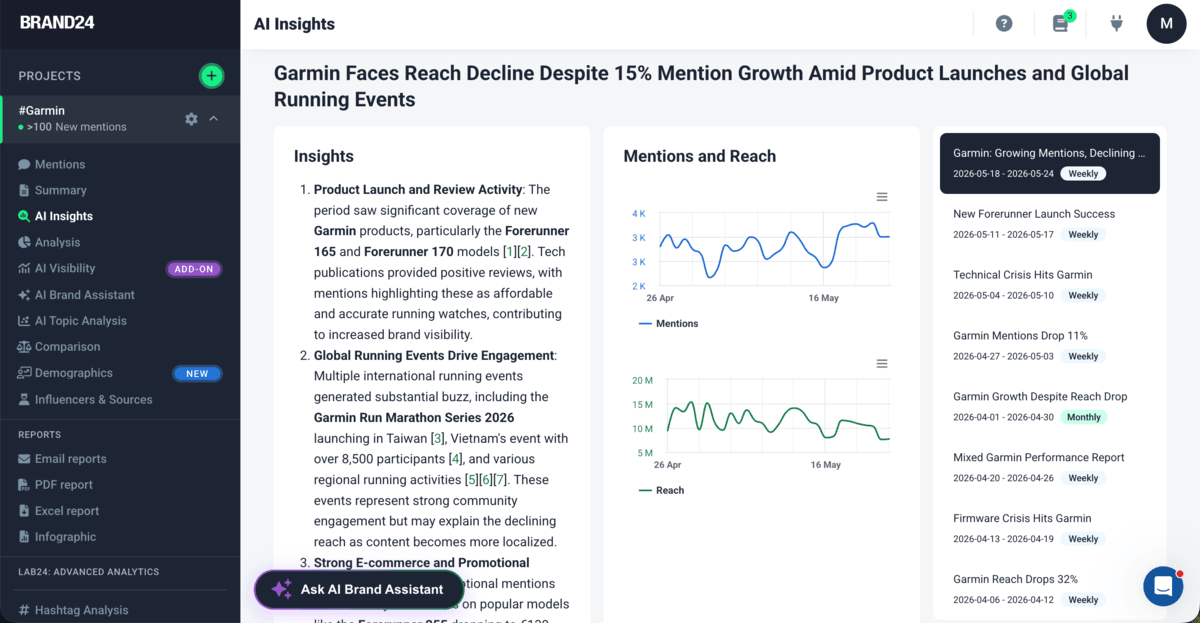
03 Get actionable advice
Instead of staring at a raw chart, features like AI Insights interpret the data for you and proactively suggest what you should do next, giving actionable insights and recommendations.
04 Crisis control with context
If your social media mentions suddenly spike, the AI tells you why it happened (e.g., “A popular podcast mentioned you”), not just that the numbers went up.
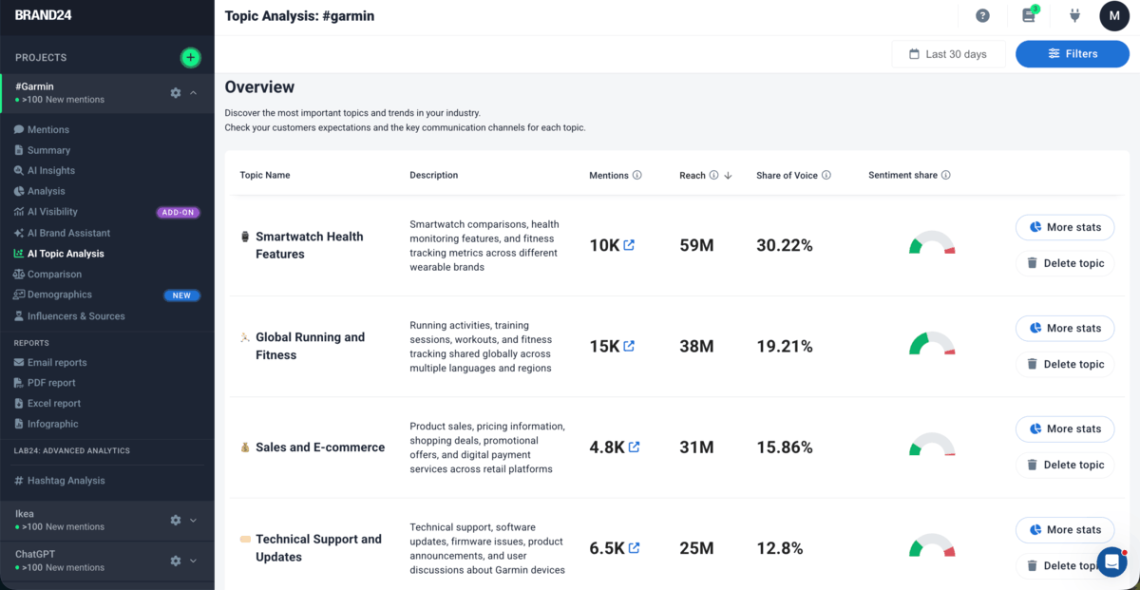
05 Automatic topic analysis
The system, using AI and NLP (natural language processing), automatically groups thousands of individual posts into big themes (like “pricing issues” or “customer service complaints”) so you can see the big picture fast.
FAQ
What’s the difference between social media monitoring and social media management?
Social media management is about creating and engaging: planning content, publishing, and interacting with your audience. It tells you what to post about, which conversations to join, and how your audience responds to your content.
How often should I check my monitoring project?
I also suggest keeping real-time alerts turned on all the time, even if you check the dashboard regularly. That way, you won’t miss a crisis just because you weren’t logged in.
Can ChatGPT analyze and monitor social media accounts?
Some social media monitoring tools, like Brand24, offer both an official ChatGPT app and an MCP integration.
That means you can connect your Brand24 monitoring data directly to ChatGPT and ask questions in plain language, without ever leaving the AI chat.
How does social media monitoring help with crisis management?
The sooner you catch an issue, the more control you have over how it plays out. Brand24’s AI Event Detection flags a spike and explains what caused it in plain English.
How does social media monitoring support GEO and AI visibility?
Second: Monitoring generates original, data-rich content, like sentiment ratios, mention volumes, trend analysis, that AI models cite as primary sources. The Brand24 research in this article (1,099 mentions, 4.09M reach, 12.5:1 ratio) is an example of exactly that kind of citable data.
What’s the difference between social media monitoring and social listening?
Most enterprise tools, including Brand24, offer both in the same platform.