Table of contents
2M Marketers

Is measuring brand awareness part of your KPIs? Then I’ve got 10 practical tactics, the key signals to track, and a set of tools to help you out.
People don’t exactly raise their hand and say, “Yep, I know this brand now.” You have to look for the signs: more branded searches, more direct traffic, more mentions, stronger survey recall, and eventually more conversions. Put a few of those signals together, and the picture gets much clearer.
So, let’s talk about how to measure brand awareness and what can make your job easier!
Key takeaways:
-
Brand awareness measures how easily people can recognize and remember your brand
It sits at the top of the marketing funnel and gives everything else something to build on: if people don’t know you, they’re unlikely to consider you, trust you, or buy from you.
-
Measuring brand awareness helps prove that your marketing is working
Tracking brand awareness over time can show whether campaigns are increasing visibility and recognition, and help you decide where to keep investing or change course.
-
Branded search is one of the clearest signs that people already know you
A 2025 study of around 150 million U.S. keywords found that 45.7% of Google searches are branded. If searches for your brand name, products, or branded terms are growing, that’s a strong sign that more people are actively seeking you out.
-
Don’t look at metrics in isolation
Brand recall tells you whether people remember you, branded search shows whether they’re actively looking for you, and mentions and share of voice show how visible you are in the wider conversation.
How to measure brand awareness: tactics, key metrics & best tools
In my experience, the most useful brand awareness checks rarely come from a single source.
The clearest picture comes from combining signals like website traffic, branded searches, online mentions, survey responses, and conversions.
If you look at a few of the key brand awareness metrics together, you can see not only whether recognition is growing but also where that growth is coming from.
With that in mind, let’s break down the 10 easy tactics you can use, plus the best brand awareness measurement tools to help you on the job.
01 Keep an eye on your website traffic
| Best tools to help you out | What they cover |
|---|---|
|
Google Analytics
|
Tracking direct traffic, referral traffic, traffic sources, and on-site behavior
|
Your website traffic is a good place to start looking for signs of growing brand awareness, and Google Analytics is your best friend here.
Keep an eye on direct and referral traffic and, more importantly, how they change over time.
Direct traffic includes people who arrive by typing your URL into their browser or using a saved link. In Google Analytics, you’ll find it under Reports → Acquisition → Traffic acquisition.
If more people are actively seeking out your website, that can be a good sign for brand recall. Someone who remembers your company well enough to go straight to your website is already a few steps beyond simply having seen your name somewhere.
But I wouldn’t treat every spike in direct traffic as proof that brand awareness is growing. GA4 can also classify visits as Direct when it can’t identify the original source, for example, because a link wasn’t tagged properly.
So, rather than chasing a universal “good” percentage, compare direct traffic against your own baseline.
Look at month-over-month and year-over-year changes, and check whether increases align with campaigns, PR coverage, events, or other brand-building activities.
If direct traffic is steadily growing while your tracking setup stays consistent, that’s a much stronger signal than a one-off spike.
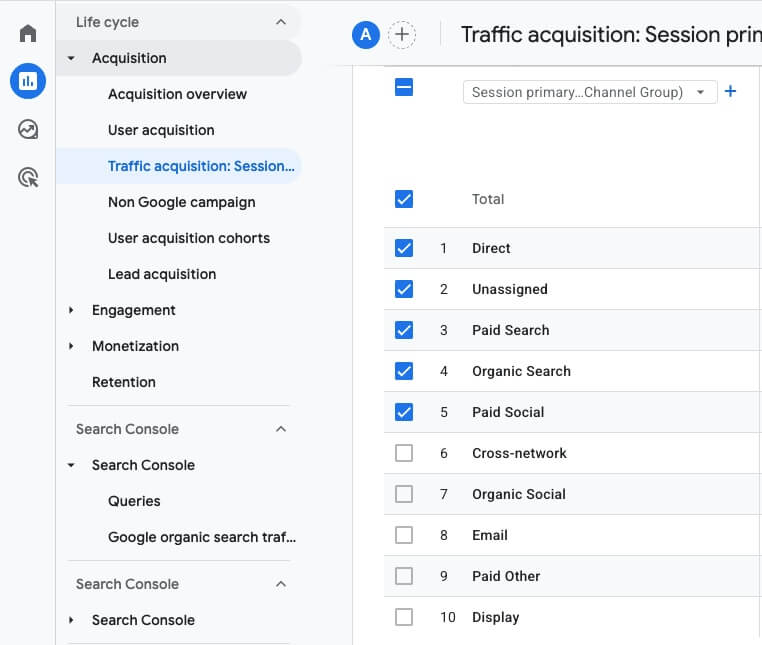
Referral traffic, on the other hand, comes from people who click a non-ad link to your website from another site, such as a blog, news publication, review site, or partner page.
For brand awareness, the interesting part isn’t only how much referral traffic you get, but where it comes from.
If referrals jump after your brand is featured in an industry publication or included in a popular comparison article, you’ve got a pretty clear indication that the mention is putting your brand in front of new people.
Open your referral sources and check:
- which websites are sending you traffic,
- whether new referring domains are appearing,
- which placements drive the most visits,
- and what those visitors do once they reach your site.
A growing stream of relevant referral traffic is generally more valuable than one random spike. If a particular publication, partnership, or campaign keeps sending engaged visitors your way, that’s something worth building on.
02 Monitor your brand mentions and the sentiment behind them
| Best tools to help you out | What they cover |
|---|---|
|
Brand24, Sprout Social, Meltwater
|
Brand mentions, sentiment analysis, conversation trends
|
Some of the best signs of brand awareness happen outside your own channels. People mention your brand in posts, recommend it in comments, complain about it on Reddit, feature it in articles, or bring it up without tagging you at all.
Brand monitoring tools, such as Brand24, Sprout Social, and Meltwater, help you catch those conversations and track how they evolve over time.
From there, it’s all about what you choose to monitor. Set up tracking for your brand name, products, campaign names, and any other relevant keywords.
Then, once the mentions start rolling in, start with the simplest question: are more people talking about you?
If people are bringing up your brand without you starting the conversation, you’ve made it onto their radar.
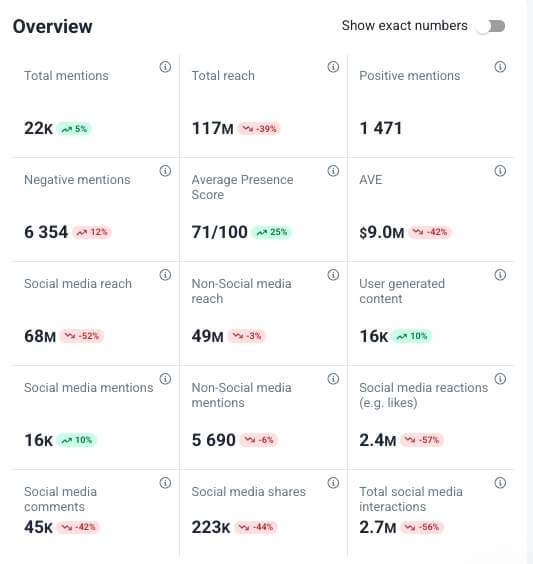
Don’t stop at the total number of mentions, though.
Compare your mention volume with your usual baseline and investigate any noticeable spikes. When the numbers jump, your next question should be: why? Was it a campaign, a product launch, a media feature, a viral post, or has something gone slightly off the rails?
Because a jump from 500 to 2,000 mentions looks fantastic on a graph until you discover 1,500 of them are complaints.
Which brings us to sentiment.
Brand monitoring tools can classify mentions as positive, neutral, or negative, so you can see not only whether the conversation is growing, but how people actually feel about your brand.
Say your mentions double after a product update, but negative sentiment rises at the same time, and customers keep bringing up the same problem. That’s a pretty clear sign to investigate the issue and pass what you find to the product, customer success, or communications team.
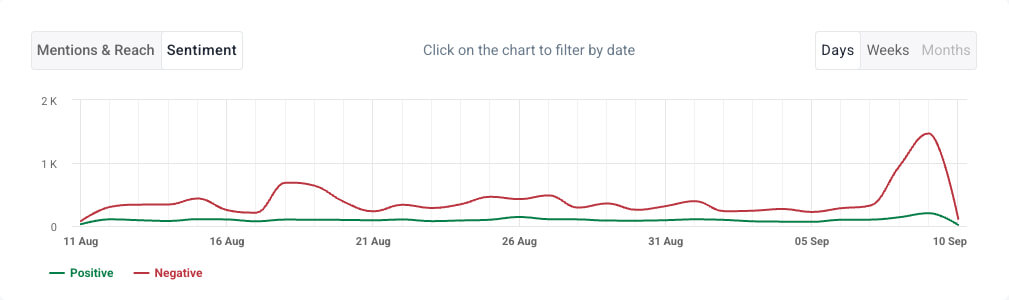
Negative conversations can sometimes become opportunities, too.
Ryanair is particularly good at this. The airline regularly spots customer complaints online and responds in the sarcastic, self-aware tone its social channels are known for.
Those replies often generate plenty of engagement themselves, with people liking, sharing, and piling into the conversation.
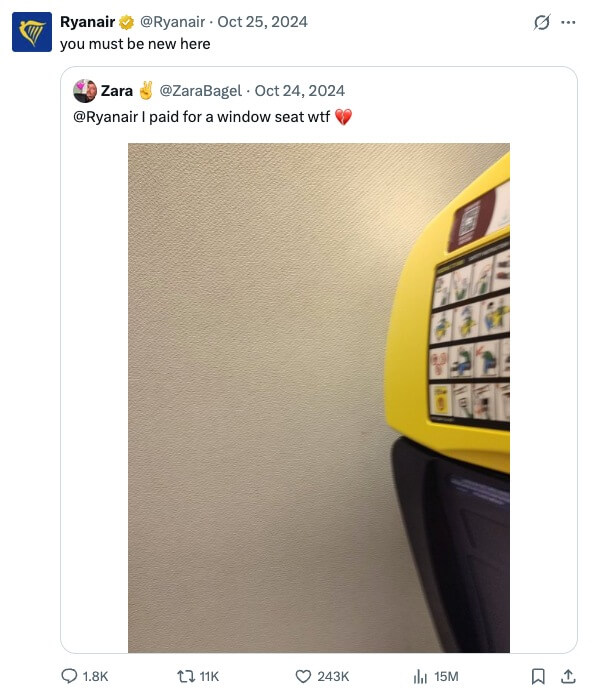
The takeaway isn’t that every brand should start roasting unhappy customers. But if the same praise, complaint, feature, or topic keeps showing up in your sentiment data, use it.
Say, customers love your onboarding experience. Pull exact quotes into your landing pages, ad copy, and sales decks.
And if the same complaint recurs (for example, slow customer support), create a brief with the top 5 recurring issues, share it with the CS or product team in your next sprint review, and track whether mention sentiment shifts after changes ship.
That’s really the point of monitoring mentions: not just counting them, but understanding what changed and what to do next.
If I had to pick one tool for this job, I’d go with Brand24 for combining mention volume, sentiment, and spike detection in one place.
03 Analyze reach and engagement
| Best tools to help you out | What they cover |
|---|---|
|
Brand24, Sprout Social, Meltwater
|
Measuring reach and engagement across online mentions
|
Next, look at what happens after people start talking about your brand.
Brand awareness measurement tools can help you see how far those conversations travel and how much interaction they generate.
Reach estimates how many people could have seen content mentioning your brand. Engagement covers the interactions it receives, such as likes, comments, shares, and reactions.
Together, they give you a full picture. High reach tells you the conversation traveled. Strong engagement tells you people cared enough to do something with it.
A recent story featuring Duolingo shows exactly how these two metrics can build on each other.
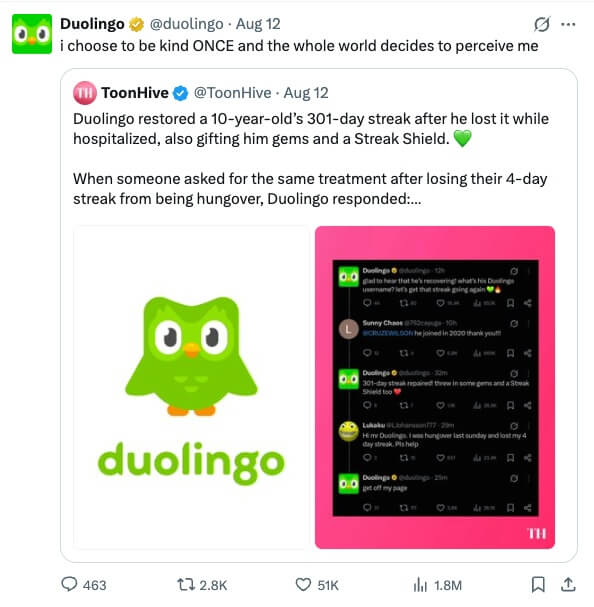
When a mother asked the brand to restore her hospitalized 10-year-old son’s 301-day streak, Duolingo did just that, and threw in some gems and a Streak Shield for good measure.
The wholesome exchange quickly took off, with other users joining the conversation and asking for their own streaks back.
According to Brand24 data, the story generated 2,279 mentions and more than 43 million in reach in just one day.
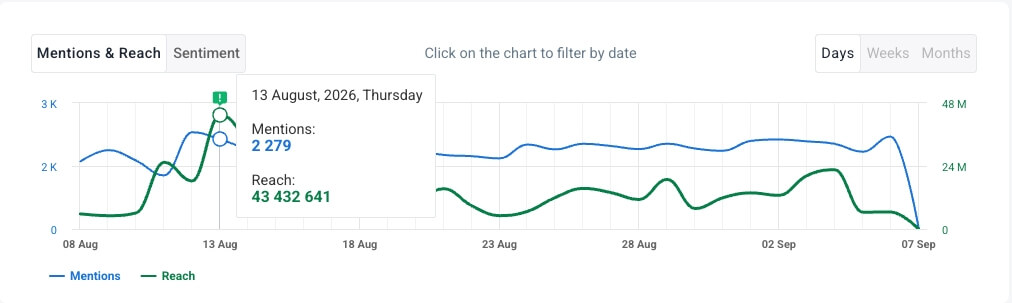
That’s the kind of spike worth digging into. Check which posts are driving the reach, what people are engaging with, and why the story traveled so far.
Then use what you learn. A pattern like that can give you ideas for future campaigns, content, partnerships, or even products.
My pick for this one: Sprout Social if your focus is mainly social media reach and engagement; Brand24 if you want to see how far brand mentions travel beyond your own social profiles.
04 Share of voice
| Best tools to help you out | What they cover |
|---|---|
|
Brand24, Sprout Social, Meltwater
|
Share of voice analysis across online sources
|
Now it’s time to zoom out and compare all that conversation with what your competitors are getting.
The metric to look at is share of voice (SOV). It’s the percentage of the overall tracked conversation that belongs to your brand, for example, on social media platforms.
The basic formula looks like this:
Share of voice = your brand mentions ÷ total mentions of all tracked brands × 100
So, if your brand gets 2,000 mentions and you and your competitors get 10,000 altogether, your share of voice is 20%.
Watch how that share changes over time. If it starts climbing, dig into where you’re gaining ground.
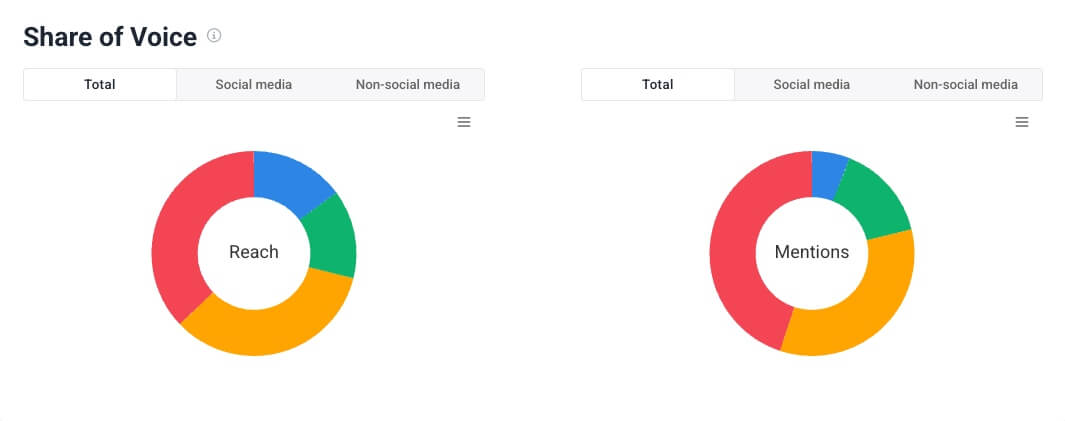
Maybe one campaign is outperforming everything else, or one topic suddenly has people talking about you instead of a competitor.
If it drops, flip the analysis around. Which competitor gained share? What were people talking about? Which channels or sources drove it?
And SOV isn’t limited to social and media anymore. With tools like Brand24, you can also track AI share of voice to see how often your brand appears in AI-generated answers compared with competitors.
05 Pay attention to brand name search trends
| Best tools to help you out | What they cover |
|---|---|
|
Semrush, Ahrefs
|
Branded search volume, search trends, and ranking changes
|
|
Google Search Console
|
Impressions and clicks from branded queries
|
Next, check whether more people are actively searching for your brand.
That matters more than you might think: an Ahrefs study of around 150 million U.S. keywords found that 45.7% of Google searches are branded.
Semrush and Ahrefs are your most useful starting points here. They can show estimated monthly search volume for your brand name, products, and other branded keywords, and help you see whether that demand is growing over time.
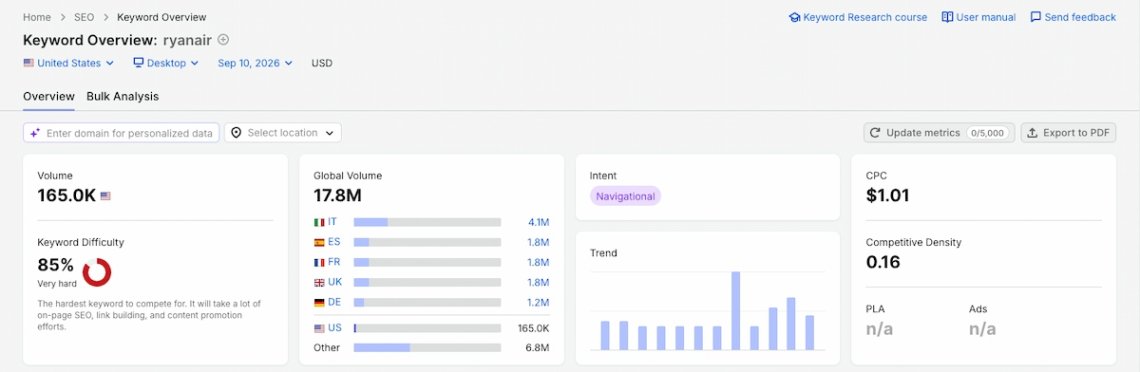
A steady increase is a good sign that more people know your brand well enough to seek it out directly.
Google Search Console gives you a slightly different view. Instead of estimating overall search demand, it shows the branded queries your website actually appears for, along with their impressions, clicks, and positions.
Things get a little messier when your brand name is generic.
Take Dove. A search for “Dove” could mean the beauty brand, Dove Cameron, an actual flying dove, or even Prince’s When Doves Cry.
Brand monitoring tools can help here by letting you create more refined searches and exclude irrelevant mentions. That gives you a cleaner view of the conversations that are actually about your brand.
06 Conduct a brand awareness survey
| Best tools to help you out | What they cover |
|---|---|
|
SurveyMonkey, Typeform
|
Aided and unaided awareness, brand recall, recognition, and perception
|
Sometimes the simplest way to find out whether people know your brand is to ask them.
Survey tools like SurveyMonkey and Typeform make this pretty straightforward. Build a short questionnaire, send it to people in your target audience, and use it to measure both unaided and aided awareness.
Unaided awareness shows whether your brand comes to mind on its own. Ask something like: “Which brands come to mind when you think of meal delivery services?”
Aided awareness checks recognition once people see your name. For example: “Which of these brands have you heard of?”
Always ask the unaided question first. Otherwise, showing people your brand name can influence what they remember.
You can also dig a little deeper with questions like:
- How familiar are you with [brand]?
- Where did you first hear about [brand]?
- Which words or qualities do you associate with [brand]?
- Have you considered or used [brand] before?
For a quick directional check, a smaller sample from your actual target audience can already tell you a lot. If you want to compare segments or report the results more confidently, you’ll need a larger sample.
Most importantly, repeat the same survey with a similar audience over time.
If unaided awareness rises from one quarter to the next, that tells you much more than running the survey once and filing the result away.
07 Observe Google Trends data
| Best tools to help you out | What they cover |
|---|---|
|
Google Trends
|
Relative branded search interest over time, by region, and against competitors
|
Google Trends offers another way to view brand interest over time.
Instead of showing absolute search volume, it shows relative search interest on a scale from 0 to 100. That makes it useful for spotting spikes, seasonality, and longer-term changes in how often people search for your brand.
You can also compare your brand with competitors or check where interest is strongest by country, region, or city.
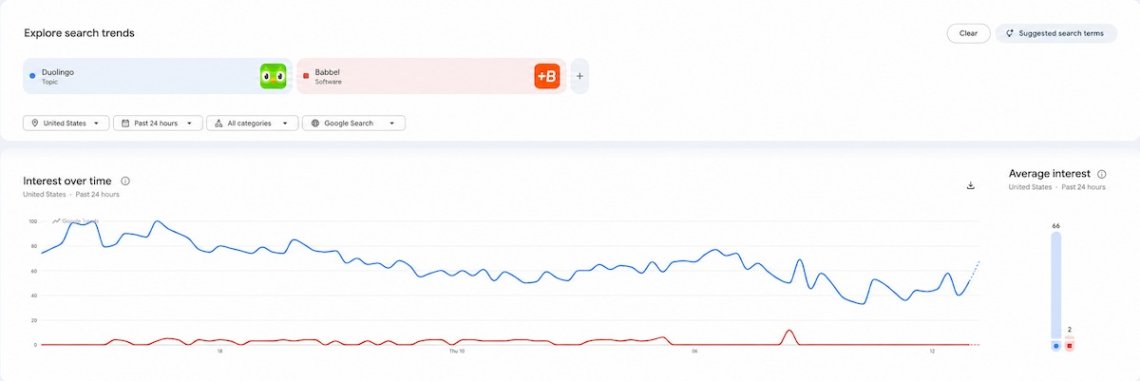
Take Nike, for example. If search interest jumps around a major product launch, campaign, or sporting event, you can see exactly when attention peaks and how quickly it returns to normal.
Just don’t treat a score of 100 as “maximum brand awareness.” It simply marks the highest point of search interest within the time and location you selected.
08 Track conversions
| Best tools to help you out | What they cover |
|---|---|
|
Google Analytics
|
Tracking purchases, sign-ups, downloads, and other website conversions
|
|
HubSpot
|
Connecting leads and conversions with their marketing sources and customer journey
|
Let’s be honest: marketers want people to take action. That’s one of the reasons we invest in brand awareness campaigns in the first place.
Google Analytics and HubSpot can help you connect that awareness with what happens next. GA is great for tracking website conversions, while HubSpot gives you more context around leads and where they came from.
Depending on your business, that might mean purchases, sign-ups, demo requests, downloads, or newsletter subscriptions.
Conversions don’t measure awareness directly, but they help you see whether growing awareness is leading to something valuable.
If a campaign is followed by more branded searches, direct traffic, and conversions, you have a much stronger case that the extra attention is paying off.
And if awareness is growing but conversions remain flat, look at the journey between them. Your landing pages, offer, messaging, or CTA may be where things are getting stuck.
09 Monitor your organic visibility
| Best tools to help you out | What they cover |
|---|---|
|
Semrush, Ahrefs
|
Tracking keyword rankings, average positions, organic visibility, and competitors
|
|
Google Search Console
|
Tracking impressions, clicks, rankings, and the queries your pages appear for
|
Content can introduce your brand to people long before they’re ready to visit your homepage or search for you by name.
That’s a big part of our strategy at Brand24. We use the blog to rank for topics our audience already searches for, putting the brand in front of people who may not know us yet.
Tools like Semrush and Ahrefs are great for tracking that visibility over time, while Google Search Console shows you how your own pages are performing in Google.
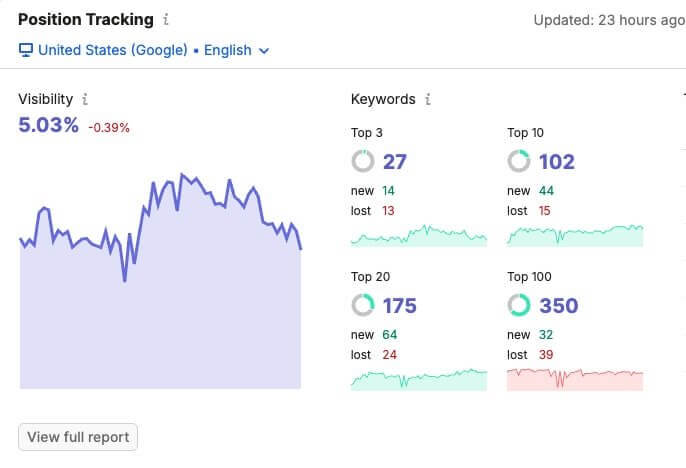
Keep an eye on:
- rankings for your strategic keywords,
- overall search visibility,
- average positions,
- and pages competing for the same keywords.
The interesting part is where that visibility is growing. If more of your content starts ranking highly for important non-branded searches, you’re giving new audiences more chances to discover your brand.
10 Check your backlink growth
Backlinks can be another useful sign that your brand is getting noticed outside your own channels.
When other websites link to your content, they’re not only helping with SEO. They’re also putting your brand in front of their own audiences and, in many cases, treating your content as a source worth referencing.
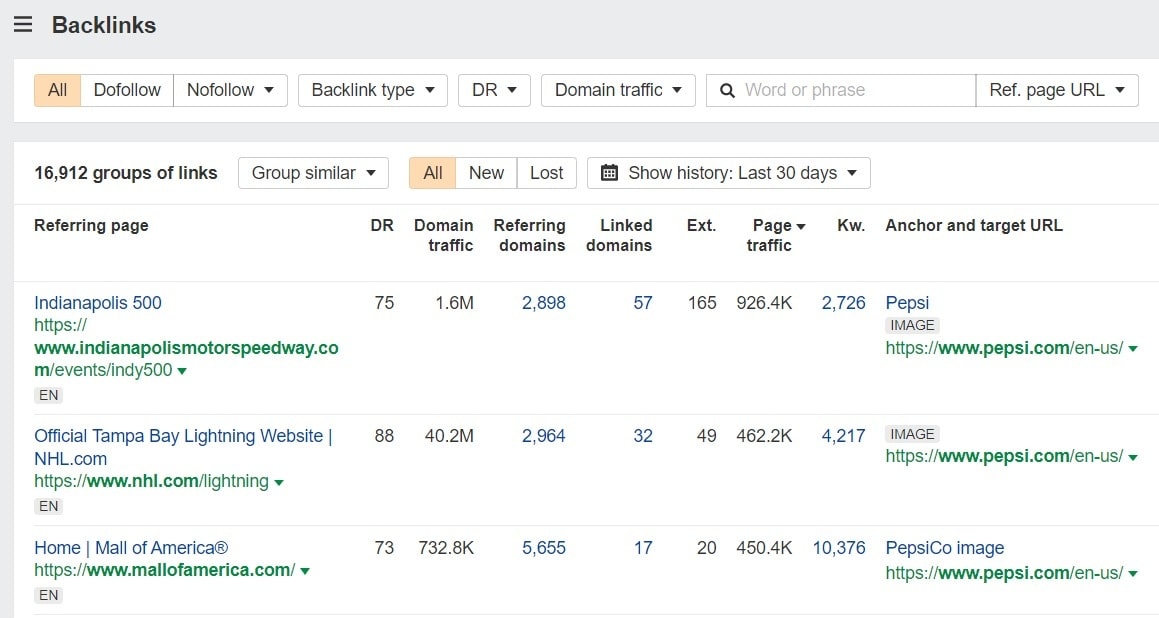
Look at:
- how many new referring domains you’re earning,
- which pages attract the most links,
- where those links are coming from,
- and whether backlinks increase after campaigns, reports, or product launches.
Quality matters much more than chasing a big number. One relevant link from a respected industry publication can be far more useful than dozens of unrelated ones.
And when you monitor backlinks, look for patterns. If your original research, reports, or data-heavy articles consistently earn links, that’s a good sign they’re helping build authority around your brand.
Make more of what works, update your strongest linkable assets, and use those insights to guide future content and PR outreach.
Best brand awareness measurement tools: summary
Brand awareness is scattered by nature. Someone might know your brand because they saw it on social, searched for it later, landed on your blog, remembered it in a survey, or eventually converted.
No single tool sees all of that.
You’ve already seen how these tools fit into the brand measurement process above. This section just pulls them together in one place so you can compare them more easily.
I’ve grouped them by the job they do best, so you can compare like with like and quickly see which ones fit your setup.
| Tool | Type | Best for | Starting price |
|---|---|---|---|
|
1
|
Brand monitoring
|
Real-time brand monitoring, sentiment analysis, and share of voice across online sources and AI search
|
$199/month
|
|
Brand monitoring
|
Social-first listening, reach, and engagement analysis
|
$79/user/month
|
|
|
Brand monitoring
|
Broad media monitoring and PR-focused competitive analysis
|
Custom
|
|
|
Surveys
|
Flexible, in-depth brand awareness surveys and audience research
|
$39/month
|
|
|
5
|
Surveys
|
Simple, engaging brand awareness surveys with a strong respondent experience
|
$29/month
|
|
Web analytics
|
Connecting brand awareness with website traffic, behavior, and conversions
|
Free
|
|
|
Search visibility
|
Comparing branded search interest over time, by region, and against competitors
|
Free
|
|
|
8
|
Search visibility
|
Branded search demand, keyword rankings, and competitor visibility
|
$139/month
|
|
9
|
Search visibility
|
Organic visibility, backlink analysis, and referring domain growth
|
$129/month
|


And in practice, the best setup will usually be a mix. Pick a few tools that cover different signals, and you’ll get a much fuller view of how awareness is growing and what’s driving it.
If I were putting together a brand awareness stack, I’d match the tools to the questions I actually need answered. For example:
- For understanding what people are saying about your brand: Brand24 + SurveyMonkey – Brand24 shows you what people are saying in the wild: mentions, sentiment, reach, and share of voice. SurveyMonkey fills in the bit social listening can’t: whether people actually remember or recognize your brand when you ask them directly.
- For connecting awareness with website behavior – Brand24 + Google Analytics – This is a strong combo if you want to see whether more conversation around your brand is followed by more direct traffic, referral traffic, and conversions.
- For tracking search-driven awareness:ż Semrush + Google Search Console – Semrush helps you understand branded search demand and how your visibility is changing, while Search Console shows what branded and non-branded queries are actually bringing impressions and clicks to your site.
- For broader day-to-day brand awareness tracking: Brand24 + Semrush + Google Analytics – This gives you a pretty balanced view across online conversations, search visibility, website traffic, and conversions. If I wanted one practical setup without going completely overboard, this would be a strong place to start.
- For a fuller brand health check: Brand24 + SurveyMonkey + Google Analytics – This covers three very different signals: what people say about you, what they remember about you, and what they do once they reach your site. It’s probably the closest you’ll get to seeing the whole picture without building a monster stack.
Conclusion
The biggest takeaway here is that brand awareness works best as a set of signals rather than a single headline metric.
At minimum, I’d keep an eye on:
- visibility: branded search, organic rankings, backlinks, reach, and share of voice;
- recognition: mentions, sentiment, aided and unaided awareness;
- and action: direct traffic, referral traffic, sign-ups, leads, and conversions.
Then compare those signals over time and against your competitors.
That’s where the useful stuff starts to show up: which marketing strategies actually increase brand awareness, which campaigns reach the right potential customers, and whether stronger awareness is translating into better brand performance.
You don’t need a full toolstack for that, either. Pick a few that cover the signals you care about, keep your setup consistent, and investigate the spikes instead of just admiring them.
That’s really the whole game if you want to build brand awareness: get seen, get remembered, see what moves and do more of what works.
So if you want to build brand awareness, the routine is pretty simple: measure, compare, learn, repeat. Not terribly glamorous, but very useful.
FAQ
Brand awareness is one of the clearest ways to tell whether your marketing efforts are paying off, especially when the goal isn’t an immediate click or conversion.
Tracked over time, it helps you connect changes in branded searches, direct traffic, online mentions, survey recall, and other awareness metrics with the campaigns you’re running.
You can then look at whether those changes are followed by more sign-ups, leads, or sales and get a much better idea of what’s working.
It also gives those numbers some context.
You can benchmark your brand recognition against competitors, check whether people actually associate your brand with the things you want to be known for, and spot audiences or markets where there’s still room to grow.
In other words, measuring brand awareness gives you something much more useful than “people seem to know us a little more now.” You get data you can use to decide where to keep investing, where to change course, and what to test next.
A good brand awareness percentage is one that’s growing among the people you actually want to reach and compares well with the brands you compete against.
The number will also depend on what you’re measuring. Aided awareness is usually higher because people are shown your brand name, while unaided awareness is a tougher test because they have to recall it on their own.
So don’t look at the percentage in isolation. Compare it with your previous results, your closest competitors, and the same audience over time. If unaided awareness is rising quarter over quarter, that’s a particularly strong sign that your brand is becoming easier to remember.
For metrics that update constantly (branded search, direct traffic, mentions, share of voice, or organic visibility), a monthly review is a good starting point.
I’d still keep an eye on them weekly or biweekly, especially around campaigns, launches, or PR activity, so you don’t miss a sudden spike or drop.
Surveys move more slowly. Quarterly or twice a year is usually enough, provided you ask the same questions and survey a comparable audience each time.
Measuring brand awareness doesn’t generate revenue on its own. The ROI comes from helping you make better decisions about where to spend your marketing budget.
If one campaign lifts brand recall, branded search, direct traffic, and eventually conversions while another barely moves anything, you have a much stronger case for where to invest next.
You can also compare what you spend on surveys, tools, and measurement with the value of the decisions they help you make. Just keep that separate from the ROI of the brand-awareness campaign itself.
Set a baseline before the campaign starts, then compare the same metrics during and after it.
Depending on the campaign, that might include branded search volume, direct traffic, referral traffic, mentions, reach, engagement, share of voice, survey recall, and conversions.
The important bit is to look at several signals together. If mentions, branded search, and direct traffic all rise around the same campaign, you have a much stronger case that awareness actually increased.
Brand awareness measurement tells you how familiar people are with your brand at a given point in time.
Brand tracking is the ongoing process of repeating those measurements to see how awareness, perception, consideration, and other brand metrics change.
So a survey run once can measure brand awareness. Running the same survey every quarter and comparing the results turns it into brand tracking.
The biggest difference in B2B is that who knows your brand matters more than how many people know it.
Track branded search, direct traffic, mentions in relevant industry sources, share of voice, organic visibility, and referral traffic. Surveys can also be especially useful when they’re aimed specifically at your target accounts or decision-makers.
Then connect those awareness signals with demo requests, qualified leads, pipeline, and assisted conversions. A relatively small lift among the right companies can be much more valuable than a big awareness spike among people who’ll never buy.
One of the biggest is treating a single metric as the whole story. More traffic doesn’t automatically mean more awareness, and more mentions aren’t necessarily good news if sentiment is tanking.
Other common mistakes include changing survey questions between measurement periods, comparing different audiences, ignoring competitor movement, and celebrating one-off spikes without checking what caused them.
Consistency matters. Keep your definitions, tools, competitor set, survey questions, and reporting periods as stable as possible.
Start with brand mentions, reach, engagement, sentiment, and share of voice.
Mentions tell you whether people are talking about you, reach shows how far those conversations travel, engagement shows whether people react to them, and sentiment helps you understand whether that attention is positive or negative.