Table of contents
2M Marketers

I’ve spent more than 2 years inside Brand24, watching brands try to “go viral” on LinkedIn… and seeing most of them fail.
Here’s the shift I’m seeing in 2026: Followers don’t make the difference. Mentions do. They’re how AI engines decide who to cite, how the LinkedIn algorithm decides who to amplify, and how your buyers make decisions.
Key takeaways
-
Mentions are the new backlinks
Ahrefs analyzed 75,000 brands and found brand mentions correlate with AI search visibility at 0.664, far stronger than backlinks (0.218). Top-quartile brands appear in AI Overviews up to 10x more often than the next quartile.
-
The conversation about your brand can happen to you, not from you
In one of my active monitoring projects, 98.9% of mentions were user-generated – fans, marketers, and creators talking about the brand without the brand posting itself (see the Duolingo case study below).
-
Brands earn mentions through strategy, not luck
Employee advocacy, creator partnerships, original research, and category presence consistently produce more mentions than one-off campaigns.
-
Speed matters
LinkedIn posts have a ~24-hour half-life, half of all engagement happens in the first day, so responding fast multiplies impact.
This article is a shortlist of the tactics I see actually working for brands. Let’s get into it!
8 ways brands earn more LinkedIn mentions:
1. Build (and arm) an employee advocacy program cause your team is your biggest mention engine
2. Partner with creators in your category, borrow credibility from the people your buyers already follow
3. Publish original research worth citing – give people something concrete to mention
4. Get into industry events as a speaker, not just a sponsor… recap posts are mention multipliers
5. Engage where the conversations already are. Show up in the comments before you ask to be in the post
6. Encourage customer-led content – at the right moment, with the right questions
7. Make your brand easy to mention. Short name, consistent hashtag, repeatable phrases are your friends
8. Track every mention and close the loop. Responding generates the next mention!
🤝 Why can you trust this guide?
Mentions are what Brand24 has been tracking every day since 2011. I’ve worked here for over the last 2 years, watched the LinkedIn data shift across brand projects, and seen what brands do differently when they understand the magic behind mentions.
The tactics below come from a mix of what I’ve watched succeed across that customer base, what the third-party data says, and what I’d genuinely do tomorrow if I were running brand marketing for a B2B company.
It’s the list of simple tactics I’d hand my own team (disclaimer: I already did that). 😉
Case study: Duolingo LinkedIn mentions
Quick case study from one of my social listening projects (because the abstract argument lands harder with real numbers).
In the last 90 days, I tracked the LinkedIn conversation around Duolingo:
| Metric | Value | Change vs. prior 90 days |
|---|---|---|
|
Total LinkedIn mentions
|
2,609
|
+755%
|
|
User-generated content (UGC)
|
2,580 (98.9% of all mentions)
|
+746%
|
|
Positive mentions
|
240
|
+860%
|
|
Negative mentions
|
48
|
+700%
|
|
Neutral mentions
|
~2,321 (89%)
|
–
|
|
Average Presence Score
|
74/100
|
+3%
|
Read that again: 98.9% of Duolingo’s LinkedIn conversation came from third parties. Marketers writing “what we can learn from Duolingo,” fans reposting their tweets, creators dissecting their ideas.
Duolingo’s own page accounts for the remaining ~1%.
This is what the rest of the article is really about. The conversation defining a brand’s reputation on LinkedIn happens largely without the brand in the room.
If Duolingo were only checking their @ notifications, they’d miss >2,500 mentions a quarter.
Source: Brand24 project data, last 90 days (Q1, 2026), filtered to LinkedIn.
8 tips for brands on how to get more mentions on LinkedIn
01 Build (and arm) an employee advocacy program
🤔 Why this works?
The single highest-leverage source of LinkedIn mentions is sitting in your Slack right now: your team.
When 50 employees post about a product launch, a milestone, or a hot take from your CEO, you don’t get one mention, you get 50, each one feeding a different network. And employee-shared content consistently outperforms branded company-page content.
An analysis of 400 million LinkedIn impressions by Vulse found employee posts get 14x more engagement than identical content from company pages: a 5.7% engagement rate for employee posts versus 0.2–0.4% for company pages.
You don’t need every employee to participate, either.
Look at DoorDash, their Social Media Manager Zaria Parvez is a category creator in her own way, and her individual posts about the company keep outperforming the ones from the company page.
That’s the model: a handful of senior people posting in their own voice, consistently, with the company in the background.
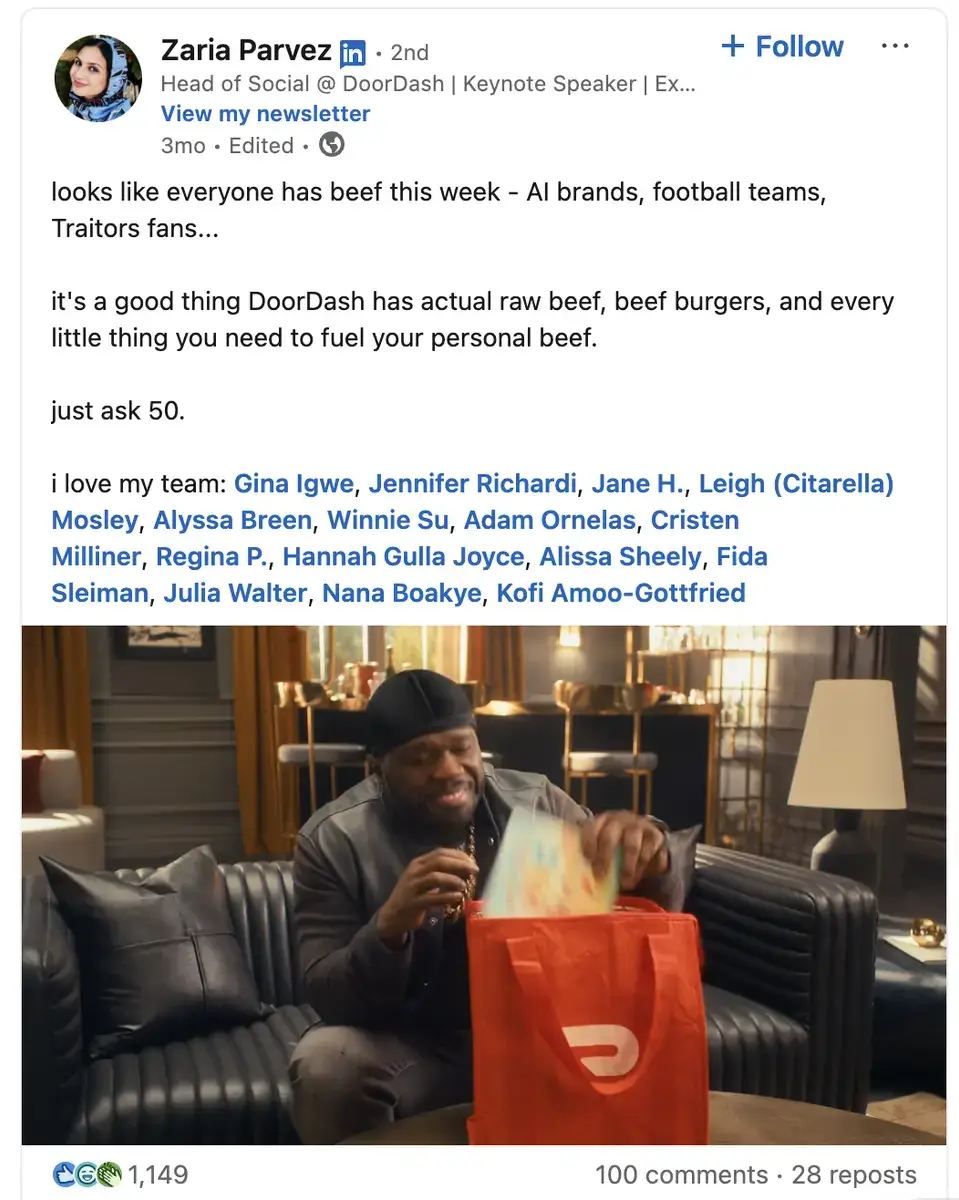
Employee posts consistently out-engage company-page posts, and each one is a separate mention.
✅ What works:
- Give employees ready-to-share content (decks, quotes, screenshots)
- Tag the company page in your own employee posts so the algorithm picks up the link.
- Make participation opt-in and rewarded, not mandatory and tracked.
❌ What doesn’t:
- Forcing employees to repost identical copy from a Slack DM (it shows, and it tanks engagement).
- Treating advocacy as “marketing’s job” without buy-in from leadership, posting first.
📊 Which post types earn the most mentions:
| Type of advocacy post | Mention impact |
|---|---|
|
Personal milestone (“3 years at X”)
|
Medium, usually mentions the brand once |
|
Product launch reaction
|
High, often quotes the brand directly |
|
“Behind the scenes” content
|
High, humanizes the brand and prompts replies |
|
Industry hot take with brand POV
|
Very high, invites others to mention you in their reactions |
02 Partner with creators in your category
🤔 Why this works?
Influencer marketing on LinkedIn doesn’t look like Instagram, and that’s good news!
You need the credibility from people your buyers already follow.
A single post from a respected industry voice can produce a wave of secondary mentions in the comments and reposts that follow. The trick is picking the right creator. Follower count is the wrong filter.
✅ Three filters you should focus on:
- Who’s in the comments? Spot-check the creator’s last 5 posts. If at least 30% of commenters hold titles that match your buyer persona (VP Marketing, Head of Demand, Founder, etc.), the audience overlap is real. If commenters are mostly other creators or unrelated industries, consider skipping.
- Comment quality to count ratio. A creator with 8K followers whose posts routinely earn 40+ substantive comments from senior buyers is worth more than one with 80K followers and a wall of “Great post! 🔥” replies.
- Posting cadence and consistency. A creator who posts 2-3 times a week, every week, builds compounding presence. One post a month is a press hit, not a partnership. (This one is easy to spot when getting the influencers’ stats)
Important note: Many valuable partnerships often aren’t paid. Send a niche creator your data, your tool, or an early-access invite. Some will mention you organically without a contract attached.
03 Publish original research worth citing
🤔 Why this works?
If you want to be mentioned, give people something to mention!
Simple, huh?
Original data like surveys, internal benchmarks, and year-over-year reports is the most reliable mention generator on LinkedIn because everyone wants to look smart by quoting numbers.
Marketers, analysts, founders, and even competitors will reference your data if it’s the only data on a given question.
✅ Formats that consistently earn mentions:
- Annual industry reports (think HubSpot’s State of Marketing)
- Public benchmarks (response rates, conversion rates, reply rates by channel)
- Trend roundups tied to a specific platform or moment
- “We analyzed X mentions and here’s what we learned” posts
That’s also the strategy we’re currently testing in Brand24 with a few reports on AI tools, like: How People Use ChatGPT in 2026: Analysis of 1.3M Mentions.
Results? Best performing content for a long time!

A small note: when you publish, push the data out as a graphic. People mention what they can quote in a single screenshot.
04 Get into industry events as a speaker
🤔 Why this works?
Every conference, webinar, and panel produces a wave of “what I learned at X” posts. If your brand is in the lineup, your brand is in those posts.
But there’s a meaningful gap between roles. Sponsorship (logo on a banner) earns fewer mentions than active participation: a speaker, panelist, or workshop host gets named in attendee recaps, quoted in takeaway posts, and tagged in photo dumps.
For proof, look at any post-conference week on LinkedIn.
After SaaStr Annual 2025, many posts like David Appel’s CMO Summit recap named specific speakers, sessions, and brands. Sponsors? Mentioned in passing, if at all.
The gap between “we partnered” and “we hosted a session” is enormous.
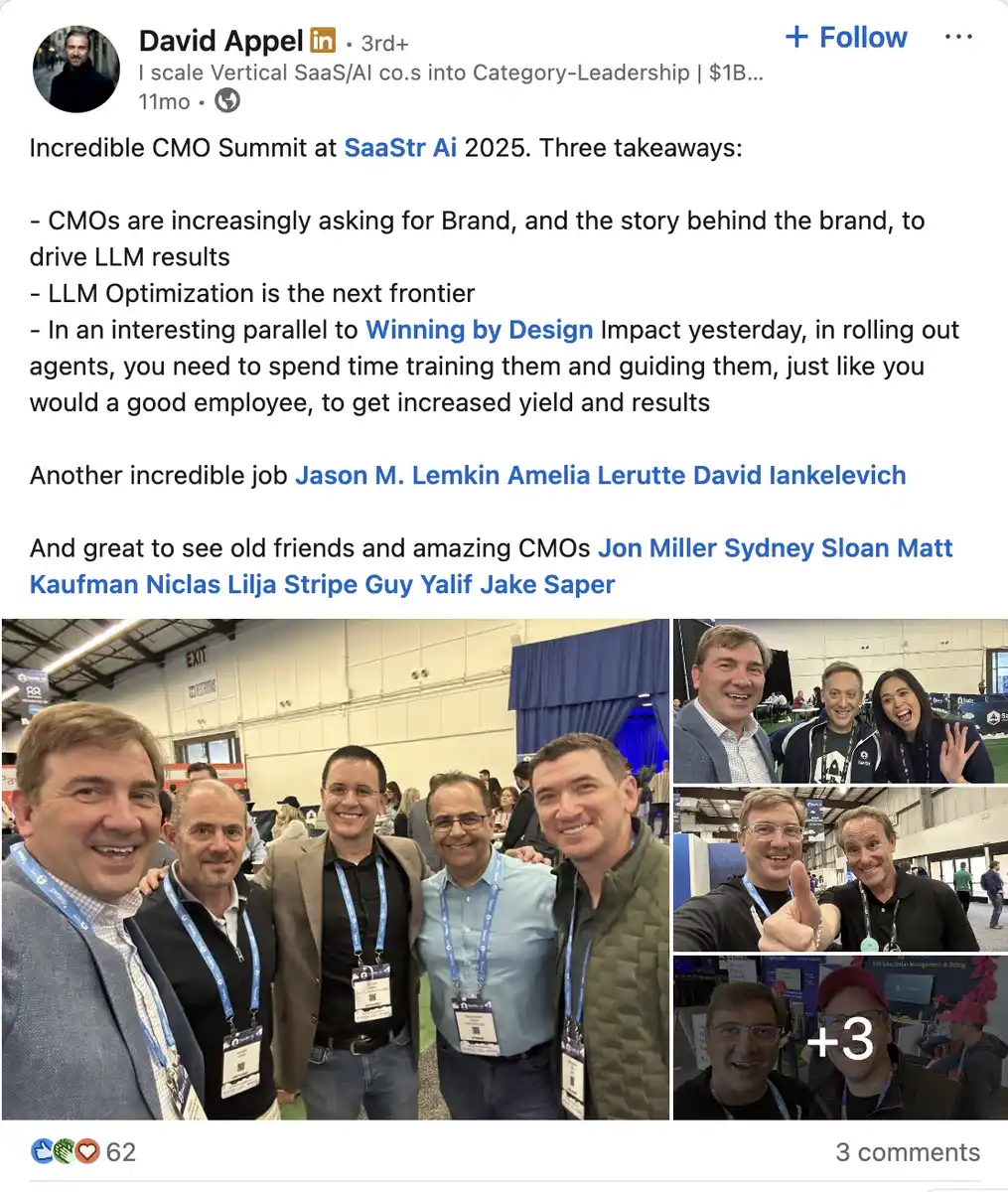
How to land the higher-leverage role on events?
- Pitch organizers with a specific talk title and a one-paragraph proof point. Lead with the data or framework you’ll share and why their audience needs it now.
- Build the talk around one quotable takeaway. A single repeatable line (“untagged mentions are the dark social of B2B”) is what ends up in most recap posts. Without one, attendees fall back to vague “great session!” mentions that don’t name you.
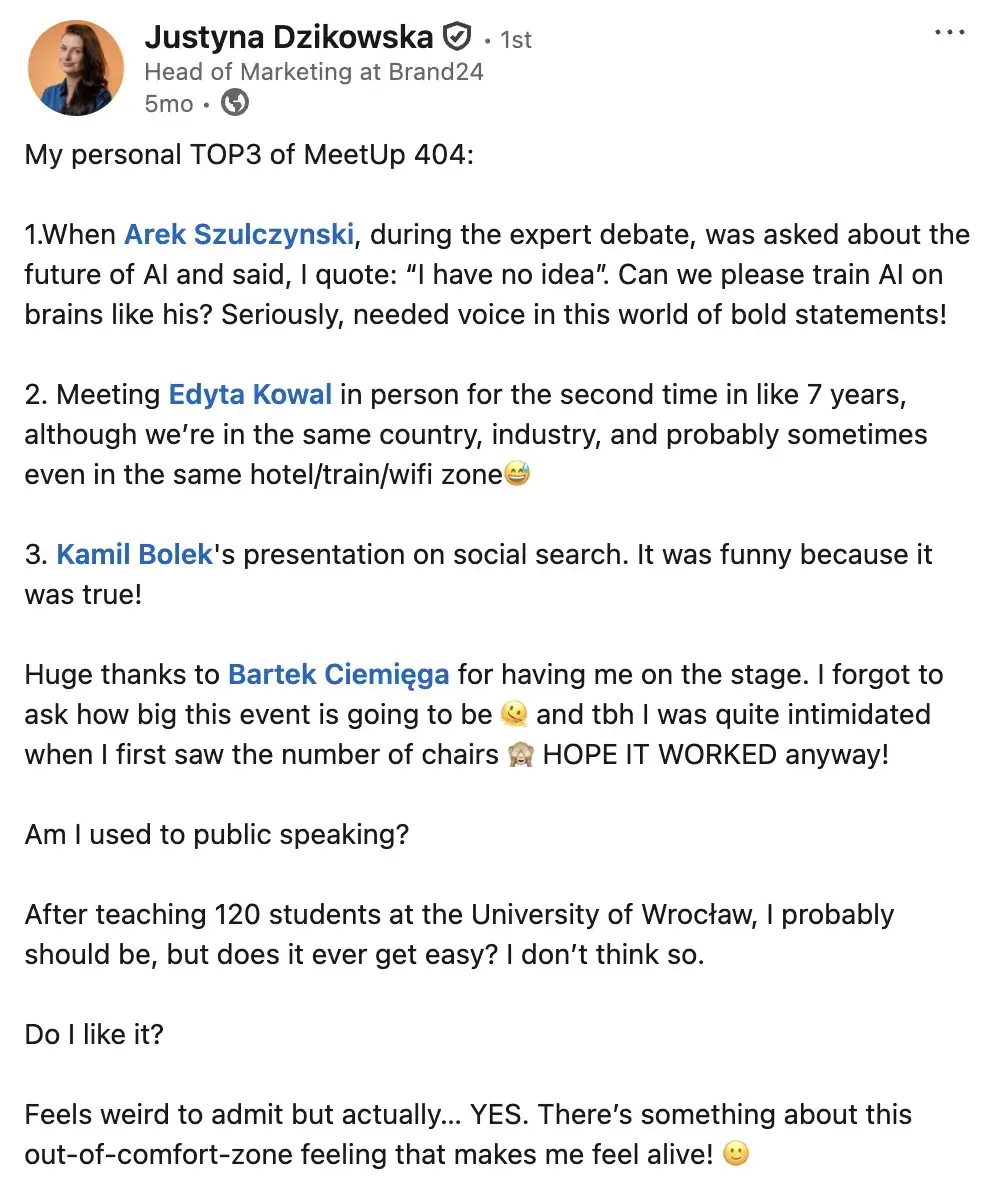
source: Justyna Dzikowska, Head of Marketing at Brand24
05 Engage where the conversations already are
🤔 Why this works?
Most brands post and walk away. The brands that get mentioned the most do the opposite: they show up in the comments of every relevant post in their category.
Dave Gerhardt has called out the same idea in his own LinkedIn post on commenting strategy, which has 117 comments of its own.
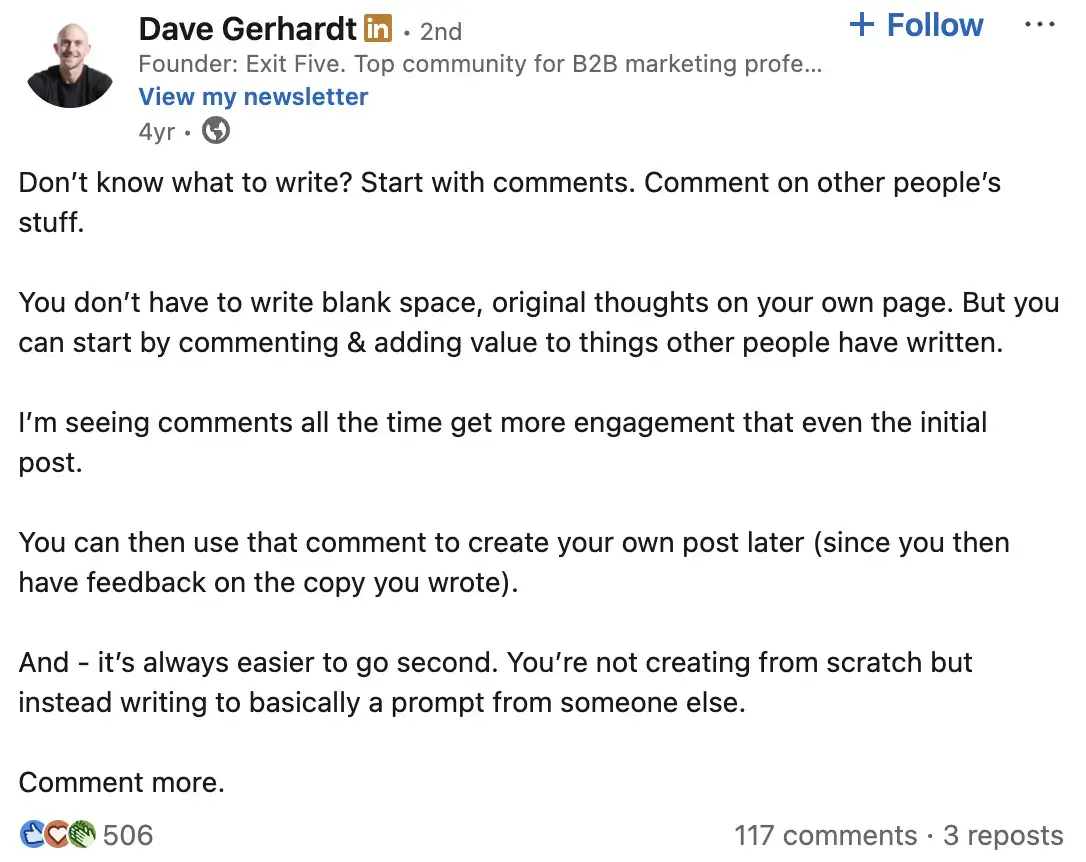
When your brand consistently adds a specific, additive comment, two things happen:
- The original poster (and their audience) starts associating you with the topic.
- The next time someone asks “who’s good at X?” in a comment thread, your name comes up… without you saying anything.
✅ What a good comment should look like?
If a category analyst posts “B2B buyers now consult AI tools before shortlisting”.
Reply with a specific data point or counterexample:
“We’re seeing the same shift in our inbound, buyers arrive already half-qualified and quote ChatGPT answers back at us in demos. The implication: your LinkedIn presence isn’t competing with other vendors anymore, it’s competing with what the LLM saw last month.”
That kind of comment positions you as a peer, not a follower, and gives the poster a reason to mention you back.
Sharp comments earn mentions. Generic ones get scrolled past.
Here’s my recommendation: try the 10-account, 30-day system.
Pick 10 accounts in your category and engage with one post each, every weekday, for a month.
Just thirty minutes a day.
To make the strategy work, make sure to filter where you comment:
| What to look for | |
|---|---|
|
Posting frequency
|
At least 2 posts per week. Dormant accounts don’t compound.
|
|
Target group
|
At least 30% of the account’s commenters hold titles in your buyer persona.
|
|
Topic match
|
The account regularly posts on themes adjacent to your category, not unrelated trending content.
|
What to expect after 30 days?
You probably won’t see a crazy spike, but you’ll surely see a reliable qualitative shift:
- More comment-thread mentions of your brand by other people in those threads (the second-order effect).
- More profile visits from senior buyers who saw your sharp take in a comment.
- More inbound “we should talk to [your brand]” tags in posts you weren’t part of.
Make sure to track it and analyze your progress!
06 Encourage user-generated content
🤔 Why this works?
Happy customers are your best amplifiers, but the it has to come at the right moment, or you’ll get awkward silence (or worse, a forced-sounding post nobody cares about).
Formats that work without feeling forced:
| Format | When |
|---|---|
|
Short customer feature feedback on your company page
|
Onboarding milestones, case study launches |
|
"Wall of love" post quoting 8-10 customers at once
|
Quarterly recaps, anniversaries |
|
Webinars, ebooks
|
Anytime, sharing knowledge |
When customers do mention you, respond fast!
Within 24 hours, ideally same-day.
A response signals to the algorithm and to anyone watching that this is a real, active brand. It also significantly increases the chance that the customer mentions you again next time.
07 Make your brand easy to mention
🤔 Why this works?
It sounds obvious, but most brands fail this test. If your name is hard to spell, your hashtags are inconsistent, and it changes every quarter, people won’t bother.
✅ The brands that get mentioned the most have:
- A short, memorable name (or a clear, consistent shortening)
- One primary branded hashtag they use everywhere (and that employees use too)
- A handful of repeatable phrases that become “theirs” (think “kindness as a service”, “bet on yourself”, just do it, etc.)
- A clean LinkedIn company page with the right name and logo so tagging actually works
My reccomendation:
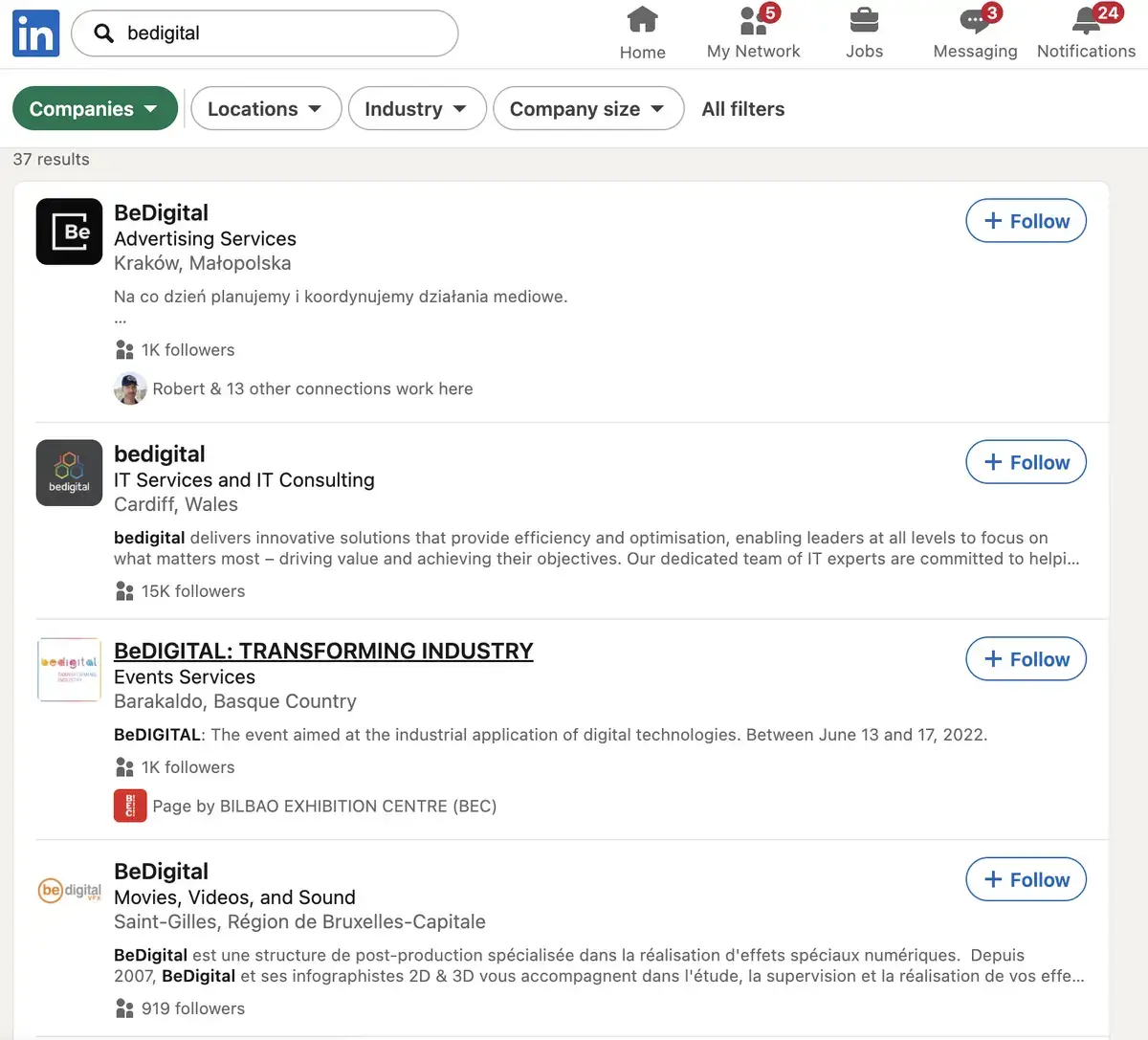
Do such an audit today. Search your brand name on LinkedIn. If the top result is a different company with a similar name, that’s a problem you can fix in 30 minutes by updating your company page metadata.
08 Track every mention (tagged and untagged) and close the loop
🤔 Why this works?
Here’s the what truth you don’t want to forget: the more mentions you respond to, the more mentions you earn.
Every time you reply to someone’s feedback, ask a question on a critical post, or thank a creator for citing your data, you’re telling the algorithm and creating a public record of “this brand is paying attention.” That alone makes other people more likely to mention you next.
Remember the Duolingo data at the top of this article? 2,580 of 2,609 mentions in 90 days (98.9%) were user-generated and most of it didn’t tag Duolingo. The brand sees the tagged ones in their notifications and might assume that’s the conversation. When in reality, there’s much more quietly shape what other people say next, and they’re invisible without the right tool.
A LinkedIn monitoring tool closes that gap.
You set up a project with your brand keywords, and it surfaces every public LinkedIn post and comment that references you (tagged or not) including more advanced analytics like sentiment analysis, the posts reach, and more.
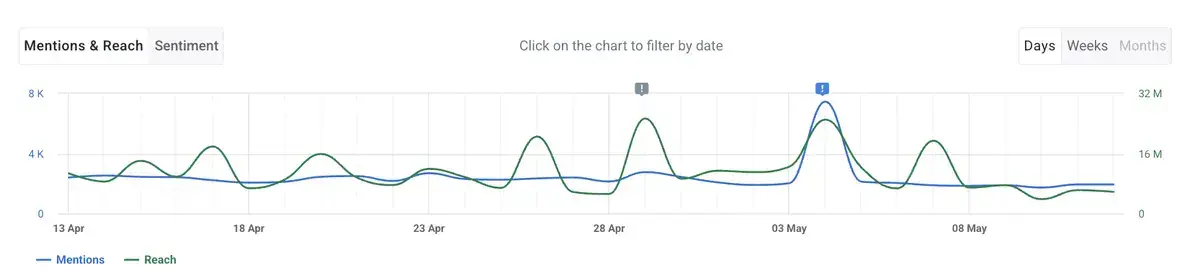
From there, what you need to do is simple:
- Respond to the new ones and turn a happy mention into a relationship.
- Defuse the negative ones, do it fast, before sentiment spreads.
- Mine the rest for positioning insights – what language do people use to describe you?
💡 Pro tip: Don’t just track your own brand. Set up parallel projects for your top 2-3 competitors and industry experts. The mentions they’re getting (and the ones they’re missing) are a roadmap of where to show up next.
FAQ
Why should you care about mentions in 2026?
Because mentions are how AI models decide who to cite, and how the LinkedIn algorithm decides who to amplify. With LLMs like ChatGPT, Perplexity, and Google’s AI Overviews sitting between your brand and your buyer, visibility now depends on how often your name shows up across the open web.
Does the number of mentions impact LinkedIn reach?
Yes, directly and indirectly. LinkedIn’s algorithm rewards accounts that get tagged and are active. Indirectly, brands with high mention volume show up in more people’s feeds organically, which compounds reach over time. It’s a flywheel: more mentions drive more reach, and more reach drives more mentions.
How quickly should we respond to LinkedIn mentions?
Same-day if you can; within 24 hours at the latest. Speed matters because LinkedIn posts have a short half-life.
According to Scott Graffius’s analysis of social media post lifespans puts the average LinkedIn post half-life at around 24 hours, meaning half of all engagement on a post happens within the first day. A fast response gets your reply in front of the largest possible audience.
What’s the single biggest mistake brands make trying to earn LinkedIn mentions?
Posting more from the company page. The data is clear: company-page posts have a much lower engagement ceiling than employee-driven and creator-driven content. Brands that pour budget into more corporate posts hit a wall, while brands that invest in employee advocacy and creator partnerships compound.
Final thoughts
- Earning mentions is a systems problem, not a content problem. The tactics above compound. Pick two or three and run them consistently for a quarter.
- Employee advocacy and creator partnerships are the easiest wins. Start there if you only have time for one thing.
- Track tagged and untagged mentions, as most of the conversation about your brand never tags you. Without a social listening tool, you’re blind.
- Respond fast! Same-day responses keep the flywheel spinning.