Table of contents
Social Listening Report: Template, Examples & Best Practices [2026]
Need to create a top quality social listening report fast? This short but highly practical guide will show you how to get a report that delivers real insights instead of boring data.
Key takeaways
-
A social listening report must tell story, not just present numbers
An effective report goes beyond brand mentions and sentiment analysis. It must provide actionable insights compiled with clear recommendations that lead to action.
-
A social listening report needs a clear goal and the right metrics
Without a defined objective, your report becomes a collection of random data. Choose KPIs that match your goal and show whether your brand is moving in the right direction.
-
Ferrari and The Witcher 4 examples show why insights > data
Numbers alone only show volume and reach, but insights explain what caused the spike, what people feel, and what risks or opportunities are emerging.
What is a social listening report?
Social listening report is a structured summary of insights gathered from monitoring online conversations about a brand, product, service, industry, or topic.
It goes beyond collecting mentions – it analyzes them to answer what people are saying, how they feel, and why it matters.
As a document, social listening report supports marketing, public relations, customer support, and product teams by providing actionable insights based on real-time online feedback and conversations.
Social listening report includes both quantitative data (like the reach and volume of brand mentions) and qualitative insights (like sentiment analysis or brand health), gathered from a variety of data sources, such as:
- Social media platforms
- News sites and blogs
- Forums
- Review platforms
- Video platforms and podcasts.
Social listening report template
Okay, you know what the heck a social listening report is.
Before we move to creating one from scratch, let me show you three social listening report examples.
I did them all with Brand24 – an AI-powered social listening tool that allows you to track & analyze brand mentions and generate & share comprehensive reports.
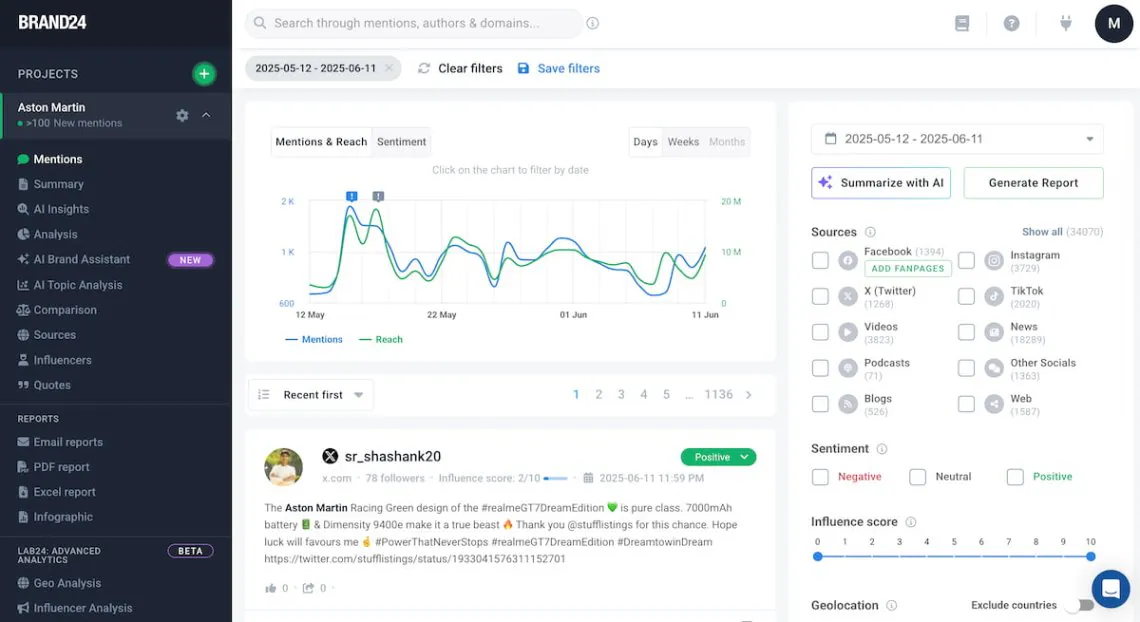
With a few clicks, Brand24 enables you to generate a ready-to-use social listening report, complete with key metrics, sentiment breakdowns, trending topics, actionable insights, and more.
How to create a social listening report in 6 steps?
01 Choose your goals
The very first step of organizing chaotic social listening data into a well-organized report is defining your primary goal(s).
A clear objective works like setting a final destination on Google Maps – it guides the entire trip, keeps you focused on what’s relevant, and minimizes the risk of not sticking to the main point.
Otherwise, it will become an overwhelming collection of random stats and quotes that no one understands or cares about – time-wasting!
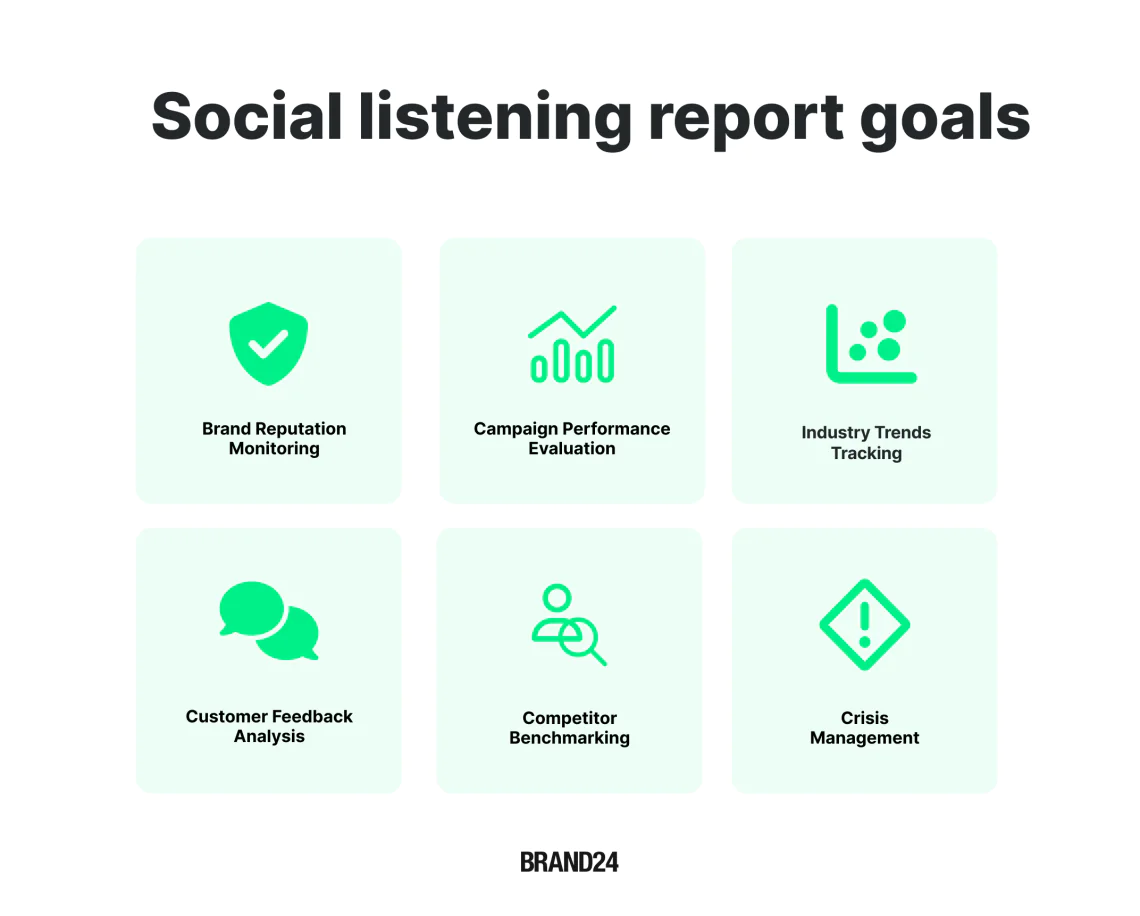
The most common social listening report goals are:
- Brand reputation monitoring – to track how the brand is perceived online
- Campaign performance evaluation – to check how well your latest marketing efforts resonated with the audience and guide your future campaigns
- Industry trends tracking – to spot emerging topics and shifts in customer preferences
- Customer feedback analysis – to identify frequent problems, requests, and customer sentiment trends. Besides, social listening can help you find leads.
- Competitor benchmarking – to compare brand visibility, sentiment, and engagement with other brands in your industry
- Crisis management – to discover potential issues early and respond to negative sentiment before it escalates.
02 Choose key metrics
Selecting key performance metrics depends on the chosen primary goals and is a logical second step to compile an effective social listening report.
If a goal is your final destination, key metrics are like road signs showing whether you’re on the right track.
They help you measure progress, spot potential wrong ways, and ensure your analysis stays aligned with the report’s purpose.
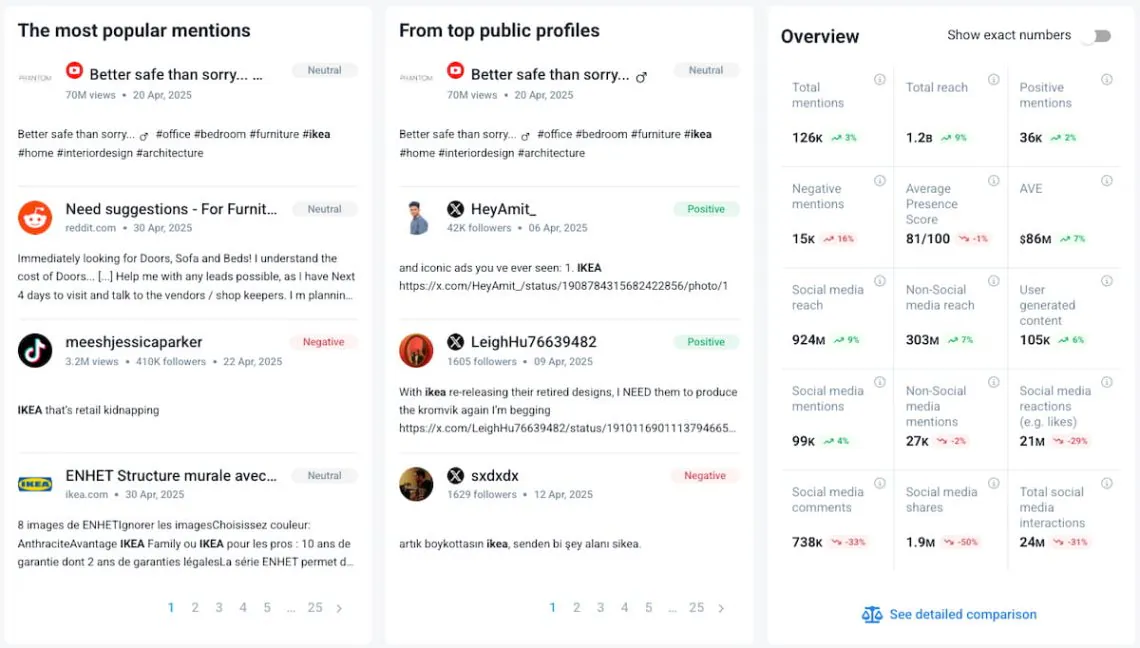
But no worries! There are universal metrics that fit all social listening reports:
- Sentiment analysis – the ratio of positive, neutral, and negative brand mentions
- Presence Score – the indicator presenting your brand awareness and popularity at the given time
- Volume & reach of mentions – tells you how impactful and engaging your content is
- Share of voice – presents your brand’s visibility in relation to your competitors/industry
- Advertising Value Equivalency (AVE) – estimates the amount of money you would have spent on paid ads to achieve the same results.
Further read: Key Social Listening Metrics
03 Present insights, not just data
To make real impact, your report must tell a story, not just present raw data.
Explain the numbers – what they mean, why they matter, and what actions should follow.
Highlight key patterns, unexpected changes, and potential risks or opportunities.
This way, your CEO, manager, or stakeholder won’t have to search for meaning – you’ll serve it directly, making the report useful, engaging, and easy to navigate.
Now, let me show you how to turn raw data into deeper insights with a quick example.
On June 3rd 2025, the gaming industry was thrilled by an exciting technical demo of The Witcher 4 – one of the most anticipated games in the world.
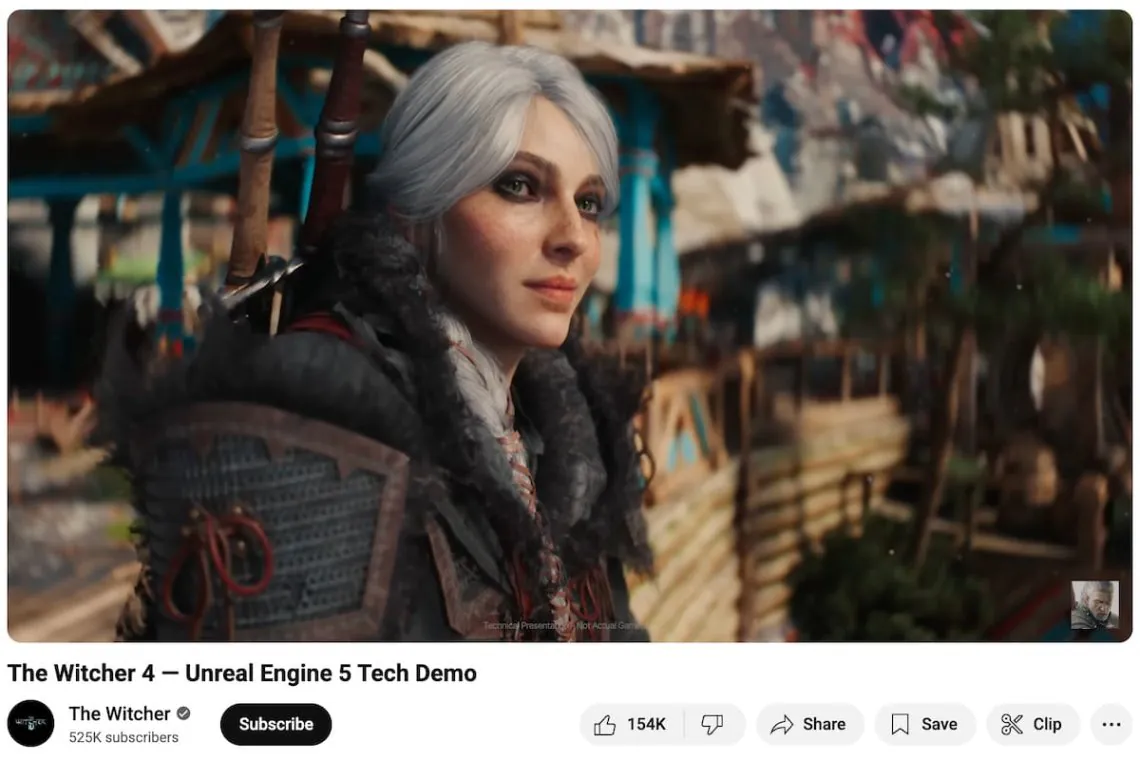
The event generated over 15,000 brand mentions, reaching nearly 170 million people. 25% of those mentions were purely positive, while 6% expressed negative sentiment only. The rest was neutral.
These are raw data. How to transform them to insights?
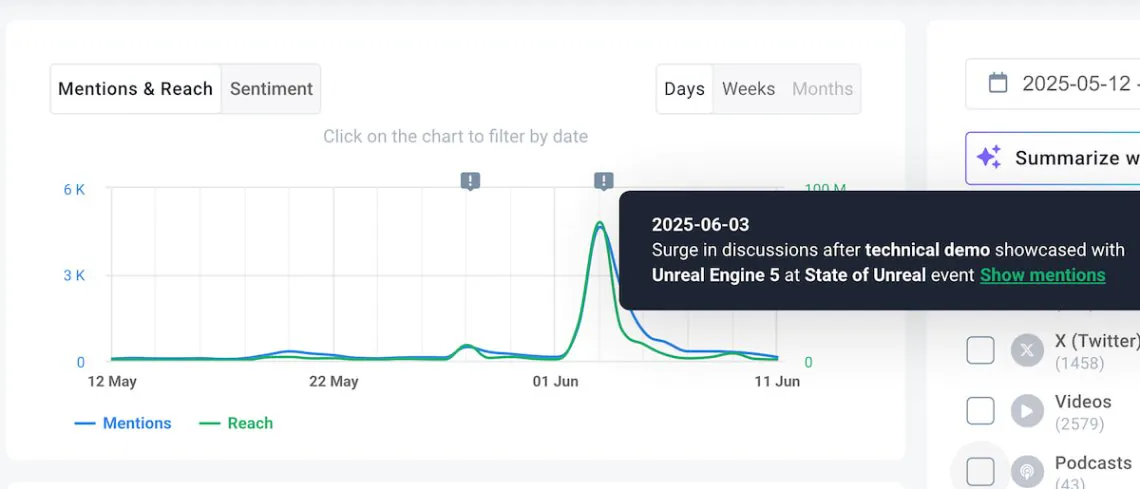
To make it quickly, you can use (for example) Brand24’s AI Insights that automate the whole process.
So, according to this feature:
- The Witcher’s demo was hugely praised for its amazing graphics and open-world potential. It was the most significant contributor to the positive sentiment increase (from 10% to 28%).
- The most serious concern about The Witcher 4 is whether the game developer (CD Projekt Red) can deliver on the promise of the tech demo due to the troubled launch of its previous game (Cyberpunk 2077)
- The gaming community is also slightly worried about the hardware requirements, especially on PCs, as many fear that the game may demand high-end equipment that not all players can afford.
Sounds different, huh?
04 Compare data with rivals or past performance
Social listening reports need reference points. It means that you have to have context to compare your performance with.
Otherwise, how would you know if you’re heading in the right direction or not?
Basically, there are two ways you can compare your brand performance:
- With your market rivals – to have a reference to competitive brands within your industry or niche
- With your past performance – to understand how your brand’s online presence, sentiment, and engagement evolve over time, spot patterns, or detect potential warning signs early.
Let’s take an example of luxury sports car brands – Ferrari, Lamborghini, and Aston Martin.
Take a look at this quick comparison:
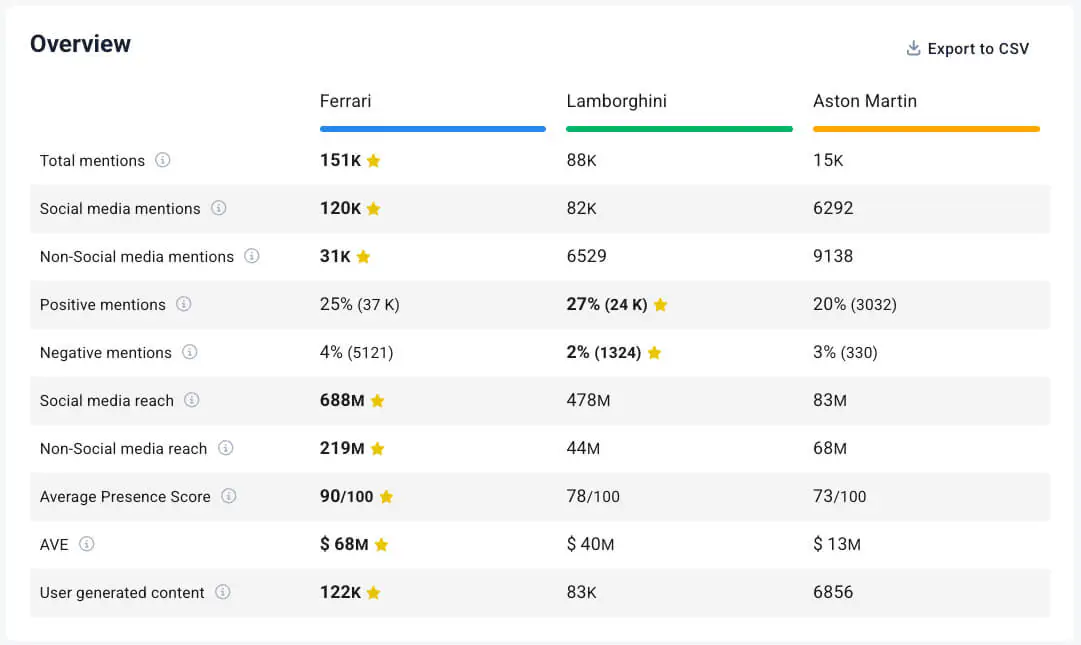
If we consider visibility, reputation, and overall social listening strategy, the winner is obvious – Ferrari.
However, the situation changes when we compare the brand’s current online performance with a past period.
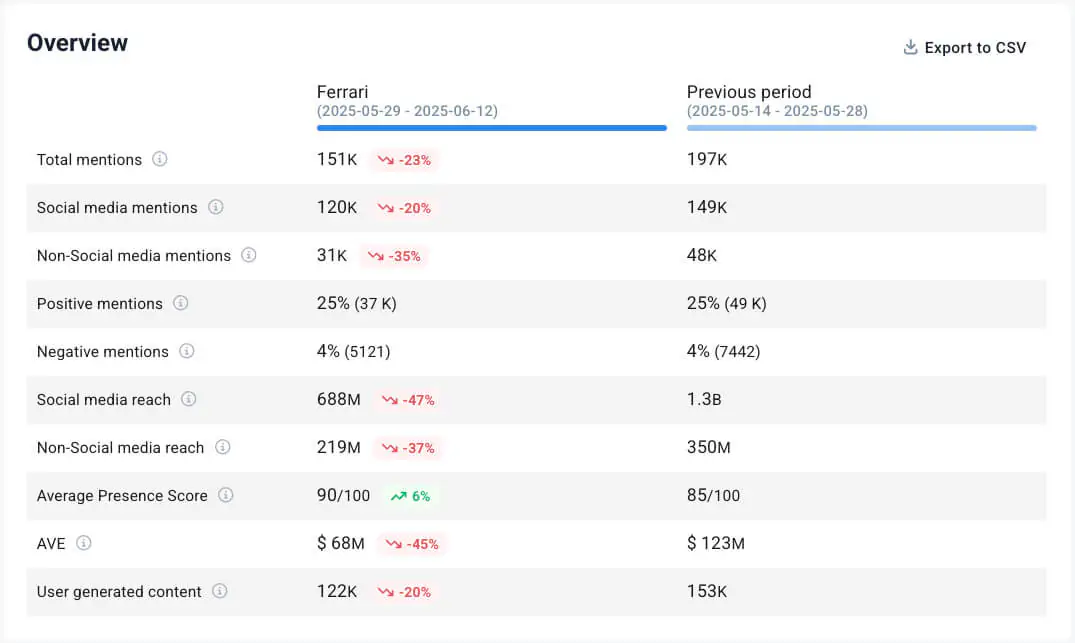
What does it tell us?
Overall, Ferrari outperforms its market rivals in most social listening categories. However, its performance has strongly declined compared to the previous period.
A conclusion?
Ferrari remains the leader, but the drop in performance may signal the need for fresh social media efforts or reputation management to maintain its position.
That example shows why data comparison should be another thing to include in a social listening report.
05 Include plans and recommendations
Including plans and recommendations into your social listening report turns it into a real decision-making tool.
They connect the dots between what happened and what should happen. Each insight you present should lead to at least one clear action, for example:
- If negative sentiment grows – suggest addressing customer concerns through improved communication or product upgrades
- If engagement drops – recommend refreshing your content strategy or exploring new platforms.
- If competitor visibility rises – propose analyzing their recent activities to get inspired for future campaigns.
Here, again, I encourage you to use the power of Brand24 AI Insights.
Next to valuable insights and trends, the feature shares personalized recommendations for your marketing strategy based on your brand mentions.
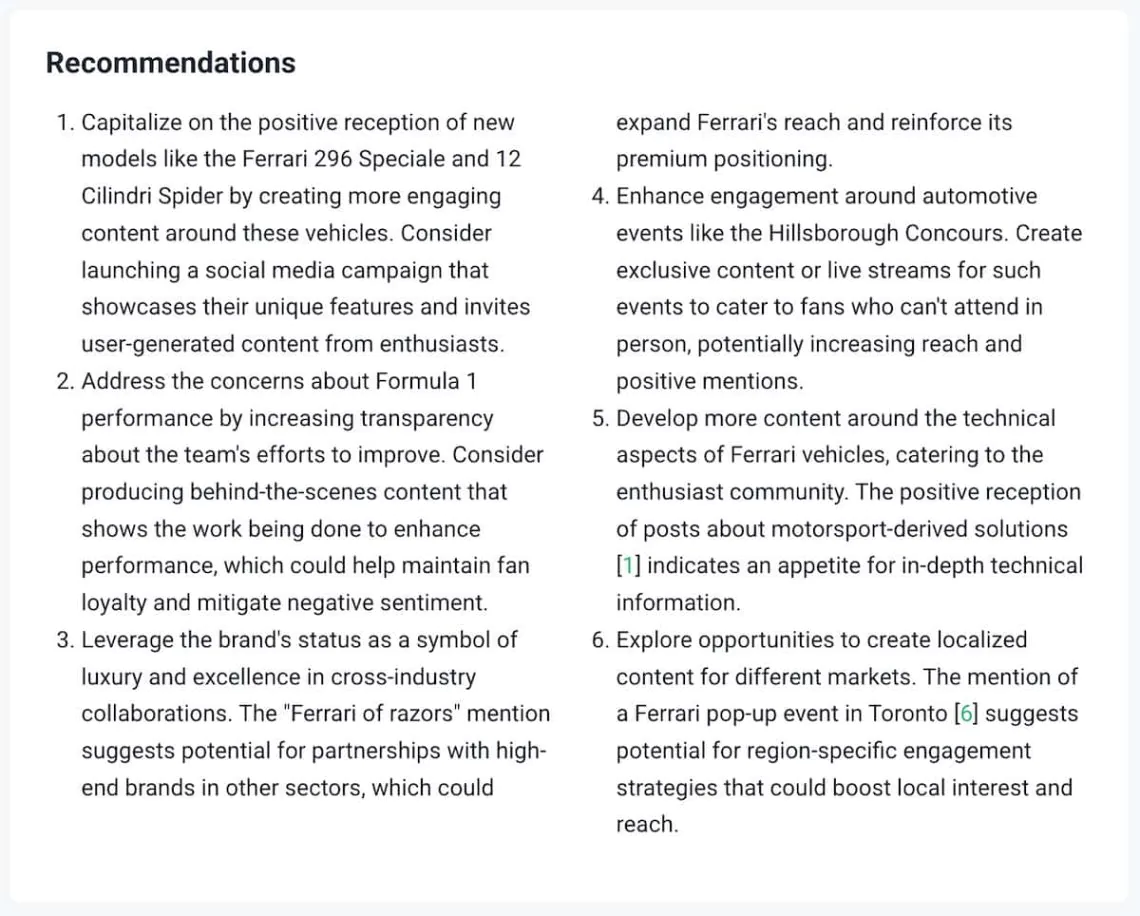
For example, in the case of Ferrari, AI Insights recommends:
- Create more engaging content for the Ferrari 296 Speciale and 12 Cilindri Spider models
- Address the concerns about Ferrari’s Formula 1 performance and create more content about technical aspects (as it receives a lot of positive reception)
- Boost engagement around automotive events like the Hillsborough Concours
And that’s concrete!
06 Remember about data visualizations
Data visualizations turn complex numbers into clear, understandable graphics that help your audience grasp insights in a blink of an eye.
Well-designed charts, graphs, and tables guide the reader’s attention to the most important takeaways without overwhelming them with raw data.
For example:
- Use pie charts to showcase sentiment distribution.
- Apply line graphs to present trends over time (mentions volume, reach, engagement).
- Implement bar charts for comparing brand performance or share of voice.
- Create word clouds to visualize the most frequently used keywords or hashtag analysis.
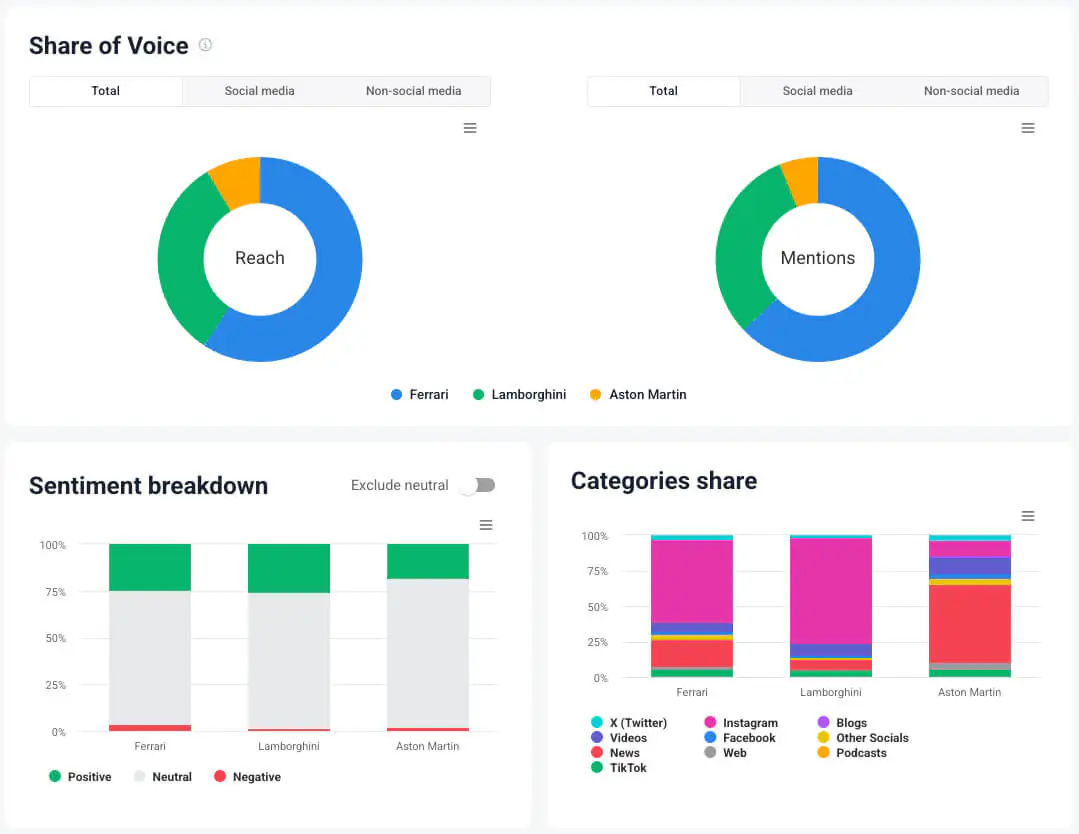
The right visualizations make your report not only more professional but also far more convincing. Especially for busy decision-makers who need to understand the key insights quickly.
Conclusion
Social listening reports help you organize chaotic online conversations into powerful business tools. They combine numbers with real meaning, so you know what’s going on with your brand.
The whole process is simple and logical.
First, you need to set a clear goal that will keep you focused and prevent you from wasting time on random data.
Next, choose the right metrics. They’ll show whether you’re on track and what needs attention.
Remember, though, to compare your data with competitors or past results, which gives you valuable context.
All that to discover insights, turning raw data into stories your team, CEO, or stakeholder can act on.
Also, remember to include clear recommendations. They can transform your report from a simple description into a document that makes a real impact.
At the end, remember that AI-powered tools like Brand24 make the whole process much easier by collecting data, analyzing it, and generating ready reports.
Final thoughts:
- Always keep in mind who you’ll present your report to when deciding on its content and complexity.
- A sentiment analysis, Presence Score, volume of mentions, share of voice, and Advertising Value Equivalency are universal metrics you can apply to any type of social listening report.
- A picture is worth a thousand words. So, instead of going too wordy, use visuals.
- Social listening tools like Brand24 can save you a lot of time due to their automatic reports, AI-powered insights and recommendations, as well as comparison features.
- Good reports lead to better decisions, not just better charts and shorter meetings. It’s essential both for B2C and B2B social listening efforts!
Start a Brand24 free 14-day trial and create an amazing social listening report in minutes!

Article Reviewed by