Table of contents
2M Marketers

Ever scrolled past an obviously AI-generated ad and wondered if everyone else is as annoyed as you?
Turns out, nearly half of them are!
I tracked 228,200 mentions of AI-generated content in May 2026 using Brand24 media monitoring: 48% are negative, and “AI slop” shows up in 35% of them.
My analysis goes through what’s driving that anger and discomfort, which industries are most exposed, and what brands can do to create generative AI brand content that works.
Key takeaways:
-
Don't use AI for product photos
They're the most common trigger for negative brand AI mentions across gaming, food, fashion, e-commerce, and sports. Consumers don't read them as a visual shortcut but as a signal about low product quality.
-
Label AI content with honesty
Being honest about using generative AI to create brand content is the strongest driver of positive sentiment. #aigenerated (564 uses) is almost entirely positive. #aislop (399 uses) is almost entirely negative. Same content, opposite reactions.
-
If you're in finance, luxury, gaming, or media, treat AI-generated content as higher-risk
These four sectors generate the most negative sentiment in the data, with dedicated boycott hashtags, immediate trust drops, and people ditching the idea of buying.
A quick look at the top problems with AI-generated content
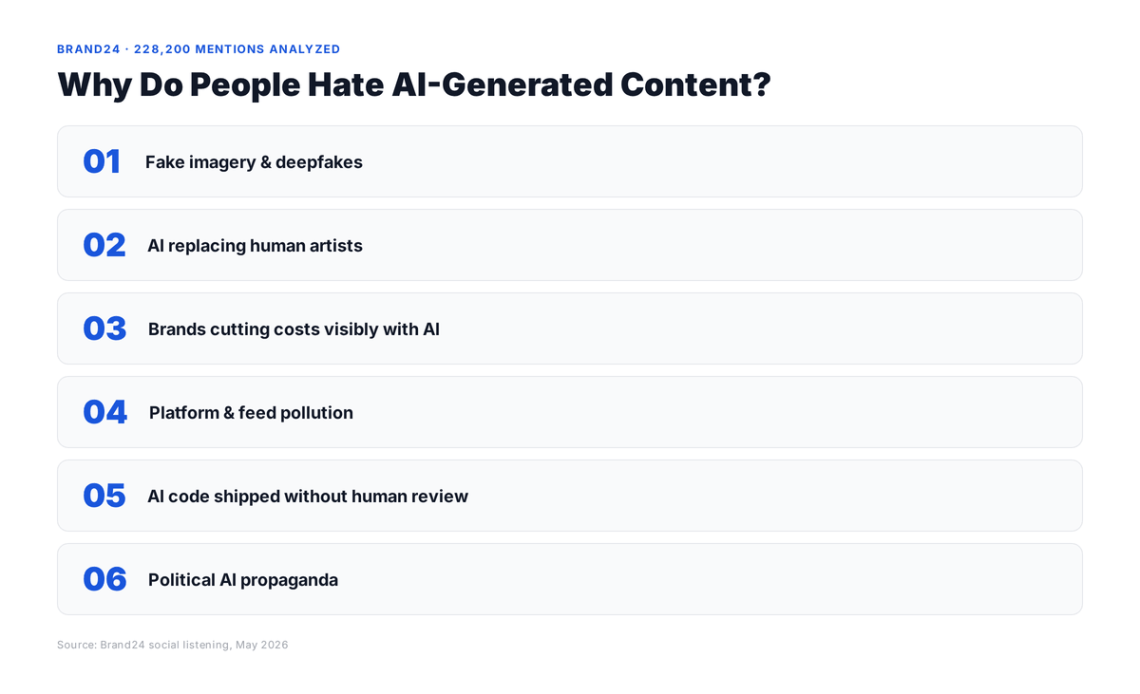
Before we dive into all the social listening metrics, here’s a quick summary of the top 6 pain points around AI-generated content:
- 1 Fake images and deepfakes presented as real
- 2 AI replacing human artists, musicians, actors, or writers in creative work
- 3 Brands using obvious AI to save money in lazy ads or robotic customer service responses
- 4 Platforms and feeds cluttered with AI-generated spam
- 5 AI-generated code deployed without proper human review
- 6 Political AI propaganda: a lot of it is Trump-adjacent
How negative is the public perception of AI content?
To understand the attitude towards AI-generated content, I looked at the sentiment share across 228,200 mentions.
The numbers are significantly more negative than what you typically see in general AI conversations.
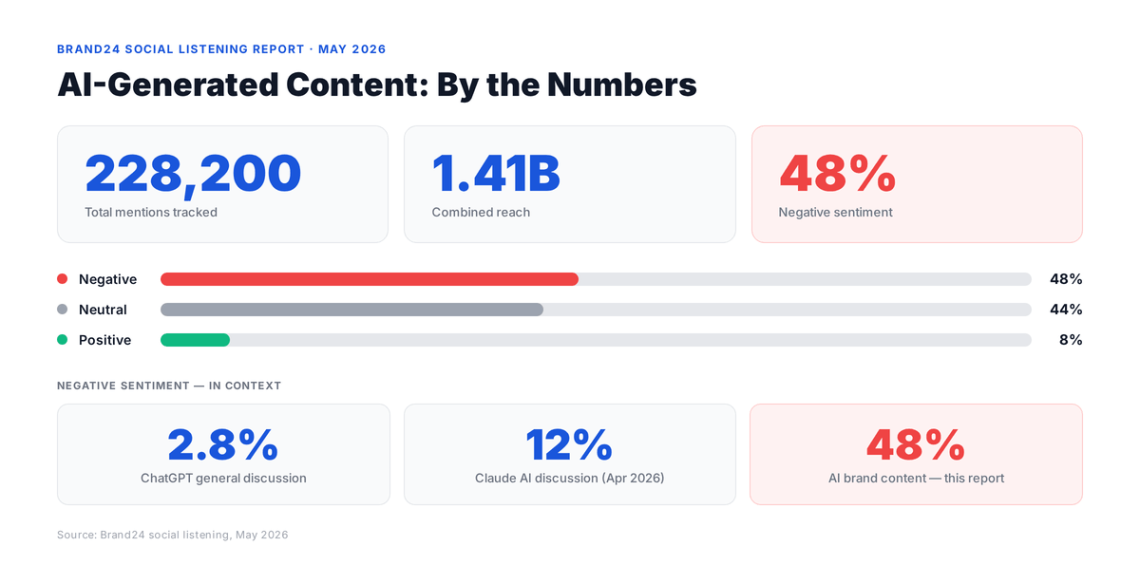
Sentiment breakdown:
- 48% negative (109.2k mentions)
- 44% neutral (101.8k mentions)
- 8% positive (17.2k mentions)
For a bit of context: in our report on Claude AI usage from April 2026, overall negative sentiment was 12%, and in the ChatGPT vs Claude social listening report, it was 2.8%.
So while people may appreciate AI overall (or at least approach it with some healthy caution), the reaction to AI-generated content specifically is much more frustrated and angry.
And this matches what other researchers are finding:
According to the PEW Research 2025 study, 34% of people say they’re more worried than excited about AI in daily life, and a 2025 Forbes article says that 55% feel uncomfortable on sites packed with AI-generated articles and stories.
Top keywords across all mentions:
- “image” (12.6%)
- “post” (10.4%)
- “video” (8.9%)
- “slop” (8.0%)
- “content” (7.6%)
Top hashtags:
- #ai (7.3k uses)
- #aiart (1.6k)
- #aigenerated (1.5k)
- #capcut (1.4k)
Top 9 discussion topics about AI-generated content
Brand24 Topic Analysis shows that there are 9 different discussion topics.
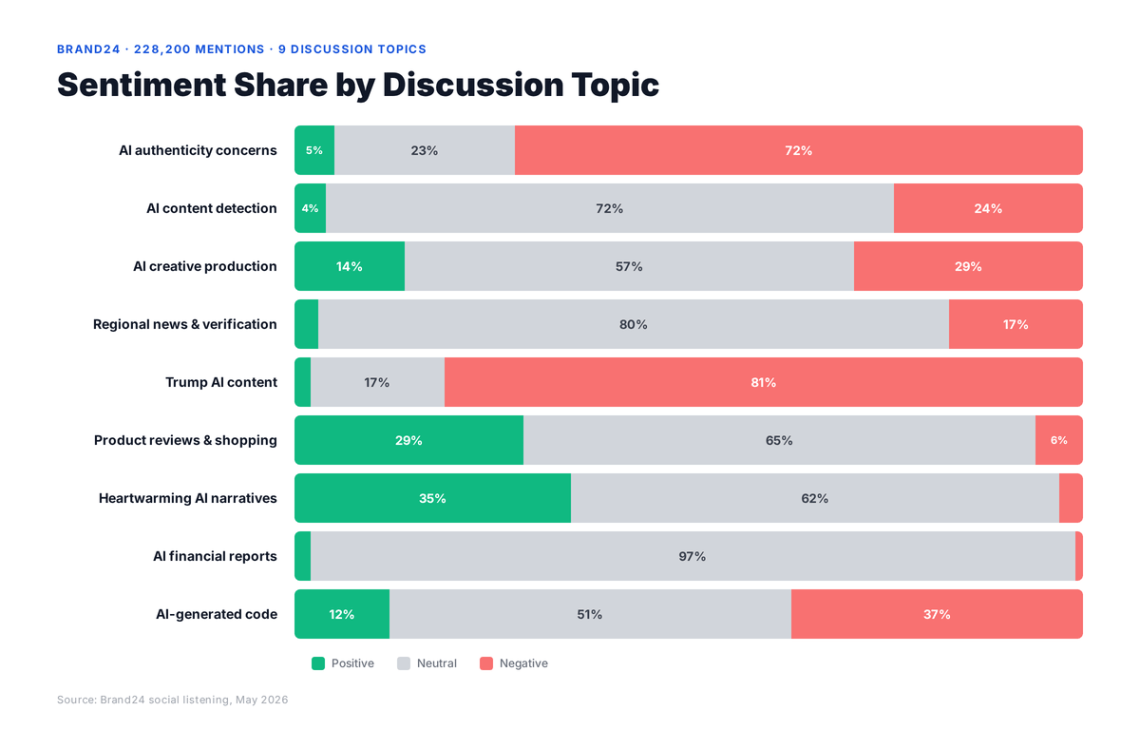
Let’s see what people focus on when they mention AI-generated content and how big those conversations are.
01 AI authenticity concerns
52.1k mentions | 101.9M reach | 71.5% negative sentiment
It’s the biggest and most heated topic.
People feel deceived and are worried about fake AI content taking over the internet:
- deepfakes,
- AI-generated voices impersonating public figures,
- cheating in school and academic fraud,
- AI images presented as real photographs.
Top hashtags and keywords:
- #aislop
- #artificialintelligence
- #ai
- “fake”
- “slop”
- “garbage”
- “misinformation”
Example quotes:
- “The internet is filled with garbage it’s all fake anymore and it’s all making people ignorant and believing the crap they see.”
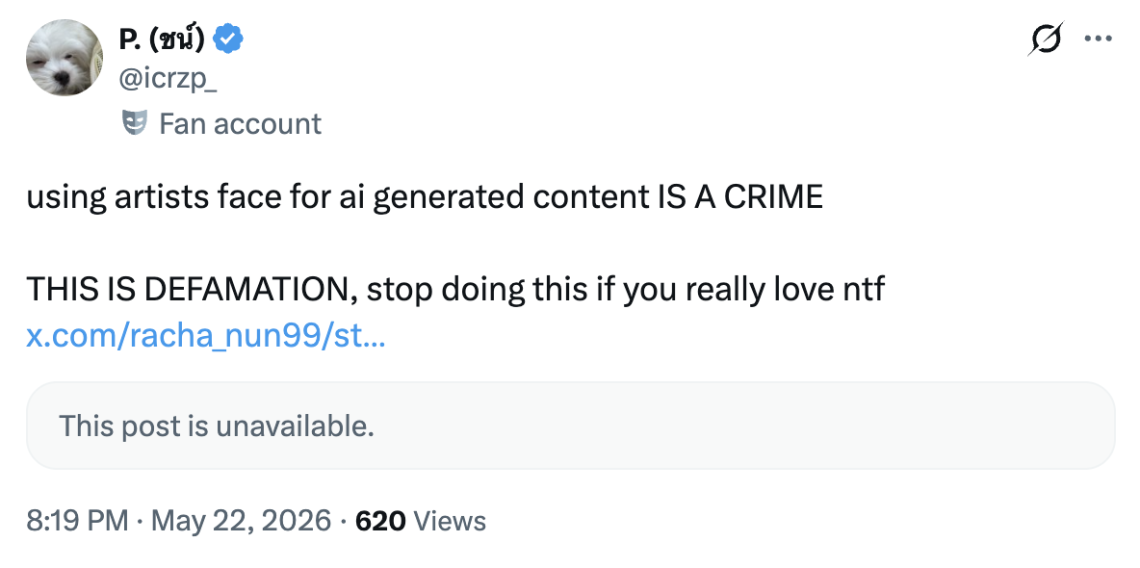
- using artists face for ai generated content IS A CRIME THIS IS DEFAMATION, stop doing this if you really love [the artist]”
02 AI content detection
21.4k mentions | 26M reach | 23.9% negative sentiment
Users are manually reporting content they suspect is AI and debating how to verify its authenticity.
I also noticed a lot of posts from an automated deepfake detection bot that reports percentage scores for AI-generated video, speech, music, and images.
Top hashtags and keywords:
- #ai
- “detection”
- “deepfake”
- “verified”
03 AI creative production
21.4k mentions | 420.6M reach | 28.9% negative sentiment | Highest reach of all 10 topics
People are talking a lot about using AI to create content like videos, music, artwork, and social posts.
Their conversations include both enthusiasm, for example, when creators share their work, and criticism, when people protest against AI invading human creative fields.
Top hashtags and keywords:
- #aiart
- #aigenerated
- #capcut
- #capcutpioneer
- #soraaiools
Frequently mentioned tools:
- Kling AI
- Sora
- Google Gemini
- CapCut
Example quotes:
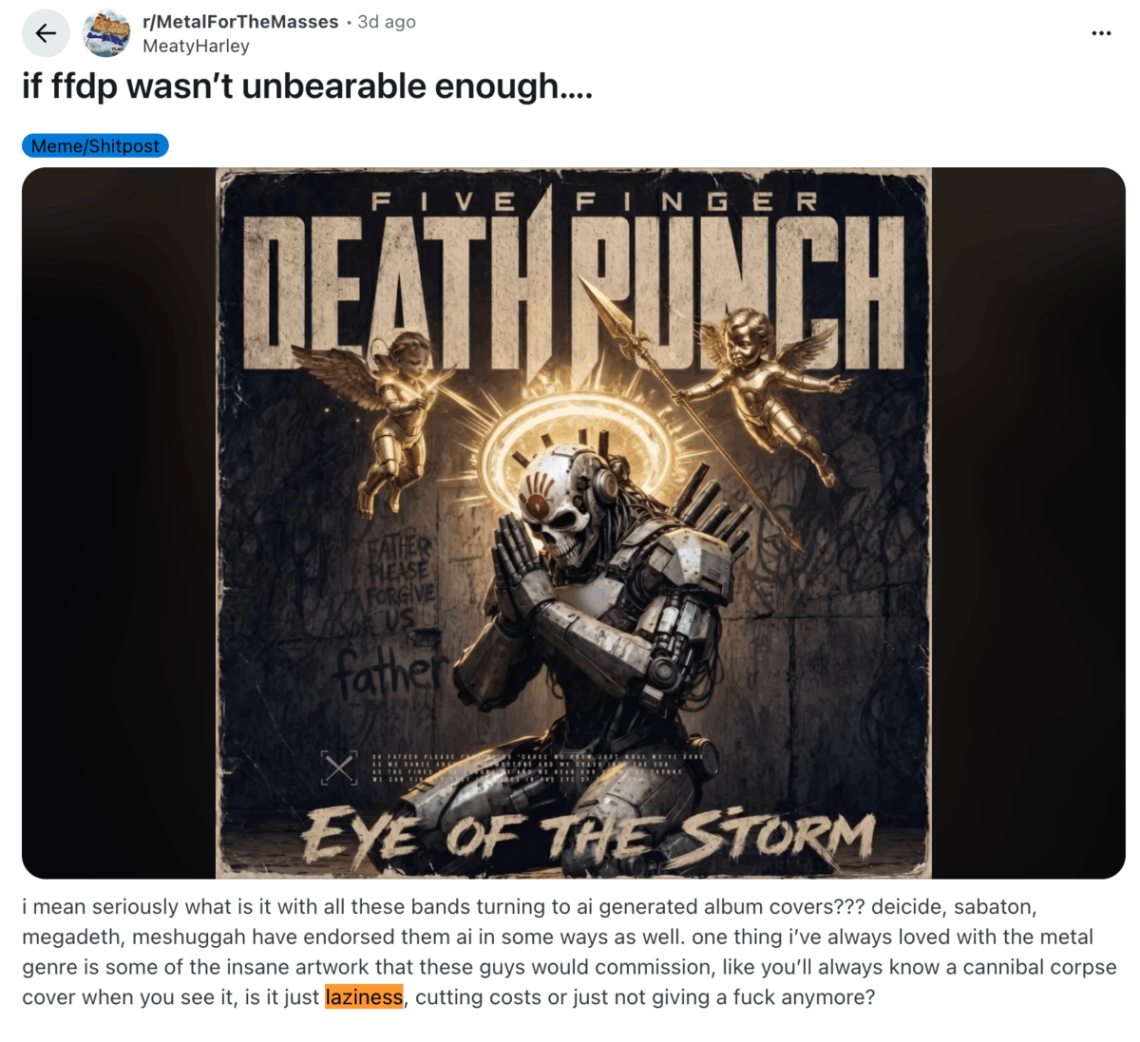
- “one thing I’ve always loved with the metal genre is some of the insane artwork these guys would commission… is it just laziness, cutting costs or just not caring anymore?” – Reddit user (about Deicide, Sabaton, Megadeth, and Meshuggah using AI-generated album covers)
- “so apparently this song is ai generated?? what the hell“
- “You have removed the essence of art by using generative AI”
- “AI slop. Heartbreaking to see such great artists resort to generative AI” – on Prada’s AI Kojima trailer
04 Regional news & verification
7.7k mentions | 167.9M reach | 80.1% neutral sentiment
It’s concentrated mostly in South Asia (Pakistan and India) and in parts of Africa and the Middle East, where AI-generated images and videos are being used for political propaganda or misinformation.
Fact-checkers and journalists are reporting it and working to confirm what’s real or fake.
Top hashtags:
- #pakistan
- #ai
- #fake
- #propaganda
Example quotes:
- “So obvious it is AI generated. Further dents any little credibility that the movement had!”
- Alert, Video shared by official handle of ‘BJP India’ is fake it’s an AI generated video.”
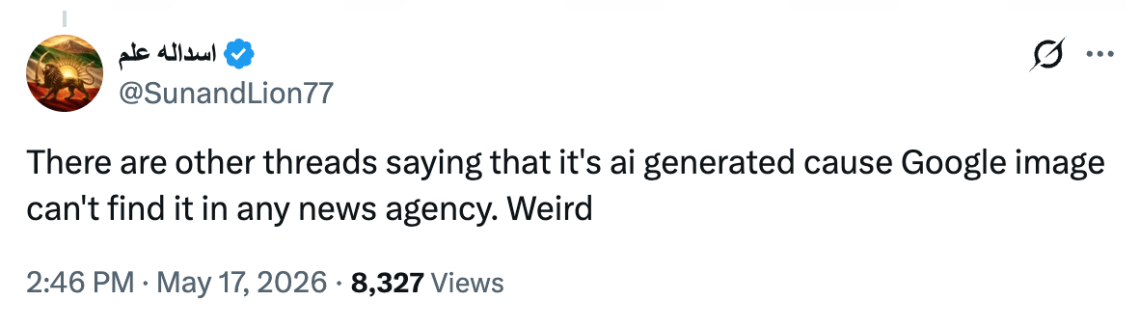
- There are other threads saying that it’s ai generated cause Google image can’t find it in any news agency. Weird”
- acknowledging that your pathetic slander campaign is supposed to be pathetic because it’s AI generated doesn’t make it any less pathetic.”
05 Trump AI content
1.9k mentions | 9.1M reach | 81.2% negative sentiment
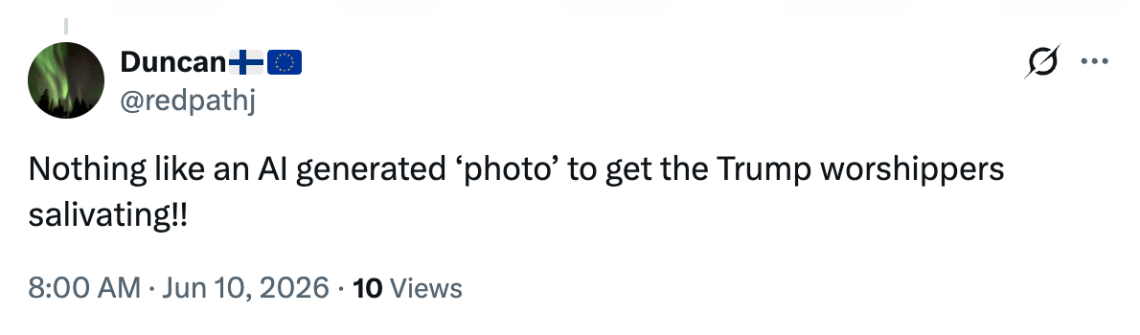
This topic includes AI-generated imagery and videos involving the USA President, Donald Trump.
The discussion around them includes posts from pro-Trump accounts featuring AI videos, critics calling them out as fake, and debates among political commentators.
Look at the huge percentage of negative sentiment: 81.2%!
Top hashtags and keywords:
- #maga
- #trump
- #aislop
- “fake”
- “fiction”
- “propaganda”
- “deepfake”
Example quotes:
- “One reality the other AI generated fiction for maga consumption”
- “The one case for not generating your own AI slop is the fact that Trump does it constantly and all of it is the weirdest sh*t you’ve ever seen.”
- “AI generated like most of Trump’s pictures”
- This is some pretty sh*tty AI slop, even for MAGA”
06 Product reviews & shopping
1.5k mentions | 139.3M reach | 28.5% positive sentiment
These discussions focus on:
- AI-generated review summaries on e-commerce sites
- brand social posts that inform about the introduction of AI solutions to their products
- user complaints about AI-driven customer service replies
Overall, when AI is used in commercial contexts, people tend to support brands being upfront about how it’s being used.
Example quote:
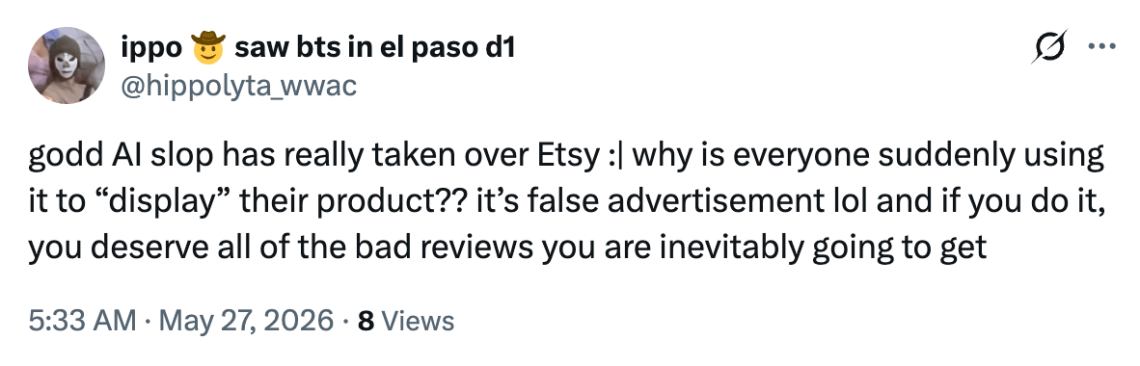
- “AI slop has really taken over Etsy. Why is everyone suddenly using it to ‘display’ their product? It’s false advertisement lol and if you do it, you deserve all of the bad reviews you are inevitably going to get.”
- “U saw this AI generated pic n still ordered?“
07 Heartwarming AI narratives
1.09k mentions | 89.5M reach | 35.2% positive sentiment
AI-generated feel-good short videos on Facebook featuring animals, family moments, and acts of kindness.
Example quotes:
- From a simple prompt to a beautiful creation… AI creates the art, but the emotions are real.”
- My favorite AI generated fictional inspirational YouTube story about Elon Musk… Imagine if Elites were really generous & give hope to average middle-class people like this.”
08 AI financial reports
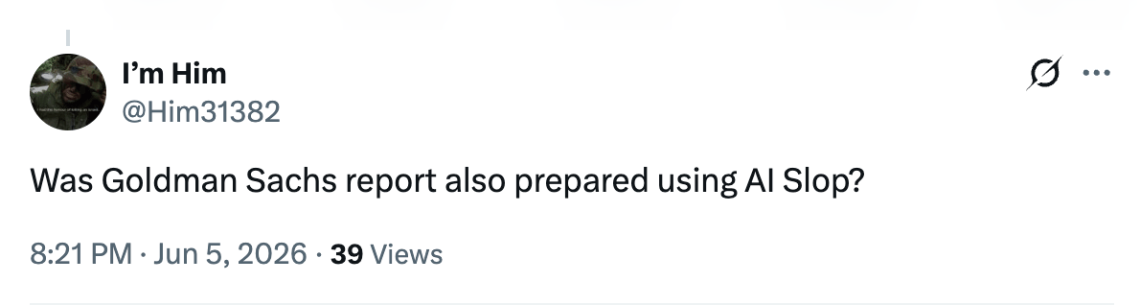
1.08k mentions | 2.3M reach | 96.7% neutral sentiment
AI-generated summaries and financial analysis content like earnings reports, stock data, market commentary.
Example quotes:
- Was Goldman Sachs report also prepared using AI Slop?”
- This report is ai generated. Allow the agency do their work”
09 AI-generated code
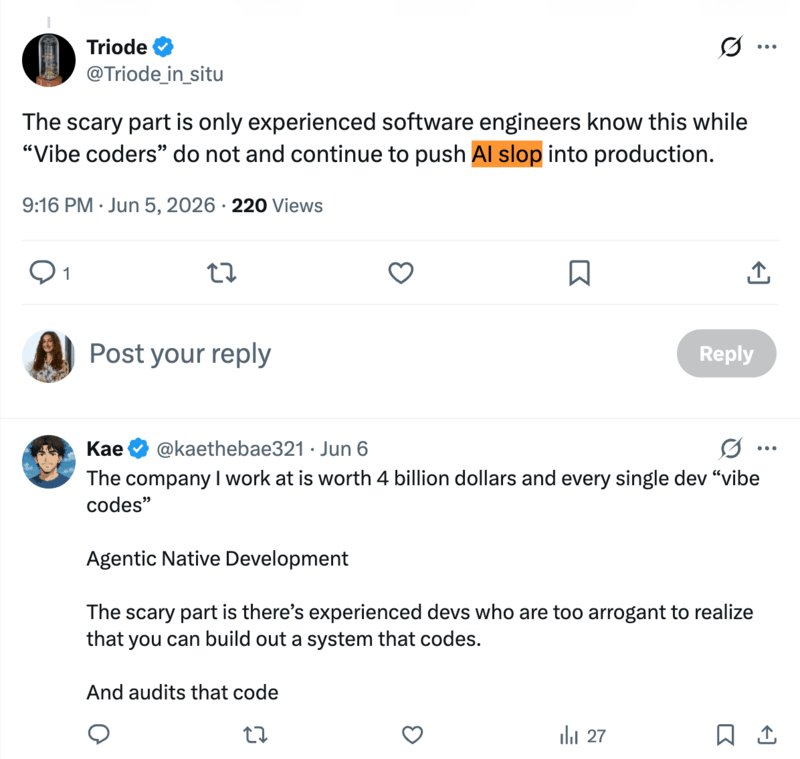
764 mentions | 2.6M reach | 37% negative sentiment
Developers debating the quality, safety, and professional consequences of AI-generated code.
Example quote:
- “The scary part is only experienced software engineers know this while ‘Vibe coders’ do not and continue to push AI slop into production.”
- “after harder testing we found several bugs and crashes in the AI generated part of the project, most critically in the GPU back-end”
Why do people hate AI-generated content?
Out of 228.2k total mentions in May 2026, 109.3k (48%) are negative, with a combined reach of 293.9M.
In other words, nearly half of the online conversations around AI-generated content are clearly hostile and are seen by almost 300 million people.
Top 5 reasons for a negative attitude towards AI
- 1 Fake and deceptive content
- 2 AI taking over creative fields
- 3 AI code without human oversight
- 4 Political AI propaganda
- 5 Platform pollution and feed degradation
Here’s what I found when I took a closer look at these topics using the AI Brand Assistant:
01 Fake and deceptive content
37.3k negative mentions | 66.4M reach | 48% of all negative reach
Examples:
- A Facebook post about a Nigerian presidential spokesperson arresting someone for making an AI voice impersonation of President Tinubu reached 14.3M people on its own.
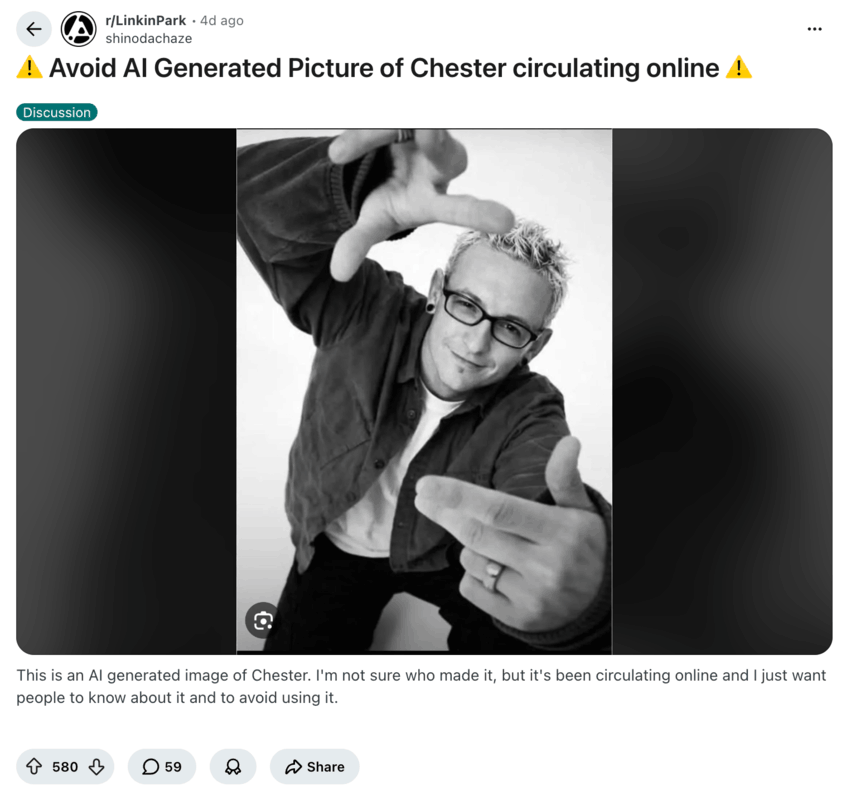
- A lot of warnings about an AI-generated image of late Linkin Park frontman, Chester Bennington, also spread widely.
Example quote:
- “As AI-generated content becomes indistinguishable from CGI, should there be ethical consequences for falsely accusing someone of using AI when they didn’t?”
02 AI taking over creative fields
6.2k negative mentions | 37.7M reach | 27.5% of all negative reach
The criticism of generative AI is present in a lot of creative fields.
Example quotes:
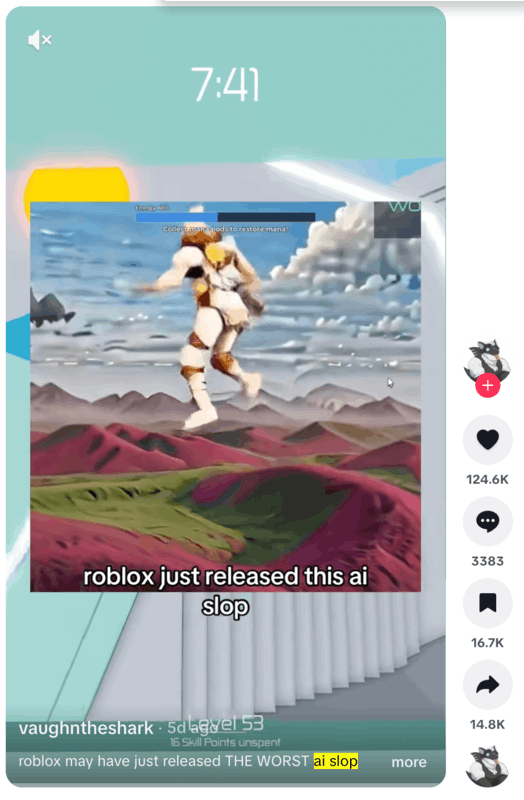
- Music: “THE WORST ai slop update” – TikTok callout on Roblox’s AI music update
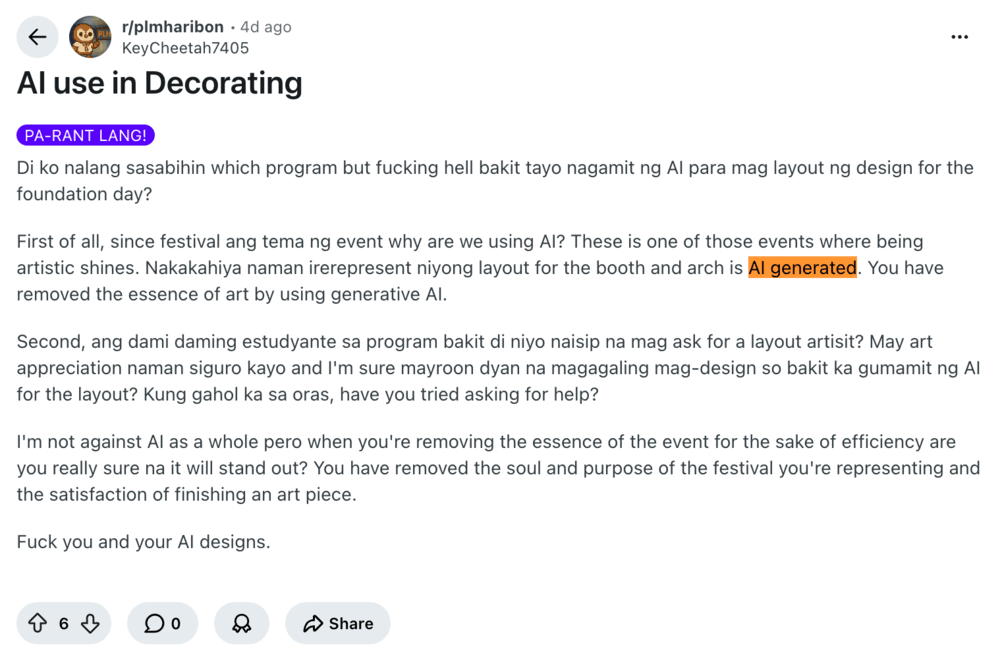
- Visual art: “You have removed the essence of art by using generative AI” – Reddit, reacting to an AI-generated design at an artist’s booth
- Film: “AI slop. Heartbreaking to see such great artists resort to generative AI” – on Prada’s AI Kojima trailer
03 Platform pollution and feed degradation
5.2k negative mentions
People are frustrated with AI content degrading the quality of platforms and social feed:
- comment bots
- Pinterest AI image spam
- YouTube AI remixes of creators’ videos without consent
Example quote:
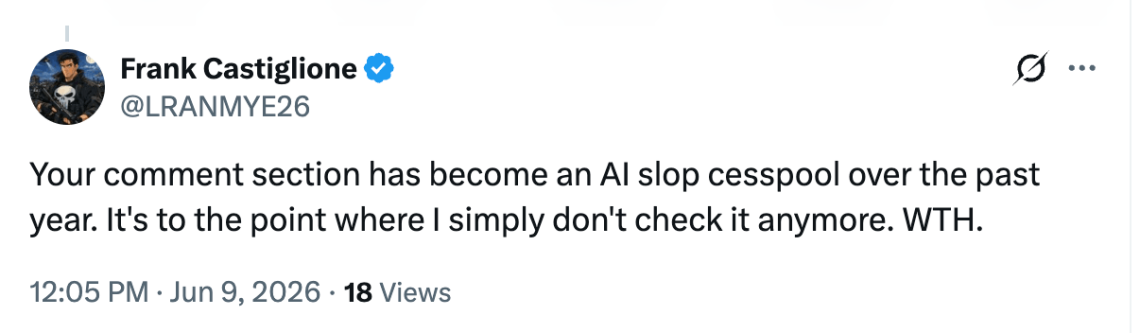
- “Your comment section has become an AI slop cesspool over the past year”
04 Political AI propaganda
1.6k negative mentions | 6.7M reach
Accusations of AI-generated political manipulation appearing all over the political spectrum.
Example quotes:
- “this crappy ai generated slopaganda will totally work”
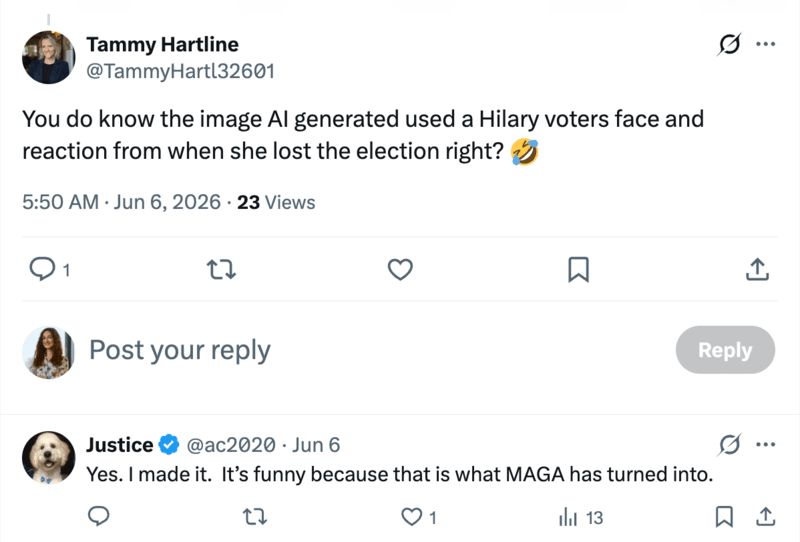
- “The image AI generated used a Hillary voter’s face and reaction from when she lost the election right?”
05 AI code without human oversight
283 negative mentions
The main complaint of the developer communities is that AI-generated code is getting pushed to production without enough review.
Example quotes:
- “Anyone who merges such a huge PR of ai generated code doesn’t deserve trust.”
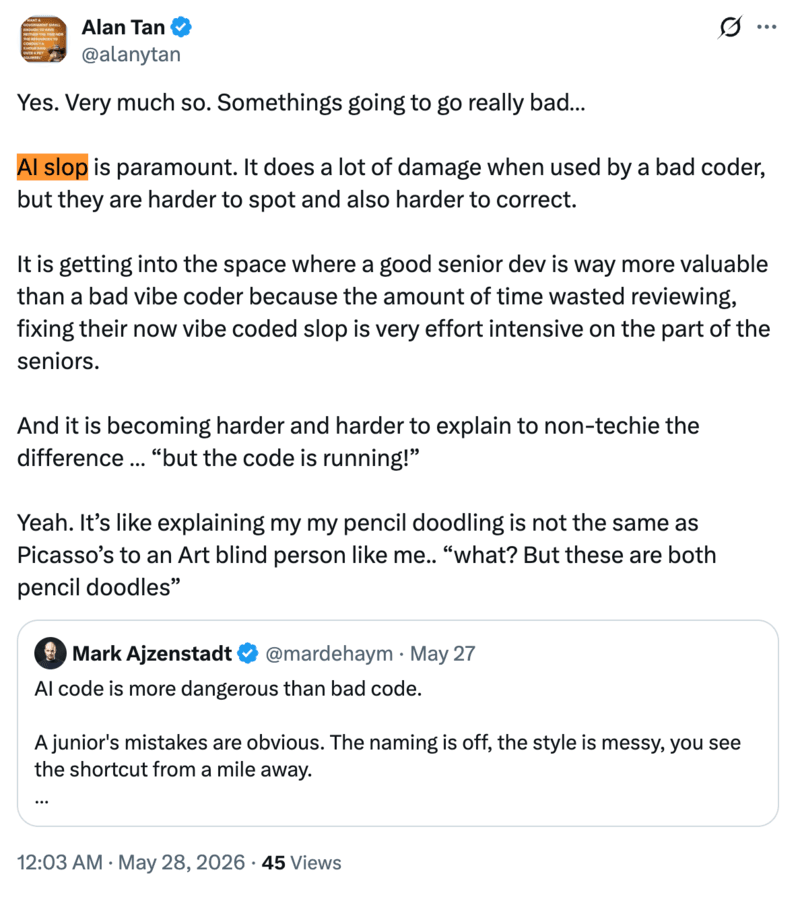
- “AI slop is paramount. It does a lot of damage when used by a bad coder, but they are harder to spot and also harder to correct… a good senior dev is way more [valuable].”
What do people think about AI slop?
Social media monitoring tool found that the word “slop” appears in 79.7k posts, which is nearly 35% of all mentions in this project, with a total reach of 221.8M.
“AI slop” has become the go-to term people use when talking about how they hate AI-generated content.
To let you get the scale: TikTok alone now has 1.3 billion videos labeled as AI-generated on its platform.
“AI slop” phrase is the community’s informal way of filtering for such low-quality content: three out of every four uses of “slop” or “AI slop” are negative.
What gets called “slop”?
I used Smart Context Filter to see what gets the “slop” label most often:
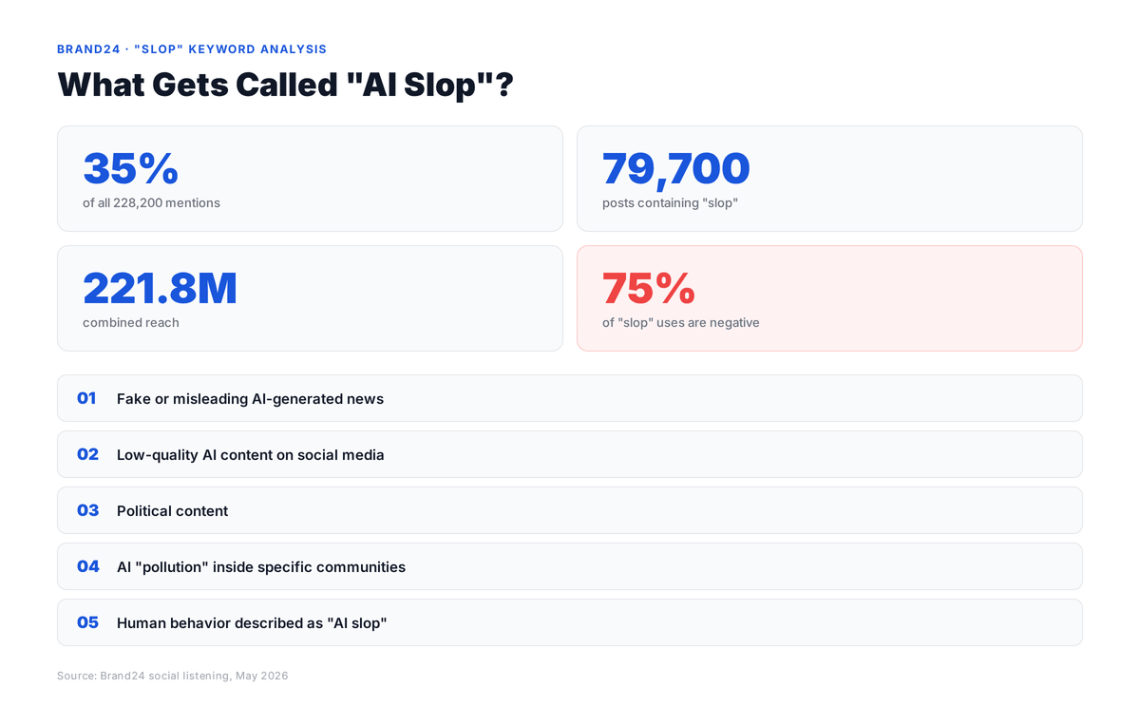
01 Fake or misleading AI-generated news
- politician voice clones
- “real” celebrity pics that aren’t real
- deepfakes presented as news
02 Low-quality AI content on social media
- Pinterest feeds packed with AI images
- YouTube full of AI remixes of creators
- comment sections filled with AI bots
03 Political content
- a lot of accusations of AI political manipulation
- Trump’s AI-generated music videos and social posts
04 AI “pollution” inside specific communities
- artists putting “NO AI SLOP” in commission posts
- gaming communities tagging AI-made assets as slop
- subreddits debating bans on AI music
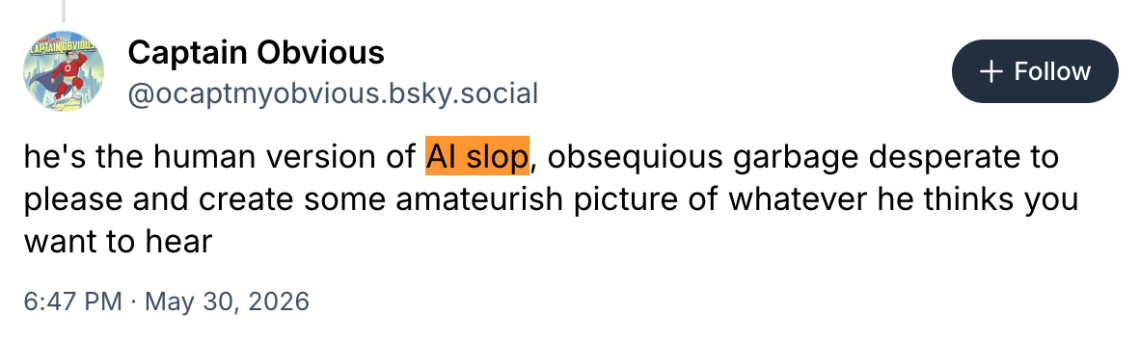
05 Human behavior
- some people extend it beyond content and use it to insult others
Example quote:
- “he’s the human version of AI slop, obsequious garbage desperate to please”
Hashtags and keywords used when discussing AI slop
| Hashtag | Uses | Context |
|---|---|---|
| #aislop | 399 | This “prostest hashtag” is used almost entirely in negative-sentiment posts |
| #art | 88 | Visual artists resisting AI in creative communities |
| #fuckai | 34 | Most aggressive anti-AI voices with negative-only context |
| #idv_no_ai | 33 | Identity V gaming boycott campaign |
| #aiart | varied | Used in both pro-AI and anti-AI discussions |
Images and videos are the content types people most often call “slop”: AI visuals tend to get the strongest negative sentiment.
Text-based AI content generates fewer “slop” references, which is helpful context for brands trying to figure out where their risk is highest.
How people discuss generative AI for brand content
Besides the posts that talk about AI content in general, there’s a part aimed straight at brands from various industries.
I analyzed them separately to spot patterns in how people discuss brand AI content, what they think brands are getting right, and where they’re doing wrong when it comes to using generative AI for content.
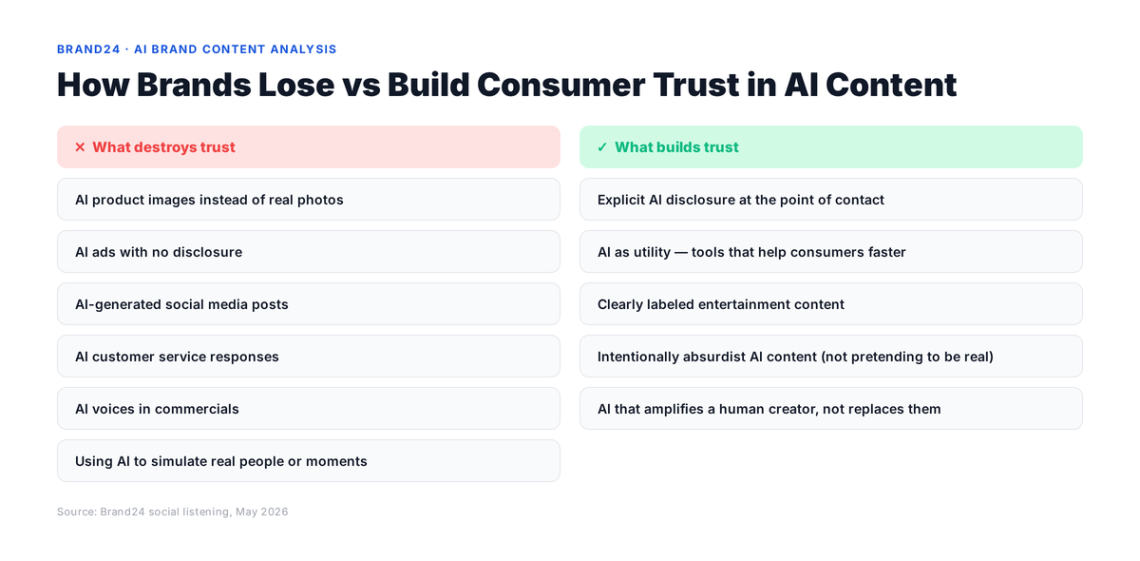
How brands destroy consumer trust in AI content
- 1 AI product images that don't match the real product
- 2 AI ads with no disclosure
- 3 AI-generated social media posts
- 4 AI customer service responses
- 5 AI voices in commercials
- 6 Using AI to simulate real people, real moments, or real product quality
How brands build AI content credibility
- 1 Transparency about using AI and making this information easy to notice
- 2 Treating AI like a practical tool that helps consumers do things faster
- 3 Clearly labeled AI-generated entertainment, especially on platforms where AI visuals are already “a norm”
- 4 Intentionally absurd or “unhinged” AI content that’s not pretending to be real
- 5 Using AI to enhance a human creator’s work instead of replacing the creator
What damages AI-generated content brand authority trust? A deep dive
01 AI product images kill buyer intent
Consumers treat AI product photos as a red flag about product quality.
Example quotes:
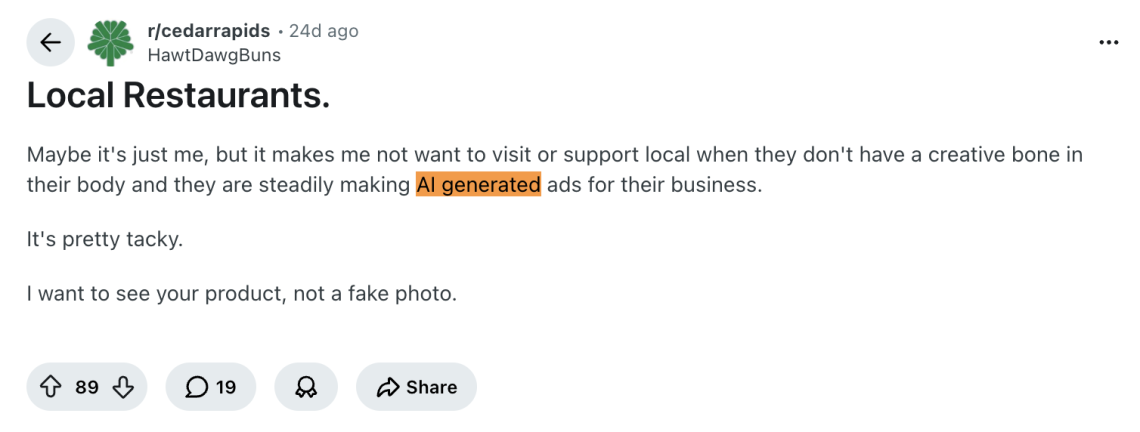
- “Local Restaurants… AI generated ads for their business. It’s pretty tacky. I want to see your product, not a fake photo.”
- “hire real human artists/photographers… This AI generated is garbage“
- “Patronizing a vendor that uses AI generated pictures of their products is a choice.”
- “We can tell that AI generated look at the chicken — it should be 2/10″
02 AI ads get blocked instantly
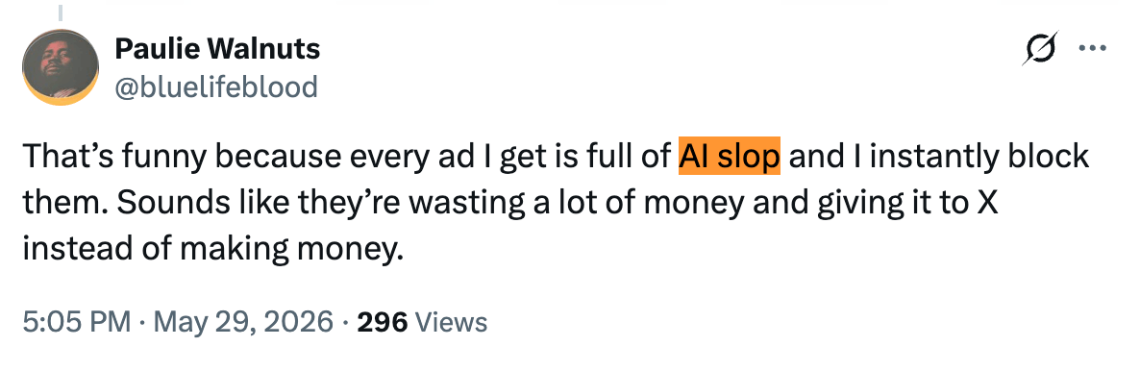
People react the same way to AI-generated ads: they ignore them right away and then actively block them.
Example quotes:
- “Every ad I get is full of AI slop and I instantly block them. Sounds like they’re wasting a lot of money and giving it to X instead of making money.”
- “I have never once spent more than 5 seconds on any AI generated ad. I scroll so fast because it legit hurts my brain. (…) Such a massive insult to your consumers and prospectives.”
03 AI social posts damage brand credibility
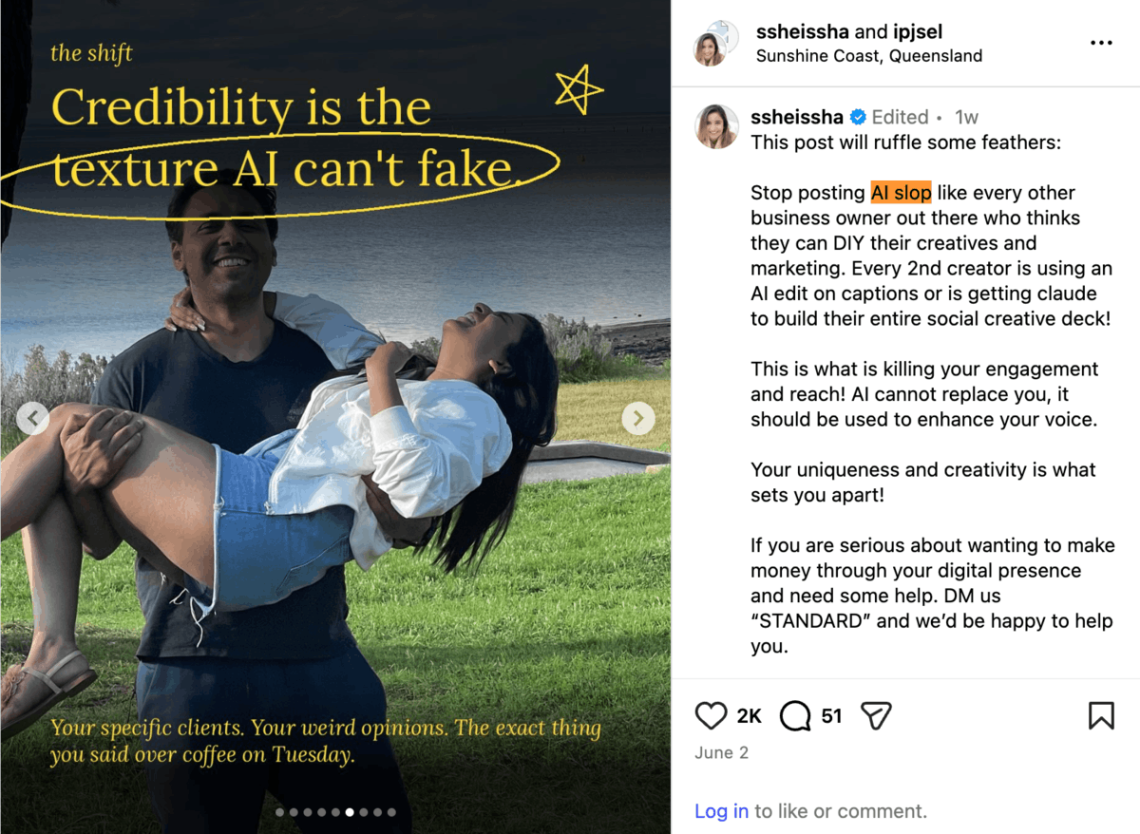
AI social posts are one of the fastest ways to damage AI-generated content brand authority trust.
People reply directly to your brand account and share their frustrations.
Example quotes:
- “don’t ruin your reputation with AI generated posts” — a direct public warning to a brand account
- “Stop posting AI slop like every other business owner” — frustrated consumer
04 The “lazy” vibe is hard to avoid
When people spot AI-generated brand content, their first thought is usually that the brand didn’t want to spend too much money.
Example quotes:
- “does no one at these companies even glance at the AI slop that they generate before making it into an ad?”
- “Cheap cheap cheap”
05 AI voices in commercials are a specific pain point
AI-generated voiceover in ads is very often referred to as irritating.
Example quote:
- “Wow, these AI generated commercial advert’s voices are irritating.”
06 AI avoidance and boycotts are real and organized
Sometimes, people online get so frustrated that they organize boycotts and personal bans on AI-generated content.
- Players protest under #idv_no_ai (used 33 times), refusing to come back to the game, after noticing NetEase’s use of generative AI in Identity V marketing materials
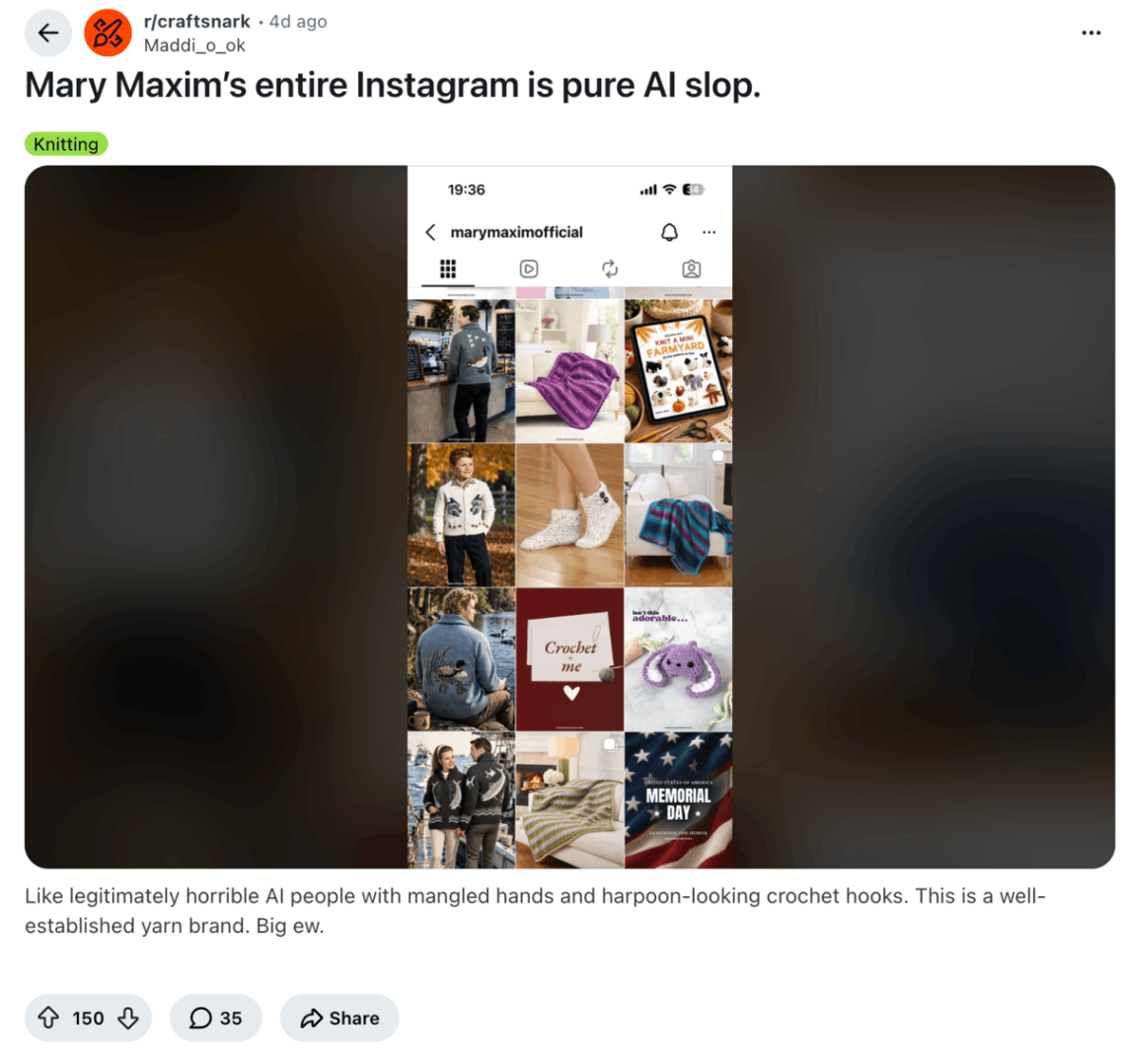
- Mary Maxim customers say AI-generated Instagram content is disgusting and making them think twice before they buy: “entire Instagram is pure AI slop… Big ew”
- Users mention explicitly blocking every advertiser using AI slop on X
- Users vow that they won’t ever engage with any AI-generated ad, no matter the brand size
What people want from AI brand content and what they get
| Dimension | What consumers want | What brands often do |
|---|---|---|
| Authenticity | Real products, real people, and honest moments | Use AI product shots, AI-generated faces, and staged “real-life” scenes |
| Openness | A clear heads-up when content is AI-made | Skip or hide any mention of AI |
| Cost | Don’t waste their time and earn their attention | Cut production budgets in ways that are obvious on screen |
| Creativity | Content that feels fresh, fun, or surprising | Use AI to produce average, “good enough” content faster |
| Context | AI is fine for entertainment, not for high-trust moments | Apply AI blindly across all content types |
Which industries are mentioned in AI brand content discussions
Based on the data I analyzed, nine industries come up most often when people talk about AI-generated content.
A quick list of industries:
- 1 Gaming
- 2 Fashion and luxury goods
- 3 Media and news
- 4 Entertainment and advertising
- 5 Tech and SaaS
- 6 E-commerce and retail
- 7 Food & restaurants
- 8 Sports
- 9 FinTech and finance
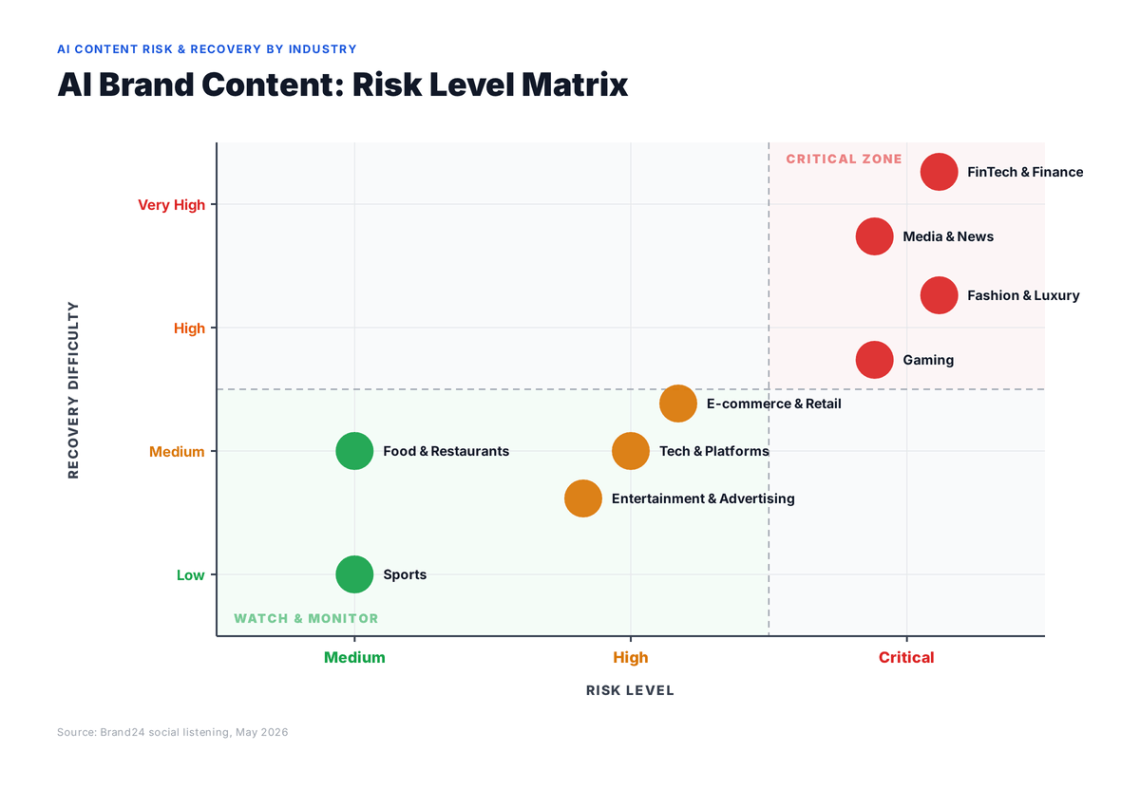
01 Gaming
AI-generated content in gaming = a danger to human creativity
Gaming industry gets the biggest negative response of all sectors.
It is most often mentioned in conversations about AI Authenticity Concerns and AI Creative Production.
Specific cases:
- PlayStation: Accused of using AI-generated promotional materials
- Roblox and Steam games: Repeatedly flagged for AI-generated assets
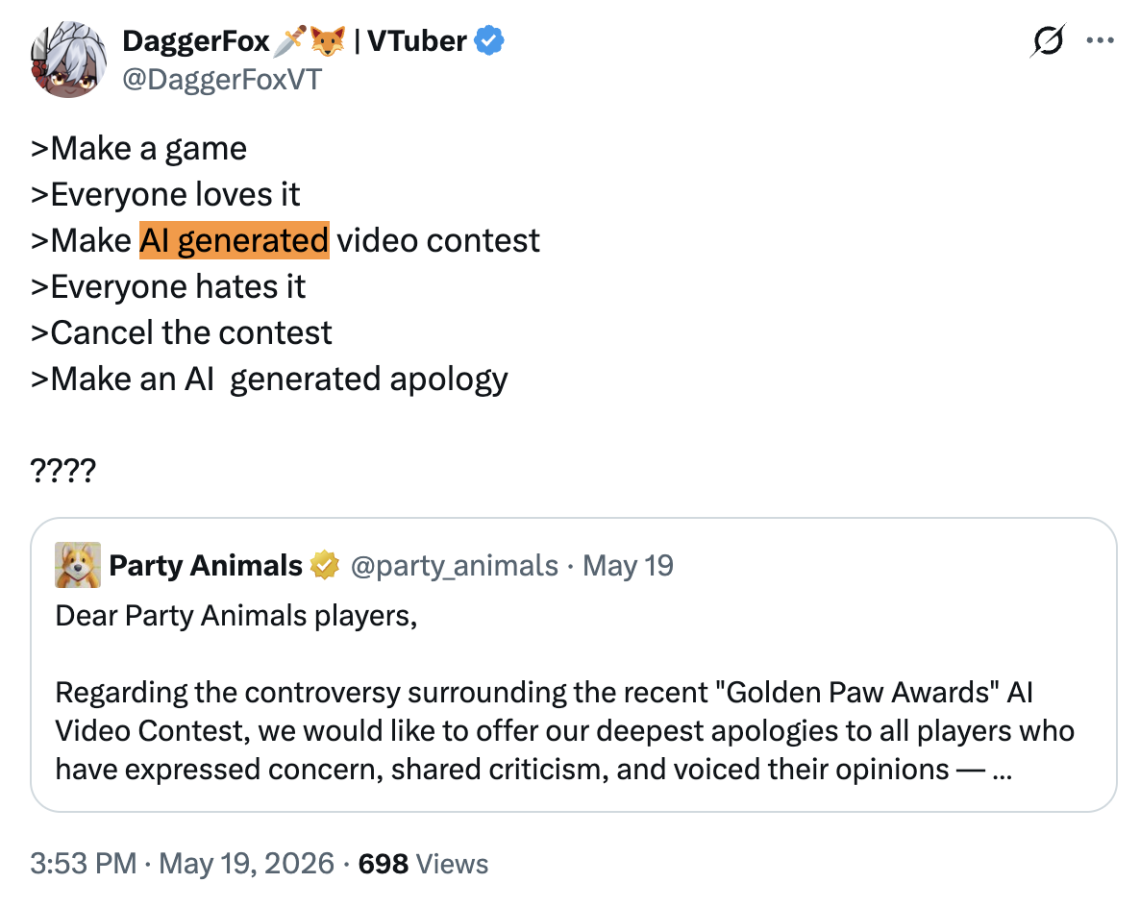
- Party Animals: Ran an AI-generated video contest, then published an AI-generated apology, causing a second wave of criticism
- Example quote: “Make a game → AI generated video contest → Everyone hates it → Cancel the contest → Make an AI generated apology ????”
- Identity V / NetEase: Their marketing activities caused a dedicated anti-AI boycott campaign
- Dead by Daylight: Users questioning AI-looking visuals
AI content rules for gaming brands
| DO | DON’T |
|---|---|
| Use AI to generate elements that players understand are AI (e.g. infinite terrain) | Use AI for paid/commissioned art, character designs, or story content without being honest about it |
| Disclose if AI is involved in a contest or community event | Post an AI-written apology if you mess up with AI content, just own it yourself |
| Engage and talk to the community before using AI in visible ways | Let negative discussions build on Reddit without acknowledging them |
02 Fashion and luxury
AI-generated content in fashion = an insult to the artistry and brand heritage
Fashion and luxury brands very often build their whole brand reputations on the idea that real human skill, vision, and hard work make the high price tag worth it.
So when they start taking shortcuts with AI, it just feels off to many of their customers.
Specific cases:
- Prada: AI-generated trailer for Hideo Kojima’s project
- Example quote: “Heartbreaking to see such great artists resort to generative AI”
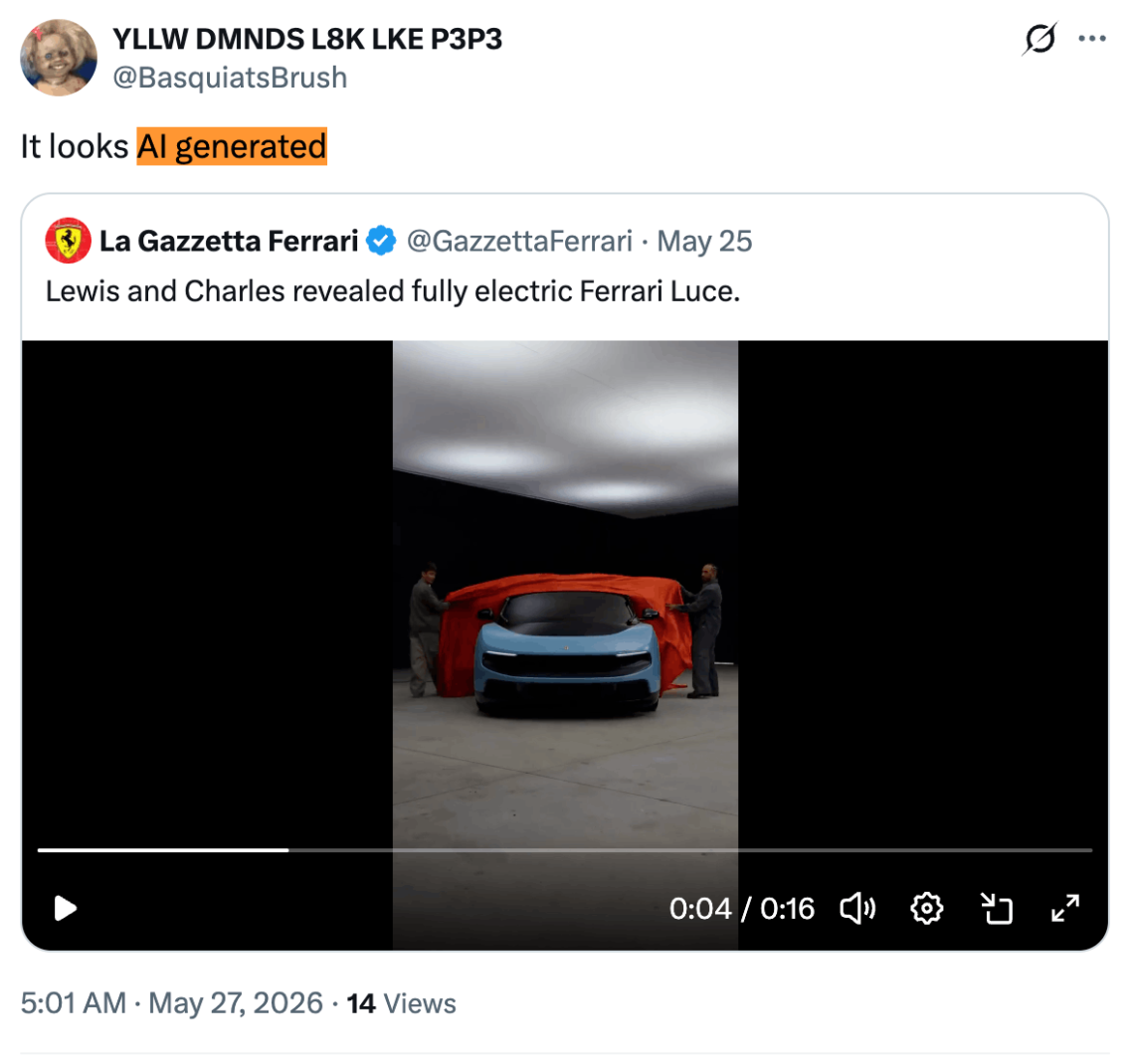
- Ferrari: An image described as “looks AI generated” triggered skepticism about the brand’s standards
- CeeLo Green: Reported a luxury watch brand’s AI image drove one user “mad”
AI content rules for fashion and luxury brands
| DO | DON’T |
|---|---|
| Use AI for internal processes invisible to consumers (logistics, demand planning, supply chain optimization) | Use AI-generated visuals in major campaigns or core brand identity assets |
| If using AI in creative work, position it as a deliberate artistic choice and be fully transparent about it | Let AI-created content show up in any premium context without clearly disclosing it |
| Collaborate on AI-powered projects with human artists who stay in charge of the creative direction | Replace commissioned artwork with cheaper AI substitutes |
03 Media and news
AI-generated content in media = credibility damage
AI-generated content from news outlets is called out as a threat to information credibility.
Specific cases:
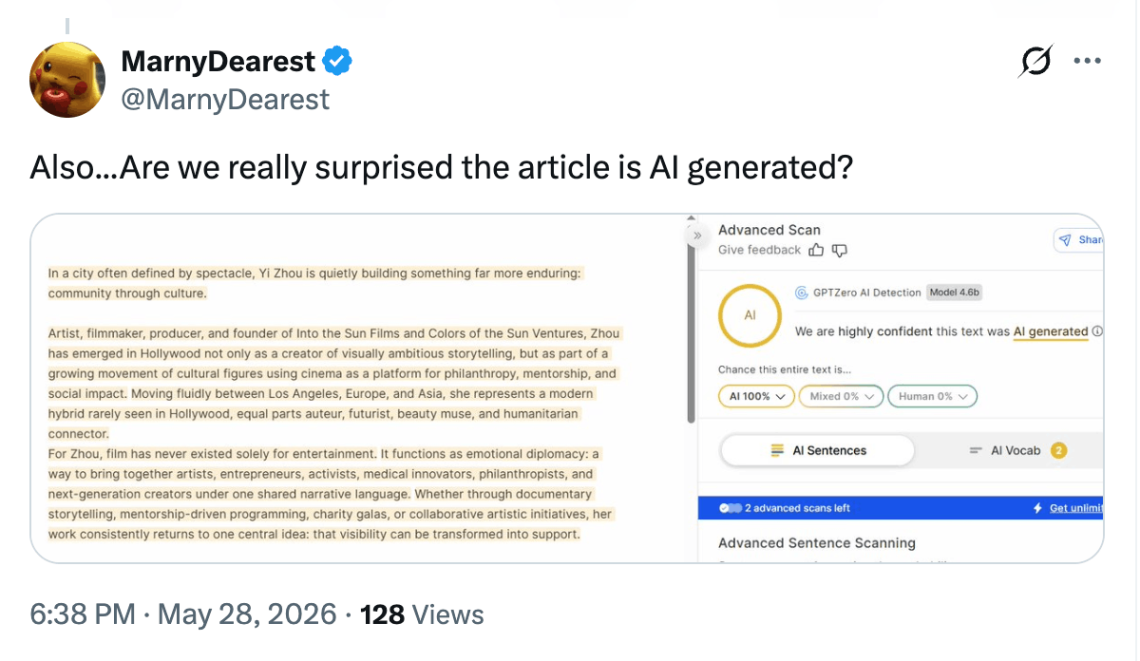
- Reactions to AI-generated articles: “Are we really surprised the article is AI generated?”
- Content farm YouTube channels using AI voices, AI video, and AI thumbnails
- The Guardian published a media industry warning: “In a world of AI slop and exploitative algorithms, consumers are seeking out this journalism, and choosing human-to-human connections”
- NY Times Today‘s article: “Going Viral Isn’t Cool Anymore. How Should Brands Show Up?” that directly links AI slop to brand decline
AI content rules for media and news outlets
| DO | DON’T |
|---|---|
| Use AI for clearly labeled non-editorial tasks like data visualization, writing image captions, accessibility summaries | Use AI to generate editorial text, news copy, or analysis, unless you fully disclose it and it gets human editorial approval |
| Label AI-assisted content clearly, so that readers can see it without looking for it | Blend AI-generated and human-written content without distinguishing them |
| Use AI detection tools as part of your editorial workflow | Assume your readers or competitors won’t notice AI-generated content |
04 Entertainment and advertising
AI-generated content in entertainment = a moral and quality failure
People see AI-generated content in entertainment and advertising as a moral and quality failure because these industries are supposed to understand creativity better than anyone.
Specific cases:
- “Big brands are even on this wave. Such a massive insult to your consumers”
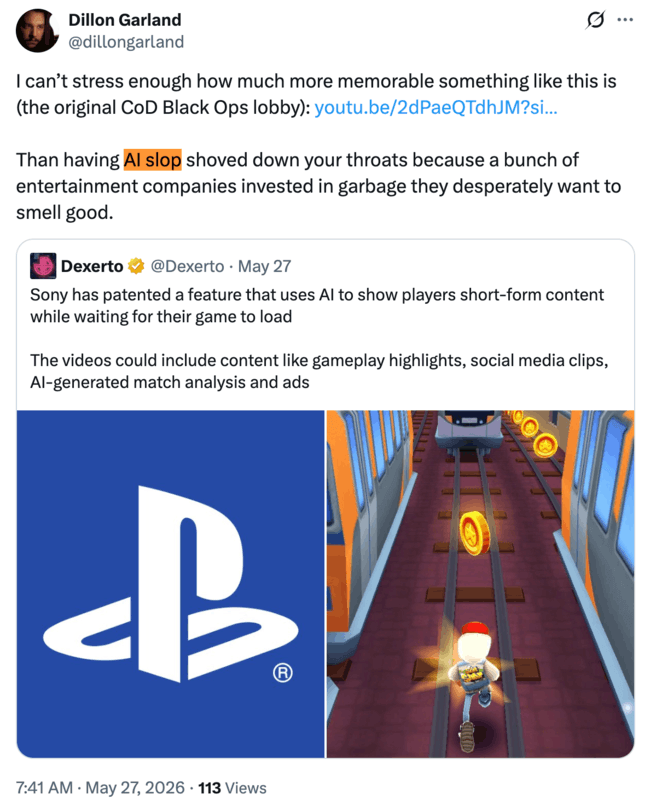
- “Does no one at these companies even glance at the AI slop that they generate before making it into an ad?”
- Entertainment companies described as having “invested in garbage they desperately want to smell good”
- Fake Korean dating site using AI-generated people in YouTube ads
AI content rules for entertainment and advertising companies
| DO | DON’T |
|---|---|
| Use AI to help speed up the production of human-led creative work | Let AI take over the creative concept, human direction, or final quality review |
| Be transparent with clients about where AI is used in production | Charge human-creative rates for AI-generated work without disclosing it |
| Test AI-driven ads with real audience panels before launching | Assume the target audience won’t notice or won’t care |
05 Tech
AI-generated content in tech = a systemic accessory to the crime
Tech companies get criticized for both the AI content they produce and for building the whole ecosystem for AI slop.
Specific cases:
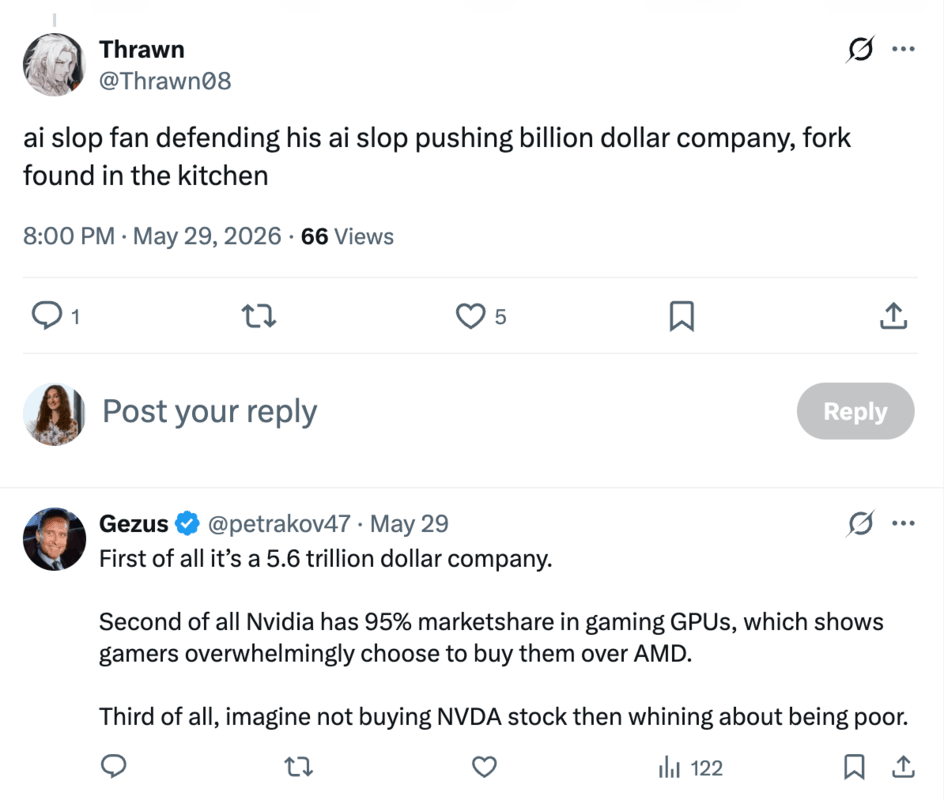
- Nvidia: “AI slop fan defending his AI slop pushing billion dollar company”
- YouTube: AI remixing creators’ videos without consent
- Advertisers on X: “every ad I get is full of AI slop and I instantly block them”
- “I can’t even walk outside without getting bombarded by AI billboards by stupid tech bros“
AI content rules for tech brands
| DO | DON’T |
|---|---|
| Proactively build and publish AI content policies that protect creators and users | Allow AI-generated content to remix or replace creator content without consent |
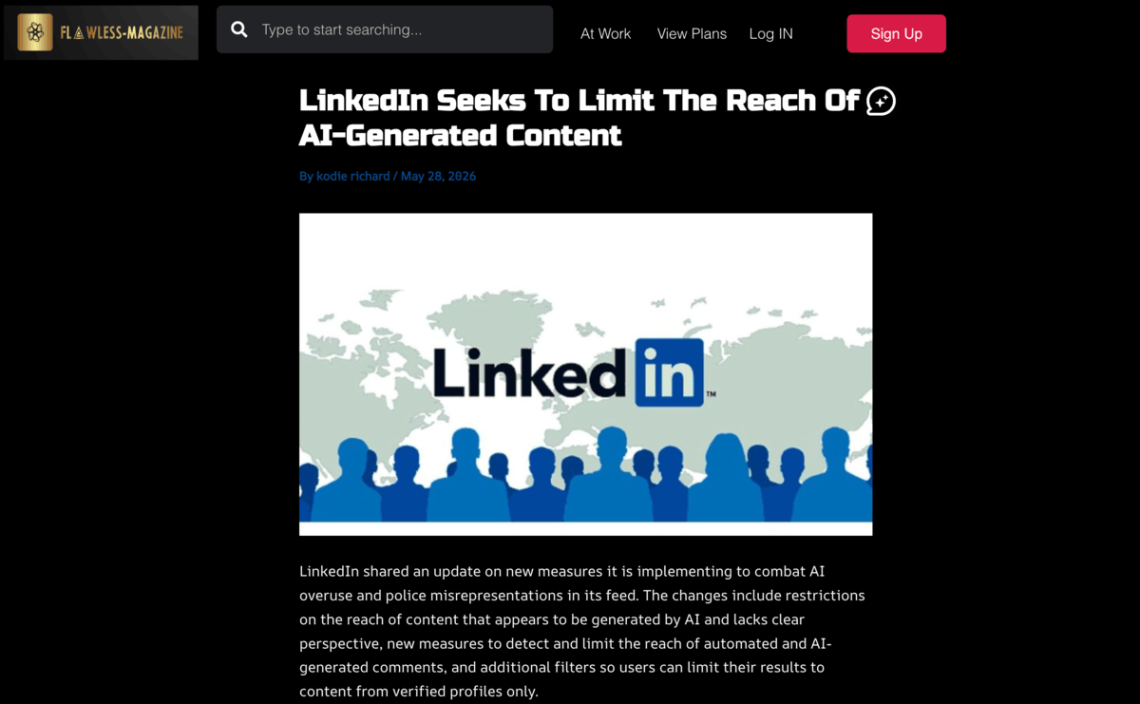
| Take visible platform-level action against AI spam (Linkedin’s approach is cited positively) | Let advertiser AI slop spread unchecked on your platform |
| Build source tracking and watermarking into AI tools | Wait until regulations force you to adopt transparency standards |
06 E-commerce and retail
AI-generated content in ecommerce and retail = reason for a change of purchase intent
Retail brands that use AI-generated product images get an instant reaction from clients, and some people even decide not to buy because of it.
Specific cases:
- Mary Maxim (yarn brand): “entire Instagram is pure AI slop… Big ew”
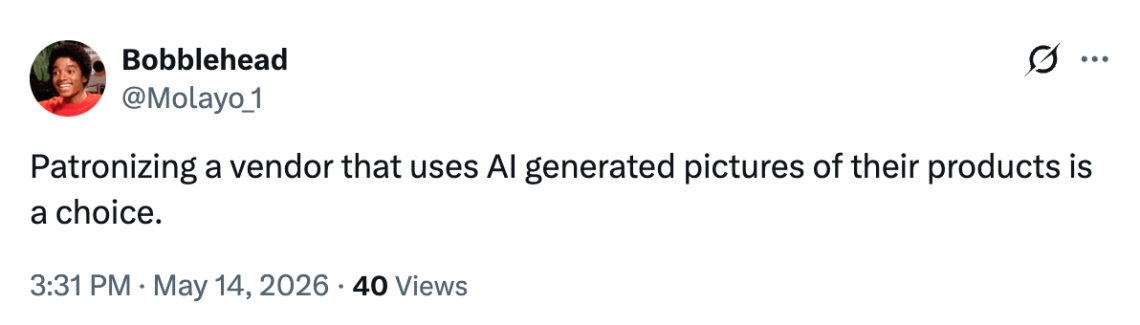
- “Patronizing a vendor that uses AI generated pictures of their products is a choice“
- Artists explicitly marketing “COMMISSIONS OPEN… NO AI SLOP“ as a value proposition against AI-using competitors
AI content rules for e-commerce and retail brands
| DO | DON’T |
|---|---|
| Use AI to help write product descriptions (labeled as AI-assisted) | Use AI-generated images to represent physical products |
| Clearly label AI-generated summaries clearly and build the disclosure into the UI | Use AI images to make products look better than they really are |
| Use AI for internal catalog management, pricing, and inventory | Replace real product photos for AI-generated images in every possible context |
07 Food and restaurants
AI-generated content in the food industry = disappearance of product trust
Restaurants that use AI-generated images often get a simple reaction: if the photo isn’t real, neither is the food.
Specific cases:
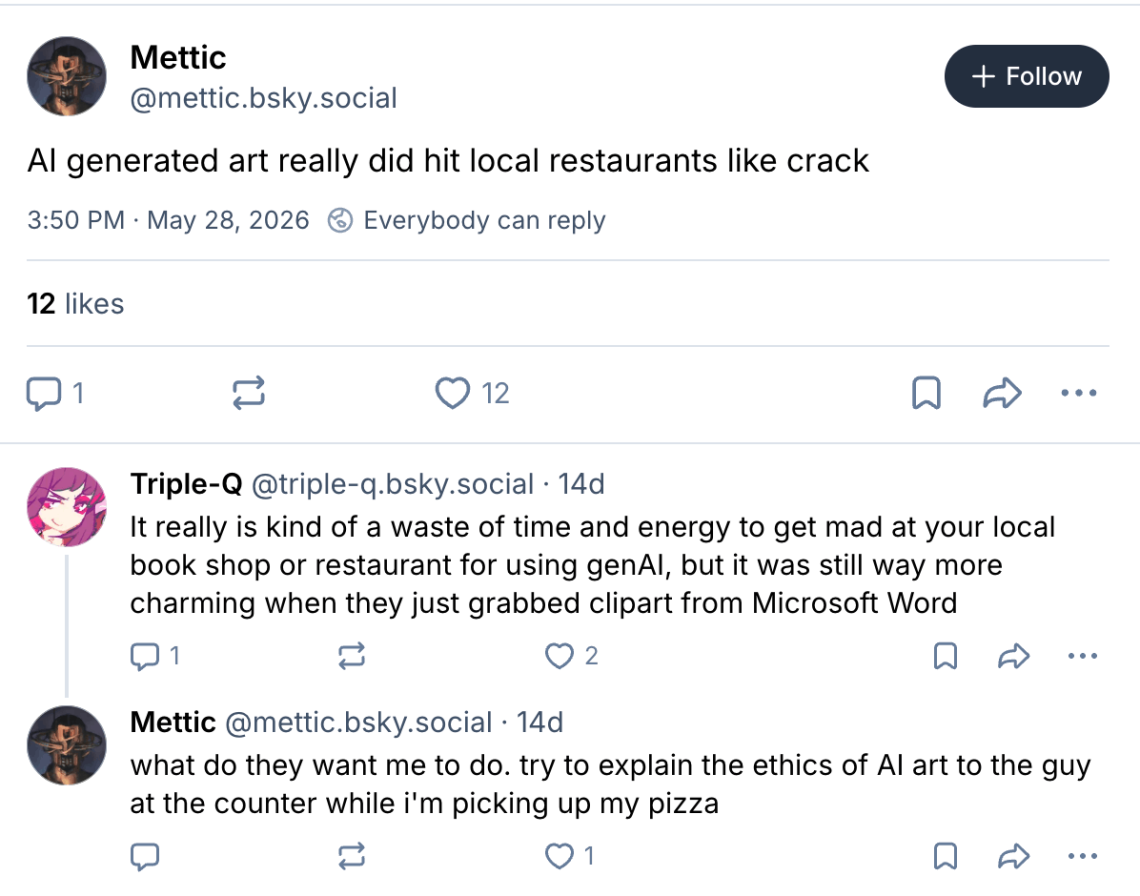
- “Local Restaurants… AI generated ads for their business. It’s pretty tacky. I want to see your product, not a fake photo.”
- “AI generated art really did hit local restaurants like crack”
- “What’s this AI slop doing at a restaurant?“
- DoorDash driver story: used AI images to fake deliveries
- “hire real human artists/photographers… This AI generated is garbage“: directed at a food product brand
AI content rules for restaurant brands
| DO | DON’T |
|---|---|
| Use AI for menu optimization, reducing waste, and optimizing kitchen workflow | Use AI images as substitutes for real food photography |
| Use AI to help with scheduling posts on socials, copy ideas, or caption drafts | Put AI-made food imagery in anything customers will see |
| Invest in real photography; it builds trust | Use AI to make dishes look different from what you really serve |
08 Sports
AI-generated content in the sports industry = trust loss and growing skepticism
Sports organizations are being reported more and more by people who are very skeptical about their AI-looking branding assets.
Specific cases:
- England Football World Cup kit: Accused of being AI slop
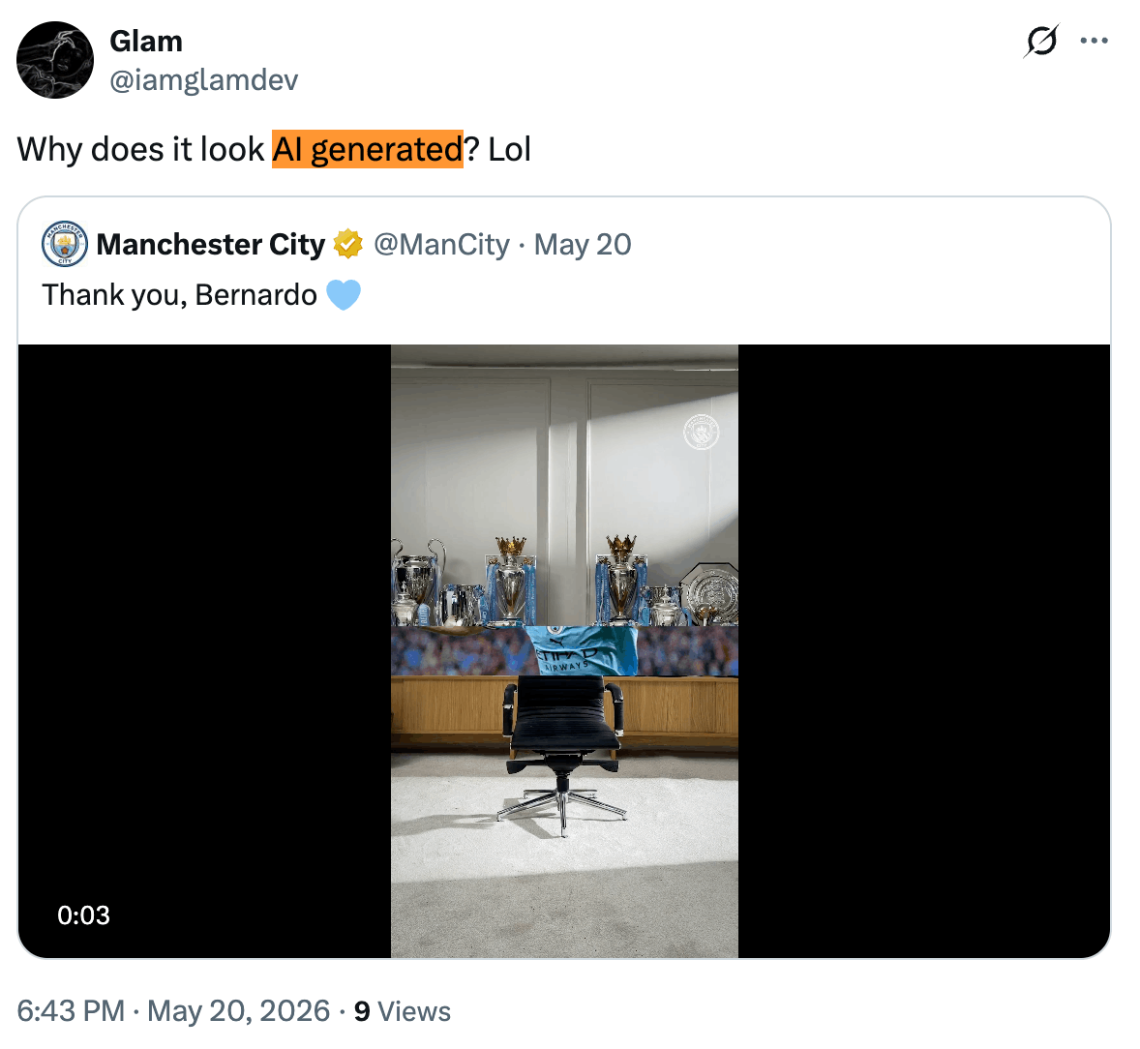
- Manchester City: X post flagged by users as: “Why does it look AI generated?”
- WWE / Triple H: Social media post reported to be AI-generated
AI content rules for sports brands
| DO | DON’T |
|---|---|
| Use AI for analytics, performance tracking, and fan engagement features | Use AI-generated visuals for official kit designs, player photos, or core club identity materials |
| Use AI to deliver personalized fan content, as long as it’s obviously customized and clearly labeled | Let “AI-ish” quality slip into any official branding |
| Use AI to build interactive fan experiences, with clear information that AI is involved | Use AI faces or AI-generated athlete imagery in any realistic or photo-like settings |
09 Finance and FinTech
AI-generated content in the finance industry = customer trust loss and disgust
Trust is already a sensitive issue in the finance industry, so people quickly notice the disconnect between “trust me with your money” and “we couldn’t be bothered to make a real ad”.
Specific cases:
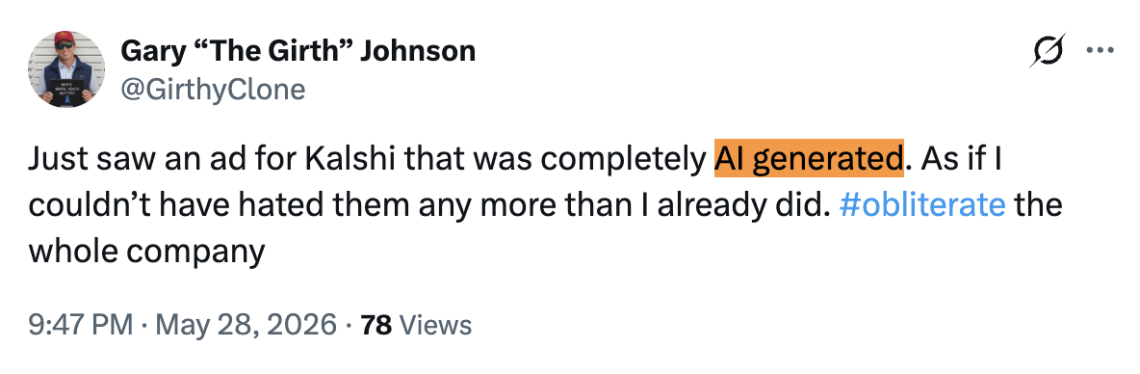
- Kalshi (fintech prediction market): AI-generated ad triggered many reposnses like: “As if I couldn’t have hated them any more than I already did”
AI content rules for finance brands
| DO | DON’T |
|---|---|
| Use AI for fraud detection, risk analysis, and compliance (processes invisible to consumers) | Use AI-generated content in customer-facing ads or brand communication |
| Use AI to deliver personalized financial reports or alerts, and make sure it’s clearly labeled | Use AI imagery or AI voices in any context related to customer trust or financial decisions |
| Create and share a clear AI policy for how you use AI in customer communication | Let AI-generated customer service responses go out without human review |
A brand checklist for AI-generated content
After analyzing the data, my conclusion is clear: AI content can work when it’s done right.
43% of businesses say they’re afraid of using AI themselves, mainly because they’re worried about accuracy and bias.
This means the AI content credibility problem is both a consumer perception issue and a real challenge inside the companies too.
Here’s what “doing it right” looks like, according to the Brand24 social listening tool:
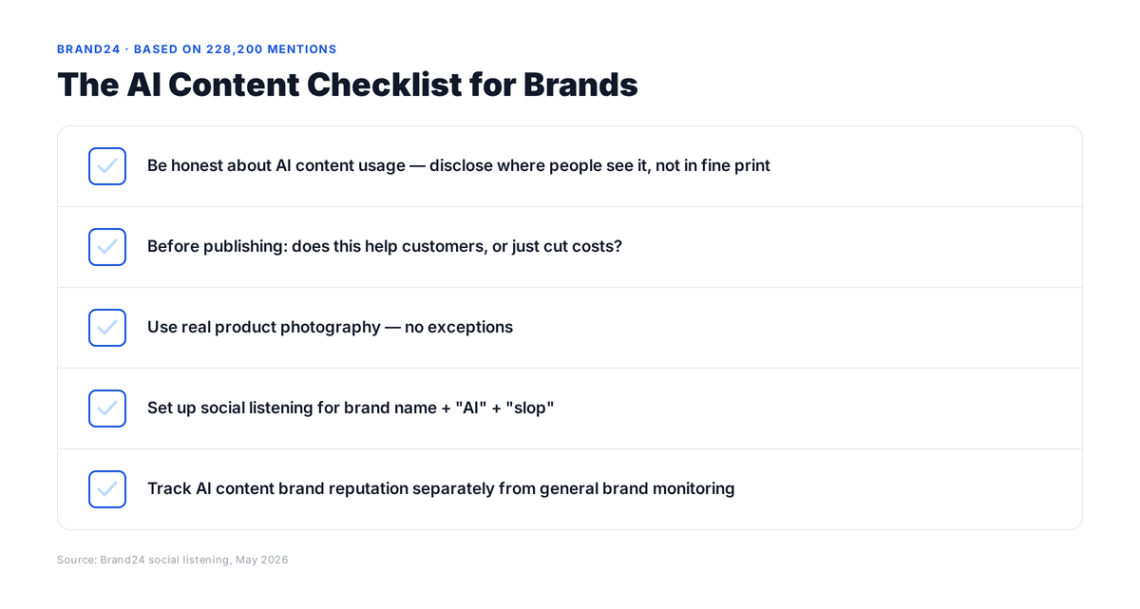
01 Be honest about AI content usage
Don’t hide it in a caption, a terms page, or an “about” section.
If it’s AI-generated, say so where the consumer encounters it.
02 Before you publish anything made with AI, ask: is this helping customers, or just cutting costs?
If the real answer is “it saves us money,” your audience will know.
If it’s “it helps customers do something faster or better,” make that the core message.
03 Use real product photography
AI-generated product images make people less likely to buy, no matter the industry.
The data makes this super clear, and it’s one of the most common problems I’ve seen in the mentions.
04 Set up social listening for your brand name + “AI” + “slop”
If you start seeing those three terms show up together even a few times, react immediately.
05 Track your AI content brand reputation individually
The sentiment analysis patterns can be totally different, and evaluating everything together as a combined score means that you might miss a sentiment drop that came from a heated critique of AI-generated content.
Set up a dedicated media monitoring project that includes your brand name with AI-related keywords.
The 4 rules of positive AI-generated brand content
I reviewed all the positive AI brand content examples in this dataset and the AI trust signals they create.
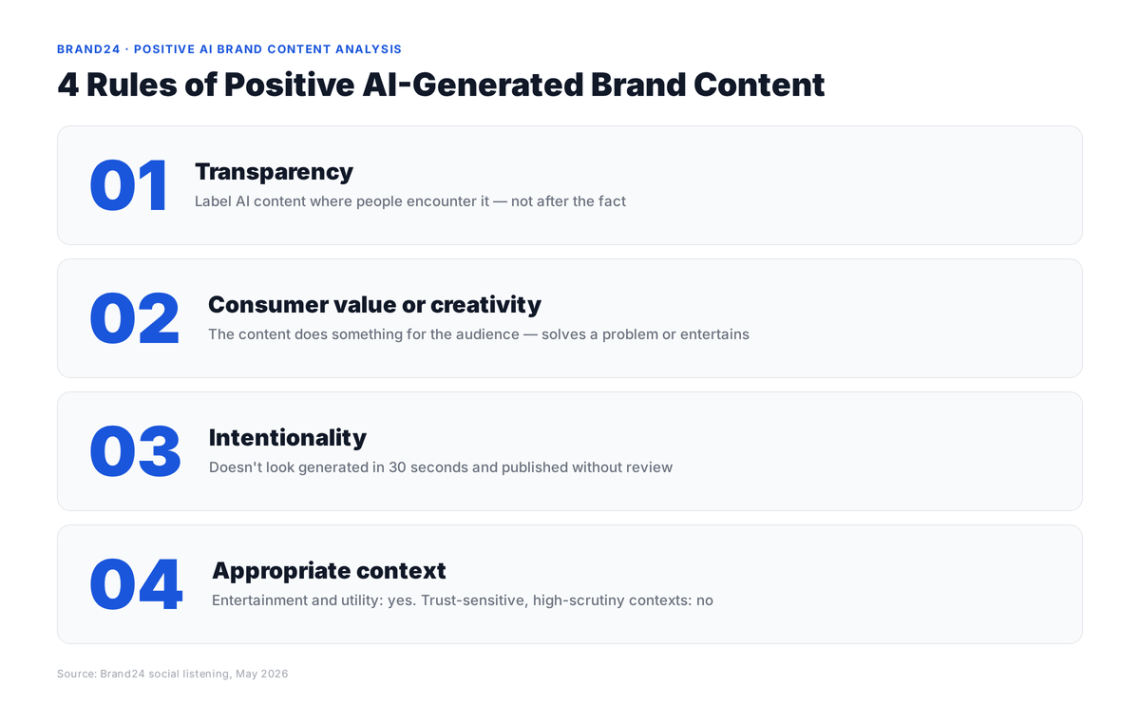
They all share four key traits:
- 1 Transparency
- 2 Consumer value or creativity
- 3 Intentionality
- 4 Appropriate context
01 Transparency
Always clearly label AI content.
Put the label right where people see the content and don’t bury it later. If it feels hidden, people will get frustrated.
Examples of praised AI-generated content labels:
- “AI Generated using Kling AI”
- “AI Generated from customer reviews”
- “This feature provides AI-generated assistive responses”
02 Consumer value or creativity
Make sure AI-generated content serves the audience.
Every positive case in our data either solves a problem for the user or entertains them.
Positive examples:
- Amazon’s review summaries help shoppers decide faster.
- CapCut tutorials teach viewers how to make their own content.
- Voxdeed’s AI contracts save time.
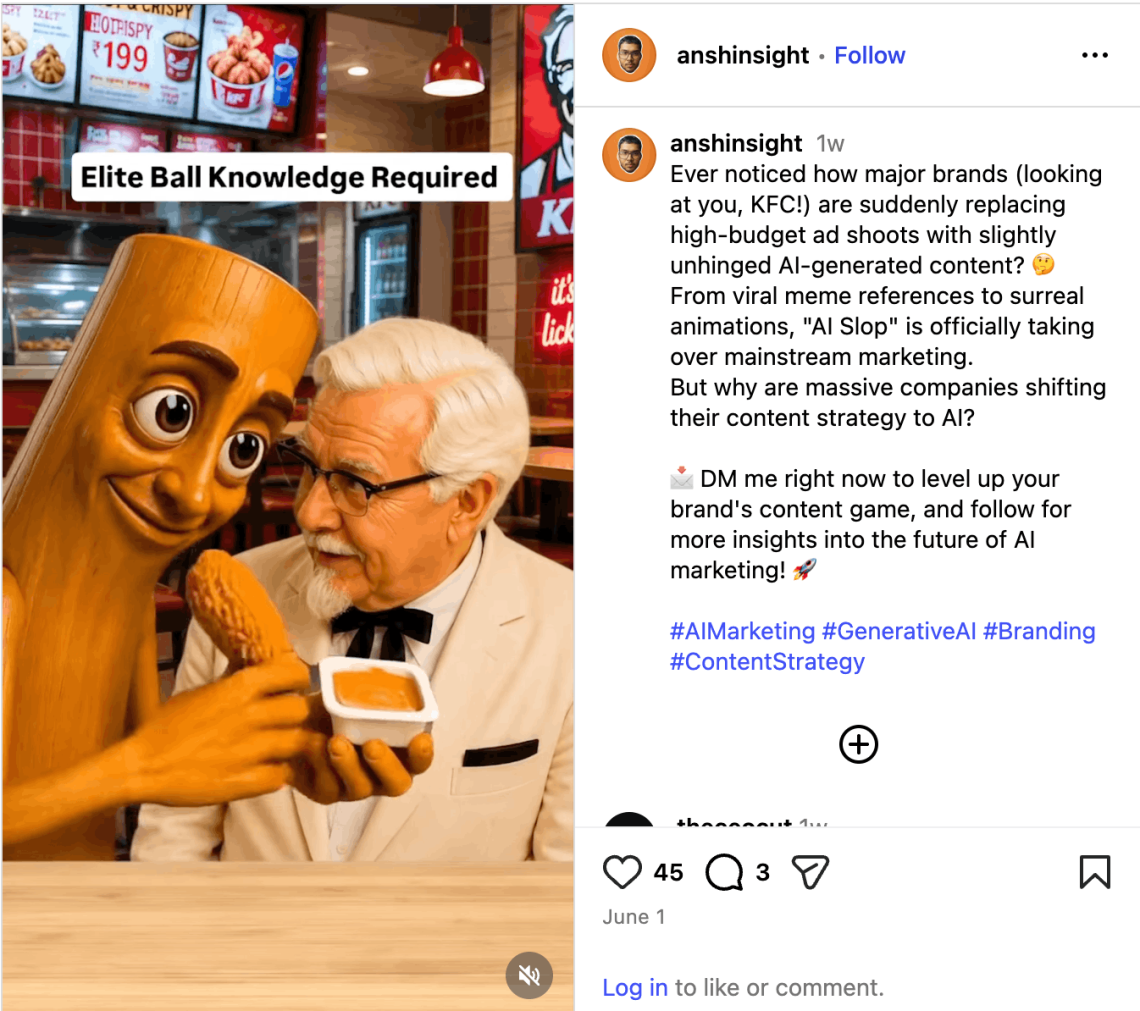
- The absurdist KFC content delights (“Ever noticed how major brands (looking at you, KFC!) are suddenly replacing high-budget ad shoots with slightly unhinged AI-generated content? From viral meme references to surreal animations…”)
03 Intentionality
Make your AI content with a clear purpose.
It can’t look like it was generated in 30 seconds and published without any review.
Example quotes:
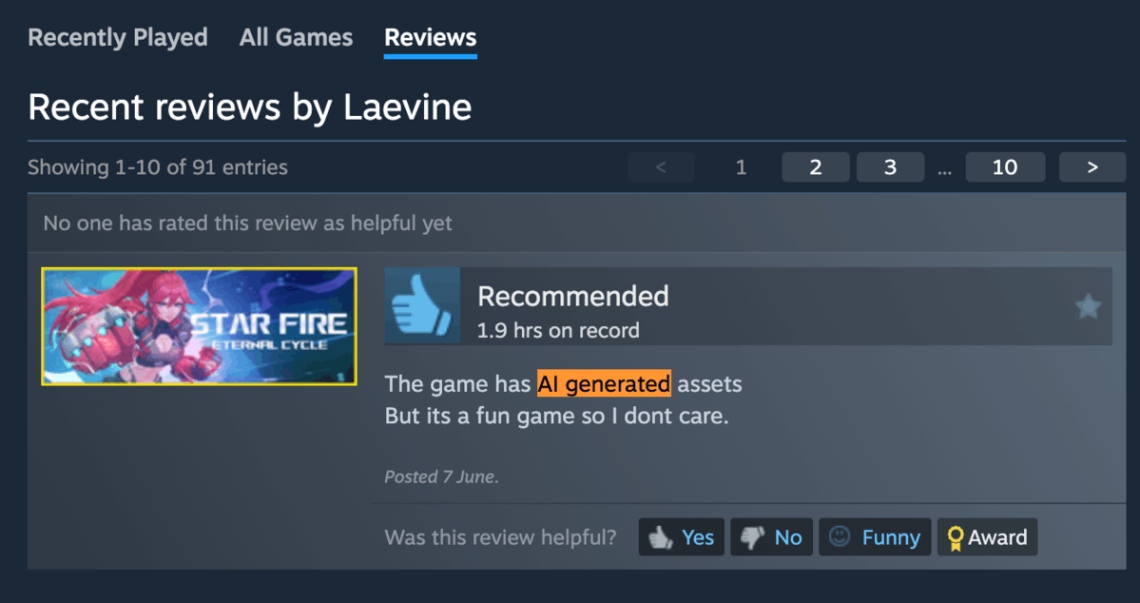
- “The game has AI generated assets But its a fun game so I dont care” from a Steam user
04 Appropriate context
AI-generated content tends to do great in entertainment, helpful/utility posts, and creative experiments.
On the other hand, it doesn’t work well in situations where trust, credibility, or authenticity are important.
For example, the same AI image that gets 35.2% positive sentiment on a Facebook lifestyle page could cause hostile responses in a financial services ad or a luxury brand campaign.
The AI-generated content dos and don’ts framework
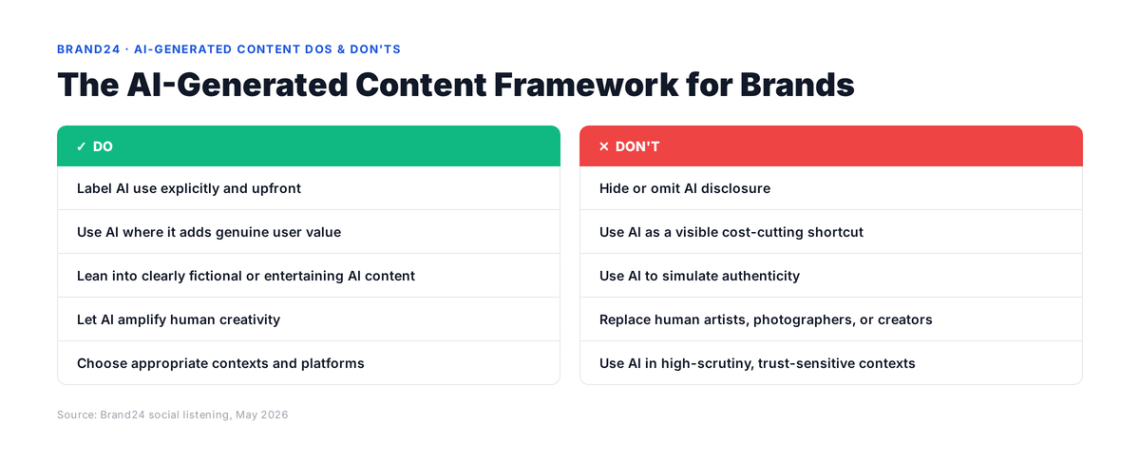
After analyzing the full social listening dataset, I prepared the five clear takeaway pairs on how brands in any industry can use AI-generated content:
| DO | DON’T |
|---|---|
| Be clear and upfront when AI is used | Hide or omit AI disclosure |
| Use AI only when it genuinely improves the user experience | Use AI as an obvious cost-cutting shortcut |
| Use AI for content that’s clearly fictional or just for fun | Use AI to fake authenticity |
| Let AI support and enhance human creativity | Fully replace artists, photographers, or creators with AI |
| Choose appropriate contexts and platforms for AI usage | Use AI in high-trust, high-scrutiny situations where credibility matters most |