Table of contents
2M Marketers

Somewhere on the internet, a new ChatGPT vs Claude mention lands every 22 minutes, and that conversation has just grown 5x in the last 3 months.
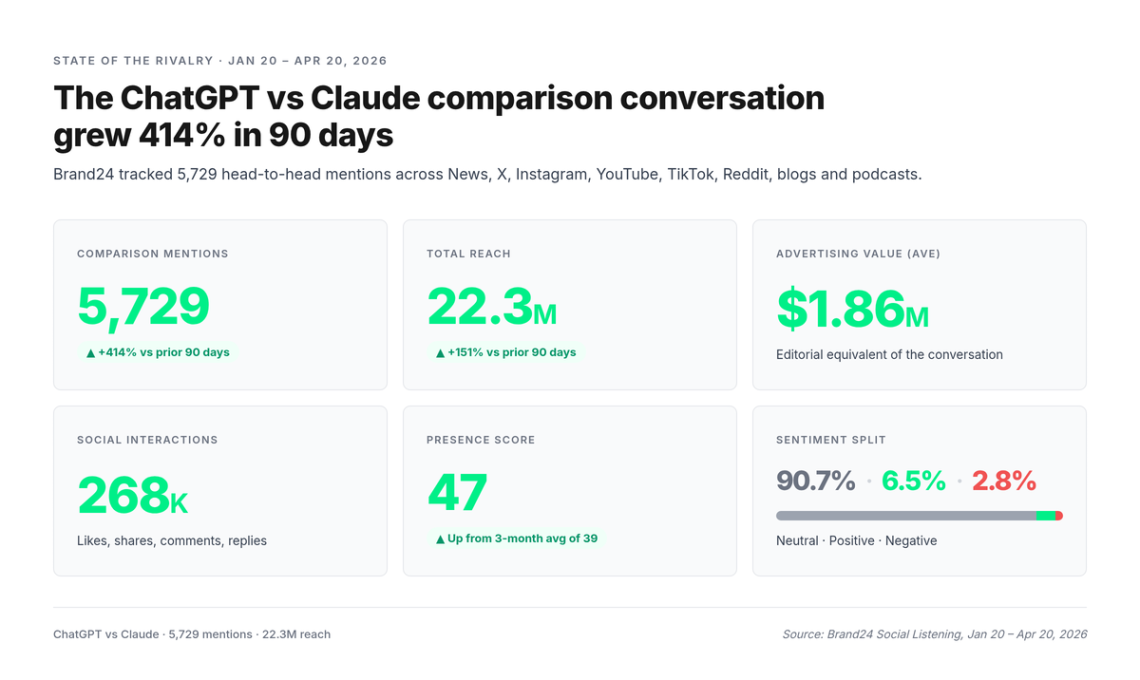
From January 20th to April 20th, 2026, we tracked 5,729 direct comparisons of ChatGPT and Claude using Brand24’s social listening. These mentions reached 22.3M people – that’s about the entire population of Florida or Taiwan!
The most interesting difference we found was how each community talks: Core Claude users see ChatGPT as a real competitor. But ChatGPT users don’t really seem to feel the same way about Claude.
Key takeaways:
-
Run a dedicated "your brand vs competitor" project in your social listening.
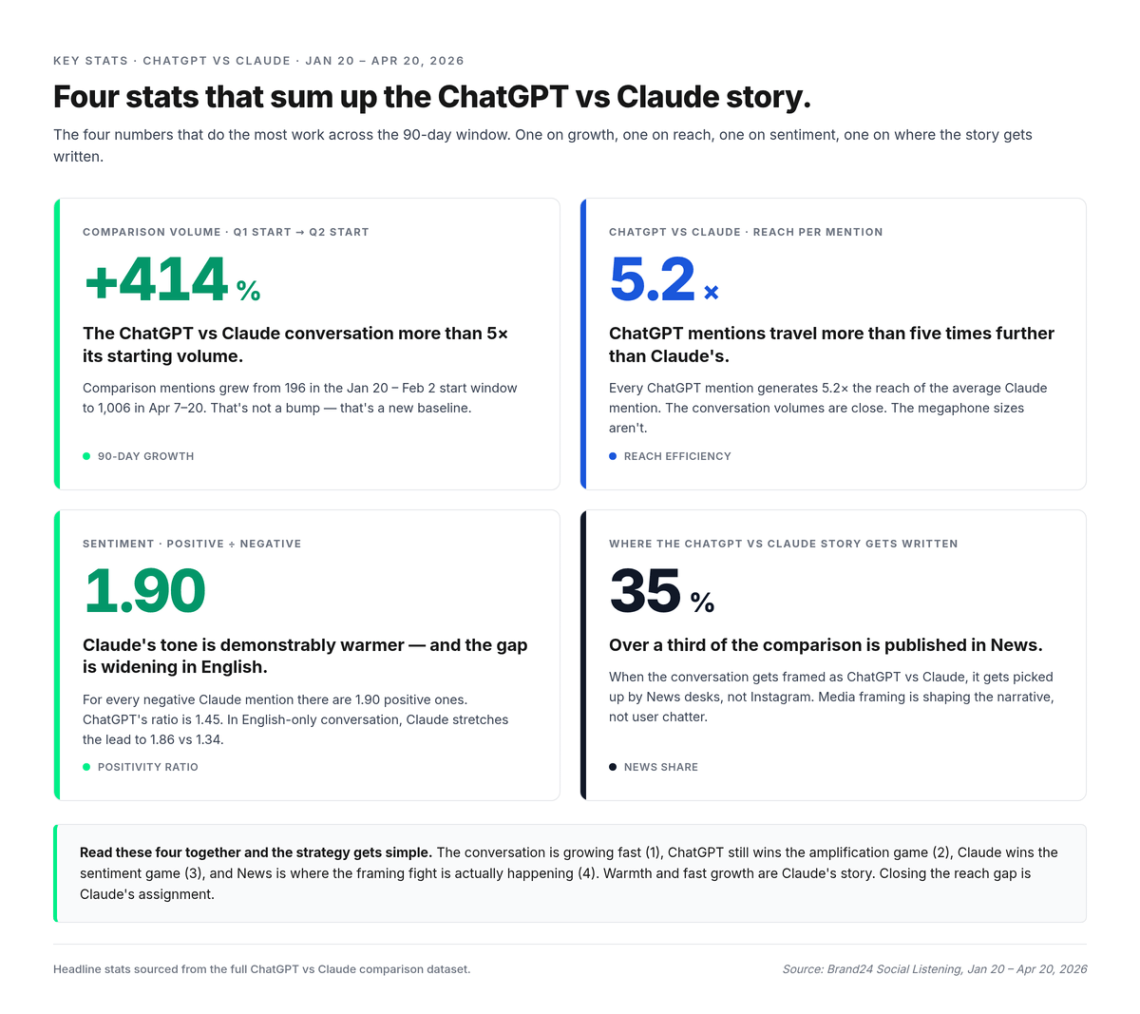
The conversations comparing ChatGPT to Claude shot up by 414% in 90 days. Neither brand's normal mention volume came close to that jump. If you only keep an eye on your own brand name, you'll miss the fastest-growing part of your industry's chatter: the very conversations where people decide which tool to pick. Use keywords like "Brand X vs Brand Y," "Product X versus Product Y," and the common ways people naturally phrase it.
-
Focus on reach efficiency, not just the total reach
ChatGPT has 5.2x Claude's reach per mention overall, but TikTok delivers 20.2k reach per mention across the whole comparison conversation. If you're struggling to catch up in reach, don't just churn out more content. Instead, figure out where each post will be amplified the most. Start tracking "reach per mention" right next to your "total reach." Total reach tells you how loud you were, but reach-per-mention tells you if you picked the right way to shout.
-
Watch which language your reach is concentrated in, not just how much overall reach you have.
Claude's huge 7.2x disadvantage in English reach almost disappears when you look at Portuguese, where it’s basically tied per mention with ChatGPT. Your reach gap against a bigger rival is likely bigger/smaller in certain languages or channels. Make sure to break down your reach by language (dempgraphics) in your social listening. If you find a language where you are on par with your competitor, that's a prime spot to grow your brand awareness without needing to spend way more.
-
Audit your context of discussion once a quarter, the way you'd audit your SEO keywords.
Claude's #4 hashtag being #chatgpt is a big clue about how both LLMs are positioning themselves. Take a look at your top 20 hashtags. Get rid of the ones that are just your brand name, and then read what's left. If you see a competitor's name or a major category word showing up high on the list, it means your audience sees you in comparison to something else. That frame is either something you can lean into or something you need to change.
This report breaks down exactly what people are saying in that comparison, looking at the popular hashtags, the main topics, where the conversations are happening, and in which markets.
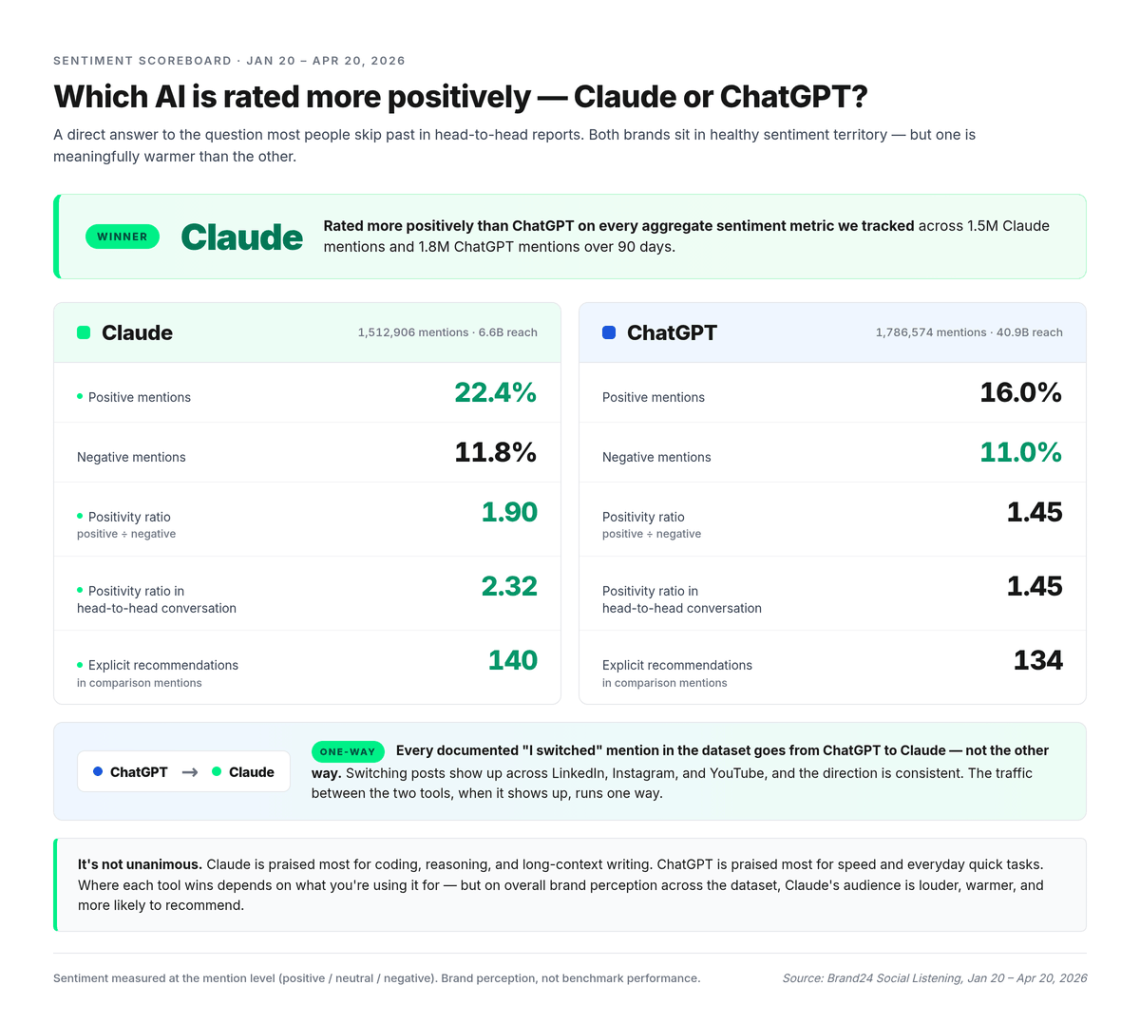
Which AI is rated more positively — Claude or ChatGPT?
Short answer: Claude.
Over the 90-day social listening period, it seems people are generally enjoying Claude AI usage more.
They talk about it in a more positive way than they do about using ChatGPT, and you can see this brand perception trend across the sentiment & engagement metrics.
Quick comparison:
| Metric | Claude | ChatGPT |
|---|---|---|
| Positive mentions | 22.4% | 16.0% |
| Negative mentions | 11.8% | 11.0% |
| Overall positivity ratio (positive ÷ negative) | 1.90 | 1.45 |
| Explicit recommendation mentions | 140 | 134 |
| “ChatGPT vs Claude” positivity ratio | 2.32 | 1.45 |
| “I switched to” mention volume | 1.3k | 0 |
For every 10 times people say something negative about Claude, they say something positive about it 19 times. When it comes to ChatGPT, for every 10 negative mentions, there are 14 positive ones.
And when people say they switch between these two tools, the direction is one-way: every documented “I switched” mention in this dataset (which was 22% of all direct comparison mentions) goes from ChatGPT to Claude, never the other way round.
ChatGPT vs Claude conversation grew 414% in Q1 2026
According to AICPB data, the ChatGPT app has about 77x more MAU (monthly active users) than Claude (as of February 2026).
We see a similar story in the Trending Topics stats from January 2026 for the overall AI market share: ChatGPT gets 64.5% in comparison to Claude’s 2.0%, putting Claude in 5th place behind Gemini, DeepSeek, Grok, and Perplexity.
Looking just at this data, it’s easy to think ChatGPT completely dominates the online conversation too, both on social and non-social media. (Turns out, that’s not actually the case!)
Here’s what I extracted from the Brand24 social listening metrics from January 20 to April 20, 2026:
- 5.7k people mentioned the ChatGPT vs Claude or OpenAI vs Anthropic comparison (a huge 414% jump from the previous 3 months)
- Conversations comparing these two AI tools got a 22.3M reach (up 151% from the previous period) and 268k social interactions (likes, shares, comments, and replies)
- This topic has a Presence Score of 47, up from a 3-month average of 39 (and it’s still going up) and $1.86M in AVE
These comparison conversations make up 0.38% of all mentions for Claude and 0.32% of all mentions for ChatGPT. Those numbers are almost identically small.
Claude peaked in March with 660k monthly mentions and stayed there through April. ChatGPT peaked earlier with 619k in February, and then dropped 29% by April.
But get this! The conversation comparing them grew over three times bigger (3.4x) in that same time, jumping from less than 300 weekly mentions in early February to over 1,000 in the last week of April.
The OpenAI vs Anthropic discussions are 8x more negative than other topics
The 5,729 ChatGPT vs Claude mentions are split into five distinct topics, and each one has a very different sentiment temperature.
1. AI Model Comparisons
- Biggest topic people are talking about
- 1,713 mentions · 6.2M reach · 54.6% share of voice
- Highest positive sentiment of any topic: 8.8%
- This is where the ‘ChatGPT vs Claude’ testing lives: coding challenges, writing tests, side-by-side demos, actual-use comparisons
2. OpenAI vs Anthropic Rivalry
- 1,037 mentions · 3.8M reach · 33.2% SOV
- 5.6% negative sentiment: high-volume negative topic
- Leadership conflicts, ethics debates, accounting allegations, and acquisitions. X and forums drive most of it.
3. AI Tools & Workflows
- 564 mentions · 1.3M reach · 11.7% SOV
- “Cleanest” topic on sentiment: just 0.7% negative
- Comparing memory features, MCP connectors, and team instruction setups
4. AI Market Leadership
- 44 mentions · 53.5k reach · 0.47% SOV
- 9.1% negative: the highest negative rate anywhere in the data
- Geopolitics and regulation: Pentagon vs Claude, market power questions, industry consolidation debates
5. AI Agent Workflows
- 36 mentions · 5.4k reach · 0.05% SOV
- 0% positive, 0% negative: pure documentation, no strong emotion at all
Here’s the whole picture in one table:
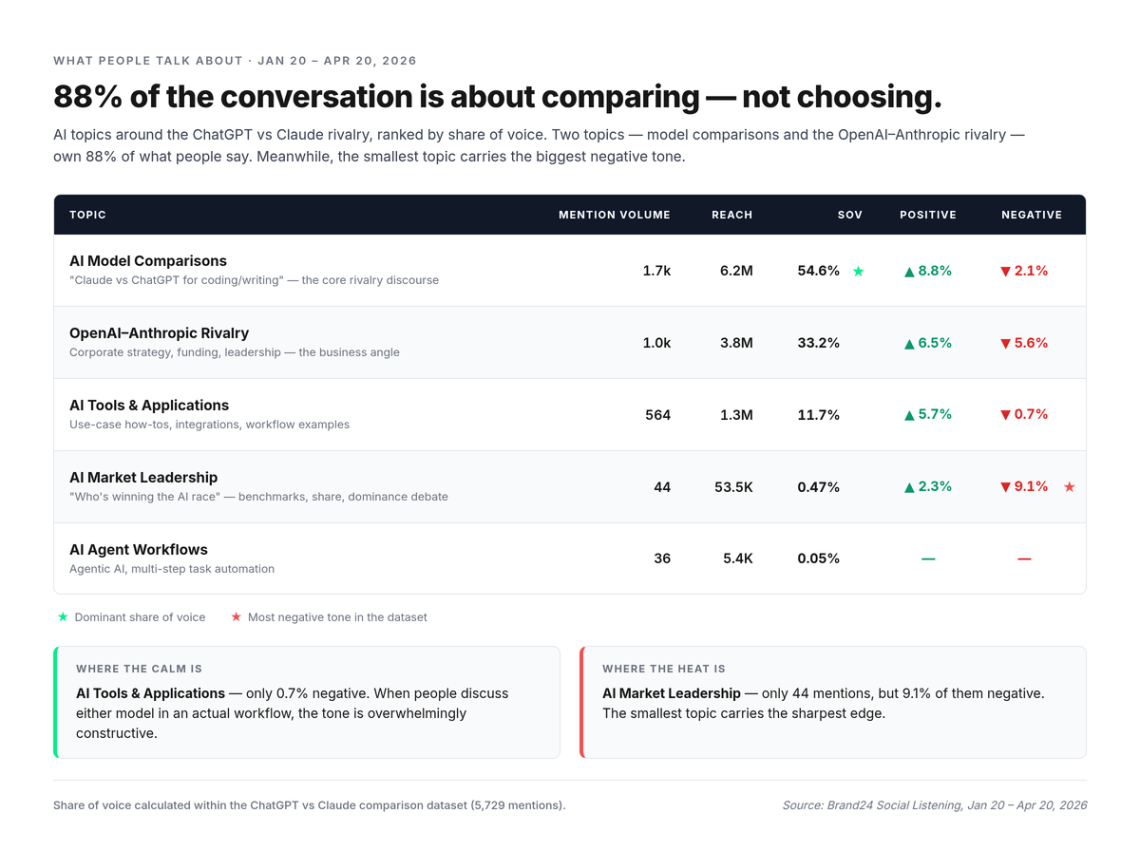
When you look at all five topics, the overall feeling is pragmatic product selection: people are just trying to figure out which tool works best for them.
I found one mention that summed it up perfectly: “Claude vs ChatGPT feels a lot like the Apple vs Samsung rivalry.” To me, that says it all: less about who wins, more about who fits whom.
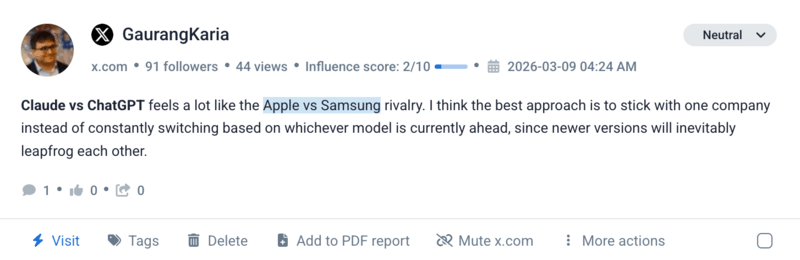
The practical workflow discussion topic has only 0.7% of negative sentiment. But the corporate and AI leadership topics are 5.6% and 9.1% negative.
That’s a huge difference: 8-to-13 times more negative sentiment when people talk about the companies than when they talk about the tools themselves!
If you combined those two numbers together into one, overall brand sentiment score, you would totally miss this important detail.
Is Claude better than ChatGPT? It depends on who’s asking
When people compare ChatGPT and Claude use cases, they usually don’t argue over a single overall winner.
They compare feature by feature, like coding, writing, ecosystem, reasoning, and pricing. And for each aspect, you get a different answer.
Here’s a look at what the media monitoring data tells us about ChatGPT versus Claude use cases:
For developers (Coding): Claude is the clear winner for serious code development work.
- People discuss it as having a bigger memory, handling multiple files at once, and being better at structured, complex planning. The general feeling is, “If you’re building something serious, use Claude.”
- ChatGPT is fine for quick fixes or debugging a small problem, but it struggles with anything that needs deeper understanding or context.
- Basically, Claude Code is the new go-to for professional coding tasks.
For writers (Writing): It depends on what you’re writing.
- If you need a long, thoughtful, nuanced article or piece of content, people say Claude does a better job.
- If you need something fast, short, or involves images/multimedia, social listening insights say ChatGPT is quicker.
The support system (Ecosystem): ChatGPT has a massive advantage here.
- ChatGPT: can browse the web, generate images, and has a huge library of add-ons (plugins).
- Claude: discussed as having a bigger “brain” (context window), but ChatGPT is considered to have all the connections and tools.
How the AI tools “think” (Reasoning): This is where the “thinking partner vs execution engine” comparison lives
- Claude: discussed as more deliberate, slower, more structured
- ChatGPT: talked about as more decisive, faster, more confident
The cost (Pricing): A minor, but often mentioned, detail.
- People notice that ChatGPT’s free and Go tiers now show ads
- Claude stays ad-free across all tiers
- This feels like a philosophical difference as much as a price point.
It’s interesting that almost half (40–50%) of the discussions comparing the AI models don’t even declare a winner. They focus on which model is better for a specific job or need.
Choose ChatGPT for speed, Claude for depth (and most people use both)
Here’s a handy cheat sheet for anyone trying to decide between ChatGPT and Claude, based on what people online recommend and how they are actually using these two AI tools.
| Brand | Strengths | Best for |
|---|---|---|
| Claude (from Anthropic) | Depth, reasoning, long-context writing, serious coding | Technical development, long-form writing, research, analysis |
| ChatGPT (from OpenAI) | Speed, versatility, ecosystem, multimodal, mass accessibility | Fast ideation, image/plugin workflows, broad utility |
Choose ChatGPT if you:
- Need all-in-one tool: web search, image generation, or plugin extensions
- Work in short, fast cycles: ideation, quick replies, brainstorms
- Want the broadest ecosystem and the largest user community
- Care about accessibility: free tier, mobile-first, global reach, mass tutorials
- Work across multiple formats (text + image + voice) in one place
Choose Claude if you:
- Do serious coding or technical development work (Claude Code workflows especially)
- Write long-form, nuanced content like articles, reports, documentation, ghostwriting
- Handle large context: long PDFs, multi-file projects, extended analyses
- Prefer an ad-free experience across all tiers
- Value depth of reasoning over speed of response
Audience verdict:
When people compare Claude vs ChatGPT, about 40-50% of them can’t or won’t choose a clear winner.
The common way they think about it is: Claude is great for bouncing ideas around or thinking deeply. ChatGPT is better for just getting things done.
The most practical advice you see in the social media monitoring data is “just use both!”
Coding and writing drive 80% of the ChatGPT vs. Claude conversation
Before we look at the table, a quick note: some of the ChatGPT and Claude use cases overlap.
If a conversation mentioned one use case, it might also count for a few other categories. That’s why the individual numbers here won’t add up to the total of 5,729.
Just think of each number as how many conversations touched upon that specific topic.
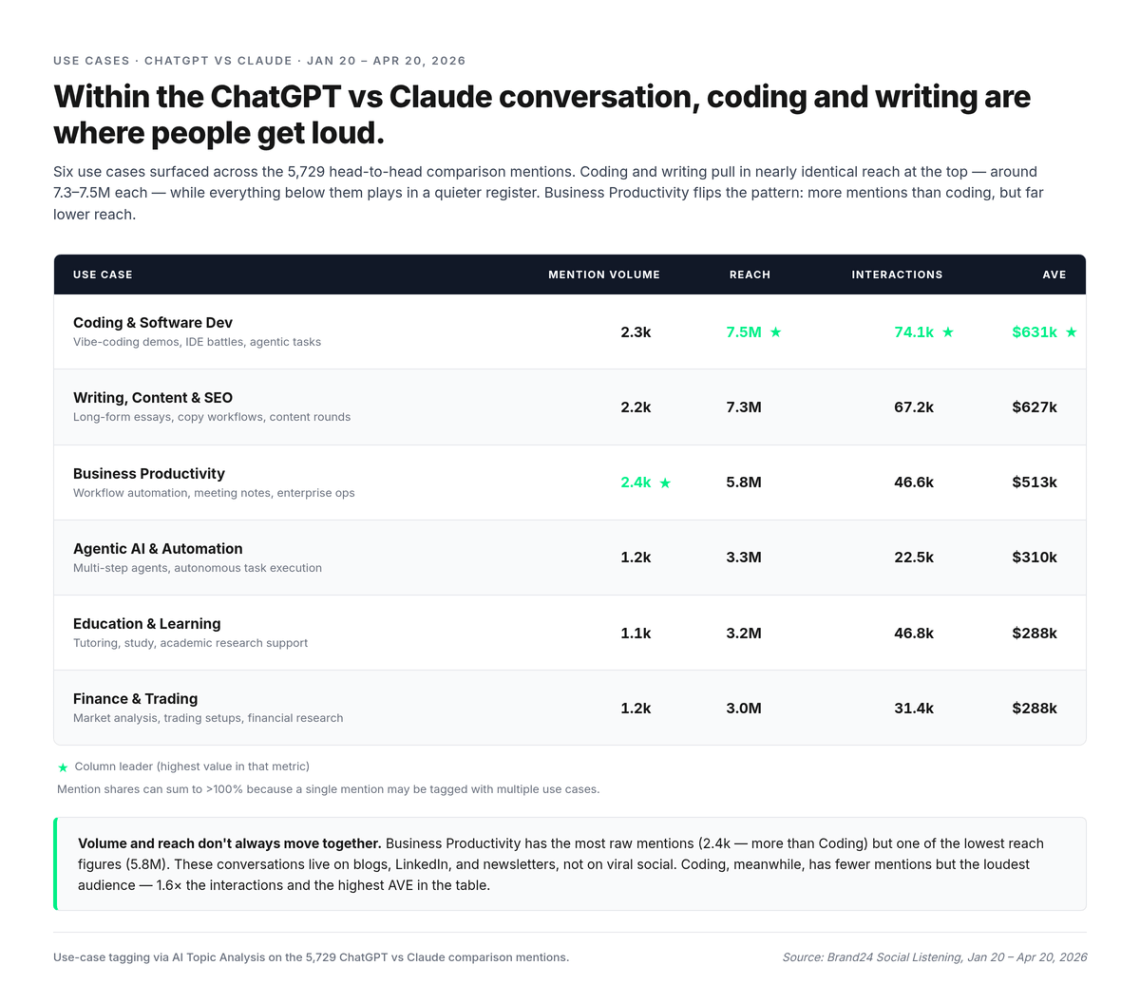
Here are the most interesting things I noticed while digging through the AI use case data:
1. Coding is the most emotionally engaged of them all
Highest interactions (74k), highest positive rate, highest AVE ($631k).
Developers have strong opinions, and they don’t hesitate to share them.
2. Writing is the most shareable category
This use case was shared 2.8k times, more than any other.
It seems that writers comparing ChatGPT’s and Claude’s writing features create a never-ending viral loop.
3. Business productivity is the most compared use case, but has a lower reach-per-mention
This comparison conversation is scattered across smaller places like niche forums and agency blogs.
It’s one of the most positive categories, with almost no negative sentiment (only 1%).

4. Comparisons for finance & trading mainly happen off social media
A huge 82.6% of this discussion is on traditional platforms like blogs, news sites, and financial portals.
People tend to read this content but don’t engage in it much: it had the fewest shares (111).

5. ChatGPT vs Claude for education is surprisingly impactful for its size
Even though it had the lowest number of mentions (1.1k), it reached 3.2M people and drove 46.8k interactions.
A small group of influential creators is making a big difference here.

The biggest chunk of comparison is in Coding and Writing use case categories.
Together, these two drive about 80% of the overall conversation volume and most of the attention.
If you had to pick just two areas to focus on for competitive intelligence about ChatGPT vs Claude AI, these would be the ones.
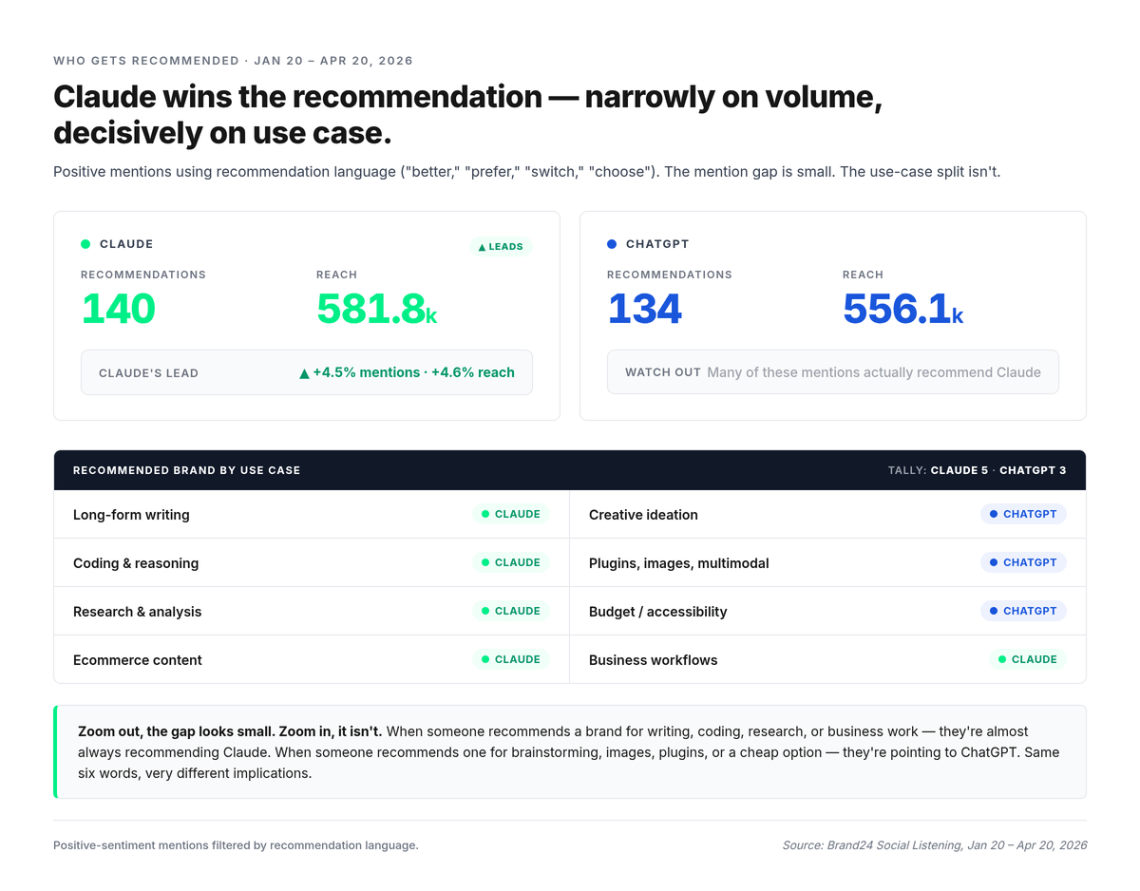
Claude wins recommendations 140 to 134
I dug into the positive mentions and specifically looked for wording people used when they were recommending one over the other, with keywords like:
- “better,”
- “recommend,”
- “prefer,”
- “switch,”
- “choose,”
- “winner.”
Here’s a quick comparison of what I found:
| Metric | Claude | ChatGPT | Edge |
|---|---|---|---|
| Positive rec mentions | 140 | 134 | Claude +4.5% |
| Reach from those recs | 581.8k | 556.1k | Claude +4.6% |
On the surface, it looks close: just a 6-mention difference, and around 26k in reach. You might even call it a draw.
But then I asked an AI Brand Assistant to read and analyze the context of these mentions.
And it turns out that, out of the 134 posts recommending ChatGPT for some tasks, many also bring up Claude as the go-to choice for more complex use cases.
Example from the data:

When you break it down by what people are using the tools for, the difference is even clearer:
| Use case | Audience recommendation |
|---|---|
| Writing, long-form | Claude |
| Coding & reasoning | Claude |
| Research & analysis | Claude |
| E-commerce content | Claude |
| Business workflows | Claude |
| Creative ideation | ChatGPT |
| Plugins, images, multimodal | ChatGPT |
| Budget / accessibility | ChatGPT |
Looking just at the number of positive mentions, Claude has only a teeny-tiny edge.
However, once you take the time to analyze the feedback that compares them, you realize people much prefer Claude, and the difference in quality is greater than the simple brand mention count suggests.
ChatGPT reaches 5.2x more people per mention, driven by mainstream media
ChatGPT reaches 5x as many people per mention as Claude. That’s a huge difference!
But why is this happening? It’s not because of how much content is being made, but who is talking about it.
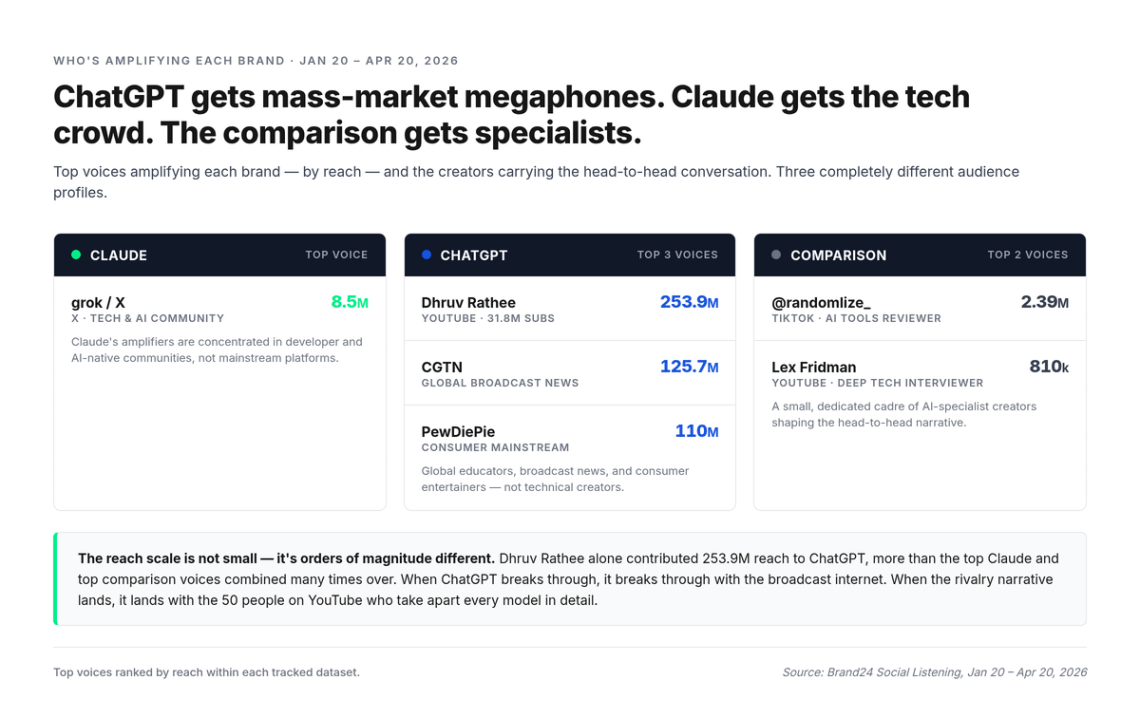
ChatGPT is being amplified by massive, mainstream personalities:
- Dhruv Rathee: a 31.8M-subscriber Indian educator, contributed 253.9M reach to the conversation about ChatGPT on his own
- PewDiePie: 110M followers, global consumer mainstream
- CGTN: 125.7M followers, Chinese state broadcast news
ChatGPT’s top voices are mass-market, global, and broadcast-scale.

Claude’s biggest voice, on the other hand, is grok/X, with 8.54 million followers in a technical AI community on X.
That’s a completely different scale and a totally different audience.
The ChatGPT vs Claude comparison conversation itself has yet another amplifier profile:
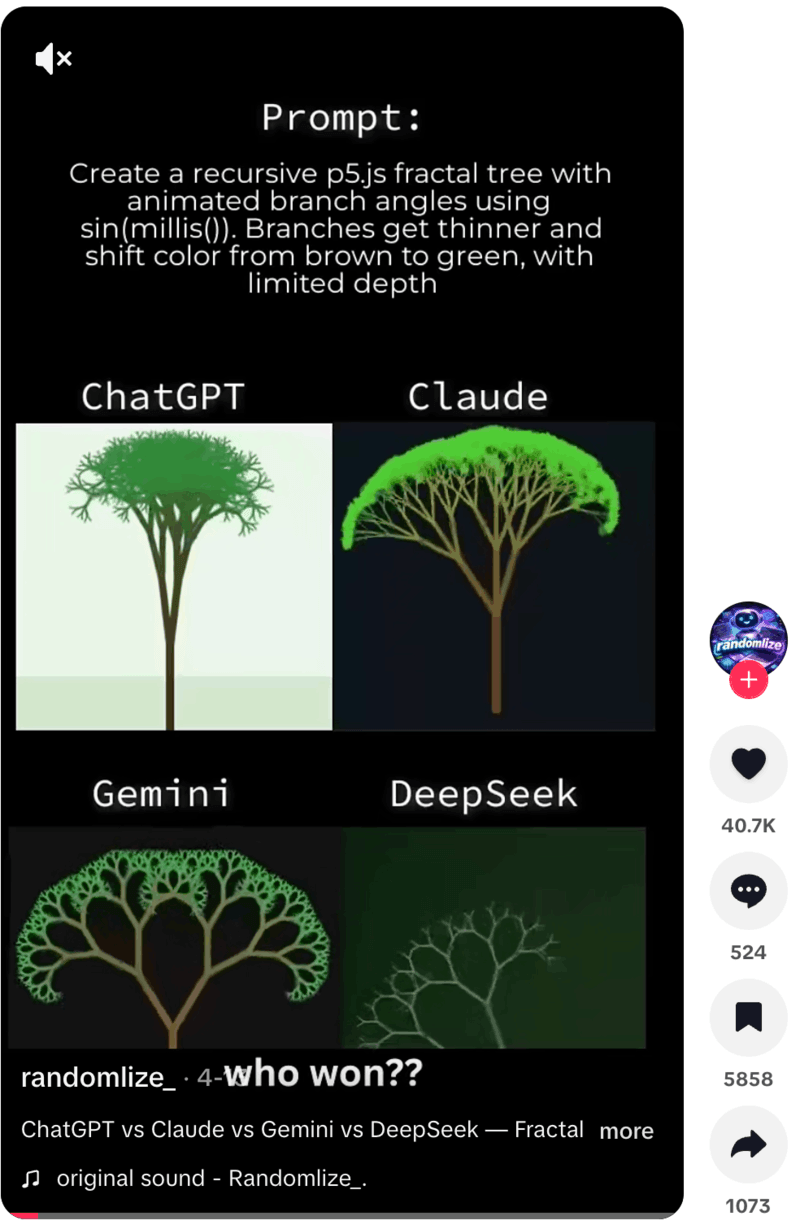
- randomlize_ on TikTok: reached 2.39M people during this time, focusing on reviewing AI tools.
- Lex Fridman on YouTube: 810k reach in this period, known for his long-form interviews about AI.
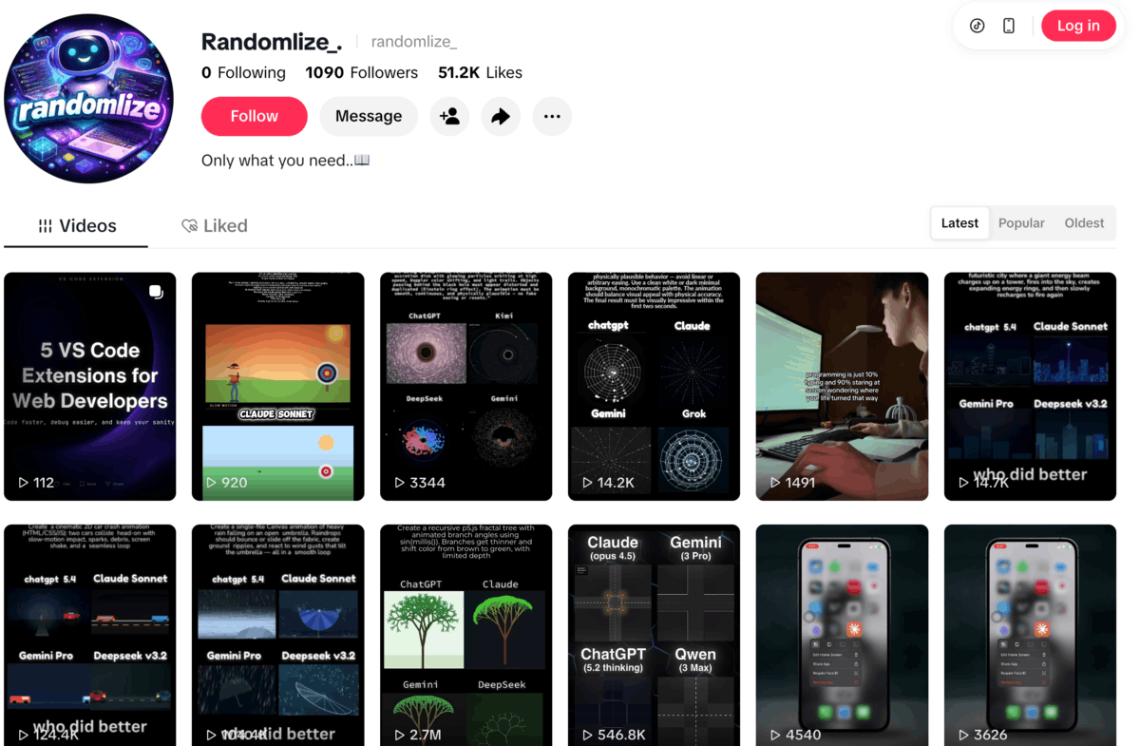
Instead of mainstream celebrities, the direct comparison relies on specialized reviewers.
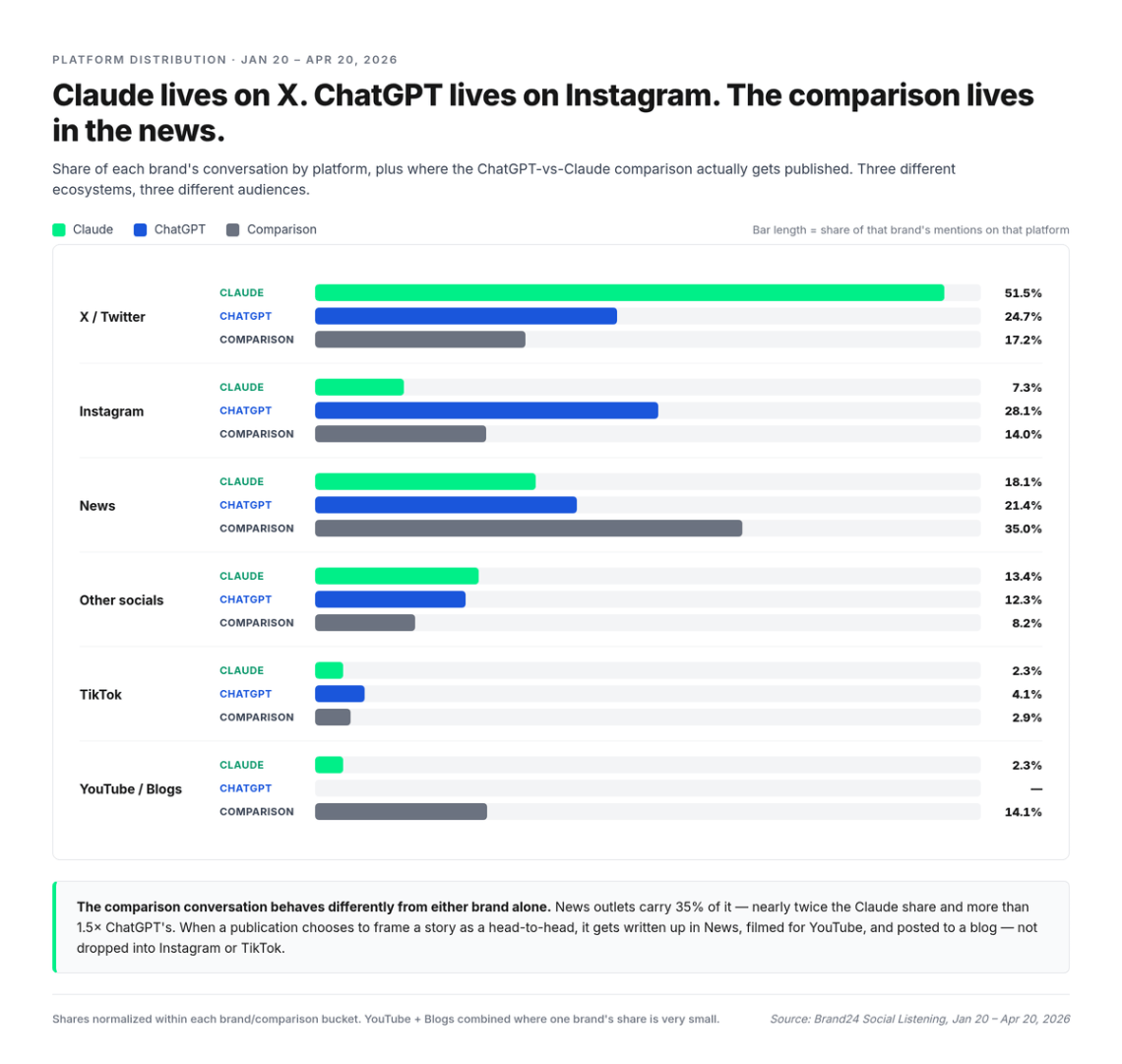
Platform distribution
It basically backs the same story:
- Claude runs 51.5% on X: developer-and-researcher internet
- ChatGPT runs 28.1% Instagram and 24.7% X: broader consumer internet
- The comparison conversation lives 35% on News, suggesting that news outlets are framing the comparison more than the native communities of the two AI brands
Sentiment distribution
People are feeling more positive about Claude:
22.4% positive sentiment compared to 16% for ChatGPT.
This is mostly thanks to Claude’s enthusiastic base on X. ChatGPT’s slightly higher “neutral” conversation volume is likely because mainstream news coverage tends to be more balanced by default.
Top influencers at a glance:
| Brand | Top influencer (by reach) | Reach | Platform | Profile |
|---|---|---|---|---|
| ChatGPT | Dhruv Rathee | 253.9M | YouTube | Indian mass-market tech educator |
| ChatGPT | PewDiePie | 110M | Multi | Global consumer mainstream |
| ChatGPT | CGTN | 125.7M | Multi | Chinese broadcast news |
| Claude | grok / X | 8.54M | X | Technical AI community |
| ChatGPT vs Claude (comparison) | randomlize_ | 2.39M | TikTok | AI tools reviewer |
| ChatGPT vs Claude (comparison) | Lex Fridman | 810k | YouTube | Long-form AI interviews |
The ChatGPT vs Claude comparison is 91% neutral
If you look at the overall sentiment analysis for the comparison project, brand monitoring tool data shows a clear breakdown:
- 90.7% neutral
- 6.5% positive
- 2.8% negative
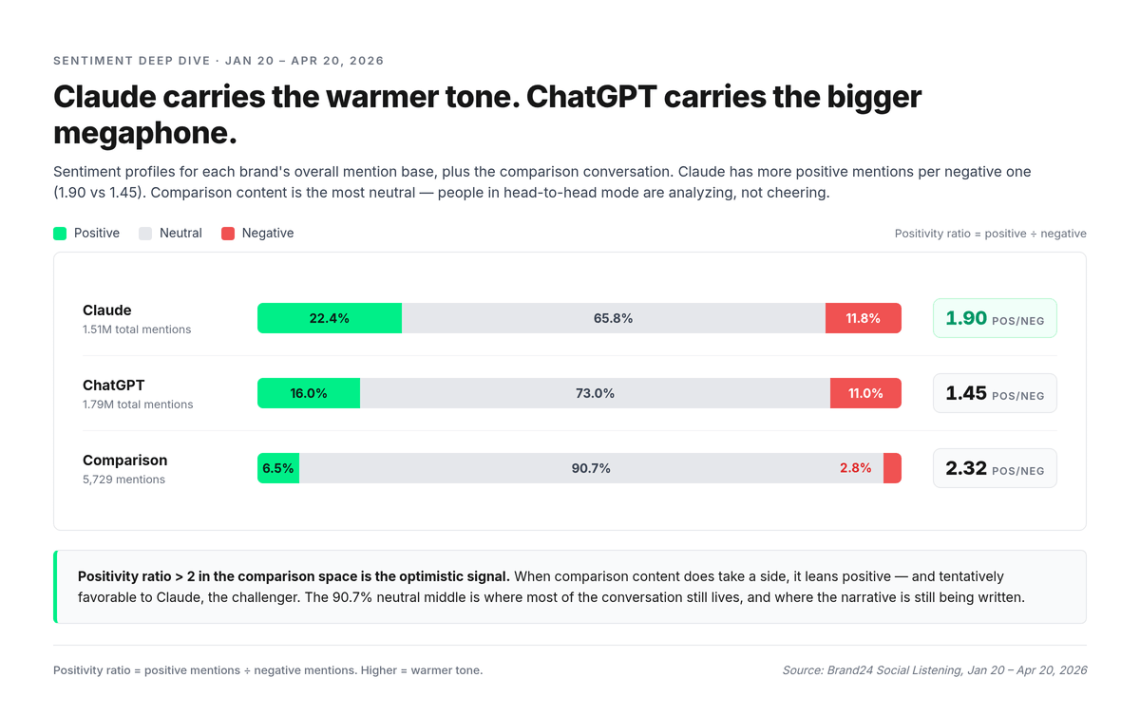
Where people praise ChatGPT over Claude, and vice versa:
1. Claude is the best for writing and coding
When users talk about deep, nuanced work, they almost always mention Claude.
2. ChatGPT wins for quick work and variety
ChatGPT is the people’s go-to for short posts, brainstorming ideas, and tasks that involve different types of media (like images and text).
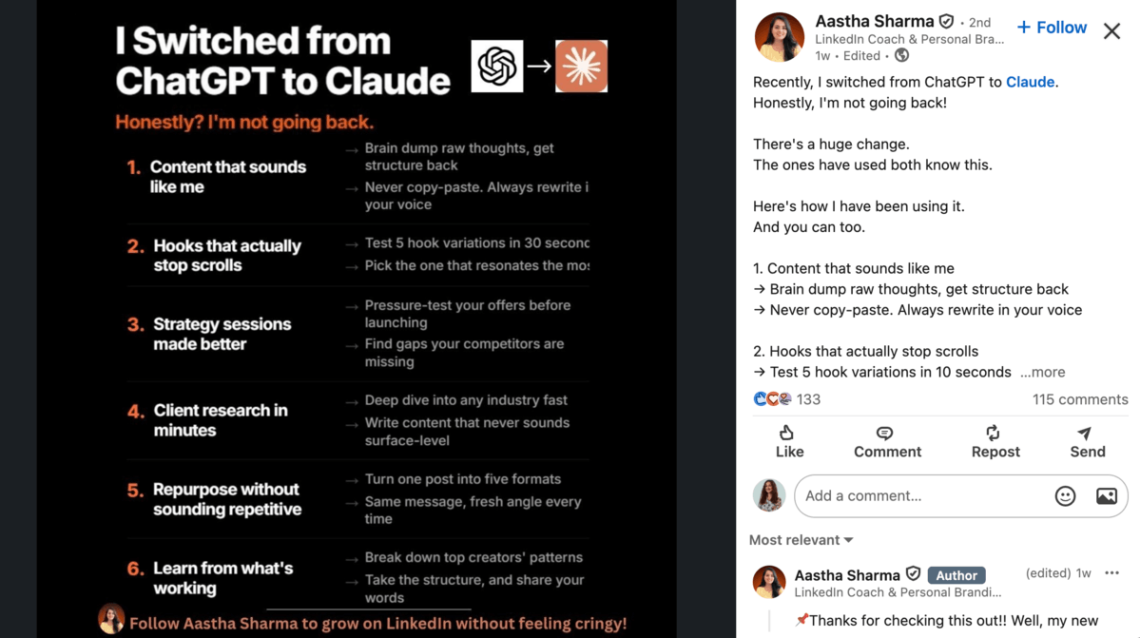
3. Some users are switching from ChatGPT to Claude
A significant number of the most-engaged positive mentions come from users saying they switched from ChatGPT, and almost always to Claude.
Where did that small bit of negative sentiment come from?
It was mostly three topics:
1. Corporate rivalry toxicity
The biggest source of negative-charged mentions was the “OpenAI vs. Anthropic” framing itself. People got pretty intense, with a lot of wording like “Morally bankrupt”.
Discussions about accounting and questioning leadership were a major magnet for negative vibes: 5.6% negative sentiment just for this topic alone.
2. Claude poor creativity criticism
For example, a Medium article titled “The Brutal Decline of Claude’s Creativity in 2026” drove a broader debate, while one Reddit thread even called Claude Opus 4.7 “legendarily bad.”

3. User frustration with conflicting advice
A lot of Reddit users got genuinely annoyed when ChatGPT and Claude gave completely opposite answers on topics like pricing, business strategy, or code.
The negative chatter is mostly aimed at the AI companies, not the actual AI tools.
For example, the most common negative hashtag for Claude is #anthropic (the company), not #claude or #claudeai (the product).
That pattern matters a lot for brand reputation tracking.
TikTok leads reach-per-mention for Claude vs ChatGPT comparisons by 10x
Social listening data shows that the platforms where people discuss both AI tools have completely different audiences:
- Claude = X-native: Over half of all Claude mentions happen on X, which is a favorite spot for developers, researchers, and serious tech users.
- ChatGPT = Instagram + X balanced: Nearly 3x Claude’s Instagram share, reflecting broader consumer/lifestyle adoption.
- ChatGPT vs Claude = editorial-first: News articles, journalist reviews, analyst reports, and thorough video reviews account for 35% of this content, the highest of any category.
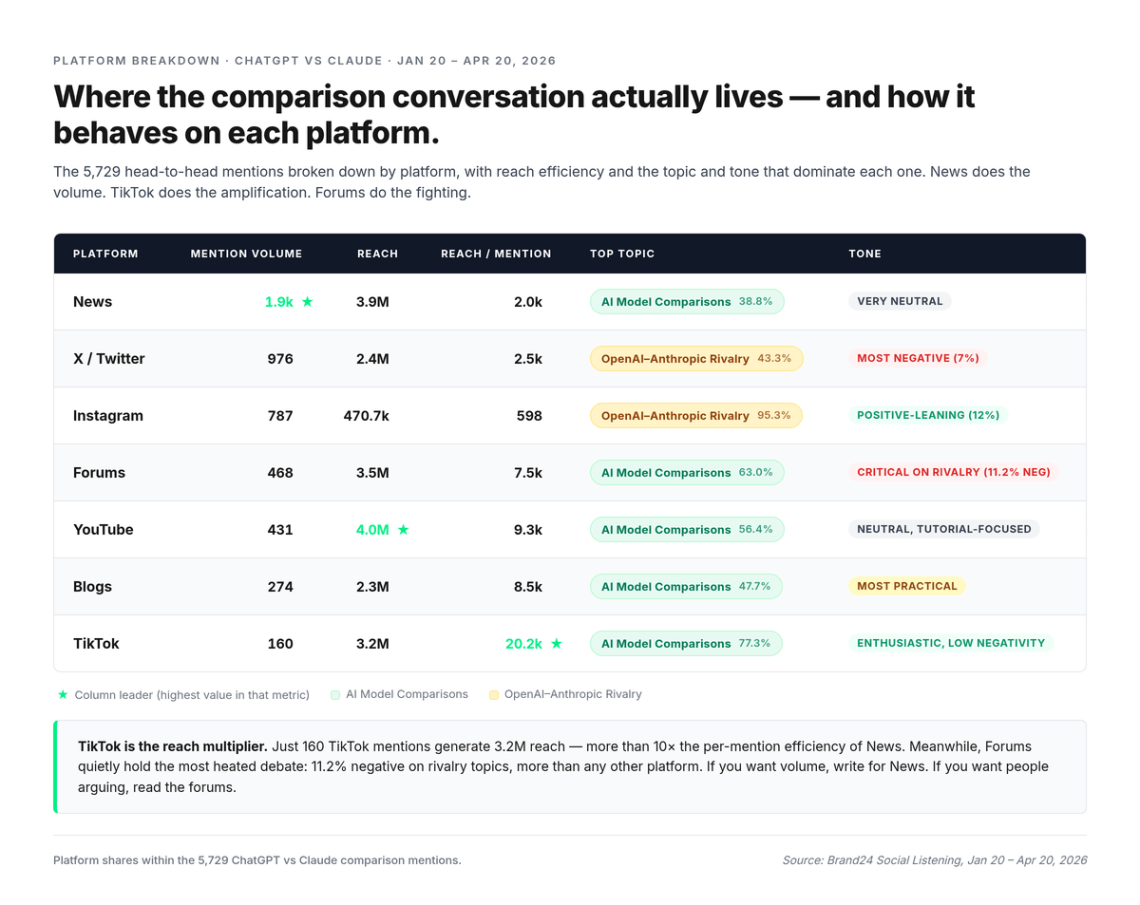
What is the tone of ChatGPT vs Claude mentions on the top 5 platforms?
News: Volume leader, neutral tone
- 1 Most neutral platform in the dataset; basically no negative coverage
- 2 Topics spread from AI Model Comparisons (38.8% SOV), OpenAI-Anthropic Rivalry (37.3%), to AI Tools Applications (22.0%)
- 3 Reach-per-mention ratio is modest at ~2,010, meaning no single news article dominates
X (Twitter): Most opinionated, rivalry-driven
- 1 The only platform where the OpenAI-Anthropic Rivalry topic leads in mention volume (390 mentions, 43.3% SOV) over AI Model Comparisons (326 mentions)
- 2 X has the most negative sentiment overall (7% negative), and the Rivalry topic is even higher at 8.7% negative
Instagram: The reach paradox
- 1 Highest positive sentiment (12%) among all platforms
- 2 AI Model Comparisons on this platform generate the most posts (364 mentions) but have tiny reach (16.5k)
- 3 Meanwhile, the OpenAI–Anthropic rivalry gets an impressive 95.3% of total Instagram reach from just 112 posts!
Videos: Highest reach, tutorial-heavy
- 1 Leads all platforms in reach at 4M total, despite just 431 mentions
- 2 What gets people talking most on YouTube are AI Model Comparisons, making up 56.4% SOV
- 3 Next up is AI Tools Applications, which performs really well here at 19.6% of SOV
- 4 This makes sense because YouTube is the go-to place for tutorials, walkthroughs, and demos.
TikTok: Viral efficiency king
- 1 It has the fewest comparison mentions, but the highest reach-per-mention ratio at over 20k
- 2 The conversation here is super focused: videos comparing ChatGPT vs Claude models grab 77.3% of the attention
- 3 TikTok discussions are mostly about viral coding challenges, animation demos, and side-by-side performance showcases.
- 4 Content about the OpenAI vs Anthropic rivalry is also there with 22.1% of the total reach
I also picked up two extra insights from Brand24’s Demographics feature that are pretty interesting:
- 30% of people engaging in the ChatGPT vs Claude conversations are active on Linkedin
- Around 24.5% of them are on GitHub
This confirms that the audience comparing these two AI tools is mostly professionals and developers. It’s not a huge surprise, but it’s good to have the numbers to back it up!
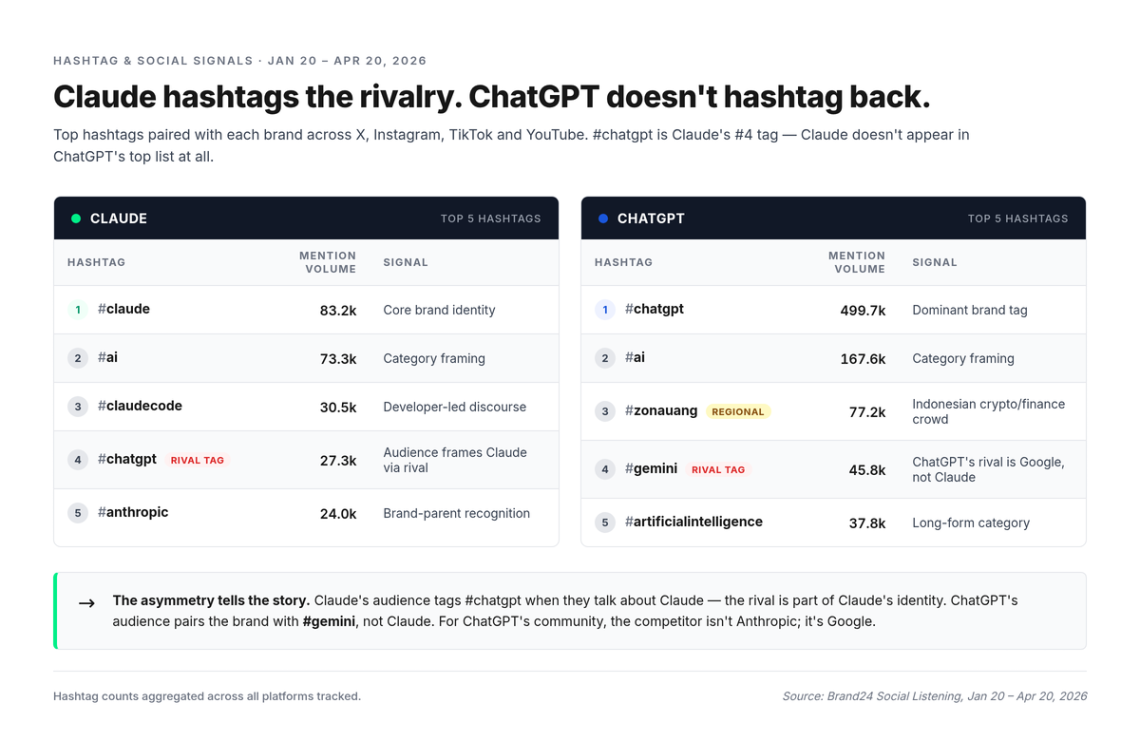
#chatgpt is Claude’s 4th hashtag, and #claude isn’t in ChatGPT’s top list.
The hashtag analytics honestly tell us a lot about the state of the ChatGPT vs. Claude conversation, too!
Here are the most popular hashtags:
| Hashtag | Mention volume | Positive mentions | Negative mentions |
|---|---|---|---|
| #chatgpt | 779 | 95 | 20 |
| #ai | 534 | 66 | 17 |
| #claude | 498 | 55 | 12 |
| #claudeai | 392 | 55 | 12 |
| #aitools | 350 | 39 | 11 |
| #artificialintelligence | 303 | 31 | – |
So, at first glance, ChatGPT wins the mention volume contest based on its single main hashtag.
Combined, #claude and #claudeai add up to 890, which is a bit more than #chatgpt on its own: Claude is generating more dedicated hashtag variety.
Interesting, but not shocking yet, right?
Now let’s look closer, and this is where it gets spicy. Let’s cPeople are feeling more positive about Claude:
22.4% positive sentiment compared to 16% for ChatGPT.
heck out the top hashtags for each brand side-by-side.
Claude’s top 5 hashtags:
- 1 #claude
- 2 #ai
- 3 #claudecode
- 4 #chatgpt (Yes, really! It's their 4th most used hashtag, with 27.2k uses)
- 5 #anthropic
ChatGPT’s top 5 hashags:
- 1 #chatgpt
- 2 #ai
- 3 #zonauang (This is a big Indonesian finance community hashtag, 77.2k uses)
- 4 #gemini (Again, a competitor! 45.8k uses, making it their 4th most-used tag)
- 5 #artificialintelligence
See the asymmetry? Two findings jump out:
- #chatgpt is the 4th most-used hashtag by the Claude community. But #claude doesn’t even make the top list for ChatGPT’s fans. When the ChatGPT crowd talks about a competitor, they usually go for #gemini, not #claude.
- #zonauang being number 3 tells us that ChatGPT has a strong base in Southeast Asia, which Claude doesn’t seem to have matched. (We’ll dig into this more when we talk about regions and languages, and it’s a bigger deal than you might think.)
One other interesting point: the negative sentiment clusters around corporate identity, not product.
People seem to complain more about #anthropic than about #claude or #claudeai. On the ChatGPT side, #openai gets more negative sentiment than #chatgpt.
Basically, the companies catch more heat than the products they make.
Claude users are English-first, while ChatGPT usage is global
The language used for Claude vs. ChatGPT comparisons is where the biggest split between the two brands shows up. It’s also where most comparison reports would stop.
It’s worth going a layer deeper, because the regional vs global picture is genuinely surprising to me.
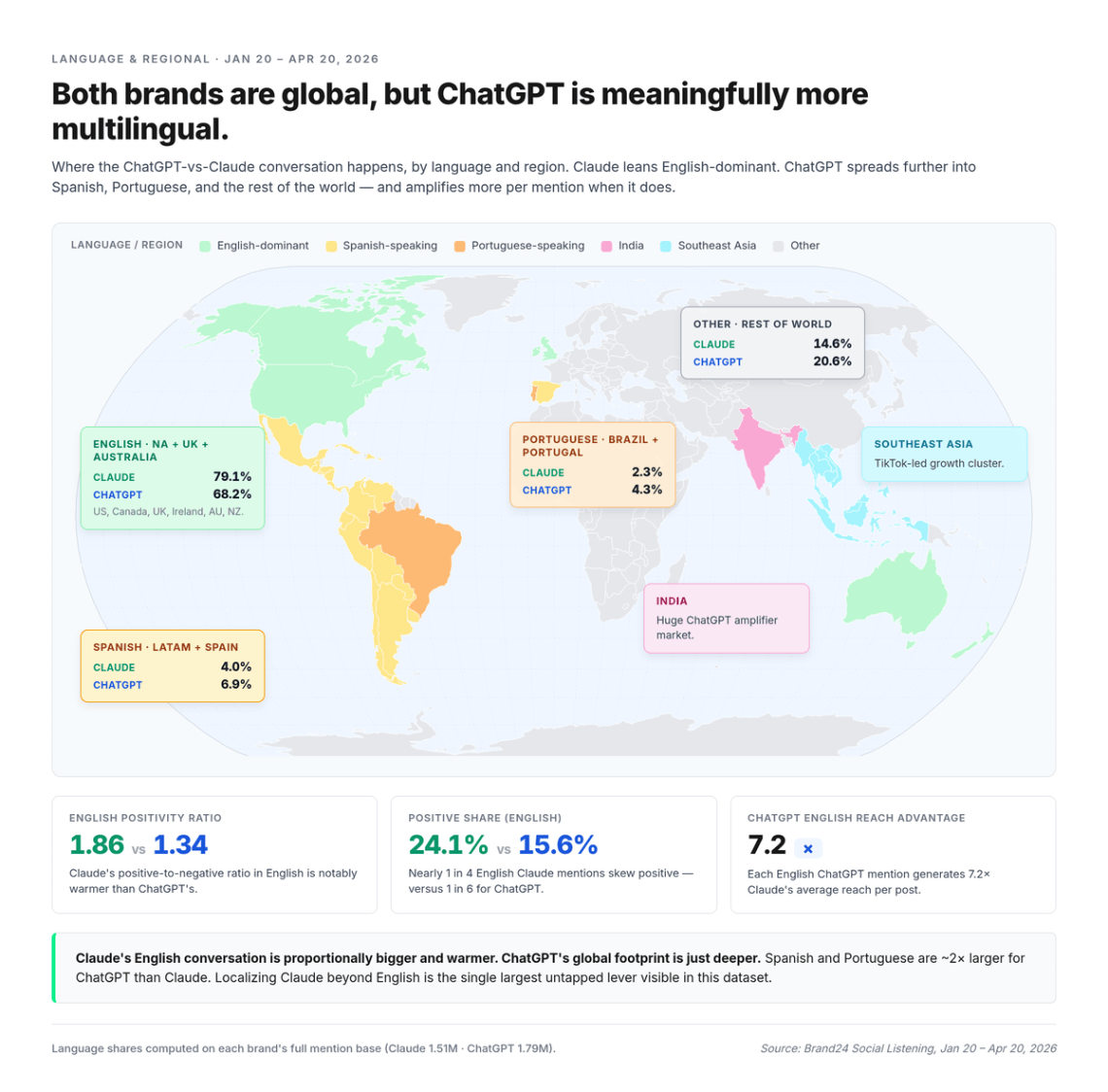
ChatGPT discussion is 2x the size of Claude in Spanish-language mentions, 2.25x in Portuguese.
Claude doesn’t have a similar-sized fan base in any other language besides English.
Now, let’s take a closer look at each market:
English-speaking markets: Equality in volume, Claude wins sentiment
The media monitoring data shows that in the US, UK, Canada, and Australia Claude and ChatGPT are almost the same in mention volume, but Claude wins when it comes to the sentiment distribution.
- Claude conversation in English seems nicer: 1 in 4 English Claude mentions is positive, compared to only 1 out of 6 for ChatGPT.
- But ChatGPT is a bigger deal: Even though Claude gets good sentiment, ChatGPT’s reach-per-mention is 7.2x Claude’s! It’s driven by mainstream media, broadcast news, and huge YouTube channels.
- Claude is a bit more of a niche hit: Claude’s English chatter mainly happens in specialized tech communities on X (Twitter). It gets mentioned a lot there, but those posts don’t spread as far as the big media mentions of how people use ChatGPT.
| Metric | Claude (EN) | ChatGPT (EN) |
|---|---|---|
| Mention volume | 1.19M | 1.21M |
| Positive sentiment % | 24.1% | 15.6% |
| Negative sentiment % | 12.9% | 11.6% |
| Reach per mention | 4.2k | 30.5k |
Spanish-Speaking Latin America: ChatGPT’s 2x top region
- ChatGPT generates twice as many Spanish-language mentions as Claude (112.9k vs 60.5k)
- This suggests a far deeper brand awareness across Mexico, Argentina, Colombia, Chile, and the broader Spanish-speaking world.
- The reach gap narrows a lot in Spanish mentions: ChatGPT has only 1.4x more reach-per-mention here (vs. 7.2x more in English).
| Metric | Claude (ES) | ChatGPT (ES) |
|---|---|---|
| Mention volume | 60.5k | 122.9k |
| Positive sentiment % | 19.0% | 17.7% |
| Negative sentiment % | 9.1% | 10.9% |
| Reach per mention | 5.9k | 8.0k |
Portuguese/Brazil: The only market where ChatGPT leads on sentiment
- ChatGPT has more mentions and 2.25x better sentiment, and it’s the only language market where that combination happens
- Reach-per-mention is almost identical, but the sentiment analysis shows that ChatGPT has won Brazilian/Portuguese hearts more effectively.
- This could probably be because ChatGPT got into the Brazilian/Portuguese market earlier and was more visible, building up a solid base of local influencer marketing activities and educational content.
| Metric | Claude (PT) | ChatGPT (PT) |
|---|---|---|
| Mention volume | 34.1k | 76.7k |
| Positive sentiment % | 23.0% | 28.1% |
| Negative sentiment % | 10.0% | 9.7% |
| Reach per mention | 3.5k | 3.6k |
Indonesia / Southeast Asia: ChatGPT’s quiet kingdom
- The Indonesian phrase #zonauang, which is used for talking about finance on social media, was ChatGPT’s third most-used hashtag, showing up a huge 77.1k times.
- Claude, on the other hand, doesn’t have any similar big hashtags in non-English Asian languages.
- This points to a massive, organic ChatGPT presence in Indonesia and broader Southeast Asia (a region with high Instagram and TikTok general activity).
- It lines up with how much ChatGPT is used on Instagram (28.1% of its platform distribution).
India: A battleground market, leaning towards ChatGPT
India stood out in the social media monitoring tool‘s data for several reasons:
- Dhruv Rathee, a massive Indian tech educator on YouTube (he has 31.8M subscribers!), was the top person spreading information about ChatGPT. His content alone reached an astonishing 253.9M people.
- Aaj Tak, a major Indian news outlet with 74.6 million followers, also played a big role in promoting ChatGPT.
- In the ChatGPT vs Claude monitoring demographics, India ranked 2nd globally at 11.4% of comparison mentions and was the only country close to the US (30.5%).
- India’s English-educated tech audience is clearly aware of both AI tools and actively making Claude vs ChatGPT comparisons, but ChatGPT’s stronger mainstream media presence in India gives it a strong reach advantage.
How to use this data if you are a marketer in 2026
Here are four social listening insights I learned from the Claude vs ChatGPT data analysis. Think of these as handy takeaways that apply to more than just the AI world:
01 Build a separate media monitoring project for your category’s “vs” conversations.
The chatter about “ChatGPT vs Claude” exploded, jumping a huge 414% in just three months! Interestingly, Claude’s own name wasn’t mentioned nearly as much, and ChatGPT’s mentions actually dropped.
This tells you something important: if you only track your own brand name, you’re missing the action where people are actually deciding what to buy.
Here’s a simple fix:
Create another project alongside your regular brand media monitoring. Use natural phrases people use when comparing, like “Brand X vs Brand Y,” “Should I use X or Y,” or even “X or Y.”
Track this conversation separately, set up alerts just for it, and report on it as its own thing.
It’s a smaller group of people, sure, but they are the ones closest to making a purchase decision in your whole data set.
02 Always include reach-per-mention on your dashboard, right next to your total reach.
Your total reach chart tells you how many people saw your stuff. But it doesn’t tell you how you reached them: was it one massive, viral TikTok, or 500 slower-moving news articles?
When I looked at the ChatGPT vs. Claude discussion, I discovered that TikTok delivered a huge 20.2k people per mention. That’s over ten times more effective than the news articles.
If you’re trying to catch up to a bigger competitor, the secret isn’t just creating more and more content.
It’s finding the platforms where every single post gets the biggest boost, and focusing your efforts there. Make sure to add a “reach-per-mention” row to your monthly report.
Total reach shows you how loud you were. Reach-per-mention tells you if you yelled in the right place.
03 Stop looking just at platforms; look at the languages when checking your reach.
Sure, ChatGPT is reaching 5.2x more people than Claude overall. But that’s mostly because of English, where their reach is 7.2x bigger.
Look at Spanish, and that lead shrinks way down to 1.4x. In Portuguese? They basically reach the same size audience per mention.
If you’re up against a bigger competitor, their advantage probably isn’t the same everywhere.
Analyze the Demographics to see your reach broken down by language. Let that info guide your strategy for PR, influencer partnerships, and paid ads.
The languages/markets where you’re already doing as well as your competitor are your cheapest and easiest places to grow your brand awareness; you won’t need to pour extra money into ads there!
04 Run your context of discussion through an audit every quarter, the way you’d audit your SEO keywords.
When I looked at Claude brand mentions, the 4th most-used hashtag was #chatgpt. That’s a huge insight about brand positioning, not just reach.
It means part of Claude’s own audience is defining Claude by mentioning its biggest rival.
Grab your top 20 hashtags and keywords defining your Context of Discussion, take out the ones that are just your brand name, and see what’s left.
If a competitor’s name, a general category word, or a hashtag about a controversy is showing up high on that list, your audience is placing you in a conversation you didn’t start.
That’s either a starting point you can use (“Yep, we’re the better choice than X”) or a narrative you need to actively change.
Either way, you’ll only find this out if you treat your hashtags like people talking about your brand, not just like a way to get more views.


