Table of contents
2M Marketers

Did you know 93% of consumers read online reviews before buying, and 94% say a bad review has made them avoid a business? Safe to say, your brand reputation can do quite a bit of talking for you.
And that talk is scattered all over the Internet, across channels you may not even be watching.
Let’s change that. I’ve rounded up the best brand reputation monitoring tools to help you keep tabs on the conversations shaping your brand.
Top 10 brand reputation monitoring tools
| Tool | Best For | Starting Price |
|---|---|---|
|
1
|
Cross-channel reputation monitoring, sentiment analysis & early crisis detection
|
$199/mo
|
|
Basic web and news mention tracking
|
Free
|
|
|
3
 |
Collecting reviews, managing customer feedback & tracking reputation across locations
|
$99/mo
|
|
4
|
Review management, customer messaging & improving local online reputation
|
$799/mo
|
|
Enterprise social listening, consumer intelligence & long-term reputation analysis
|
Upon request
|
|
|
Centralizing reviews, spotting recurring feedback themes & competitor benchmarking
|
$89/mo
|
|
|
Monitoring reviews, listings, local search performance & reputation risks across locations
|
Upon request
|
|
|
8
|
Managing reviews, listings, social reputation & visibility in AI search
|
Upon request
|
|
9
|
Automating review requests, monitoring reviews & white-label reputation reporting
|
$99/mo
|
|
10
|
Social listening, community management & tracking reputation across social media
|
$79/user/mo
|


There’s no shortage of tools promising to keep an eye on your reputation. The catch is, they can mean very different things by that.
Some are built around reviews, some focus on social conversations, and some cast a much wider net.
With that in mind, these are the tools that help monitor brand reputation across key channels: social media, review sites, news, forums, podcasts, video platforms, and AI answers.
I work with brand monitoring data daily, so I know which features are absolute must-haves, and which ones you can probably live without.
For this list, I looked at each tool’s coverage, reputation-specific features, alerts, review monitoring, pricing, and limitations.
I tested the tools hands-on where possible, using existing accounts or free trials. I also cross-checked key details and user ratings on G2 and Capterra rather than relying only on product pages.
And yes, I work at Brand24, so I naturally know our tool better than the others here. I’ve kept that in mind throughout, judged it by the same criteria as the rest, and called out where it could do better, too.
Now, let’s dig into the best online reputation management tools.
01 Brand24
4.6/5
G2 (359 reviews)
4.7/5
Capterra (255 reviews)
14 days / Free trial
From $199 / Month
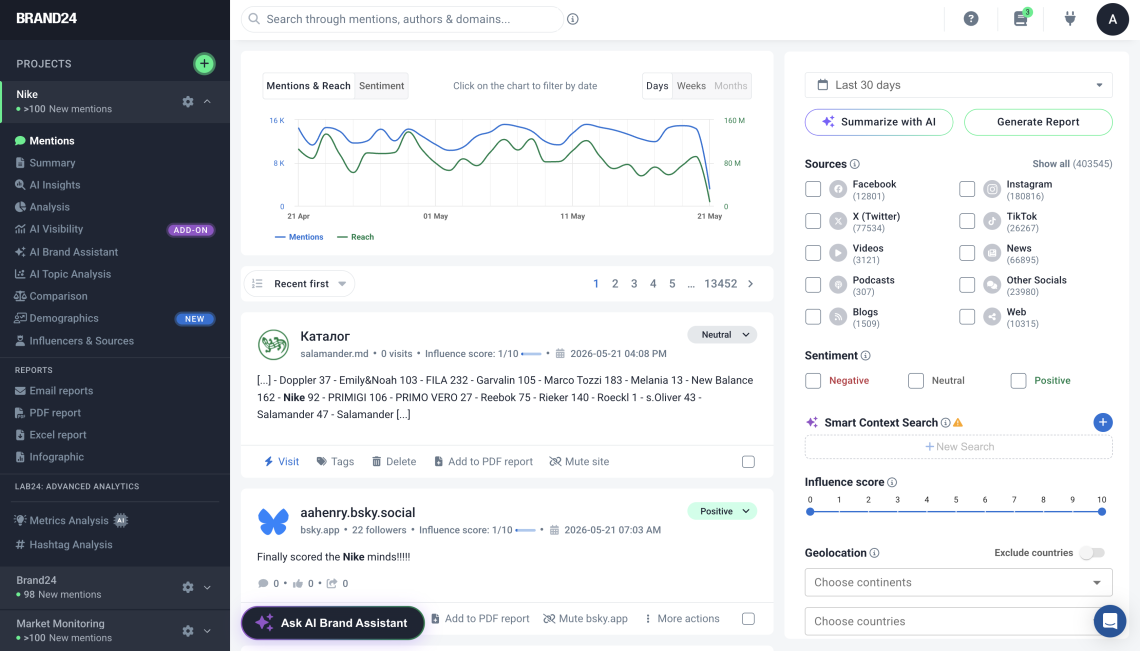
Brand24 is an AI-powered media monitoring tool that tracks brand conversations across social media, review sites, news, blogs, forums, podcasts, newsletters, and AI answers. That gives you a pretty broad view of what’s being said online.
For day-to-day reputation monitoring, I like how easy it is to narrow the view. You can filter mentions by things like source, sentiment, reach, or domain, so you’re not stuck scrolling through everything the tool collects.
And you don’t have to keep one eye on the dashboard all day to catch new reviews or sudden spikes in mentions. Alerts flag the important stuff for you instead.
Brand24 also tracks visibility in ChatGPT, Gemini, Perplexity, Claude, and Google AI Overviews, so you can see how your company is being represented in AI answers, too.
Why did I pick Brand24?
I like that it doesn’t box you into a reviews-only or social-only workflow. We all know a Reddit thread or a news article can wobble a brand’s reputation just as much as a one-star review, if not more. Brand24 helps you catch that.
It works like an early-warning system. You’re not relying on someone to manually spot a negative sudden spike or a high-reach mention before it starts snowballing.
In this context, three features stand out:
- Cross-channel monitoring – Track mentions across social media, news, blogs, forums, reviews, podcasts, newsletters, and AI answers without stitching together several tools.
- Sentiment & Topic Analysis – See whether conversations are positive, negative, or neutral, then dig into the themes actually driving them. Much more useful than a mention count on its own.
- Anomaly Detection & AI Insights – Catch unusual spikes in mentions or reach, then get a summary of the trends and events behind the change.
✅ Strengths:
- Widest source coverage on this list, including AI chatbot monitoring
- Genuinely deep AI feature set developed by an in-house R&D team
- Real-time alerts via email, Slack, or in-app
- Exportable reports in PDF, Excel, PowerPoint, and shareable online links
- Easy integrations with Slack, Google Sheets, and more
- Strong value for money vs. enterprise alternatives
⚠️ What could be better:
- No historical data access, monitoring starts from project creation
- The entry-level Individual plan has 12-hour update delays and limited keywords
Overall verdict: The strongest all-rounder on this list. Best for agencies, mid-sized businesses, and enterprises that need to track reputation across multiple channels rather than focus mainly on reviews.
02 Google Alerts
N/A
Free trial
Free
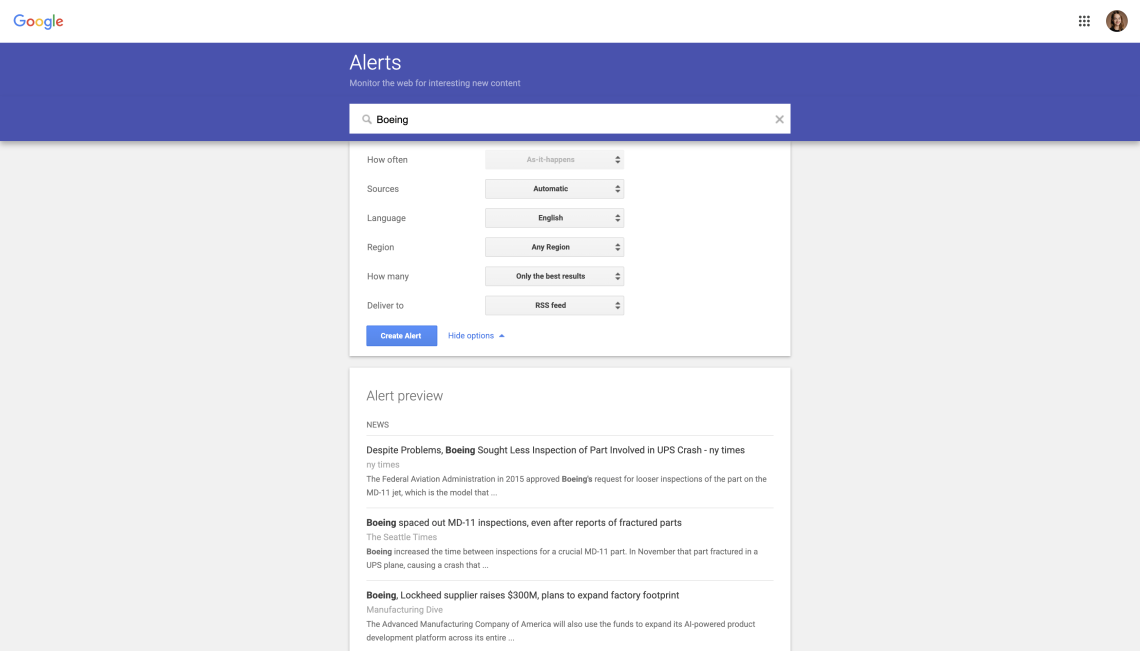
Google Alerts is about as simple as reputation monitoring gets. Pick a keyword, add your email, and Google will notify you when it finds a new matching result on the web.
I’d treat it as a very basic starting point. It’s completely free and covers only public web content, missing social media, forums, review sites, and anything behind a login.
There’s also no sentiment analysis, no dashboard, no filtering, and no analytics.
For popular keywords, alerts can become noise-heavy and easy to ignore.
Think of it as a smoke detector with no fire location data: better than nothing, but you’ll outgrow it quickly.
Why did I pick Google Alerts?
It won’t give you sentiment analysis, dashboards, or deep reporting, but it does one useful thing well: it lets you keep an eye on new web mentions without spending a dime.
Its strongest features are:
- Custom alert frequency – Choose between as-it-happens, once a day, or once a week. Simple, but useful.
- Source filters – Narrow alerts to news, blogs, web pages, videos, discussions, books, or finance results.
- Language & region targeting – Filter results by language and country, and choose between only the best matches or all results.
✅ Strengths:
- Completely free, no account needed
- Zero setup time
- Useful baseline for tracking brand name on the open web
⚠️ What could be better:
- No social media coverage
- Delayed, often incomplete notifications
- No sentiment analysis, filtering, or analytics
- Misses content behind logins (Reddit, forums, social platforms)
Overall verdict: A useful free complement to a proper monitoring tool, but not a standalone brand reputation monitoring solution for any serious brand.
03 GatherUp
4.5/5
G2 (50 reviews)
4.6/5
Capterra (41 reviews)
14 days / Free trial
From $99 / Month
GatherUp is a slightly different type of online reputation management software than the two mentioned before. This one specializes in review management, an essential part of online reputation management.
What I like about it is that it lets you be proactive. You can send personalized review requests to existing customers instead of waiting for feedback to appear on its own.
That means you’re not just replying to comments after the fact. You can actively encourage customers to leave reviews on third-party platforms such as Facebook and Google.
Why did I pick GatherUp?
Simple. I like that it doesn’t make you wait around for reviews to happen.
You can actively ask for feedback, catch unhappy customers before issues spill into public reviews, and keep the whole process moving via email, SMS, QR codes, and surveys.
Key features:
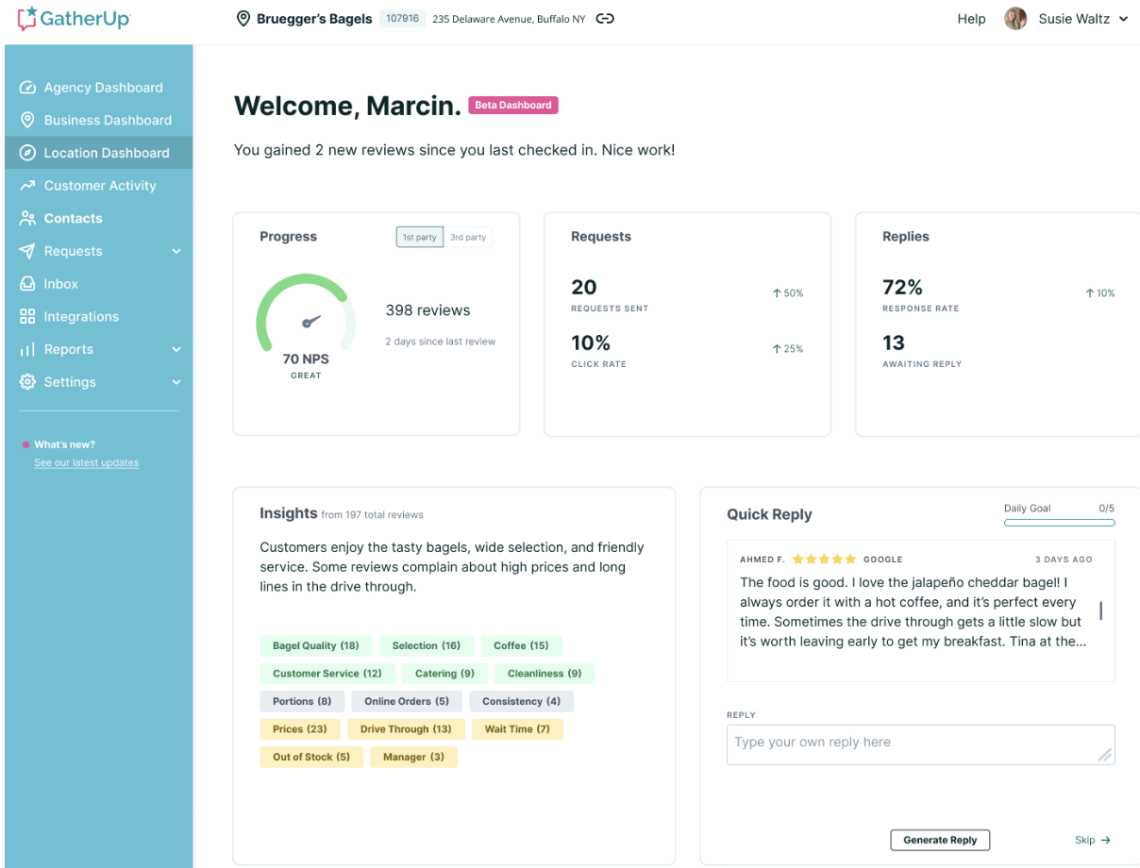
- Automated review requests – Send email and SMS requests after a customer interaction, with QR codes and custom feedback links as extra options. Good for turning review collection into a routine.
- NPS & feedback surveys – Collect first-party feedback alongside public reviews, so you can catch unhappy customers and understand what’s behind the rating before everything ends up on Google.
- SmartReply & Smart Tags – Generate editable, sentiment-aware review responses and automatically surface recurring themes in customer feedback.
✅ Strengths:
- Automated review request workflows via email, SMS, and QR code
- AI Smart Reply for faster, consistent review responses
- NPS surveys and first-party feedback collection alongside third-party reviews
- Multi-location management built for agencies
- Integrates with Salesforce, HubSpot, Mailchimp, Zapier, and major POS systems
⚠️ What could be better:
- Third-party review monitoring limited to Google, Apple, and Facebook (no Yelp, Trustpilot, etc.)
- Reporting features are basic compared to enterprise tools
- Interface can feel dated
Overall verdict: A solid choice for local service businesses and agencies wanting to actively build review volume. Less useful for brands that primarily need broad web or social monitoring.
04 Broadly
4.7/5
G2 (75 reviews)
4.8/5
Capterra (336 reviews)
Demo only
$799 / Month
Broadly is a reputation and customer engagement platform aimed squarely at local service businesses: trades, healthcare, automotive, and real estate.
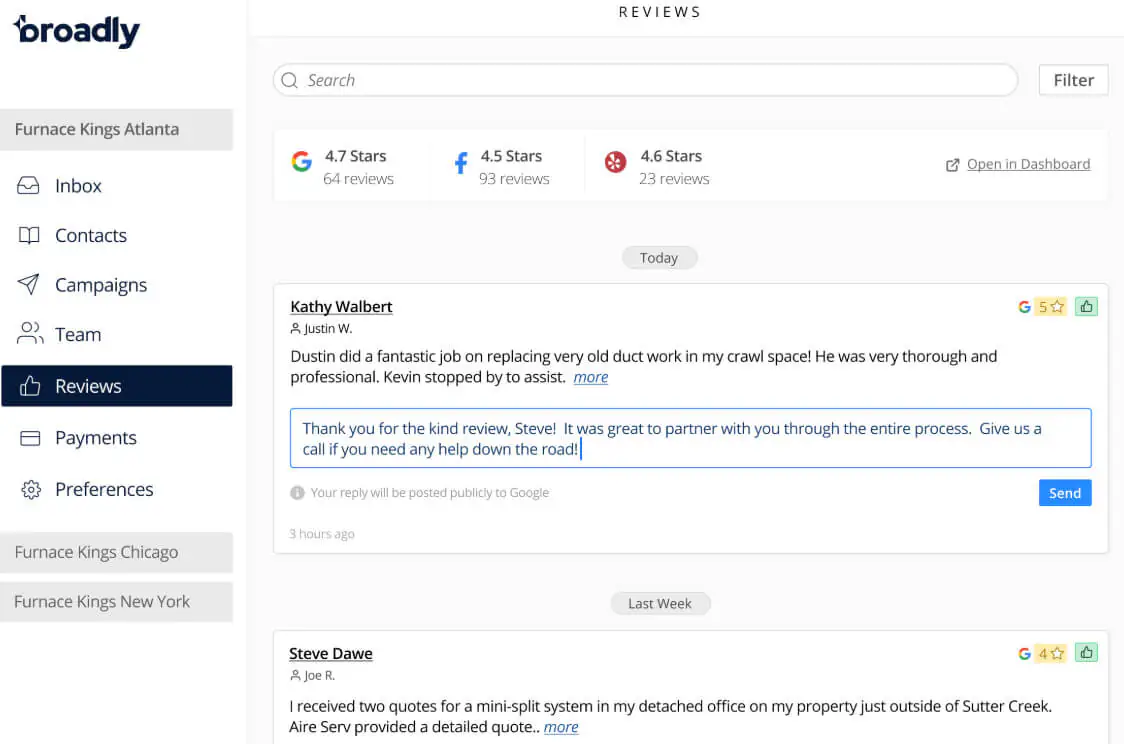
Its core workflow is pretty straightforward: send automated messages after a customer interaction, ask for feedback, and direct happy customers to leave a review on Google, Facebook, TripAdvisor, or another platform you care about.
It also comes with a unified inbox, AI-powered web chat, and social media management, so there’s quite a bit packed into one tool.
Why did I pick Broadly?
I like that it doesn’t stop at collecting feedback. Its reporting helps you spot recurring themes in what customers are saying, which is much more useful than simply watching the review count go up.
Where Broadly stands out:
- AI Reputation Specialist – Draft and automate review responses across Google and Facebook, so keeping up with feedback takes less manual work.
- Local Search Grid – See how your business ranks across different areas for target keywords. Especially useful when reputation and local visibility go hand in hand.
✅ Strengths:
- AI Chat Receptionist handles website, social, and messaging inquiries 24/7
- Automated review requests and AI-powered response suggestions
- Citation Builder syncs listings across hundreds of directories
- SEO reporting and local search ranking tools included
- Mobile app for on-the-go management
⚠️ What could be better:
- No free trial; pricing is among the steeper options for small businesses
- Required onboarding fee adds to the upfront cost
- Less suited for SaaS, B2B, or large enterprises
Overall verdict: A compelling all-in-one for local service businesses that want to combine reputation management with AI-powered customer communication. The price reflects its breadth but may be high for small businesses with a single location.
05 Brandwatch
4.2/5
G2 (1711 reviews)
4.2/5
Capterra (255 reviews)
Demo only
Upon request
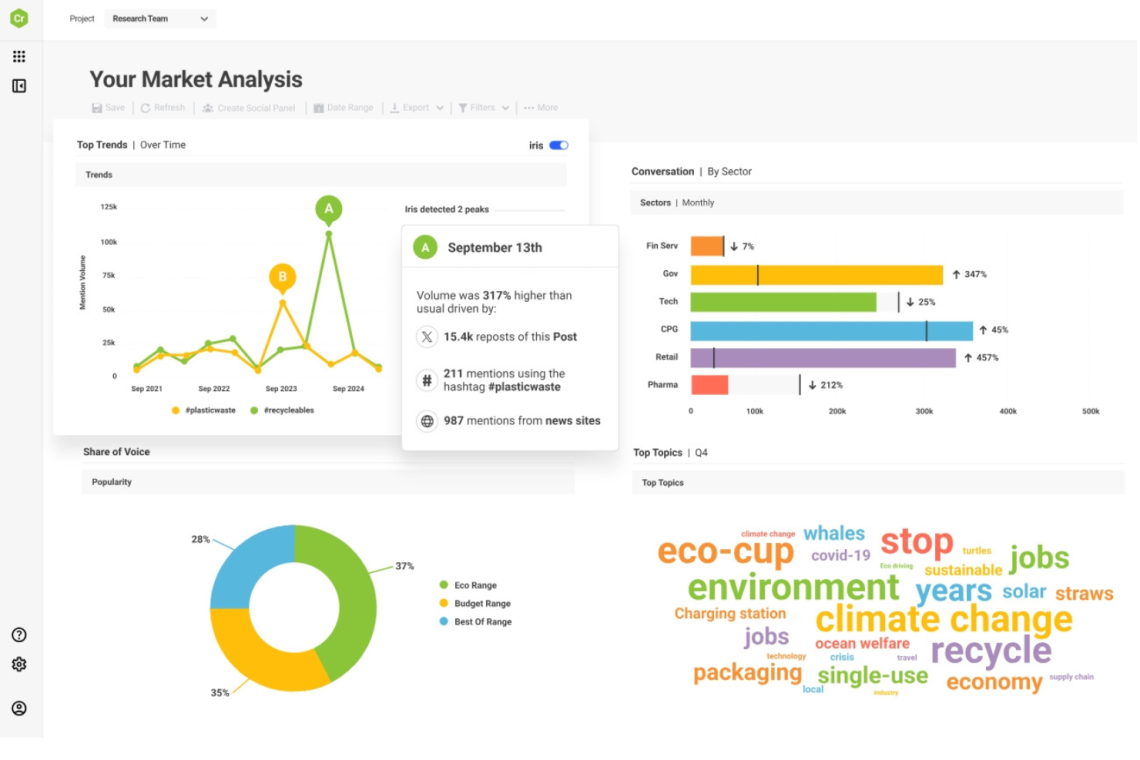
Brandwatch is the more enterprise-heavy option on this list, with a strong focus on social media monitoring.
Its big 2026 push is Iris AI, an always-on assistant that lets you query data in a conversational way, generate summaries, and flag emerging risks and trends.
Brandwatch also supports both real-time and historical reputation analysis, with segmentation by sentiment, demographics, and more – crucial for shaping public perception strategies.
In practice, that makes it better suited to deeper reputation research and long-term trend analysis than simple day-to-day mention tracking.
Why did I pick Brandwatch?
What impressed me most was how far back – and how deep – you can take the analysis.
Historical data, reputation-risk scoring, visual monitoring, and highly customizable queries make it an especially strong pick when you want to study how perception has changed over time or dig into a reputation issue from several angles.
Key features:
- React Score – Labels conversations by reputation risk and flags harmful or highly emotional content as low-, medium-, or high-risk.
- Image & logo recognition – Finds your logo in images even when nobody mentions the brand name in the caption. A big plus for catching the visual conversations that traditional keyword monitoring misses.
- Custom queries & dashboards – Build detailed searches and dashboards around specific brands, campaigns, competitors, or issues. There’s a learning curve, but the flexibility is a major reason Brandwatch works so well for deeper research.
✅ Strengths:
- Iris AI for conversational data exploration and real-time trend detection
- React Score for LLM-integrated brand reputation scoring
- Image and video recognition for visual brand mentions
- Historical data access across billions of conversations
- Expanded coverage, including podcasts, Threads, and TikTok
- Integrations with Google Analytics, Salesforce, and major CRMs
⚠️ What could be better:
- Pricing is enterprise-only and among the highest in the market
- Steep learning curve; onboarding is time-intensive
- Complexity can be overkill for teams without dedicated analysts
Overall verdict: The most powerful option on this list for large enterprises that need deep consumer intelligence, AI-driven reputation scoring, and global coverage. Not suited for SMBs.
06 ReviewTrackers
4.6/5
G2 (161 reviews)
4.7/5
Capterra (172 reviews)
Demo only
From $89 / Month
ReviewTrackers keeps things pretty focused: it pulls customer reviews from 120+ sites, including Google, Facebook, TripAdvisor, Yelp, and niche industry platforms, into one dashboard.
Teams can also assign reviews, set alerts, and track response rates by location. There’s a mobile app too, which is handy if reputation management isn’t something you only do from a desk.
Why did I pick ReviewTrackers?
For me, its strongest point is operational clarity. You can collect reviews in one place, respond to them, request new ones by email or SMS, and use Trending Topics to spot recurring themes and sentiment patterns in customer feedback.
Key features:
- Competitor benchmarking – Compare your ratings, review performance, and customer feedback against competitors.
- Review request campaigns – Send automated emails and SMS messages to drive more reviews, rather than waiting for customers to remember to leave one on their own.
- Location-level reporting – Compare performance across branches, track response rates, and see where customer feedback is slipping.
✅ Strengths:
- 120+ review sources in one dashboard
- Trending Topics text analytics to surface recurring customer themes
- SMS and email review request campaigns
- Competitor review tracking and benchmarking
- API access and Zapier integration for workflow automation
⚠️ What could be better:
- No built-in local SEO or listings management
- Lacks predictive analytics and automated AI-generated insights
- Limited scalability reported by enterprises managing hundreds of locations
- Native CRM and POS integrations are minimal
Overall verdict: A reliable, well-regarded review management platform for mid-sized businesses and multi-location brands. Solid for review operations; not a full social listening or media monitoring tool.
07 Chatmeter
4.5/5
Capterra (74 reviews)
Not available
Upon request
Chatmeter is a great AI-powered brand reputation management solution for agencies, chains, franchises, or resellers.
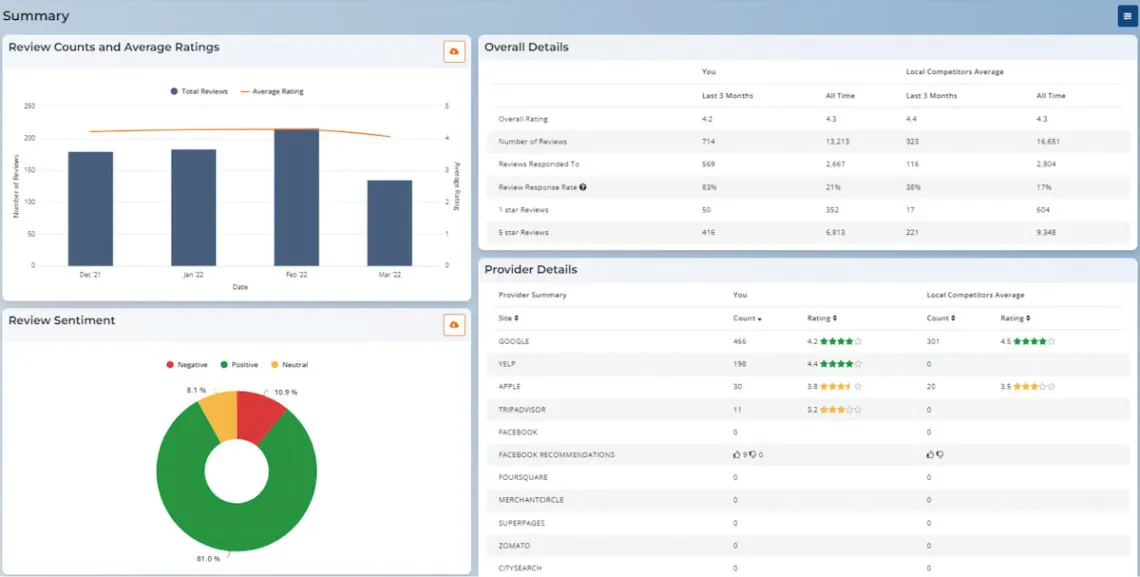
It centralizes the monitoring and management of customer reviews, social media interactions, and local listings across various platforms.
The tool notifies you about any reviews found on local review sites. That’s a goldmine of customer insights you can use to boost your business.
Moreover, Chatmeter lets your customers find the right information about the nearest business location. If you want to focus on local activities, Chatmeter is your go-to tool.
There’s also Pulse AI, which analyzes customer feedback in real time and highlights customer sentiment trends and areas that may need attention.
On top of that, Chatmeter offers tools for generating customer surveys and managing social media content, so it goes well beyond monitoring alone.
Why did I pick Chatmeter?
Chatmeter’s unique strength lies in multi-location reputation monitoring. It can help larger brands see where problems are emerging, compare locations, and spot serious review risks before they start affecting the wider business.
Key features:
- Pulse AI: Signals – Ask plain-language questions about reviews, surveys, and social feedback, then get a summary of what customers are saying and why. It can even pull relevant images from reviews into the analysis.
- Risk Monitoring – Flags reviews that mention issues such as safety, discrimination, harassment, theft, or unfair business practices and shows which locations need attention first.
✅ Strengths:
- Pulse AI: Signals with photo analysis in reviews (industry first)
- Pulse AI: Competitive Intelligence with location-level regional maps
- Review Generation tool for proactive review volume building
- Surveys 2.0 with generative AI-powered analysis
- Local SEO and listings management at scale
- Risk Monitoring flagged 300,000+ risky reviews in 2024 alone
⚠️ What could be better:
- High annual cost puts it out of reach for smaller businesses
- Onboarding is complex; steep learning curve
- Contract rigidity (annual commitment required)
Overall verdict: The most advanced multi-location reputation platform on this list. Ideal for franchise brands, large chains, and agencies managing hundreds of locations. The price reflects genuine enterprise capability.
08 Birdeye
4.7/5
G2 (4234 reviews)
4.7/5
Capterra (707 reviews)
30 days / Free trial
Upon request
Birdeye is one of the more all-in-one options on this list, especially if reviews are only one part of your reputation strategy.
Birdeye Social covers multi-location social media management, including content creation, scheduling, and performance tracking.
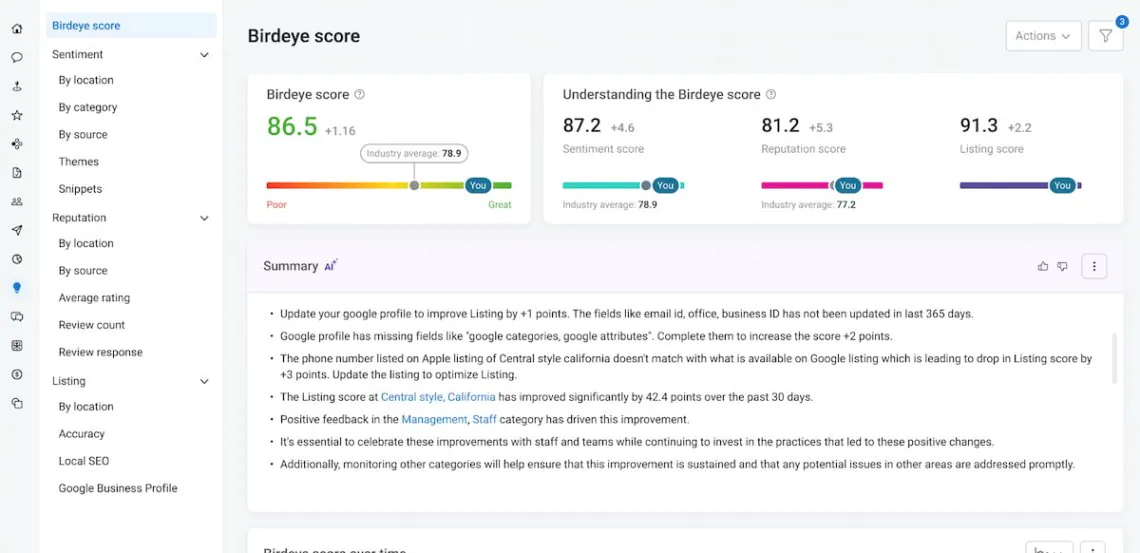
Then, Insights AI delivers tailored recommendations based on sentiment analysis across all review sources.
There’s also Competitors AI, which benchmarks your reputation against rivals, while custom AI models help keep review responses and social posts consistent with your brand voice.
Birdeye has moved into AI visibility, too. Search AI shows how your company appears across ChatGPT, Google AI Overviews, Perplexity, Gemini, and other AI platforms.
Add tools like its Google SEO Rank Report, Listings Verifier, and Uber Eats menu sync, and you’ve got a pretty broad local reputation toolkit.
Why did I pick Birdeye?
What stood out to me while testing Birdeye was how connected everything felt.
Reviews don’t sit neatly in their own little corner. You can move naturally from customer feedback to local performance, competitive context, and AI visibility, making it easier to see the big picture.
Key features:
- Review management across 200+ sites – Monitor, filter, assign, and respond to reviews from one dashboard instead of bouncing between platforms. Birdeye can also turn a review into a ticket when it needs follow-up.
- AI review responses – Draft or automate on-brand replies, with the option to escalate critical feedback instead of treating every review the same.
✅ Strengths:
- Search AI for AI answer engine visibility monitoring
- Insights AI and Competitors AI for actionable benchmarking
- Custom AI models for on-brand review responses and social posts
- 200+ review platform coverage
- 3,000+ integrations including Squarespace, Zoho, and Mitchell1
- Recognized as Top AI Product Globally on G2 2026
⚠️ What could be better:
- Per-location pricing scales up fast for multi-location businesses
- Starter plan ($299) excludes AI features — requires higher tiers
- Some users report onboarding complexity
Overall verdict: A strong, constantly evolving all-in-one platform for SMBs and growing multi-location businesses. Particularly compelling for brands that want to manage reviews, social, and AI search visibility in one place.
09 Grade.us
4.6/5
G2 (146 reviews)
4.8/5
Capterra (244 reviews)
14 days / Free trial
$99 / Month
Grade.us is the go-to review management platform for marketing agencies and SEOs.
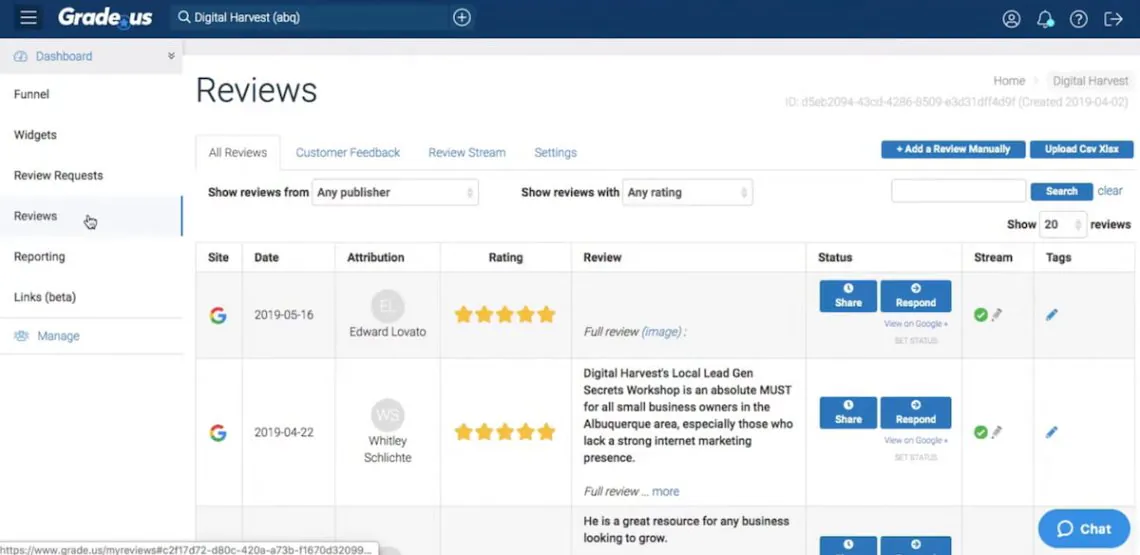
You can automate review requests through email and SMS drip campaigns, monitor 100+ review sites, and set up custom review funnels that guide happy customers toward the platforms that matter most.
Positive reviews can also be automatically shared on social media, which is a nice way to squeeze a little more value out of good feedback.
Why did I pick Grade.us?
Where Grade.us really stands out is the reseller side. Lead generation, multi-client management, and ROI reporting are baked into the platform, so it makes the most sense to deliver reputation management for clients rather than just manage it for your own brand.
Key features:
- White-label platform – Rebrand the dashboard, reports, and client-facing experience as your own. This is the big one if you’re selling reputation management as a service rather than using the tool only in-house.
- Custom review funnel – Guide happy customers toward public review sites while routing unhappy feedback back to the business first.
- Review widgets & social sharing – Turn positive reviews into website widgets or automatically share them on social channels.
✅ Strengths:
- Best-in-class white-label option for agencies (full branded domain + SSL)
- Automated email and SMS review request drip campaigns
- 100+ review site monitoring with instant alerts
- Social proof widgets for client websites
- Auto-posting of positive reviews to social media
- Designed specifically for the agency reseller model
⚠️ What could be better:
- Interface is less polished than newer competitors
- Limited API documentation makes custom integrations challenging
- Some users report unexpected price increases
- No major AI feature set beyond basic review monitoring
Overall verdict: The strongest choice for digital marketing agencies building a review management service. If white-labeling and reseller tools matter to you, Grade.us is hard to beat. Less compelling for brands managing their own reputation directly.
10 Agorapulse
4.5/5
G2 (974 reviews)
4.6/5
Capterra (713 reviews)
30 days / Free trial
From $79 / User / Month
Agorapulse is a social media marketing management platform with a much stronger listening side than you might expect at first glance.
In 2025, it made a significant move by acquiring Mention, a dedicated social listening tool, meaning its listening capabilities are now substantially deeper than those of most social management competitors.
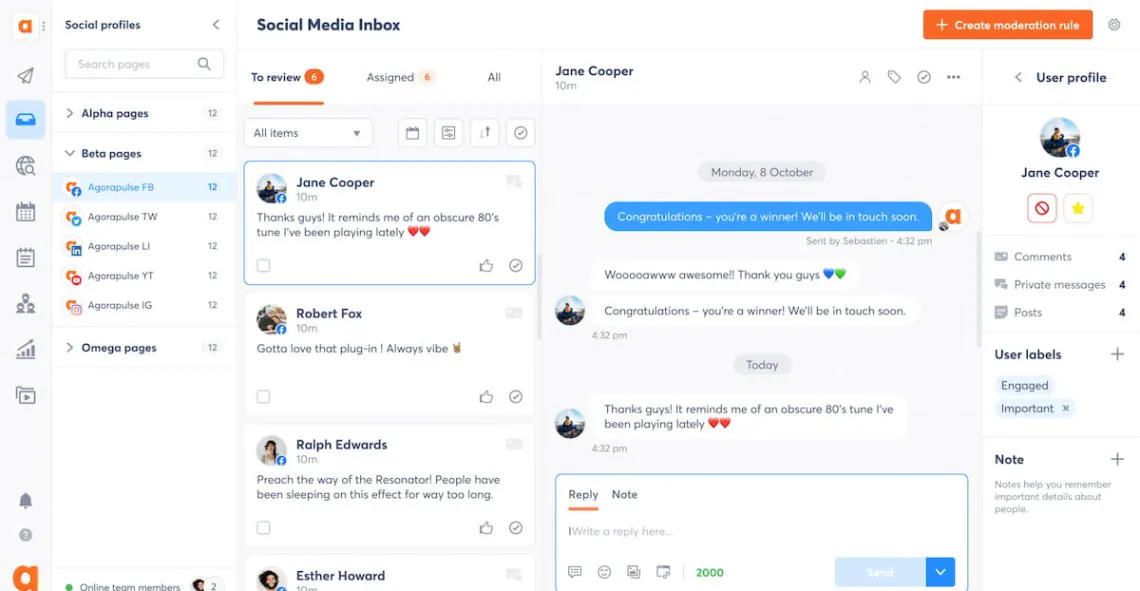
The unified inbox brings messages, comments, and mentions together, while social listening lets you track brand mentions, keywords, and competitor activity in real time. You can also filter by language, location, and source, which helps when the volume starts piling up.
But the feature that stands out most to me is ROI tracking. It connects social activity to Google Analytics revenue goals, giving you a much clearer link between conversations and business results.
AI writing assistance, collaborative calendars, and ad comment moderation round out the day-to-day toolkit, giving social teams a fairly complete set.
Why did I pick Agorapulse?
What sold me on Agorapulse is that the listening side feeds directly into the sales pipeline.
You can track brand and competitor conversations, filter out irrelevant noise, watch for sentiment or volume shifts, and then connect that activity back to revenue through Google Analytics.
Key features:
- Search Screening – Automatically filters out irrelevant keyword matches from listening results. Very useful when your brand name also means something else.
- Competitive Listening & Share of Voice – Track your brand and competitors in the same search, then compare conversation volume and share of voice across platforms.
- Volume & sentiment alerts – Get notified when mention volume suddenly jumps or sentiment shifts, and create dedicated searches around crisis-related keywords.
✅ Strengths:
- Enhanced social listening via Mention acquisition
- Supports 11 social platforms, including Threads, Bluesky, and Reddit
- ROI tracking that ties social activity to actual revenue
- Unified inbox with AI writing assistance
- Competitor benchmarking on the Advanced plan and above
- Free plan available; strong customer support (avg. 30-min response time)
⚠️ What could be better:
- Per-user pricing escalates quickly for larger teams (3-person team on Standard = $297/month)
- Reporting customization is still limited on lower plans
- Weaker on non-social monitoring (news, review sites, forums)
Overall verdict: The best option on this list for social-first teams that want management, listening, and ROI tracking in one platform. If you need broader web or review site coverage, pair it with a dedicated monitoring tool.
How to choose a brand reputation monitoring tool
By this point, you’ve probably noticed there isn’t one obvious “best” option.
Some tools are great for reviews, some are built for multi-location teams, and some make more sense when you need broad monitoring across social, web, news, and AI.
The easiest way to narrow it down and choose the best reputation management software for your brand is to start with what you actually need to watch:
| Business type / need | Best-fit tools |
|---|---|
|
Solo marketer or small team with a tight budget |
Google Alerts + Brand24’s entry plan |
|
Local service business |
GatherUp, Broadly, or Birdeye |
|
Franchise or multi-location brand |
Chatmeter or ReviewTrackers |
|
Marketing agency |
Grade.us for white-label review management; Brand24 for client monitoring projects |
|
Social media management + basic monitoring |
Agorapulse |
|
Mid-to-large brand that needs everything |
Brand24 for comprehensive monitoring + AI insights; Brandwatch for enterprise-scale intelligence |
Why is brand reputation monitoring important?
Reputation can feel a little abstract right up until it starts affecting clicks, sales, reviews, or whether someone chooses you over a competitor.
The numbers speak for themselves:
- 93% of consumers read online reviews before making a purchase decision
- 98% of shoppers read reviews before buying online – especially for unfamiliar brands
- 94% of people say a bad review has made them avoid a business
- A one-star rating boost can increase revenue by 5–9%
- 72% of consumers say positive reviews increase their trust in a business
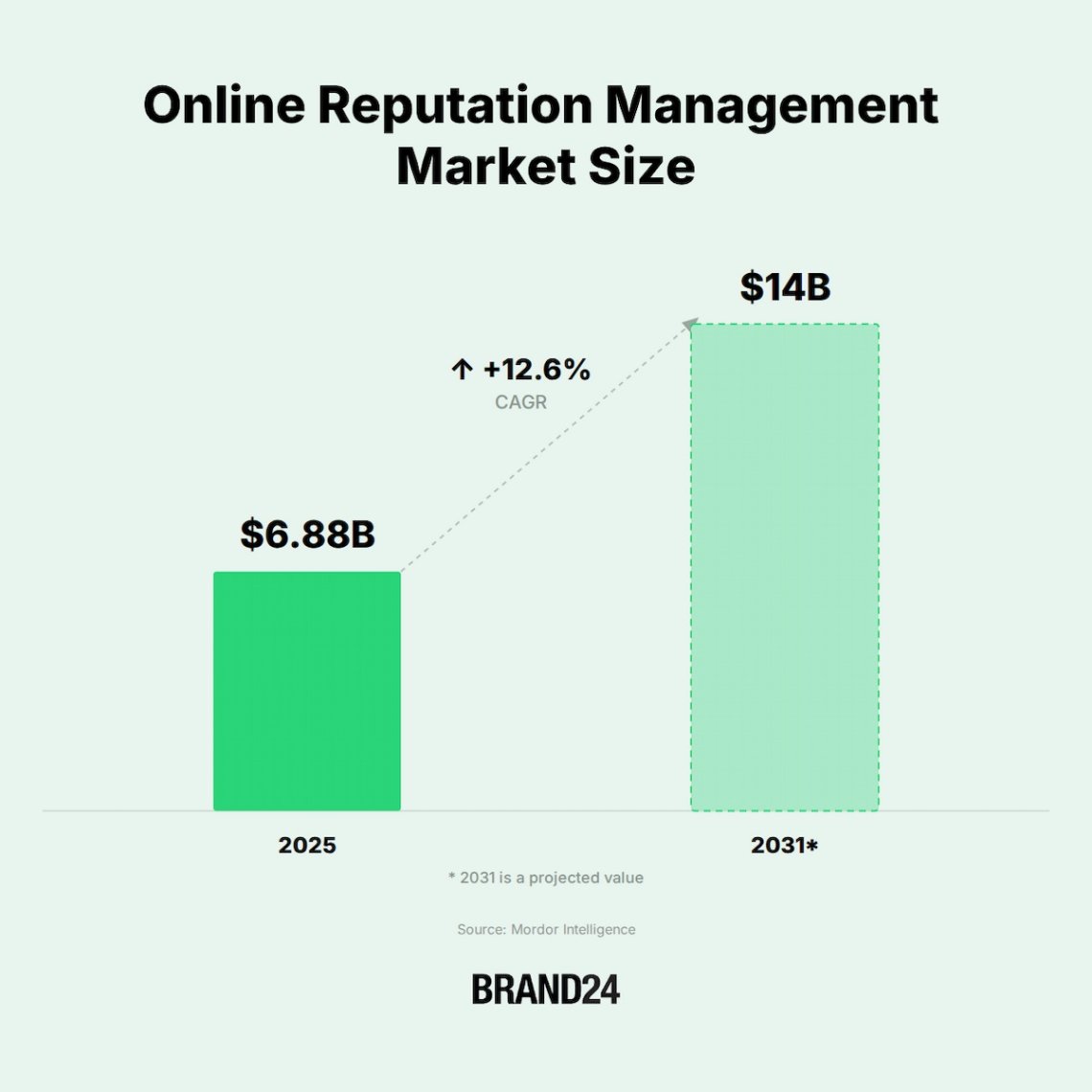
Beyond reviews, the online reputation management market itself is growing fast. Valued at $6.88 billion in 2025 and projected to reach $14 billion by 2031. The investment tells you everything about how seriously businesses now take this.
What surprised me most, though, is how much of a brand’s online reputation now lives in AI answers. When someone asks ChatGPT, “Which project management tool should I use?”, your reputation in that answer matters just as much as your Google Reviews score.
Most brands still aren’t watching that layer very closely.
That creates a pretty big blind spot, especially now that reputation is being shaped across so many different channels.
And with brand reputation monitoring, you can:
- Protect against crises before they escalate
- Spot recurring issues before they start affecting customer loyalty
- See where competitors are gaining or losing trust
- Improve visibility across search, social media, reviews, and AI answers
In other words, you’re not just protecting your reputation; you’re actively building a more positive online presence for your brand.

Conclusion: Brand reputation monitoring checklist
If you take only one thing from this guide, make it this: good reputation monitoring is about catching the right signals early enough to act on them.
That means tracking more than reviews. Depending on your business, you may need to watch social media, news, forums, podcasts, and even AI answers.
And that’s exactly why brand reputation monitoring in 2026 isn’t optional – it’s infrastructure. Here’s how to set up a solid foundation:
- 1 Choose your primary tool based on budget, team size, and monitoring scope
- 2 Set up keyword projects for your brand name, product names, key people, and competitors
- 3 Configure real-time alerts for negative sentiment spikes
- 4 Monitor review platforms relevant to your industry (not just Google)
- 5 Track AI chatbot visibility — how is your brand described in ChatGPT, Gemini, Perplexity?
- 6 Assign response ownership — who handles negative reviews? In what timeframe?
- 7 Run a monthly reputation report covering sentiment trend, volume, top sources, and key topics
- 8 Use competitor monitoring to benchmark your share of voice
- 9 Act on insights — monitoring only creates value when it changes behavior
Final thought from me: the brands that win at reputation aren’t the ones with the most five-star reviews.
They’re the ones that respond fastest, learn from feedback, and stay visible in the places where conversations actually happen, including places that didn’t exist three years ago.
FAQ
Brand reputation monitoring means tracking how people perceive and discuss your brand online: across social media, review sites, news coverage, forums, podcasts, and increasingly, AI-generated answers.
The process involves collecting and analyzing brand mentions, identifying sentiment trends, detecting crises early, and building a clearer picture of how the public sees your company.
Manual monitoring is nearly impossible at scale. Tools automate mention collection across dozens of sources, provide sentiment analysis, send real-time alerts, and generate reports – saving hours of work while catching things you’d otherwise miss.
Social listening focuses mainly on conversations happening across social media. Brand reputation monitoring is broader and can also cover reviews, news, blogs, forums, podcasts, and AI-generated answers.
There’s plenty of overlap, though. Tools such as Brand24, Brandwatch, and Agorapulse combine social listening with broader reputation-monitoring features, each with distinct strengths and source coverage.
You can start for free with Google Alerts or Agorapulse’s free plan. Paid options on this list start at around $79/user/month for Agorapulse, $99/month for GatherUp and Grade.us, and $199/month for Brand24.
Enterprise-focused tools such as Brandwatch, Chatmeter, and Birdeye generally require a custom quote. Always check what’s actually included in the starting plan, especially AI features, number of locations, users, and monitored sources.
Yes, but only some tools do this. Brand24 is the most capable option here, tracking mentions across ChatGPT, Gemini, Perplexity, Claude, Grok, and others. This is increasingly important as more consumers use AI to discover and evaluate brands.
Brand24, Brandwatch, Birdeye, and Chatmeter are all strong AI-powered options, but they’re built for different jobs.
Brand24 is best for broad monitoring across social media, news, forums, reviews, and AI answers, with built-in sentiment, topic, and anomaly analysis. Brandwatch is stronger for large-scale consumer intelligence, historical analysis, and reputation risk detection.
Birdeye focuses more on reviews, local reputation, and AI search visibility, while Chatmeter is especially useful for multi-location brands that need review analysis, risk monitoring, and local performance insights.
Acknowledge the issue quickly, apologize where warranted, take the conversation offline when appropriate, and follow up with a resolution. Speed matters – the same-day response rate significantly impacts how other readers perceive your brand.
Track product names, key executives, common misspellings, competitor names, and relevant industry keywords. Also, monitor your brand’s hashtags, and in 2026, set up alerts for how AI tools describe your category.
Absolutely. In fact, small businesses often have more to lose from a single viral negative review than large enterprises. The good news is that affordable options exist, and you don’t need to monitor the entire Internet from day one.
Start with the places where customers are most likely to talk about you – usually Google reviews, one or two social platforms, and relevant industry sites. Set alerts for your business name and respond to negative feedback quickly. If mentions start piling up, it’s time to move to a broader monitoring tool.