How to Do a Business Audit? The 5 Step Guide [2026]
In today’s fast-paced business environment, staying competitive requires more than just a good product or service—it demands a deep understanding of your company’s inner workings. That’s where a business audit comes in.
A thorough audit not only highlights areas of financial, operational, and strategic strength but also identifies risks and inefficiencies that could be holding your business back.
A business audit comprehensively evaluates a company’s operations, financial health, compliance, and performance. It assesses various aspects, such as accounting practices, internal controls, and operational efficiency, to identify opportunities, strengths, weaknesses, and areas for improvement.
Companies can maintain financial health, ensure compliance, and uncover new growth opportunities by regularly conducting business audits.
The best part?
AI-powered tools have made this once time-consuming process easier and more efficient.
These advanced tools can now automate parts of the analysis, allowing business owners to focus on decision-making and improvement strategies with greater confidence and speed.
What is a business audit?
An audit is like a routine checkup for your company, much like a doctor’s examination of your body.
Just as a doctor evaluates your overall health by checking vital signs, a business audit assesses your company’s financial, operational, and compliance vitals.
It identifies any weaknesses or inefficiencies, ensuring everything runs smoothly and in line with regulations.
This diagnostic tool for marketers and business owners ensures your brand is fit, strong, and ready to compete in a crowded marketplace.
Without this checkup, it’s easy for unnoticed problems to grow into major setbacks.
Types of audits
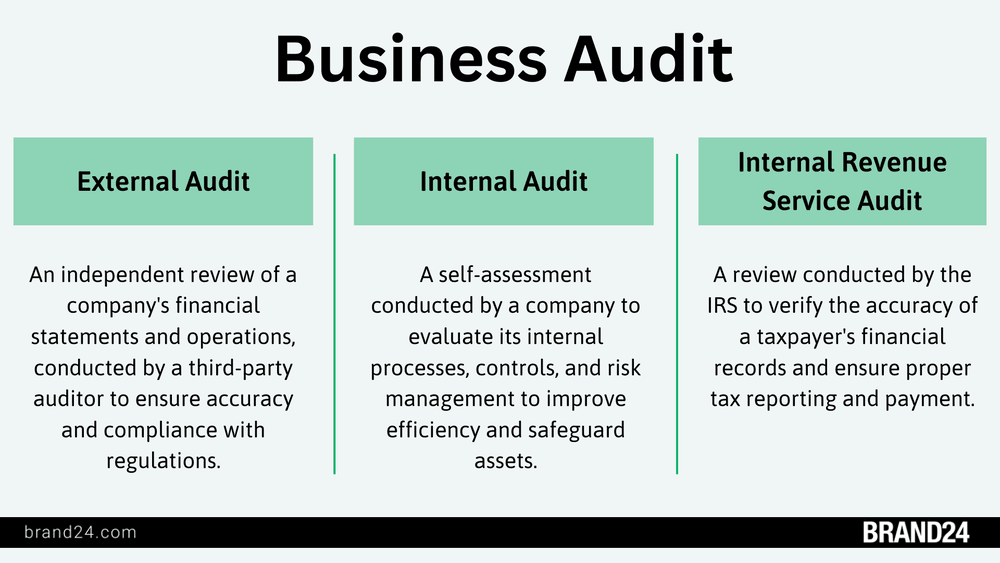
In general, there are 3 popular types of audits. These are:
External audit
Internal audit
Internal Revenue Service Audit (IRS audit)
Types of audits – original infographic by Brand24
While all of them are useful, I will focus on internal audits in this article.
Why?
Because you can conduct it on your own.
Thus, it’s the most effective and cost-efficient method!
You can determine your company’s performance and introduce improvement procedures thanks to the internal audit findings.
With them, you’ll improve your company’s efficiency, streamline business processes, and boost revenue in the long term.
A business audit isn’t just about collecting data. It’s about understanding it. Raw metrics and dashboards help you seepatterns, but turning those patterns into strategic action often requires deep analysis and expert interpretation.
That’s where Insights24 comes in. It’s a market intelligence service that goes beyond traditional analytics. It combines:
AI-powered data collection from online conversations and digital sources.
Expert human analysis to interpret trends and context.
Clear, actionable recommendations tailored to your business goals.
What Insights24 can add to your audit:
1. More meaningful insights (not just numbers) Rather than showing charts, Insights24 explains what’s driving changes, e.g. Why did this trend happen?What triggered the sentiment change?
2. Strategic context across the market It benchmarks your performance against competitors and wider market movements.
3. Customized intelligence reports Reports are built for your business priorities, not generic purpose.
Use Brand24 to collect and monitor online signals or use Insights24 to go deeper and understand what it all means in your market and competitive landscape.
How to do a business audit?
That was a handy shortcut, especially if you conduct routine audits (which, by the way, is very useful).
However, if you haven’t done a business audit in a while, a more complex approach may be more appropriate.
Check out the following 5 steps.
Step 1: Collect data
Data is the core of any audit process. A business audit requires a lot of it, as this particular audit has a very broad scope.
The essential data you need to do an audit of your business includes:
Financial statements (balance sheet, income statement, cash flow statement)
Business tax returns and financial records for the past fiscal year
Internal control policies and procedures
Inventory records and asset valuations
Sales reports and revenue data
Expense and payroll records
Contracts with vendors, suppliers, employees, and clients
You have to collect some of this data internally from different departments within your company.
The remaining data processing, such as customer insights and online performance brand metrics, can be done through media monitoring tools. This way, you can save time and quickly identify areas for improvement.
At this point, you have collected all the necessary data.
What’s next?
Let’s get to analyzing them. It’s good to have the data audited previously to make this step more efficient. This way, you can track your progress in time and easily spot regression.
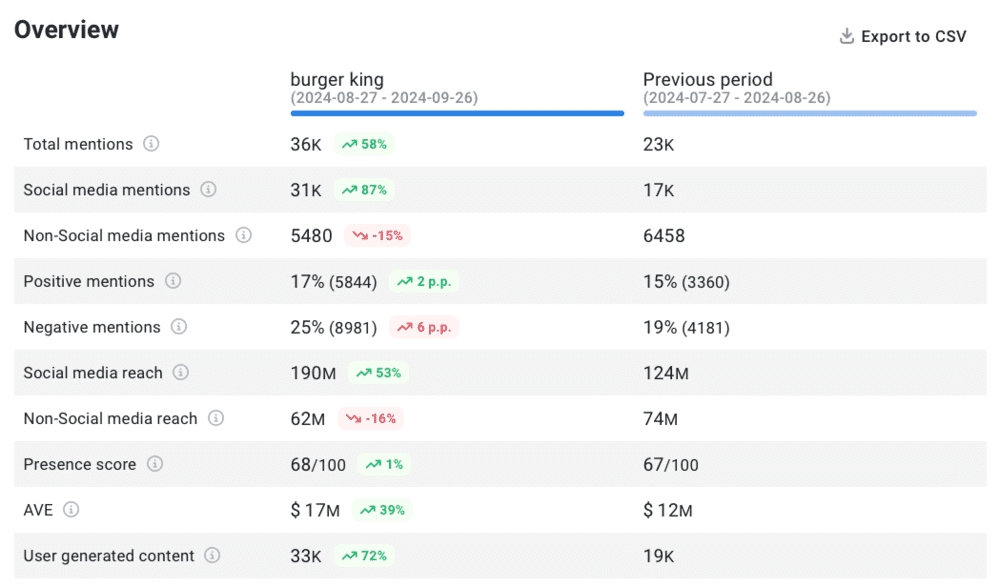
Alternatively, if you don’t have any historical data, you can use Brand24’s Period Comparison feature.
It allows you to contrast any 2 chosen periods with ease.
Brand24: Period Comparison
As you can see, Burger King’s current period has been a great success. They improved most of their online marketing metrics.
The biggest progress happened in social media mentions (87%) and UGC (72%).
The only worrying result is the growing negativity (6 p.p.).
Additionally, while the social media results are impressive, non-social sources performed slightly weaker than earlier.
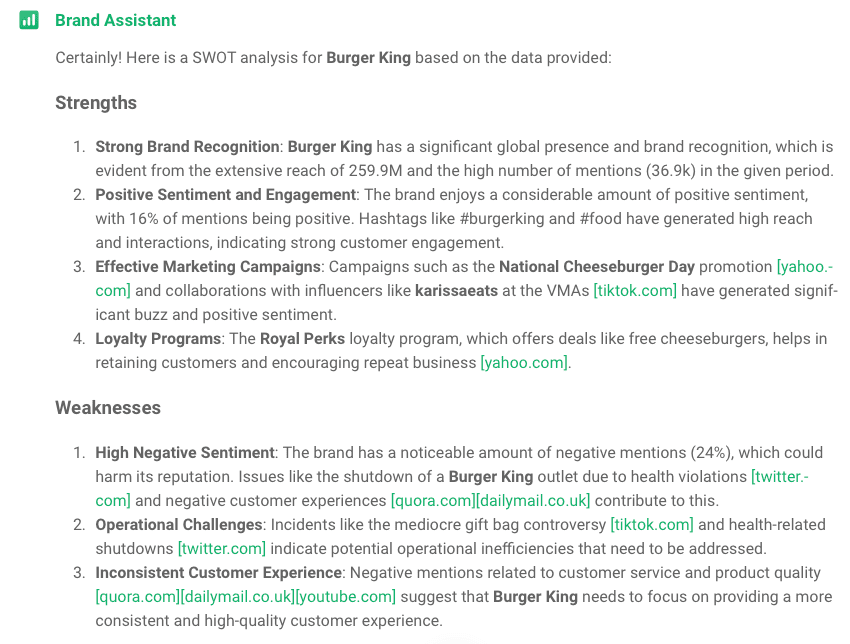
A SWOT analysis—which identifies a company’s strengths, weaknesses, opportunities, and threats—is a crucial step in any business audit.
It provides a clear snapshot of internal and external factors affecting the business.
By analyzing strengths and weaknesses, companies can understand where they excel and where improvements are needed internally.
Opportunities and threats focus on external forces, helping businesses identify market trends, potential growth areas, and risks that could hinder progress.
A SWOT analysis is a strategic lens in a business audit.
It guides decision-makers to optimize operations, seize new opportunities, and mitigate risks.
So, how do you conduct a SWOT analysis?
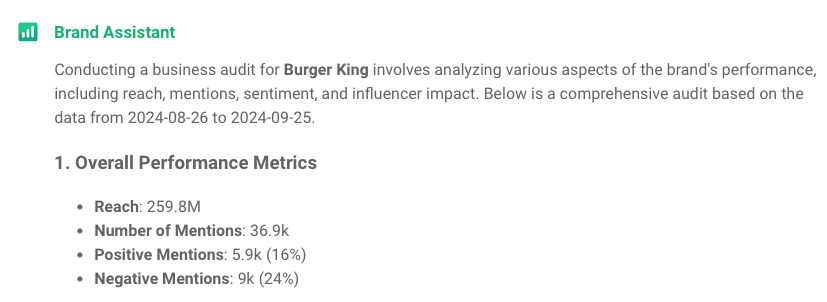
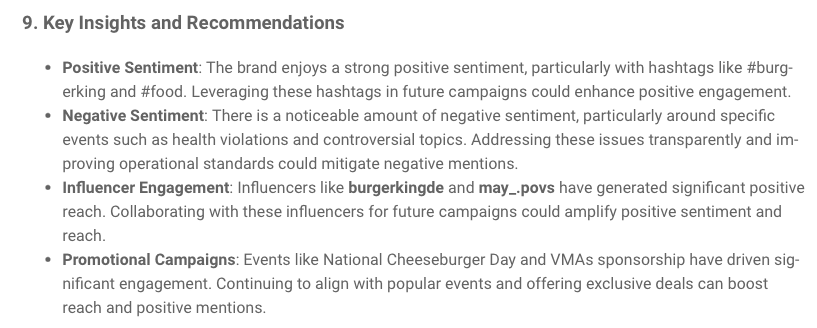
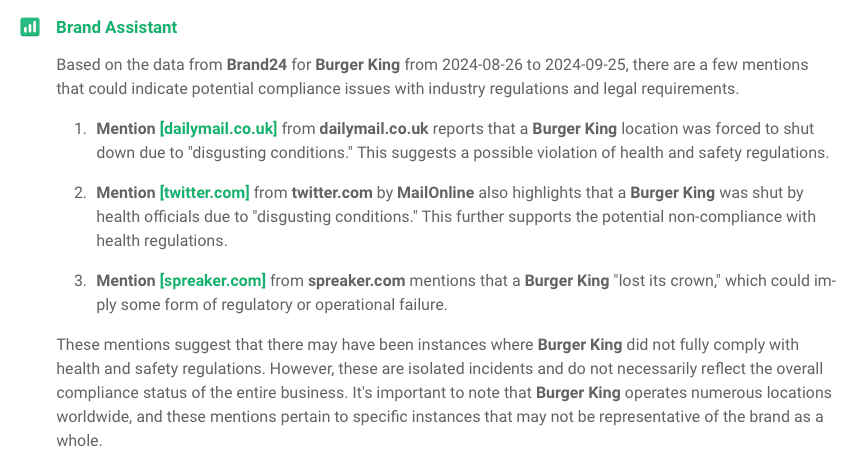
Just ask our AI Brand Assistant for it. He’s an expert ; )
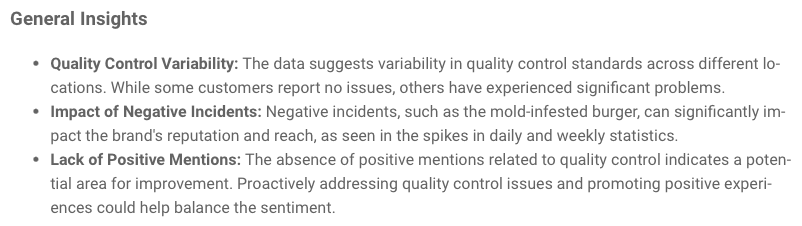
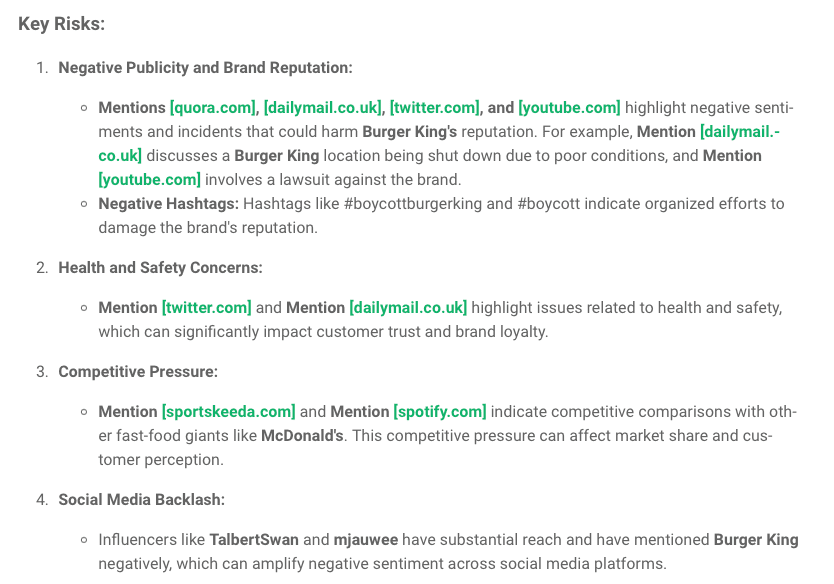
AI Brand Assistant by Brand24: SWOT analysis – strengths and weaknesses
AI Brand Assistant by Brand24: SWOT analysis – opportunities and threats
Step 4: Benchmark the performance
I already mentioned comparing your results with past records. Another important thing is knowing your position in the market by comparing your performance with competitors.
To start competitor research, you must know who your competitors are.
Nothing simpler than that. Just ask our AI Brand Assistant!
AI Brand Assistant by Brand24: Burger King competitors
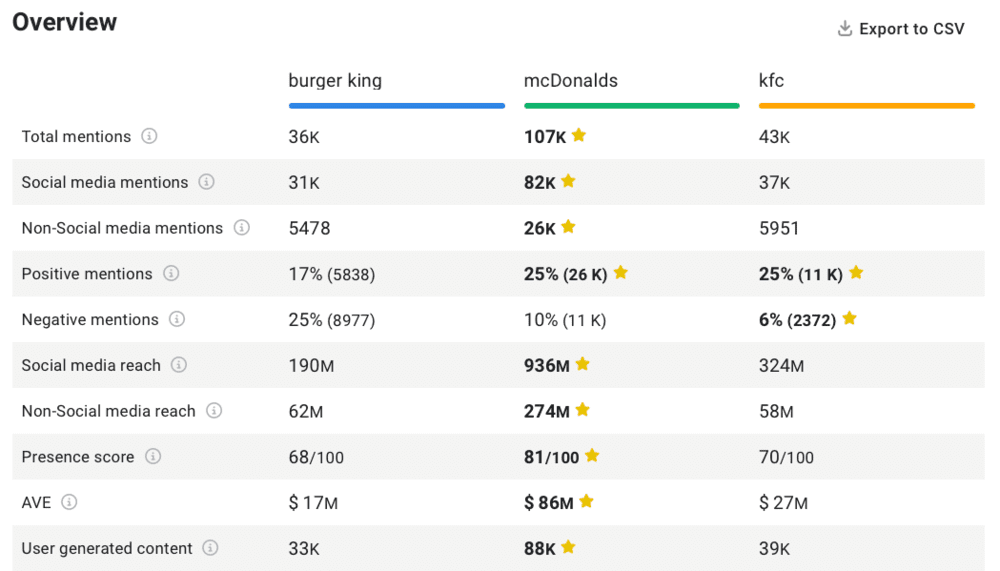
Now, you can either continue the conversation and ask for a detailed metrics comparison or set up media monitoring projects for each competitor and compare them in the Comparison tab.
Brand24: Comparison of Burger King, KFC, and McDonald’s
This kind of comparison clearly shows your strong and weak sides, indicating what you should improve to win with your competitors.
Step 5: Monitor and review
Business audits should be conducted regularly—ideally annually—to ensure that the company stays on track and adapts to changing market conditions.
Regular audits allow business owners to catch and address issues early, preventing minor problems from escalating into costly ones.
However, in times of rapid growth, significant changes, or shifts in the market, more frequent audits may be necessary, such as quarterly reviews.
Consistent audits also foster better financial statements management, regulatory compliance, and operational efficiency, ensuring the business remains competitive, compliant, and primed for long-term success
Conclusion
In conclusion, a business audit is vital for maintaining a company’s health and ensuring long-term success.
By regularly evaluating operations, financial records, and risks, businesses can stay agile, compliant, and prepared for growth.
With the integration of AI-powered tools, the audit process has become more efficient, giving business owners and marketers a clear path to making informed, strategic decisions.
In today’s ever-evolving marketplace, conducting regular audits is not just beneficial—it’s essential for staying competitive and thriving.
Final thoughts:
There are 3 popular types of audits: external audit, IRS audit, and internal audit. The last one is handy as you can conduct it on your own without engaging external auditors.
Most audits are all-encompassing projects that analyze many different business areas, but you can also determine a certain part of your business to be audited. Certainly, a complex review is beneficial, but if some aspects are more important than others, focus on auditing them first.
By analyzing documentation, including financial records, you can also prepare for an IRS audit or any other external financial audit, as your internal auditors may discover incorrect accounting records or a material misstatement.
Leverage modern AI software to speed up your audit operations without lowering their accuracy.
Leverage AI Brand Assistant, track mentions, compare metrics & more!
How to Do a Business Audit? The 5 Step Guide [2026]
Blog
Analytics & Reporting
Brand24
Insights, analyses & case studies
Agnieszka Wolanin
Business audits used to be time-consuming and tedious tasks. Not anymore! You can do a business audit in 5 steps. Discover innovative strategies & modern tools.