Table of contents
2M Marketers

Did you know that brand reputation directly impacts your revenue?
Each time someone has a good association with your brand, they spend about 18% more money, and every bad association can cut their spending by around 12% (HBR, 2026).
To understand how brand reputation management works in practice, I analyzed 49.7k online mentions, using Brand24’s AI Brand Assistant.
This guide shares everything I learned from that research.
Key takeaways
-
What is brand reputation management?
Brand reputation management is the ongoing practice of monitoring, influencing, and protecting how your brand is perceived in customer reviews, social media, news, and AI Search.
-
Why is brand reputation management important?
Consumers spend 51% more with brands they trust. In 2026, brand reputation also determines whether LLMs like ChatGPT or Google AI Overviews recommend or ignore your brand.
-
How do you measure brand reputation?
Brand reputation is measured through sentiment analysis, share of voice, review ratings, and volume of brand mentions over time. Tools like Brand24 track them in real time across all major platforms.
-
What affects brand reputation the most?
According to Brand24's 2026 research, the biggest drivers are product quality, responsiveness to customer concerns, and digital visibility, including how your brand appears in AI chatbot responses.
-
What is the best way to manage brand reputation?
The best approach is the six steps in the Brand24 Reputation Management Loop: to mix real-time monitoring, quick responses to negative mentions, proactive community building, crisis readiness, and ongoing competitive benchmarking.
Let’s dive in!
What is brand reputation management? Definition
Brand reputation management is the ongoing practice of monitoring, influencing, and protecting how your brand is perceived by: customers, prospects, general public, media, and AI chatbots that generate answers based on what they’ve indexed about you.
The simplest way to think about it is:
- Brand reputation is what people say about you (your brand) when you’re not in the room.
- Brand reputation management is everything you do to shape that conversation and to catch it when it goes sideways.
Here’s how it can look like in practice:
Lay Kuen Y., Community Lead at MailerLite, told us something that stuck with me: they started to respond to every single brand mention online.
This shift from passive monitoring to proactive engagement turned their Brand24 project into a community-building engine.
During a single Black Friday campaign, their brand visibility surged by 20% and social media reach grew by 169%.
(See the full success story in the Benefits section below.)
The components of brand reputation management every brand needs to have covered:
- 1 Monitoring: tracking what people say across social media, reviews, news, forums, and podcasts in real time
- 2 Review management: responding to feedback, flagging fake reviews, and making it easy for happy customers to share their experience
- 3 Crisis management: detecting threats early and having a tested response plan ready before you need it
- 4 Content & SEO: publishing fresh, authoritative content that shapes both search results and topical credibility in LLMs
- 5 AI search visibility: ensuring your brand is accurately and positively represented in ChatGPT, Gemini, Perplexity, and Google AI Overviews
- 6 Competitive benchmarking: knowing where you stand relative to competitors in sentiment, share of voice, and review quality
Brand reputation management vs. online reputation management. Differences
Brand reputation, brand reputation management, and online reputation management (ORM) are three related but distinct terms.
Brand reputation management is the broadest. It includes every channel and marketing effort that shape and influence how people see your company.
Online reputation management is a smaller part of reputation management. It only focuses on your online presence.
So how do they differ?
Brand reputation
- It is the overall perception of your brand, shaped by:
- product/service quality,
- customer service,
- executive behavior,
- press coverage,
- and word of mouth.
- It “lives” everywhere, both online and offline: in social media, news, reviews, AI-generated responses, and even in the conversations that your customers have outside the internet.
Brand reputation management
- It is everything you do to monitor, influence, and protect that perception.
- It’s the broadest of these terms.
Online reputation management (ORM)
- It is a part of brand reputation management.
- It focuses specifically on digital channels, like search results, review platforms, and social media.
A quick comparison:
| Term | What it covers | Scope |
|---|---|---|
| Brand reputation | How your company is perceived by customers, media, the public, and AI chatbots | Offline + online = everywhere |
| Brand reputation management | All activities to monitor, shape, and protect brand perception | Broadest |
| Online reputation management (ORM) | Digital-only reputation: search results, review platforms, social media, online news outlets | Online only |
Brand reputation management 2026 trends [Brand24 original research]
To understand how brand reputation management is discussed by marketers in 2026 (like, what worries brands, what they’re trying to achieve, and where the biggest pain points are), I used Brand24’s AI Brand Assistant to analyze online mentions around brand reputation management across social and non-social media.
Before going deeper, here’s what stood out most when I looked at the data:
- 1 Product Quality and Trust dominates the conversation
- 2 Cybersecurity breaches are the #1 pain point
- 3 Crisis communication speed is the #1 challenge for marketers
- 4 Consumer Products & Retail drives 46.8% of all brand reputation discussions
- 5 05 AI search visibility is an emerging but also much-discussed desired outcome of managing brand reputation
What people discuss when they talk about brand reputation management?
When I sorted the online conversation into topic clusters, five main themes emerged.
Two of them (Product Quality and Digital Strategy) get almost all of the discussion reach (97.45%)!
A quick summary:
| Topic | What people talk about | Reach / SoV | Sentiment share |
|---|---|---|---|
| Product Quality & Trust | Consumer reviews, buying guides, brand trust as a purchase signal | 276.8k reach | >50% of all topic reach | Mostly neutral (informational buying content) |
| Digital Business Strategy | AI adoption, social listening, ORM tools, social media strategy | 239.6k reach | ~45% of all topic reach | 13.9% positive, 2.8% negative |
| Marketing, PR & Communications | Reputation crisis playbooks, PR agency services, employee brand advocacy | Smaller volume, high strategic density | Neutral-positive (professional problem-solving tone) |
| Brand Reputation Damage | Cyberattacks, outages, loyalty fraud, ethical failures | Smallest volume | 25% negative (the only topic with real alarm in it) |
| Market Analysis & Forecasts | Industry reports, CAGR projections, B2B research | Niche | 100% neutral (pure information) |
Now let’s go through these topics in more detail:
01 Product Quality & Trust
276.8k reach | >50% of all topic reach | 13.9% positive | mostly neutral sentiment
What do people discuss here?
- The biggest conversation with a lot of informational, purchasing-intent content where brand reputation functions as a trust signal.
- Buying guides, product comparisons, and review roundups.
Example quote:
- A Reddit user comparing infrared sauna models noted that “brand reputation was one of many considerations researched before purchase alongside EMF levels, wood type, and warranty.”
02 Digital Business Strategy
239.6k reach | ~45% of all topic reach | 13.9% positive | 2.8% negative sentiment
- Very close to Topic 1 in both reach and sentiment profile.
- Together, these two topics account for 97.45% of all topic reach in the data
What do people discuss here?
- How businesses adapt through AI adoption, social listening, and ORM tools.
Key insight from this topic: Brands that fail to adapt their digital strategy put their reputation at risk.
03 Marketing, PR & Communications
Smaller volume | high strategic density | neutral-positive sentiment
What do people discuss here?
- Marketers talk about reputation management as a discipline, sharing opinions about crisis playbooks, social listening tools, ORM agencies, or employee advocacy.
- The tone is proactive: people discuss having systems in place before a reputation crisis
Example quote:
- “From cyber threats to operational disruptions, having a clear plan can protect your people, brand reputation, and stakeholder trust.”
04 Brand Reputation Damage
Smallest topic by volume | 25% negative sentiment, highest of all topics
What do people discuss here?
- This is where cyberattacks, server outages, loyalty fraud, and brand ethical failures are discussed.
05 Market Analysis & Forecasts
Niche volume | 100% neutral sentiment | B2B/research-oriented
What do people discuss here?
- Industry reports, CAGR projections, and B2B assessments where brand reputation appears as one of a core market aspects.
Example quote:
- A Rankpage Malaysia analysis cited in the data argued that ‘brand reputation is becoming increasingly machine-readable’, pointing to a shift in how LLMs evaluate brands
What are top brand reputation management pain points?
Sentiment analysis showed that the six most common reputation management pain points that people mention online are:
- 1 Cybersecurity breaches & data leaks
- 2 Poor or misconfigured AI implementation
- 3 Product & service quality failures
- 4 Operational & logistics failures
- 5 Social media backlash & unanswered criticism
- 6 Corporate mismanagement & internal culture failure
Let’s dig a bit deeper and see what exactly people say about each of these pain points:
01 Cybersecurity breaches & data leaks
- Marketers see security incidents as direct threats to their brand reputation.
- The most common threats they list are:
- data breaches,
- DDoS attacks,
- supply chain attacks,
- phishing,
- API vulnerabilities.
- The big worry is that once a breach breaks customer trust, it’s really hard to win it back.
02 Poor or misconfigured AI implementation
The second-most-popular topic focuses on how poorly designed AI tools can hurt a brand’s reputation.
People mention:
- chatbots that offend users,
- AI-generated content that feels generic or inaccurate,
- biased algorithms,
- and a lack of AI visibility.
This topic shows a growing anxiety that while AI can boost efficiency, brands can pay a price if they roll out AI-powered products too fast.
03 Product & service quality failures
A third pain point that I often saw in these conversations is about unmet expectations:
- products that don’t match brand’s prestige
- too much packaging that frustrates customers
- and how even small quality issues can hurt long-term reputation
A lot of these conversations show that when a brand has a stronger reputation, people expect more, and they’re even more disappointed if the experience doesn’t live up to it.
04 Operational & logistics failures
Another major pain point marketers bring up online is dealing with:
- shipping delays,
- server outages,
- inventory mistakes,
- and payment processing failures.
05 Social media backlash & unanswered criticism
I noticed that people talk about this issue in two ways:
- brands not reacting fast enough (like not responding to negative posts)
- as a proactive risk (having a messy, inconsistent social media strategy).
From my marketing experience, the pain here is about speed and showing up as a brand, because when brands respond too late, or don’t respond at all, they lose control of their own story.
06 Corporate mismanagement & internal culture failure
I think this is a more “structural pain point than others, because the damage is internal before it shows up to the public. People discuss here:
- bad executive decisions,
- toxic workplace culture,
- dealership/franchise networks that don’t follow brand standards
All these can destroy the brand reputation built over the years.
Top 5 brand reputation challenges that marketers face
What do people find hardest about brand reputation management day-to-day?
When I dug into the social listening data, five challenges kept coming up:
- 1 Crisis communication & speed of response
- 2 Trust in the age of AI & misinformation
- 3 Social media & UGC as uncontrollable gatekeepers
- 4 Siloed organizational ownership
- 5 Absence from AI search
| Challenge | What people talk about (+ quotes) |
|---|---|
| Crisis comms & speed of response | Lack of preparation causes “brand reputation freefall.” Businesses make “fundamental errors” in communication during crises, turning them into “catastrophic brand reputation disasters”. |
| Trust in the age of AI & misinformation | AI chatbots are seen as actively causing brand damage: one source catalogued “5 Reputation Disasters” linked directly to chatbot breakdowns. |
| Social media & UGC as gatekeepers | Brands can’t really control their own story: “Review aggregators, social listening tools, and influencer culture have turned everyday users into gatekeepers of brand reputation.” |
| Siloed reputation ownership | Many brands treat reputation as “a PR problem”, but “the risks usually start in product, HR, or legal”, long before PR team ever hears about it |
| Visibility in AI search | Brands that don’t appear in ChatGPT, Gemini, or Perplexity responses risk losing authority where users increasingly look first: “Absence from AI-generated answers is itself a reputational vulnerability.” |
Which industries care most about brand reputation?
The industry split was more concentrated than I expected, and the discussions within each industry feel pretty different from one another.
| Industry | Share of Voice | Brand reputation discussed as: |
|---|---|---|
| Consumer products & retail | 46.8% | Buying signal: shoppers weigh brand reputation like a product specification |
| Entertainment & celebrity | 32.3% | Quantified metric: monthly reputation scores, fan-driven campaigns |
| Marketing, PR & communications | 9.4% | Operational discipline: crisis plans, tools, agency benchmarks are widely discussed |
| Luxury goods | 6.7% | Financial asset: reputation has a direct impact on resale value and premium pricing |
| Technology & cybersecurity | ~2% | Trust infrastructure: security breaches are treated as direct threats to brand reputation |
| Healthcare, pharma & beauty | ~2% | Credibility signal: brand reputation is tied to safety, compliance, transparency |
| Automotive | ~1% | Reliability check: quality issues can change how people see your brand |
What outcomes people hope to get from brand reputation management
Besides understanding what marketers struggle with in managing brand reputation, I also wanted to analyze what they are trying to achieve.
Our research highlights seven different outcomes:
| Outcome | How is it discussed online? (Quotes) |
|---|---|
| Customer trust & loyalty | Most cited aspiration across all topics and industries. Transparent communication and responsive customer service reduce negative sentiment by up to 30%. |
| Revenue & price premium | Brands with a strong reputation can charge about 10% more (per an IAB report). And people typically spend 51% more with brands they trust. |
| Crisis resilience | Emotional investment from customers can help protect your reputation, but only if you’ve built it up before a crisis hits. |
| Talent attraction | Reputation management ‘produces the kind of reputation that attracts talented people who want to work somewhere they respect.’ |
| Investor confidence | Companies are using AI-powered tools to turn reputation from something hard into a clear, measurable financial asset. Strong sustainability credentials are also a direct draw for investors and funding. |
| AI search visibility | Being cited by ChatGPT, Google AI Overviews, and Perplexity is now a stated brand reputation goal. Brand trustworthiness influences AI recommendations by up to 40% (Nielsen 2025). |
| Word-of-mouth & advocacy | ‘A single review can influence hundreds of buying decisions. Today people check Google Reviews, online presence, brand reputation before spending even a small amount.’ |
The Brand24 Reputation Management Loop
A lot of brand reputation guides just hand you a checklist of best practices and leave it at that.
I’ve never loved that format, because it makes online reputation management feel like a one-time checklist rather than something you work on constantly.
The way I think about it: brand reputation management is a loop of six steps that feed each other:
- 1 Monitoring surfaces insights.
- 2 Insights guide responses.
- 3 Responses improve customer experience.
- 4 Better customer experience means fewer crises.
- 5 Competitive benchmarking keeps you honest.
- 6 And then…it starts again.
This framework is called the Brand24 Reputation Management Loop.
Let’s walk through each step in more detail:
Step 1: Monitor everything that matters
Without real-time media monitoring, you’re always reacting to things that already happened.
Manual monitoring, like typing your brand name into Google, covers maybe 5% of what’s actually being said about you.
I recommend monitoring all of these keywords in your social listening tool simultaneously:
- 1 Brand name, product names, CEO names, branded hashtags, and common misspellings
- 2 Social media, news, blogs, review sites, forums, podcasts, and video platforms
- 3 Competitor keywords, to catch problems that affect your industry
A real-life example:
Cryptiony used Brand24 to monitor both their brand mentions and keywords like ‘cryptocurrency tax.’
Within two years, their monitored reach grew 500×.
(Full story in the Benefits section below.)
Step 2: Analyze sentiment, topics, and trends
Volume tells you what’s happening and sentiment tells you why it’s happening.
Four things I look at:
- Sentiment share over time: a sudden drop in positive sentiment is an early warning signal, even if total mention volume stays stable
- Topic breakdown: which specific subjects (for example: product quality, shipping, pricing, customer service) are driving sentiment changes
- Competitor sentiment: what customers are complaining about with your competitors, which your product may already solve
- Platform breakdown: for example, negative mentions on Reddit or forums behave very differently from negative news articles
| Metric | How to measure it? |
|---|---|
| Sentiment share over time | Look for sudden drops in positive sentiment; they can be early warning signals, even if total mention volume stays stable |
| Topic breakdown | See which specific subjects (for example: product quality, shipping, pricing, customer service) are driving sentiment changes |
| Competitor sentiment | Analyze what customers are complaining about with your competitors, which your product may already solve |
| Platform breakdown | For example, negative mentions on Reddit or forums behave very differently from negative news articles |
Step 3: Respond before small customer problems become PR crises
Speed of response is the #1 challenge in our research. It’s also the biggest single lever you control.
The response sequence I’d recommend:
- 1 Acknowledge fast: respond before the thread grows, even if just to say you're looking into it
- 2 Show empathy: validate the frustration but don't be defensive
- 3 Keep them informed: don't go silent while you work on a solution
- 4 Deliver a clear explanation: specific, easy to follow, no industry jargon
- 5 Give a follow-up: the step that many brands skip, and the one that most reliably turns a frustrated customer into an advocate
One stat I keep coming back to:
According to ReviewTrackers, 45% of consumers say they’re more likely to visit a business that responds to negative reviews.
Step 4: Improve the customer experience continuously
This step is about closing the loop between what customers say and what you change after the feedback.
The cycle I recommend using:
- Media monitoring tool surfaces recurring complaints
- Topic analysis identifies which category they fall into (product, shipping, support, pricing)
- Product or operations teams fix the underlying issue
- Future complaints in that category decrease, and sentiment improves
Gartner research says that 68% of consumers now frequently wonder whether the content and information they see online is even real.
So, every real customer interaction, like a legit review or an authentic reply to their messages, builds trust in a way AI-generated content just can’t.
Step 5: Prepare for reputation crises
I’d suggest putting together a minimum viable crisis plan.
The best ones I’ve seen included:
- Clear ownership: who responds, who approves messaging, who escalates, and in what order
- Pre-drafted templates for the scenarios most likely to hit your brand: data breach, product recall, executive controversy, operational failure
- Brand monitoring tools implemented to catch warning signs before they spread, for example, tracking keywords beyond just your brand name
- A defined escalation path from ‘social mention flagged’ to ‘full crisis response activated,’ with time thresholds for each stage
Step 6: Measure performance and benchmark competitors
Gartner predicts that by 2027, 40% of CMOs who ask for bigger budgets could lose their C-suite influence, simply because they struggle to prove the value of their spending.
The good news is that benchmarking with what your competitors are doing to support their brand reputation is a great way to show that value and justify your strategy.
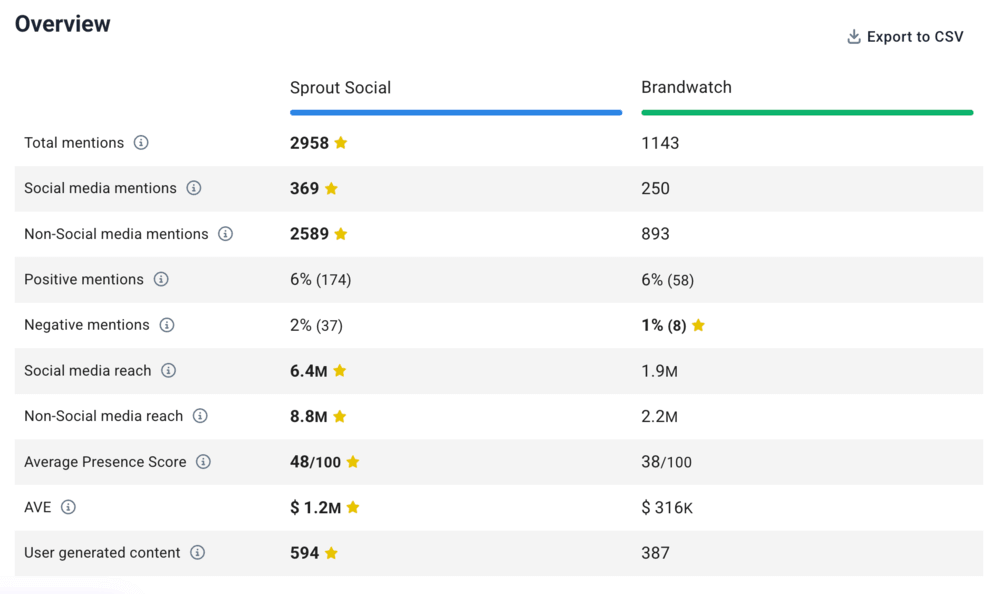
The competitive benchmarking metrics I recommend to look at are:
| Metric | What it measures |
|---|---|
| Sentiment analysis | Positive vs. negative vs neutral mentions volume |
| Share of voice | Your mention volume vs. key competitors |
| Mention volume by platform | Where conversations are growing, where they’re quiet, and where they’re quietly getting worse |
| Response rate and time on negative mentions | Track it internally, it tells you a lot about whether your brand reputation management process is working well |
Benefits of brand reputation management [+ real examples]
I handpicked four real-world success stories from Brand24 clients to show what brands in various industries can achieve with strong brand reputation management:
Brand reputation management for SaaS
Key benefits for this use case:
- Community building at scale: your can turn every brand mention into a brand-client relationship opportunity
- Campaign performance measurement: know exactly which campaign elements drove a reach spike
- Social proof pipeline: build a pool of advocates from customers that proactively engage
- Proactive reputation protection: catch negative mentions before they burst into PR crises
A real-life example – MailerLite:
MailerLite used Brand24 to proactively engage and respond to every brand mention, instead of just monitoring and ignoring.
Community Lead Lay Kuen Y. compared and analyzed campaign periods and used the data to prove marketing ROI to stakeholders.

In a single Black Friday campaign, brand visibility rose by 20% and social media reach grew by 169%.
📚 See MailerLite’s success story: Maximizing Brand Impact and Community Engagement
Brand reputation management for Finance
Key benefits for this use case:
- Crisis prevention in a high-trust market: catch security threats before they spread
- Partnership identification: find who leads the discussion around your brand, thn reach out and invite them to partner with you
- Competitive intelligence: use the pain points people share online about your competitors to improve your own product
- Influencer discovery: find the right influential voices around you without manual research
A real-life success story – Cryptiony:
Cryptiony‘s CMO Hanna Milczarek ran three parallel Brand24 projects:
- brand mention monitoring for crisis prevention,
- keyword monitoring for ‘cryptocurrency tax’ to find partners and potential customers,
- and competitor tracking to uncover pain points their product could solve.
Within two years it led to: 500× increase in reach, 12.6k% growth in online discussion about Cryptiony, and 10 new influencer partnerships established.
📚 See Cryptiony’s success story: How to Use Social Listening to Boost Reputation and Drive Growth
Brand reputation management for MarTech & Business Intelligence
Key benefits for this use case:
- Misinformation prevention: catch inaccurate claims about your product before they overtake the general opinion on your brand
- Multi-market monitoring: track online discussions across languages and regions at the same time
- Competitive gap discovery: find where you’re missing from the conversation
- Cross-team intelligence: your brand, sales, and product teams can run the same reputation monitoring and always stay aligned
A real-world example – Piwik PRO:
Piwik PRO‘s PR Manager Marcin Pluskota used Brand24 to:
- flag inaccurate descriptions of their data collection practices (critical in a GDPR-sensitive space),
- monitor ‘alternatives to Google Analytics’ to find product placement gaps,
- and use language filters to adapt their messaging to different markets.

The result: they prevented crises before they happened, discovered new influencers, and a sales team was armed with actual competitor intelligence.
📚 See Piwik PRO’s success story: Maximizing Brand Reputation and Marketing Insights
Brand reputation management for Manufacturing & Hardware
Key benefits for this use case:
- Social selling: jump into people’s conversations when they’re ready to decide and buy
- Crisis prevention in niche forums (like Reddit or Quora) where brands are often invisible
- UGC tracking: find content about your product you didn’t know even existed
- Influencer identification: discover influential voices in your community without manual analysis
A real-world example – Zmorph:
Zmorph equipped their community manager with Brand24 to monitor brand and product category mentions.
After setting up a media monitoring tool project, the community manager spotted a buyer discussion on X and made a sale.
The team also spotted and dealt with negative Reddit and Quora threads about their brand before they escalated.
📚 See Zmorph’s success story: How Does Zmorph Use Media Monitoring
Best brand reputation management tools for 2026
As a Brand24 team member, I work with reputation monitoring data every day, which means I also know what separates software that actually works from one that just looks good on a features page.
I evaluated the tools below against five criteria that any strong brand reputation management software should cover:
- Best for: what type of company or use case each tool is built for
- Real-time monitoring: what sources it covers (social, news, blogs, forums, review sites)
- AI features: what the tool actually does with AI beyond basic sentiment tracking
- Crisis detection: whether it alerts you before a problem spreads
- AI search visibility: whether it tracks how your brand appears in ChatGPT, Perplexity, and Google AI Overviews
Here are the ones I’d recommend:
| Tool | Best for | Real time monitoring | AI Features | Crisis detection | AI Search visibility tracking |
|---|---|---|---|---|---|
| Brand24 | Brands that need 360-degree social listening + AI-powered reputation analysis | Social platforms, videos, news, blogs, forums, review sites, podcasts | AI Brand Assistant, Topic Analysis, Anomaly Detector, AI Insights | ✅ Yes — Storm Alerts | ✅ Yes — tracks brand mentions in most LLMs |
| Reputation.com | Companies managing multi-location reputation | Review platforms, social media, search engines | Reputation IQ & AI Reputation Manager | ✅ Yes —Smart Alerts | ✅ Yes — AI Location Presence Insights, Listings & GEO Tools |
| ReviewTrackers | Brands focused primarily on review monitoring and response | 100+ review platforms | Review analytics, competitor benchmarking | ⚠️ New review alerts only | 🚫 No |
📚 Read full tool breakdown: The 15 Best Online Reputation Management Software to Try in 2026
FAQ
What is brand reputation management?
It includes tracking mentions, responding to feedback, managing crises, and publishing content that shapes how you appear online.
What is the difference between brand reputation and online reputation management?
Brand reputation management = the active practice of monitoring and protecting that perception across all channels.
Online reputation management (ORM) = a digital-only part of reputation management, focused on search results, review platforms, and social media.
How do you measure brand reputation?
Tools like Brand24 track all of these in real time across social media and non-social sources.
What affects brand reputation the most?
Responsiveness to customer concerns and visibility in AI search are close behind.


