Table of contents
How to Increase Social Media Brand Engagement [2026 Guide]
Social media isn’t just where people hang out – it’s where they discover what to buy next. In 2026, half of consumers in the U.S. say social is one of their main ways of learning about new brands and products, and 45% have made a purchase directly through a social platform in the last month. That’s exactly why social media brand engagement on social media matters so much.
Key takeaways
-
Social media engagement is the strength of your relationship with people online
– and how that relationship shows up in actions like comments, shares, saves, DMs, tags, mentions, and repeat purchases. It’s not just visibility. It’s interaction, loyalty, and advocacy.
-
A simple way to think about it
engagement = listening + showing up + rewarding people. The fastest way to grow it is to use insights (from analytics or social listening) to learn what your audience cares about, respond to mentions (good and bad — especially influential ones), post at the right times, vary your formats, and join relevant trends without forcing it.
-
Mentions, comments, and DMs are your engagement fuel.
Engagement grows when your brand stops acting like a billboard and starts acting like a participant in the conversation.
What is social media brand engagement?
Social media brand engagement is the total of interactions people take with your brand or content on social platforms, such as likes, comments, shares, saves, clicks, direct messages, and mentions, showing how actively your audience responds to what you post and how you show up online.
For a social media marketing strategy to be effective, you need to build a long-lasting relationship between you and your target audience. That’s why it’s vital to look at social engagement as a continuing string of communication rather than a singular interaction.
The key to successful social media engagement is using social media channels to create authentic interactions, monitor discussions, and provide value to other users.
Every social media channel has its rules, which you have to obey if you want to build or improve social media engagement.
Is social media engagement important?
Without a doubt, it is!
Black Friday 2025 was a huge moment for social commerce: TikTok Shop US reported $500M+ in sales over the four-day Black Friday/Cyber Monday period, and creators posted nearly 10 million shoppable videos during the campaign.
Engagement isn’t just “nice comments” — it can directly move revenue.
Especially in today’s social media world, where every company has creative social media engagement strategies and bigger and bigger marketing budgets.
Robust social media engagement levels will help you:
- increase customer loyalty and create word of mouth marketing
- improve your customer experience by answering questions and responding to complaints
- build brand awareness by becoming an industry leader
Social media engagement can make a difference for your business.
Key fact: A loyal following is the best form of marketing. Happy customers will share their experience with their friends and family. That’s a priceless form of advertisement.
Moreover, creating social media engagement will help you during a crisis. A crisis will hit you sooner or later. Building social media engagement will help you manage the social media crisis.
And I don’t see engagement as something that starts with a like or a comment. It starts earlier—with the way you position your brand and the stories you tell.
Tip: When considering social media engagement, think not only about direct communication between your followers and your brand, but also about the messages you convey through your marketing strategy.
To put it simply, don’t wait for your customers to reach out to you. Instead, show how your product or service can solve their problems and help in everyday situations.
How to increase social media brand engagement?
Short answer: To boost social media brand engagement, share content that people actually want to react to, invite responses with simple questions, show up consistently, and keep the conversation going by replying quickly – then repeat the formats and topics that earn the most comments, saves, and shares.
You probably already have at least a couple of social media profiles. Some people engage with your social media content.
What should you do to improve social media brand engagement?
Having a good organic social media brand engagement means that your content is resonating with your target audience. It means you’re producing exactly the content your audience is looking for.
Of course, this can mean something different for each social media platform. Hashtags (especially trending hashtags) are crucial to getting engagement on Instagram, while participation in Twitter chats and simply conversing with people can increase your Twitter engagement.
Meanwhile, sharing user-generated content and engaging in Facebook Groups are more effective on Facebook.
This video shares even more good tips on how to increase your social media engagement on Facebook:
There’s also nothing wrong with boosting your social media engagement a bit with paid ads, but ask yourself this: how likely are you to interact with an ad? Probably not very. Neither is your audience.
But when they’re actively searching – whether it’s for a product, a solution, or an answer you can provide – that’s a win.
Check:
Tactics to increase social media brand engagement
Let’s be honest – having robust social media engagement rates is not that easy. It takes time and effort to build an engaged community around your brand.
Important: There will be around 5.66 billion social network users in 2026.
A slice of this pie is your potential customers. And they’re ready to hear your message. That’s why I think the effort is worth it.
But how to reach out to them in all the noise? Here are our tips and tricks to improve your social media brand engagement.
Social media listening and social media brand engagement
Successful social media brand engagement depends on your ability to listen to your target audience.
Real-life example: Rothy’s used the comment section as a feedback loop: they read what people kept asking for, then launched the product and credited the community for the idea. It’s a simple model: listen → spot patterns → ship the thing → give people credit → earn even more engagement.
I strongly recommend Brand24, not only because I work here, but because it’s also one of the most robust and yet affordable tools on the market.
Brand24 is a media monitoring tool, which means it will collect publicly available online mentions from the whole Internet.
When it comes to social media, the tool will collect mentions from Facebook, Instagram, Twitter, YouTube, Twitch, and TikTok.
Social media monitoring starts by creating a project. In the project settings, you need to fill in keywords you’d like to track on the Internet. Think about:
- the name of your company;
- the name of your product or service;
- your branded hashtag;
- general terms related to your industry.
Tip: Create separate projects for every keyword, depending on what you want to achieve. For example, if you want to measure hashtag performance, I recommend setting up a separate project with just your branded hashtag.
Once your project is created, the tool will start gathering and analysing all publicly available mentions.
All the data is an immense help when it comes to improving your social media brand engagement. Let’s see how you can use them!
Choose the right social media platform
It sounds like a no-brainer, but if you want to have a high social media engagement, you need to be present on the right social media channel. Broadcasting into the void won’t bring you anywhere.
Which means you have to analyse your audience and search for social media channels where your audience is present.
Thankfully, that’s the first thing you’ll spot when you log in to your Brand24 dashboard. All the mentions are categorized according to their source.
Here is how it looks in our case:
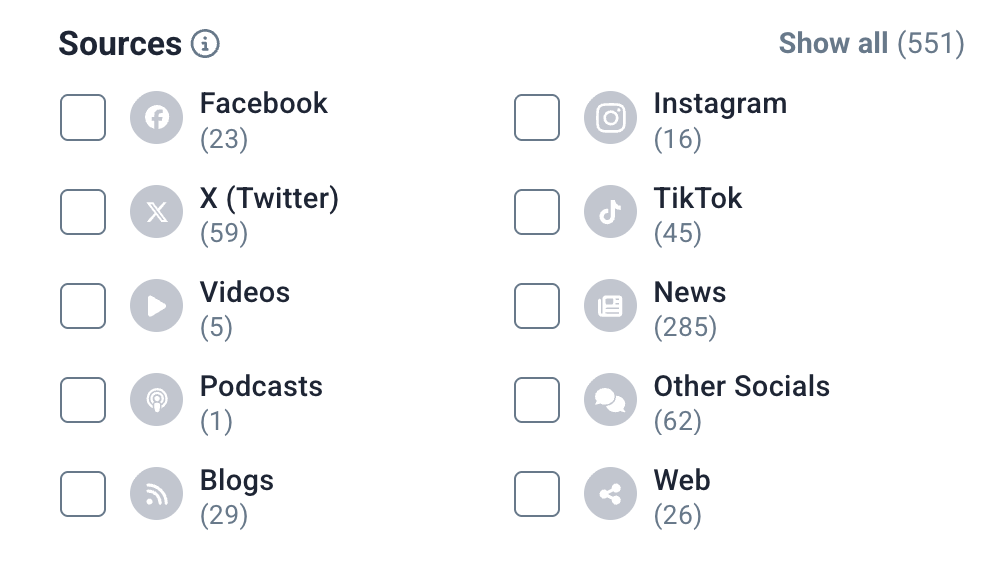
If you want to analyse some other, more niche or local, social media channel, we got you covered!
Simply go to the filters on the left side and filter the results according to a specific domain.
Create social media engagement
I wasn’t joking when I said social media engagement looks like a long-term relationship. And every relationship needs a good start!
The easiest way to start a conversation is to simply ask about something. What do your customers like about your product? How do they use it?
You can encourage users to show a practical application of your products.
Inviting your followers to post user-generated content (UGC) has several positive effects:
- You can reach a much wider audience. The followers of your followers will see your product. That means you get much bigger exposure, which can result in improved social media engagement.
- You can show your audience that you care about them. Commenting on your users’ photos or sharing them (with their permission, of course!)
- It will help you come up with content ideas. The amount of content you have to generate on a daily/weekly/monthly basis can be quite overwhelming. UGC, be it photos, statutes, or tweets, will help you fill your content calendar.
Another great thing about conversations is that they give your brand a human touch.
And when people see a human behind the corporate message, their trust level goes up.
Cooperate with influencers
Influencer marketing has been the go-to social media engagement strategy.
Think of social media influencers as friends who recommend products or services they find particularly useful. A recommendation from an influencer builds trust and improves social media engagement.
Tip: Micro-influencers are especially powerful here. Their audiences are smaller, but usually more focused and more likely to engage.
How to choose the influencer to boost your social media engagement?
The most effective influencers are probably already talking about you! You can spot them with a little help from a social media monitoring tool.
All the data you’re interested in is in the Influencers tab.
Brand24 collects and analyses social media mentions. One of the perks of the Influencers tab is that you can filter out specific sources you want to get the data from.
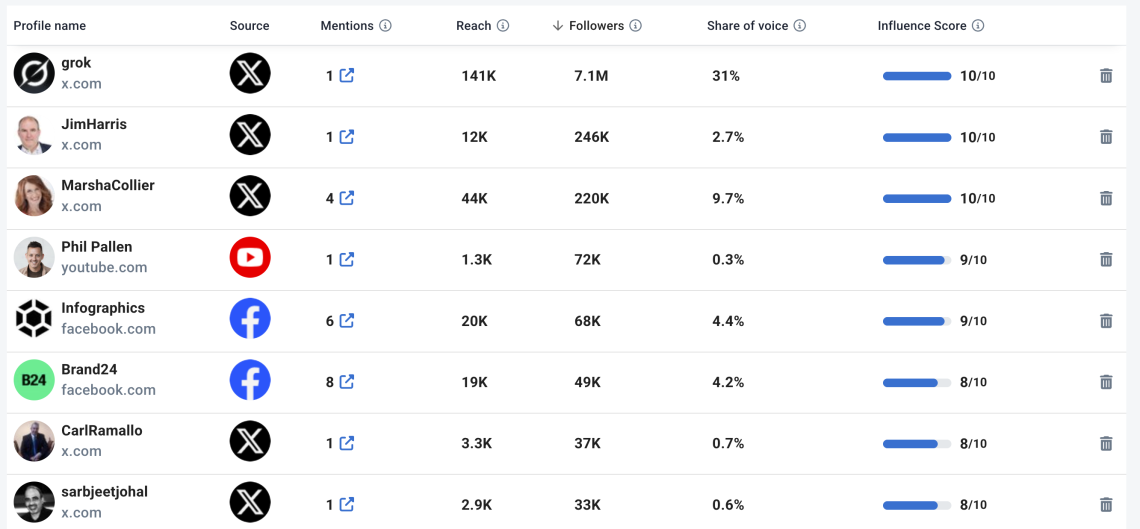
You can easily spot the most influential and active authors talking about your product or the ones that are the most active within your business niche.
Respond to negative reviews
Every company, sooner or later, will receive a negative review. That’s not the end of the world.
In fact, a negative review can actually boost social media engagement – it all depends on how you respond.
Key fact: Responding to negative reviews means replying quickly and professionally to customer complaints on social media or review platforms to reduce frustration, protect your brand reputation, and often turn criticism into engagement and trust.
React quickly. From my experience, the sooner, the better. Customers often expect an answer to their complaint within the first hour.
How to spot a negative review in time?
With a little help from a social media listening tool.
Real-time social media monitoring collects all publicly available mentions, and the sentiment filter helps you catch negative ones right away.
Just swipe the tab to the left, and the tool will display only negative mentions from a specific time frame.
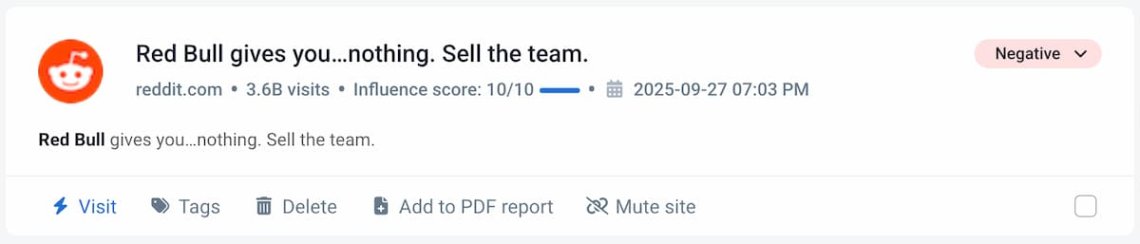
Once you spot a negative social media post, click “Visit,” and you’ll be redirected to the source of the mention.
Worried you won’t get there fast enough to prevent a crisis from escalating? Here are three options:
- Slack integration: connect your project with a Slack channel and get a notification when there’s a new negative result
- Email notification: receive a Storm alert when there’s an unusual spike in the number of mentions
- In-app notifications: use the iOS and Android app to stay up to date with new mentions
If you want to learn more about responding to negative reviews, take a look at this post: Positive Sides of Negative Reviews.
It outlines detailed tactics on how to turn the tables around and benefit from negative feedback.
Engage in conversations
With social media monitoring, you can not only monitor the conversations strictly related to your company, but also more general topics centred around your business niche.
That comes in handy as you can jump into conversations. Engaging in conversations will help you to:
- reach brand new audiences – there are people who are unaware of your company and a way it can help them. Find them and offer them your services. Even if they decline your offer, you’ll make them aware of your company.
- establish your brand as an industry leader. Nike is a leader not only because it makes sweating glamorous, but because it offers a whole lifestyle. You can download free training plans and engage in a community built around your discipline. Think about doing something similar around your brand!
Improving your organic social media reach should be at the top of your marketing to-do list. Hopefully, now you know where to start!
How to measure social media brand engagement?
Short answer: Measure social media brand engagement by adding up interactions per mention, looking at how that number changes over time, which posts drive the most interactions, and which channels perform best. Interpret engagement together with sentiment to understand the tone and scale of the reactions.
Like with every other social media metrics, you should measure your social media brand engagement.
Measuring social media brand engagement levels will give you a lot of useful information, for example:
- what is the reach of your social media posts?
- how do you compare against your competitors?
- what should you do to improve social media brand engagement?
I like this old marketing saying – if you don’t measure, you can’t improve it. If you want to improve social media brand engagement, you have to know how to measure the effects of your work.
Measuring social media brand engagement will help you prove the value of your work. With hard numbers at hand, you will be able to show how social media impacts the company’s bottom line.
What social media metrics should you take into account?
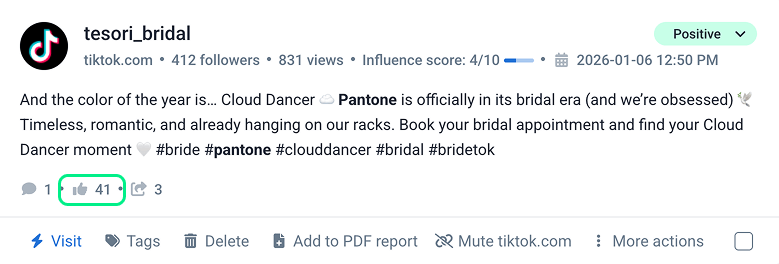
Likes
Can you imagine any social media platform without likes, hearts, or thumbs-up? I can’t!
It’s important to gain likes under your new social media posts. It’s a strong indicator for social media algorithms that your audience wants to interact with.
Likes are a passive form of social media brand engagement as they don’t require any active form of commitment.
Comments and shares
Many people think that you should count comments and shares together with engagement. But I would argue that these are different types of social media engagement.
Comments and shares are a more proactive form of social media brand engagement. Your users need time to write comments. If they share a post, they vouch with their authority for the content.
That’s why you should count comments and share separately.
Moreover, social shares help you reach brand new audiences.
Sentiment
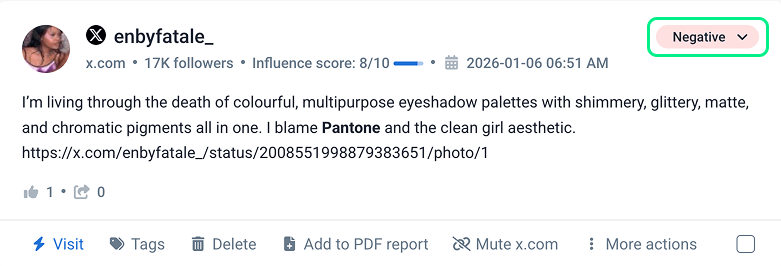
To have a full picture of what is said about your brand online, you need to know how people feel about your brand.
High levels of social media engagement and prevailing negative sentiment won’t help you achieve your goals. Positive sentiment around your brand will help you increase social media brand engagement.
Audience growth
Building a social media presence can have many benefits. One of them is increasing your brand awareness.
That’s why you should regularly check the growth of your audience.
You’re on social media for your audience. You should focus on posting content that resonates well with your audience.
Online mentions
Building brand awareness on social media is not only about the growth of your audience. Your profile mentions are equally important.
Why is it important to track the volume of media mentions of the name of your brand?
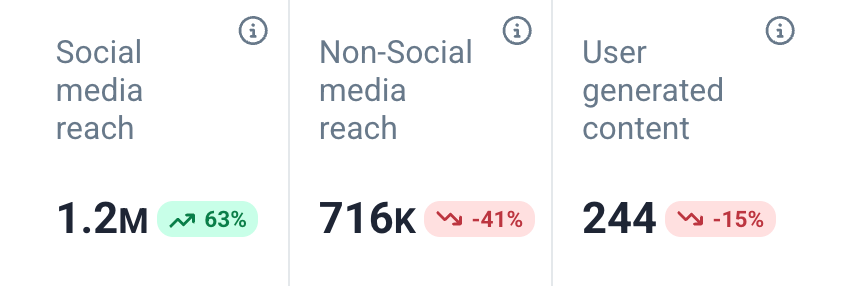
Because the more often you’re mentioned online, the more you’re considered to be an industry leader.
This kind of awareness can affect your bottom line — the next time a potential customer is looking for a solution that you offer, they might choose your company.
Your brand will be associated with positive experiences.
How to measure social media engagement using analytics tools?
In practice, you can measure engagement in two main ways: native analytics or a media monitoring (social listening) tool.
Most social media networks provide their own analytics dashboards. For example:
- Facebook offers Audience Insights
- Instagram provides statistics/Insights
- YouTube has YouTube Analytics
First of all, they are free. If you’re on a budget, there is an ideal solution.
Secondly, they offer reliable data. After all, who knows better about your Facebook media engagement than Facebook itself?
However, there are downsides. You’ll be working across separate tools for every channel, which makes it difficult to compare your social media presence side by side.
In practice, that often means:
- exporting data manually from multiple places
- combining it in a spreadsheet to get a single view
- spending extra time just to understand overall engagement trends
Important: There’s also another challenge to native channels: not every platform offers strong analytics. Some newer or fast-growing channels may have limited reporting compared to more established networks.
To get all the data you need, you can take a look at a tool.
If you want a broader, cross-platform view, a media monitoring tool can help.
Using Brand24 as an example, a social listening tool lets you measure engagement alongside context.
You can track the total volume of mentions (how often people talk about you) and pair it with sentiment (whether those conversations are positive, neutral, or negative).
Together, these metrics give you a fast read on how your brand is performing online.
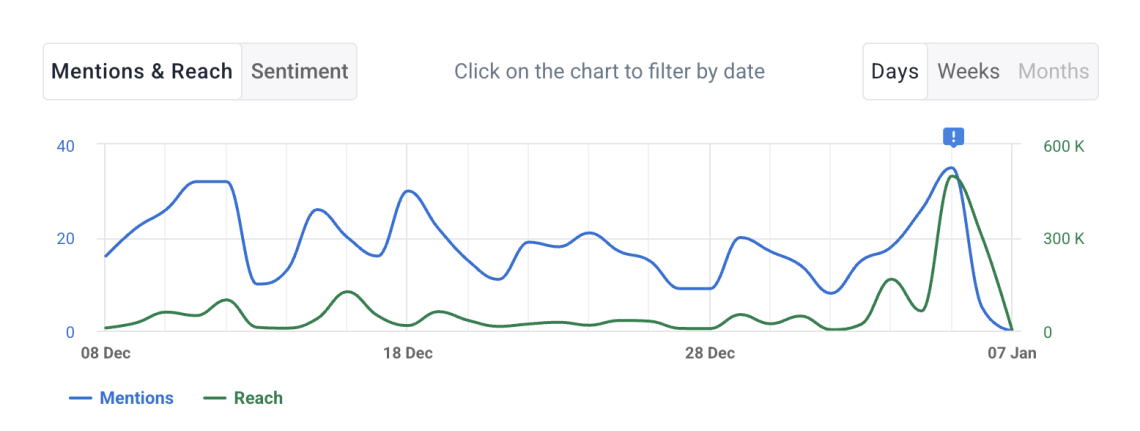
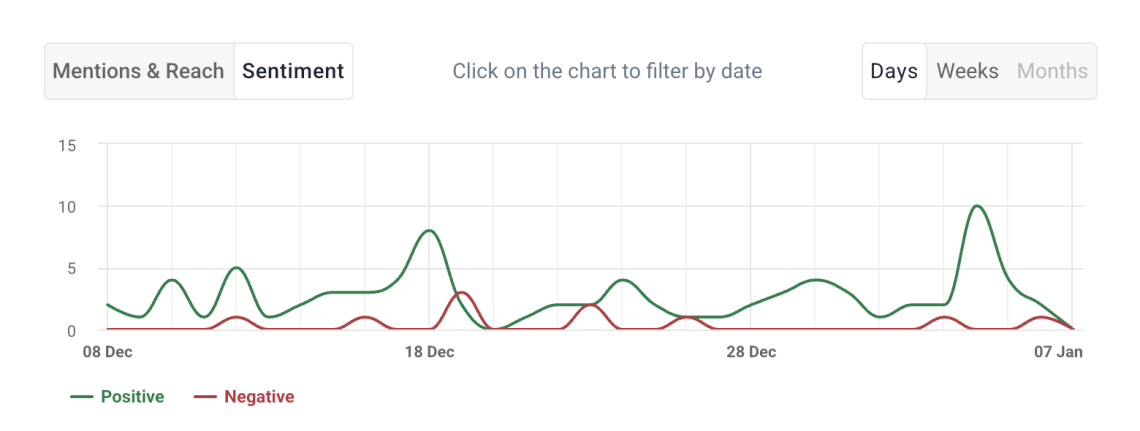
Brand24 offers a set of filters that will help you get the information you need. You can analyse different social media platforms separately or combine all the data.
Brand24 also makes it easier to analyze results in different ways. You can use filters to:
- review each platform separately, or
- combine everything into one overall view
And in the Analysis tab, you can find insights such as:
- total number of mentions
- estimated reach
- total likes, comments, and shares
- trending hashtags
- top public accounts talking about you
- context of a discussion
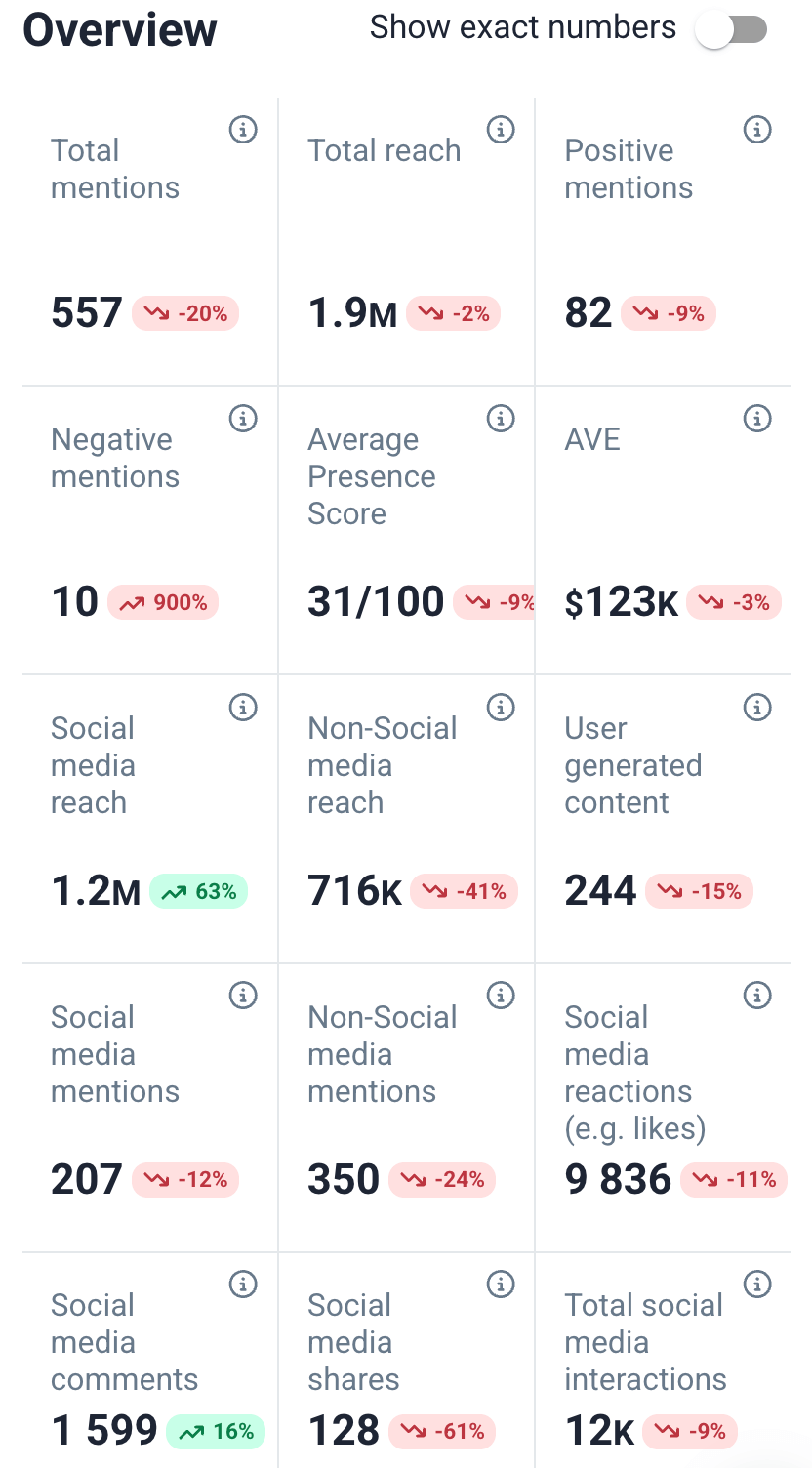
The benefit of this approach is that it not only helps you measure engagement – it enables you to improve it.
For example, trending hashtags can inspire what to talk about next, and top accounts can help you spot influencers or partners who already drive reactions around your brand.
Conclusion
Social media brand engagement isn’t a nice-to-have — it’s how people build trust in your brand before they ever buy.
When you treat every comment, mention, and DM as part of the customer journey, you’ll see stronger loyalty, better word of mouth, and fewer small issues turning into big problems.
Start simple: show up consistently, respond fast, and use what your audience already reacts to as your roadmap.
Measure, adjust, repeat — and your engagement will grow in a way that actually supports your business goals.
I prepared a quick checklist that will help you get started with social media brand engagement:
| To-do item | Why it matters |
|---|---|
| Pick the right platforms | Focus on the channels where your audience actually talks and buys. |
| Know what counts as engagement | Track likes, comments, shares, saves, clicks, DMs, and mentions. |
| Post with a purpose | Share content people want to react to (not just scroll past). |
| Ask for interaction | End posts with a simple question or prompt (e.g., “Which one would you choose?”). |
| Show up consistently | Regular posting beats “random bursts” every time. |
| Reply fast (especially to questions + complaints) | Engagement grows when you keep the conversation going. |
| Turn customers into content | Encourage UGC (tags, photos, reviews) and reshare with permission. |
| Watch for negative mentions | Catch issues early and respond professionally before they escalate. |
| Join niche conversations | Engage beyond your own posts to reach new audiences. |
| Measure + repeat what works | Double down on formats that earn the most comments, saves, and shares. |
FAQ
Why is my social media brand engagement so low?
Low social media brand engagement could be due to several factors: your content might not be resonating with your audience, posting times might not align with when your audience is active, or your posts may lack calls to action. Identifying and improving these areas can help in improving social media engagement.
What is an example of social media brand engagement?
Social media brand engagement can take many forms, such as likes, comments, shares, retweets, and mentions. For example, if a follower comments on your post or shares it on their own feed, it counts as engagement. These actions are a direct reflection of a successful social media strategy.
How to leverage social media for brand engagement?
Use social media for engagement, post relevant and interesting content consistently, respond to comments, ask questions, hold contests, or use interactive features like polls or live videos. Encourage your social media pages’ visitors to interact, creating more social media interactions and boosting engagement.
What’s a “good” engagement rate on Instagram / TikTok / LinkedIn?
A “good” engagement rate depends on your industry, audience size, and post type, but the best benchmark is your own trend over time. Compare engagement rate by format (Reels vs. carousels vs. static, video vs. text) and track whether it’s improving month over month—then double down on the formats that consistently beat your average.
Should we respond to every comment and DM?
Not every single one, but you should respond to the important ones consistently: questions, complaints, purchase-related messages, and high-visibility comments (especially from influential accounts). If you can’t reply to all, use a simple rule: prioritize anything that signals intent (help needed, decision-making, emotion) and aim for fast response times.
Should we hide/delete negative comments—or reply publicly?
Reply publicly in most cases—calm, helpful responses build trust and often turn criticism into positive engagement. Hide or delete only when comments are spam, hate, harassment, or clearly malicious; otherwise, acknowledge the issue, offer a solution, and move the detailed back-and-forth to DMs.
How do I track brand engagement when people talk about my brand without tagging me?
You can’t rely on notifications alone—track your brand name, product names, common misspellings, and branded hashtags across platforms. A social listening tool like brand24 helps here because it captures public mentions even without tags, so you can respond, measure volume and sentiment, and spot which conversations are driving engagement.
How often should a brand post to increase brand engagement (without annoying people)?
Consistency beats intensity: post often enough to stay recognizable, but not so much that quality drops. Start with a sustainable cadence (e.g., 3–5 posts/week plus Stories/daily short updates if that’s your channel), watch engagement per post, and scale up only if engagement stays stable or improves.
How do I report engagement to leadership in a way that connects to revenue?
Tie engagement to business outcomes, not vanity numbers: show which content and conversations lead to clicks, sign-ups, leads, or purchases (and how sentiment is trending). The simplest approach is a monthly snapshot: engagement trends + top drivers (posts/mentions) + impact metrics (traffic, conversions, pipeline, support tickets reduced) so it’s clear what engagement did, not just what it was.”

Article Reviewed by