Table of contents
2M Marketers

Social listening is now a $10.37 billion industry, and 76% of marketers worldwide are already using it. We’ve gathered over 50 key stats to help you understand everything from its market size and adoption to ROI and AI trends.
Let’s look at the numbers and what they tell us about social listening in 2026.
Key takeaways
-
The social listening market is worth $10.37B today
and is projected to reach $20–25B by 2030–2032. (The Business Research Company; Grand View Research)
-
76% of marketers globally use social listening software,
and 55% plan to increase investment, but only 10% can act on insights within hours. (Statista; Sprout Social)
-
Brand mention monitoring (27.6%) is the top social listening use case by share of voice,
while competitive intelligence (24.9%) and trend detection (33.4%) are what marketers expect social listening to help them with most. (Brand24 2026 research)
-
94% of marketing professionals use AI-powered social listening,
but only 3% fully trust AI-generated insights. (The SILab, State of Social Listening)
-
64.6% of marketers say API restrictions are their top challenge in social listening,
and 56% struggle to show social listening importance to leadership. (The SILab, State of Social Listening)
-
78.5% of social listening teams now use more than one social listening tool,
because of data coverage gaps that no single tool fully solves. (The SILab, State of Social Listening)
All statistics in this article come from primary sources:
- industry reports and articles,
- academic research,
- brand studies,
- and Brand24’s own data.
Every statistic here was hand-picked from its original publication, and we deliberately avoided linking to data aggregator sites, where numbers often get misquoted or taken out of context.
If you’re planning to cite any of these stats, every link takes you to the original study, article, or report.
Social listening market size statistics
If you’ve ever needed to justify a social listening budget to leadership, these are the numbers you want on that slide.
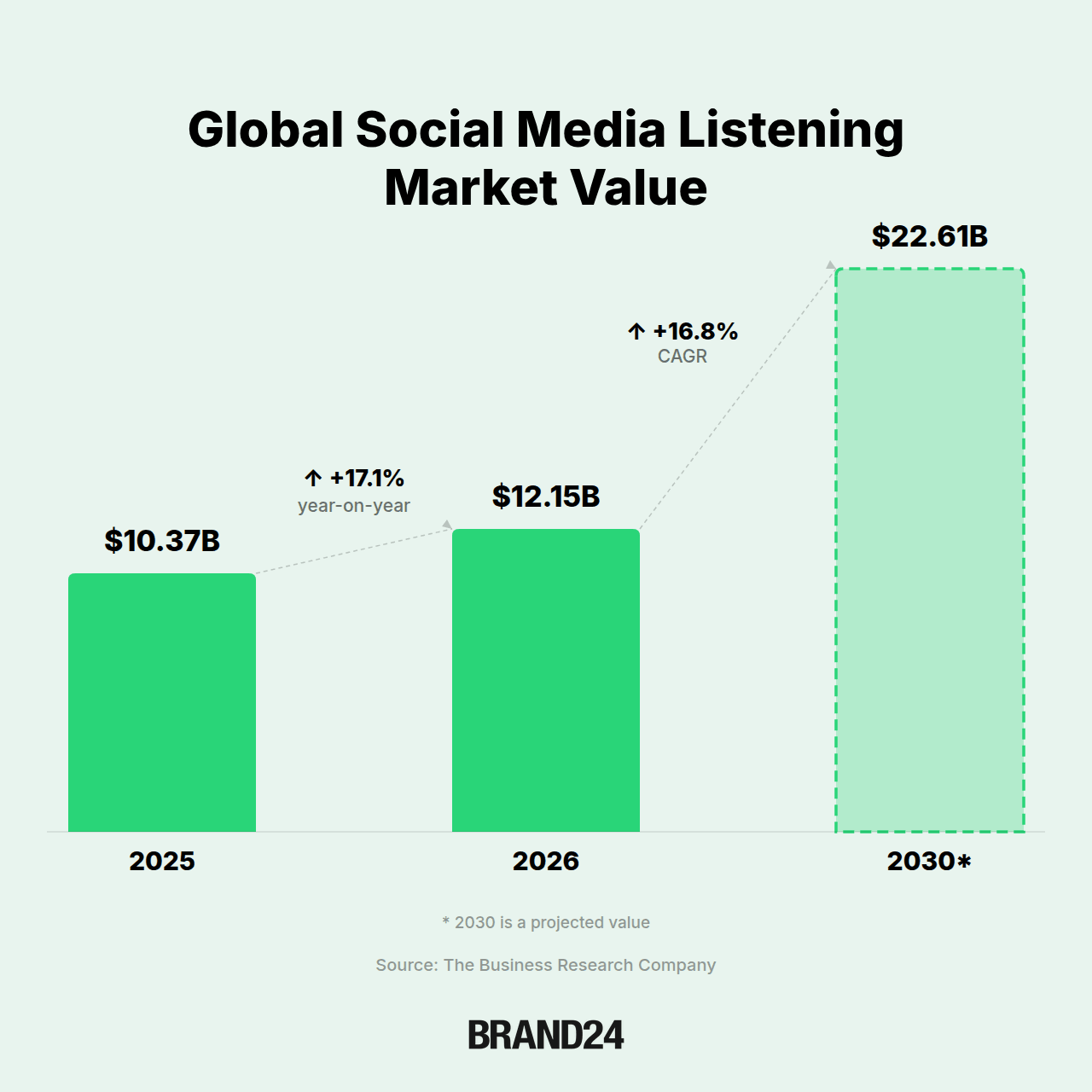
- The global social media listening market is valued at $12.15 billion in 2026 (17.1% annual growth from $10.37 billion in 2025). (The Business Research Company)
- It’s projected to hit $22.61 billion by 2030 at a 16.8% CAGR. (The Business Research Company)
- Other analysts forecast even higher numbers: $20.2 billion by 2030 at a 14.3% CAGR (Grand View Research) and $25.69 billion by 2032 (Coherent Market Insights).
- In the US alone, the market is $2.97 billion in 2025, growing to $11.2 billion by 2035 with a CAGR of 13.88%. (SNS Insider)
- Among industries, Travel & Hospitality is the one where social listening grows fastest, with a projected 17.99% CAGR through 2035. (SNS Insider)
Social listening market regions
- North America is the biggest market: 39.9% of global revenue in 2024. (Grand View Research)
- Asia-Pacific is the fastest-growing region, with ~16.57% CAGR through 2026–2035 (SNS Insider) and 16.02% through 2031 (Mordor Intelligence).
Social listening software statistics
- Software makes up the biggest share: 64.1% of total market revenue in 2024 (Grand View Research) and over 73% in 2025, caused by cloud-based enterprise adoption. (SNS Insider)
- The services segment is growing even faster, with a projected 15.31% CAGR. (SNS Insider)
💡 What this means for you: The social listening market is growing at 14-17% annually, which means more vendors, better AI features, and more integration options made available every year.
Social listening use cases statistics
How to use social listening effectively starts with knowing what other marketers do with it.
Here’s what Brand24’s own 2026 research found:
Brand24 tracked and analyzed the keywords “social listening” and “ai social listening” from May 2026 to August 2026 using Brand24’s AI Brand Assistant.
The analysis covered 22,430 mentions with a total reach of 62.5M across all major online sources. Sentiment share: 9% positive (1,969 mentions), 1% negative (327 mentions), 90% neutral.
Social listening use cases ranked by share of voice
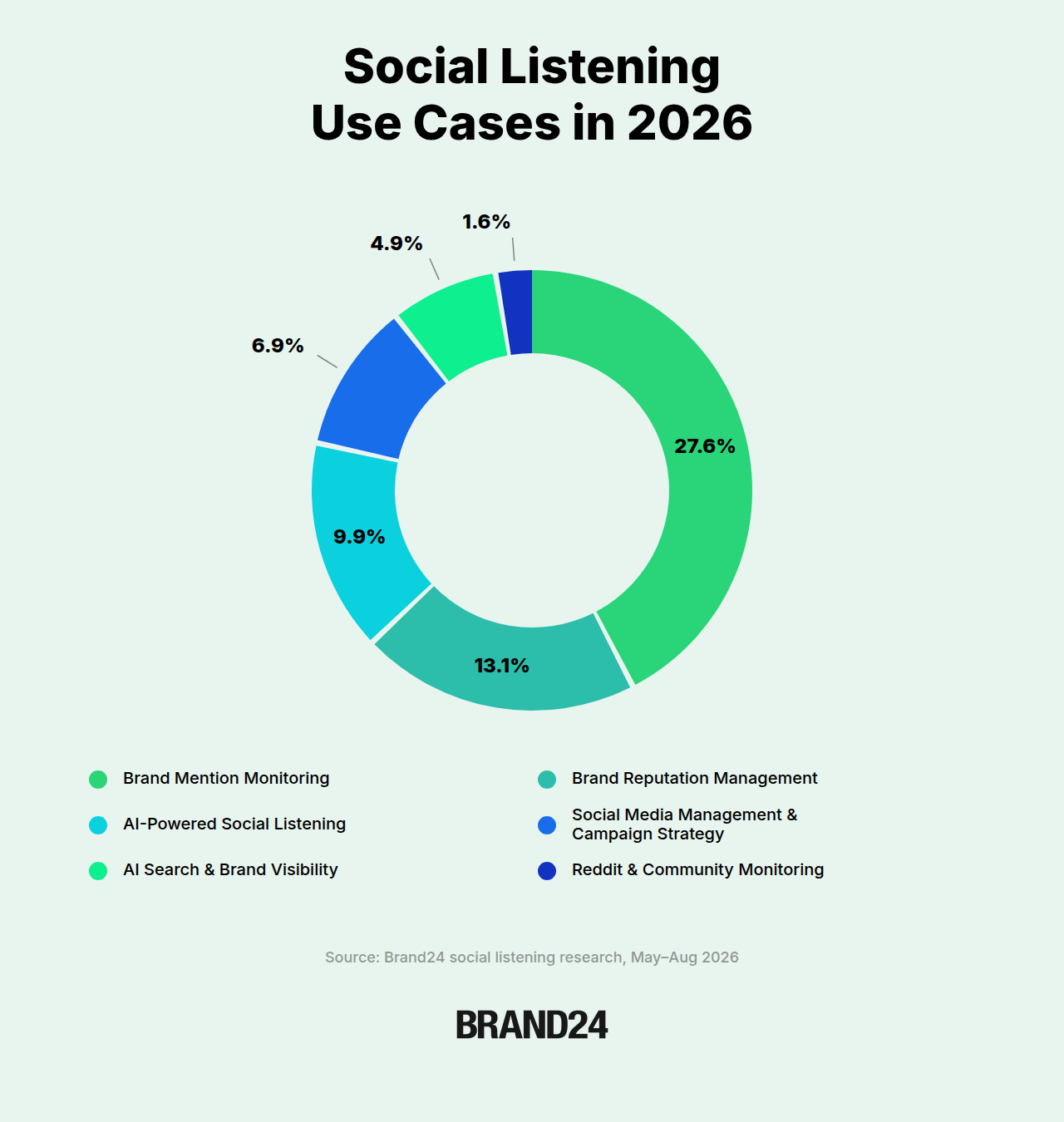
| Use case | Share of Voice (%) | Description |
|---|---|---|
| Brand Mention Monitoring | 27.6% | Tracking brand mentions, keywords, and sentiment across channels. |
| Brand Reputation Management | 13.1% | Proactively monitoring and protecting how a brand is perceived across media. |
| AI-Powered Social Listening | 9.9% | Using AI social listening tools for competitor analysis, trend detection, and workflow automation |
| Social Media Management & Campaign Strategy | 6.9% | Gathering listening insights for content strategy and campaign planning. |
| AI Search & Brand Visibility | 4.9% | Tracking how your brand shows up in AI chatbot answers. |
| Reddit & Community Monitoring | 1.6% | Finding high-intent buyer conversations on Reddit, Hacker News, and Linkedin. |
(Source: Brand24 research, May-Aug 2026)
Importance of social listening statistics
What are the outcomes marketers expect from social listening, and why do they think it’s important in their marketing strategies?
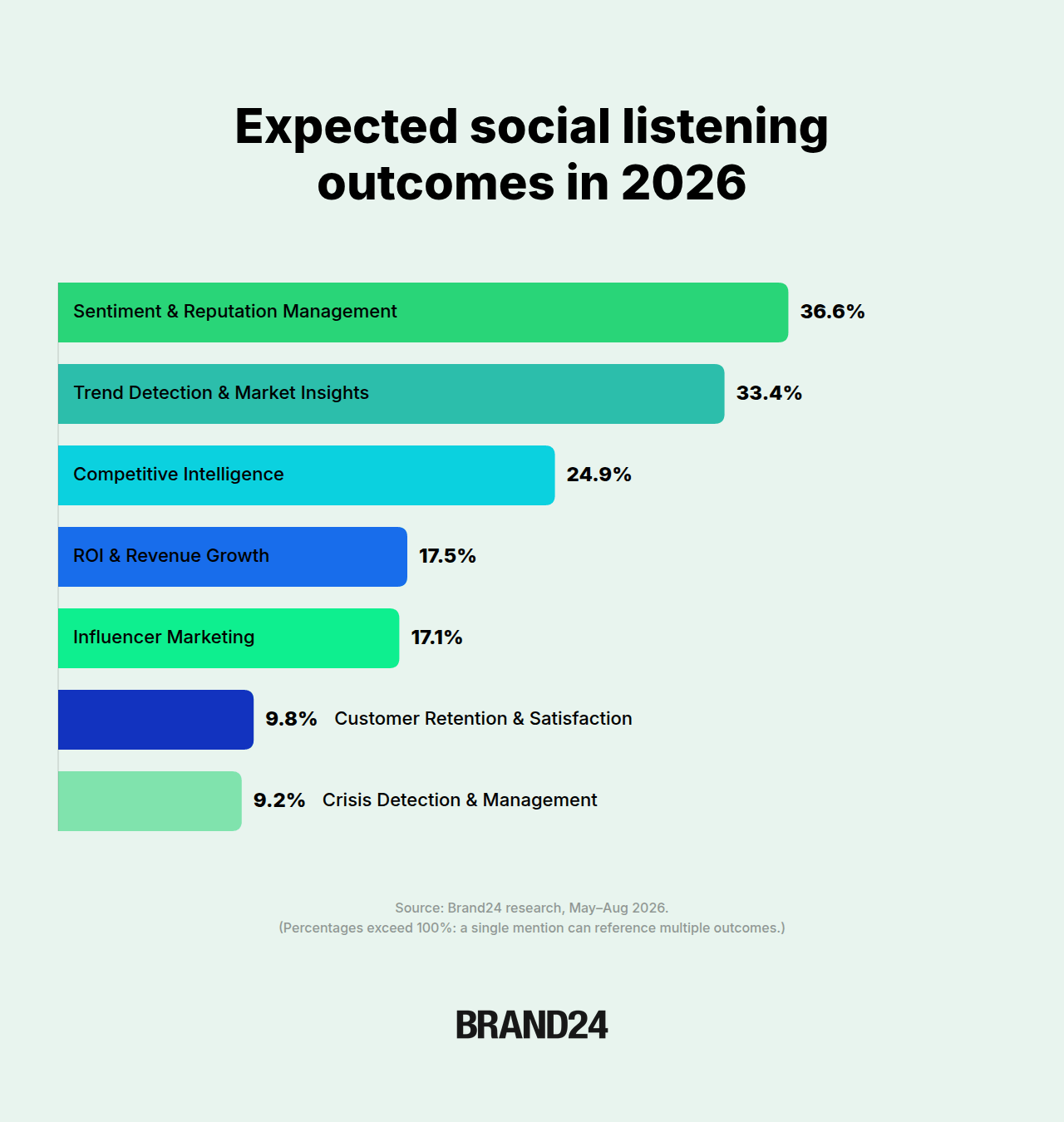
According to Brand24’s data, social listening can help with:
| Desired outcome | Mention volume (% share) |
|---|---|
| Sentiment & Reputation Management | 36.6% |
| Trend Detection & Market Insights | 33.4% |
| Competitive Intelligence | 24.9% |
| ROI & Revenue Growth | 17.5% |
| Influencer Marketing | 17.1% |
| Customer Retention & Satisfaction | 9.8% |
| Crisis Detection & Management | 9.2% |
(Brand24 research, May-Aug 2026. Percentages exceed 100%: a single mention can reference multiple outcomes.)
💡 What this means for you: If your team is only using social listening to track media mentions, you’re using about 27% of its potential. There is so much more to use in your strategy, including competitive intelligence, or trend and influencer discovery. One of the fast-growing trends in social listening is tracking AI mentions in LLMs; if you’re not yet monitoring what AI tools are saying about your brand, it’s a great area to focus on to stay ahead in 2026.
Social listening adoption statistics
Most marketers in 2026 already use social listening. But having the social listening tool and acting on insights are two very different things.
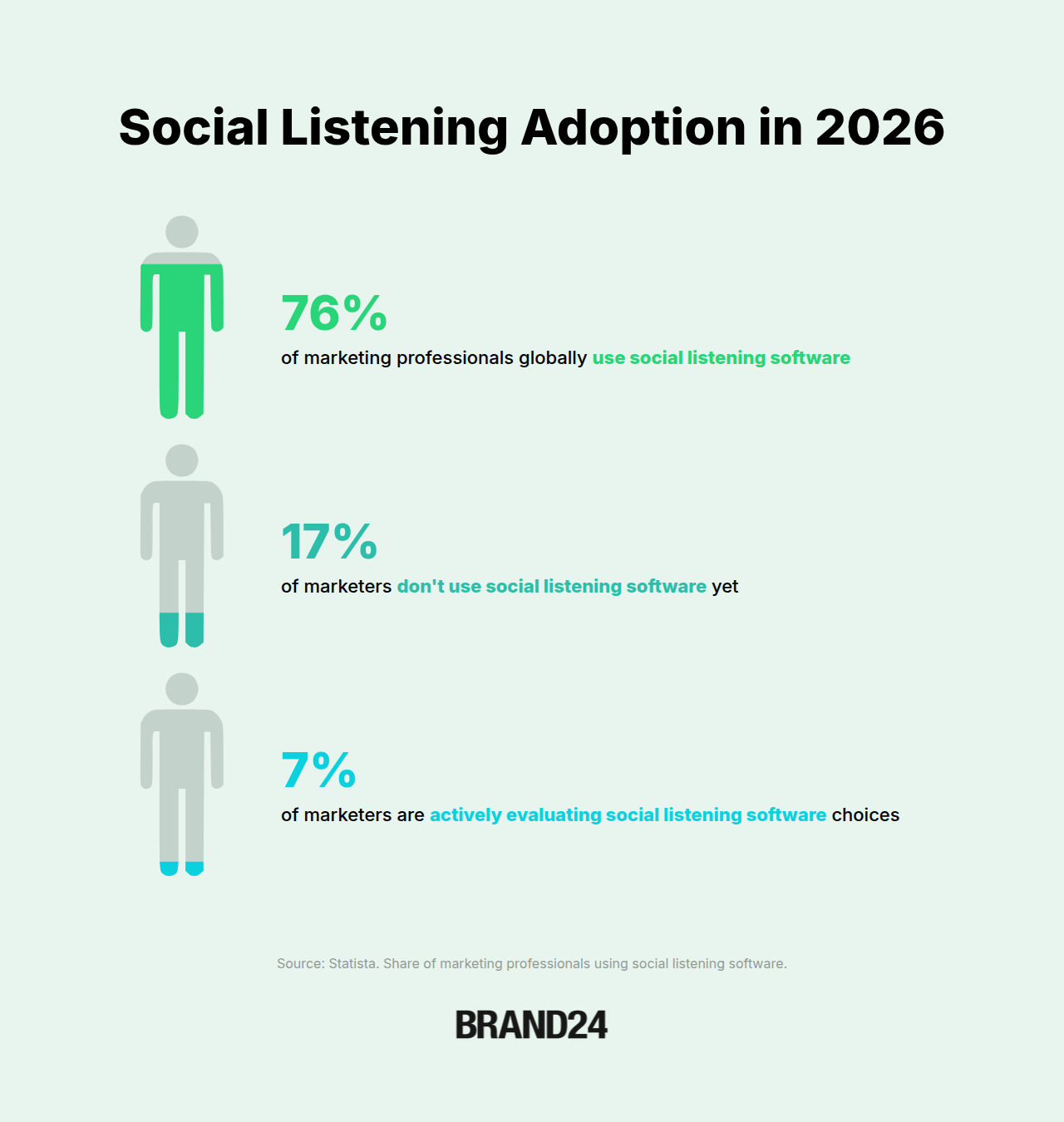
Here is the data that proves it:
- 76% of marketing professionals globally use social listening software. Another 17% don’t use it yet, and about 7% are actively evaluating it. (Statista)
- In the Americas, nearly 60% of companies use social listening strategies as part of their social media marketing. (Statista)
- 55% of marketers worldwide expect to increase the time and resources devoted to social listening. (Statista)
Having said that, adoption of social listening doesn’t always mean it has a major impact on brand strategy:
- 93% of professionals say social intelligence is important for future growth, but only 10% can act on an insight within hours. (Sprout Social, Social Intelligence Report)
Most marketing teams are already listening, but still very few can respond to brand mentions in real time.
- 94% of business leaders say social media data has helped build brand reputation and loyalty, while 91% say their company’s success depends on how effectively they use social data. (Pulsar, 2026)
Social listening regional adoption
- In Europe, over 83% of enterprises in the information and communication sector used social media for business in 2025. (Eurostat)
- 41.5% of marketing professionals in APAC had an active social listening program in 2023. (Statista)
💡 What this means for you: Most of your competitors already have social listening software, however, the real competitive gap is to have the processes to act on social listening insights fast. If you do this, you’re already ahead of 90% of the market.
Social listening ROI statistics
ROI from social media listening and analytics is easier to prove than most marketers think.
Companies across industries have the numbers to show it:
- In transport and ride-sharing: a single one-day social campaign drove 100% growth in discussion volume, 250% more shares, 90% more likes, 24% higher engagement, 11% more new users, and 7% more rides. (Uber case study)
- In B2B SaaS: a change from cold outreach (2% success rate) to social listening lead gen resulted in a 30% engagement rate: a 15× improvement. (Traffit case study)
- In email marketing: 33 days of brand presence tracking generated a 20% increase in brand visibility and a 169% growth in social reach. (MailerLite case study)
- In marketing agencies: discovering that every third of a client’s brand mentions was posted on forums and Reddit and then acting on it, generated a 1000% increase in views and 300% follower growth. (GreenRoom Agency case study)
- In professional services: social listening contributed to 30–40% of new business over several years, including the largest client accounts. (Fello case study)
- In HR tech: regular media monitoring delivered a 10% year-over-year increase in brand mentions and stable growth in brand visibility. (eRecruiter case study)
Beyond the hard numbers, social listening also gives you peace of mind:
- 76% of marketers who use social listening feel confident in their Linkedin and Instagram ROI, which is a great advantage over teams that don’t have that same insight. (Statista)
💡 What this means for you: Social listening ROI isn’t industry-specific and scales with how well a team acts on what it finds using social listening tools.
AI social listening statistics
Most social listening teams have already made the shift to AI-powered social listening.
Let’s see the data that proves it:
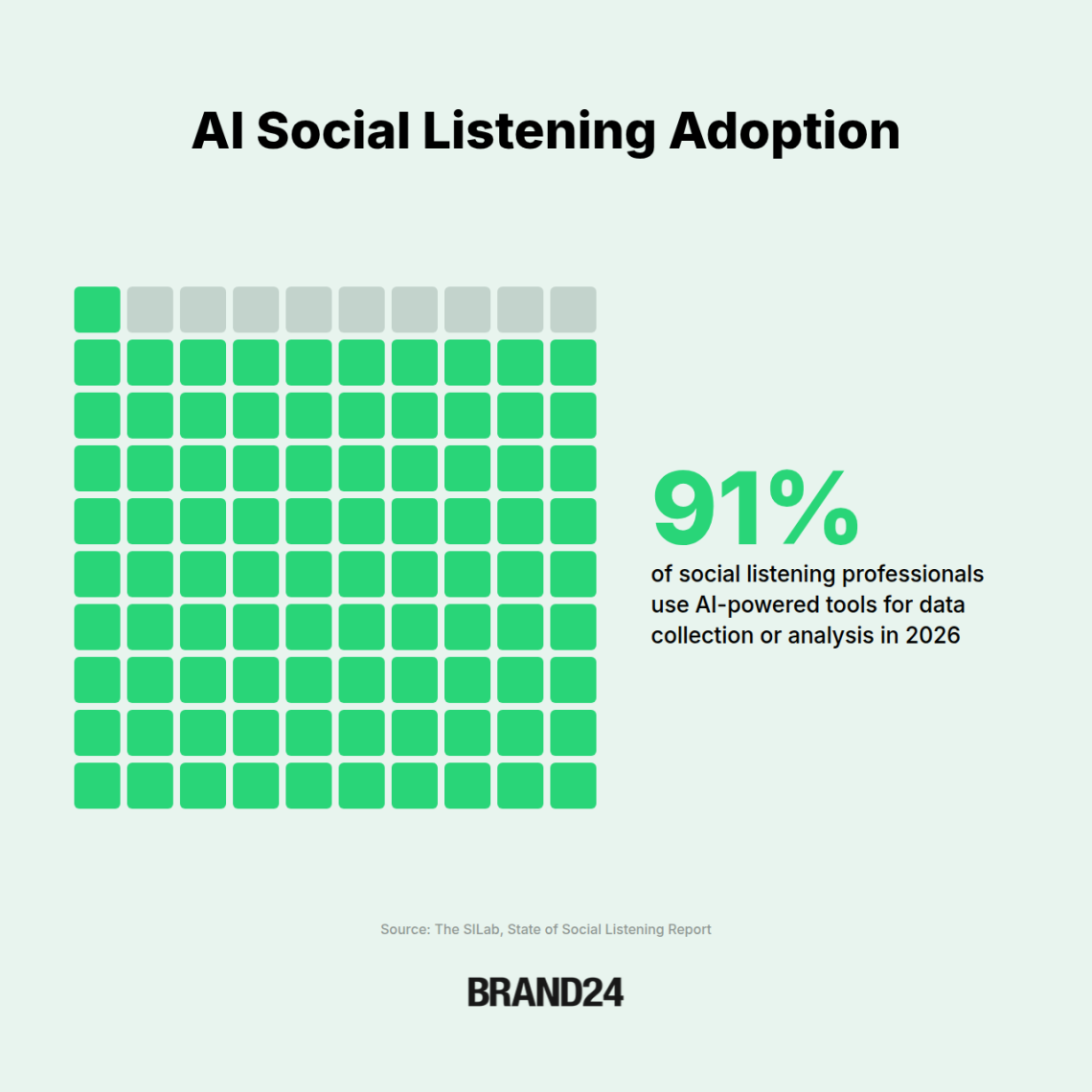
- 91% of social listening professionals use AI-powered tools for data collection or analysis. (The SILab, State of Social Listening Report)
- 94% incorporate generative AI into their workflows to some degree. (The SILab, State of Social Listening Report)
- 42.5% of US marketers now use social listening tools to track brand visibility in AI-generated results like ChatGPT and Perplexity. (NP Digital / eMarketer)
- 1 in 10 marketers says trend-based content has already led to direct LLM referrals. (Adobe)
Social listening AI trust gap statistics
- Only 3% of practitioners fully trust AI-generated insights. (The SILab, State of Social Listening Report)
- 61.2% see AI as useful but needing extensive human control. (The SILab, State of Social Listening Report)
- 82.6% of marketers believe AI will enhance rather than replace human analysis over the next five years. (The SILab, State of Social Listening Report)
- Only 6% of professionals think AI will fully take over social listening work. (The SILab, State of Social Listening Report)
💡 What this means for you: Only 3% of experts fully trusting AI insights on their own is actually a good thing. It shows that seasoned marketing pros see AI as a powerful partner that speeds up their social media listening rather than replacing it. And if you’re not monitoring your AI search visibility, now is the time to start: over 2 out of 5 of your US competitors already do it.
Social listening implementation statistics
How to implement social listening sometimes comes with real challenges.
Here’s what the recent numbers show:
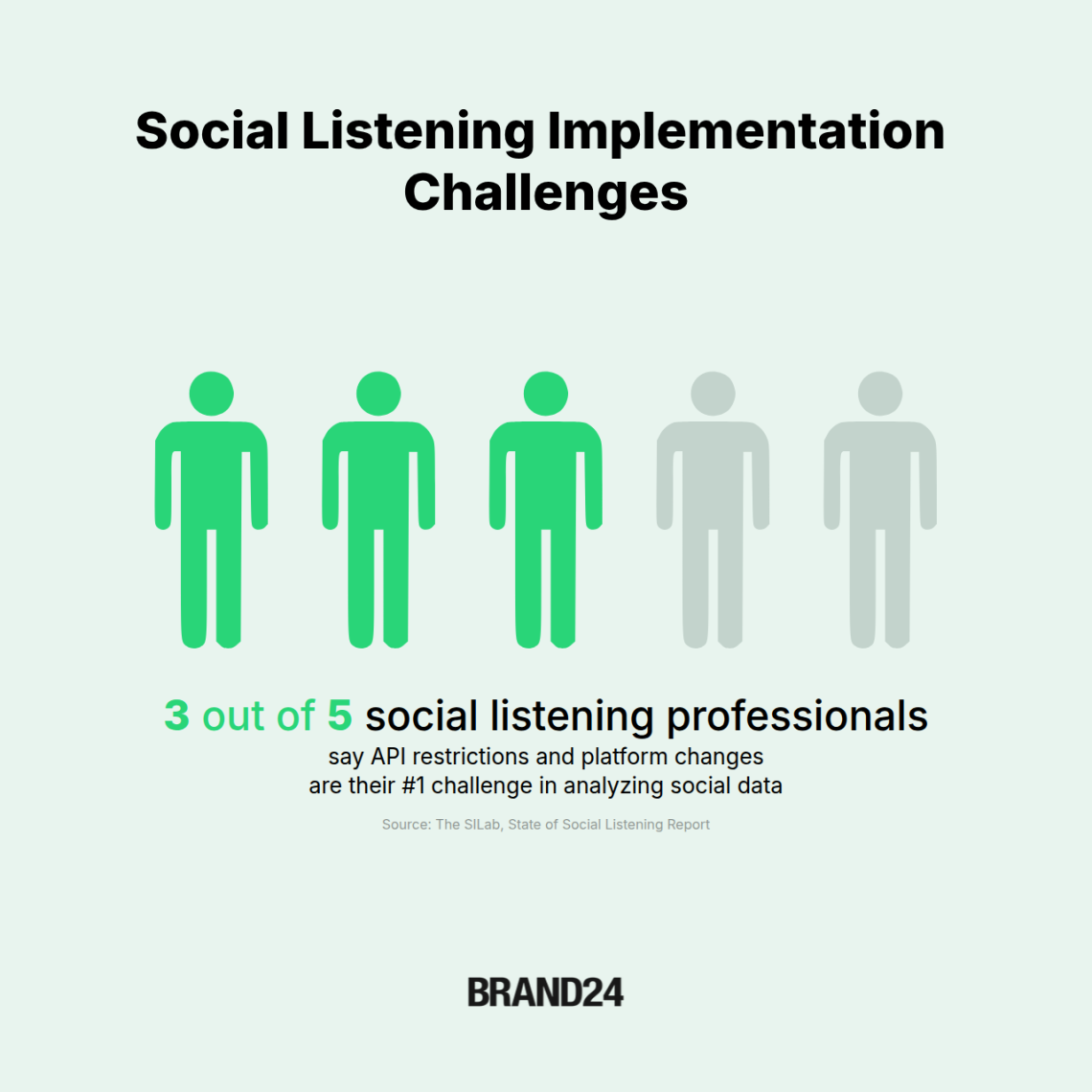
- 64.6% of social listening professionals cite API restrictions and platform changes as their #1 challenge when analyzing social data. (The SILab, State of Social Listening Report)
- 73.7% of practitioners who switch tools do so because of data access limitations. (The SILab, State of Social Listening Report)
Because of this, platform data coverage has become the most important factor to weigh when you’re evaluating your social media monitoring tool implementation options.
- 56% of in-house brand teams struggle to demonstrate the business value of social listening to leadership. (The SILab, State of Social Listening Report)
- 29.6% of agency marketers say social listening drives their strategic decisions, but for in-house teams, that number falls to just 9.9% (The SILab, State of Social Listening Report)
- 47% of brands outsource social listening entirely to agencies or consultants; the #1 reason is team size (64.7% say their in-house team is too small). (The SILab, State of Social Listening Report)
- Only 10% of social intelligence professionals can act on an insight within hours, even though 93% says it’s critical for brand growth. (Sprout Social, Social Intelligence Report)
Social media usage statistics: Why is social listening important?
If you ever need to explain the importance of social listening to anyone, show them these statistics about social media:
- 5.66 billion social media user identities exist globally, which is 68.7% of the world’s population. (DataReportal, Digital 2026 Global Overview Report)
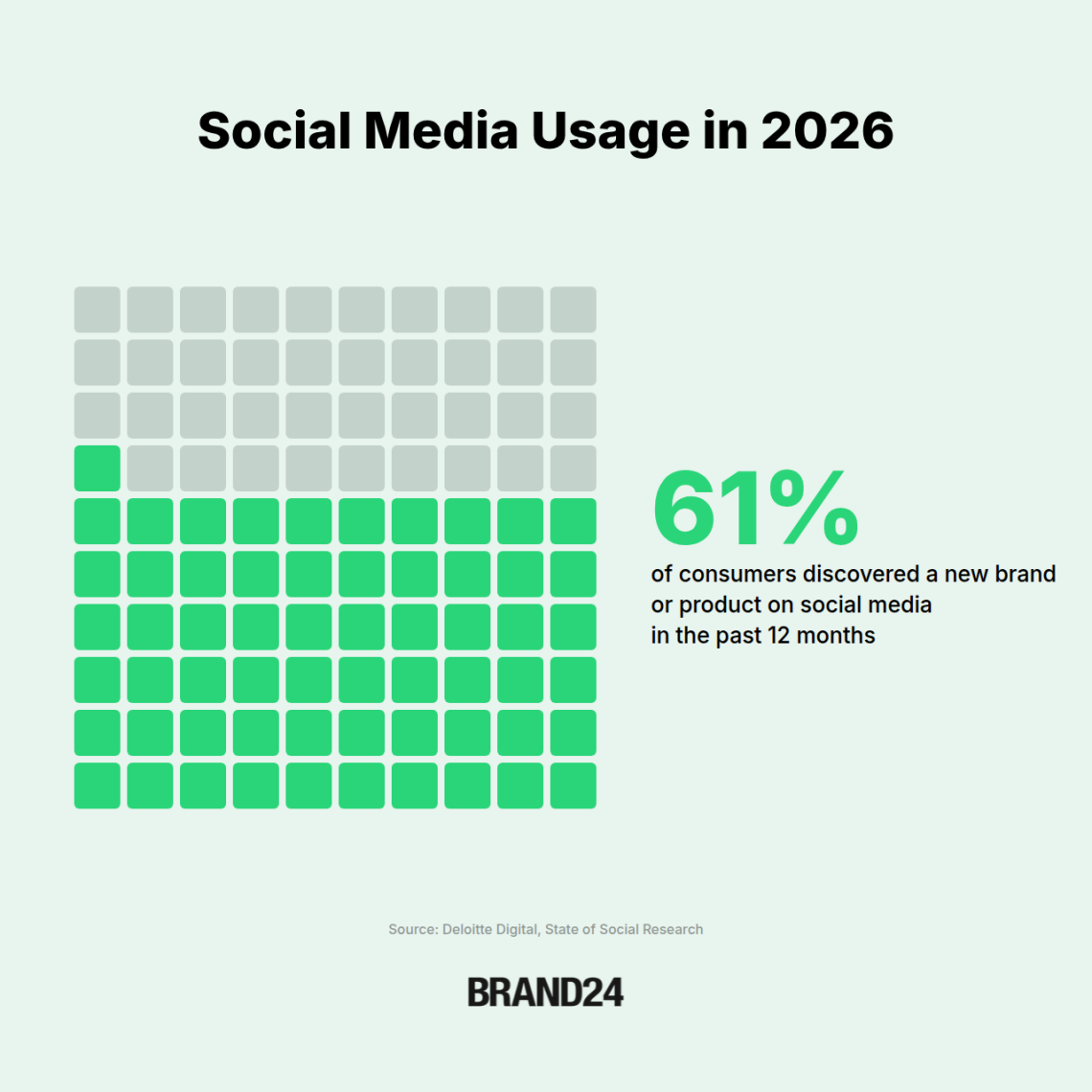
- 61% of consumers discovered a new brand or product on social media in the past 12 months. (Deloitte Digital, State of Social Research)
- 81% of consumers say the influencers and creators they follow are trusted sources of information. (Deloitte Digital)
- 57% of consumers who follow influencers bought or recommended a brand after seeing a brand-creator partnership. (Deloitte Digital)
- 39% of 18–24-year-olds use social media as their main news source, up from 21% in 2015, and overtaking news and apps. (Reuters Institute)
- 93% of consumers think it’s important for brands to keep up with online culture, but a third say it’s embarrassing when brands jump on trends without understanding the broader context. (Sprout Social / Harris Poll)
- 93% of consumers who lose belief in a brand churn silently without a word, and 55% only share their disappointment with friends. They almost never reach out to the brand directly, giving you a chance to fix things. (Ogilvy, APAC Believability Index 2026)
💡 What this means for you: Social listening is the only mechanism that catches the declining brand reputation signals, like positive sentiment drops or subtle negative signs in audience discussion topics, before it shows up in your revenue numbers.
Social listening tools statistics
The social listening tools market has never had more options, and teams are using more of them than ever.
Here’s the freshest data:
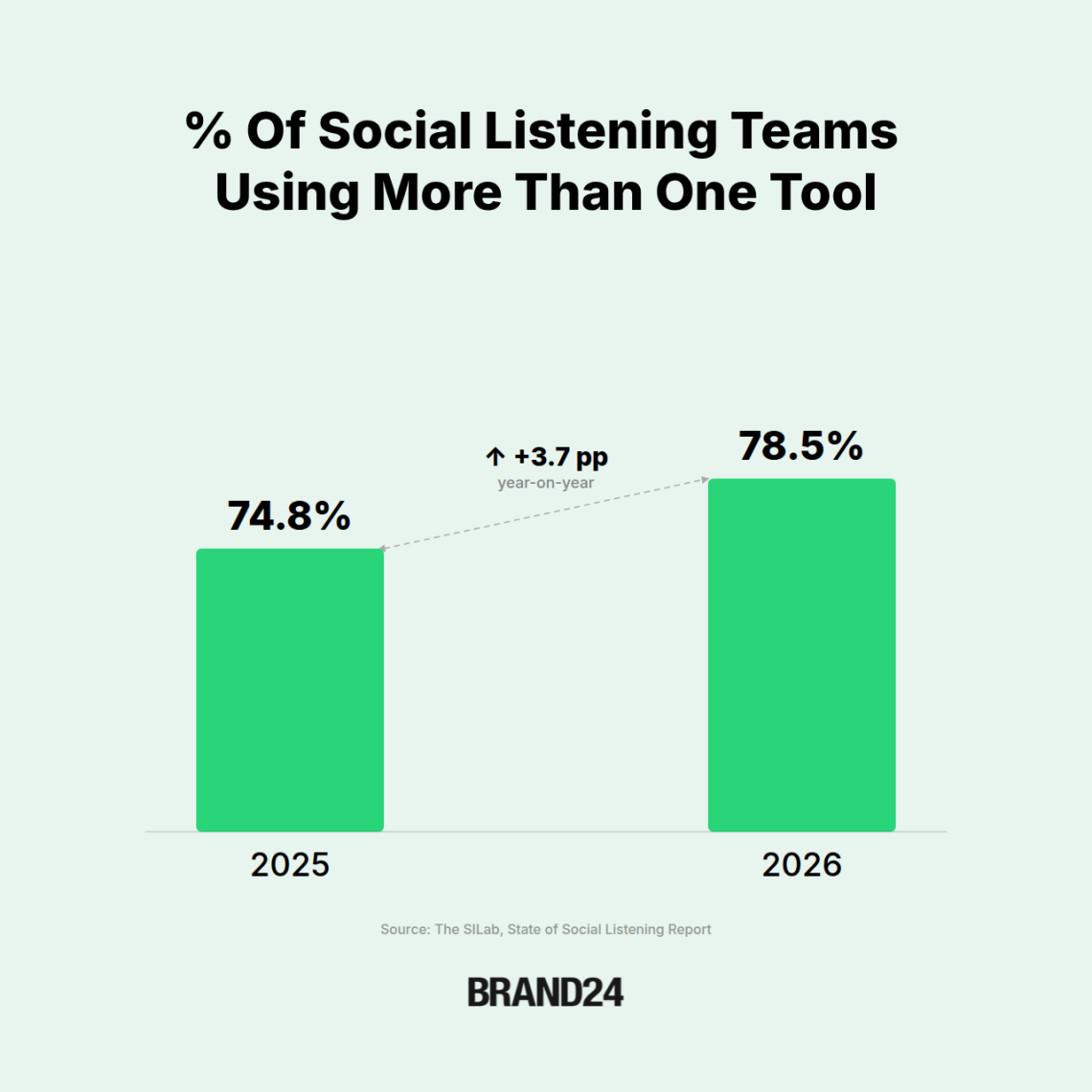
- 78.5% of social listening teams use more than one platform, up from 74.8% the previous year. Multi-tool setups are now the norm, not the exception. (The SILab, State of Social Listening Report)
- 82.8% of organizations review their social listening platforms at least once a year, and 27.8% do it on an ongoing basis. (The SILab, State of Social Listening Report)
- 73.7% of practitioners who switch tools do so because of data access limitations. (The very same challenge that encourages teams to add more tools to their stack in the first place). (The SILab, State of Social Listening Report)
We’re also seeing a real push for “data blending“. Teams are getting smarter about connecting the dots:
- 52.1% of teams now combine social listening data with search data as their primary additional source to get a fuller picture. (The SILab, State of Social Listening Report)
- The share blending social with any third-party data has nearly doubled: 23.3% in 2025 vs. 11.8% in 2024. (The SILab, State of Social Listening Report)
When it comes to where most of the social listening cost is going, technology is clearly the priority:
- 73% of brand leaders and 76% of agency leaders plan to invest in technology, versus just 55–56% who plan to invest in people (The SILab, State of Social Listening Report).
💡 What this means for you: Think of your social listening tool stack like a puzzle: before adding more pieces, focus on the gaps you need to fill. Instead of just asking “which platform is best?”, try asking “which data sources am I missing?” For many teams, the most effective first step is simply blending media monitoring and search data. It transforms “what people are saying” into a deeper picture of “what people are saying and searching for”, which makes your data much more reliable.
FAQ
The global social media listening market is valued at $10.37 billion in 2025, projected to reach $20.2–$22.6 billion by 2030 at a CAGR of 14–17%. (Grand View Research; The Business Research Company)
In the US, it grows from $2.97 billion in 2025 to $11.2 billion by 2035. (SNS Insider)
76% of marketing professionals globally use social listening software. (Statista)
Nearly 60% of companies in the Americas include it in their social media marketing strategies, and 55% globally plan to increase their investment. (Statista)
According to Brand24 2026 social listening analysis, the main social listening use cases are:
- brand mention monitoring (27.6%),
- brand reputation management (13.1%),
- AI-powered competitive intelligence (9.9%),
- social media campaign strategy (6.9%),
- AI search and brand visibility tracking (4.9%),
- and Reddit/community monitoring (1.6%).
Transportation companies have seen 100% discussion volume growth from a single one-day campaign. HR tech companies have grown lead engagement from 2% to 30%. Real estate businesses have attributed 30–40% of new business to social listening over several years.
API restrictions top the list, cited by 64.6% of professionals. (The SILab)
Demonstrating bottom-line value is a close second (56% of in-house teams).
Only 10% of teams can act on insights within hours, even though 93% call it critical. (Sprout Social)
91% of social listening professionals use AI-powered tools for analysis, and 94% incorporate generative AI into their workflows, but only 3% fully trust AI-generated insights. (The SILab)
42.5% of US marketers now track brand visibility in AI-generated results like ChatGPT and Perplexity. (NP Digital / eMarketer)

