Table of contents
2M Marketers

If the start of Q3 2026 has you wondering what the biggest social listening trends for 2027 will be, you’re in the right place.
The top ones to watch are video listening, monitoring brand visibility in AI chatbots, and AI-powered predictive analytics.
I found them by analyzing over 15.7k online mentions using the Brand24 AI Brand Assistant (June – September 2026) and by asking three Brand24 experts what they expect next year.
Below, you’ll find all seven social listening trends, the data behind them, and a checklist to get your marketing strategy ready for the upcoming Q1.
Key takeaways
-
Short-form video is the most discussed social listening trend for 2027
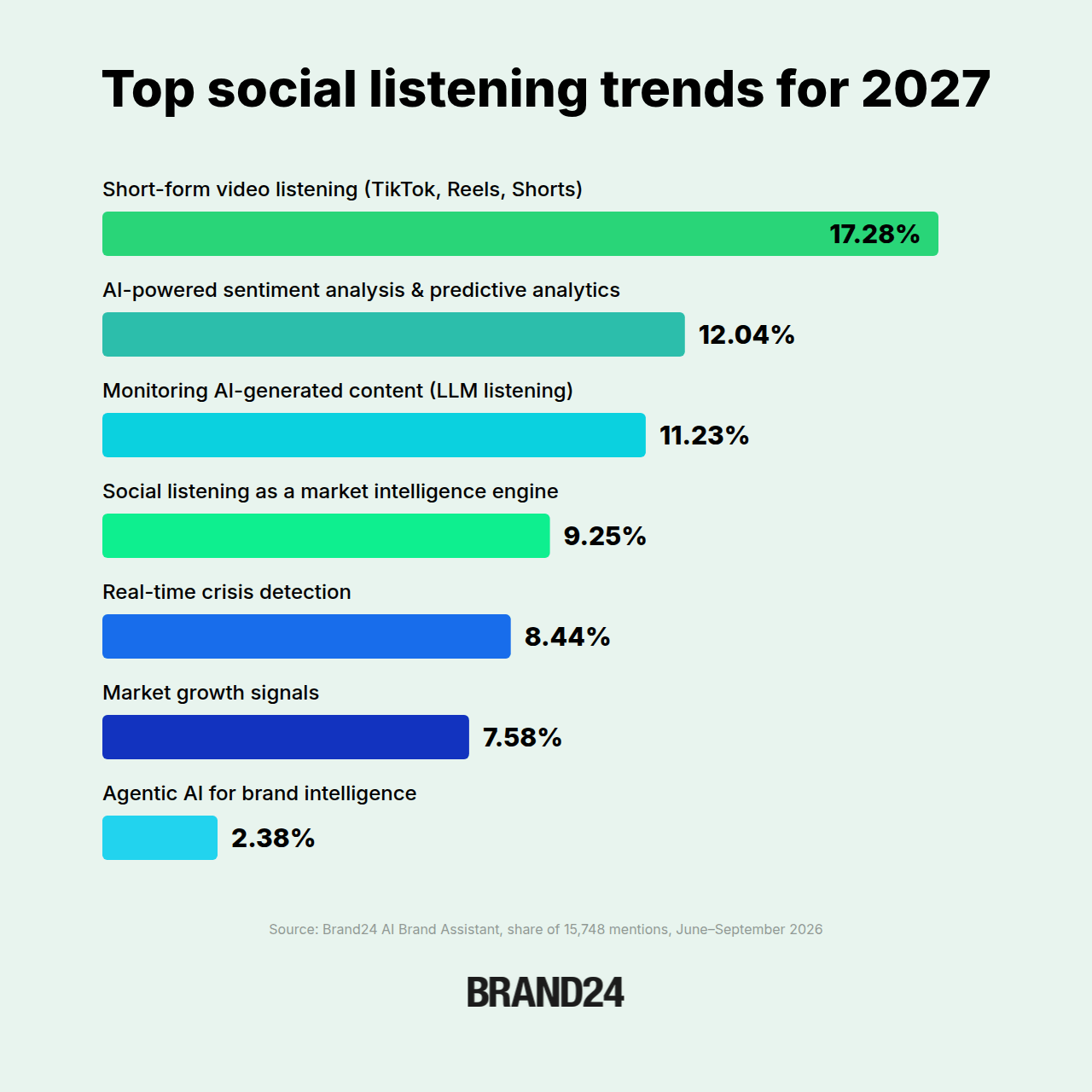
Video listening of short forms like TikTok, Reels, Shorts accounts for 17.28% of the 15,748 mentions analyzed by Brand24. Many brand mentions are spoken in videos and never appear in comments, and text-only monitoring can miss them completely.
-
What AI models say about a brand = a part of brand reputation now
Content about monitoring AI chatbots comes from sources with high influence, so it reaches more people than its mention count suggests. Brand24 CEO Michał Sadowski sees the fight for backlinks turning into a fight for credible brand mentions that LLMs learn from.
-
Social listening is moving from counting mentions to predicting what comes next
AI-powered sentiment and predictive analytics is the second-largest trend in the Brand24 data (12.04%). Our experts expect that tools will not only detect crises, but also estimate their impact, and recommend responses.
-
YouTube, TikTok, and Reddit will be the key data sources in 2027
All three Brand24 experts name YouTube and TikTok, and two of them add Reddit. These are the places where people share their opinions and where AI models learn which brands to recommend.
I put this article together using two elements: original Brand24 data and the opinions of three Brand24 experts. Here’s how I did it:
- Data source: Brand24 social listening project for the keyword “social listening trends”
- Period: June to September 2026
- Volume: 15,748 mentions across all 7 trends combined (one mention can belong to more than one trend)
- Analysis: Brand24 AI Brand Assistant grouped the mentions into trends and calculated each trend’s share of voice (SoV) by mention volume and by reach
- Expert panel: Michał Sadowski (CEO), Karol Kłaczyński (Head of Product), and Mikołaj Winkiel (Chief Evangelist) answered five questions about social listening trends in 2027
I asked each Brand24 expert the same five questions:
- Which social listening trends will be key in 2027, and why?
- Where do you see the greatest value of AI in social listening: in more efficient mention analysis, sentiment analysis, trend prediction, or somewhere else?
- Which platforms or data sources will matter most for social listening in 2027?
- What should brands start doing now to prepare their social listening strategy for 2027?
- Looking back at 2026, which trend or event most changed your thinking about the direction social listening is heading, and why?
Top 7 social listening trends for 2027
Here is a quick shortlist before we get into the details:
- 1 Spoken mentions become a key social listening source
- 2 AI visibility monitoring becomes a standard social listening channel
- 3 Predictive analytics becomes a core social listening feature
- 4 Social listening becomes a full market intelligence engine
- 5 Crisis detection moves to automation of responses
- 6 Filtering out AI-generated noise becomes a core social listening task
- 7 Brands monitor more sources as platforms limit access to their data
Mikołaj Winkiel, Chief Evangelist at Brand24, explains:

01 Spoken mentions become a key social listening source
Short-form video listening is the most talked-about trend in our data.
It accounts for 17.28% of mentions and nearly a quarter of their reach (23.08%). In practice, this means that in 2027 you’ll want to know what people say in:
- TikToks,
- Instagram Reels,
- YouTube Shorts,
- as well as what they type in the comments.
All three of our experts agree that spoken content matters more and more. Karol Kłaczyński, Head of Product at Brand24, sees that the demand is growing in different formats:

When we asked him which platforms will matter most, he added:
Michał Sadowski, CEO of Brand24, explains why video data is so valuable:

And Mikołaj Winkiel thinks video is the part of AI mentions in social listening that people talk about the least:
Other research shows how much video affects what people buy:
- 50% of US consumers said video made them aware of products or brands. They also say YouTube is 1.7x more likely than other social platforms to influence brand consideration. (Source: Google/BCG, 2025)
- 46% of consumers bought products they discovered on YouTube, with 23% saying that YouTube Shorts are the most convincing format. (Source: Channel Factory via MediaPost, 2025)
- Video analytics is the fastest-growing analytics type in the social listening market, at 13.29% CAGR. (Source: Mordor Intelligence)
02 AI visibility monitoring becomes a standard social listening channel
Keeping track of AI search visibility and what AI models say about brands is the third most discussed trend in our data (11.23% of mention volume), but it comes second when it comes to reach (10.50%).
Why is that?
Because people writing online about monitoring ChatGPT, Gemini, and Perplexity tend to have big audiences, so the topic travels further than the number of mentions would suggest.
For Michał Sadowski, social listening is becoming a big part of AI visibility:
Looking back at 2026, it’s also the change that shaped his thinking about social listening the most:
Mikołaj Winkiel remembers the exact moment in 2026 when he noticed this shift by himself:
He sees LLM monitoring as a natural next step for media monitoring and social listening:
Karol Kłaczyński adds that AI Search visibility also changes which sources you should keep an eye on:
For Karol, it’s all part of a bigger shift he noticed in 2026:
03 Predictive analytics becomes a core social listening feature
AI-powered sentiment analysis and predictive analytics is the second biggest trend in Brand24 social listening data, with 12.04% of share of voice.
People are clearly more interested in what mentions mean (the context) and what might happen next (the forecast and insights) than in simply how many mentions there are.
Michał Sadowski points out that the basics of using social listening tools haven’t changed much. What’s changing is what you get out of it:
He also explains where AI helps the most:
Michał expects social listening to become more predictive in 2027, too.
As he puts it, “social listening products will not only provide data, but will likely drive decisions”.
Karol Kłaczyński focuses on how much cheaper and easier the analysis has become:
He also sees a change in what social listening works on, and in who can do it:
Mikołaj Winkiel doesn’t think AI will replace the classic social listening features:
What AI adds, according to Mikołaj, is the ability of synthesizing data:
The time between getting the data and making a decision is shrinking, too. Mikołaj lists it among the key social listening trends for 2027:
04 Social listening becomes a full market intelligence engine
Social listening as a market intelligence engine takes 9.25% of mentions in our data.
More and more companies use social listening tools outside marketing and PR, for example, in product, sales, investor relations, or leadership teams.
When I asked the AI Brand Assistant to look at which use cases people discuss online, trend detection was the top 1 (33.4% of share of voice), followed by brand mention monitoring (27.6%) and competitive intelligence (24.9%).
Mikołaj Winkiel suggests connecting social listening with the rest of your company’s data:
The social listening market is growing, too:
- 7.58% of people discussing social listening online were also discussing its market growth signals.
- And according to the freshest estimations, the social media listening market is worth $10.91 billion in 2026. It will probably reach $20.51 billion by 2031 (with 11.19% CAGR). (Source: Mordor Intelligence)
05 Real-time crisis detection moves to automation of responses
Mikołaj Winkiel explains where AI can help:
Michał Sadowski expects tools to go one step further and suggest what to do next:
The marketers’ predictions found by the Brand24 AI Brand Assistant in online mentions are even bolder. They expect crisis tools in 2027 to draft responses and notify the right people automatically.
Real-time crisis detection was discussed by 8.44% of people online, but its reach grew by 47.4% between July and August 2026, more than any other trend in our data.
The number of mentions went down in the same period, so fewer people wrote about crisis detection, but those who did had much bigger audiences.
6. Filtering out AI-generated noise becomes a core social listening task
Our experts see AI content slop and AI-generated noise as one of the biggest challenges for social listening in 2027, even though it doesn’t really show up in the online discussions about trends.
Karol Kłaczyński describes how big the problem is getting:
Mikołaj Winkiel warns that brands are often targets, too:
For Michał Sadowski, this changes what makes a social listening tool valuable:
Well… At least people still prefer content made by humans: 43% prefer ads and videos created by people, and only 7% prefer AI-generated ones. (Source: Channel Factory via MediaPost, 2025)
Brand24 social listening analysis found that disinformation as a topic is barely discussed online, but Brand24 experts see it as a serious risk.
All three of them mentioned AI-generated noise, fake news, or bot networks, but disinformation doesn’t show up as a separate trend in the online conversation.
Karol Kłaczyński connects it to how fast AI developed in 2026:
7. Brands monitor more sources as platforms limit access to their data
According to Mikołaj Winkiel, the biggest risk for social listening in 2027 is losing access to data:
On top of that, online conversations are spreading to more and more places:
- Mikołaj points to podcasts and newsletters, “because that’s where expert opinions are shaped, and almost nobody monitors them”.
- Karol Kłaczyński adds that a lot depends on the region, where “smaller social platforms dedicated to specific interests or purposes” are gaining importance.
Which platforms will matter most for social listening in 2027?
According to experts from Brand24, YouTube, TikTok, and Reddit will matter most for social listening in 2027.
That’s where people share their honest and most emotionally loaded opinions, and where AI models learn about brands. LLMs also become a data source of their own.
Mikołaj Winkiel explains why:
| Platform / source | Why it matters in 2027 | Named by | Expert proof |
|---|---|---|---|
| YouTube | 1. A lot of spoken reviews and tests 2. It’s still hard for AI to mimic 3. Has a strong influence on purchases | Michał Sadowski, Karol Kłaczyński, Mikołaj Winkiel | “Sources built around authentic conversations will become increasingly important, particularly YouTube as it is still mostly difficult to mimic by AI” (Michał Sadowski) |
| TikTok | 1. Short-form video is the #1 trend discussed online (17.28% SoV) 2. Many mentions are spoken, not typed | Michał Sadowski, Karol Kłaczyński, Mikołaj Winkiel | “It depends a lot on the region. Globally, ‘spoken’ sources are gaining, mainly TikTok and YouTube, and in my opinion they’ll keep gaining” (Karol Kłaczyński) |
| 1. Authentic opinions are formed here 2. Often cited by LLMs and used to train them | Karol Kłaczyński, Mikołaj Winkiel | “Reddit, TikTok, and YouTube [will matter most], because that’s where authentic opinions are and, just as importantly, that’s what models are trained on” (Mikołaj Winkiel) | |
| LLMs (ChatGPT, Gemini, Claude, Perplexity, Grok, Google AI Overviews) | 1. They shape purchase decisions 2. It’s a data source that didn’t exist two years ago | Michał Sadowski, Mikołaj Winkiel | “[Another important source are] LLMs themselves as a data source, which two years ago simply didn’t exist” (Mikołaj Winkiel) |
| Comparison and review sites | 1. Frequently cited by LLMs in product answers | Karol Kłaczyński | “Because LLMs are pushing further into the market and taking over the role search engines used to play, Reddit will definitely matter, and so will all the sources LLMs cite, for example comparison sites in the case of products” (Karol Kłaczyński) |
| Podcasts and newsletters | 1. It’s where expert opinions are shaped 2. Monitored by a small number of brands yet | Mikołaj Winkiel | “Podcasts and newsletters [will matter], because that’s where expert opinions are shaped, and almost nobody monitors them” (Mikołaj Winkiel) |
| Regional and niche platforms | 1. Interest-specific communities that differ by market | Karol Kłaczyński | “Regionally, [what will matter are] smaller social platforms dedicated to specific areas of interest or purposes” (Karol Kłaczyński) |
How to prepare your social listening strategy for 2027?
A good first step is to check what people and AI models already say about your brand.
As Karol Kłaczyński puts it: “First of all, check where you are now, what you know about your brand, and how you’re able to react to it”.
He also explains that what comes next depends on the size of your brand:
Whatever the size of your brand, you can go through this checklist I prepared based on our experts’ advice:
01 Track AI mentions of your brand and category
“It takes ten minutes and quite often ruins your mood, but it’s better to know”, says Mikołaj Winkiel.
How to do it?
Use AI visibility tools to track your AI brand mentions in answers from ChatGPT, Gemini, Perplexity, and other AI models, in which position, and next to which competitors.
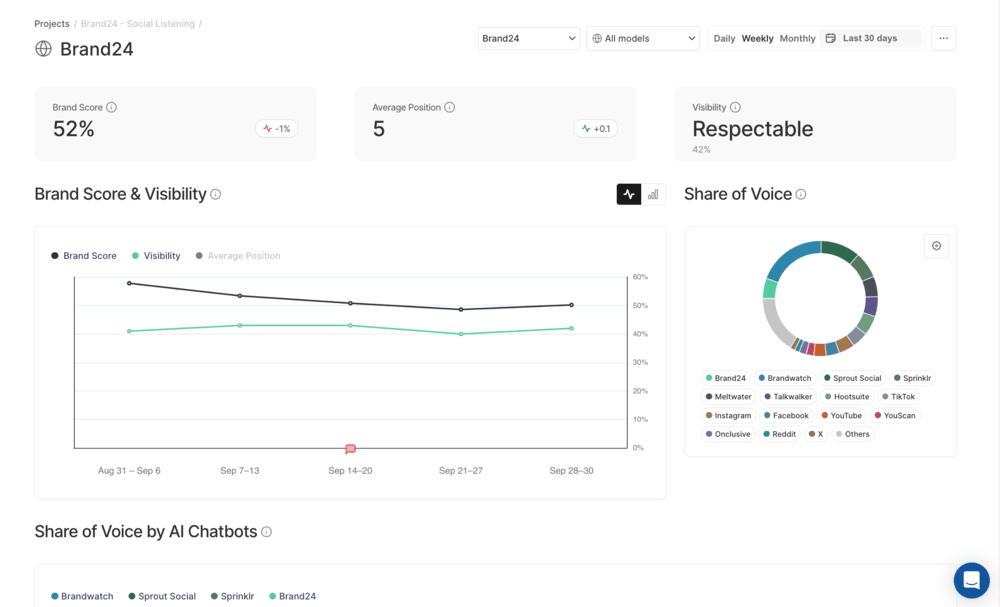
These tools analyze how AI models position your brand, so you can track your AI share of voice and the exact sources they cite.
02 Review your media monitoring setup
Many brand names are also everyday words, people’s names, or places, so a project can quickly fill up with mentions that have nothing to do with your brand.
Mikołaj Winkiel recalls: “When we were setting up monitoring for a cosmetics brand, before the project had only mentions of perfume left, we had to exclude an actor, an airplane, and a few places on the map. And that’s not an exception, just a pretty typical Tuesday”
How to do it?
Some social listening tools have AI features that clean up your results for you.
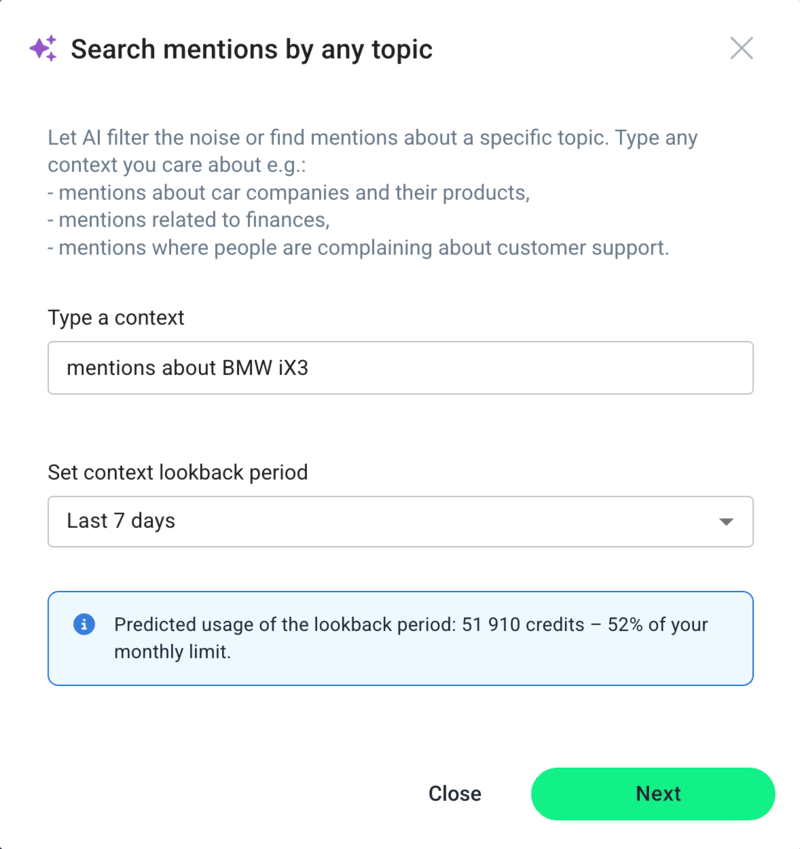
One of them is Smart Context Search in Brand24:
you describe what you’re looking for in plain words (for example, “Gemini Google’s AI assistant”), and the tool filters out mentions from a totally different context, like in this case, horoscopes.
It’s worth reviewing your setup every few months, because new products and campaigns bring new keywords.
03 Add video transcript and spoken content to your sources
Make sure your TikTok and YouTube monitoring analyzes what’s said in these videos, as well as in captions and comments.
How to do it?
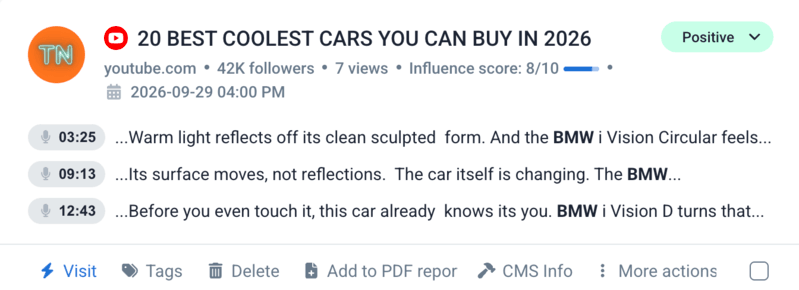
Check whether your social listening tool analyzes what’s said in videos, as well as titles and descriptions.
For example, in Brand24, you can monitor YouTube and TikTok transcripts, so you’ll catch your brand name even if it comes up in the 20th minute of a review.
04 Define what counts as a signal
“Decide what is a signal that needs a reaction and what is just information”, advises Mikołaj.
How to do it?
A signal = a brand mention that needs someone to act. It can be a sudden spike in mentions, a wave of negative comments, or a post from an author with a big reach.
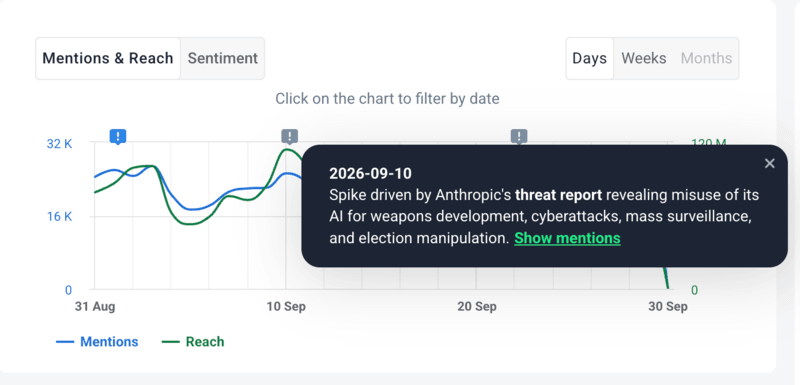
Set up alerts for these situations in your social listening tool and send them to the teams responsible for reacting.
As Mikołaj puts it, “a tool without an owner doesn’t work, no matter how much AI is inside it”.
05 Connect social listening with sales and customer service data
Any brand mention will tell you much more when you can see what was happening in the company at the same time.
With a social listening API, you can send mention data, sentiment, and AI summaries straight to your BI dashboards (like Looker or Power BI) or other internal tools.
Then you can compare spikes in mentions with sales results or the number of support tickets from the same days.
06 Get mentioned where AI models look
Michał Sadowski recommends “actively building the authority and narratives that can improve [brands’] visibility and recommendations within AI answers”.
How to do it?
Check which websites or social media posts are cited by AI chatbots when they answer questions about your category, and which of them mention your competitors but not you.
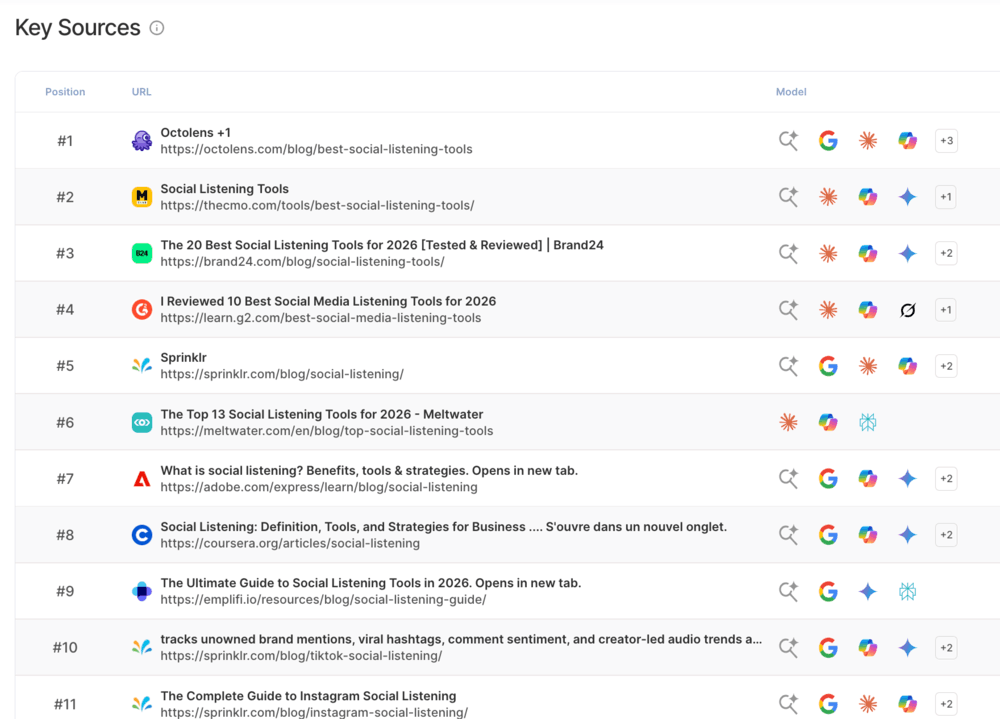
Sometimes, those are the places worth reaching out to with PR, expert comments, or partnerships.
07 Build your own historical datasets for social listening
Michał suggests creating benchmarks “that cannot be easily reproduced using publicly available AI models”.
How to do it?
Turn the data you own into your original research. For example, we analyzed 46.4k online mentions in our report on AI visibility tracking issues.
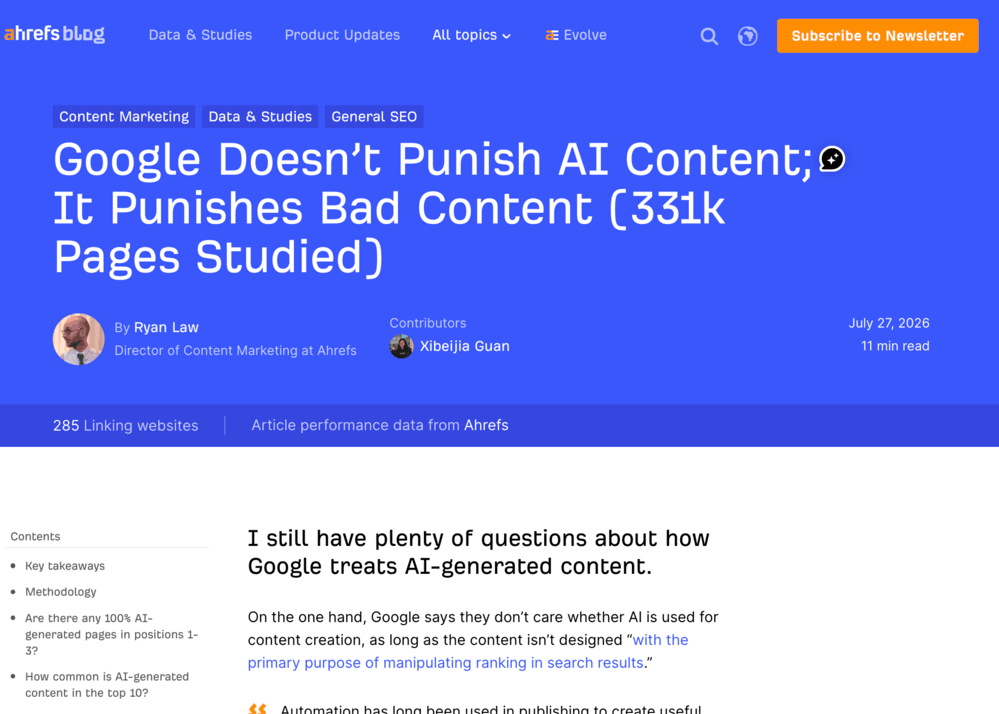
Ahrefs did its own research on about 1 million top-ranking pages to check if Google punishes AI content.
FAQ
The most important social listening trends for 2027 are short-form video listening, LLM monitoring, and AI-powered predictive analytics. In a Brand24 analysis of 15,748 mentions (from June to September 2026), short-form video led with 17.28% share of voice. Other key trends include real-time crisis detection, market intelligence, fighting disinformation, and managing data access.
AI helps social listening move from collecting mentions to explaining them and predicting what’s next. For example, Brand24 AI Insights sums up thousands of mentions in a few sentences, spots anomalies that may signal a crisis, and analyzes spoken content in YouTube and TikTok videos. Our experts expect the next step to be tools that also suggest how to respond.
YouTube, TikTok, and Reddit are the platforms to watch in 2027, according to Brand24 experts. They’re full of honest opinions, and they feed the AI models that recommend brands. Podcasts, newsletters, comparison sites, and regional niche platforms are worth adding too.
A good place to start is to use an AI visibility tool to ask LLMs about your brand and to review the setup of your media monitoring tool.
Then you can add TikTok and YouTube social listening, decide and prioritize which signals need your reaction, and connect social listening with your sales and customer service data. It also helps to have one person on your team who owns the tool.
Short-form video listening is the biggest social listening trend for 2027. It accounts for 17.28% of the 15,748 mentions analyzed by the Brand24 AI Brand Assistant and nearly a quarter of their reach. Brands want to know what people say about them in TikToks, Reels, and YouTube Shorts, where many mentions are spoken and never written down.
Agentic AI shows up in many industry predictions, but it’s the smallest trend in our data, with 2.38% of mentions. None of the three Brand24 experts named it as a key trend for 2027. They expect better synthesis, anomaly detection, and response recommendations to come first.
AI-generated content and bot networks add a lot of noise to online conversations and make it easier to run disinformation campaigns against brands. Brand24 experts expect filtering out this noise to become one of the most important jobs of social listening tools in 2027. Social listening also helps spot these campaigns while they’re still forming.
AI helps social listening move from collecting mentions to explaining them and predicting what’s next. For example, Brand24 AI-powered features sum up thousands of mentions in a few sentences, spot anomalies that may signal a crisis, and analyze spoken content in YouTube and TikTok videos. Brand24 experts expect that in 2027, the next step will be tools that also suggest how to respond.


