Table of contents
2M Marketers

According to DataReportal 2026 data, 5.79 billion people are active on social media, spending an average of 19 hours per week talking about brands they love or hate.
Most of what they say about you happens without tagging you!
To understand where social listening stands in mid-2026, I analyzed over 1.2k online mentions using Brand24’s AI Brand Assistant.
What I found shapes everything in this guide: the definition, the strategy framework, the research data, and the real case studies.
Key takeaways:
-
What is social listening? Definition
Social listening is the practice of monitoring online conversations about your brand, competitors, or industry in real time, and using the analysis to make smarter business decisions.
-
Why does it matter in 2026?
Only 1% of sources cited by LLMs come from brand-owned websites (McKinsey, 2026). The other 99% — forums, reviews, social posts — is where AI learns what to say about your brand. If you're not monitoring those sources, you have no visibility into how AI search represents you.
-
What's the difference from social monitoring?
Monitoring tells you what was said. Listening tells you why and what to do about it.
-
What is AI-powered social listening?
AI makes social listening easier by understanding context and emotions, grouping conversations into themes, flagging unusual patterns or spikes, cutting down on irrelevant mentions, and delivering clear summaries with actionable insights.
-
How do I build a social listening strategy?
Use the Brand24 Social Listening Cycle framework: Define → Monitor → Analyze → Act → Optimize → Report.
What is social listening? Definition
Social listening is the process of monitoring what people say online about a brand, topic, or industry and then taking strategic action based on that information. It goes beyond tracking likes or mentions by focusing on context, sentiment, patterns and themes, and the intent behind conversations.
The short version: Social listening = What are people saying? + Why are they saying it? + What should we do about it?
Here’s how I think about it: social listening is like having an always-on focus group, except none of them are performing for you, and all of them are speaking honestly.
For example, they’re on Reddit at 11pm complaining about a competitor. They’re recommending your product on TikTok to 40,000 followers without tagging you. They’re asking ChatGPT which tools are worth buying in your category.
If you’re not picking up any of these signals, your marketing decisions are built on pretty incomplete data.
Why do you need social listening? It will help you discover and analyze:
- Brand reputation & perception
- Competitor reputation & perception
- Customer sentiment & emotions
- Real-time feedback
- AI brand visibility
- Emerging trends & market opportunities
- Target audience insights & demographics
- Campaign effectiveness
- PR crisis quickly
- Backlink opportunities
Key elements of social listening in 2026:
| Social listening element | What it is |
|---|---|
| Real-time monitoring | Monitoring in real time of online conversations across multiple social platforms and channels |
| Sentiment analysis | Automatically detecting whether mentions are positive, neutral, or negative, and using natural language processing (NLP) for emotion detection |
| Instant notifications | Storm alerts for spikes in mentions and sentiment drops |
| Topic and trend analysis | Clustering conversations into themes (very often by AI-powered features) |
| Competitive benchmarking | Analyzing competitors’ share of voice, reach, customer satisfaction, and PR wins or failures |
| Trendspotting | Tracking emerging hashtags, keywords, and hot topics in the industry |
| Advanced reporting | Easy reporting with scheduling and quick sharing features to inform your stakeholders |
Here’s how social listening can look in practice:
- 1 Pasibus, a Polish restaurant chain, started using a social listening tool to monitor customer feedback in real time.
- 2 They discovered demand signals from cities where they had no locations yet, and used that data to guide their expansion decisions.
- 3 Listening to online mentions became, as their Marketing Director put it, "simply a must-have" for spending their marketing budget wisely.
(See the full success story in the Benefits section below.)
What is AI-powered social listening?
AI-powered social listening is the advanced form of social listening that uses artificial intelligence (AI), specifically natural language processing (NLP), and machine learning, to process, interpret, and act on online conversations at a scale no human team could match.
In simple terms:
AI-powered social listening = tracking mentions + understanding context + analyzing emotions + discovering trends + delivering actionable insights faster
What are the three advantages of AI social listening?
- 1 It speeds up the analysis of monitored data, especially for enterprise teams.
- 2 Presents ready-to-use insights and recommendations.
- 3 My favourite one: you don't need to interpret the data by yourself, because AI does the work for you!
How AI can level up social listening in 2026? Top tools already have these features built in!
Let’s see a quick table of AI-powered features:
| AI feature name | What it does |
|---|---|
| Context-aware sentiment analysis | Automatically detects whether mentions are positive, negative, or neutral, even when there’s irony, sarcasm, or slang involved, and understands emojis and hashtags. |
| Built-in AI chat | A “personal analyst” for your data. Ask it anything (for example “What are the top complaints about our product this month?”) and get an instant answer, based on real-time monitoring data. |
| Automatic topic clustering | Groups thousands of mentions into clear themes without any manual sorting (e.g., “customer pain points”, “promotional content”, “product feedback”). |
| Anomaly detection | Spots unusual mention spikes or sudden sentiment drops and tells you what caused them |
| Plain-English insight summaries | Automatically transforms complex data into summaries, recommendations, and key takeaways. |
| Smart context filtering | Understands what you mean, not just what you type. Enables filtering and analyzing mentions based on context, not just keywords. |
| AI visibility tracking / LLM Listening | Newest feature offered only by the best social listening tools: track answers of ChatGPT, Perplexity, Gemini, Google AI Overviews, and other LLMs about your brand. |
That last one is critical in 2026:
McKinsey says that 60% of Gen Z consumers use AI overviews for research, and 23% discover new brands only through organic social spaces.
If your brand is absent or misrepresented in AI-generated answers, you can be invisible to a great portion of your audience!

Social listening vs. social monitoring. Differences
Monitoring tells you what happened. Listening tells you why it happened and what to do next.
- Social monitoring = watching
- Social listening = understanding
In a nutshell:
Monitoring helps you handle day-to-day interactions. It’s tactical, reactive work of tracking mentions.
Listening is a strategic, proactive practice of spotting patterns, identifying trends, and using what you learn to guide your business decisions.
I prepared a quick comparison table for you to see how they differ:
| Aspect | 📡 Social Monitoring | 🧠 Social Listening |
|---|---|---|
| Focus | Individual online mentions | Patterns and trends |
| Approach | Reactive | Proactive |
| Goal | Day-to-day management | Strategic decisions |
| Timeframe | Short-term | Long-term |
| Output | Alerts, responses | Insights, strategy |
| Who uses it | Community managers | Marketing leaders, brand strategists |
The relation between them:
Social media monitoring is a part of social listening – it’s the part where you track and collect data, while social listening digs into that data to uncover insights and inform your next moves.
What do online conversations say about social listening? [Brand24 Original Research]
To understand how social listening is discussed in 2026, I used Brand24’s AI Brand Assistant to analyze social listening conversations across online sources.
Let’s see what marketing teams worry about, what use cases dominate, and which industries talk about it most.
The data covers June 3 – July 3, 2026.
How big is the social listening conversation?
In 30 days, the topic of “social listening” generated:
- 1,271 mentions across social media, news, forums, online communities, videos, and blogs
- 28,506 social interactions, including 20,782 reactions, 611 comments, and 7,113 shares
- Advertising Value Equivalent (AVE): $420,200
Sentiment distribution:
| Sentiment | Mentions | Share | What it means |
|---|---|---|---|
| 🔵 Neutral | ~958 | 75.3% | Informational, professional — tool comparisons, how-tos, job listings |
| 🟢 Positive | 241 | 19.0% | Real enthusiasm for results and capabilities |
| 🔴 Negative | 72 | 5.7% | Industry criticism |
Overall, the tone is mostly neutral and informative: marketers and agencies chatting about tools, strategies, and how they get their social media listening work done.
Top words in “social listening” mentions:
| Word | Share | What it means |
|---|---|---|
| “tool” | 32.6% | The conversation is heavily product-evaluation-oriented |
| “brand” | 25.6% | Brand use cases dominate the discussion |
| “platform” | 20.9% | People are actively comparing and switching platforms |
| “social media” | 20.2% | Primary channel, even as we expand coverage to include LLMs and podcasts |
| “marketing” | 18.6% | Marketing teams are the primary practitioner audience |
Emotion distribution:
Overall, the emotional vibe in conversations about social listening is really optimistic and confident:
| Emotion | Share | What it means |
|---|---|---|
| 🤝 Trust | 28.2% | People view social listening as a “proven”, established field |
| 😊 Joy | 26.0% | Real excitement, especially around new AI features |
| 🚀 Anticipation | 24.5% | Forward-looking confidence about where social listening is heading |
| 😒 Distrust | 8.1% | Frustration with social listening tool pricing and unclear contracts |
| 😤 Anger | 4.9% | Strong negative reactions to specific tool limitations |
We can see a strong mix of trust and anticipation, and I think it says a lot: people see social media listening as an important, really exciting topic.
What are the key topics of discussion about social listening?
When I asked AI Brand Assistant, it identified 8 distinct discussion topics in the data.
A quick list of the most frequent topics of discussion about social listening:
- 1 Social listening strategy
- 2 Social media job roles
- 3 AI marketing tools
- 4 Digital reputation insights
- 5 Social media management
- 6 Reddit brand monitoring
- 7 Digital marketing strategy
- 8 Brand sentiment measurement
Here’s a summary of the top 5:
1. Social Listening Strategy
708 mentions · 504.7k reach · 8.5% share of voice
What do people discuss here?
Everything from basic “how to track brand mentions” to advanced strategic frameworks.
2. Social media job roles
585 mentions · 2.2M reach · 36.5% share of voice
What do people discuss here?
Social listening now appears as a required skill across marketing and content roles, signaling it’s moving from nice-to-have to table stakes.
3. AI Marketing Tools
346 mentions · 793.9k reach · 13.4% share of voice
What do people discuss here?
Social listening viewed as one of the key AI-powered capabilities reshaping marketing in 2026.
4. Digital reputation insights
250 mentions · 1.5M reach · 25.3% share of voice
What do people discuss here?
How brands monitor and protect their reputation using social listening.
5. Social media management
250 mentions · 1.5M reach · 25.3% share of voice
What do people discuss here?
Social listening as an embedded analytical layer inside social media management workflows.
What are the top 5 pain points in social listening?
Sentiment analysis detected 107 negative mentions over the 30-day analysis period, with a combined reach of 283.9k.
A quick list of the top 5 pain points that I noticed in the data:
- 1 Pricing that locks out smaller teams
- 2 Tool dashboards full of data, no clear next steps
- 3 Keyword counting breaks in the real internet
- 4 Important platforms and content types are missing
- 5 AI chatbot conversations are invisible to most tools
Let’s see the real examples of mentions for each pain point:
🔴 Pain Point 1: Pricing that locks out smaller teams
Enterprise social listening pricing is often discussed as out of reach: quote-only rates, year-long contracts, and cancellation rules that seem built to lock people in instead of earning their loyalty.
Real examples of mentions:
- “The barrier to entry is ridiculous. Most of them start at a couple of hundred dollars a month just to track basic keywords. For a solo founder or a small team…”
- “Many social listening contracts price on seat count but throttle on query volume or mention limits”
🔴 Pain Point 2: Dashboards full of data, no clear next step
Raw mention counts give teams a false sense of productivity.
Real examples of mentions:
- “Unpopular opinion: your social listening tool is a very expensive way to feel busy. It tracks every mention of your keyword and drops them all in a dashboard — 500 hits this week! Look at all that ‘engagement.’ Except most of those 500 are people…”
- “The real problem isn’t data quality. It’s decision infrastructure. Teams don’t fail at social listening because they lack information. They fail because the information doesn’t arrive with a clear next step attached.”
🔴 Pain Point 3: Keyword counting breaks in the real internet
Most social listening tools still rely on basic keyword matching and that approach can’t pick up on sarcasm, irony, subculture slang, or the way niche communities actually talk and behave.
Real example of mention:
- “Basic social listening tools are useless in the era of internet sarcasm and subcultures. Counting keywords won’t save your brand from a PR crisis born in a niche digital community.”
🔴 Pain Point 4: Important platforms and content types are missing
People keep pointing out that tools lack coverage on some social media platforms, even though that’s where many of the most influential conversations happen.
Real examples of mentions:
- “Most social listening dashboards track hashtags, keywords, mentions, and influencers, but very few track audio behaviour with the same level of discipline.”
🔴 Pain Point 5: AI chatbot conversations are invisible to most tools
People notice that traditional social listening tools were built for human-generated content and have a critical blind spot; they miss what AI tools are saying about brands entirely.
Real examples from data:
- Their traditional social listening tools, while excellent for human-generated content, were missing huge swaths of what was being said about them online.”
Which industries discuss social listening most actively?
Along with learning what marketers find most challenging about social listening, I also asked the AI Brand Assistant about which industries talk about social listening the most.
Here’s a quick list of the top 7 industries:
- 1 Marketing & Advertising Agencies
- 2 PR & Communications
- 3 Tech & SaaS
- 4 Retail & E-Commerce
- 5 Healthcare & Pharma
- 6 Higher Education
- 7 Media & Journalism
Now, let’s take a look at how each industry talks about social listening and what those conversations are like:
| 🏢 Industry | Dominant discussion angle | Example from the data |
|---|---|---|
| Marketing & Advertising Agencies | Client strategy, content pivots, competitive intelligence | “Most businesses treat social listening as a reporting tool rather than a forward-looking strategy driver” |
| PR & Communications | Crisis early warning, reputation protection | Companies using social listening tools report 15% faster PR crisis response time |
| Tech & SaaS | Buying signal detection; LinkedIn and Reddit as intent databases | “Old standard: social listening lives in marketing. New standard: social listening feeds growth, product, and sales simultaneously.” |
| Retail & E-Commerce | Customer feedback loops, inventory optimization | “AI social listening can cut inventory waste by up to 30% for consumer tech brands, turning Instagram chatter into actionable stock forecasts.” |
| Healthcare & Pharma | Misinformation monitoring, patient safety narratives | Social media tools help “identify recurring misconceptions, misinformation, and patient concerns before they become larger reputational issues” |
| Higher Education | Enrollment conversations, institutional reputation | Social listening now taught as formal curriculum topic |
| Media & Journalism | Trend discovery before mainstream | Some news outlets say they are experimenting with AI social listening “to identify emerging global narratives before they become widely reported” |
Benefits of social listening [with real examples]
I handpicked five real-world success stories from Brand24 clients to show what brands across different industries can accomplish with a strong, well-executed social listening strategy.
Social listening for Tech & SaaS
Key benefits for this use case:
- Misinformation prevention: catch incorrect descriptions of your product before they sabotage sales conversations
- Competitive gap discovery: find the conversations you’re missing from completely
- Multi-market monitoring: track discussions in various languages and regions at the same time
- Cross-team intelligence: give your brand, sales, and product teams the same real-time data
A real-world example — PiwikPRO:

PiwikPRO’s PR Manager Marcin Pluskota used social listening to:
- spot and flag inaccurate descriptions of their data collection practices on social media and blogs, especially important in a GDPR-sensitive space, where one misleading post can destroy a sales conversation
- monitor a keyword “alternatives to Google Analytics” to find placement opportunities and competitive gaps
- catch privacy misinformation early and respond before it spread
📚 See Piwik PRO’s success story: Maximizing Brand Reputation and Marketing Insights
Social listening for Finance & Fintech
Key benefits for this use case:
- Competitive intelligence: turn competitor product changes and customer complaints into your own market opportunities
- Crisis prevention in a high-trust market: detect negative sentiment before it spreads, especially in sectors where trust = product
- Partnership and influencer identification: find who is the top voice in discussions around your brand and reach out to them
- Real-time market signal detection: track regulatory and reputational risks as they emerge online
A real success story — XTB:
XTB, a global trading platform, used social listening tool to monitor competitors in real time:
- their promotions,
- product changes,
- and the customer complaints triggered by those changes.
When a competing platform changed its stock investment product and users started complaining online, XTB spotted it in media mentions before their sales team even had to ask!
They used that insight to pitch their own option to frustrated customers who were already looking for a better alternative.
What they did: track competitor mentions, categorize the sentiment, and send an alert to the commercial team when a competitor weakness showed up in a social listening tool.
📚 See XTB’s success story: How XTB Uses Brand24 to Dominate the Online Trading Market
Social listening for Restaurants & Hospitality
Key benefits for this use case:
- Community-driven product development: turn customer feedback and reactions to the menu into data-backed decisions
- Influencer ROI tracking: connect influencers’ reach metrics to your sales results
- Smarter expansion planning: identify where people already demand your restaurant before deciding to open a new location
- Campaign performance tracking — measure engagement, positive sentiment, and earned media value of your marketing activities
A real-world example — Pasibus:
Pasibus, a Polish fast-casual restaurant brand, used social listening to:
- monitor reactions to “Burger of the Month” launches,
- track influencer campaign performance,
- and spot demand signals in cities where they didn’t have a restaurant yet.

Take for yourself from their listening setup: AVE (Advertising Value Equivalent) has been a core marketing KPI for over three years.
They also tie Brand24 reach data directly to sales figures to forecast conversion rates from influencer campaigns.
📚 See Pasibus’s success story: How Pasibus Uses Brand24 to Understand Its Customers’ Needs
Social listening for Retail & Consumer Goods
Key benefits for this use case:
- Early trend detection: spot emerging interests of consumers before they become too mainstream
- Cultural relevance monitoring: stay in sync with what your audience cares about right now
- Consumer language mining: discover how customers describe your product category in their own words
- Competitive campaign tracking: find out which competitor campaigns are winning or failing and why
A real-world case study — Neon Panda:
Neon Panda, a Mexican beverage brand, uses social listening to stay culturally relevant and catch new trends before their competitors do.
Thanks to social media monitoring, Neon Panda noticed that “natural hydration” started growing as a topic in organic consumer conversations, before it hit mainstream search trends.
That meant they already had content and product ideas ready to release when the trend peaked, while competitors were still catching up.
Take for yourself from their listening setup: monitor industry and lifestyle keywords, track which consumer topics are gaining popularity, and use these meaningful insights in your content or social media strategy and product planning.
📚 See Neon Panda’s success story: 2 Smart Ways Neon Panda Stays Ahead of Trends With Brand24
Social listening for Marketing Agencies
Key benefits for this use case:
- Discovery of unlinked mentions: find backlink opportunities your clients don’t know exist
- Lead generation at scale: identify potential clients publicly asking about discussing marketing services
- Client ROI reporting: show measurable reach and earned media value with real data
- Competitive positioning: show clients exactly where they stand vs. where their rivals are in the share of voice context
A real example of success — Chili Fruit:
Chili Fruit, a link-building and consulting agency, uses a social listening tool primarily to surface unlinked brand mentions for their clients. Each one is a lost backlink opportunity that social listening helps find and act on at an agency scale.

Results from their social listening implementation:
- Up to 1,500 unnotified mentions captured for more than a dozen clients
- Approximately 10% of each client’s monthly backlink target fulfilled purely through mention monitoring
- Over 100 external content projects initiated from Brand24 data
📚 See Chili Fruit’s success story: How to Boost Personal Branding: Uncovering Hidden Mentions Through Media Monitoring
Social listening for Higher Education
Freie Universität Berlin (FU Berlin) monitors how the university is seen and discussed across global markets — using social listening to spot risks to reputation before they turn into bigger PR crisis.
For a research institution with an international student audience, understanding how rankings, campus events, and faculty decisions are discussed in online conversations is a real competitive advantage.
📚 See FU Berlin’s success story: Scientific Research with Social Listening: Leveraging Brand24 for Trend Analysis
Want to see even more real results that social listening can drive? Take a look at the Labubu case study in our article on the benefits of sentiment analysis.
The Brand24 Social Listening Cycle Framework
From my experience as a social listening expert in Brand24, the teams that get most value from social listening share one thing: they treat it as a cycle, not a one-time setup.
If you also want to follow the steps of the best marketing teams using social listening, you’ll need the right brand monitoring tool and the right framework.
Here’s the Brand24 Social Listening Cycle: a practical, six-step framework I recommend for building and maintaining a social listening strategy.
Define → Monitor → Analyze → Act → Optimize → Report
Step 1: Define your goals and use cases
Before you touch a single keyword, be specific about what you want to achieve. Social listening can “serve a lot of masters” and the teams that get the most from it start with a clear use case:
- Brand monitoring: Track what people are saying about your brand and products.
- Brand health: Track negative mentions, brand sentiment shifts, and share of voice.
- Customer care: Spot complaints and questions outside your owned channels.
- Market intelligence: Monitor competitors, industry trends, and emerging players.
- Campaign analysis: Measure engagement, reach, and sentiment around launches.
- Crisis prevention: Detect negative sentiment spikes early and manage response.
- Product feedback: Improve products and services based on real, relevant conversations.
- Influencer discovery: Find advocates in your niche that match your business.
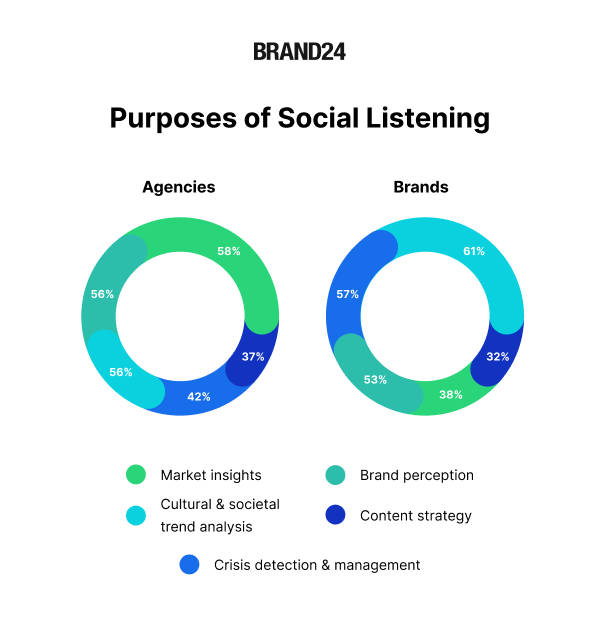
According to the State of Social Listening 2025 report, the most common goals of using social listening across businesses are: market insights (58% of agencies, 37.5% of brands), cultural & trend analysis (61.1% of brands), brand perception (52.8% of brands), and crisis management (56.9% of brands).
💡 My pro tips as a marketer with experience in social listening:
1. Start with one or two goals maximum. Why? A vague starting point produces vague results.
2. Choosing your goal or goals for your social listening strategy is not a lifetime decision! They can naturally evolve and expand over time.
Step 2: Pick the social listening tool that fits your needs
Once you know what you’re after, you need the right social listening tool. Most of them offer free trials in 2026, so you can try a few out before committing long-term.
How to choose the best social listening tool?
Based on what I’ve learned working in marketing, I’d focus on these three key elements:
1. Check the number of sources it monitors
What to look for in an advanced social listening tool (2026 checklist):
- social media (Facebook, Instagram, X/Twitter, LinkedIn, TikTok, Bluesky, Telegram),
- blogs, forums, communities (Reddit, Quora),
- news sites, online magazines, newsletters (real-time media coverage, Substack, Medium, etc.)
- podcasts and video platforms (YouTube, Twitch, Spotify, Soundcloud),
- review sites (TripAdvisor, Yelp, Trustpilot, App Store, Google Play),
- multilingual and regional sources (not only global ones),
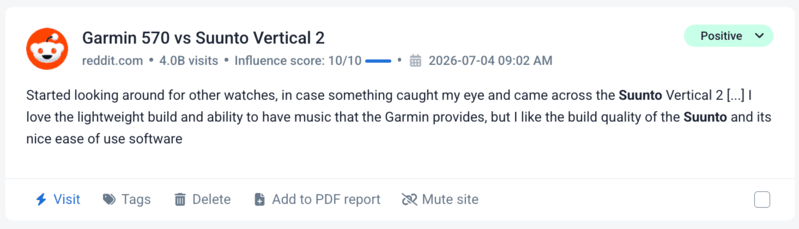
- and, what is most important in 2026 (!), LLMs (ChatGPT, Claude, Perplexity, Gemini, etc.).
2. See if it includes features that support your goals
Key features of social listening tools I’d look for in 2026:
| Feature type | What it includes |
|---|---|
| Data collection and coverage | 1. Real-time monitoring 2. Historical data availability 3. Multi-platform coverage |
| Search and filtering | 1. Advanced filters 2. Boolean search 3. Smart filtering by context |
| Analytics and insights | 1. Sentiment & emotion analysis 2. Intent detection 3. Topic clustering 4. Trend spotting 5. Share of voice (SOV) measurement 6. Competitor comparison 7. Reach & engagement tracking 8. Geo & demographic insights 9. Influencer & top voice analytics |
| Alerting and proactive detection | 1. Event detection 2. Real-time & storm alerts 3. Multi-channel, personalized notifications |
| AI-powered & advanced intelligence | 1. AI summaries 2. Automatic insights and recommendations 3. Built-in AI chat (“ChatGPT-like”) 4. AI visibility analysis |
💡 My pro tips as a marketer with experience in social listening:
Pay attention to whether the tool is consistently improving and developing its service and adding useful AI features.
3. Evaluate if its pricing feels cost-effective
Before you buy the software, make sure you’ve calculated the total cost of ownership. I usually do that by asking two questions:
- What’s the subscription fee? (monthly or annual)
- Are there any add-ons, and do they cost extra? (extra mentions, additional seats, or advanced modules like AI visibility tracking or historical data pulls)
In my research, I found that in 2026, there are basically two types of tools for social listening:
- larger media management platforms that sell social listening as an add-on,
- or dedicated tools where social listening is the main feature.
Platforms with social listening as an add-on (updated July 2026):
| Tool | Overview | Starting price |
|---|---|---|
| Hootsuite | Powerful social media management platform with monitoring features | Basic monitoring starts at $199 per user, and you can add advanced social listening with a custom plan |
| HubSpot | All-in-one marketing, sales, and CRM platform with a social media management toolset | Plans start at $800 per month |
| Sprout Social | Social media management and analytics platform with a social listening feature | Pricing starts at $199 per month, social listening is offered as an add-on |
Dedicated tools where social listening is the main feature (updated July 2026):
| Tool | Overview | Starting price |
|---|---|---|
| Brand24 | Specialized social listening tool with AI visibility tracking features | Individual plans start at $199 |
| Mention | Social listening and media monitoring tool | Plans start at $599 |
| Meltwater | Global media intelligence and social listening platform | Around $7000 per year for a basic, 1-user subscription |
💡 My pro tips as a marketer with experience in social listening:
Most tools can provide a cost estimate if you ask. For the final price, it’s best to schedule a quick meeting to get the most accurate details.
Step 3: Choose keywords to monitor
Social media listening tools track key terms like brand names, hashtags, and industry topics.
Just make sure you choose keywords that align with your monitoring goals!
What keywords to monitor?
| Keyword type | Examples |
|---|---|
| Brand, product, or service names | Sephora, “Rare Beauty”, “Samsung Galaxy S25” |
| Company hashtag (if you have one) or campaign-specific hashtags | #GlowUp (L’Oréal), #JustDoIt (Nike), #ShotOniPhone (Apple) |
| Your CEO’s or any other prominent team members’ names | “Selena Gomez” (Rare Beauty founder), “Sam Altman”, “Bernard Arnault” |
| Competitors’ brand names and hashtags | MAC Cosmetics, Adidas, #GooglePixel |
| Industry buzzwords and trending topics in your niche/category | “clean beauty”, “fast fashion dupe”, “foldable phone” |
| Names of events you’re participating in or sponsoring | “Paris Fashion Week”, #CES2026, “Sephora Beauty Insider Event” |
| Your target audience’s language (how they describe the problem you solve) | “drugstore dupe”, “iPhone vs Samsung” |
Step 4: Analyze social listening data
Now that your social listening project is up and running and the data’s coming in, it’s time to dive in and start exploring!
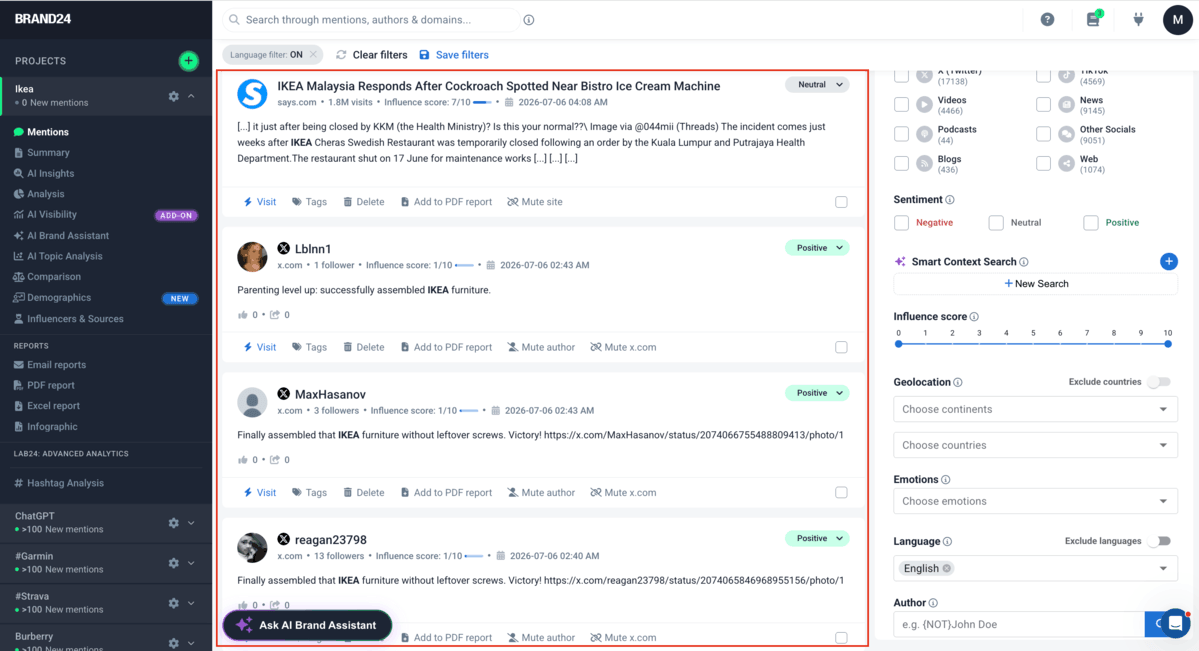
Pay attention to these 10 key social listening metrics:
| 📊 Social listening metric | What does it measure? |
|---|---|
| Mention volume | How often are your brand, products, or keywords mentioned? |
| Reach and impressions volume | How many people potentially saw your brand mentions? |
| Engagement | Likes, shares, comments, clicks, showing interaction of the target audience with your content |
| Sentiment share | Proportion (%) of positive, negative, and neutral mentions |
| Share of Voice (SOV) | Your brand’s conversation share vs. competitors |
| Trending topics and frequent keywords | Common themes, hashtags, or terms linked to your brand or industry |
| Audience demographics & location | Who’s talking about you and in which world regions? |
| Top influencers and key sources | Key individuals or sites driving the conversation around you |
| Response time | How quickly and effectively does your brand respond? |
| Crisis signals or spikes | Sudden increases in mentions or negative sentiment |
💡 My pro tips as a marketer with experience in social listening:
I check volume and sentiment distribution first in any analysis session.
Together they tell you the most important thing fast: is this conversation big and positive (amplify), big and negative (act immediately), small and positive (note it), or small and negative (monitor closely)?

Step 5: Act on insights & optimize
At this point, you’ve gathered some social listening data, and now it’s time to put it to work!
Here are three master tips from Adam Górnicz, Customer Success Manager at Brand24 and an expert in optimizing monitoring projects.
1. Optimization tip
“Use your brand’s domain, Twitter/X handle, or Facebook URL as additional keywords, as some posts skip the full brand name entirely!“
2. Refinement tip
“Use the excluded keywords feature to cut noise; check the “Context of Discussion” tab to find common irrelevant terms to exclude.”
3. Extend-your-view tip

Step 6: Report and benchmark
At this stage, we need to “close the loop,” which basically just means checking if your social listening strategy is working well.
I’d suggest setting up automated reports that run on a schedule, instead of rebuilding them by hand every time.
What I track in social listening reporting:
- Sentiment trend month-over-month
- Share of Voice vs. top competitors
- Presence Score shifts after campaigns or events
- Advertising Value Equivalent (AVE) to communicate the value of earned media to leadership
- AI visibility in the top AI chatbots
📚 Read more: 7 Inspiring Social Listening Examples for 2026
What is the future of social listening?
What’s coming in 2027 and beyond? And what emerging trends should we be watching in the digital listening space?
Social listening, and especially AI-powered social listening, is becoming core business infrastructure.
I’ve pulled together what the leading research agencies (HubSpot, McKinsey, Gartner) and Michał Sadowski, CEO and Founder of media monitoring and listening software, predict for the next 12–18 months.
1. Social listening is becoming fuel for AI visibility & LLM SEO
- Michał Sadowski believes that in 2026, volume and quality of brand mentions on Reddit, LinkedIn, Quora, YouTube, and X increasingly influence how ChatGPT, Claude, and Gemini describe your brand. AI mentions = new “backlinks” for AI search visibility.
- HubSpot’s 2026 research shows that 40.6% of marketers are already updating their brand strategy specifically for AI Search, and brands that track their social conversations will be better positioned to understand what’s influencing those AI answers.
2. Social intelligence is becoming conversational through MCP
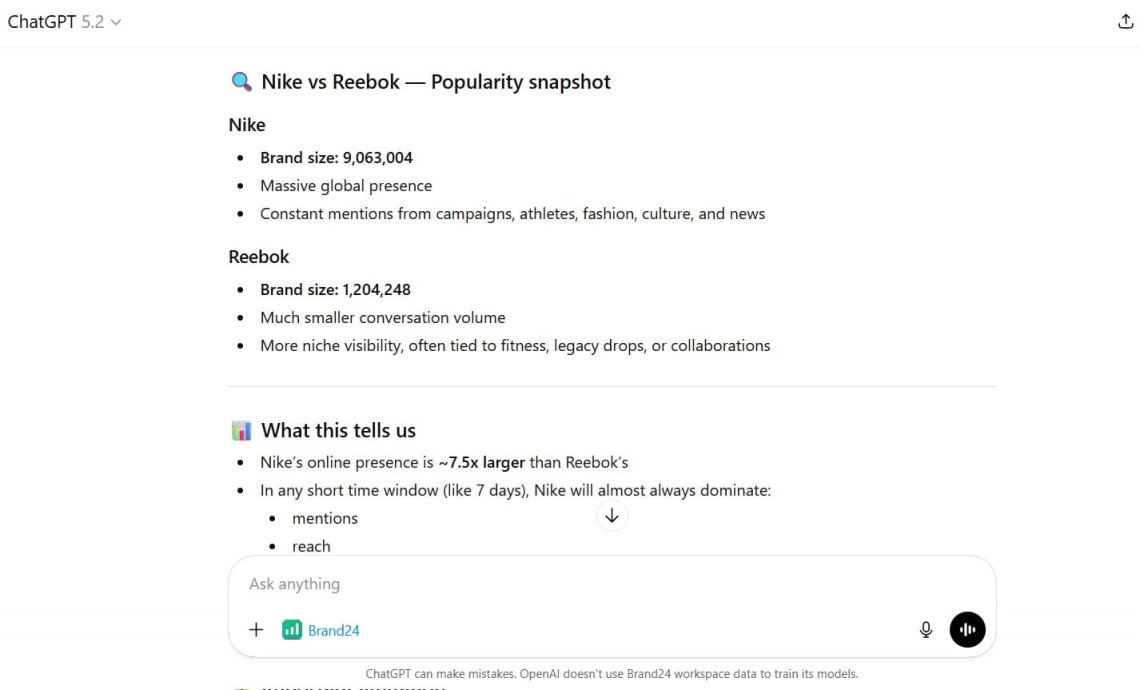
- Forrester’s June 2026 research shows 75% of enterprise leaders are already adopting agentic AI. Instead of logging into a social listening tool dashboard, you can ask your AI Assistant, “How have people discussed our new pricing in the last 7 days?” and get an evidence-based answer drawn from live social listening data.
- Michał Sadowski believes that in 2026, social listening evolves from passive analytics to interactive, LLM-accessible intelligence.
3. Brand websites are losing influence and AI Search is taking over
- Overall open web traffic is down 8% since 2023, according to McKinsey’s 2026 study. Consumers get answers directly inside AI results without clicking through to brand websites.
- Only 1% of sources cited by LLMs come from brand-owned websites, while the rest come from forums, reviews, and social media posts. If you don’t know what’s being said in those places, you can’t shape how AI represents your brand. Social mentions tracking is the only way to understand and influence those sources at scale.
4. Brand discovery is moving to social and AI, especially for Gen Z

- McKinsey’s State of the Consumer 2026 shows 60% of Gen Z use AI overviews for research, and 23% discover brands only through organic social channels.
- Gartner’s Future of Marketing 2026 backs up what we’re already seeing: traditional broadcast is getting less effective with Gen Z. If your social listening strategy still doesn’t include Reddit, TikTok, and AI-generated answers, you’re already way behind!
FAQ
Social listening is the practice of monitoring online conversations about your brand, competitors, and industry, and using the analysis to make informed business decisions. It covers context and sentiment across social media, news, forums, review sites, podcasts, and AI-generated content, not just direct @mentions.
Social monitoring collects individual mentions and generates alerts — it’s tactical and reactive.
Social listening analyzes patterns across those mentions to identify trends, understand sentiment, and inform strategy. Monitoring is a component of listening, not a substitute for it.
Because only 1% of sources cited by LLMs come from brand-owned websites, the rest come from forums, reviews, and social media posts (McKinsey, 2026). At the same time, half of all consumers now use AI-powered search to research brands (HubSpot, 2026).
You can start with social listening by using the Brand24 Social Intelligence Cycle framework: define your goals, set up monitoring, analyze mentions and sentiment, act on what you learn, optimize your setup, and report.
AI is changing social listening in a way that it supports sarcasm- and culture-aware sentiment analysis, topic clustering, anomaly detection, and plain-English summaries from complex data.
A key capability in 2026 is LLM Listening/AI visibility tracking: monitoring what chatbots say about your brand.
When someone asks ChatGPT, Perplexity, or Gemini about your brand or category, the answer is built almost entirely from third-party sources.
Social listening lets you monitor what those sources say, catch inaccuracies early, and ensure the narrative AI picks up is accurate and consistent.
The most important social listening metrics are:
- volume of mentions (is interest growing?),
- sentiment trend (is perception improving?),
- share of voice (how do you compare to competitors?),
- reach and impressions (how many people see these posts?).
Based on Brand24’s 2026 data: marketing and advertising agencies, PR and communications, tech and SaaS, retail and e-commerce, healthcare and pharma, and higher education see the highest engagement with the topic.
In practice, any organization with customers, competitors, or a public reputation has a strong use case.