Table of contents
2M Marketers

Brand monitoring shows what people say about your brand, how often, and in what tone (positive, neutral, or negative). This helps you understand public sentiment and trends in reputation.
Key takeaways
-
AI visibility is now part of brand monitoring
Brands with strong Quora and Reddit presence get cited up to 4x more often in ChatGPT answers, per SE Ranking research, making forums a 2026 monitoring priority.
-
Pricing can differ – from free to custom enterprise plans
Paid plans start around $99/month (BrandMentions) and $199/month (Brand24); Brandwatch and Meltwater require custom quotes for enterprise-scale coverage.
-
Look for AI + web monitoring integrations
Brand24 and Semrush's AI Visibility Toolkit track mentions and what AI say about your brand. Match the tool to your teams needs and choose one tool that combines both if possible.
-
Untagged mentions now carry SEO/AEO weight
Mentions that don't tag your brand handle still influence AI visibility and can be converted into backlinks, so favor tools that surface untagged mentions.
The best brand monitoring tools for 2026:
Let’s dive in!
| Tool | Coverage | Key Features | Pricing | G2 Rating | Best For |
|---|---|---|---|---|---|
|
1
|
25M+ sources: social media, blogs, news, forums, newsletters, podcasts, review sites, video, etc.
|
Real-time monitoring, AI sentiment analysis, AI Insights & Brand Assistant, instant alerts, analytics (SOV, reach, AVE, sentiment trends), influencer analysis, custom reports
|
Plans start at $199/month
|
⭐ 4.6/5
|
Teams needing real-time social listening + AI insights
|
|
Social media, blogs, news, forums, reviews, general web & video pages.
|
Web & social monitoring, real-time alerts, sentiment analysis, competitor tracking, influencer identification, trend & historical analytics
|
Plans start at $79/month
|
⭐ 4.9/5
|
SMBs on a budget who still need multi-channel coverage
|
|
|
100M+ sources across social media, news, blogs, forums, reviews; broad web monitoring.
|
Deep consumer intelligence, advanced sentiment (sarcasm detection), image & video logo recognition, influencer & audience insights, competitor benchmarking, alerts, customizable dashboards, social media management
|
Custom pricing
|
⭐ 4.4/5
|
Enterprise consumer intelligence (image recognition)
|
|
|
270k+ news sources, social platforms, blogs, forums, reviews, podcasts, TV & radio, print
|
Comprehensive monitoring (online + offline media), real-time alerts, sentiment, competitor analysis, AI insights, PR CRM (media lists + outreach), social publishing & engagement
|
Custom pricing
|
⭐ 4.1/5
|
PR teams needing offline + online media in one place
|
|
|
5
|
AI chatbots/LLMs: ChatGPT, Gemini, Claude, Perplexity, Grok, DeepSeek, Copilot, AI Overview
|
AI visibility tracking, brand score & average position in AI answers, competitor benchmarking, prompt suggestions
|
Plans start at $99/month
|
–
|
Teams with AI chatbot visibility tracking priority
|
|
ChatGPT, AI Overview, AI Mode, plus SEO datasets
|
AI visibility score, competitor benchmarking, prompt research & tracking, gap analysis, content opportunity insights
|
Plans start at $199/month
|
⭐ 4.5/5
|
SEO teams adding AI visibility to existing workflows
|
|
|
Google-indexed news, blogs, forums, general web (no social media)
|
Free email alerts, basic keyword tracking
|
Free
|
–
|
Freelancers or anyone needing free, basic keyword tracking
|


When gathering data, I focused on functionality, data accuracy and coverage, analytics and reporting quality, ease of use, and customer support.
To back that up, I tested most of these tools myself and cross-checked my impressions against real user reviews on G2 and Capterra.
Yes, I work at Brand24. I’ve tried to keep this comparison fair by leaning on the same criteria and public review data for every tool, including ours. If anything, working here means I know brand monitoring strengths and limits better than I could from the outside.
You can monitor your brand in various ways depending on your needs.
That’s why I categorized the tools. Hope you’ll find it helpful!
Specialized brand monitoring tools
Let’s start by examining software where monitoring is the primary feature. These tools focus on delivering high-value data, developing features, and increasing the number of monitored sources.
01 Brand24
4.6/5
G2 (345 reviews)
4.7/5
Capterra (254 reviews)
14 days / Free trial
From $199 / Month
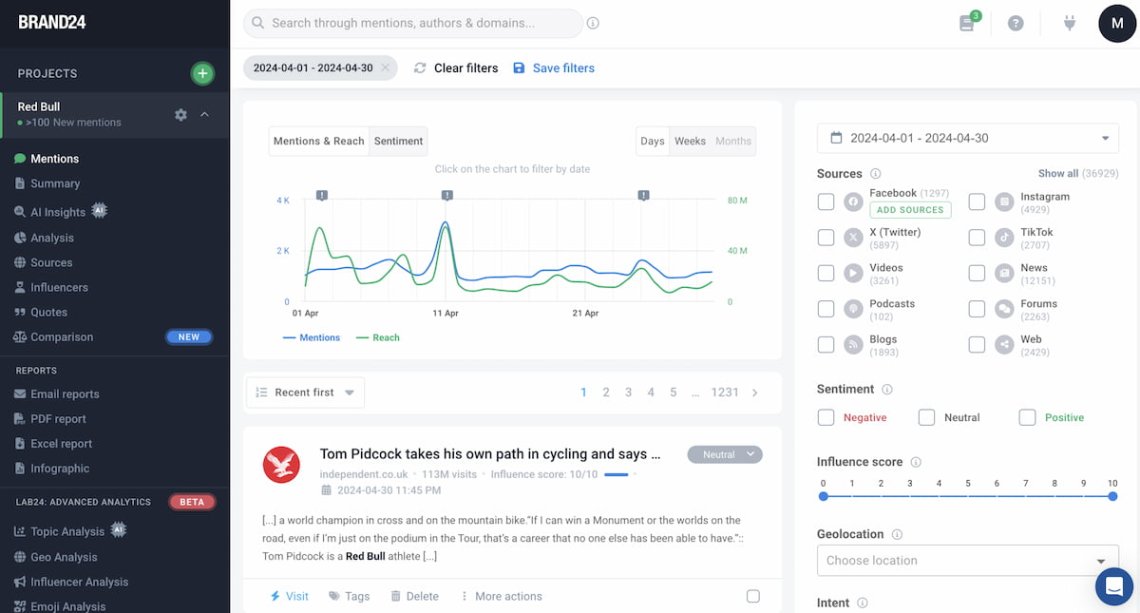
Brand24 is an AI-powered social listening and media monitoring tool that tracks and analyzes mentions (or any keywords) in real-time across the internet.
The tool tracks mentions of your brand name, products, hashtags, and competitors across over 25 million online sources, including:
- Social media channels: Facebook, Instagram, X (Twitter), YouTube, TikTok, Twitch, Reddit, LinkedIn, Medium, Quora, Telegram, Bluesky
- Review sites: TripAdvisor, Yelp, Booking, App Store, Google Play, Trustpilot
- Blogs
- Video platforms
- Podcasts
- Discussion forums
- Newsletters
- Online news sources
- All other publicly available mentions on the web
Key features:
- Real-time monitoring – Tracks mentions of your brand across social media, news sites, blogs, forums, and more, as they happen.
- AI-powered sentiment analysis – Automatically categorizes mentions as positive, negative, or neutral and tracks emotions.
- AI Features (Insights & Brand Assistant) – AI interprets brand data to surface trends, threats, and opportunities, and answers questions like “What’s hurting our reputation?”
- Customizable reports – Automatically generated PDF, Excel, or online reports tailored to your needs.
Why I picked it?
It’s the best option for real-time brand monitoring. I don’t need to dig in myself, but get an AI-based analysis of my brand. Plus, it’s great for quick check-ups on AI responses. Instead of manually prompting ChatGPT or Perplexity myself, I can see in one place how my brand is being described and cited across AI answers, right alongside my regular mention data.
In summary, you can use Brand24 to:
- Monitor brand mentions and reputation in real time.
- Detect PR crises or negative feedback early and respond fast.
- Track and get AI analysis of key monitoring metrics
- Track and compare competitors or industry mentions.
02 Brandmentions
4.9/5
G2 (240 reviews)
5/5
Capterra (60 reviews)
7 days / Free trial
From $99 / Month
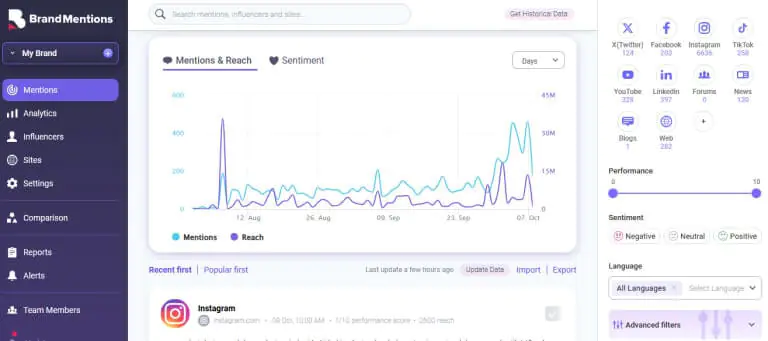
Brandmentions is an affordable social listening tool for small and medium-sized companies.
The tool monitors:
- Social platforms: X (Twitter), Facebook, Instagram, TikTok, LinkedIn, YouTube, Pinterest, Reddit, Bluesky
- News sites
- Blogs
- Forums
- Review sites
- General web
- Video pages
Key features:
- Web & social monitoring – Tracks mentions across social media, news, blogs, forums, reviews, and the wider web.
- Real-time alerts – Notify you instantly when your brand or keywords are mentioned.
- Sentiment analysis – Identifies positive, negative, and neutral mentions (with emotion-level detail).
- Competitor tracking – Monitors competitors and industry keywords.
- Reporting – Customizable reports, filters, and analytics.
- Trend & historical analysis – Tracks how mentions and sentiment change over time.
- Influencer identification – Identifies key voices discussing your brand.
Why I picked it?
I did it specifically because it delivers solid social + web coverage at a fraction of the cost of the enterprise tools on this list.
In summary, you can use Brandmentions to:
- Get alerts so you can respond quickly to praise, complaints, or crises.
- Track mentions of your brand, products, or competitors.
- Monitor reputation, public sentiment, and customer feedback.
- Detect trends and changes in conversation over time.
- Compare yourself with competitors.
- Find influencers or key voices talking about your brand.
All-in-one comprehensive solutions
These tools combine monitoring, engagement, publishing, and analytics in one platform. Using them can save you time. On the other hand, they are more expensive, and monitoring can be an extra paid add-on.
03 Brandwatch
4.2/5
G2 (1,709 reviews)
4.2/5
Capterra (255 reviews)
Upon request / Free demo
Upon request / Pricing
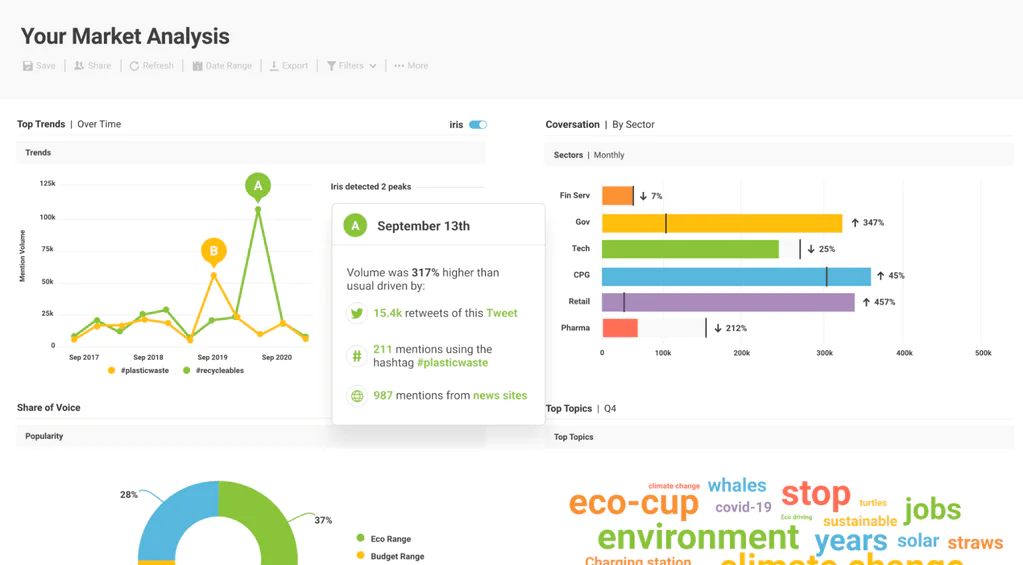
Brandwatch is a leading digital consumer intelligence and social media management platform with a monitoring feature.
It is, however, one of the most expensive brand reputation monitoring tools on the market.
The tool monitors:
- Major social networks: X (Twitter), Facebook, Instagram, LinkedIn, TikTok, YouTube, Reddit, Bluesky
- Blogs
- News sites
- Forums and communities
- Review sites and public review platforms
Key features:
- Extensive source coverage – Monitors over 100 million sources, including major social media platforms, news sites, blogs, and review sites.
- Sentiment analysis– Uses AI to determine the tone (positive, negative, neutral) of mentions and detect sarcasm or specific product feedback.
- Real-time alerts – Provides instant notifications for sudden changes in conversation volume or sentiment, aiding swift reputation management.
- Audience and influencer analysis – Identifies key audience demographics and top industry influencers.
- Competitor benchmarking – Allows tracking and comparison of brand performance against competitors.
- Image and video recognition – Identifies logos within images and videos for visual brand exposure tracking.
- Customizable reporting – Offers detailed, shareable reports and interactive dashboards.
Why I picked it?
The sarcasm-aware sentiment analysis genuinely impressed me, though I’d only recommend it if your budget matches its “custom pricing.”
In summary, you can use Brandwatch to:
- Create custom reports for PR, marketing, and leadership teams
- Monitor your brand across social media, news, blogs, forums, and the wider web.
- Analyze sentiment and emotions behind conversations.
- Detect crises early through real-time alerts and mention spikes.
- Identify trends, topics, and emerging issues in your industry.
- Discover influencers and key voices driving conversations.
- Understand your audience through demographic and behavioral insights.
- Manage and publish social media content (with its social management suite)
Check: Brandwatch Alternatives
04 Meltwater
4.1/5
G2 (3,128 reviews)
4.0/5
Capterra (96 reviews)
Upon request / Free demo
Upon request / Pricing
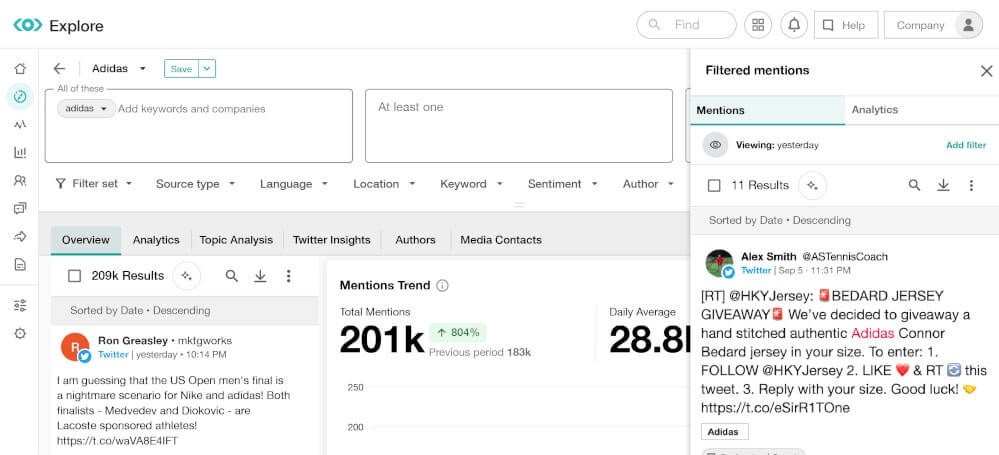
Meltwater is a global media intelligence software with social listening and social media management features.
The tool monitors:
- Social media: Facebook, Instagram, X (Twitter), YouTube, Reddit, LinkedIn, Twitch, Pinterest
- Online news
- Blogs
- Forums & communities
- Review sites
- Podcasts
- TV & radio
- Print media (newspapers, magazines)
Key features:
- Comprehensive coverage – Tracks brand mentions across 270,000+ news sources, all major social platforms, blogs, forums, review sites, podcasts, and print/broadcast media.
- Real-Time alerts – Instant notifications for important mentions or emerging issues.
- Sentiment analysis – AI identifies positive, negative, or neutral conversations to show how public perception evolves.
- Competitor analysis – Monitors competitor mentions to help benchmark performance and spot trends.
- AI-powered insights – Surfaces key themes, influencers, and emerging topics from large data sets.
- Reputation management – Centralizes reviews and mentions to help protect and manage brand image.
- Social media management – Supports publishing, scheduling, engagement, and performance tracking across major social channels.
Why I picked it?
I’ve worked with Meltwater when a client needed offline media coverage (TV, radio, print) alongside social… that’s the main reason I’d pick it over a social-only tool.
You can use Meltwater to:
- Analyze PR, marketing, and brand performance.
- Uncover consumer needs, identify trends, and inform product development.
- Monitor competitor coverage, campaigns, and launches
- Access PR databases, build media lists, send press releases, and manage outreach.
- Plan, schedule, and publish across multiple social platforms.
- Analyze PR, marketing, and brand performance.
Check: Meltwater Alternatives
Brand monitoring tools for AI visibility
The appearance of ChatGPT revolutionized the way users search for brands. That’s why we should also monitor AI brand visibility right now. Let’s check the tools that work great for that.
05 Chatbeat
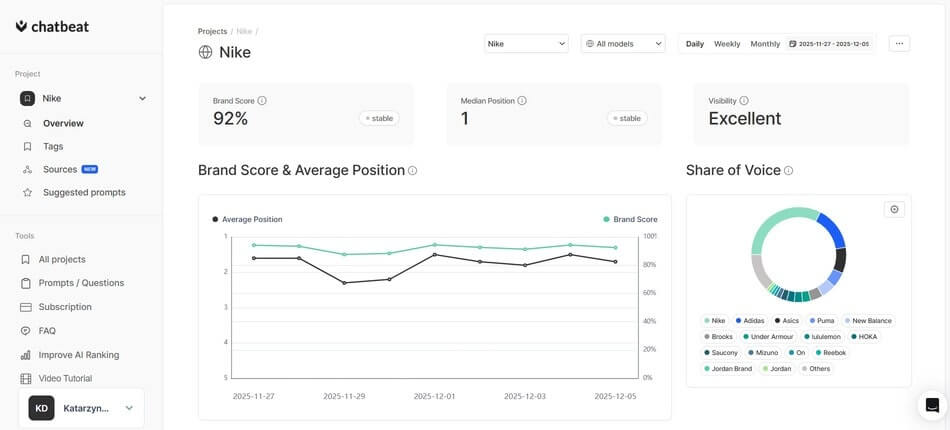
Chatbeat is a brand monitoring tool that shows how your brand (or product, company, etc.) appears in answers generated by AI chatbots and large-language models (LLMs).
The tool monitors:
- ChatGPT, Gemini, Claude, Perplexity, DeepSeek, Grok, Copilot, and Google AI Overview.
Key features:
- AI visibility tracking – Monitors major AI models to see if, how often, and in what context a brand appears in their generated responses to user prompts (questions).
- Brand score and average position – The tool provides metrics to indicate visibility and average ranking within AI answers, allowing companies to measure their exposure.
- Prompt suggestions – Identify valuable prompts where your brand should be visible, but isn’t.
- Competitive analysis – Track how competitors are mentioned by AI chatbots, providing insights into their share of voice in the generative AI space.
Why I picked it?
I started testing Chatbeat as soon as AI visibility became a real concern for clients, and I recommend it if your main question is simply “does my brand show up when someone asks ChatGPT about it.”
You can use Chatbeat to:
- See exactly how often your brand, products, or key industry topics appear in AI-generated answers.
- Track brand score, average position, share of voice, and brand rankings.
- Monitor whether AI is accurately mentioning new features and products.
- Find key sources that deliver visibility.
06 Semrush
4.5/5
G2 (3,383 reviews)
4.6/5
Capterra (2,317 reviews)
7 days/strong> Free trial
From $149 Monthly
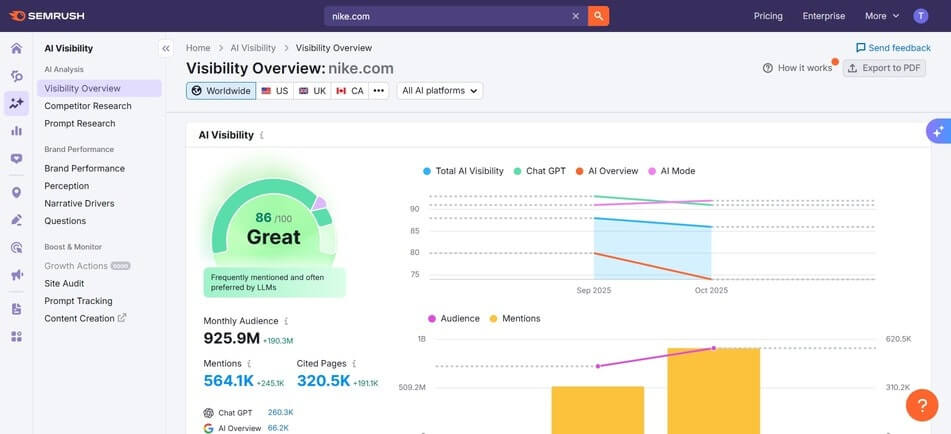
Semrush is a powerful SEO tool that offers the AI Visibility Toolkit, which helps you understand how your brand, company, and products perform in AI searches.
The tool monitors:
- ChatGPT, AI Overview, AI Mode, and other AI platforms.
Key features:
- AI visibility score and benchmark – Measures how often your brand appears in AI-generated answers and compares it to competitors.
- Competitor benchmarking – Shows how your AI visibility, mentions, and citations stack up against rivals.
- Prompt research – Finds user prompts, trending topics, and AI-driven questions to guide content strategy.
- Prompt tracking – Monitors your brand’s visibility for selected prompts over time to measure performance.
- Gap analysis – Identifies prompts or topics where competitors are mentioned but you aren’t, revealing content opportunities.
Why I picked it?
I already use Semrush for SEO, so testing its AI Visibility Toolkit felt natural – I picked it because it ties AI visibility directly to the keyword and content data I’m already tracking.
You can use Semrush to:
- Monitor the overall SEO and AI performance as well as brand health.
- Discover new prompts and topics that users ask AI.
- Report your brand visibility and performance.
- Manage your social media effectively.
Discover how to monitor and enhance your brand mentions in ChatGPT in this comprehensive guide.
Free and basic option
Free tools offer very basic monitoring with limited functionalities. For broader, more accurate coverage and analysis, you need to use paid tools.
07 Google alerts
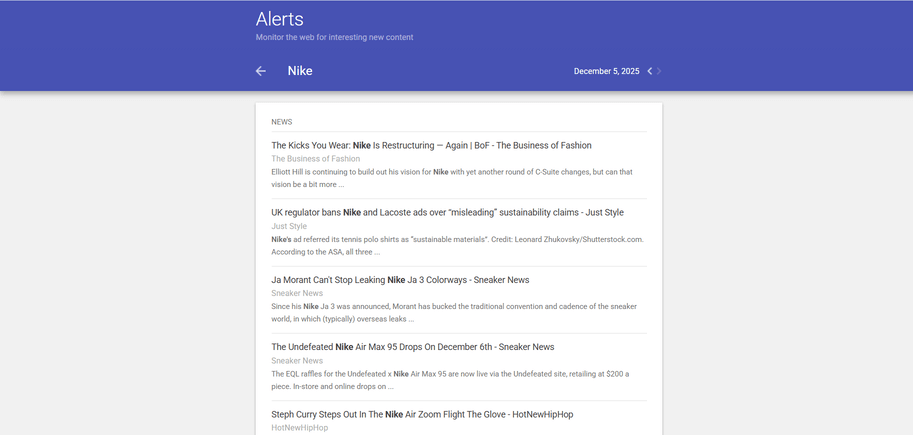
Google Alerts is a completely free tool that sends email notifications with no advanced analytics. Useful for basic monitoring.
The tool monitors:
- News websites,
- Blogs
- Forums and discussion boards
- General web pages indexed by Google
- Important: It does not monitor most social media platforms
Why I picked it?
To be honest, it’s a free option to test if monitoring is useful for your brand, but it doesn’t offer anything spectacular. Even for basic finding mentions, it can lag or miss some.
Key features of Google Alerts:
- Basic online monitoring
- Email notifications for new results on chosen keywords
- Simple filters by region, language, and sources
What is brand monitoring?
In short: Brand monitoring is the process of tracking and analyzing all public mentions of your brand across the internet.
The core purpose: The primary purpose of brand monitoring is to understand, manage, and influence brand perception and reputation across various channels in real-time.
What is AI-powered brand monitoring?
AI brand monitoring refers to the use of artificial intelligence (AI) to track, analyze, and understand online conversations about a brand in real time.
Instead of manually checking social media, reviews, and news, AI systems automatically gather and interpret vast amounts of online data, providing brands with clear and valuable insights.
AI is essential for brand monitoring in 2026 because it’s the only way to keep up with the scale, speed, and complexity of online conversations.
In short, AI:
- Processes massive volumes of mentions in real time
- Understands context, not just keywords
- Detects sentiment shifts and crises early
- Turns raw data into actionable insights
- Helps brands react faster and stay competitive
What are the key elements of online brand monitoring?
In 2026, a solid brand monitoring tool should offer:
- Competitor analysis – monitoring conversations about competitors to benchmark performance and identify market gaps.
- Mentions tracking – detecting whenever your brand is mentioned online (tagged or untagged).
- Broad platform coverage – including news websites, blogs, forums (Reddit, Quora, Medium), social media (Facebook, X (Twitter), LinkedIn, Instagram, TikTok, Telegram, Bluesky), review sites (TripAdvisor, Booking, Yelp, App Store, Google Play, Trustpilot), podcasts and video platforms (YouTube, Twitch, Spotify, Soundcloud), and newsletters.
- LLM monitoring – tracking mentions across ChatGPT, AI Overviews, AI Mode, Perplexity.
- Brand sentiment analysis – assessing whether those mentions are positive, neutral, or negative.
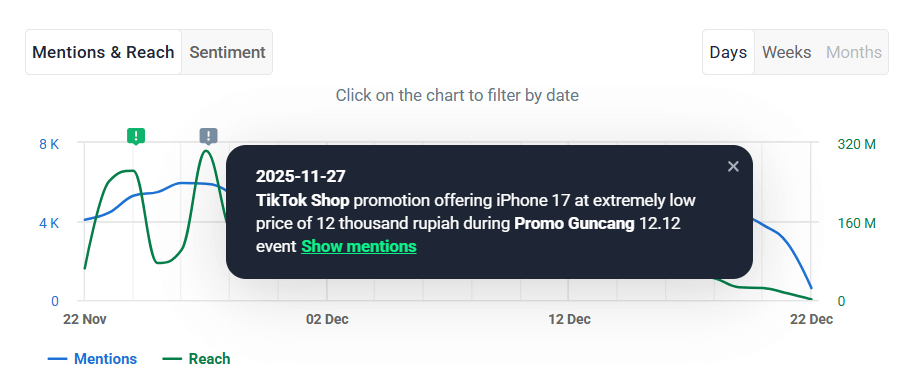
- Reach & engagement – measuring how many people saw or interacted with the mention.
- Influencer identification – spotting who is talking about your brand and how influential they are.
- Crisis prevention – getting alerted to negative buzz early to respond quickly.
- Insight generation – analyzing feedback to understand customer pain points.
Why is brand monitoring important?
Monitoring online mentions is a key part of managing a brand. It helps you measure PR and sales KPIs, understand customer sentiment, track competitors, and discover trends.
Brand and social media monitoring support you in:
- Boosting sales through influencer collaborations
- Measuring hashtag campaign performance
- Tracking competitors and industry activity
- Improving customer experience by catching negative comments early
- Analyzing sentiment around products or campaigns
- Learning more about your audience
- Conducting brand analysis and market research
Manually searching for mentions across blogs, forums, and social media is a time-consuming and unreliable process.
Brand monitoring tools simplify this process by collecting mentions and providing powerful analytics, allowing you to stay on top of conversations and trends.
Research by SE Ranking shows that brands receiving mentions on Quora and Reddit significantly increase their chances of being cited in ChatGPT.
In fact:
- Minimal Quora presence (up to 33 mentions) results in 1.7 citations.
- Minimal Reddit presence (up to 131 mentions) results in 1.8 citations.
- Brands with millions of mentions on Quora and Reddit have about 4 times higher chances of being cited than those with little activity.
How to track media mentions for a brand?
Effective media mention tracking combines accurate keywords, the right tools, real-time alerts, and ongoing analysis, not just counting mentions.
Take a look at the step-by-step guide:
Step 1: Define your goals
Before diving in, ask:
- Are you tracking a campaign, a product launch, or general brand awareness?
- Are you focusing on reputation, competitor insights, or crisis alerts?
Your goal will determine the metrics and sources you’ll prioritize.
Step 2: Choose the right keywords
Create a list of keywords to monitor. These may include:
- Brand name (with variations & misspellings)
- Product names
- Campaign hashtags
- Competitor names or brands
- CEO or spokesperson names
- Industry-related terms
- Domain or app name
Tip: Add language variants if you operate across countries.
Step 3: Choose your monitoring method
While selecting a brand monitoring tool, look for:
- Comprehensive multi-channel coverage: Tracks brand mentions across social media, news sites, blogs, forums, reviews, podcasts, video platforms, and emerging channels.
- Real-time monitoring & alerts: Delivers instant notifications for spikes, risks, or sentiment changes through customizable alerts.
- Advanced AI-powered sentiment analysis: Understands context and sarcasm while showing sentiment trends over time.
- AI-driven topic, trend & intent detection: Automatically cluster mentions into topics, find user intent, and emerging issues or potential crises.
- Advanced analytics: Provides clear insights with trend analysis, share of voice, competitive comparisons, and exportable reports.
- Competitive & influencer intelligence: Benchmarks competitors and identifies influencers and brand advocates based on reach and engagement.
- Global, multilingual search: supports advanced keyword and Boolean search, multiple languages, regional insights, and noise reduction.
Step 4: Analyze the mentions
Track the following key metrics:
- Volume of mentions (daily/weekly trends)
- Reach (how many people saw the mentions)
- Sentiment (positive, neutral, negative)
- Top sources (e.g., TikTok, Twitter, blogs)
- Influencer mentions (see who’s driving the conversation)
- Trending hashtags/topics around your brand
- Share of voice (your visibility vs competitors’ visibility)
Check more: Brand metrics you should track
Step 5: Apply Insights
Turn data into decisions:
- Double down on high-performing channels or topics.
- Respond to negative sentiment fast.
- Engage with influencers already talking about your brand.
- Use feedback to prioritize features and improvements.
- Adjust strategy based on competitor strengths and weaknesses.
BONUS: Tips for better tracking
Check some tips that will make your brand monitoring process more effective:
- Track untagged mentions (not just @username): In 2026, untagged mentions impact the AI visibility, and you can turn such mentions into backlinks.
- Track misspellings, variants, and slang: People may mispronounce your brand name, but they still talk about it, and you need to be aware of that.
- Set up projects for competitors: Spot gaps or opportunities and learn from their mistakes.
- Set up alerts & automation: Get Storm Alerts, weekly reports, or Slack updates to be up to date.
- Monitor beyond social media: Track news, blogs, forums, reviews, communities, podcasts, and video platforms where deeper conversations happen.
- Identify and engage key influencers: Focus on authors with high reach or credibility rather than only high mention volume.
- Review and refine regularly: Update keywords, alert thresholds, and reports as your brand, products, or market evolve.
How to monitor your brand in AI search results?
Monitoring brand mentions in AI search engines requires a different approach than traditional SEO tracking.
There’s no ranking position to measure, and AI responses are dynamic.
For marketing managers at B2B and e-commerce companies, the goal is threefold: track whether your brand appears in AI-generated answers, how often it’s cited relative to competitors, and what context it’s mentioned in.
The next level is identifying which sites feed LLMs so your brand appears in AI search results.
How to do it?
- Start by defining your monitoring prompts.
Choose 10-15 queries that represent your core customer journeys. The questions your audience actually asks ChatGPT, Perplexity, or Claude.
Include both (“best [your category] tools”) and problem-focused queries (“how to [solve X problem]”). - Next, establish a tracking system.
Use a simple spreadsheet or tools like Brand24 or Chatbeat to automate monitoring across AI tools, then conduct monthly reviews to identify trends and refine your content strategy for AI discoverability.
Brand monitoring real-life examples
01 Tracking media coverage & PR impact: HypeAuditor
HypeAuditor, an all-in-one influencer marketing and analytics platform, uses media monitoring tool to track media coverage, measure the impact of its PR, and stay ahead of competitors.
Results:
- HypeAuditor filters mentions by influence, source popularity, language, and region to see where and how the brand is being covered worldwide.
- The team uses metrics like Advertising Value Equivalency to report the estimated media value their PR efforts generate.
- By spotting journalists and outlets that cover competitors, HypeAuditor can reach out with relevant stories or data of its own to grow media relationships.
- The tool even reveals competitor mentions in podcasts or influencer content, opportunities to pitch HypeAuditor’s executives for interviews or commentary.

02 Lead generation, 40% more deals: Fello
Fello, a marketing agency focusing on deep-tech clients, uses a monitoring tool for searching potential clients.
Results:
- Rather than cold outreach, Fello tracks conversations and keywords across the tech/innovation space to spot potential dream clients.
- Fello monitors market problems and trends. Alerts notify the team when discussions arise around specific issues or companies.
- Monitoring insights help Fello craft presentations for clients that feel highly informed and relevant, not generic.

Conclusion
Nowadays, online conversations move faster and spread wider than ever before.
Keep in mind:
- In 2026, brand monitoring will be crucial for any brand that wants to remain trusted and competitive in a rapidly evolving landscape.
- AI-powered brand monitoring helps handle the scale and complexity of data, understand context and sentiment, and turn data into insights.
- When choosing a brand monitoring tool, look for wide source coverage, real-time alerts, and AI insights, not just raw data.
- The right brand monitoring solution helps brands move from reacting late to acting early and strategically.
FAQ
- Brand monitoring tracks all public mentions of your brand across the web – news, blogs, forums, reviews, and social media.
- Social listening analyzes the sentiment and trends within social conversations specifically.
- Social media monitoring covers only social platforms, with no deeper analysis.
- Brand tracking is the broadest, measuring awareness and perception over time, often via surveys.
Cover social media, search results, news and blogs, review sites, forums like Reddit and Quora, podcasts and video, newsletters, and AI platforms like ChatGPT and Gemini. Start with the channels your audience already uses, then expand.
The core metrics are:
- mention volume,
- sentiment score,
- share of voice,
- reach,
- Advertising Value Equivalency (AVE),
- Presence Score,
- engagement rate,
- influencer reach
Track them together cause volume without sentiment, or reach without engagement, gives an incomplete picture.
Compare tools on source coverage, real-time alerting, AI sentiment accuracy, integrations, pricing, ease of use, and reporting. Check verified G2 and Capterra reviews rather than vendor claims, and weight the criteria toward your main goal like PR, competitive intelligence, or AI visibility.


