Table of contents
2M Marketers

Brand tracking provides a consistent measurement of your brand’s perception in the market over time. It shows whether your brand is getting stronger or weaker over time and why.
Key takeaways
-
What is brand tracking?
Brand tracking is an ongoing process that evaluates your brand's performance, awareness, and perception over time. It helps determine whether your brand is strengthening, where mentions are coming from, and how you stack up against competitors.
-
Importance of AI brand visibility tracking
AI brand visibility tracking measures: whether your brand is mentioned in AI-generated answers, and how often AI tools recommend your brand.
-
Why does it matter?
Brand tracking helps you understand: brand visibility and awareness in your market, brand perception, sentiment, usage, loyalty, advocacy, and competitive positioning.
What is brand tracking?
Brand tracking is the continuous process of monitoring your brand’s presence and perception in the marketplace. It provides insights into brand awareness, sentiment, reputation, and customer loyalty, helping you measure the impact of your marketing efforts and make data-driven decisions.
It provides you with valuable insights such as:
- 1 Is the brand getting stronger?
- 2 Which source delivers the most mentions?
- 3 Is awareness increasing or decreasing?
- 4 What's the sentiment around your brand?
- 5 What's your social media and non-social reach?
- 6 How does your brand compare to competitors?
- 7 Who is talking about your brand?
- 8 What are the trending topics your audience is talking about?
Brand tracking typically involves collecting and analyzing data from various sources, such as media monitoring, surveys, social media, sales figures, and customer feedback.
The analysis will indicate what aspects of your brand’s online presence you should improve.
To get actionable insights, you need to track your brand over a long period.
Only that way can you identify the important changes in your target audiences and distinguish them from seasonal fluctuations.
Your brand success depends on the ongoing research you conduct.
How to track your brand? 4 Steps
01 Set core brand KPIs
Clearly state what you want to achieve with brand tracking. It could be improving customer satisfaction, increasing brand awareness, or assessing the ROI of a marketing campaign.
- Awareness – how visible your brand is
- Perception – what people think and feel about it
- Consideration & intent – why people are likely to choose it
- Usage & loyalty – satisfaction, repeat purchase & advocacy
- Competitive positioning – how you compare to competitors
- Brand equity – perceived value and willingness to pay more
Choose metrics that align with your objectives, such as Net Promoter Score (NPS) for customer satisfaction, website traffic for brand awareness, or conversion rate for marketing ROI.
Check: How to Conduct a Brand Analysis? Track Key Metrics
02 Utilize brand tracking methods
Tracking a brand involves using various methods and tools to collect and analyze data from different sources.
Here are some common methods and tools you can use:
Brand tracking surveys
Brand tracking surveys are a type of market research tool you can use to monitor and assess the performance and perception of a brand over time.
These surveys provide valuable insights into how a brand:
- 1 Evolves over time
- 2 Is recognized in the market
- 3 Compares to competitors
- 4 Builds loyalty and advocacy
- 5 Responds to marketing efforts
Depending on the scale and method, surveys can be expensive and time-consuming. Furthermore, if the survey is not well designed, it can deliver skewed results.
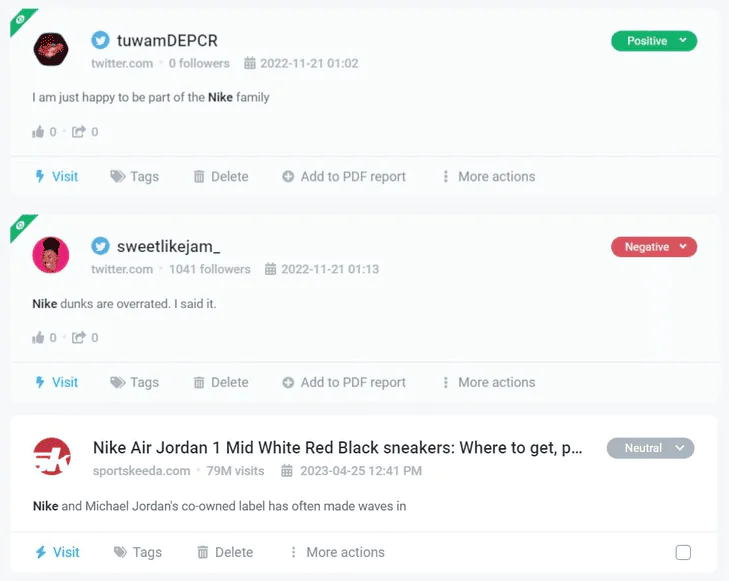
Media monitoring
Media monitoring plays a key role in brand tracking by helping you keep tabs on your brand’s image, reputation, and performance in the public domain.
It involves scanning various channels such as news, forums, blogs, podcasts, newsletters, reviews, and social media platforms for mentions and discussions about your brand, products, or services.
With a media monitoring tool like Brand24, you will be able to:
- 1 Build strong brand awareness
- 2 Track AI brand visibility
- 3 Check the brand sentiment
- 4 Conduct competitor analysis
- 5 Measure brand health
- 6 Manage crises
- 7 Manage online reputation
- 8 Discover consumer insights
- 9 Monitor influencers
- 10 Track hashtags and campaigns
Online analytics
Using advanced tools can provide valuable insights by offering a comprehensive view of how users interact with your website and online content.
Online analytics can help you measure:
- 1 Website traffic and engagement
- 2 Audience demographics and interests
- 3 Source of traffic
- 4 Conversion rates
- 5 Campaign and content performance
- 6 Site speed
Brand monitoring tools like Google Analytics provide measurable metrics that can be utilized to evaluate different aspects of brand performance. These metrics include website traffic, engagement, conversion rates, and more.
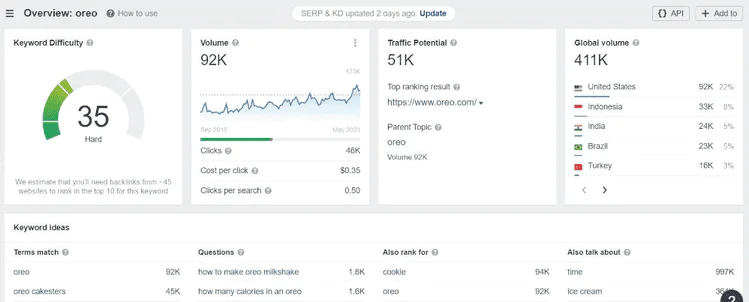
You can also use SEO tools like Ahrefs of Semrush to discover organic and paid keywords, backlinks profile, domain rating, search volume, and other key metrics of your brand.
Reviews and ratings analysis
If your brand is present on review websites like Booking, Trustpilot, Capterra, etc., you should pay attention to opinions left there.
Reviews and ratings analysis can be a powerful tool, providing direct consumer insights into how customers perceive and experience your brand’s products, services, and overall customer experience.
Currently, they are gaining importance because they serve as a source for ChatGPT and other LLMs. Which means, gaining mentions on influential review sites impacts the AI brand visibility.
By analyzing reviews and ratings, you will learn more about the:
- 1 Customer satisfaction
- 2 Product and service quality
- 3 Brand image and reputation
- 4 Customer experience
Sales data analysis
Your sales data provides direct insight into your brand’s market performance.
Understanding which products or services generate the most revenue can help you focus your brand’s direction.
Sales data analysis can help you measure:
- 1 Revenue and growth
- 2 Market share and positioning
- 3 Customer behavior
- 4 Seasonal and temporal trends
- 5 Sales channels performance
- 6 Return on investment (ROI)
03 Collect and analyze data
For best results, I recommend you use all 4 methods I listed above.
Using all these sources gives you a more complete understanding of your brand, from public perception to user behavior to financial performance.
For example, a drop in sales can correlate with negative media mentions or a spike in website bounce rate.
While analyzing data is important to pay attention to those key brand tracking metrics:
| Metric | What It Measures |
|---|---|
| Awareness (Visibility) | How well-known your brand is |
| Perception (Brand Image) | What your brand stands for |
| Consideration & Demand | Likelihood of purchase |
| Loyalty & Advocacy | Strength of customer relationship |
| Competitive Strength | Performance vs competitors |
Brand tracking example
For the purpose of this article, I will show you how to track a brand using a media monitoring tool.
Collecting and analyzing data from media monitoring tools can significantly impact brand tracking. They provide real-time insights into public perception, competitive landscape, and brand growth.
Let’s check which brand tracking metrics it can present you.
First of all, you can track the volume of mentions and sources that deliver them.
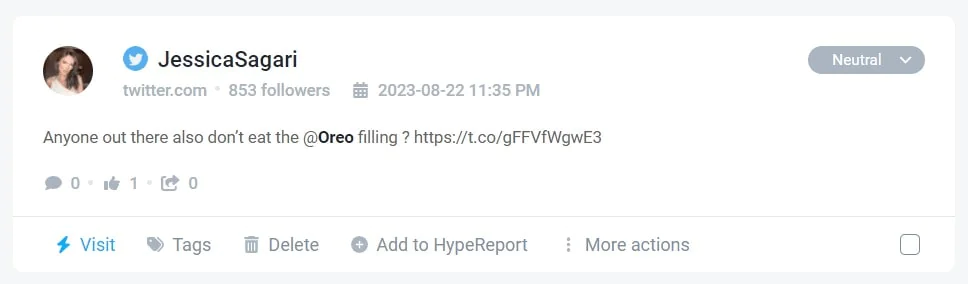
Thanks to mentions and reach chart, you can track brand growth over time.
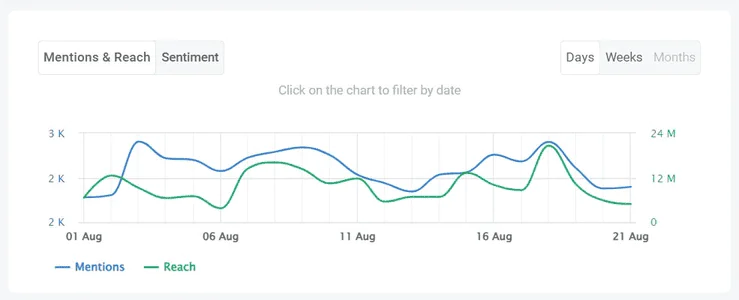
Media monitoring tools often include sentiment analysis, which gauges the overall tone (positive, negative, or neutral) of mentions of your brand across various channels like social media, news, blogs, forums, etc.
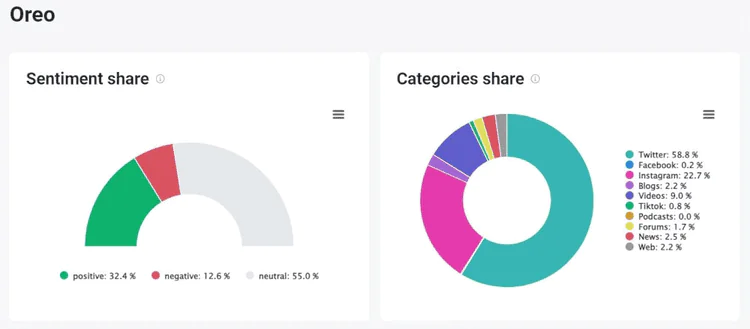
Thanks to the sentiment chart, you can track any spikes in positive and negative mentions.
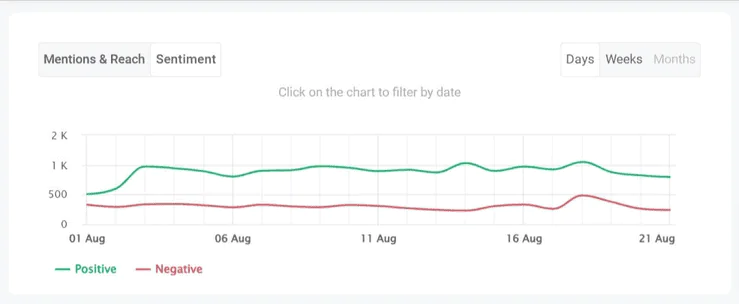
Knowing who is talking positively about your brand can help you identify potential brand advocates for future collaborations.
By identifying and analyzing negative comments, you can take immediate action to mitigate issues and improve your brand’s reputation.
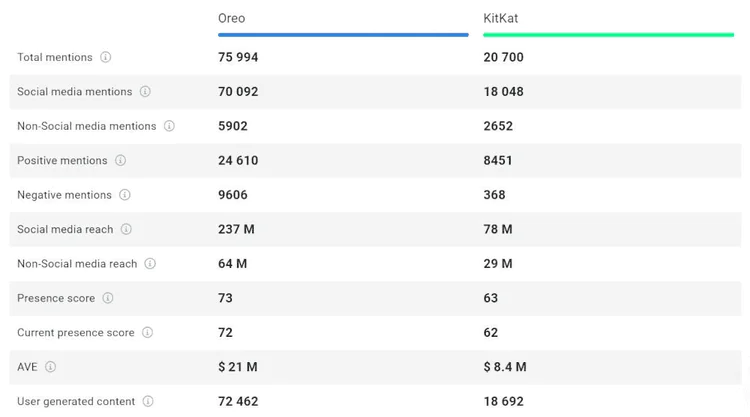
Media monitoring tools allow you to track mentions and brand sentiment regarding your competitors, providing a valuable context for your own brand performance.
Here you can see the comparison of Oreo and KitKat:
Users often share their experiences and opinions about products and services on social media.
Social listening allows you to collect unsolicited feedback, which can be more candid than responses in formal brand tracking surveys.
Tools like Brand24 can provide a range of key brand tracking metrics, such as share of voice, AVE, social media reach, non-social reach, interactions, and AI mentions from LLMs like ChatGPT, Gemini, or Preplexity.
All those key metrics and features will help you better understand your brand perception.
04 Monitor continuously
Combining data from different sources helps in generating actionable insights.
Knowing what the public is saying about your brand (media monitoring), how they interact with you online (analytics), how they feel (surveys), and how these factors influence buying decisions (sales data) allows for a nuanced, data-driven brand strategy.
Continuous brand tracking is essential in today’s fast-paced and competitive market for several key reasons:
- 1 Consumer behavior, market trends, and competitive landscapes change rapidly. Brand tracking helps a brand stay aligned with these changes.
- 2 You can manage their reputation more effectively by monitoring sentiments and conversations around the brand
- 3 It helps to measure progress toward long-term objectives and strategic goals
- 4 Ongoing customer feedback helps in the improvement of products and services
- 5 Regular monitoring of sales data helps in accurate forecasting, pricing strategies, and inventory management
Case study
eRecruiter is an applicant tracking system that helps teams manage the recruitment process.
The problem: They lacked a complete view of online conversations about their brand. Their monitoring was fragmented across multiple tools, required manual work, and still missed important discussions.
- Monitors their brand, competitors, and industry keywords
- Tracks trends and recurring themes in conversations
- Identify what topics gain traction
- Finds and engages in niche discussions beyond their main channels
- Adjusts messaging based on real audience sentiment
How they benefit:
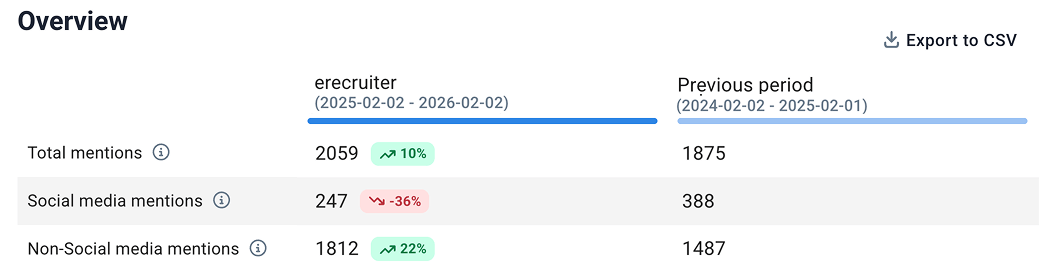
- 1 +10% year-over-year increase in mentions
- 2 Better positioning around AI and CSR topics
- 3 Brand visibility became a measurable growth KPI
Is brand tracking worth the effort?
Many industry experts will answer this question shortly — yes, it is!
Tracking the data about your company, products, or services will answer many key questions and help you position your brand as an industry expert.
Key Advantages of Brand Tracking:
- Real-time insights benefit multiple departments: Brand tracking supports marketing, customer service, sales, and strategic decision-making across the organization.
- Improves branding strategy: Helps refine positioning and align messaging with audience expectations.
- Increases customer loyalty & lifetime value: Enables better understanding of customer needs and behaviors.
- Enhances customer service: Supports implementation of more tailored and responsive solutions.
- Optimizes marketing efforts: Allows you to track and evaluate campaign performance effectively.
- Drives sustainable growth: Brands that consistently track performance can better meet consumer needs and scale successfully.
The disadvantages of brand tracking
There are, however, some drawbacks when it comes to tracking your brand.
- Data quality challenges: The internet generates massive amounts of content (articles, photos, social media posts, mentions), and much of it may be irrelevant or unhelpful for brand reputation or awareness analysis.
Solution: Use brand tracker with noise reduction filters that automatically remove irrelevant mentions and improve data accuracy (note: not all tools offer this feature).
- Time-consuming manual tracking: Manually monitoring and analyzing brand mentions across numerous online sources requires significant time and effort due to the constant flow of new content.
Solution: Leverage AI-powered analytics that can process large volumes of data and automatically present actionable insights, significantly reducing analysis time.