Table of contents
2M Marketers

Ever since Meta shut down Facebook Analytics in 2021, finding the right replacement has meant piecing together native tools and third-party platforms. I spent the last four weeks comparing the most popular options to see what each one does best, what it helps you measure, and who it’s a good fit for.
Here are the results. Let’s dive in.
Best Facebook analytics tools: shortlist
Before we dig in deeper, here’s the cheat sheet: the 10 Facebook analytics tools I trialed and reviewed, with the best use case for each.
- Brand24: best for sentiment analysis and catching both tagged and untagged Facebook mentions of your page.
- Meta Business Suite & Facebook Page Insights: best for first-party page analytics with audience data straight from Meta.
- Facelift Data Studio: best for building highly customized analytics dashboards around large sets of social media metrics.
- Keyhole: best for tracking hashtags and campaign conversations alongside Facebook performance.
- Google Analytics: best for measuring how Facebook traffic contributes to conversions.
- Sprout Social: best for combining Facebook analytics with publishing, engagement, and team workflows.
- Fanpage Karma: best for turning competitor data into ideas for better-performing Facebook content.
- Sotrender: best for analyzing organic and paid Facebook results side by side.
- Socialinsider: best for detailed video and Reels analysis with strong performance reporting.
The top 10 Facebook analytics tools
| Tool | Who it’s best for | Top features | Pricing |
|---|---|---|---|
|
1
|
Small businesses, mid-market teams, and agencies
|
Mention monitoring, sentiment analysis, share of voice & competitive analysis
|
From $199/month
|
|
Solo creators and small businesses
|
Page analytics, post engagement metrics, demographics insights
|
Free
|
|
|
Agencies, mid-market, and enterprise teams
|
Customizable dashboards, competitive benchmarking, 500+ social media metrics
|
Custom
|
|
|
4
|
Small businesses, marketing teams, and agencies
|
Hashtag tracking, real-time social analytics, competitor tracking
|
Custom
|
|
Small businesses and marketing teams
|
Traffic and conversion tracking, UTM campaign analysis, multi-channel attribution reporting
|
Free
|
|
|
Mid-market teams, enterprise teams, agencies
|
Cross-channel performance analytics, custom reporting
|
From $99/ user/month
|
|
|
Small businesses and agencies
|
Competitor benchmarking, performance score & page comparison, content scheduling
|
Free plan available, from $69/month for more advanced features
|
|
|
Marketing teams and agencies
|
Organic & paid analytics, historical performance tracking
|
From $80/month
|
|
|
Marketing teams, agencies, mid-market teams
|
Video & Reels analytics, custom dashboards
|
From $99/month
|
|
|
10
|
B2B marketing teams, mid-market teams, enterprise teams
|
B2B conversion & attribution tracking, CRM & marketing automation integrations, multi-channel social analytics
|
From $499/month
|


Facebook analytics in 2026 is a bit of a patchwork. Since Meta retired the standalone Facebook Analytics tool back in 2021, we’ve had to bounce between Business Suite, Page Insights, Ads Manager, and third-party tools to get the full picture.
API and privacy changes have made things even trickier, since not every tool can access the same data.
That’s why choosing the right tool really depends on the Facebook insights your team needs most. Once you know that, it’s much easier to narrow down the options. Let’s take a closer look
I spent four weeks testing and researching the Facebook analytics tools on this list, comparing each one against the same criteria.
Since Brand24 is our own tool, I obviously know it better than the others. I’ve kept that in mind throughout the review and applied the same standards to every platform.
I looked at 7 key factors: coverage of Facebook core metrics, depth of analytics, cross-channel integration, social listening & sentiment analysis, suitability for different business types, reporting, and market recognition.
I also checked public reviews and user feedback to see where my own experience matched or differed from what other users were saying.
01 Brand24
4.6/5 – G2 (356 reviews)
4.7/5 – Capterra (255 reviews)
14-day free trial available
From $199/month
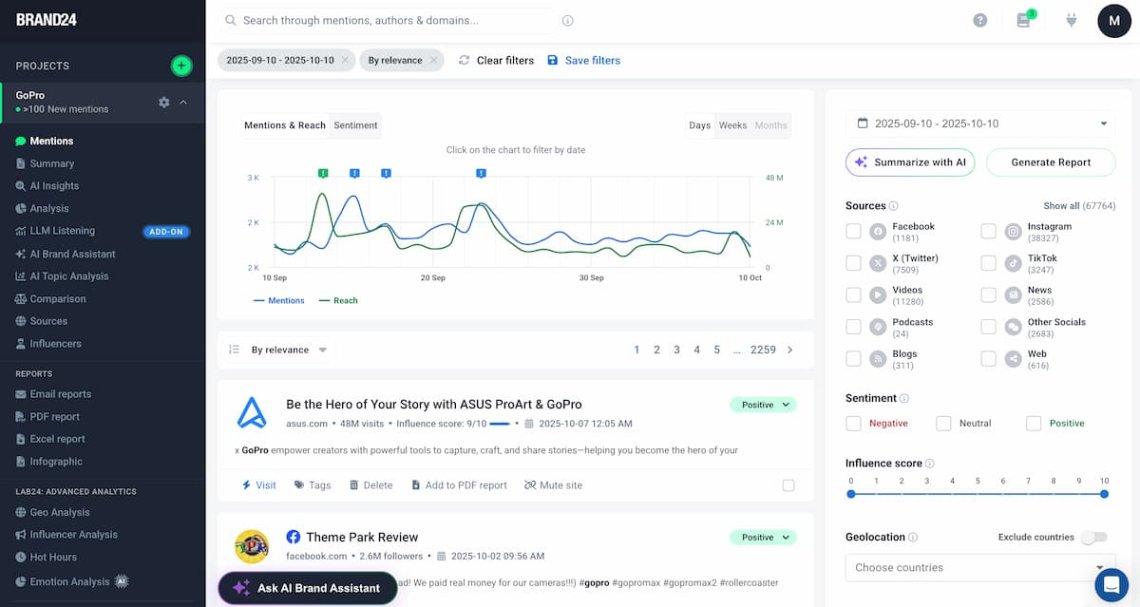
Brand24 is an all-in-one social media monitoring tool that tracks tagged and untagged Facebook mentions and shows you the data behind them: volume, reach, engagement, sentiment, and more.
For day-to-day marketing, it’s useful for tracking campaigns, monitoring reputation, identifying recurring topics, and catching conversations that would otherwise be easy to miss.
Why did I pick Brand24?
Brand24 is naturally familiar territory for me, but its place on this list comes down to what it adds beyond native Meta business tools.
- Mention monitoring: track Facebook mentions around your page, including mentions without a direct tag.
- Sentiment analysis: see how people react to your brand over time and spot shifts in perception early.
- Share of voice: compare your Facebook visibility to competitors’ to see who is getting more attention.
🔗 Source coverage and integrations: Facebook, Instagram, LinkedIn, YouTube, X (Twitter), TikTok, Reddit, Quora, Telegram, Twitch, news, blogs, forums, reviews, newsletters, podcasts, and more.
✅ Pros:
- Real-time tracking of tagged and untagged mentions
- Built-in & AI-powered Facebook sentiment analysis
- Share of voice and brand awareness metrics
- Multi-platform monitoring with AI-driven reports and analytics features
❌ Cons:
- No scheduling and publishing features
- Doesn’t replace native tools for first-party page and ad performance metrics
Brand24 is the perfect choice for medium-to-large businesses that want to monitor Facebook discussions about their brand across the web.
For me, the biggest value is catching untagged mentions and putting them into context with sentiment, topics, and competitor visibility.
I’d pair it with Meta’s native tools: Meta for first-party page and ad metrics, Brand24 for the wider conversation. This way, you get the full picture of what’s happening on and outside of your Facebook page.
02 Native tools (Meta Business Suite & Facebook Page Insights)
Free
Free
No marketing action would be complete without using Meta’s native Facebook analytics tools.
There are two of them: Meta Business Suite and Facebook Page Insights. Their features sometimes overlap, but they’re useful for slightly different jobs.
Facebook Page Insights is handy for quick checks of your page, audience, and content performance.
Meta Business Suite goes a step further, combining more detailed analytics with publishing, inbox, and management tools for both Facebook and Instagram.
Why would I recommend Meta’s native tools?
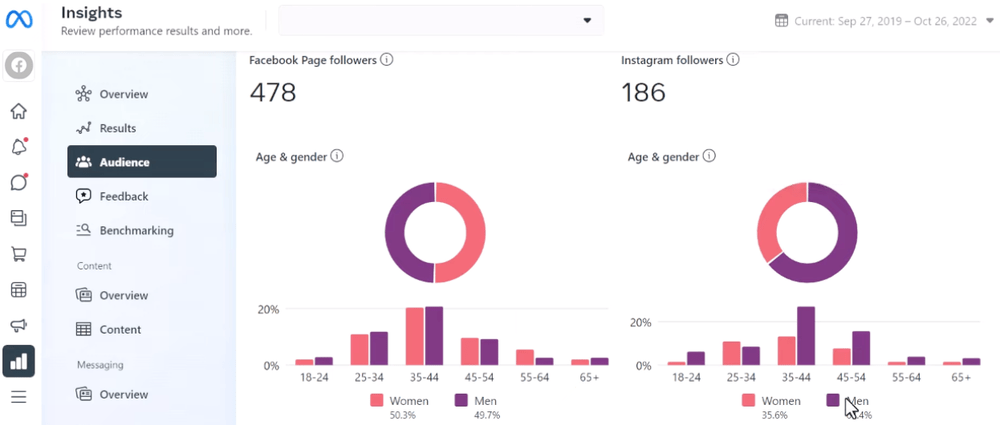
Simple: the data comes directly from Meta. For metrics such as reach, engagement, and audience demographics, they give you the first-party numbers you’ll want as your baseline.
- First-party Page and content metrics: check reach, engagement, follows, visits, and see which posts are getting the best response.
- Audience insights: learn more about who follows your Page, including age, gender, and location.
- Facebook & Instagram in one place: compare performance across both platforms in Meta Business Suite, then plan, publish, and manage content from the same dashboard.
🔗 Source coverage and integrations: Native tools don’t integrate with external tools and sources beyond Facebook & Instagram.
✅ Pros:
- Completely free and built directly into Facebook
- Covers essential page, content, and audience metrics
- Easy starting point for seeing which content performs best
- Meta Business Suite combines Facebook and Instagram analytics
❌ Cons:
- Limited scope, as it only tracks your own page data
- Doesn’t give you a cross-platform view beyond Meta’s ecosystem
- No advanced analytics like sentiment analysis
I find Facebook’s native analytics tools are best for small businesses or individuals who need a free and easy way to get an overview of their page performance.
For growing brands and agencies, they will quickly become too limited.
My advice? Start with the native analytics, then pair them with another tool as your page and reach grow over time.
03 Facelift Data Studio
4.7/5 – G2 (68 reviews)
4.6/5 – Capterra (8 reviews)
Free 7-day trial available
Custom pricing on request
Facelift Data Studio (formerly Quintly) is a strong option if you need to go deeper with your Facebook reporting.
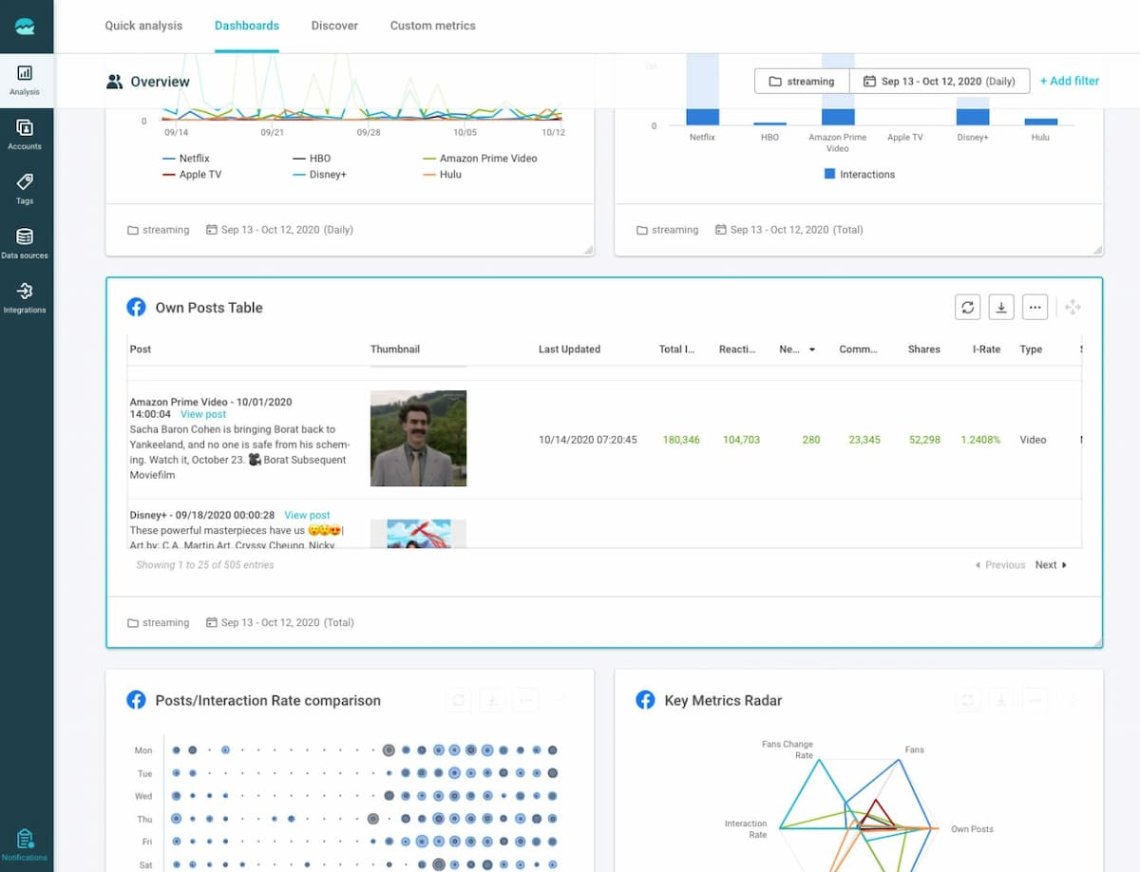
With customizable dashboards and access to 500+ metrics, you can build detailed reports around your own performance, compare it with competitors, and bring Facebook data together with your other social channels.
Why did I pick Facelift Data Studio?
What stands out for me is the flexibility. Instead of working with a fixed set of reports, you can choose the metrics that matter to your team and build dashboards around them.
- Customizable dashboards: choose from 500+ metrics and build reports around the Facebook KPIs you want to track.
- Cross-channel reporting: analyze Facebook alongside your other social platforms instead of reporting on each one separately.
- BI integrations: connect your data with tools such as Looker Studio, BigQuery, Tableau, and Brandwatch Vizia for more advanced reporting.
🔗 Source coverage and integrations: Facebook, Instagram, YouTube, X/Twitter, LinkedIn, Snapchat, TikTok, Google Data Studio (Looker Studio), Google Big Query, Tableau, and Brandwatch Vizia.
✅ Pros:
- Fully customizable dashboards
- Access to 500+ social media metrics
- Strong competitor benchmarking
- Useful integrations for more advanced data analysis
❌ Cons:
- Expensive compared with simpler social media analytics tools
- The number of metrics and customization options can make it difficult to learn at first
I think Facelift Data Studio is a great choice for agencies and large organizations that need very detailed, customizable Facebook analytics and multi-platform tracking.
Its depth comes at a cost (in both price and complexity), so smaller teams or beginners might find it too expensive and difficult for their needs.
04 Keyhole
4.3/5 – G2 (70 reviews)
5/5 – Capterra (2 reviews)
Free demo version available
Pricing on request
Keyhole is a good option if you want to track your Facebook performance while keeping a close eye on competitors, hashtags, and conversations happening around your brand.
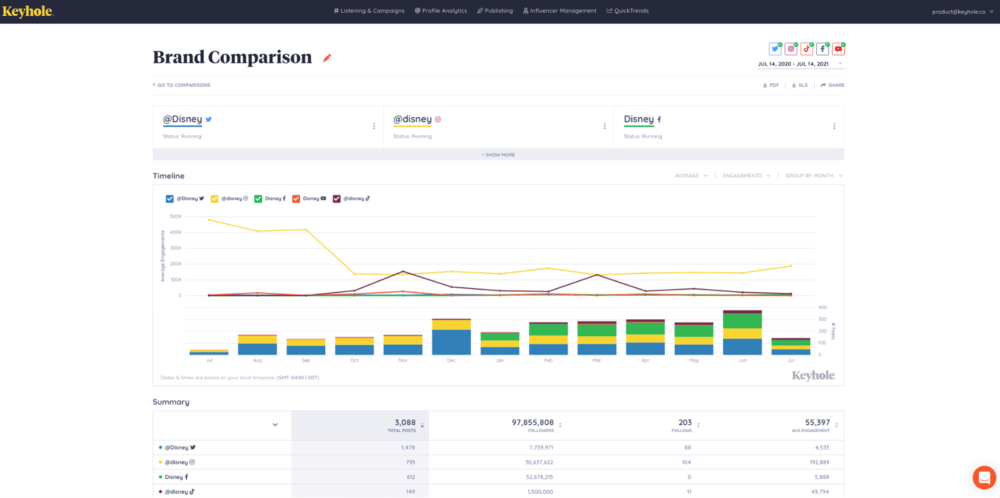
You can use it to compare your page with competitors, follow changes in engagement over time, and combine current Facebook data with historical performance to see what’s gaining or losing traction.
The basic plan provides access to analytics data for Twitter, Instagram, and Facebook.
If the scope of your activity and social mentions increases (i.e., by succeeding in your campaign), the cost of extra credits will likely be higher.
Why did I pick Keyhole?
What stands out to me is the combination of social media analytics and monitoring. You’re not limited to checking your own Page performance – you can also follow competitors, keywords, and hashtags from the same platform.
- Real-time and historical analytics: track current performance while reviewing historical data to spot longer-term trends.
- Hashtag and keyword tracking: monitor relevant Facebook conversations and see which topics are getting attention.
- Performance recommendations: use Keyhole’s analytics to identify opportunities to improve engagement and content performance.
🔗 Source coverage and integrations: Facebook, Instagram, X (Twitter), LinkedIn, YouTube, news, blogs, and forums.
✅ Pros:
- Tracks several social channels from one dashboard
- Monitors Facebook hashtags and keywords
- Real-time and historical performance data
- Measures your Facebook performance against competitors
❌ Cons:
- Credit-based pricing can become expensive as your monitoring volume grows
- Important social media networks like LinkedIn, TikTok, and YouTube analytics require a more expensive plan
Personally, I’d reach for Keyhole when I’m running a campaign and want to keep tabs on three things at once: my own performance, competitor activity, and the conversation around the topic. That’s where it feels most useful.
I’d be less keen on it for always-on monitoring, though, because the credit-based pricing can make a growing campaign more expensive than you expect.
Further read: Keyhole alternatives
05 Google Analytics
Free
Free
You don’t need to rub your eyes.
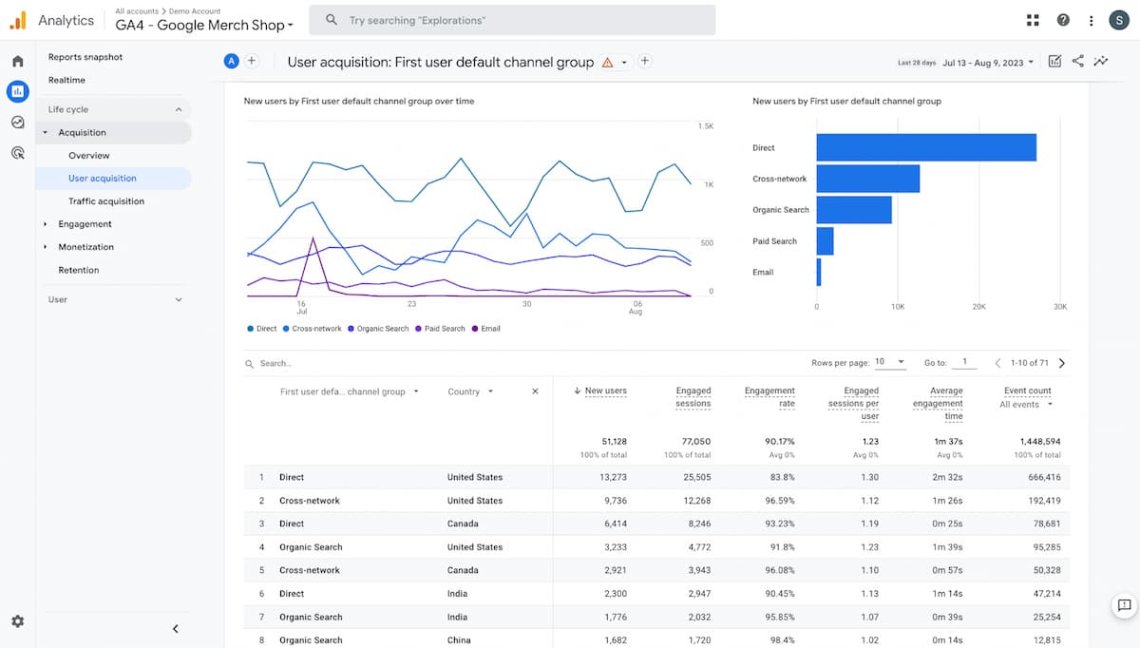
Although at first glance, Google Analytics 4 may not seem like a primary choice for social media, it can be a highly useful addition to your Facebook analytics toolkit.
As you probably know, Google Analytics is a free analytics platform that collects numerous data and tracks websites, mobile apps, and events traffic.
How to use it for your Facebook analytics?
Usually, brands and businesses treat Facebook as an indirect marketing channel. In other words, Facebook functions only as a stopover.
Why? Because the final destination – conversion – usually happens on the website. And here’s where GA4 comes to play.
Thanks to UTM parameters and Google Analytics custom reports, you can track conversion paths from Facebook and see what role the platform plays in your funnel.
You can also check the quality of your Facebook traffic using metrics such as engagement time, sessions, and page views.
And if you want to go deeper, there are plenty of tutorials and guides showing how to customize Google Analytics for your needs.
Why did I pick Google Analytics?
Because Facebook engagement only tells part of the story. If your content strategy or campaign aims to drive traffic, leads, or sales, I’d want GA4 in the mix to see whether those clicks turn into something valuable.
- Traffic and conversion tracking: see how much website traffic comes from Facebook and what those visitors do once they arrive.
- UTM campaign tracking: tag your Facebook links to compare individual posts, campaigns, or ads and see which ones drive the best results.
- Conversion path analysis: understand where Facebook appears in the journey before a purchase, sign-up, or another key action.
- Traffic quality analysis: compare Facebook visitors with other channels using metrics such as engagement, sessions, and page views.
🔗 Source coverage and integrations: Google Analytics primarily collects data from your website and/or mobile app. Facebook and other social channels can be tracked through referral traffic and UTM-tagged links.
✅ Pros:
- Completely free
- Connects your Facebook campaigns to business outcomes, allowing you to measure social media ROI
- Helps put Facebook into the context of your wider marketing funnel
❌ Cons:
- It’s not a dedicated Facebook tool, so it won’t show in-app metrics like post engagement or follower growth
- Configuring UTM parameters and goals can be difficult and time-consuming for those unfamiliar with web analytics
- GA4 interface can take time to get comfortable with
Personally, I wouldn’t use Google Analytics as my main Facebook analytics tool, but I’d almost always use it alongside one.
Facebook can tell me whether people clicked. GA4 helps answer the much more important question: what happened after the click?
06 Sprout Social
4.4/5 – G2 (6,871 reviews)
4.4/5 – Capterra (608 reviews)
30-day free trial available
From ~$99/month per user
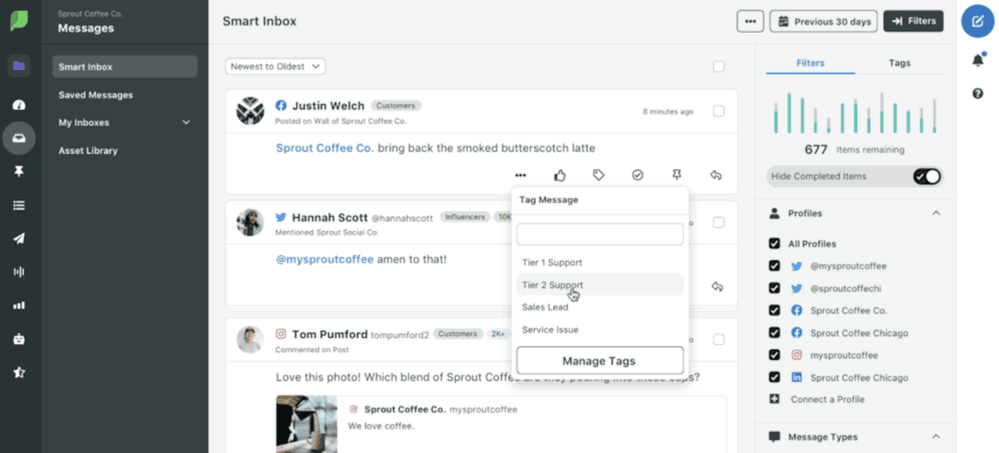
Sprout Social lets you manage several Facebook Pages, keep messages and comments in one inbox, schedule content, and analyze performance alongside your other social channels.
Why did I pick Sprout Social?
For me, one of the strongest advantages of Sprout Social is its reporting feature. It’s already excellent at the base level, but for even more advanced Facebook analytics reports, you can reach for the Premium page.
- Premium Analytics: build customized reports around the key metrics that matter to your team and share them with stakeholders.
- Smart Inbox: collect Facebook comments, posts, DMs, reviews, and ad comments in one place.
- Content planning and publishing: schedule Facebook content alongside your other social channels and manage campaigns from one calendar.
🔗 Source coverage and integrations: Facebook, Instagram, Threads, LinkedIn, TikTok, X (Twitter), YouTube, Pinterest, Bluesky, Facebook Messenger, WhatsApp, news sites, blogs, and review sites.
✅ Pros:
- An all-in-one tool to manage Facebook and other social media accounts together
- Smart Inbox that collects all your Facebook comments and messages in one place
- Content planning that helps you schedule your posts and campaigns ahead of time
❌ Cons:
- It can become very pricey, especially as you add more social profiles or need advanced features
- Essential features like full social listening are locked behind the highest-cost plans
- Probably excessive if Facebook is the only channel you need to manage
All in all, Sprout Social is best suited for larger companies and agencies that need to manage and analyze multiple social media profiles (including Facebook) in one hub.
Its high cost and broad feature set can be excessive for small businesses or those focused solely on Facebook.
Further read: Sprout Social alternatives
07 Fanpage Karma
4.5/5 – G2 (130 reviews)
4.5/5 – Capterra (13 reviews)
14-day free trial available
Free plan available, from $69 per month for more advanced features
Fanpage Karma is a lesser-known Facebook analytics tool that offers quite an impressive number of features.
In addition to regular analytics, it helps you identify the best posting times, formats, keywords, and top-performing posts. You can also use it for content planning, community management, reporting, and basic social listening.
And the best part? Every user can check some of their free Facebook analytics tools, such as performance score, competitor comparisons, and social media index.
Why did I pick Fanpage Karma?
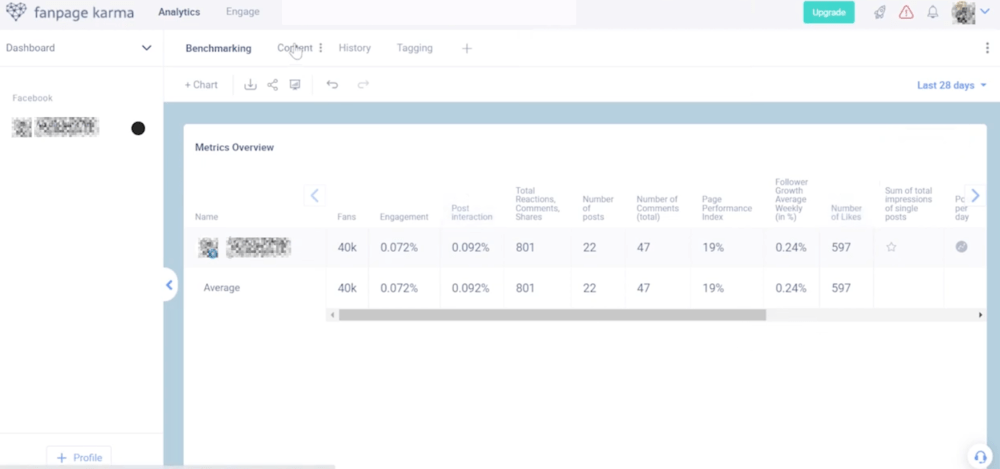
I like that competitor analysis is built into the everyday analytics workflow. Instead of looking only at your own numbers, you can quickly see how your page stacks up against similar brands and use that context when planning your next posts.
- Content optimization: identify your best posting times, formats, keywords, and top or underperforming posts.
- Custom reports: build reports around the metrics you care about and compare Facebook performance across different periods.
- Free analytics: use selected Facebook analytics features without committing to a paid plan.
🔗 Source coverage and integrations: Facebook, Instagram, LinkedIn, Pinterest, Threads, TikTok, Bluesky, and YouTube.
✅ Pros:
- Helps identify the best posting times, formats, and content
- Strong competitor benchmarking
- Combines analytics, publishing, and community management
❌ Cons:
- Occasional inaccuracies when it comes to gathering Facebook data
- Metrics and updates aren’t always instant, so you might have to wait to see the latest changes in your page statistics
Personally, I’d use Fanpage Karma when I need inspiration backed by competitor data. Seeing which formats and topics work for similar pages gives me much more context than just watching my own engagement move up or down.
That’s why I recommend Fanpage Karma to small teams and agencies that want to keep a closer eye on competitors without jumping straight into a heavy analytics platform.
08 Sotrender
4.8/5 – G2 (117 reviews)
4.7/5 – Capterra (33 reviews)
7-day free trial available
From $80 per month
Sotrender is widely considered as one of the best Facebook analytics tools – and I have to agree.
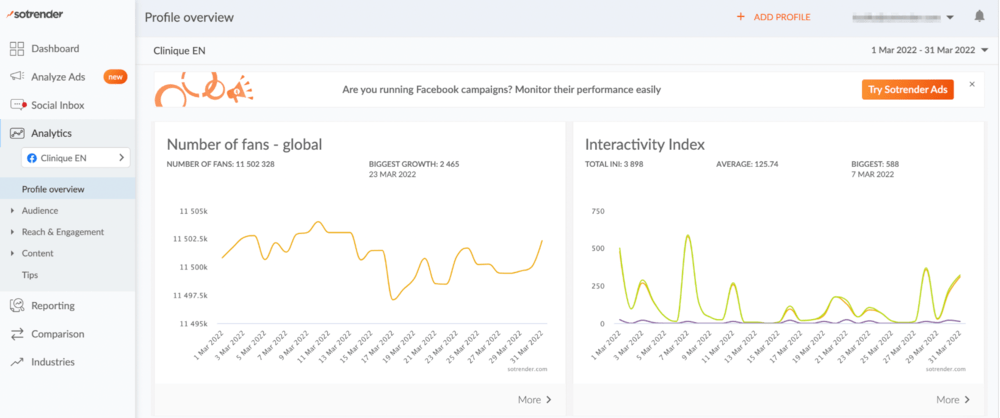
It brings current and historical Facebook data into a single dashboard, lets you benchmark your results against competitors, and also tracks ad metrics such as CPC and CPM.
Why did I pick Sotrender?
What I like here is that paid and organic performance sit side by side. If you’re running Facebook content and Meta ads at the same time, you can see both parts of your strategy without switching between separate reports.
- Organic performance analytics: track reach, engagement trends, audience activity, and content performance over time.
- Historical data: look beyond current results to spot longer-term patterns and seasonality.
- Facebook Ads analytics: analyze paid performance, including CPC, CPM, clicks, and other campaign metrics. Sotrender also offers a dedicated Meta Ads optimization add-on.
🔗 Source coverage and integrations: Facebook, Instagram, LinkedIn, YouTube, TikTok, and X (Twitter).
✅ Pros:
- Provides rich Facebook, Instagram, LinkedIn, and YouTube analytics in one dashboard
- Shows both current stats and historical trends, helping you follow your Facebook performance over time and spot patterns
- Tracks your Facebook ad metrics (CPC, CPM, etc.) in addition to organic engagement
- Generates ready-to-use PDF, PPTX, and XLS reports
❌ Cons:
- Customizable reporting is somewhat limited, so you might not be able to tailor every report exactly to your needs
- The amount of historical data available and some of the more advanced features depend on your plan
Personally, I’d put Sotrender high on the list for teams that run both organic Facebook content and paid campaigns.
Being able to check how your posts perform, compare that with competitors, and then look at CPC and CPM without piecing everything together manually is where I see the most value..
09 Socialinsider
4.7/5 – G2 (142 reviews)
4.9/5 – Capterra (18 reviews)
14-day free trial available
From $99 per month
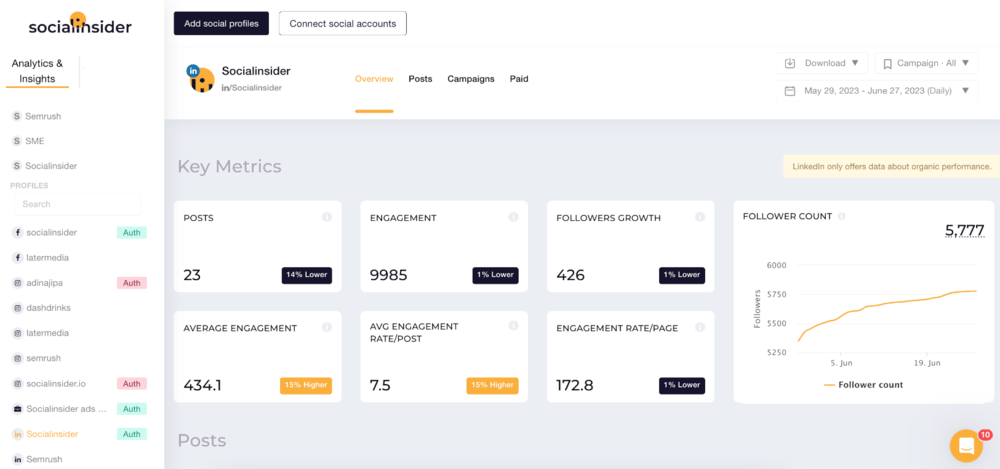
Socialinsider brands itself as more of a reporting tool than the other Facebook analytics tools on the list.
No wonder! It offers a decent choice of dashboards and metrics about your Facebook page.
You can monitor engagement data, reach, clicks, and impressions, compare them with your competitors’ and the whole industry’s Facebook performance, as well as track video metrics.
Why did I pick Socialinsider?
The reporting side is what caught my attention here. You get plenty of ready-made dashboards, but you can also take the data further thanks to integrations with Looker Studio, Power BI, and the Analytics API.
- Content analytics: see which posts, formats, and topics drive the strongest results and which ones underperform.
- Facebook video & Reels analytics: analyze video performance separately and compare metrics such as views, engagement, and video length across formats.
- Custom reporting: connect Socialinsider data to Looker Studio, Power BI, or the Analytics API to build reports tailored to your needs.
🔗 Source coverage and integrations: Facebook, Instagram, LinkedIn, TikTok, YouTube, X (Twitter), Looker Studio, and Power BI, plus an Analytics API.
✅ Pros:
- In-depth Facebook analytics plus data for Instagram, LinkedIn, TikTok, and Twitter
- Specialized video analytics (including Facebook Reels stats)
- Useful cross-platform reporting
- Integrations for building custom dashboards
❌ Cons:
- Pricing is relatively high and can be a barrier for very small businesses or solo marketers
- Focuses mainly on analytics and reporting, so you’ll need another tool for publishing or community management
- Doesn’t replace a social listening tool for tracking wider brand conversations and sentiment
Socialinsider is an excellent choice for agencies and data-driven teams who want comprehensive Facebook performance reports and competitive benchmarks across multiple accounts.
The combination of competitor benchmarks and detailed content reporting makes it especially useful for figuring out why certain posts or formats are working – and what you should do more of.
It’s powerful for deep analytics and visualization (especially for video content), but it lacks publishing and social listening features.
10 Oktopost
4.4/5 – G2 (203 reviews)
4.5/5 – Capterra (110 reviews)
Free demo version available
From $499 per month
Oktopost is a social media management tool primarily designed for B2B marketers.
Among dozens of options and features, Oktopost provides detailed insights, enabling you to make informed (and cost-effective) decisions about your Facebook business page.
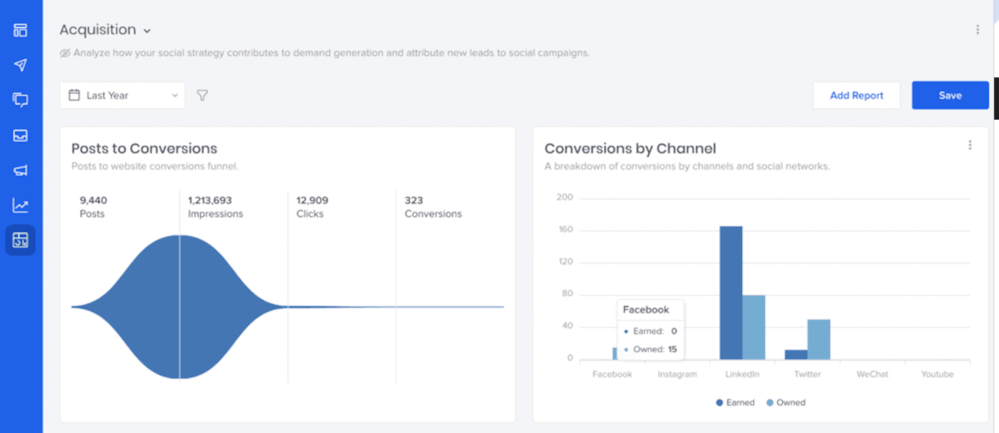
Instead of stopping at reach, engagement, and content performance, it helps you connect Facebook activity with leads, conversions, and sales data.
Why did I pick Oktopost?
What stands out to me is how closely it connects Facebook with the rest of the B2B marketing stack. If your social media strategy feeds into lead generation or sales, Oktopost gives you much more context around what that activity is contributing.
- Conversion and attribution tracking: see how Facebook content contributes to leads, conversions, and other business outcomes.
- CRM and marketing integrations: connect social data with tools such as Salesforce, HubSpot, Marketo, and Google Analytics.
- Cross-channel analytics: measure Facebook alongside your other social platforms instead of reporting on each channel separately.
🔗 Source coverage and integrations: Facebook, Instagram, X (Twitter), TikTok, LinkedIn, Facebook Ads, LinkedIn Ads, Google Analytics, Looker Studio, Microsoft Power BI, Salesforce, Dynamics 365, Marketo, HubSpot, Eloqua, Salesforce Pardot, Slack, Microsoft Teams, Bitly, Zapier, Canva, and more.
✅ Pros:
- Strong focus on B2B attribution and lead generation
- Connects Facebook activity with CRM and sales data
- Wide range of marketing and BI integrations
- Combines analytics, publishing, and social media management
- Useful for teams that need to report social media impact beyond engagement metrics
❌ Cons:
- Built mainly for larger B2B teams, so it can be excessive for smaller companies
- Pricing is aimed at the enterprise market
- The number of integrations and features comes with a steeper learning curve
Oktopost is a top choice for large B2B organizations that want to connect Facebook marketing to their sales pipeline and CRM. It excels at providing an integrated, data-rich approach to Facebook analytics.
However, its complexity and cost mean that smaller companies or those without a need for such integrations will likely find it excessive.
Personally, I’d choose Oktopost when I need to show how Facebook activity feeds into leads and revenue. That connection between social activity and the sales pipeline is where I think the tool earns its place on this list.
If your Facebook reporting stops at reach, engagement, and follower growth, though, you won’t get enough value from its B2B setup.
How to use Facebook analytics tools for your business and audience growth?
By now, you should have a pretty good idea of which tools are the best match for your business. But do you know what to do with all the data you collect?
Here are a few ways I’d turn Facebook analytics into something that can improve your marketing.
1. Find the content your audience responds to
Use Page and post analytics to compare reach, engagement, clicks, and other performance metrics across your content.
Look for patterns: which topics get people talking, which formats bring clicks, and which posts quietly disappear into the feed. Then use those findings when planning your next batch of content.
2. Check what your competitors are doing better
Competitor analytics can give your own numbers some much-needed context.
Compare posting frequency, engagement, content formats, and share of voice to see where other brands are getting ahead.
Tools like Brand24, Fanpage Karma, Facelift Data Studio, and Socialinsider will be particularly useful here.
3. Connect Facebook activity with conversions
A high-performing Facebook post is nice. A high-performing post that also brings leads or sales is nicer.
Use UTM parameters and Google Analytics to follow Facebook visitors once they reach your website.
This way, you’ll see which posts and campaigns drive valuable traffic and which ones generate plenty of clicks but little else.
4. Optimize your ad spend
Facebook analytics can show you which campaigns bring the best results for the money you spend. Compare metrics like CPC, CPM, conversions, and ROAS, then shift more budget toward the campaigns that perform best.
5. Keep an eye on what people say about your brand
Your native page analytics won’t show every conversation happening around your brand.
Social listening tools can help you find untagged mentions, follow sentiment, and spot conversations that are starting to pick up.
That gives you a chance to respond to feedback, catch potential issues early, or simply join a conversation while it’s still relevant.
6. See how people react to campaigns over time
Don’t judge a campaign by one screenshot of your dashboard.
Compare performance before, during, and after a campaign. Look at engagement, reach, sentiment, mentions, website traffic, and conversions where possible.
Together, those signals give you a much better idea of whether the campaign changed anything beyond the numbers on the post itself.
Conclusion
Facebook analytics gets much easier once you know what you want the data to help you with. Meta’s native tools are a great starting point, but they mostly cover your own page and content performance – useful, but hardly the whole story.
Once you need more context around competitors, conversions, mentions, sentiment, paid performance, or cross-channel reporting, that’s where the other tools on this list start to earn their place.
So how do you choose the right Facebook analytics tool for your business? I have a couple of final tips.
| If you need to… | Check out… |
|---|---|
|
Understand your own Facebook performance and audience
|
Meta Business Suite & Facebook Page Insights, Socialinsider
|
|
See how your brand visibility stacks up against competitors
|
Brand24, Facelift Data Studio, Socialinsider
|
|
Measure campaign and post performance
|
Meta Business Suite, Keyhole, Sotrender
|
|
Connect Facebook activity with conversions and business results
|
Google Analytics, Oktopost
|
|
Build detailed reports and dashboards
|
Facelift Data Studio, Sprout Social, Socialinsider
|
|
Analyze paid and organic performance together
|
Sotrender, Meta’s native tools
|
|
Manage Facebook alongside other social channels
|
Sprout Social, Oktopost, Fanpage Karma
|
|
Track mentions of your page across Facebook
|
Brand24, Keyhole, Sprout Social
|
For most marketers, one tool probably won’t cover every question. I’d start with Meta’s native data, see what’s missing, and add another platform only when there’s a clear reason to do so.
Final takeaways:
- Use Meta’s native tools as a foundation before investing in advanced analytics
- Think beyond numbers and focus on metrics that align with your business goals
- Connect Facebook performance with wider marketing results whenever you can
- Use the data to decide what to post, what to improve, and where to focus next
FAQ
Facebook analytics tools help you understand how your page, content, audience, ads, and wider brand presence are performing.
Depending on the tool, you can track anything from reach and engagement to website conversions, competitor performance, brand mentions, and sentiment.
It depends on what you want to measure.
For first-party Page data, Meta Business Suite and Facebook Page Insights are the obvious starting point. Brand24 is useful for mentions and sentiment; Google Analytics for website conversions; Sotrender for organic and paid performance; and Socialinsider for deeper reporting and video analytics.
There isn’t one standalone Facebook Analytics tool anymore. Meta retired Facebook Analytics in 2021, and today its analytics are spread across tools such as Meta Business Suite, Facebook Page Insights, Professional Dashboard, and Ads Manager.
Which one you use depends on whether you’re checking Page content, creator performance, or paid campaigns.
Yes. Meta Business Suite and Facebook Page Insights are free and let you check first-party data about your Page and posts, including reach, engagement, views, audience data, and content performance.
For many creators and small businesses, that’s plenty to get started. You’ll need a third-party tool if you want features like competitor benchmarking, sentiment analysis, or broader mention tracking.
Native Facebook analytics tools – Meta Business Suite and Facebook Page Insights – are great for starters, but definitely not enough for serious marketing.
Here are the most problematic areas:
- No cross-platform view: Meta’s native tools don’t integrate with other social media platforms
- Native tools track only your page: you can’t monitor brand mentions outside your page, external conversations, or competitor performance
- There’s no sentiment analysis: native tools show only numbers, but not how people feel about your Facebook activity
- Limited competitive insights: basic benchmarking exists, but you can’t access deeper competitor comparisons
- Weak reporting flexibility: dashboards are fixed, and advanced customization is limited
For first-party campaign data, Meta Ads Manager should be your starting point. It gives you the numbers directly from Meta and lets you analyze campaign, ad set, ad, and placement performance.
I’d add Sotrender if you want to look at paid and organic Facebook performance together, and Google Analytics if you need to see what happens after someone clicks the ad and lands on your website.
That depends on your goal, but I’d start with:
- Content: reach/views, engagement rate, clicks, and shares
- Audience: audience growth and demographics
- Video & Reels: views, watch time, retention, and engagement
- Paid campaigns: CTR, CPC, CPM, conversions, and ROAS
- Brand performance: mentions, sentiment, and share of voice
- Website impact: traffic, leads, and conversions from Facebook
Views are a good start, but they don’t tell you whether people stuck around.
Pay attention to watch time, average view duration, retention and drop-off points, engagement, and Reels performance. Socialinsider, for example, now separates Facebook Reels analytics from regular video reporting and provides dedicated metrics for the format.
I’d pay particular attention to what happens during the first 3-10 seconds. If viewers disappear there, your opening probably needs work.
Rather than chasing one universal retention benchmark, compare new videos against your own recent average.
Start with the job you need the tool to do.
Consider:
- Your goals: decide if your priority is measuring content performance, paid ads, brand awareness, lead generation, or reputation. Then, shortlist tools that align with your primary goal.
- Metrics depth: check whether tools offer engagement and reach data, conversion tracking, historical trends, share of voice, or sentiment analysis.
- Competitive analysis: if benchmarking matters to you, make sure the tool supports competitor tracking, industry comparisons, and performance rankings.
- Cross-platform capabilities: most brands exist on multiple social accounts. Look for tools that integrate with those you use daily.
- Integrations: if you use a CRM, BI tools, or ad platforms, ensure your Facebook analytics tool integrates well with them.
- Real-time monitoring: if your brand reputation is a top priority, choose a tool that offers real-time tracking and alerts.
- Reporting and dashboards: consider which software lets you customize reports, automate them as needed, and export them in formats such as PDF, PPT, or CSV.
- Ease of use: advanced tools are powerful but can be overwhelming. Check if the learning curve is worth the effort.